


Thursday, 4:50 PM. Quarterly review. The CFO asks a reasonable question: which lead sources produced the most profitable events last quarter?
Marketing has the lead sources in the marketing platform. Operations has event margin in the catering system. The answer arrives Monday. It took two exports and one spreadsheet; the spreadsheet relies on a join nobody fully trusts, and a footnote explains that three corporate accounts exist under two spellings.
Every system in the room did its job. The catering system knows the events. The marketing platform knows the campaigns. Each one holds a customer record, and the two records don’t agree on who the customer is.
Nothing was missing. The problem is that the question spans two systems of record, and neither one owns the customer.
The short answer: Flex Catering is catering software with its own built-in CRM, built around online ordering, production, and delivery. CaterSuite runs catering on HubSpot, so the customer record, the pipeline, and the marketing and sales tools sit on one platform alongside catering operations. The choice is between a catering application with CRM features and catering built on the CRM; in practice, a decision about which system should own the customer.
Flex asks which catering features you need. The better question is which platform should own your customer for the next ten years.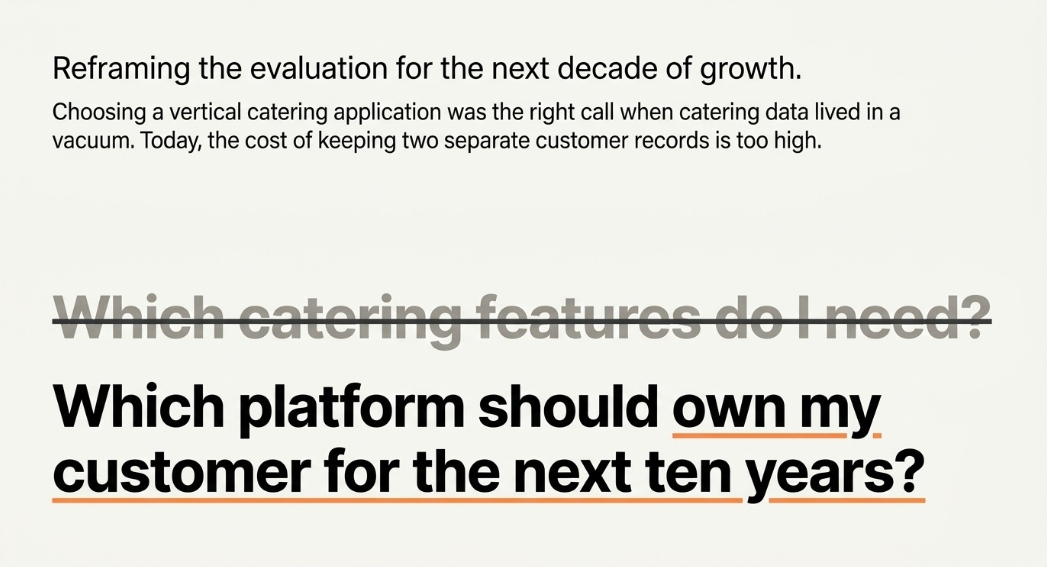
That’s a different decision from the one most catering software evaluations are built around, and it says nothing against the last one. If your operation chose a strong vertical catering application, that was the right call when it was made. Catering software was where catering data lived, and marketing ran somewhere else.
What has changed is the cost of keeping two customer records. A second system of record recreates The Disconnect: the gap between marketing, sales, and catering operations when each runs in its own system and nothing talks to anything else. The pattern is laid out in why catering inquiries slip through the cracks.
What This Comparison Actually Measures
Seven dimensions, chosen for the person who owns the platform decision:
- Customer record ownership: which system is the system of record for the customer.
- Integration ownership: who builds, maintains, and supports the connections between systems.
- Lifecycle reporting: what can be reported, from first inquiry to repeat event.
- Ordering and delivery: storefront, dispatch, drivers, and marketplace orders.
- Production: BEOs, prep sheets, and kitchen planning.
- Plan gating: what’s included, what’s an add-on, and what needs a higher tier.
- Tier and price: what each choice costs to start and to grow.
Rows 4 and 5 are where catering applications compete feature by feature. Rows 6 and 7 decide what each choice costs as the business grows. Rows 1 through 3 decide which platform owns the customer.
That last question isn’t unique to catering. In HubSpot’s 2026 State of Marketing:
- 27.6% of marketers named sales–marketing alignment a top challenge.
- Only 65% said they have high-quality audience data.
- The report ties both problems to disconnected data sources and silos.
Those are cross-industry figures. But any operation running two customer systems will recognize where the gap comes from: the record lives in more than one place.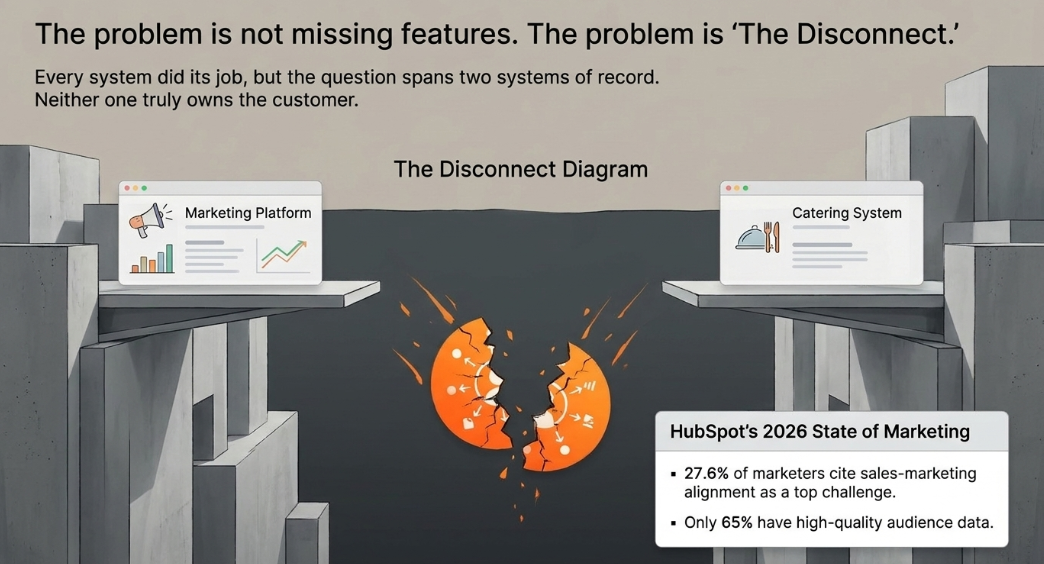
The Side-by-Side
|
Dimension |
Flex Catering |
CaterSuite |
|
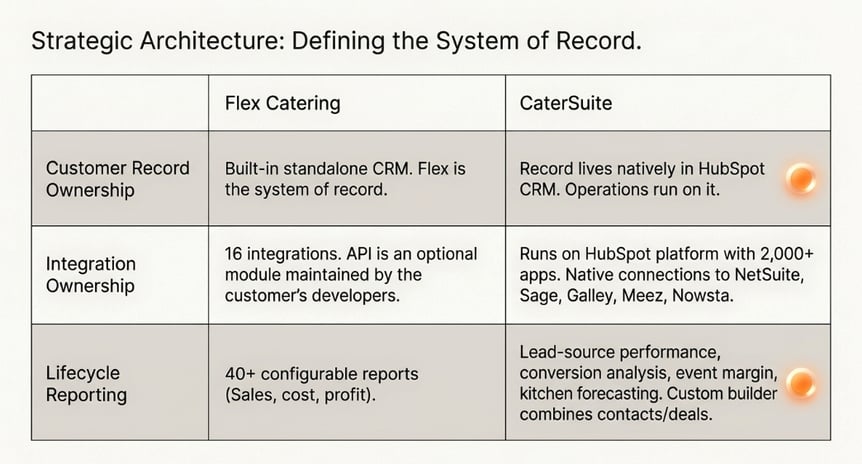
Customer record ownership |
Built-in CRM with deals and tasks, customer and company records, website forms, and email autoresponders. Flex is the system of record for the customer. |
The customer record lives in HubSpot CRM (contacts, companies, deals). Catering operations run on it. |
|
Integration ownership |
16 listed integrations, including QuickBooks Online, Xero, MYOB, Mailchimp, Klaviyo, Deputy, Nowsta, ezCater, and Square POS. Zapier and API are add-ons. The API is an optional module, typically built and maintained by the customer’s developers or partner. No HubSpot or Salesforce integration listed. |
Runs on HubSpot’s developer platform (APIs, webhooks, OAuth, UI extensions), with 2,000+ marketplace apps. Listed integrations: QuickBooks, Xero, NetSuite, Sage, Galley, Restaurant365, Meez, Nowsta, StaffMate, PandaDoc. |
|
Lifecycle reporting |
40+ configurable reports. Sales, cost, and profit tracking. Reporting across one or multiple locations. |
Lead-source performance, pipeline and conversion analysis, event profitability and margin, revenue dashboards, labor and kitchen-workload forecasts. HubSpot’s custom report builder combines contacts, companies, and deals (Professional and above). |
|
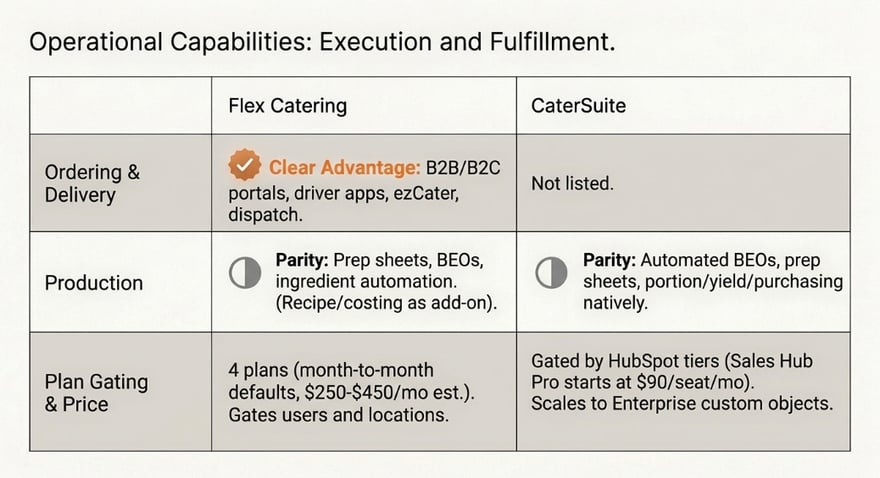
Ordering and delivery |
Flex advantage. Branded B2C/B2B online ordering, customer portal, group ordering, cut-off times, dispatch and delivery run builder, driver app with proof of delivery, Google Maps routing, ezCater and delivery-partner integrations. Recurring orders and KDS are add-ons. |
Not listed on the CaterSuite page. |
|
Production |
Parity. Prep sheets, BEOs, production reports, ingredient and quantity automation. Recipe builder and food costing are an add-on. |
Parity. Automated BEO generation, kitchen prep sheets, menu-driven production planning, portion and yield calculation, ingredient and purchasing lists. |
|
Plan gating |
Four plans (Ballroom, Pantry, Off Premise, Enterprise). Each includes 2–5 users, 1 driver, and 1 location. Add-ons cover accounting integration, Zapier and API, SSO, POS, SMS, recipes and costing, KDS, and extra users, drivers, and locations. |
Gated by HubSpot tiers and seats. Custom objects, multi-account management, quote rules, and multi-touch revenue attribution are on HubSpot Enterprise. |
|
Tier and price |
No published prices. Capterra lists “from $350/mo,” flat. TrustRadius lists $250–$450 by plan. A one-time onboarding fee generally applies. |
HubSpot list prices start with Sales Hub Professional, plus CaterSuite implementation. CaterSuite pricing is not published on its page. |
Flex wins the ordering and delivery row outright, and production is a tie. The shared integrations are ties too: QuickBooks, Xero, and Nowsta. The rest of the decision sits in rows 1 through 3: which system owns the customer, who owns the connections, and what can be reported across the full lifecycle.
Where Each Product Wins
Flex is built for the order-to-delivery side of catering, and it documents that side in depth:
- a branded online ordering site for consumer and business customers
- a customer portal and group ordering
- dispatch management and a delivery run builder
- a driver app with proof of delivery and Google Maps routing
- integrations with ezCater and delivery partners
- a kitchen display system as an add-on
It also includes its own CRM and multi-location support with per-location menus, pricing, and branding. Plans default to month-to-month, with no long-term contract. Flex describes FlexInsight, an AI chat assistant, as the first stage of a broader capability. Reviews are strong on a small sample: 5.0 out of 5 on Capterra, from 11 reviews.
Production isn’t a concession; it’s parity. Flex documents prep sheets, BEOs, production reports, and ingredient and quantity automation. CaterSuite documents automated BEO generation, kitchen prep sheets, menu-driven production planning, portion and yield calculation, and purchasing lists. Neither product is the reason to choose on kitchen output alone.
Where CaterSuite separates is upstream of the kitchen: which system owns the customer, and whether marketing, sales, and catering operations work from the same platform.
The HubSpot-Native Difference
Both products have a CRM. The question is which one owns the customer.
Flex’s CRM is real. It includes deals, tasks, customer and company records, website forms, and email autoresponders. A caterer whose marketing and sales run nowhere else can reasonably run the customer on Flex.
The decision changes when marketing and sales already run on HubSpot, or plan to. Then two systems each hold a customer record:
- HubSpot’s record carries campaign history, email engagement, and lead source.
- Flex’s record carries orders, events, and invoices.
Nothing natively connects them. Every new contact, renamed company, or merged account becomes a question of which system is right.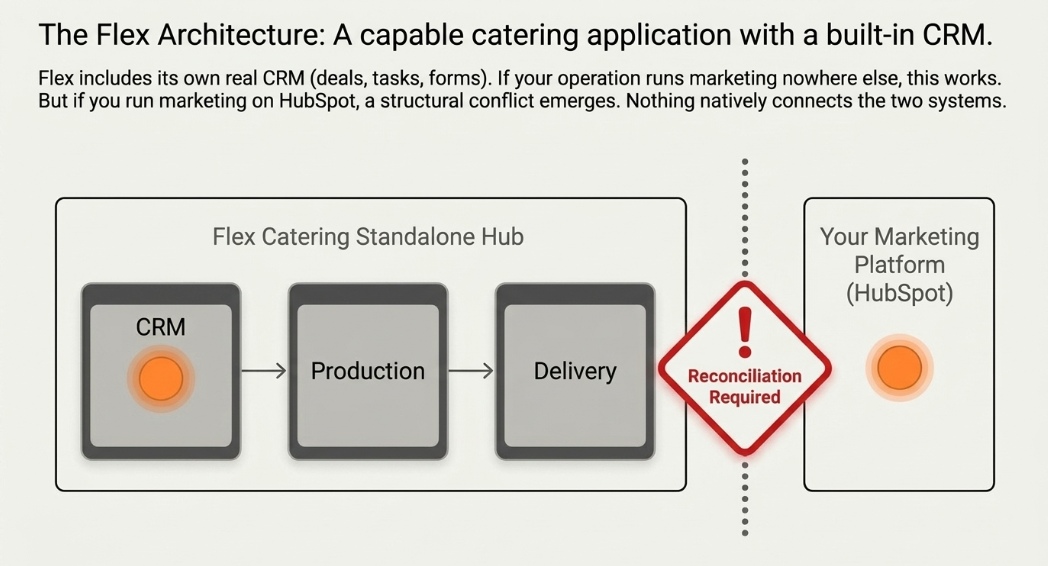
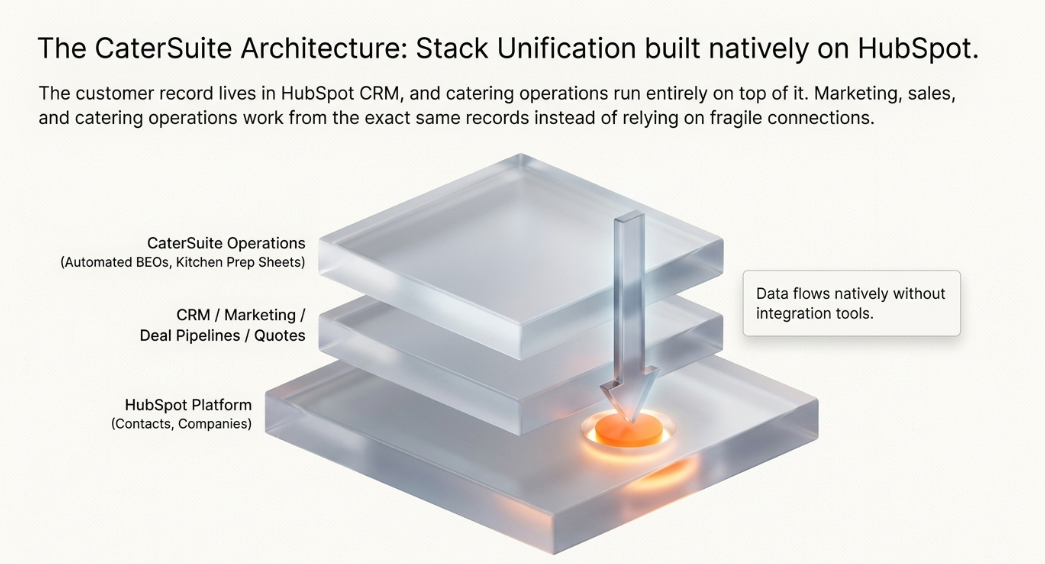
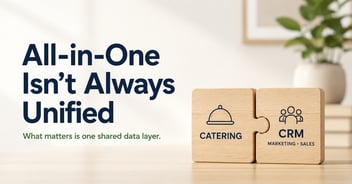
CaterSuite makes the other choice. The customer record lives in HubSpot CRM (contacts, companies, and deals) and catering operations run on top of it. That’s Stack Unification: marketing, sales, and catering operations on one platform, HubSpot, working from the same records instead of through connections someone has to build and keep running. The full case is in the HubSpot-native catering platform.
Catering doesn’t begin when the order arrives.
An order-led system starts the customer at the order. In practice, the customer starts earlier: a campaign, a form, a follow-up, a quote. Then come the event, the invoice, and ideally the next event. The first steps happen before any order exists, usually in marketing’s tools.
In CaterSuite, that full sequence sits on HubSpot:
- web inquiries captured into HubSpot contacts
- lead scoring and qualification
- automated follow-ups and reminders
- deal pipelines built for catering stages
- quotes on the deal
- BEO generation and production planning
- reporting on lead-source performance, pipeline and conversion, event profitability and margin, and kitchen workload
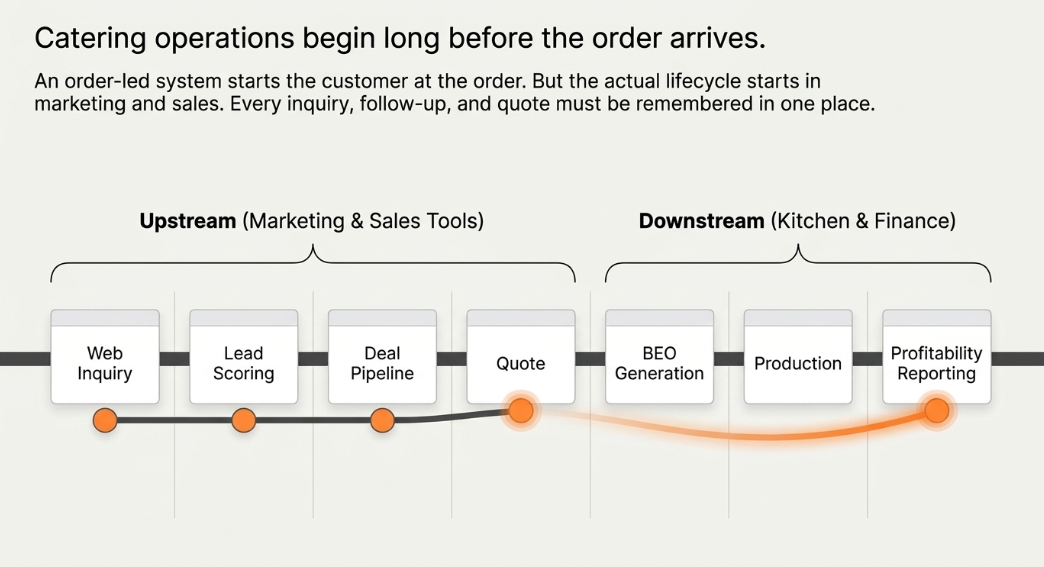
That is One System That Remembers: every inquiry, contact, follow-up, email exchange, and quote kept in one place, and staying there when people change roles or leave. See what unified catering operations actually look like.
Be precise about the CFO’s question, because a platform decision deserves it. CaterSuite reports on lead-source performance and on event profitability. HubSpot’s custom report builder can combine contacts, companies, and deals in one report on Professional and above. Whether lead source against event margin resolves in a single report depends on where each field lives. That’s a question to put to any vendor in a demo, CaterSuite included. HubSpot’s own terms also note that its revenue reporting tools aren’t meant to be a system of record for financial reporting. Margin for the books still comes from accounting.
What CaterSuite changes is the starting point: the inquiry and the event begin on the same platform, rather than in two systems that have to be reconciled afterward.
Who owns the integration?
Flex lists 16 integrations. Zapier and its API are add-ons. Flex’s integration FAQ describes the API as an optional module whose scope depends on the project, with the customer’s developers or an integration partner typically building and maintaining the connection. Its features page also references webhooks for custom connections.
No native HubSpot or Salesforce integration is listed. A HubSpot connection is possible, since Zapier lists HubSpot among the apps that pair with Flex. But the caterer owns that connection: its field choices, its failures, and its upkeep. It’s the same “connection you maintain” pattern covered in the full CaterSuite vs Caterease breakdown.
CaterSuite runs on a platform designed to be extended:
- HubSpot’s developer platform offers REST APIs, webhooks, OAuth, and UI extensions.
- HubSpot lists more than 2,000 apps in its marketplace.
- CaterSuite’s own listed integrations cover accounting (QuickBooks, Xero, NetSuite, Sage), kitchen data (Galley, Restaurant365, Meez), staffing (Nowsta, StaffMate), and contracts (PandaDoc).
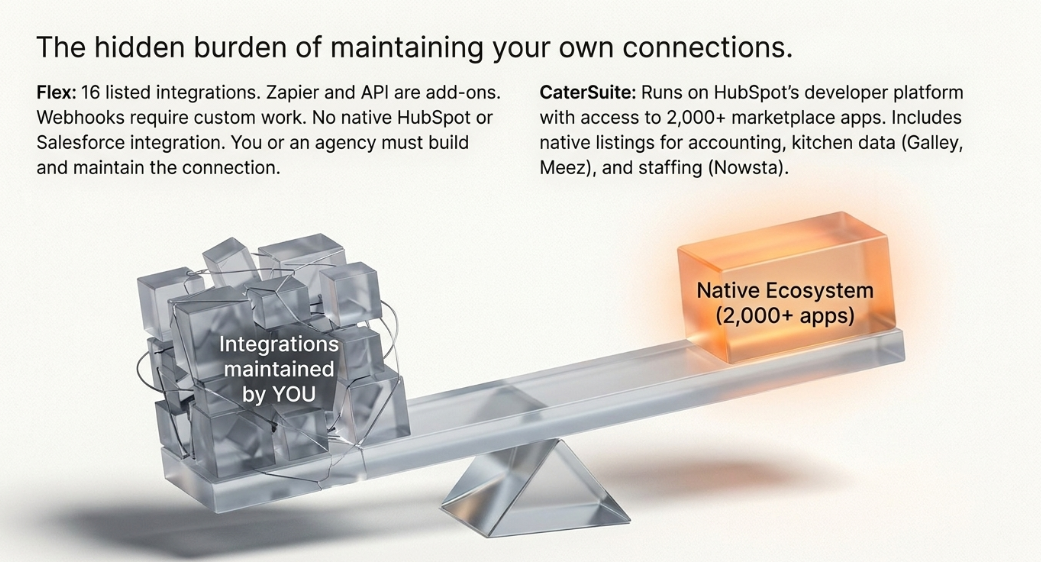
Fairness cuts both ways. HubSpot’s terms note that work built through its APIs or custom code may fall outside standard support. Extensions have an owner on either platform. The difference is what needs a connection at all. With CaterSuite, the customer record, marketing, and sales are already on HubSpot, so the connection that matters most is never built.
What the HubSpot layer documents
A platform decision should apply one question to both vendors: what is documented, configurable, extensible, and contractually supportable today?
For the HubSpot layer of a CaterSuite deployment (the customer record, pipelines, marketing, quotes, and payments), HubSpot publishes three things:
- a SOC 2 Type 2 report available to customers and prospects, plus a public SOC 3 report
- a 99.95% monthly uptime target for paid subscriptions, which it commits to commercially reasonable efforts to meet
- hosting in AWS data centers in the US, Canada, Australia, and the EU
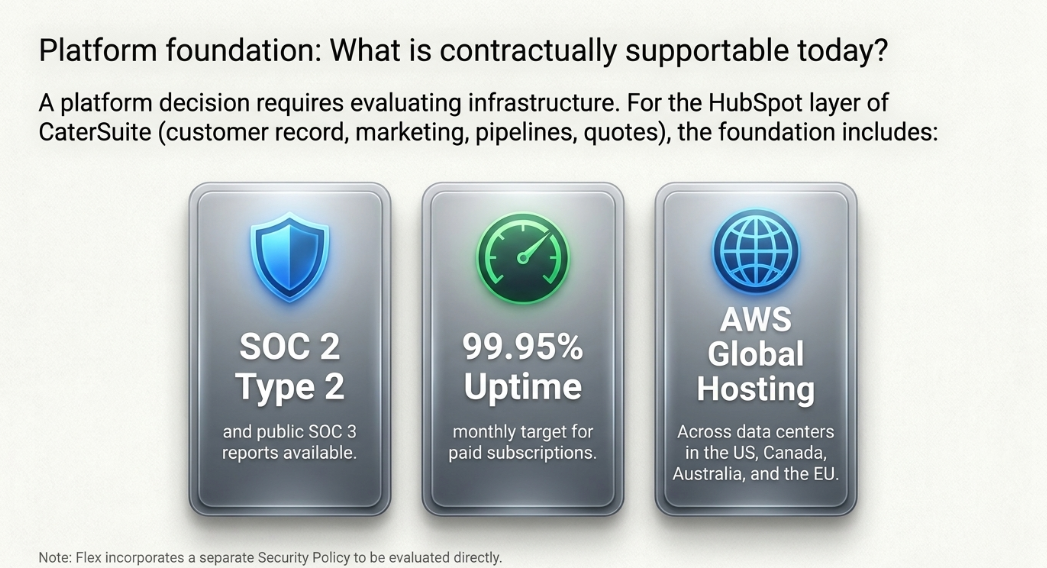
Those statements cover HubSpot, not every component of a CaterSuite deployment. Ask for the rest during evaluation. Flex’s terms incorporate a separate Security Policy; evaluate it directly with Flex.
Production stays at parity either way. What differs is what feeds the kitchen. In CaterSuite, the customer and the pipeline upstream of every BEO live on the platform marketing and sales already run.
Which One Is Right for You
Flex Catering fits if:
- Your operation is order-led, or drop-off-heavy, and branded online ordering, group orders, dispatch, a driver app, and ezCater orders are central to the business.
- You’re comfortable with Flex’s CRM as the system of record for the customer.
- Month-to-month plans matter to you.
- You run multiple locations and need per-location ordering menus; Flex documents that.
CaterSuite fits if:
- You run a multi-location full-service operation.
- Marketing and sales already run on HubSpot, or will.
- You want the customer owned by the platform rather than by the catering application.
- Online ordering and dispatch aren’t the center of the business.
For multi-location buyers, catering software for multi-location operations goes deeper. For the wider field, start with the full catering software comparison. If the deciding question is which platform should own the customer, see how CaterSuite handles this.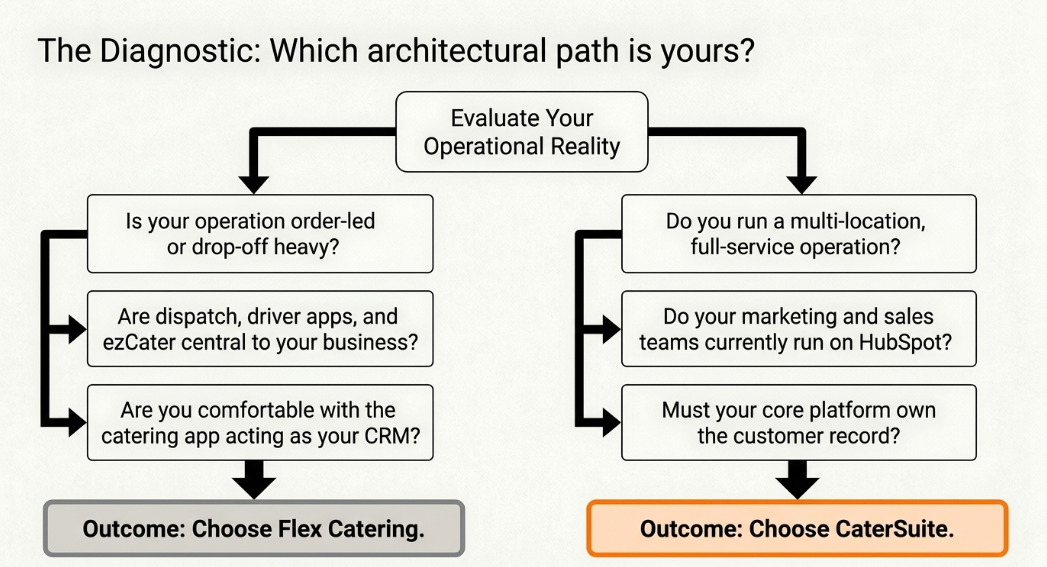
The CaterSuite Perspective
Choosing a capable catering application is not the same decision as choosing which platform owns the customer. For years they were the same decision, because the catering system was the only place catering customers lived. Operators who chose a strong vertical app made the right call for that era, and their teams built real operations on it.
The question has moved. Marketing, sales, and service now share a customer platform, and every system that holds its own copy of the customer adds a reconciliation someone has to own. CaterSuite starts from the customer platform and builds catering operations onto it, so the customer record is decided once.
FAQ
How much does Flex Catering cost?
Flex doesn’t publish prices. It offers four plans (Ballroom, Pantry, Off Premise, and Enterprise), and its pricing FAQ says new accounts generally include a one-time onboarding fee. Capterra’s listing shows “from $350 per month,” flat. TrustRadius lists Pantry at $250, Ballroom at $300, and Off Premise at $450 a month. The two listings conflict, so treat both as reference points rather than quotes. Add-ons, such as extra users and locations, Zapier and API access, and KDS, cost extra.
Does Flex Catering integrate with HubSpot?
Not natively. Flex’s integrations page lists 16 integrations, and HubSpot and Salesforce aren’t among them. Zapier and API access are add-ons, and Zapier lists HubSpot among the apps that can pair with Flex. Flex describes its API as an optional module, typically built and maintained by the customer’s developers or an integration partner. Its terms require prior written consent before connecting unauthorized third-party applications.
Is Flex Catering a CRM?
Yes. Flex includes CRM with deals and tasks, customer and company records, website forms, and email autoresponders. The distinction this comparison draws isn’t CRM versus no CRM. It’s whether a catering application or the customer platform marketing and sales use should be the system of record for the customer.
Does CaterSuite do online ordering and delivery dispatch?
The CaterSuite page doesn’t list online ordering, delivery dispatch, a driver app, or ezCater sync. Flex documents all four, and that row is a clear Flex advantage. If branded online ordering and delivery dispatch are central to the business, confirm those requirements with CaterSuite directly before deciding.
What HubSpot tier does CaterSuite need?
If you already run HubSpot, CaterSuite works on your existing account, starting at Sales Hub Professional: HubSpot lists $90 per seat per month billed annually, plus one-time onboarding. Quote-to-payment runs on Revenue Hub Professional, from $85 per seat per month billed annually. Nurture funnels and social campaigns run on Marketing Hub Professional. Custom objects, multi-account management, quote rules, and multi-touch attribution require HubSpot Enterprise. These are HubSpot’s list prices, not CaterSuite pricing.
Does CaterSuite report on lead-source performance and event profitability?
Yes. CaterSuite lists lead-source performance analytics and event profitability and margin analysis among its reports, alongside pipeline and conversion analysis and kitchen workload forecasting. HubSpot’s custom report builder can combine contacts, companies, and deals in a single report on Professional and above. Whether a specific cross-question resolves in one report depends on where each field lives, so confirm your report list in a demo.
Which fits a drop-off-heavy operation versus a multi-location full-service caterer?
For a drop-off-heavy or order-led operation, Flex’s branded ordering, group ordering, dispatch, driver app, and ezCater integration are documented strengths, and its multi-location support covers per-location menus. For a multi-location full-service caterer whose marketing and sales run on HubSpot, CaterSuite keeps the customer on that platform and builds catering operations around it.
The Choice, in One Line
Back to Thursday at 4:50. The CFO’s question wasn’t hard. It was split across two systems that each owned a version of the customer.
Flex is a capable catering platform, strongest at ordering, fulfillment, and delivery, and choosing it means choosing Flex’s CRM and Flex’s integration model. CaterSuite keeps the customer on HubSpot and builds catering around it. The decision is which system should own the customer for the next decade.
See How CaterSuite Gives Multi-Location Operators a Single View on HubSpot
If your catering system and your CRM disagree on who the customer is, the gap starts at the platform, not the feature list. Book a 60-minute executive call to see catering operations software built for multi-location operators, running on HubSpot.

Leave a Comment