


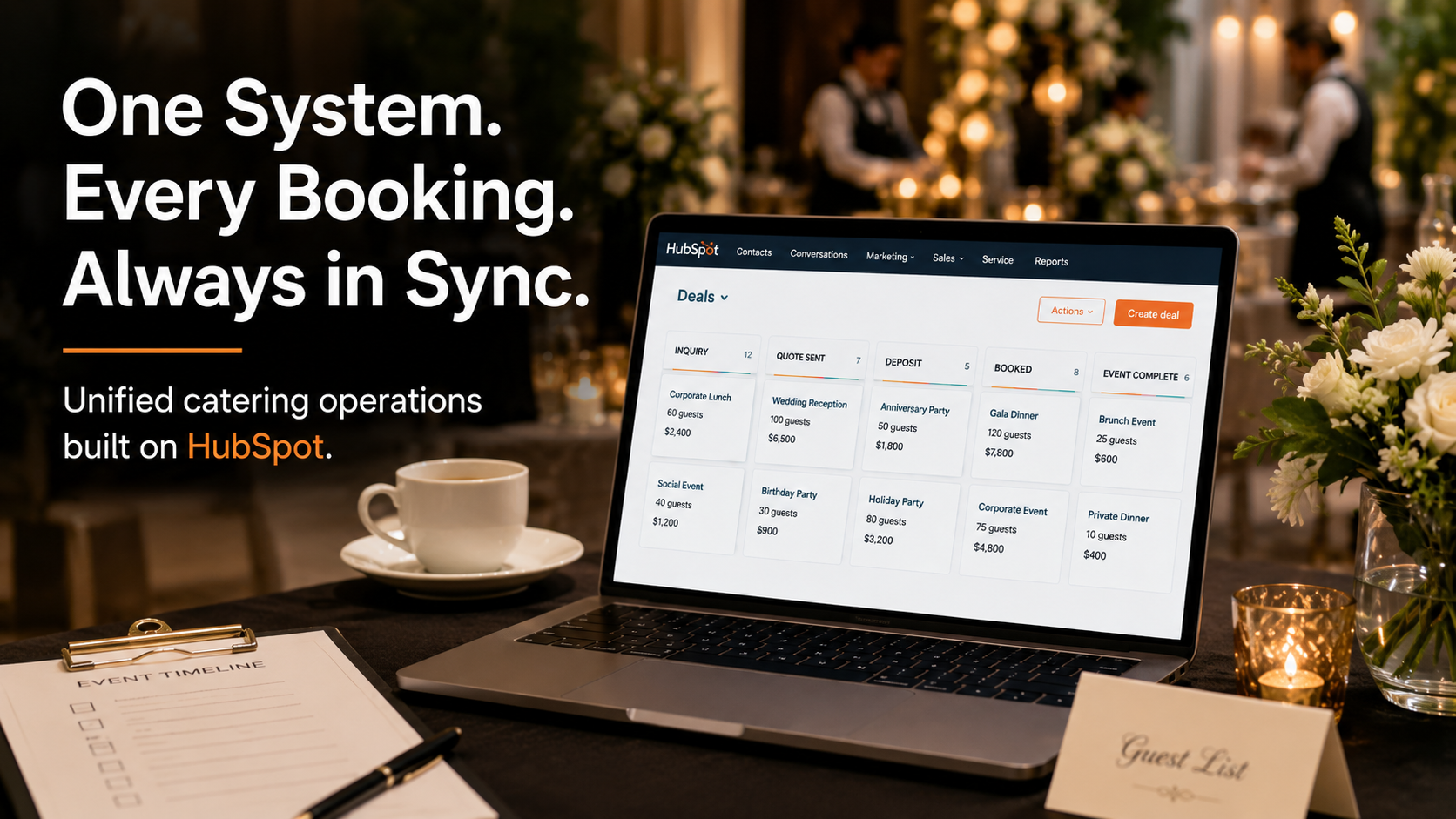
One System That Remembers is a single place where every inquiry, booking, contact, follow-up, quote, and past event lives together, and stays there even when an employee changes roles or leaves. Instead of an account's history scattered across a booking tool, an inbox, a spreadsheet, and accounting, it sits on one shared record that any team member can see. The picture doesn't have to be rebuilt every time someone departs, because the knowledge lives in the system rather than in a person's head.
You already know what the fragmented version feels like. The booking lived in three places: the catering software, a spreadsheet someone started two years ago, and a printed BEO. The follow-up was a sticky note. And the real account knowledge, that this client always changes the headcount twice, that they pay late but reliably, that last year's gala almost went sideways over the dietary list, lived in the head of the coordinator who managed them. Then the coordinator left, and all of it walked out with her.
Now picture the opposite. A client calls. Whoever picks up opens one record and sees everything: every past event, every quote, the deposit history, the email thread from eighteen months ago, the note about the headcount. Not because anyone is exceptionally organized, but because the system holds it, and held it even though the person who built that relationship is gone. The new coordinator is up to speed in minutes, not months.
That second picture has a name, and the rest of this is about what it actually takes to get there.
The opposite of fragmentation isn't tidiness
It's tempting to think the fix for scattered information is discipline, better filing, a stricter naming convention, and a shared drive that everyone promises to update. But you've tried that, and it erodes the moment things get busy, because the information still lives in separate places held together by people remembering to keep them in sync.
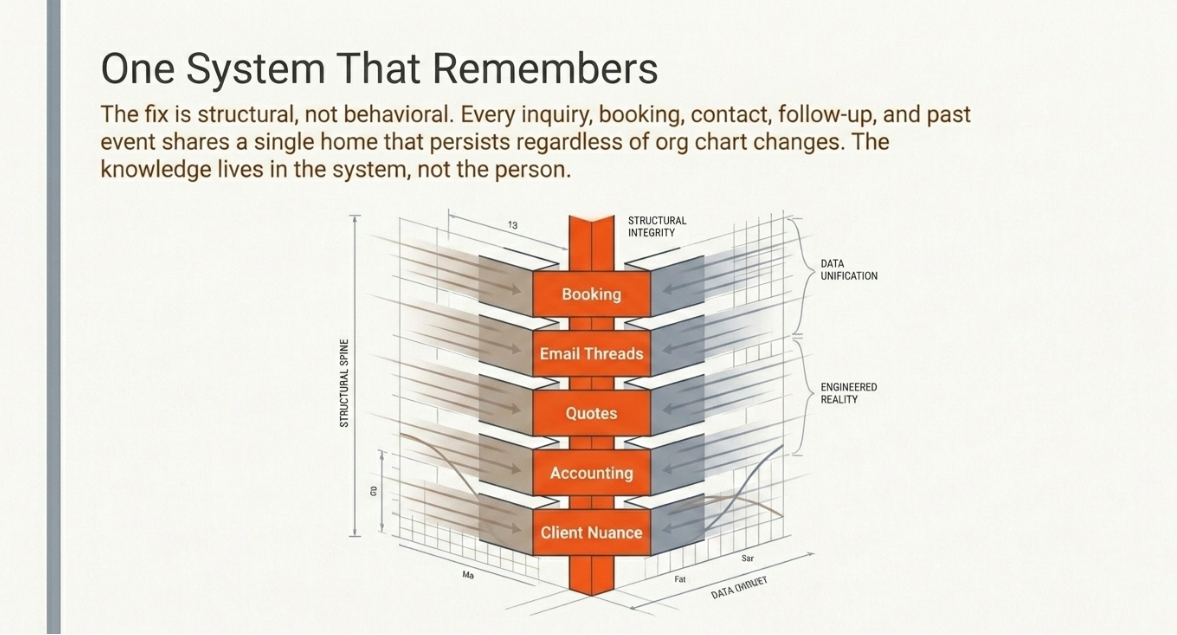
The real opposite is One System That Remembers: a single place where every inquiry, booking, contact, follow-up, and quote lives, and stays there even when people change roles. It's the positive counterpart to the disconnect that this end-state replaces, the gap between disorganized marketing, fragmented sales, and catering operations where each runs in its own system and nothing talks to anything else. The Disconnect is the problem. One System That Remembers is what's on the other side of it. And the thing that gets you from one to the other isn't tidiness, it's that the information shares a single home in the first place.
Why the picture fragments today
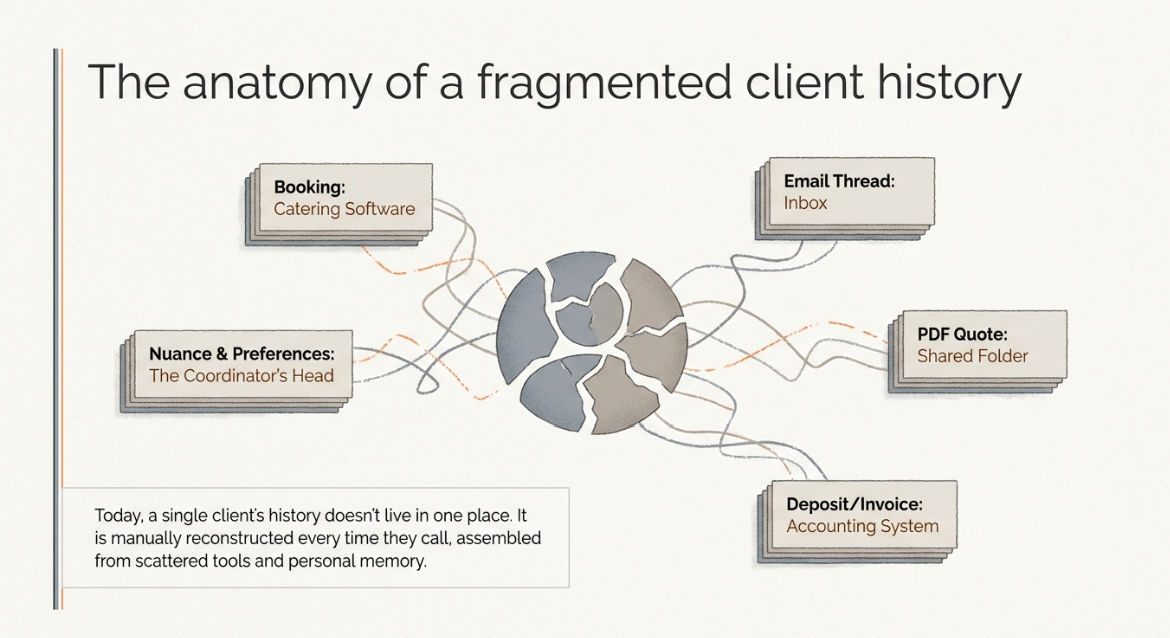
Walk through where a single client's history actually lives in most catering operations, and the problem explains itself.
The booking is in the catering tool. The email exchange is in someone's inbox. The quote is either in a PDF in a folder, attached to an email, or both. The deposit and invoice are in accounting. The note about how this client likes things done is in a coordinator's memory, maybe a personal notebook. The past events are reconstructable only by whoever was there. No single record holds the whole account; it's assembled every time from pieces that live in different systems and among different people.
That's manageable right up until someone leaves. And in this industry, people leave. The National Restaurant Association has long pegged average annual turnover in restaurants and hospitality around 75%, a foodservice benchmark that lands squarely on catering. When a tenured coordinator or salesperson goes, the institutional knowledge goes with them: how the account was handled, what almost went wrong last time, which contact actually makes the decisions. The replacement inherits the records that happen to exist in systems and gets to guess at the rest. The picture gets rebuilt, slowly, at the cost of mistakes the departed employee would never have made. And it compounds, every departure thins the operation's memory a little more.
This is the same fragmentation that produces re-keying the same booking into multiple systems, the cost side of running disconnected tools, where the same event gets typed into the booking software, accounting, and the schedule, and the numbers still don't match. One System That Remembers is what resolves both: the history that stays, and the single entry that doesn't have to be re-typed.
| Catering Operations: Fragmentation vs. Unified System Comparison | ||
| Feature or Operational Aspect | Fragmented Operation Status | Unified System (CaterSuite) Status |
| Industry Turnover Benchmark | $75\%$ average annual turnover in restaurants and hospitality | Mitigates $75\%$ turnover impact by retaining persistent account history |
| Staff Turnover Impact | Institutional knowledge walks out the door when employees leave | Knowledge lives in the system; history stays even when people change roles |
| Onboarding Efficiency | New hires must rebuild account pictures from fragments over months | New coordinators are up to speed in minutes by reading existing timelines |
| Operational Growth | Knowledge leaks; operation resets each time the org chart changes | Knowledge compounds; operation gets smarter as it runs |
| Data Storage & Accessibility | Scattered across booking tools, inboxes, spreadsheets, and accounting | One shared record; single source of truth accessible to the whole team |
| Data Entry & Accuracy | Re-keying the same booking into multiple systems; numbers often don't match | Single entry that doesn't have to be re-typed across marketing, sales, and ops |
| Client History Depth | Relies on coordinator's memory (e.g., dietary lists, payment habits) | Persistent history of every inquiry, booking, quote, and past event |
| System Integration | Disconnected tools; information held together by people | Stack Unification: platforms talk natively without fragile integrations |
| Catering Specifics | BEOs and event details often exist only on paper or separate files | Native catering layer for BEOs and event records on CRM records |
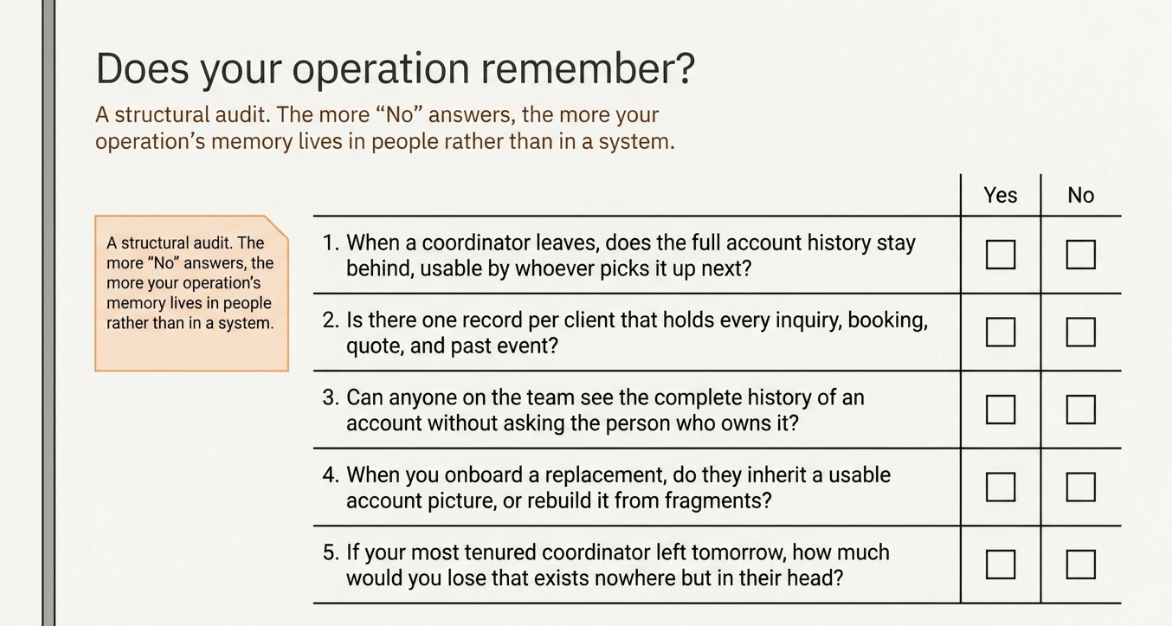
Does your operation remember, or does the knowledge walk out the door?
A short audit. The more "no" answers, the more your operation's memory lives in people rather than in a system:
- When a salesperson or coordinator leaves, does the full account history stay behind, usable by whoever picks it up next?
- Is there one record per client that holds every inquiry, booking, quote, and past event, or is it scattered across tools?
- Can anyone on the team see the complete history of an account without asking the person who owns it?
- When you onboard a replacement, do they inherit a usable account picture, or do they rebuild it from fragments?
- If your most tenured coordinator left tomorrow, how much would you lose that exists nowhere but in their head?
If those answers worry you, the issue isn't that your people don't document enough. It's that there's no single place where the documentation would live and stay.
Where does a system that remembers come from
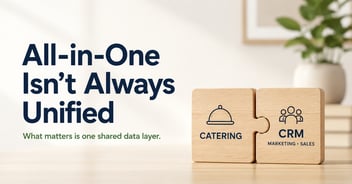
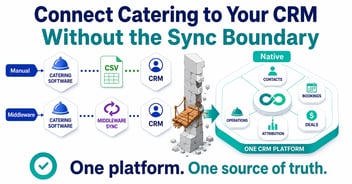
One System That Remembers exists for one structural reason: marketing, sales, and operations share a single platform, so the inquiry, the contact, the deal, and the history all live on one record instead of scattering across tools. That's Stack Unification, marketing, sales, and catering operations on one platform, talking natively rather than through fragile integrations. What Stack Unification means for catering is the full argument; the memory version of it is concrete.
On a unified platform, the record is the memory. HubSpot records carry persistent history, every property value, and a timeline that logs every activity, every change, and every association in chronological order. The contact, the deal, and the communication history sit on one record that any team member can open, described by HubSpot's own CRM as a single source of truth for marketing, sales, and service data accessible to the whole team. When the coordinator who built the relationship leaves, the record doesn't leave with her. The timeline is still there. The next person reads it instead of reconstructing it.
Here's the honest boundary on what that takes. Native HubSpot already gives you persistent contact and deal records with a full activity timeline, that's the single-source-of-truth mechanism, and it's real out of the box. What it doesn't natively hold is catering-specific history: BEOs, event records, the catering fields, and the event structures a catering operation actually runs on. You can approximate those by hand with custom objects, and some operators do. CaterSuite is the purpose-built HubSpot-native catering layer that makes catering history native rather than assembled, every event, BEO, and catering detail on the same persistent record as the contact and the deal. Same platform the marketing and sales already run on; built so the catering memory stays too.
The recommended path
If your operation's memory currently lives in your most experienced people, and you feel the drop every time one of them leaves, the fix isn't a better documentation habit. It's a single record that holds the history of whether or not the person who created it is still around.
For an operator who wants the account picture to stay, the requirement is one platform where it all lives: a single platform that unifies catering operations, so the inquiry, booking, quote, and event history sit on one record that doesn't fragment or walk out the door. If you're still mapping the broader landscape first, the full catering software comparison lays the options out side by side.
The CaterSuite perspective
A system that remembers isn't a nicer filing cabinet. The belief behind CaterSuite is that there's a real difference between knowledge that compounds and knowledge that leaks. When the account history lives in a person, every departure is a withdrawal from an account you can't see the balance of, and you only learn how much was in it after it's gone. When history lives in one shared record, every event handled makes the next one easier for whoever handles it. The operation gets smarter as it runs instead of resetting each time the org chart changes. That's the whole point of putting the memory in the system rather than asking your people to be the memory.
FAQ
What does unified catering operations look like?
It looks like one place where every inquiry, booking, contact, follow-up, quote, and past event lives together and persists even when staff changes. Instead of assembling an account's history from a booking tool, an inbox, a spreadsheet, and accounting each time, anyone on the team opens a single record and sees the whole picture. That end-state is what's meant by One System That Remembers.
What is One System That Remembers?
It's a single place where every inquiry, booking, contact, follow-up, quote, and event history lives, and stays there even when an employee changes roles or leaves. It's what replaces the fragmentation of separate tools: rather than the account picture living partly in systems and partly in people's heads, it lives on one shared record, so the knowledge doesn't depart when the person does.
What happens to the account history when a catering employee leaves?
In a fragmented setup, much of it leaves too, the relationship knowledge, the context, the "how this client likes things" that lived in the coordinator's head. Given the hospitality turnover that the National Restaurant Association benchmarks at around 75% annually, that loss is frequent and compounding. On one shared record, the history stays behind for whoever picks the account up next.
How do you keep all catering event history in one place?
By running the operation on one platform where the contact, deal, and event history share a single persistent record, rather than syncing separate tools. When marketing, sales, and operations live on the same system, there's no separate place for history to scatter to; that's what Stack Unification produces, and it's what keeps the full account picture in one place over time.
Does CaterSuite work for caterers who already use HubSpot?
Yes, CaterSuite is built on HubSpot. If you’re marketing or sales already run on HubSpot, catering operations can join the same platform without integrations. The inquiry, contact, deal, and event history live on one record. One contact record, one pipeline, one source of truth across marketing, sales, and operations, and it stays put when people change roles.
What's the difference between native HubSpot and CaterSuite for keeping catering history?
Native HubSpot gives you persistent contact and deal records with a full activity timeline and a single source of truth mechanism. What it doesn't hold out of the box is catering-specific history: BEOs, event records, catering fields. CaterSuite is the HubSpot-native catering layer that adds those, so the catering memory is native rather than approximated with hand-built custom objects.
Keep the history, even when people change
If your operation's memory walks out the door every time a coordinator leaves, the unified booking and inquiry system puts every inquiry, booking, quote, and event on one HubSpot-native record, so the account picture stays behind for whoever picks it up next.
Leave a Comment