


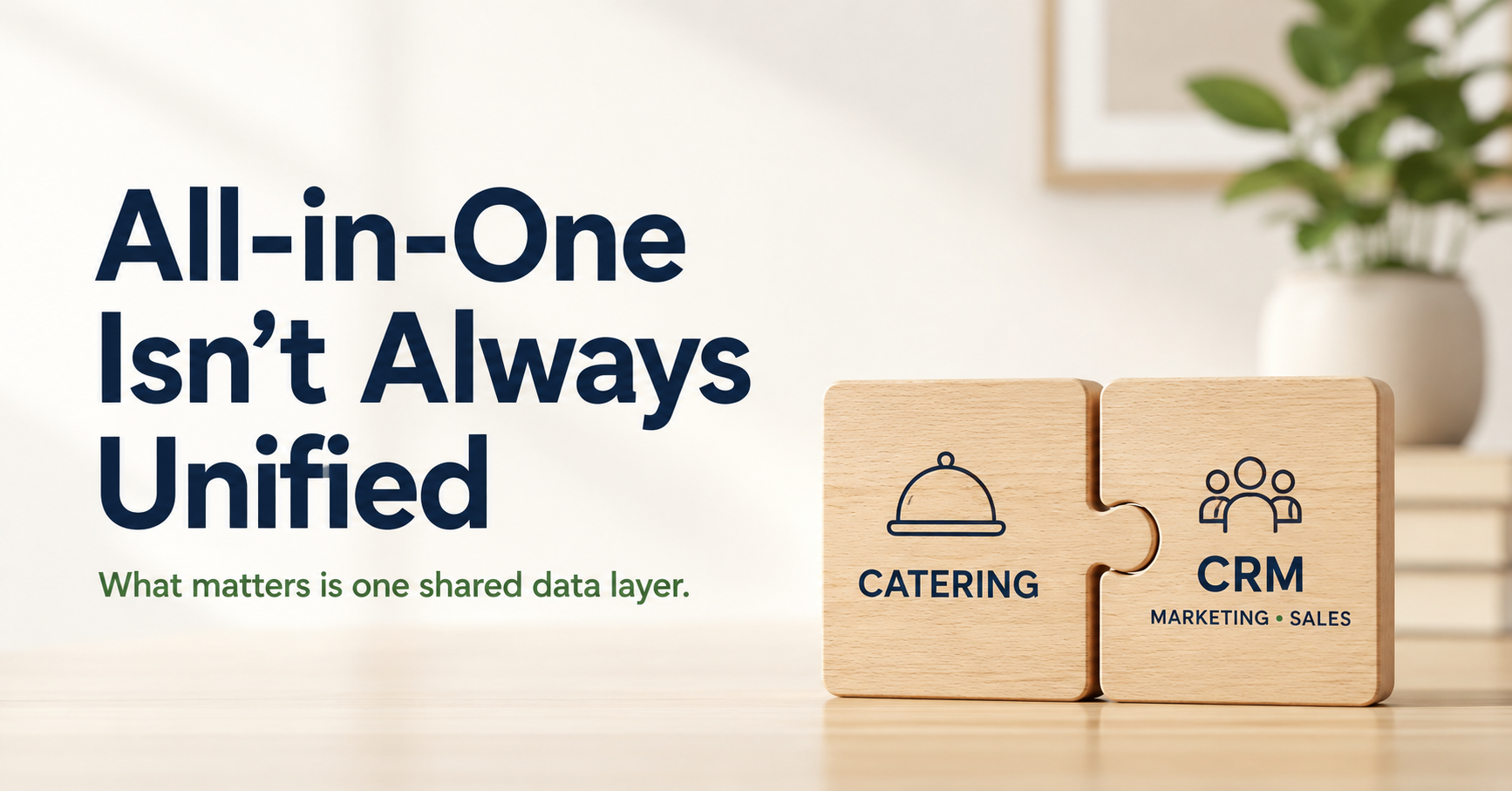
"All-in-one catering software," as the category uses the term, means every catering function, booking, proposal, kitchen production, delivery, and a built-in CRM, in one product. There is a second sense: catering operations unified with marketing, sales, and the CRM on a single platform. Only the second removes the sync boundary between catering and the rest of your stack; this is what CaterSuite is on HubSpot: catering on the same platform, and the same contact records, as marketing and sales. The distinguishing test: does the platform share your data layer, or connect to it?
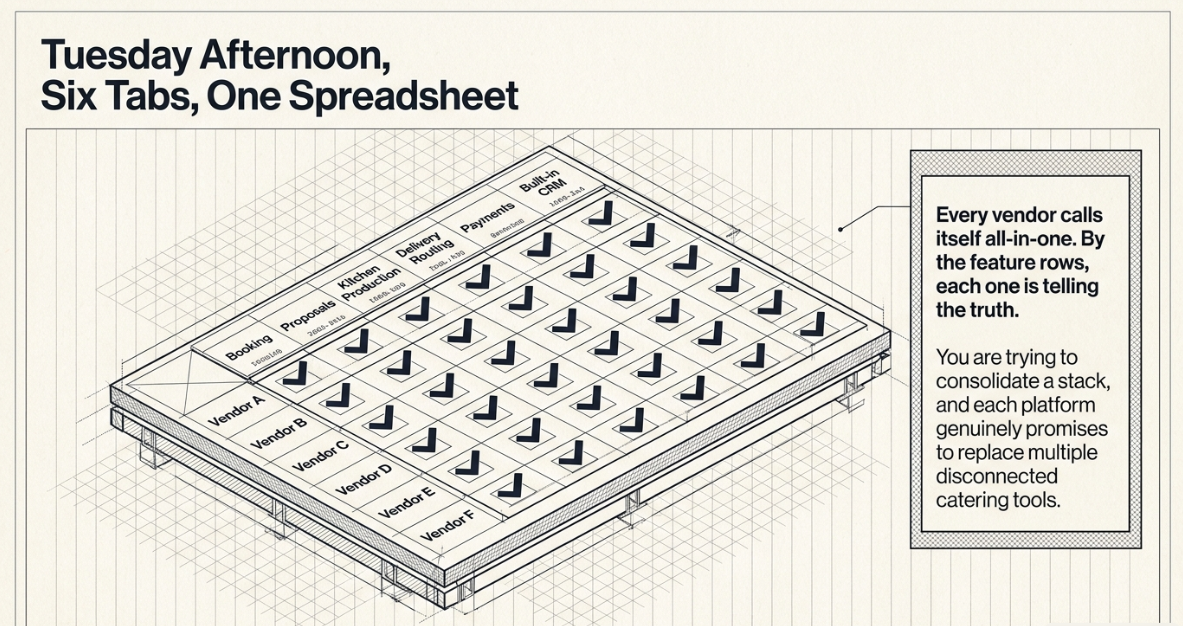
Tuesday afternoon, six browser tabs, one spreadsheet. You're the one building the vendor comparison, because you're the one who owns the stack the winner has to live in. A column per capability: booking, proposals, kitchen production sheets, delivery routing, payments, and a CRM. Six platforms, and the rows are green all the way down. Every vendor calls itself all-in-one, and by the feature rows, each one is telling the truth.
Then you get to the row you added, the one the vendor comparison templates never include: HubSpot integration. And every cell in that row is some flavor of the same answer. A connector. An open API. A Zapier recipe. A partner-built sync, "updated quarterly."
That row is the whole evaluation. You're trying to consolidate a stack, and each of these platforms would genuinely replace three catering tools, while adding a sync boundary between catering and everything else your company runs on. Six all-in-one products, and buying any of them makes your architecture less unified than it was this morning.
Nobody's lying to you. The vendors and the spreadsheet are just using different sentences. "All-in-one" has two meanings in this category, and the difference is structural. Most platforms mean every catering function in one product, which still leaves a boundary between catering and your marketing, sales, and CRM. The second meaning has a name: Stack Unification, catering operations on the same platform as marketing, sales, and the CRM, so there is no boundary to sync across. This article defines both senses precisely, grants what the first genuinely delivers, and gives you the five questions that reveal which one a vendor is actually selling.
What "All-in-One" Means in the Catering Software Category
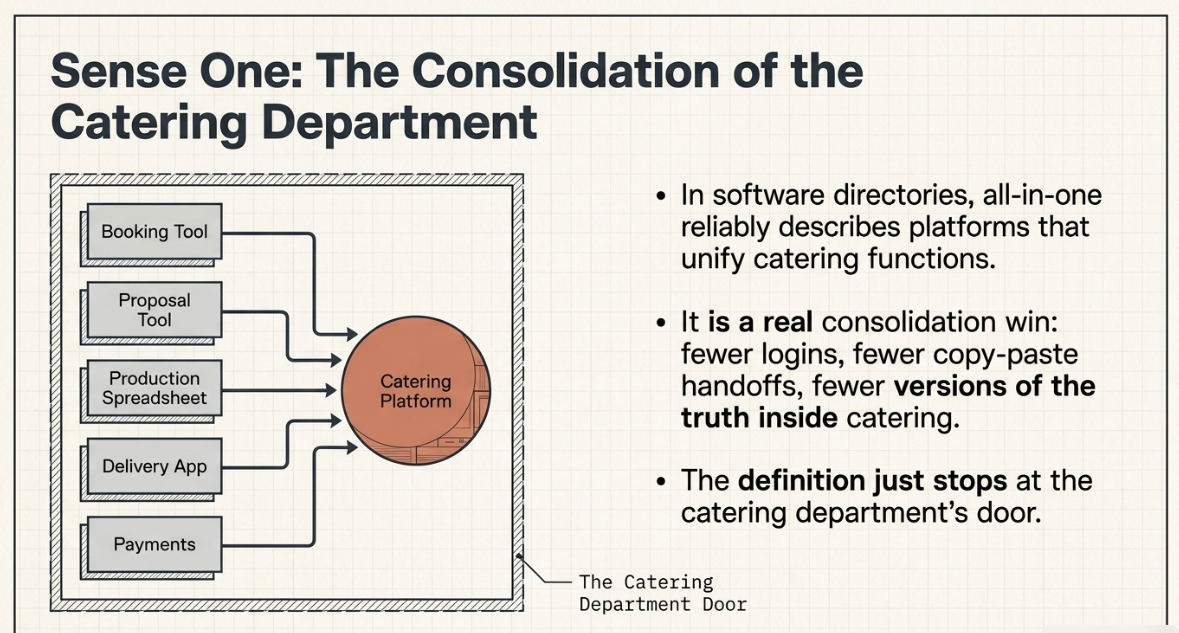
Start with the category's own definition, because it's consistent and it's checkable. In software directories, "all-in-one catering software" reliably describes platforms that unify catering functions: online ordering, event booking, proposals and contracts, kitchen production, delivery logistics, payments, and, almost always, a built-in CRM. Listings on Software Advice and GetApp carry the label within this exact scope, across multiple vendors. The "all" in the category's all-in-one is all catering tools.
And that is a real consolidation win. Be honest about it, because your operations team will be: a sense-one platform replaces a booking tool, a proposal tool, a production spreadsheet, and a payments workaround with one system the catering team actually lives in. Against point tools and spreadsheets, that's fewer logins, fewer copy-paste handoffs, fewer versions of the truth inside catering. If the alternative is five disconnected catering tools, a sense-one platform is genuinely better.
The definition just stops at the catering department's door. Which is precisely where your job starts.
The Boundary "All-in-One" Doesn't Mention
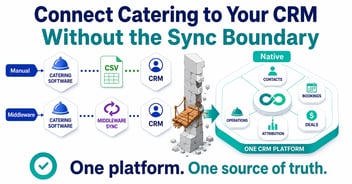
Look again at what "built-in CRM" means for a company that already runs HubSpot: a second CRM. A second contact database, with its own records for the same customers, its own pipeline, its own reporting, connected to your actual system of record across a sync that somebody has to map, monitor, and own. The platform unified catering and, in the same motion, split your customer data into two.
The costs are passed to your function first. Attribution: the campaign touch lives in HubSpot; the booked revenue lives in the catering platform; the join between them is only as good as the sync's match logic. Lifecycle and reporting: a contact's journey now has a seam in the middle, and every report that crosses the seam is a reconciliation exercise. This isn't a catering-specific affliction; in HubSpot's 2026 State of Marketing, drawing on 1,500+ marketers, teams consistently named disconnected data sources, internal silos, and the lack of a centralized source of customer information among their top data challenges, with difficulty sharing data across the organization cited by 12.4% as their single biggest obstacle to a data-driven strategy. A sense-one platform doesn't cause that condition, but for a HubSpot shop, it preserves it: the catering data is unified with itself and disconnected from you.
Sense two is a different structural property. On HubSpot's developer platform, a native app's objects are standard CRM objects; they live in your portal, are associated with your contacts and deals, and behave like HubSpot's own records. A booking written by a native catering product lands on the contact record, your attribution already reads. There's no second database because there's no second system; the "integration row" in your spreadsheet becomes meaningless, because there's nothing to integrate.
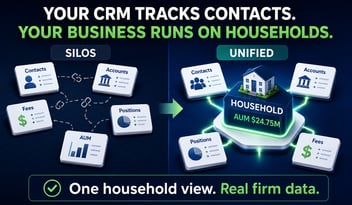
What that produces on the operations side has a name in this corpus: One System That Remembers, where every inquiry, every booking, every contact, every follow-up, every email exchange, every quote, and every event history lives in one place, and stays there even when people change roles or leave. For the full picture of what that looks like in a working catering operation, see what unified catering operations actually look like. For you, the shorter version: one contact record, from first touch to final invoice, readable by the reporting you already run.
Five Questions That Reveal Which "All-in-One" a Vendor Means
Put these in the RFP or ask them on the demo call. Each one distinguishes the two senses in a way that feature checklists can't.
- Does your platform have its own contact database, or does it read and write directly to my CRM's contact records? "Our CRM syncs with yours" is sense one. A second database is a second system, regardless of the sync quality.
- When a booking closes, where does revenue attribution live, your reports or my CRM's? If campaign-to-booking reporting happens within the catering platform, your marketing data must sync, and your attribution now depends on that sync.
- If the connection to my CRM stops working, what breaks, and who notices first? Sense-two platforms can't fail at the boundary because there isn't one. If the honest answer involves a monitoring dashboard, you're buying a sync.
- Is the connection to my CRM a native app on that platform, middleware, or an export? The word "integration" covers all three. Only one of them refers to shared objects; the other two refer to copies.
- If I already run marketing and sales on HubSpot, what does your platform add to my stack, and what does it duplicate? The duplication list is the real total cost: every duplicated object is a future reconciliation.
A vendor with sense-two answers will love these questions. A vendor with sense-one answers will redirect to the feature list. Both responses are informative.
All-in-One for a HubSpot Shop
The evaluation question, restated: not only does this platform have every catering feature, but does this platform share a data layer with the stack I own? For a company running marketing and sales on HubSpot, only a platform-native catering product answers yes, the property can't be added by integration, because integration is the thing that removes it.
The consolidation instinct you're acting on is the market's direction, not a private preference. In catering's own trade research, Catersource's State of the Industry names tool overload as the biggest technology challenge operators report, and finds that the most successful organizations are consolidating their stacks into integrated systems spanning inquiry through post-event analysis. Across industries, BetterCloud's State of SaaS puts the average company at 106 SaaS apps, down from 112 the year before, the second consecutive annual decline, and notes that consolidation runs over multiple years because of contracts, migration, and integration dependencies. That last finding is worth holding onto: consolidation is a program, not a purchase. Which makes the definitional question sharper, not softer. If each consolidation move requires real effort, the moves should reduce the number of boundaries in the stack rather than relocate them.
A sense-one platform consolidates catering. A sense-two platform consolidates catering into your company. Both are honestly called all-in-one. Only one of them shrinks your spreadsheet's integration row to zero.
Catering Software All-in-One Category Comparison
| Meaning of All-in-One | Data Layer Connectivity | Primary Benefit | CRM Relationship |
| Stack Unification | Native objects; shared data layer | Removes sync boundaries; one record for all | Single source of truth; no second database |
| Stack Unification | Talk natively; no integration needed | One system that remembers everything | Native app objects are standard CRM objects |
| Stack Unification | Shared objects; no boundary to fail | Consolidates catering into the company | Attribution reads CRM records directly |
| Functional Consolidation | Connects via sync/API or middleware | Replaces point tools; unified workflow | Built-in CRM; requires sync monitoring |
| Functional Consolidation | Disconnected sources; internal silos | Fewer logins for catering users | Duplicates objects; creates data seams |
| Functional Consolidation | The boundary between catering and depts | Consolidates catering department tools | Attribution and revenue live in silo |
Where to Go From Here
If you're still building the comparison spreadsheet: ground the category first with the full catering software comparison, then add the integration row and the five questions above to every vendor column.
If your CRM is not HubSpot: a sense-one platform with a well-maintained middleware connection may genuinely be your best available consolidation, go in with the boundary priced honestly, a named sync owner, and question three answered in writing.
If HubSpot is your system of record: evaluate the sense-two option directly, catering operations built on the platform your marketing already runs, and hold it to the same five questions. A platform-native product should make all five trivially easy to answer.
The CaterSuite Perspective
"All-in-one" should mean fewer systems in your company, not more features in ours. That's the belief CaterSuite is built on: a catering product's job is to join the platform its buyers already run, the contact records, the pipelines, the reporting, marketing, and sales live in every day, rather than stand beside it with a database of its own. A catering platform can be complete and still be a silo. The version of complete that matters to the person who owns the stack is the one where catering stops being a separate place, and data has to travel to.
Frequently Asked Questions
What does "all-in-one catering software" mean?
As the category uses the term, it means one product that covers the catering workflow end-to-end: online ordering, event booking, proposals, kitchen production, delivery, payments, and usually a built-in CRM. Software directories apply the label in exactly this scope. The term describes the consolidation of catering functions; it makes no claim about unification with your marketing, sales, or CRM stack.
Is all-in-one catering software the same as a unified platform?
Not necessarily. An all-in-one catering product unifies catering tools. A unified platform means catering shares one data layer with marketing, sales, and the CRM, one contact database, and one reporting surface. The first can exist alongside a disconnected stack; the second is a structural property of where the product is built.
Does all-in-one catering software include a CRM?
Usually, yes, it's its own. That's the detail to note: for a company already running a CRM, a built-in catering CRM is a second contact database synced with the first. The question to ask isn't "does it have a CRM" but "does it use mine."
Does this work for caterers who already use HubSpot?
Yes, CaterSuite is built on HubSpot. If your marketing or sales already run on HubSpot, catering operations can join the same platform without integrations. An inquiry from a form lands on the same contact record as a referral from your sales team. One contact record, one pipeline, one source of truth across marketing, sales, and operations.
What is Stack Unification?
Stack Unification is marketing, sales, and catering operations running on one platform, HubSpot, so they talk to each other natively rather than through integrations that have to be maintained. It's the precise name for the second sense of all-in-one: not every feature in one product, but every function on one data layer.
Can an all-in-one catering platform replace HubSpot?
It replaces catering tools, not a marketing and sales platform. Catering products' built-in CRMs and email modules are built for the catering workflow, not for campaign management, attribution, or lifecycle marketing at a company scale. Running marketing from a catering product recreates the boundary problem in reverse; now, marketing is the disconnected function.
How do I evaluate all-in-one claims before buying?
Use the five questions above, and put them in writing. The short version: find out whether the platform has its own contact database, where attribution lives, what breaks when the CRM connection fails, whether the connection is native or middleware, and what the platform duplicates in your current stack. Feature lists tell you what a product does; those five answers tell you what it is.
Put Catering on the Platform Marketing and Sales Already Run
Bring the vendor spreadsheet, integration row included. In a 30-minute walkthrough, see how CaterSuite runs catering as native objects inside your HubSpot portal: one contact database, one attribution surface, and nothing in the sync-monitoring column.
Leave a Comment