


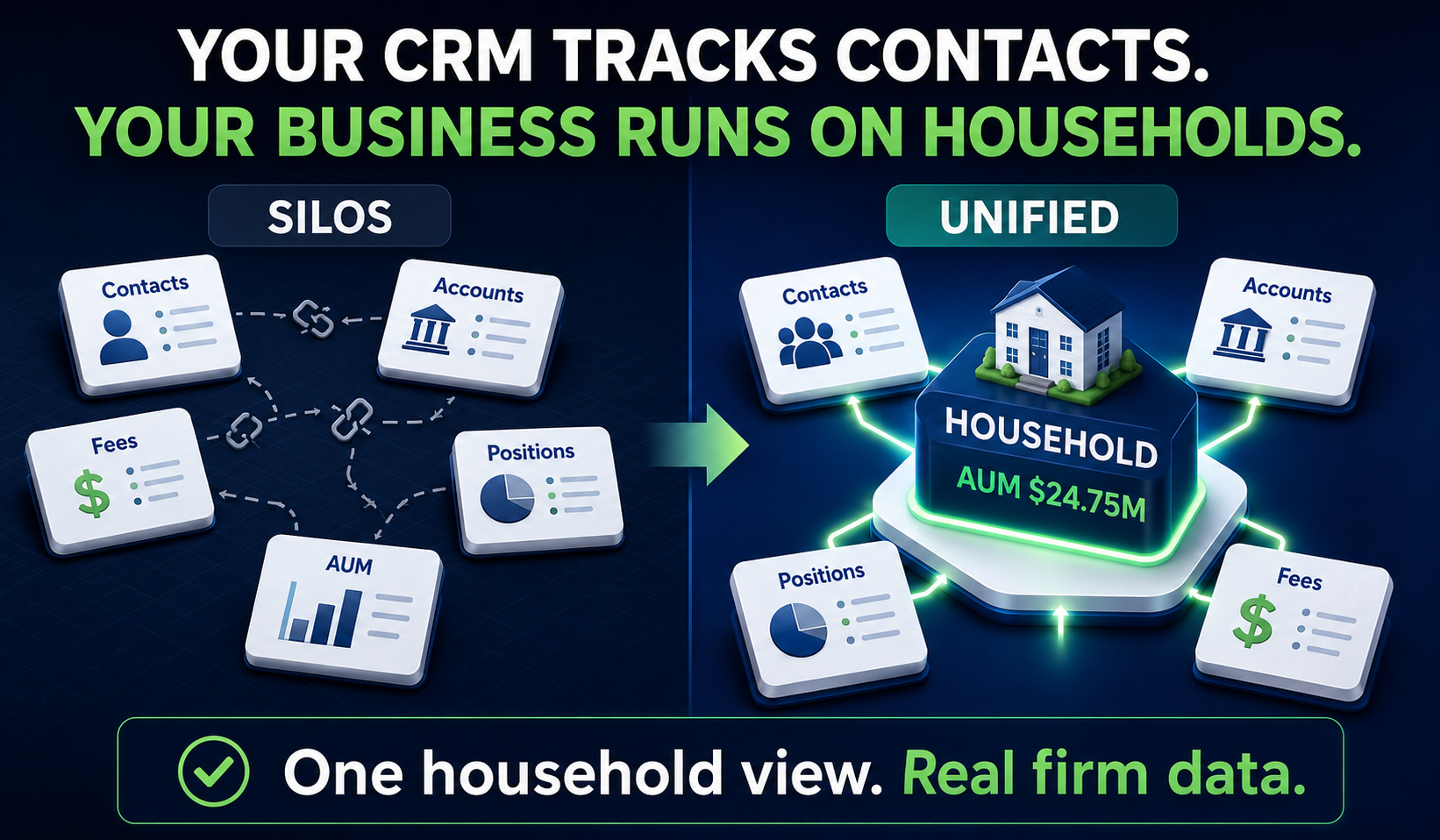
Yes, HubSpot works for financial advisors, but not out of the box. Standard HubSpot tracks contacts, companies, and deals; an advisory firm runs on households, accounts, positions, and fee schedules. With Enterprise-tier custom objects modeling those records (CETDIGIT's six-object architecture: Household, Contact, Company, Account, Position, Fee/Revenue), AUM rolls up on the household record, and HubSpot's AI agents finally have real firm data to work on.
The quarter-end export
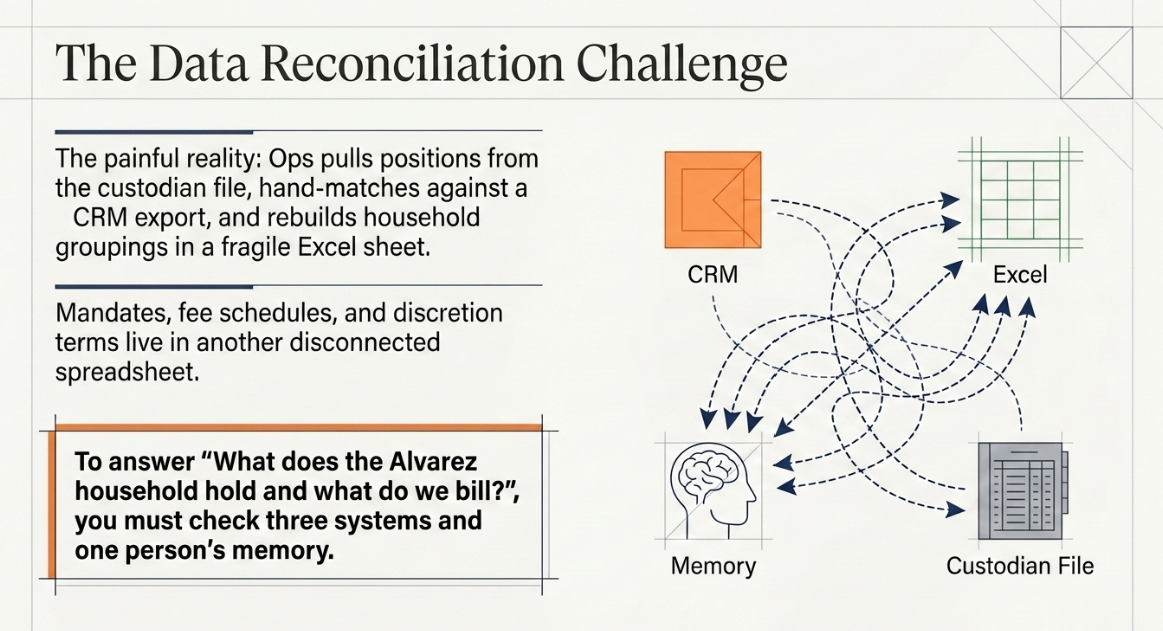
It's the last Friday of the quarter, and the AUM report is an Excel export again. Someone on the ops team pulls positions from the custodian file, matches them by hand against a CRM export, and rebuilds the household groupings in the spreadsheet that broke last quarter when a client added a trust account.
The mandate itself, the fee schedule, investment policy, and discretion terms live in another spreadsheet, bolted to a CRM that has no idea it exists. Ask the CRM, "What does the Alvarez household hold with us, and what do we bill on it?" The honest answer: check three systems and one person's memory.
That is the pain in one sentence: the CRM tracks contacts; the business runs on households, accounts, and mandates.
A contact-shaped CRM meets a household-shaped business
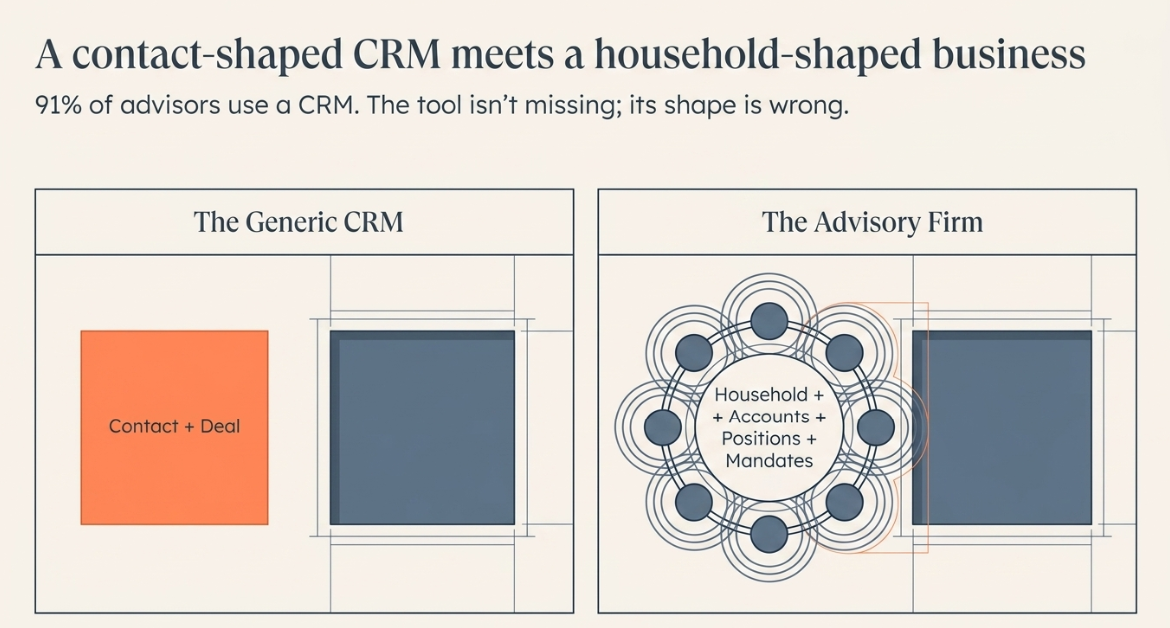
Advisors do not lack CRM. In the 2026 T3/Inside Information survey of 2,906 advisors, CRM ranked as the single most valuable software category, ahead of financial planning and portfolio tools, and 91% run one. The tool is universal. The problem is its shape.
A generic CRM is built around a person and a deal. An advisory firm is built around a household: people connected to accounts, accounts holding positions, positions generating fee revenue under a mandate. When the system's basic unit is a contact, everything the business runs on has nowhere to live. So it lives in spreadsheets, notes fields, and heads.
Who this affects
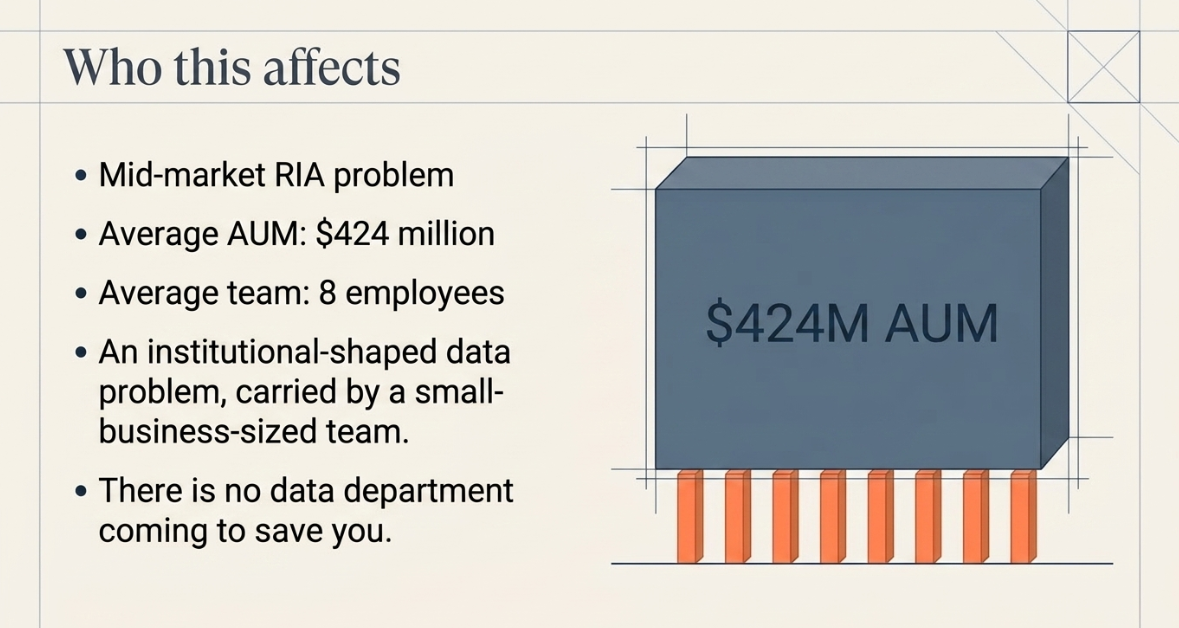
This is an RIA and wealth-manager problem, and it bites hardest in the middle. Per the 2026 Investment Adviser Industry Snapshot (IAA/Comply), the average adviser serving individual clients runs about $424 million in AUM with eight employees; most firms manage under $1 billion. An institutional-shaped data problem, carried by a small-business-sized team. No data department is coming to fix the quarter-end export. There are eight of you.
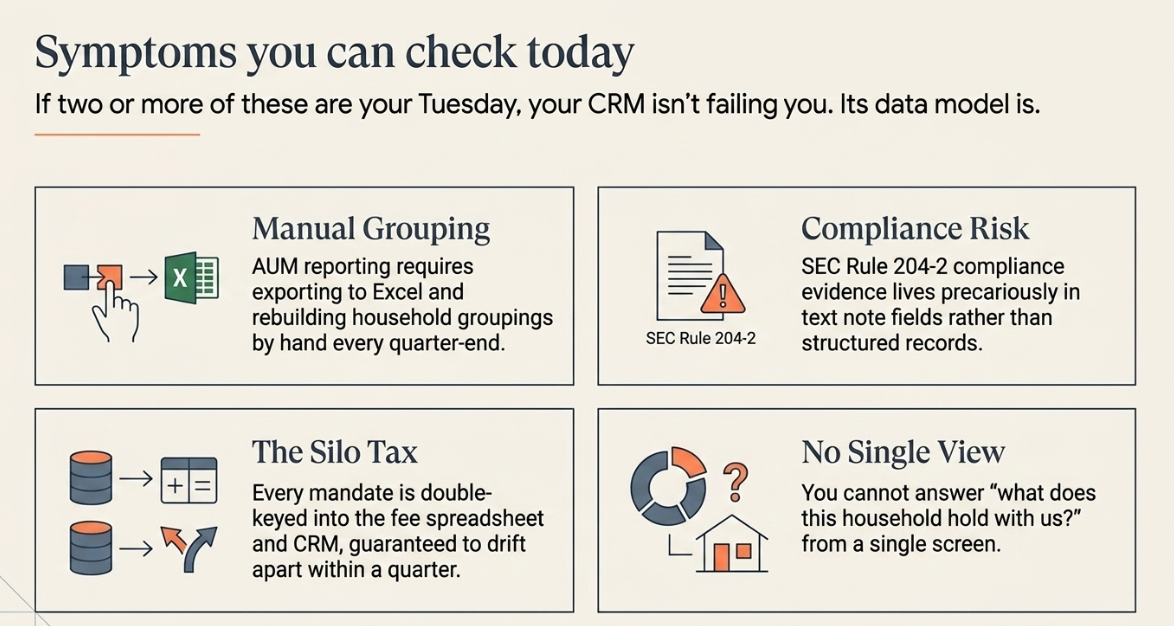
Symptoms you can check today
- AUM reporting means exporting to Excel every quarter-end, with household groupings rebuilt by hand each time.
- Compliance evidence lives in notes fields, while SEC Rule 204-2 (17 CFR § 275.204-2) requires true, accurate, current records of the advisory business, kept easily accessible.
- Every mandate gets keyed twice, into the fee spreadsheet and into the CRM, and the two drift apart within a quarter. (This is the Silo Tax in an advisory firm: the same fact living in two places, at a running cost.)
- Nobody can answer "what does this household hold with us?" from one screen.
If two or more of these are your Tuesday, the CRM isn't failing you. Its data model is.
Why the generic fix fails
The usual fix is more fields on the contact record: an "AUM" number typed in by hand, a "household name" text field, and a folder of fee PDFs. That's a spreadsheet wearing a CRM costume. The numbers go stale the day they're entered, nothing sums across a family's accounts, and the audit trail is still a notes field.
It also kills the AI conversation before it starts. Advisor AI adoption is past curiosity: 52% in the T3 survey now use a generative-AI tool, up from 41% a year earlier. But an agent pointed at a contact-shaped CRM has nothing true to reason over. It can't summarize a household; it can't see.
The HubSpot + AI answer: data model first, then AI
The order of operations matters, and HubSpot's own documentation points one direction: the AI layer works on CRM records and their relationships. Build the model first; then the AI has something real to act on.
Step one: make HubSpot speak your nouns. HubSpot's custom objects let a firm define its own record types beyond contacts and companies: a Household record, an Account record, a Position record, and a Fee record. Each has its own fields, connected to the others and to the people involved (a contact labeled "Primary" on a household, say). One thing to say plainly: custom objects require an Enterprise-tier HubSpot subscription. That is the tier this whole pattern lands on.
Step two: make the numbers live on the record. HubSpot's rollup properties can automatically sum a number across associated records. That mechanism is how, in CETDIGIT's financial-services deployments, a household record shows total AUM across its accounts: on the record, not rebuilt in Excel at quarter-end. To be precise: "AUM rollup" is not a feature HubSpot ships in a box; it is what a properly built data model does with HubSpot's rollup mechanics. For sensitive fields, Enterprise accounts can add per-property access control (Sensitive Data properties): structured, reportable records where note fields give you none. That supports your Rule 204-2 obligations; no software confers them.
Step three: put AI on top. Once households, accounts, and fees exist as records, HubSpot's Breeze AI layer has a business to work in:
|
What you want |
The HubSpot piece |
The conditions, plainly |
|
Pipeline and outreach follow-up |
Breeze Prospecting Agent: researches enrolled contacts and target accounts, runs guardrail-led outreach |
Sales Hub Professional or Enterprise; runs on HubSpot Credits |
|
Client-servicing responses |
Breeze Customer Agent: answers inbound questions from your knowledge sources, escalates when unsure |
Assigned seat required; Credits consumed only on resolution; current tier gating per HubSpot's docs |
|
Data works inside workflows |
Data Agent actions: analyze, categorize, and research record data automatically |
Generally available, Credit-metered; record summarization is in beta |
The honest budgeting note: Breeze agents run on HubSpot Credits on top of the subscription. Plans include a monthly allotment by tier; more can be purchased, and usage-based features pause when credits run out. Budget for the meter, not just the license.
The CETDIGIT perspective
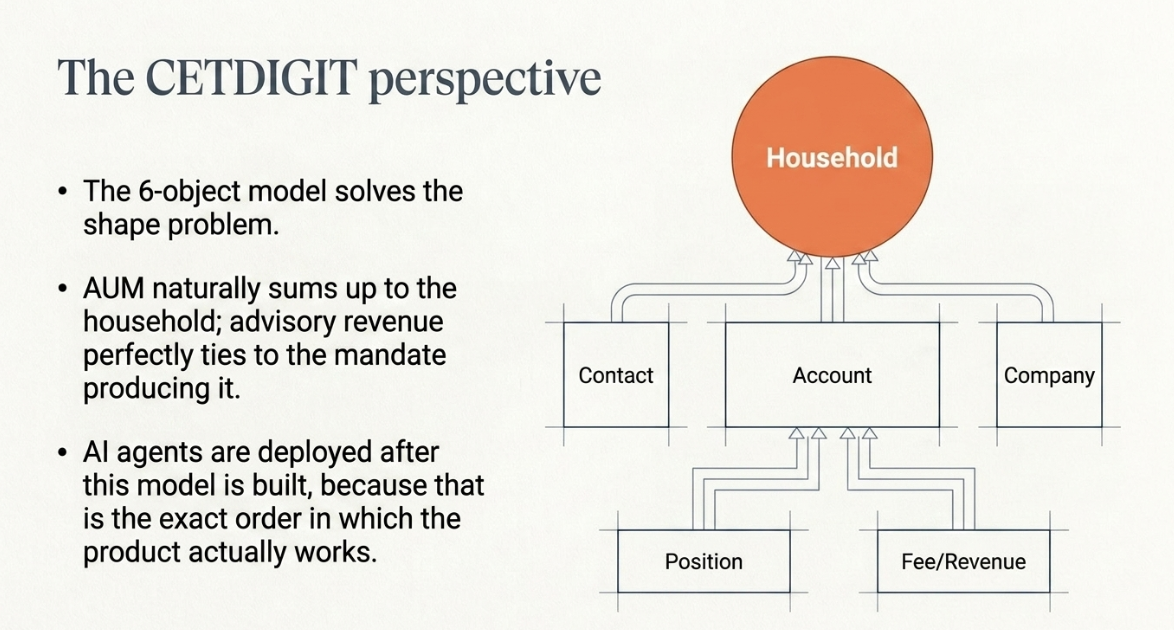
CETDIGIT is a HubSpot Elite Partner, and the six-object model (Household, Contact, Company, Account, Position, Fee/Revenue) is built and running in CETDIGIT's financial-services deployments. In plain terms: a place for households, a place for accounts, a place for what each account holds, and a place for what it earns. AUM sums up to the household; advisory revenue ties to the mandate that produces it. The AI agents come after, because that is the order in which the product works.
Recommended path
If the quarter-end scene above is yours, start with how the data model would map: [CETDIGIT financial services](BLOCKED, EIC to supply FS-primary URL). For the AI layer on top, see AI agents for HubSpot.
FAQ
Does HubSpot work for financial advisors?
Yes, with one condition: the data model has to be extended past contacts. Out of the box, HubSpot tracks contacts and deals; an advisory firm needs households, accounts, positions, and fees as real records. HubSpot's Enterprise custom objects make that possible; CETDIGIT's six-object model is a built implementation of it.
What HubSpot tier do custom objects require?
Enterprise. Custom objects, the mechanism behind household, account, position, and fee records, are available only on Enterprise editions of HubSpot's hubs. Object and property counts are capped by subscription; the six-object model fits a standard Enterprise pattern comfortably. If your rep hears "we need households and accounts as records," Enterprise is where that conversation lands.
Can HubSpot report AUM?
Not as a named, out-of-the-box feature, and a pitch that says otherwise deserves a hard look. HubSpot provides rollup properties that sum values across associated records. Applied to a custom-object model of households and accounts, that is how a household record displays total AUM. The reporting is real; the data model has to exist first.
What do Breeze AI agents cost to run?
They're metered through HubSpot Credits, on top of your subscription. Seat-based plans include a monthly credit allotment by tier, and more can be purchased; by default, usage-based AI features pause when credits run out. Per-unit pricing changes; budget against HubSpot's current credit terms, not a quoted rate.
Is HubSpot compliant with SEC recordkeeping rules?
No software makes a firm compliant; Rule 204-2 obligations belong to the adviser. A properly modeled HubSpot gives you structured, reportable, access-controlled records (including Enterprise-tier Sensitive Data properties) where a generic CRM gives you note fields. That supports the audit trail your compliance program has to produce; it does not replace the program.
Want to see it against your own book?
A short call to walk through how your households, accounts, and mandates would actually sit in HubSpot. No pitch, just the mapping. Book a time with the CETDIGIT team.


Leave a Comment