


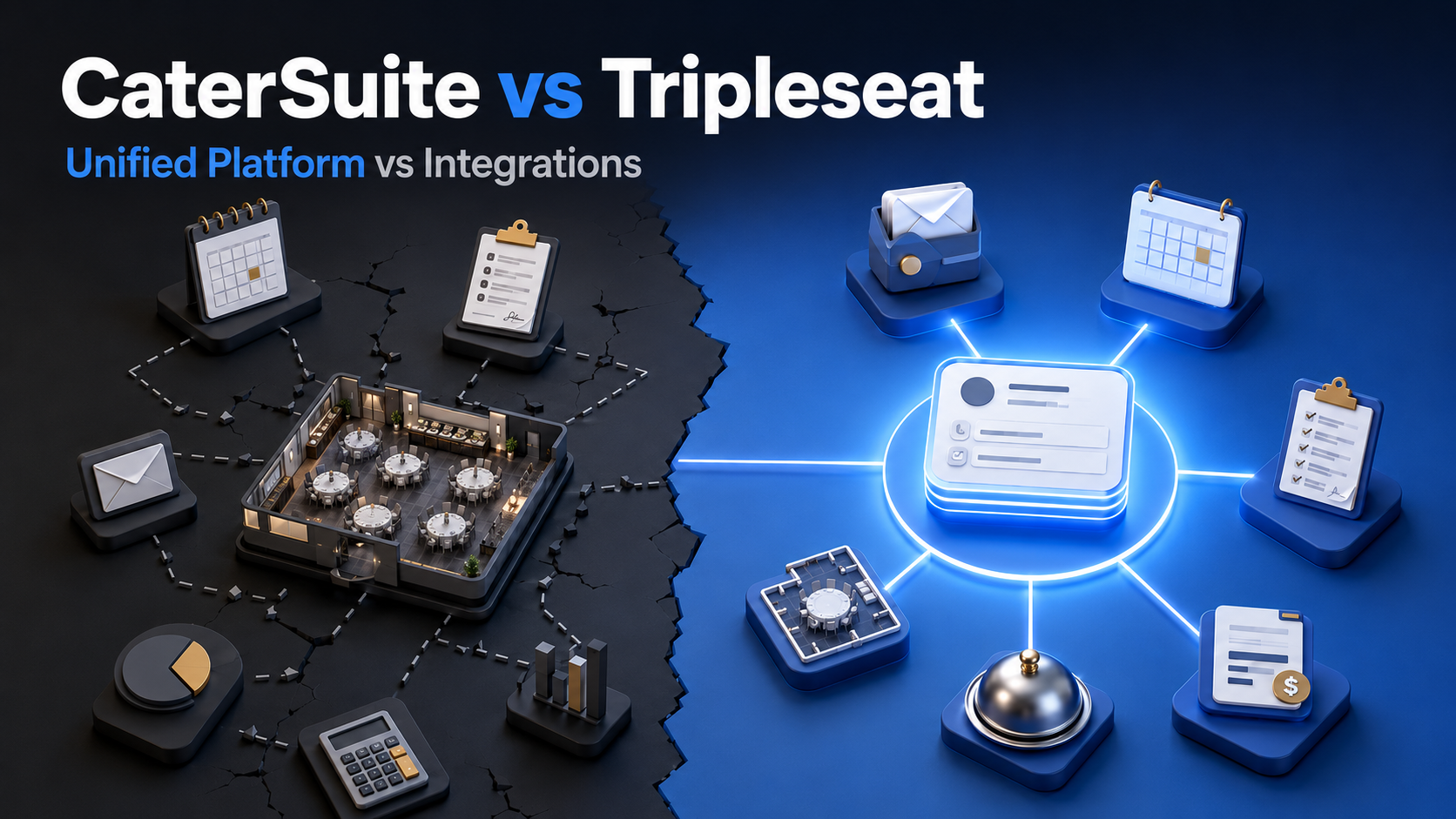
Tripleseat is a capable, well-regarded event-management platform built for venues and restaurants, with mature booking and BEO workflows. CaterSuite is a HubSpot-native catering operations platform. The core difference is stack unification: Tripleseat connects to marketing and accounting via integrations, whereas CaterSuite runs marketing, sales, and catering operations on a single platform. Tripleseat wins for venue and restaurant event management; CaterSuite wins for caterers who want inquiry, booking, production, and follow-up to share a single source of truth.
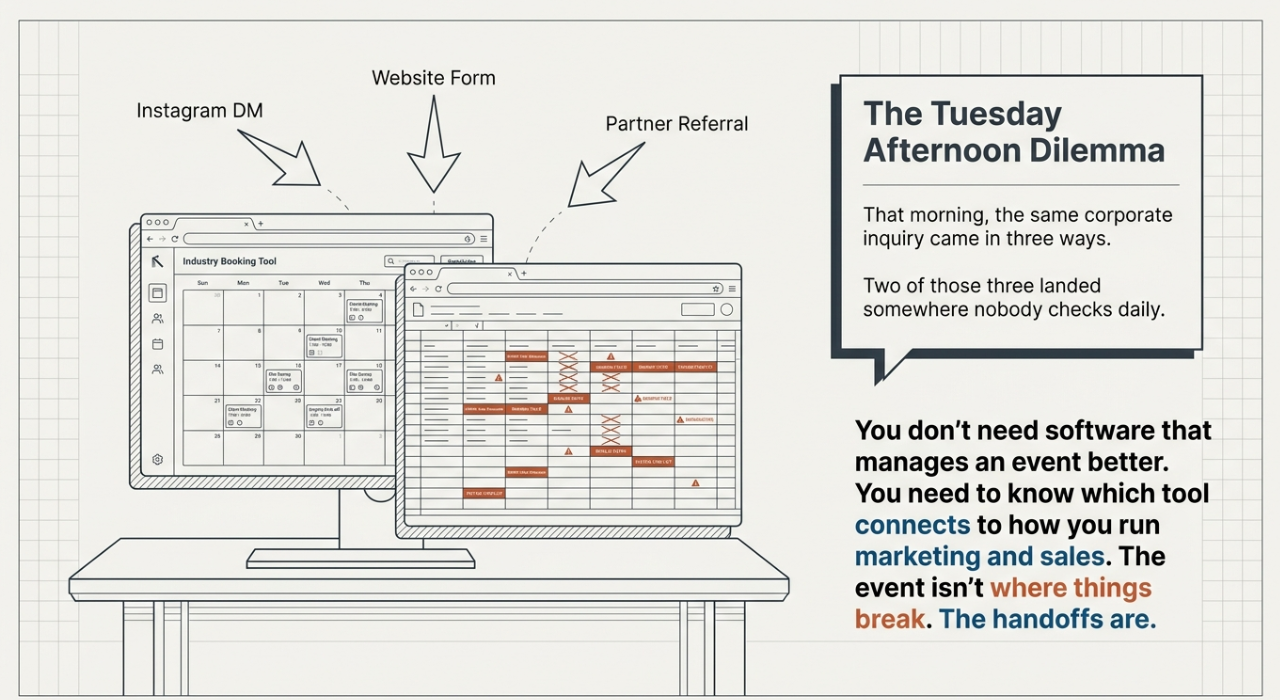
It's a Tuesday afternoon, and you've got two tabs open. One is Tripleseat's product page; you've heard good things; a venue friend swears by it. The other is a spreadsheet of what your operation actually needs: a booking system, BEOs the kitchen trusts, a production board that matches what sales sold, and some way to stop losing the leads your marketing person generates.
That morning, the same corporate inquiry came in three ways, once through your Instagram DMs, once through the contact form, once forwarded by a venue partner. Two of those three landed somewhere nobody checks daily. You don't need software that manages an event better. You need to know which tool actually connects to how you run marketing and sales, because the event isn't where things break. The handoffs are.
That question, which one connects to how we already work, is the one this comparison answers.
What this comparison is actually measuring
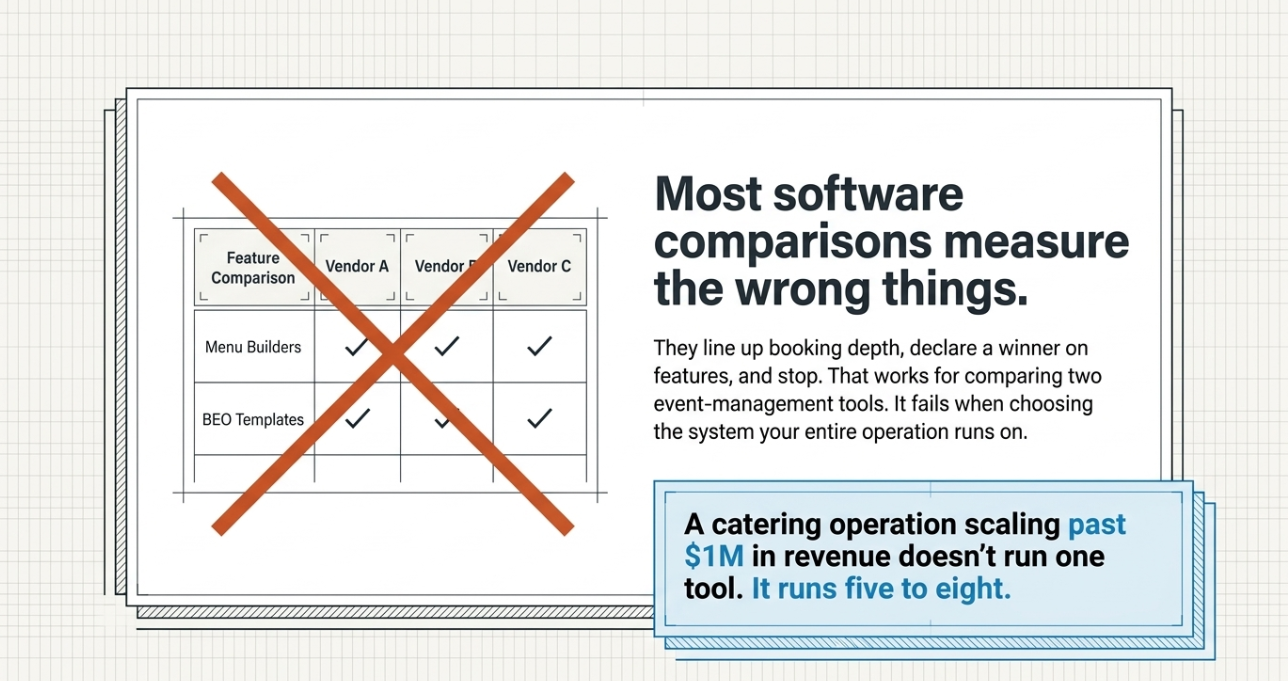
Most catering software comparisons measure the wrong things against each other. They line up booking depth, menu builders, and BEO templates, declare a winner on features, and stop. That's a fair way to compare two event-management tools. It's the wrong way to choose the system your whole operation runs on.
A catering operation above $1M doesn't run one tool. It runs five to eight: a booking system, a CRM, an email platform, a quote tool, a kitchen app, staff scheduling, accounting, plus marketing that lives somewhere else entirely. The pain isn't inside any one of those tools. It's in the gaps between them. That gap has a name: it's The Disconnect, the space between disorganized marketing, fragmented sales, and catering operations, where each runs in its own system and nothing talks to anything else. (Why catering inquiries go unanswered even when the inbox is being watched covers how this plays out at the inquiry stage.)
So this comparison measures both layers. The event layer: booking and BEO depth, venue/restaurant event management, kitchen and production coordination. And the connection layer: how marketing, sales, and operations share data, how the stack fits together, and the total cost of ownership once you count the hours spent reconciling tools that don't talk. Tripleseat is strong on the first layer. The second layer is where the two products genuinely diverge.
Side-by-side: Tripleseat vs CaterSuite
|
Dimension |
Tripleseat |
CaterSuite |
|
Core focus |
Event management for venues, restaurants, hotels, bars |
HubSpot-native catering operations |
|
Booking / BEO workflows |
Mature, deep, well-regarded; proposals, menus, contracts per event |
Full booking and BEO coverage on HubSpot |
|
Kitchen & production coordination |
Strong event-centric production tools |
Production tied to the same record as the booking and contact |
|
CRM / contact history |
Stores contact data tied to events; not a full CRM |
Native HubSpot CRM, one contact record across functions |
|
Marketing–sales connection |
Via integrations (QuickBooks, Mailchimp, others) |
Native, marketing and sales already live on the platform |
|
HubSpot-native / stack unification |
No, connects to HubSpot only through integration |
Yes, built on HubSpot; this is the differentiator |
|
Cross-function reporting |
Per-event and venue reporting; cross-tool requires manual pulls |
One platform, one source of truth across functions |
|
Total cost incl. coordination |
License plus the ongoing hours of integration upkeep |
License plus near-zero cross-tool reconciliation |
Tripleseat does not publish standard pricing publicly; quotes are tailored to venue size and needs. One directory lists a starting point around $149/month, but that figure is single-sourced and not confirmed on Tripleseat's own site, so treat it as approximate.

Where each product wins
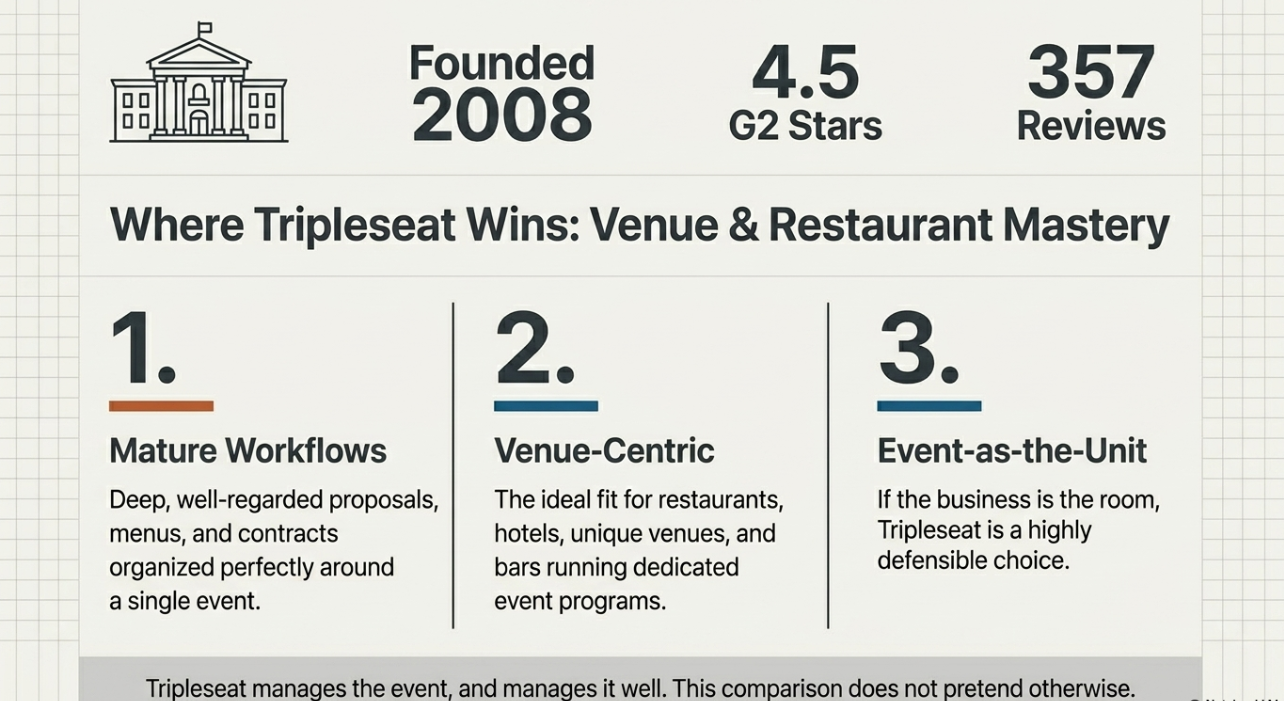
Tripleseat earns its reputation. Founded in 2008 and used by tens of thousands of venues, it holds around 4.5 stars on G2 across roughly 357 reviews. Its event-management and BEO workflows are mature and well-liked; proposals, menus, contracts, and client communication are all organized around each event. For restaurants, hotels, unique venues, and bars running event programs, it legitimately fits the "best for venues and restaurants" label it's known for. If your operation is venue-centric and the event itself is the unit you manage, Tripleseat is a strong, defensible choice. This comparison doesn't pretend otherwise.
Where Tripleseat reaches its structural edge is the connection layer. It's a standalone event-management platform, so the link to marketing and accounting runs through integrations, QuickBooks, Mailchimp, and others, rather than native unification. Some users report integration gaps; one reviewer noted it couldn't connect to their accounting system at all. Reviewers also note that some features lean more venue-specific than catering-specific, and that there's a learning curve. None of that makes it a weak product. It makes it a product built for a different job than ending The Disconnect.
CaterSuite wins on exactly that dimension, and only that dimension. It isn't a claim to better booking screens. It's that marketing, sales, and operations run on one platform instead of being stitched together.
The HubSpot-native advantage
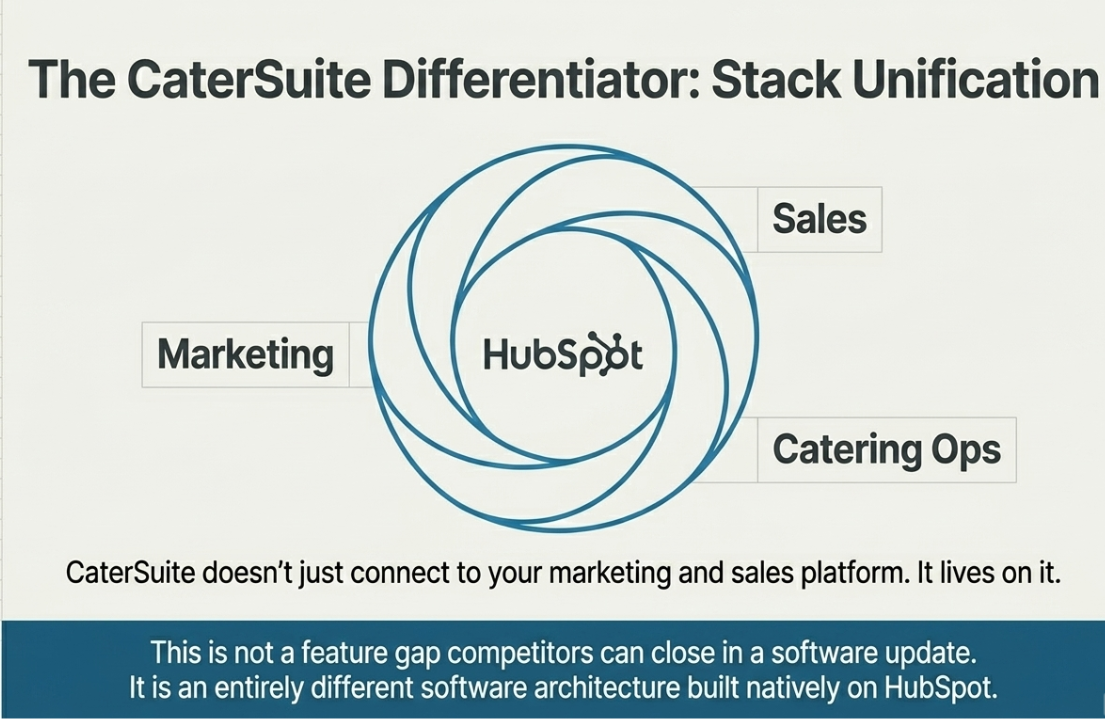
Here's the architectural difference, stated plainly. Tripleseat connects to your marketing and accounting through integrations. CaterSuite lives on the platform your marketing and sales already use, or are moving to. That's Stack Unification: marketing, sales, and catering operations on one platform, talking natively rather than through fragile integrations. (The HubSpot-native catering platform is where that argument lives in full.)
Why this matters operationally: with a standalone tool, the Instagram lead lands in one place, the marketing email engagement in another, the booking in a third, and the kitchen learns about the event at the production briefing. Every integration between those is a seam that can leak, and the seams are exactly where inquiries go unanswered, and numbers stop matching.
On HubSpot, the chain is one record. The inquiry becomes a contact, becomes a deal, becomes a booking, becomes a kitchen production job, becomes a delivered event, becomes a billed invoice, all tied to the same contact, all on the same platform. HubSpot's own 2026 State of Marketing research found that marketers' top struggles include disconnected data sources, company silos, and no centralized source of customer information. That's The Disconnect, named by the platform vendor whose research surveys 1,500-plus marketers. The fix isn't a better integration. It's not needing the integration.
This is the one dimension a standalone catering or event product cannot enter without rebuilding itself on HubSpot. It's not a feature gap Tripleseat could close in a release. It's what the product is.
Recommended path
Choose by where your operation actually breaks.
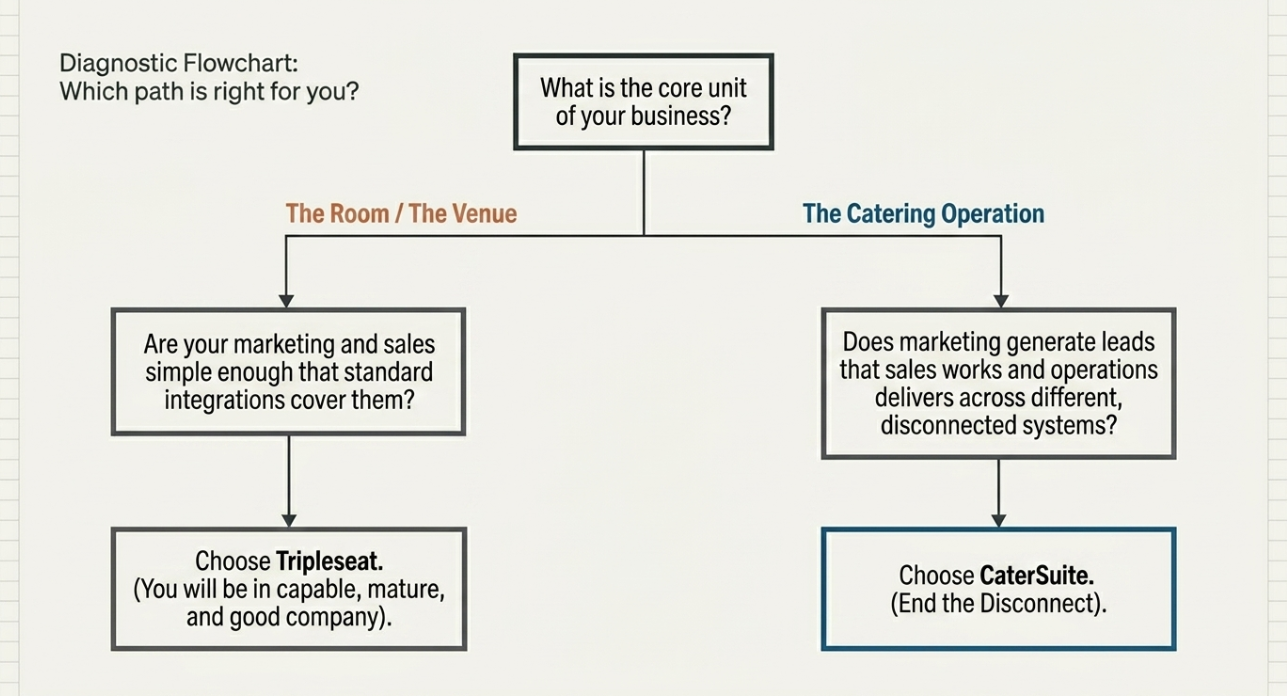
If you're venue- or restaurant-centric, your business is the room, the event is the unit, and your marketing and sales are simple enough that a couple of integrations cover it, Tripleseat is a capable, mature choice and you'll be in good company.
If your operation is a catering business where marketing generates leads, sales works them, and operations delivers, and those three live in different systems that don't talk, the booking tool isn't your real problem. The Disconnect is. That's the case for a platform built on HubSpot, where the whole chain shares one source of truth. You can see how CaterSuite handles this directly, and it's worth reading the full CaterSuite vs Caterease breakdown and the full catering software comparison alongside this one before you decide.
The CaterSuite perspective
The operating belief behind CaterSuite is simple: the event is one system among five to eight, and managing that one system beautifully doesn't fix an operation that's fragmented across the other seven. Every catering business that grows past the owner's head eventually runs into the same wall: not a booking problem, a connection problem. The bet is that unification, not another standalone tool, is what actually scales a catering operation. Build catering on the platform marketing and sales already run, and the handoffs stop being the place things break.
FAQ
Is Tripleseat good for catering? Yes, particularly for venue- and restaurant-centric event operations. It's a mature, well-regarded event-management platform with strong BEO workflows and around 4.5 stars on G2. Its event-management depth is real. The honest caveat is that some features lean more venue-specific than catering-specific, and it manages the event rather than unifying marketing, sales, and operations.
What's the difference between Tripleseat and CaterSuite? Tripleseat is a standalone event-management platform that connects to marketing and accounting through integrations. CaterSuite is HubSpot-native, so marketing, sales, and catering operations run on one platform. Tripleseat wins on venue/restaurant event management; CaterSuite wins on stack unification.
Does Tripleseat connect to HubSpot? Tripleseat integrates with various tools, including QuickBooks and Mailchimp. It can connect to HubSpot through integration, but it is not HubSpot-native; the catering operation doesn't live on the same platform as marketing and sales. That native-versus-integration distinction is the core difference here.
Does CaterSuite work for caterers who already use HubSpot? Yes, CaterSuite is built on HubSpot. If your marketing or sales already runs on HubSpot, catering operations join the same platform without integrations. An inquiry from a Google form lands in the same place as a referral from your sales team and a request from a HubSpot workflow. One contact record. One pipeline. One source of truth across marketing, sales, and operations.
How much does Tripleseat cost? Tripleseat does not publish standard pricing publicly; quotes are tailored to venue size and needs. One directory lists a starting point around $149/month, but that's single-sourced and not confirmed on Tripleseat's own site, so treat any specific figure as approximate.
Is CaterSuite a Tripleseat alternative? For caterers prioritizing stack unification, yes. If your priority is managing venue events and a couple of integrations cover your marketing and accounting, Tripleseat may fit better. If your priority is ending the gap between marketing, sales, and operations, CaterSuite is the alternative built for that.
The short version
Tripleseat manages the event, and it manages it well; that's not in dispute. But the event is one system among the five to eight your operation runs, and the place catering businesses actually lose money is the gaps between those systems, not inside any one of them. Tripleseat connects to marketing and sales through integrations. CaterSuite ends The Disconnect by living on the platform marketing and sales already use. Back to that Tuesday shortlist: the right question was never "which tool runs the event better." It was "which one connects to how we already work."
See how CaterSuite ends The Disconnect
If your marketing leads, sales follow-ups, and event operations live in different places and nothing talks, see how CaterSuite handles this on a single HubSpot-native platform, where the inquiry, the booking, the kitchen, and the follow-up finally share one record.



Leave a Comment