


Monday morning, 9:04 AM. The operations meeting starts.
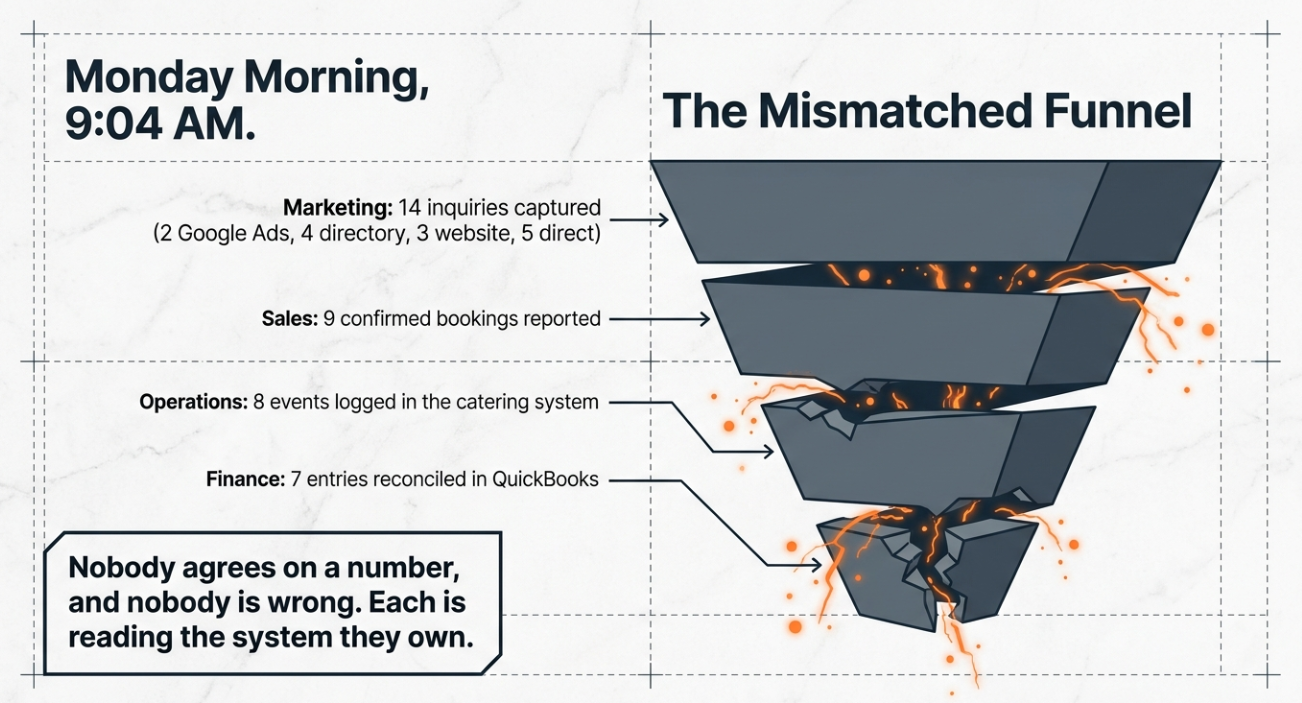
Your marketing person opens HubSpot on her laptop. Fourteen inquiries came in last week: two from Google Ads, four from the wedding directory, three from the website form, and five from direct referrals entered manually by a salesperson. She followed up on eleven of them.
Your salesperson says nine are confirmed bookings. The catering system shows eight. QuickBooks shows seven.
Nobody agrees on a number, and nobody is wrong; each of them is reading the system they own. The problem is that none of those systems is the same system.
Somewhere in that gap between fourteen HubSpot inquiries and seven QuickBooks entries is your Thursday booking. A corporate client filled out your website contact form at 9:47 AM on Thursday, asking about a plated dinner for 80 people. The form went into HubSpot. It never reached whoever takes bookings. It has been sitting there since Thursday morning. Whoever sent it almost certainly found someone else by Thursday afternoon. Harvard Business Review research tracking 2,241 companies found that leads contacted after 24 hours are 60 times less likely to qualify than leads contacted within the first hour.
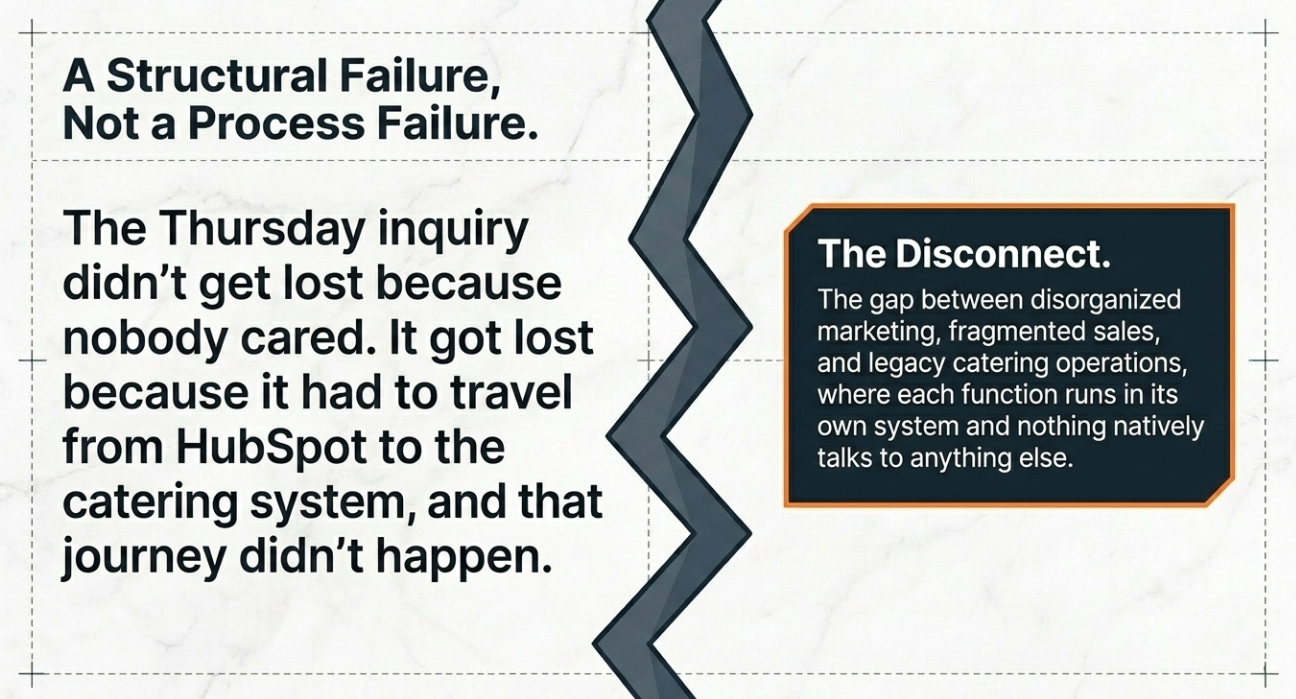
That inquiry wasn’t lost because nobody cared. It was lost because it had to travel from HubSpot to the catering system, and that journey didn’t happen.
|
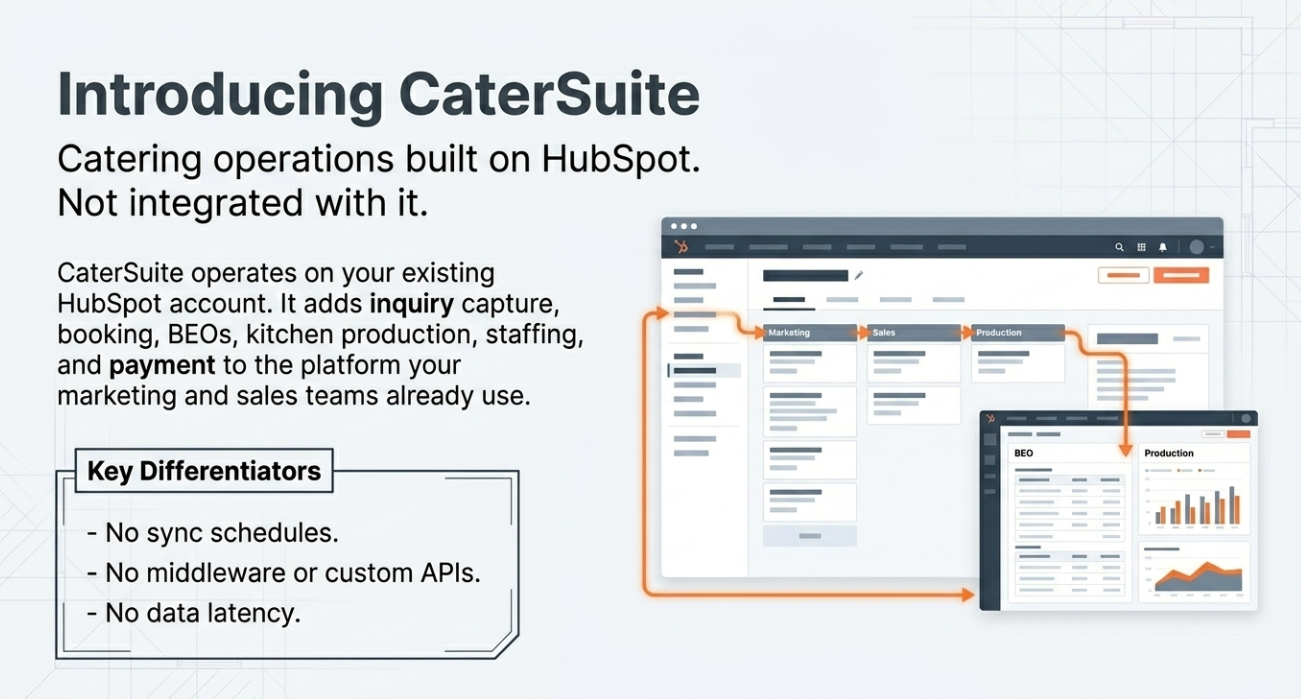
CaterSuite is a catering operations platform built natively on HubSpot, the only catering software where inquiry capture, booking, kitchen production, staffing, payment, and event history all live on the same platform that runs your marketing and sales. Unlike legacy catering products, which connect to HubSpot through third-party integrations that require maintenance and introduce data-sync gaps, CaterSuite is built on HubSpot itself. Inquiries from a website form, a referral, a marketing campaign, and a repeat client all land in the same contact record and the same pipeline your marketing team already uses. For catering operators who use HubSpot or are evaluating it, CaterSuite integrates catering operations into the existing stack rather than adding another disconnected system. |
The Thursday inquiry didn’t get lost because of a process failure. It got lost because of a structural one. What your operation is running into every Monday morning is The Disconnect, the gap between disorganized marketing, fragmented sales, and legacy catering operations, where each function runs in its own system and nothing talks to anything else. Inquiries land in different places. Follow-ups live on notes and open tabs. Marketing leads never reach the person taking bookings. The canonical problem in catering operations is not that individual tools are bad. It is that they were never built to share the same data layer. For the full breakdown, see The Disconnect explained in catering operations.
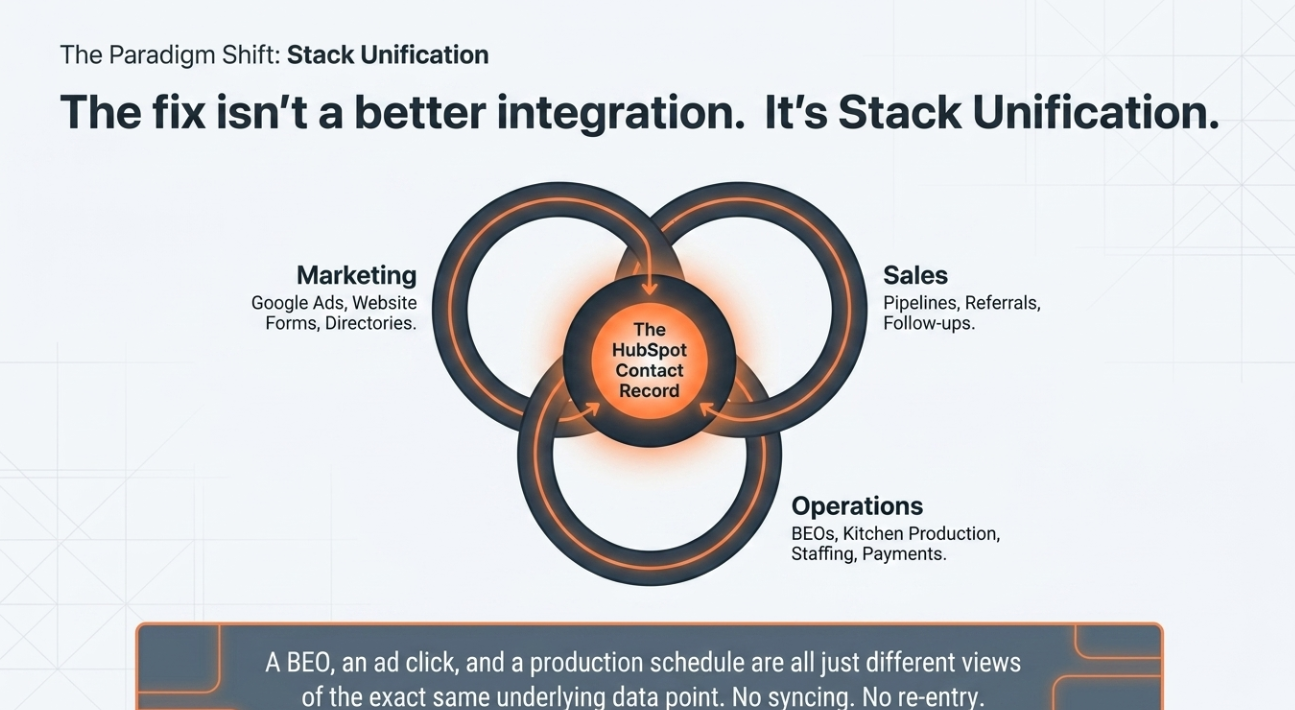
The fix isn’t a better integration. It’s Stack Unification, marketing, sales, and catering operations all on one platform, so they talk to each other natively rather than through connectors that require maintenance and break when either side updates. That is what HubSpot-native catering software means, and it is the only architectural position that eliminates The Disconnect rather than managing it.

Why Your Catering System and HubSpot Don’t Talk to Each Other
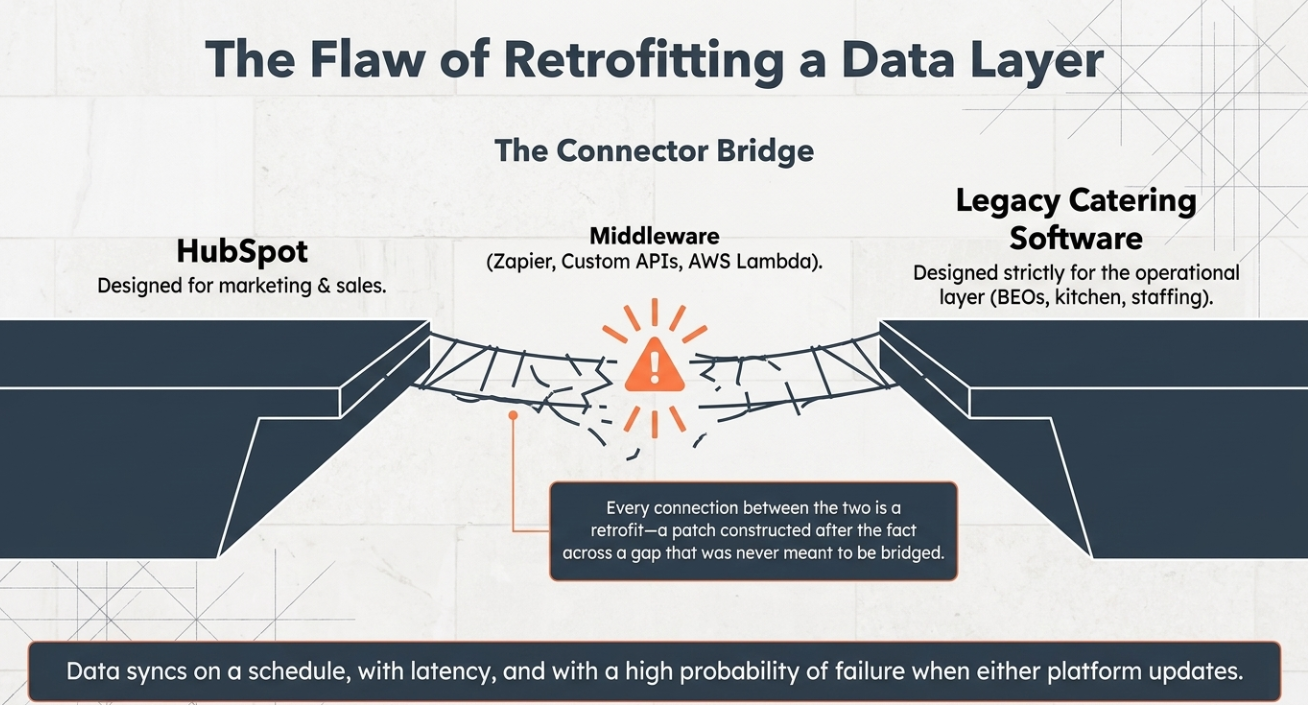
Legacy catering software was built around the operational layer. Bookings, BEOs, kitchen production schedules, staffing, payments, and the product were designed to run the event from the moment the booking was confirmed. That is not a design flaw. It was the right scope for the era in which those products were built.
What those products were not built to do is share a data layer with marketing or sales. Every connection a legacy catering platform makes to HubSpot is a retrofit, a bridge constructed after the fact across a gap that was never meant to be bridged.
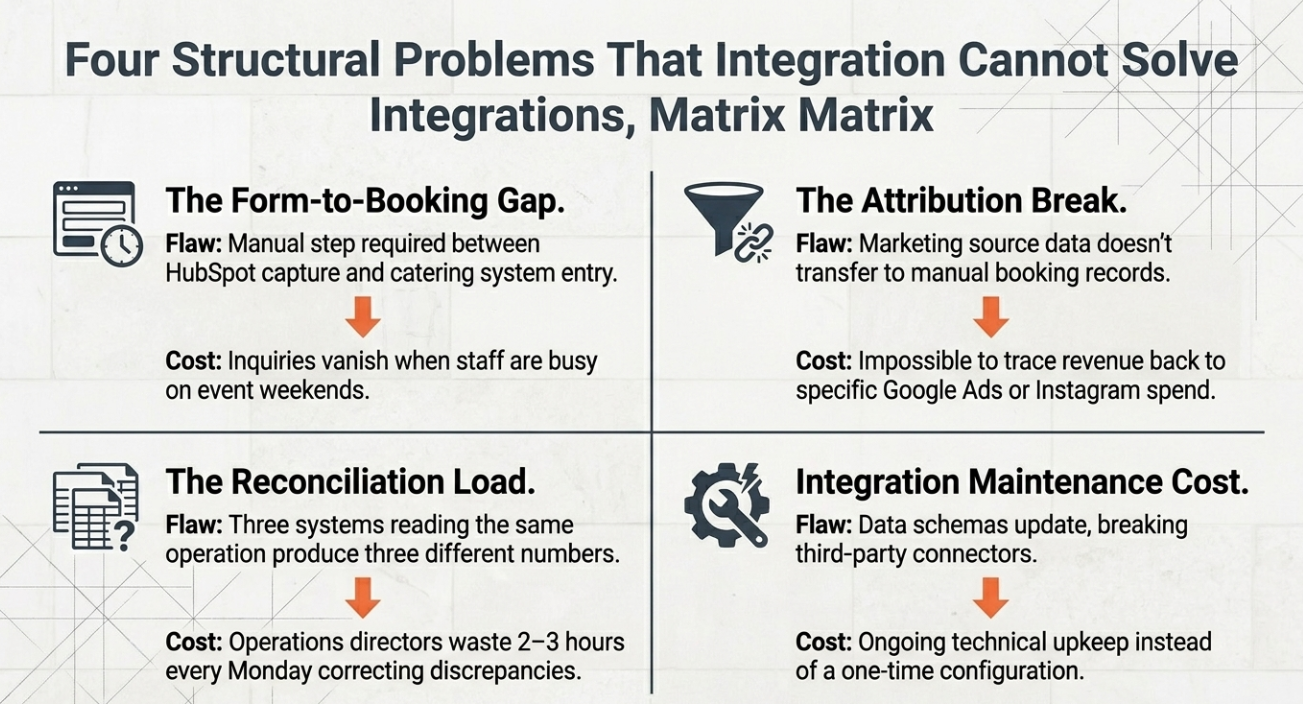
This creates four structural problems that integration cannot solve:
The form-to-booking gap
HubSpot captures the inquiry. The catering system captures the booking. Between those two events is a manual step: someone sees the HubSpot entry and creates a record in the catering system. When that step fails, because the person responsible is on the floor during a weekend event, or because the inquiry came in through a form that goes to one inbox while bookings are taken from another, the inquiry disappears. There is no automatic connection because the two systems are not the same system.
The attribution break
When a booking is created manually in the catering system after a HubSpot inquiry, the marketing source of that inquiry, the Google ad it clicked, the wedding directory it came from, and the Instagram post it followed are not visible in the catering record. Revenue cannot be traced back to marketing spend because the booking and the marketing data live in different databases. You know roughly what you spent on marketing. You cannot tell which spend produced which event.
The reconciliation load
Three systems reading the same operation produce three different numbers. The time spent every Monday reconciling those numbers, operations directors routinely spend two to three hours on this, is time not spent planning production or managing clients. It is time to correct errors that a unified platform would not produce.
The integration maintenance cost
Third-party connectors between catering software and HubSpot require a middleware layer, Zapier, a custom API, and, in some cases, custom infrastructure as AWS Lambda functions. When either platform updates its data schema, the middleware may break. Reconnecting it requires technical attention. This is not a one-time configuration cost; it is an ongoing one. For an overview of how the broader catering software market handles this, see how the major catering platforms compare.
These four problems share a cause: the catering system and the marketing platform were designed independently, and every integration between them is a patch on an architectural gap rather than a solution to it.
What The Disconnect Actually Costs a Catering Operation
The costs are not abstract. They show up in specific places.
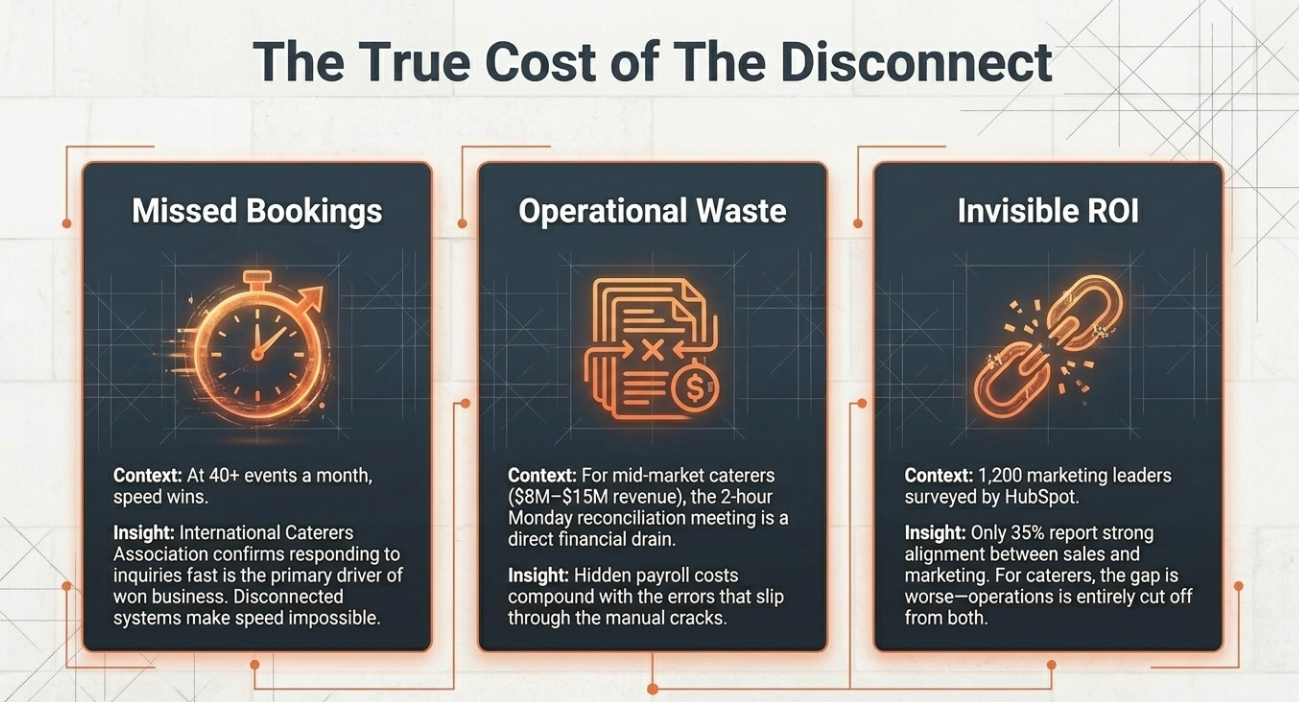
Missed bookings
The Thursday inquiry is the clearest version. A lead comes in through a HubSpot form, sits unworked, and converts elsewhere. For a catering operation running 40-plus events a month, this happens more than once. The International Caterers Association surveyed catering operators and found consistent agreement among high-performing caterers: responding to inquiries fast wins the business. When the system that captures inquiries doesn’t connect to the system that manages bookings, the speed of response depends entirely on someone checking the right inbox at the right time. That is not a reliable process.
Reconciliation time
The Monday meeting that runs for two hours to produce one agreed-upon event count is a direct cost. The operations director’s time, the sales person’s time, the marketing person’s time, all of it spent correcting discrepancies between systems that should agree but don’t. At a mid-market catering operation running $8M to $15M in annual revenue, the reconciliation load is a meaningful line item even before you account for the errors that slip through when the reconciliation isn’t thorough.
Marketing spend you can’t measure
HubSpot’s own research across more than 1,200 marketing leaders found that marketers with a single source of truth for marketing and sales data are 56% more likely to report strong alignment between the two functions, and that only 35% of marketers currently say sales and marketing are strongly aligned. In catering operations, the gap is more severe: the third leg of the business, operations, is disconnected from both. Google Ads spend, wedding directory fees, and Instagram investment, none of it can be cleanly traced through to catering revenue if the booking system doesn’t share data with the marketing platform. The money gets spent; the ROI stays invisible.
How to Know Whether Your Catering Stack Has the Disconnect
Five questions. If you answer “yes” to three or more, the Disconnect is active in your operation.
- When an inquiry comes in through your website’s HubSpot form, does someone have to manually enter it into your catering system, or does it appear there automatically?
- If a marketing campaign drove 20 inquiries this month, can you trace how many became bookings and how much revenue they generated, without building a manual report from multiple systems?
- Do your weekly or monthly operations meetings involve reconciling event counts between different tools?
- If a client who booked 18 months ago sends a new inquiry today, does whoever receives it have immediate access to that client’s full booking history, including the marketing channel that originally brought them in?
- When a booking changes, headcount, date, or menu, does that change appear automatically everywhere it needs to, or does someone enter it more than once?
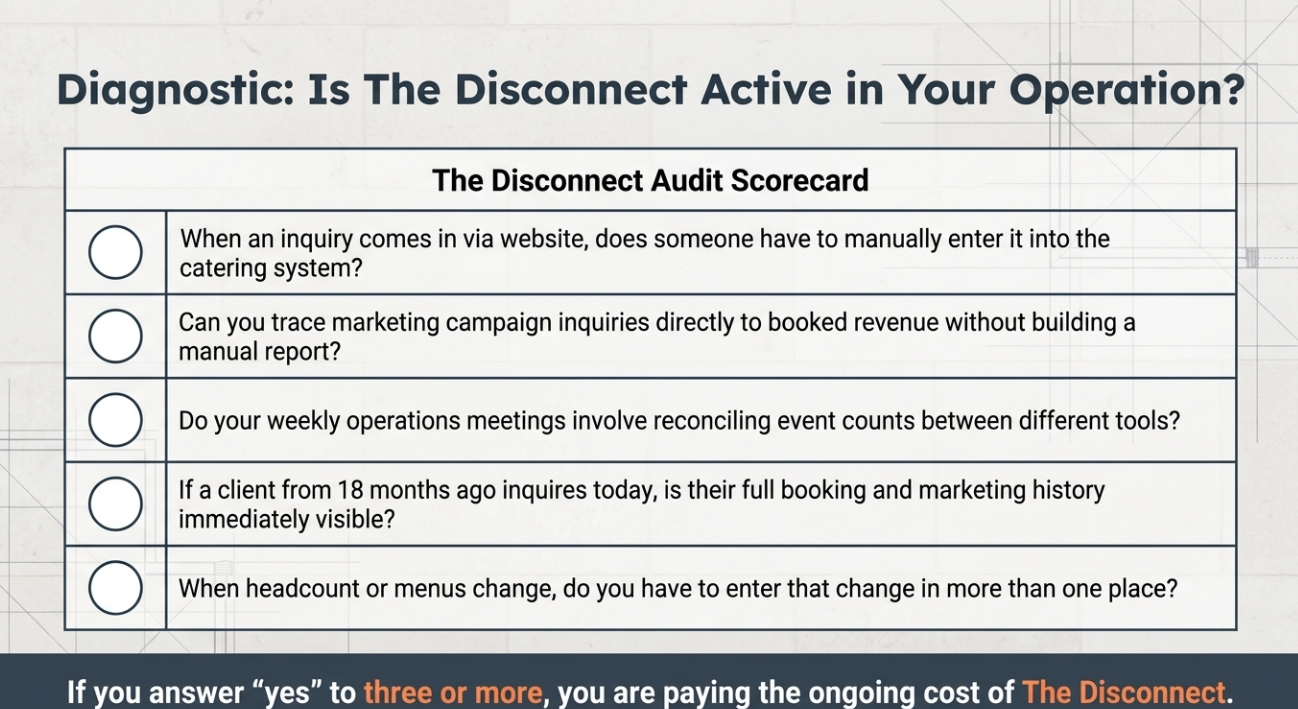
These questions don’t require a software audit or a consultant. They describe what happens on a normal week in a catering operation running disconnected tools. If the answer to most of them is “yes, someone enters it manually” or “no, we can’t see that,” the operation is paying the cost of The Disconnect in reconciliation time, missed bookings, and marketing spend it cannot account for.

What HubSpot-Native Actually Means for a Catering Operation
Every major catering software product can be connected to HubSpot with enough technical work. Caterease and CaterZen connect through third-party integrations. Tripleseat connects through custom middleware; there is no native HubSpot integration in Tripleseat’s official partner marketplace. Building the connection requires a custom integration layer that must be maintained as both platforms update.
That is not the same thing as being built on HubSpot.
Integration means two separate systems syncing data through a connector. One system updates; the connector carries the change to the other system on a schedule, with a lag, and with the possibility of failure. The inquiry on Thursday didn’t get lost because the connector failed. It got lost because the connector was never triggered, no one entered the HubSpot form submission into the catering system, so the sync had nothing to carry.
Native means the data was never separated in the first place.
When catering operations live on HubSpot natively, this is what changes operationally:
The inquiry from a website form and the inquiry from a repeat client who called in are the same contact record. The sales pipeline the salesperson works on and the booking list the operations director manages come from the same source. The marketing attribution for the Google Ads campaign that drove the inquiry is visible on the same record as the kitchen production sheet for the event it became. When a booking changes, the change appears everywhere, not because a sync ran, but because there is only one place where the data lives.
No one re-enters information. No one reconciles. The information is there because it was never somewhere else.
This is Stack Unification: marketing, sales, and catering operations on one platform, HubSpot, so they share data natively rather than through connectors that require maintenance, introduce latency, and break when either side updates. It is the structural advantage that legacy catering software cannot match without rebuilding its products from scratch. A catering platform built on top of HubSpot has not solved the integration problem. A catering platform built on HubSpot has eliminated it.
HubSpot’s 2025 State of Marketing research, drawn from surveys of more than 1,200 marketing leaders, found that 87% of marketers using connected CRM systems report having an effective marketing strategy, compared to 52% of those without a connected CRM. For catering operations, the connection point that matters is not just marketing to CRM. It is marketing to CRM to catering operations, all three legs on one platform.
That is what HubSpot-native means. Not a feature. The platform itself.
|
Comparison of Catering Software and HubSpot Connectivity
|
||
| Platform / Software Name | Integration Type | Key Connectivity Stats |
| CaterSuite | Native (Built on HubSpot) | 100% data unification; eliminates 2-3 hour weekly reconciliation meetings. |
| Tripleseat | Third-party (Custom middleware) | 0 native HubSpot Marketplace listings; requires manual custom integration layer. |
| Caterease | Third-party Integration | Requires middleware/connectors; risk of data-sync gaps and maintenance costs. |
| CaterZen | Third-party Integration | Syncs via external connectors; subject to integration maintenance and lag. |
| Legacy Catering Systems | Retrofit / Bridge | Manual entry required for HubSpot forms; high reconciliation load. |
| HubSpot (General) | Platform Core | 87% strategy effectiveness with connected CRM vs 52% without. |
| Lead Qualification (Speed) | Process Metric | Leads contacted after 24h are 60x less likely to qualify than those contacted within 1h. |
| Marketing & Sales (Aligned) | Single Source of Truth | 56% more likely to report strong alignment between functions. |
| Industry Alignment | Market Survey | Only 35% of marketers say sales and marketing are currently strongly aligned. |
If Your Catering Stack Has The Disconnect, Here’s What to Do Next
If three or more of the audit questions above describe your operation, you are managing The Disconnect today, probably through a combination of manual data entry, weekly reconciliation meetings, and a running awareness that some inquiries are not being followed up on as quickly as they should be.
The structural fix is Stack Unification: bringing catering operations onto the same platform as marketing and sales. Not connecting catering software to HubSpot. Running catering operations on HubSpot.
That is what CaterSuite is. The booking, the BEO, the kitchen production schedule, the staff assignment, the deposit, the follow-up email, and the client’s full event history, all on the same platform your marketing team opens every morning.
If your catering operation already runs HubSpot for marketing or sales, or is evaluating HubSpot, the next step is seeing what catering operations look like when they live on the same platform. See the catering operations system built on HubSpot and see how CaterSuite connects to your HubSpot stack.
Why CaterSuite Is Built on HubSpot
CaterSuite was built on HubSpot because we believed the real problem in catering operations was not a feature gap; it was an architectural one. Every catering software product on the market solves the operational layer well: bookings, BEOs, kitchen production, and staff scheduling. What none of them solved was the gap between those operations and the marketing and sales functions that feed them. We built on HubSpot because that is where marketing and sales already live for the catering businesses we work with. The answer to The Disconnect was not a better integration. It was building catering operations on the platform where the disconnect doesn’t exist.

Frequently Asked Questions
Does this work for caterers who already use HubSpot?
Yes, CaterSuite is built on HubSpot. If your marketing or sales already run on HubSpot, catering operations can join the same platform without integrations. An inquiry from a Google form lands in the same place as a referral from your sales team and a corporate request from a HubSpot workflow. One contact record. One pipeline. One source of truth across marketing, sales, and catering operations.
Does CaterSuite replace my existing HubSpot subscription?
No. CaterSuite runs on your existing HubSpot account. It adds catering operations, inquiry capture, booking, BEOs, kitchen production, staffing, and payment to the HubSpot platform you already pay for. Your marketing team keeps working in HubSpot. Your catering team works in the same place. The two stacks become one.
How is this different from a HubSpot integration?
An integration connects two separate systems through a third-party connector. When one platform updates, the connector may break. Data syncs on a schedule rather than in real time, which means there is always a gap between what one system knows and what the other shows. CaterSuite is not an integration. It is built on HubSpot, which means the catering data and the marketing and sales data are already on the same platform. No connector to maintain. No sync schedule. No lag.
What happens to my data if I already use a different catering system?
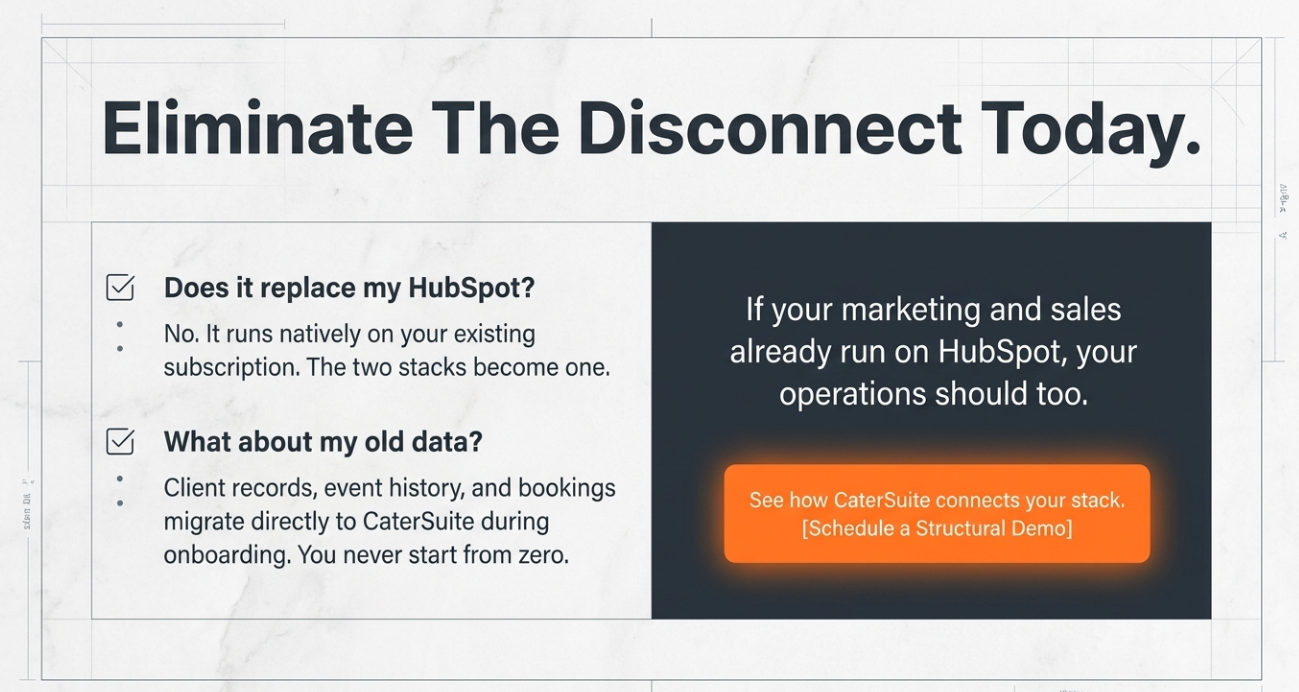
Your existing catering data can typically be migrated to CaterSuite during onboarding. Client records, event history, and booking details transfer, so your team doesn’t start from zero. Migration scope is confirmed during the onboarding process, which the demo covers.
Do I need technical knowledge to use CaterSuite with HubSpot?
No. If your team uses HubSpot today, CaterSuite works within the HubSpot environment they already know. There is no middleware to configure, no custom API to maintain, and no integration layer to build or monitor. The platform is the platform.
What does catering software cost when it’s built on HubSpot?
CaterSuite pricing is confirmed at the demo stage. For context, standalone legacy catering platforms range from around $99 per month for entry-level tiers to enterprise pricing. When comparing total cost, it is worth accounting for what a HubSpot-native solution eliminates: integration maintenance time, data reconciliation, payroll, and the cost of marketing spend you currently cannot trace to specific bookings.
Can catering software actually connect to HubSpot natively, or does it always need a custom integration?
Most catering software connects to HubSpot through third-party middleware, Zapier, custom APIs, or services that require technical build-out and ongoing maintenance. CaterSuite is the exception: it is built on HubSpot rather than connected to it. The distinction matters because middleware introduces sync delays, requires upkeep, and can break when either platform updates. Native means the data was never separated to begin with.
See CaterSuite, Catering Operations Built on HubSpot
|
If your marketing and sales already run on HubSpot, catering operations should too. CaterSuite is the only catering platform built natively on HubSpot, where the inquiry, the booking, the production schedule, and the client history all live in one place. |

Leave a Comment