


A CRM system of record stores what happened, contacts, stage transitions, and activity history entered by a human. A system of action responds to what is happening right now: it detects behavioral signals across buyer channels and triggers autonomous workflows without waiting for a human to review the data. In 2024, both Gartner and Forrester independently formalized this architectural distinction. The gap between them is not a software gap. It is a Revenue Intelligence gap, the measurement and activation layer that converts captured data into autonomous revenue action.
The Signal No One Acted On
The pipeline review is scheduled for Tuesday morning. A Salesforce Admin pulls the weekly prep report: 47 open opportunities, accurate stage data, and three formal reviews conducted this month. The AI tools are connected and returning activity metrics. An account manager flags that a target enterprise account has gone quiet, with three contacts not responding to outreach for eleven days.
The admin pulls the account record. Everything entered is there. Two discovery call notes. Four email threads. A proposal was sent on March 19th. The record is complete.
What is not in the record: the signal that two of those contacts visited the pricing page four times in the past week. One of them downloaded the implementation guide. The system did not fail to capture that information. It was never asked to look for it.
The meeting happens. The opportunity remains marked Active. Two weeks later, the deal goes to a competitor whose system detected the pricing page visits, triggered an outreach sequence, and booked a call within six hours of the first visit.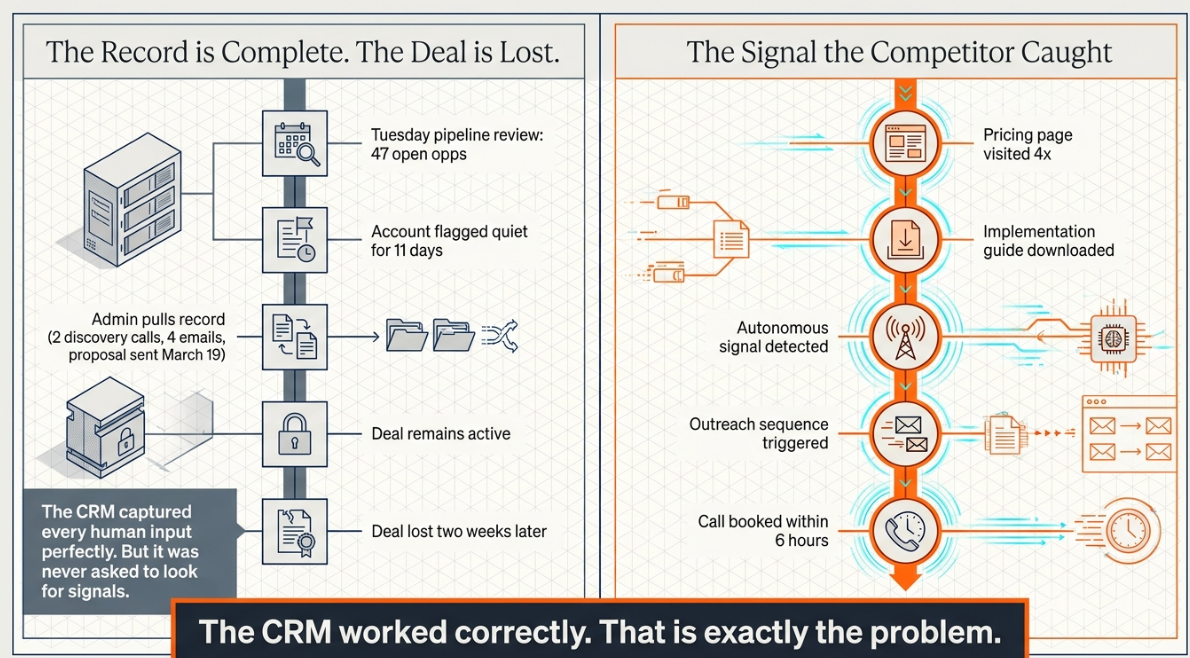
The CRM worked correctly. That is the problem.
The system of record was the right architecture for a buying environment where a human could monitor five channels and act on what they found. According to McKinsey's 2024 B2B Pulse Survey of more than 3,000 B2B decision-makers, buyers now interact across an average of 10.2 channels in their purchase journey, up from five channels in 2016. Revenue Intelligence, the real-time sensing layer that detects which accounts are showing buying behavior across those channels, is not a feature of the system of record. It requires a different architectural layer sitting on top of what you already own.
The gap is not a failure of implementation. It is a structural shift in signal volume that outpaced what the system of record was designed to handle.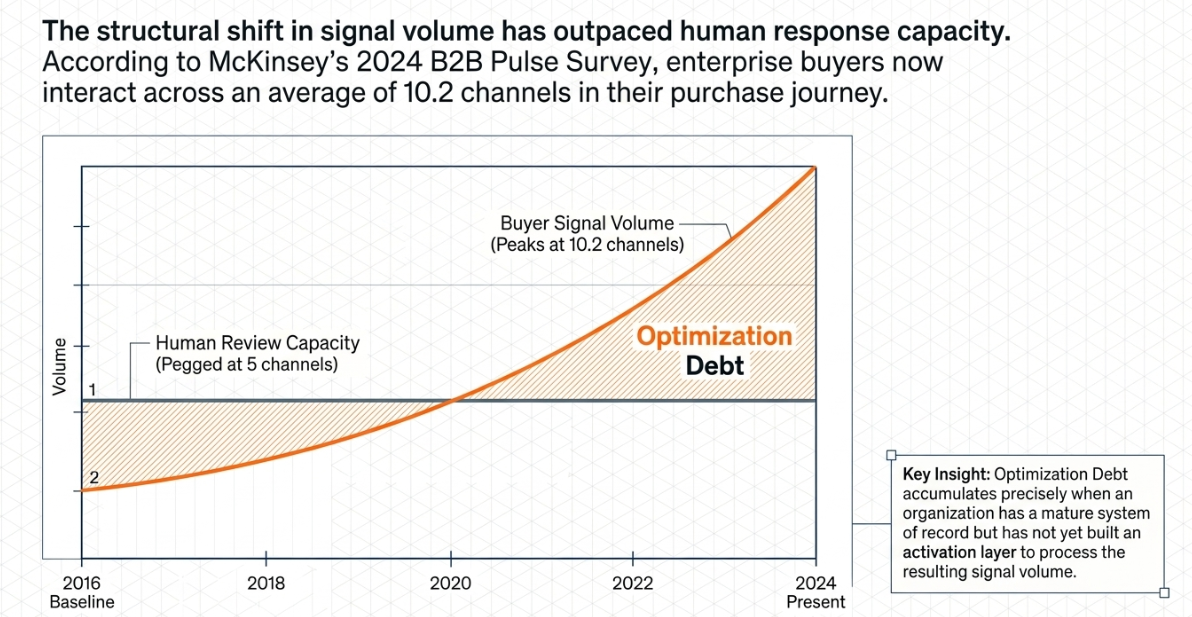
What the CRM Captured Correctly
The Salesforce instance logged every human-entered data point accurately: calls made, emails sent, stage transitions, proposal delivery dates. The forecast produced reflected those inputs correctly. This is the system of record performing exactly as specified, a reliable, searchable archive of revenue history.
What the CRM Was Never Designed to Do
The CRM was not designed to continuously scan account behavior for buying signals, detect when multiple stakeholders from the same company converge on high-intent content within a 72-hour window, and trigger an autonomous outreach sequence before a rep's calendar review. That capability requires a signal detection architecture and an orchestration layer that processes events in real time, not in response to a human login.
What "System of Record" Actually Means — and Why It Was the Right Choice
The term "system of record" emerged when the primary challenge in enterprise revenue operations was reliability: capturing customer data consistently enough to make strategic decisions. Before CRMs became the standard, enterprise deal history lived in inboxes, spreadsheets, and the memory of individual reps. Losing a rep meant losing the relationship. A system of record solved that problem with precision. Every contact logged, every interaction archived, every pipeline number traceable.
That was the right problem to solve in 2010, and CRM-as-system-of-record solved it well.
In October 2024, Gartner formally defined the Revenue Action Orchestration category, the analyst community's recognition that enterprise revenue operations had evolved to require something the system of record was not built to provide. Forrester independently defined the Revenue Orchestration Platform category in April 2024, arriving at the same structural conclusion from a different analytical frame. Two major analyst firms formalizing the same category in the same year is not a coincidence. It is the market arriving at a consensus that the architecture needs a new layer.
The system of record is not wrong. It is incomplete for a buying environment that now generates ten times the signal volume it did when the system was designed.
Optimization Debt, the gap between what the stack costs to build and what it is currently returning in revenue, accumulates precisely when an organization has a mature system of record and has not yet built the activation layer on top of it. The investment was sound. The follow-through architecture was never scoped.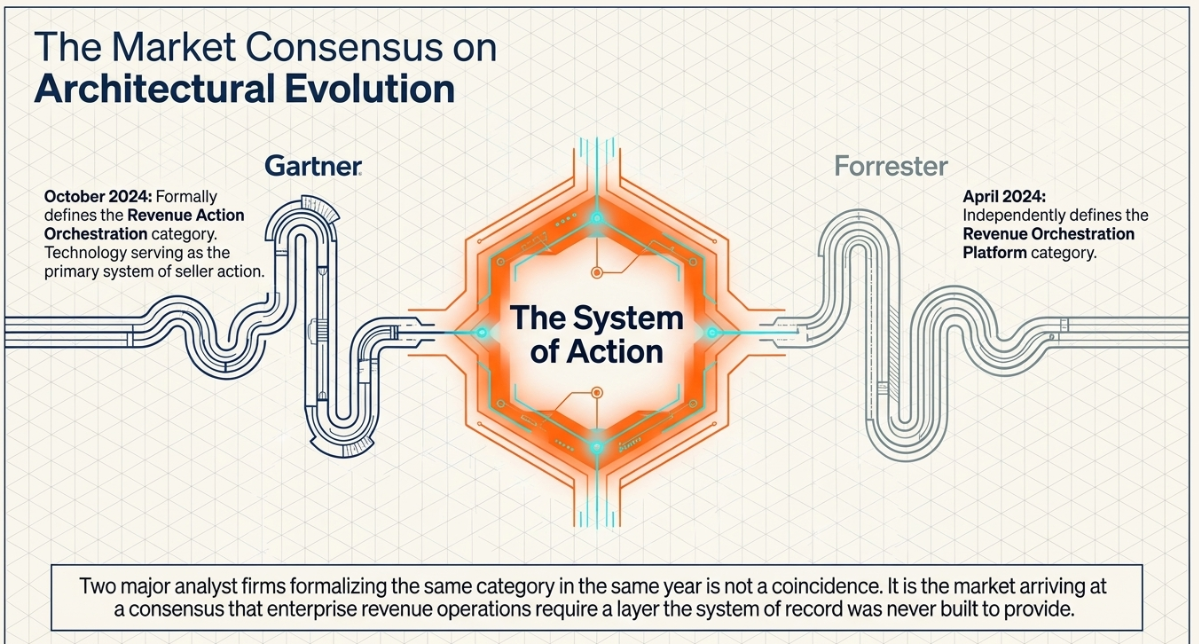
Who Does This Distinction Affect Most
This comparison matters differently depending on where a reader sits in the revenue architecture maturity curve.
The VP Revenue Operations or Salesforce Admin built and maintains the system of record. It works. The pipeline is clean, the reports are accurate, and the CRM adoption rate is high. What they are fielding is the CFO's question about why the system isn't producing the revenue outcomes the investment projected. The answer is not that the system of record is broken. It is that the system of record was never scoped to include the activation layer, and that layer is what produces autonomous revenue action from the behavioral data the CRM has been collecting for years.
The CRO or Head of RevOps sees the 81%/67% contradiction in their own organization: AI deployed and active, quota attainment declining. The Silo Tax — the measurable cost of AI experiments that add rework rather than accelerate revenue, is the Segment 2 variant of this gap, where the tools are not connected. In Segment 3, the tools are connected. The data flows. Nothing acts on it autonomously.
For companies earlier in the maturity curve, those without a structured system at all, the problem that precedes the system-of-record gap is the Dark Funnel: pipeline that cannot be seen, leads that fall through before they are ever captured. That is a different problem requiring different remediation. This article addresses readers who have already solved the capture problem and are now confronting the activation gap.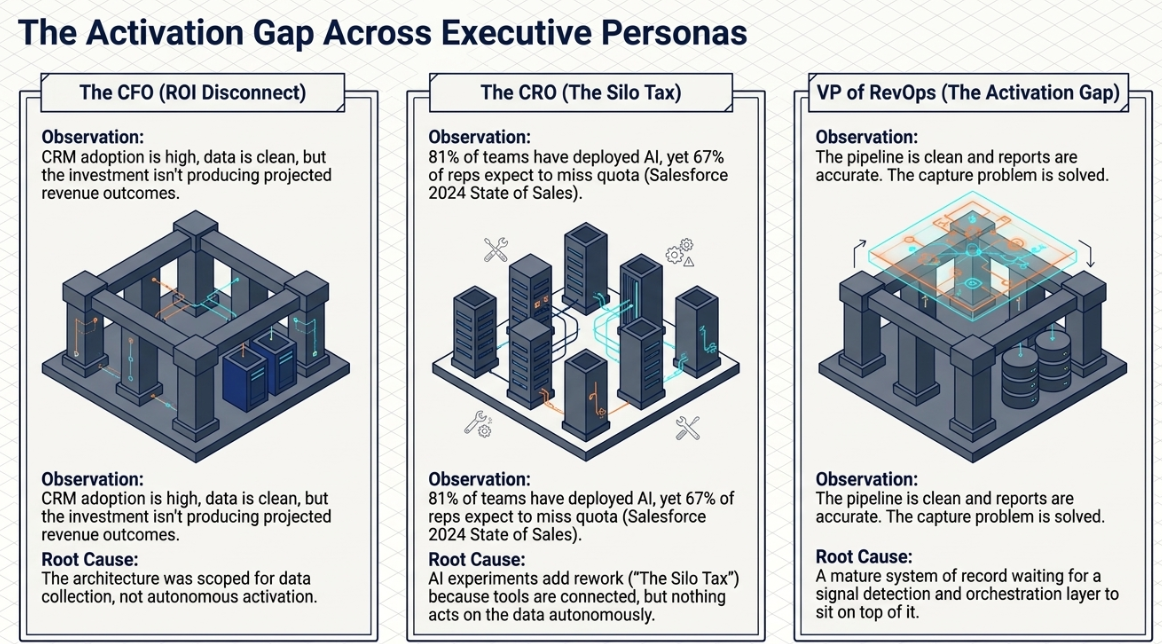
What a System of Action Does That a System of Record Cannot
The distinction is not about features. It is about the direction of information flow and the architecture of response.
Signal Detection vs Data Capture
A system of record captures data that a human enters. A system of action reads signals that buyers generate, pricing page visits, content downloads, keyword searches, and competitive comparison activity, across multiple channels, in real time, without requiring human intermediation. Gartner's June 2025 research on agentic AI projects that at least 15% of day-to-day work decisions will be made autonomously through agentic AI by 2028, up from 0% in 2024. The direction of the market is unambiguous. The structural shift from capture to detection is not a future consideration; it is the architecture decision that differentiates the top 6% of AI performers from the remainder, per McKinsey's 2025 research.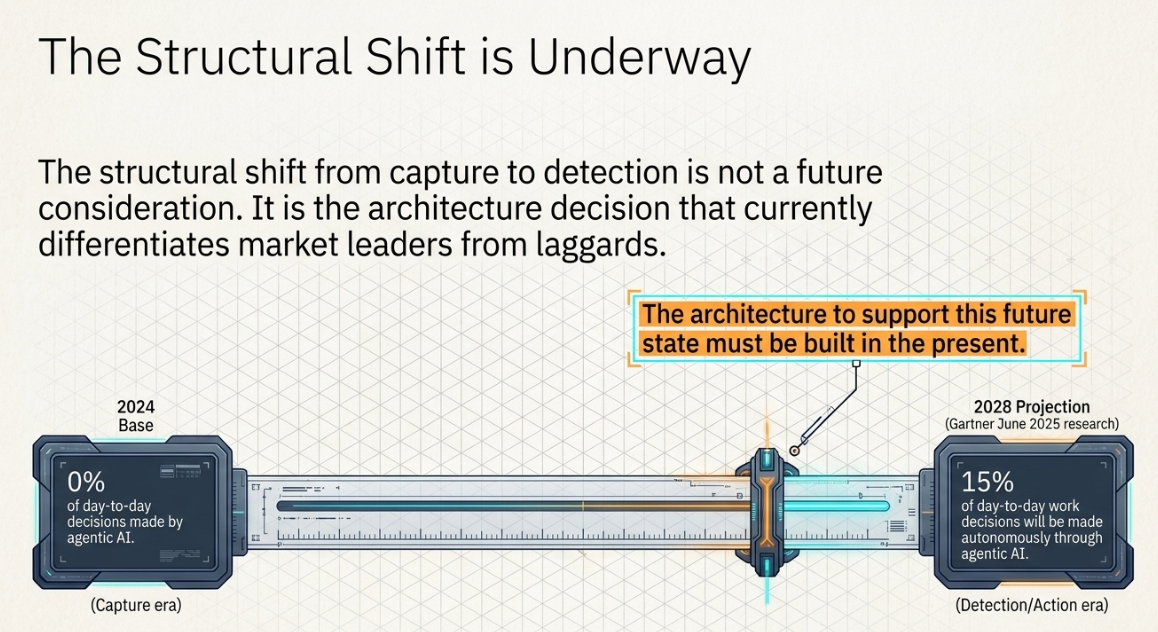
Autonomous Execution vs Human Review
A system of record surfaces information to a human, who decides whether to act and when. The latency in that model is the deal loss. A system of action connects signal detection directly to execution: a behavioral trigger fires a workflow, which deploys an agent, which executes the revenue action, outreach sequenced, meeting booked, internal alert surfaced, without a pipeline review in between. Gartner's November 2025 research found that fewer than 40% of sellers will report that AI agents improved their productivity, the reason being that most organizations deploy AI agents into a system of record architecture, where the agent makes recommendations but cannot act on them without human approval. The agent advises. The human delays. The competitor acts.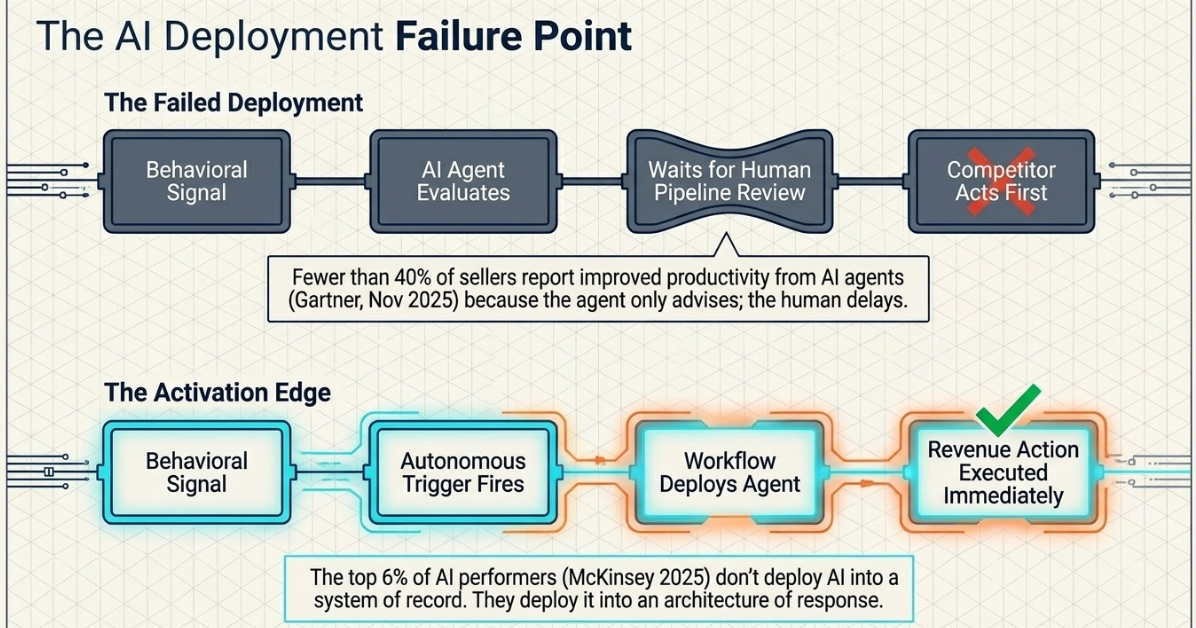
Outcome Measurement vs Activity Reporting
A system of record measures activity: calls made, emails sent, meetings held, and deals at a stage. These metrics describe what the sales organization did. They do not describe what the revenue architecture produced. A system of action measures Cost per Outcome, the fully loaded cost of each closed revenue unit attributed to a specific signal-triggered workflow. This is the metric that makes the board conversation about AI ROI answerable with a number rather than a narrative. The canonical architecture for this framework is detailed in the AI Revenue Engine category explainer; the summary: CPO replaces activity-based ROI measurement with outcome-based attribution, connecting every revenue action to the signal event that triggered it.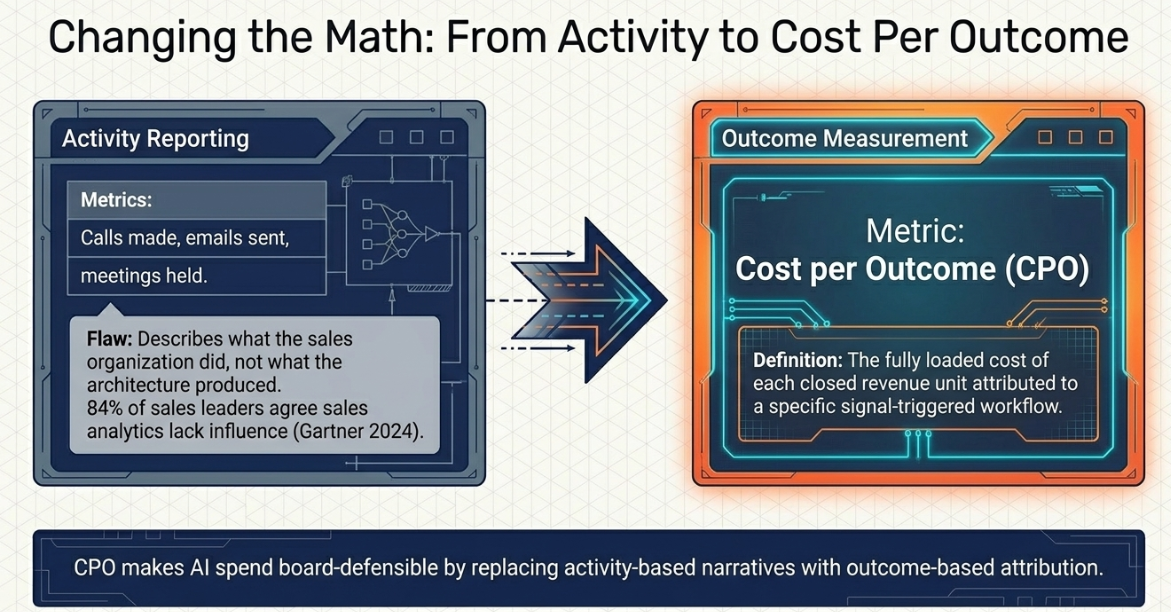
System of Record vs System of Action — The Comparison Table
|
Dimension |
System of Record |
System of Action |
|
What triggers action |
A human reviews the CRM and decides to act |
A behavioral signal, pricing page visit, intent trigger, contract proximity, detected autonomously |
|
Who executes |
The rep who remembered to check |
An AI agent operating continuously, without waiting for a pipeline review |
|
How it handles buyer signals |
Captures what was entered by a human |
Reads across 10+ buyer channels (McKinsey B2B Pulse, 2024), normalizes into a unified signal model |
|
How ROI is measured |
Activity metrics: calls made, emails sent, stage updates |
Cost per Outcome, revenue attributed to specific autonomous signal-triggered workflows |
|
What it produces for the board |
Pipeline report, forecast confidence interval |
Revenue Intelligence, real-time attribution of outcomes to specific signal events |
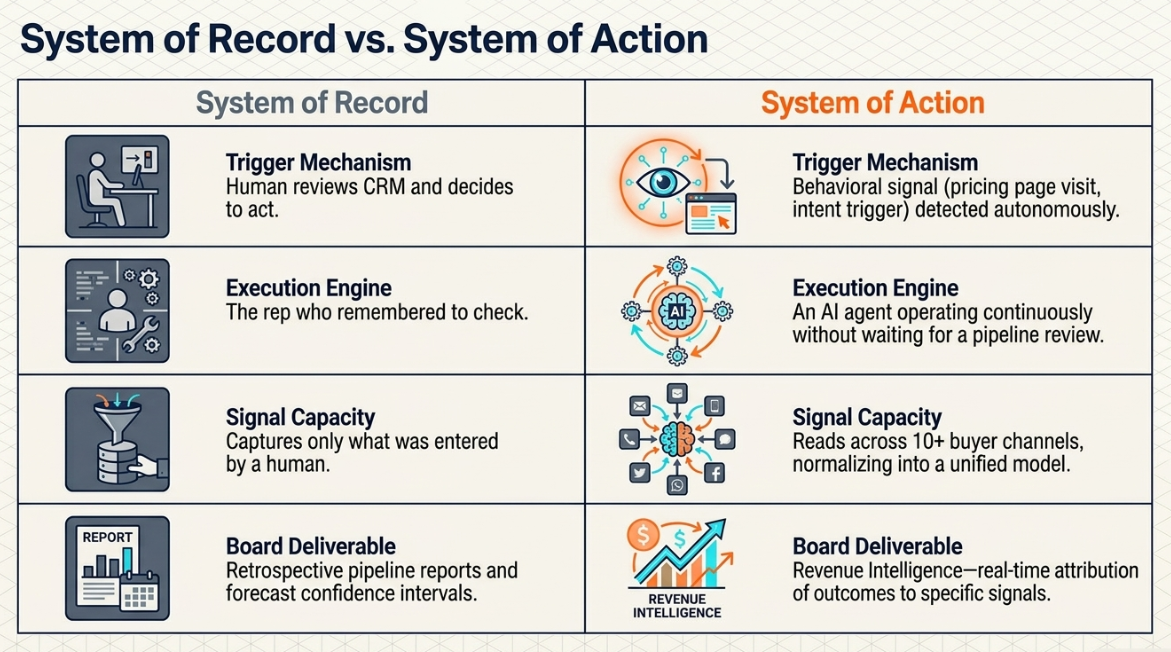
What triggers action: The system of record requires a human to notice a signal and act on it. The system of action detects the signal and acts without human intermediation. In a 10.2-channel buying environment, the human-review model creates the latency that loses deals.
Who executes: The Salesforce 2024 State of Sales data captures the contradiction precisely: 81% of sales teams have implemented or are experimenting with AI, while 67% of reps do not expect to meet their quota. AI deployed into a system of record produces AI that waits for a human to act. Gartner's November 2025 research confirms: fewer than 40% of sellers report improved productivity from AI agents deployed into systems that do not redesign the activation architecture.
How ROI is measured: Gartner's 2024 survey of sales leaders found 84% agreed that sales analytics has had less influence on sales performance than leadership expected. Analytics that describe activity cannot prove the architecture is producing outcomes. CPO measurement, possible only in a system of action, replaces the description with attribution.
What it produces for the board: Revenue Intelligence is forward-sensing, not retrospective. The board can see which accounts are in a Moment of Readiness right now, not which accounts were active last quarter.
The CETDIGIT Perspective — Cognitive Core, Activation Edge, and the Layer Between
The Cognitive Core / Activation Edge architecture, introduced in the AI Revenue Engine category explainer, is the CETDIGIT translation of the system-of-record vs system-of-action distinction into platform terms.
The Cognitive Core is the intelligence layer: deep account logic, multi-stakeholder relationship mapping, complex deal memory, and long-cycle pipeline management. It is built for depth. It is the system of record, correctly positioned as the architectural foundation that should not be replaced.
The Activation Edge is the execution layer: autonomous prospecting, real-time outreach, behavioral signal response, and continuous account monitoring. It is built for speed. It is the component that the system of record cannot provide because speed and depth require different architectural priorities.
CETDIGIT operates the orchestration layer between them, the system that makes the Cognitive Core and Activation Edge function as a unified system of action rather than two separate data repositories. The Revenue Graph, the architectural model that maps how buying decisions actually occur across signals and channels rather than in a linear funnel, is what this orchestration layer navigates. Every signal detected by the Activation Edge is routed through the Revenue Graph to the Cognitive Core, triggering the appropriate revenue action without human review in between.
Revenue Intelligence is what proves the architecture is working: real-time sensing of which accounts are showing buying behavior, attribution of revenue outcomes to specific signal events, and CPO measurement that makes AI spend board-defensible.
The AI Revenue Engine is CETDIGIT's implementation of this architecture, building the system of action on top of the Cognitive Core a company already owns. The CETRAI platform is the orchestration layer that connects signal detection to revenue execution without requiring RevOps to manage the workflow logic manually. As part of CETDIGIT's broader AI services architecture, the system of action sits within a layered solution set that begins with data foundation and scales through revenue orchestration.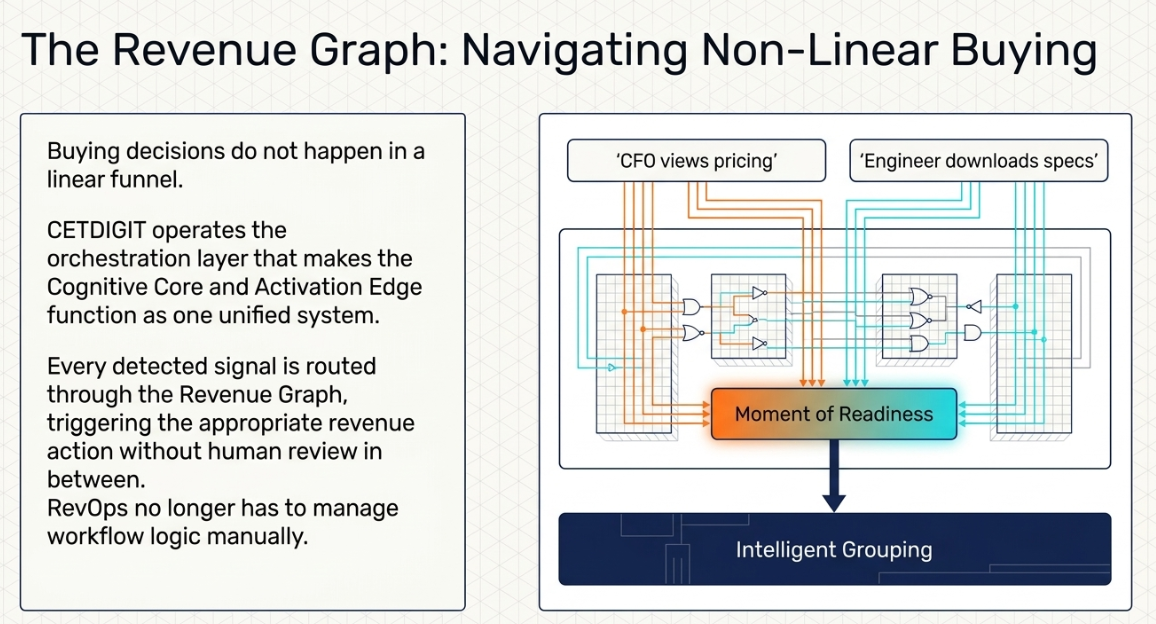
Recommended Path — How to Move from System of Record to System of Action
The entry point for the transition depends on where the current architecture breaks down.
If the primary gap is data accessibility, behavioral signals exist in the environment but are not exposed to the AI layer, the starting point is the Data and AI Foundation work that structures those signals for activation. A system of action cannot read data it cannot access.
If the primary gap is orchestration, the data is accessible, but no layer connects signal detection to revenue execution. The starting point is the CETRAI platform, which operates the signal-to-action workflow without requiring RevOps to build and maintain the logic manually.
If the full architectural transition is required, signal detection, orchestration, and Revenue Intelligence measurement are all absent or fragmented, the entry point is the AI Revenue Engine, which builds all three components on the existing system.
If the question is where to begin, if it is unclear which gap is primary, an AI strategy diagnostic establishes the specific activation gap before architecture work starts.
CETDIGIT's Revenue Graph Audit engagement is the 90-day structured framework through which every one of these routing paths begins, producing a behavioral signal inventory, a CPO baseline, and a Revenue Intelligence architecture recommendation that makes the board conversation about AI ROI answerable with specific numbers.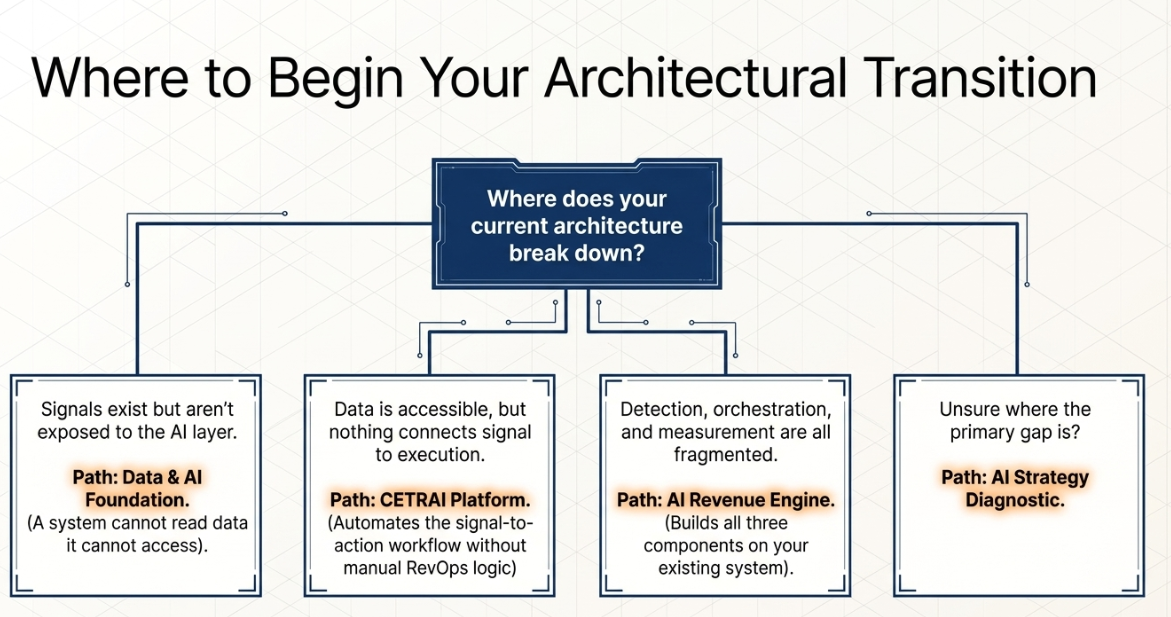
FAQ
What is the difference between the CRM system of record and system of action?
A system of record stores what happened: contacts, opportunities, and activity history entered by humans. It requires a human to review data and decide to act. A system of action detects what is happening in real time, behavioral signals across buyer channels, and triggers autonomous revenue workflows without waiting for human review. In 2024, Gartner formalized this distinction as the Revenue Action Orchestration category, and Forrester defined the parallel Revenue Orchestration Platform category. Both analyst bodies arrived at the same architectural conclusion: the CRM's record-keeping function and the activation layer required to act on signals are structurally distinct and require different architectural components.
Why is Salesforce considered a system of record and not a system of action?
Salesforce was architected as a system of record: reliable, structured capture of customer data that a revenue team enters. That was the correct problem to solve when CRM became the enterprise standard. The buying environment has since changed. McKinsey's 2024 B2B Pulse Survey measured B2B buyers using an average of 10.2 channels in their purchase journey. Salesforce captures what humans enter; it was not designed to autonomously detect behavioral signals across ten channels and trigger action without a rep logging in first. This is an architectural scope constraint, not a platform failure. The activation layer sits on top of Salesforce as an orchestration component, not in place of it.
What does a CRM need to do to drive revenue autonomously?
Three capabilities constitute the architectural minimum: signal detection (reading behavioral data across buyer channels in real time, not waiting for human entry), autonomous execution (triggering revenue workflows from signal events without requiring human review at each step), and outcome attribution (measuring CPO, the specific revenue outcome produced by each signal-triggered action). Most CRM implementations have the data infrastructure to support all three. What they lack is the orchestration layer that connects signal detection to execution and the Revenue Intelligence layer that attributes outcomes. Gartner projects 15% of day-to-day work decisions will be made autonomously through agentic AI by 2028; the architecture to support that requires the system-of-action layer now.
How do I turn my existing CRM into a system of action?
The transition does not require replacing the CRM. The Cognitive Core, the depth, account logic, and relationship memory in the existing Salesforce environment, is the correct architectural foundation. The system of action is built on top of it through three additions: a unified signal model that exposes behavioral data to the AI layer, an orchestration platform that routes signal events to autonomous execution workflows, and a Revenue Intelligence layer that measures outcomes in real time. CETDIGIT's Revenue Graph Audit engagement is the structured framework for assessing which of these three layers is missing and in what sequence to build them.
What is the difference between Revenue Intelligence and a CRM dashboard?
A CRM dashboard reports what happened: pipeline by stage, forecast by rep, activity by period. It is retrospective and human-triggered; someone opens the dashboard and reads it. Revenue Intelligence is forward-sensing and autonomous; it detects which accounts are in a Moment of Readiness right now, identifies which deals are at risk before the forecast call, and surfaces attribution data connecting specific buyer signals to specific revenue outcomes. The dashboard is accurate but passive. Revenue Intelligence is the active sensing layer that makes the system of action possible.
What is Cost per Outcome, and how is it different from traditional CRM metrics?
Traditional CRM metrics measure activity: calls made, emails sent, meetings booked, and deals at a stage. These metrics describe what the sales organization did. Cost per Outcome (CPO) measures what the revenue architecture produced: the fully loaded cost of each closed revenue unit attributed to a specific signal-triggered workflow. CPO makes AI spend board-defensible because it connects every revenue action to its originating signal event. When the system of action is operating, and Revenue Intelligence is attributing outcomes, CPO replaces the activity narrative with a verifiable number. This is the metric that ends vague AI ROI reporting and produces the answer the board actually needs.
Did Gartner or Forrester recognize the system-of-action category in 2024 or 2025?
Yes. Gartner formally defined the Revenue Action Orchestration (RAO) category in October 2024, describing it as technology that serves as "the primary system of seller action and a single source of truth for sales interactions." The inaugural Gartner Magic Quadrant for Revenue Action Orchestration was published in December 2025. Forrester independently defined the Revenue Orchestration Platform (ROP) category in April 2024, recognizing the convergence of sales engagement, conversation intelligence, and revenue operations intelligence into a single platform category. Both analyst definitions formalized in the same calendar year constitute the clearest available signal that the system-of-action architectural distinction is no longer a vendor positioning claim; it is a recognized structural category in enterprise technology.
Revenue Graph Audit
Book a 90-day Revenue Graph Audit. We will show you exactly where the ROI is hiding in your current stack, the behavioral signals your Cognitive Core is collecting that no activation layer is reading, the CPO your architecture is capable of once Revenue Intelligence is running, and the specific transition path from system of record to system of action that fits your current data environment.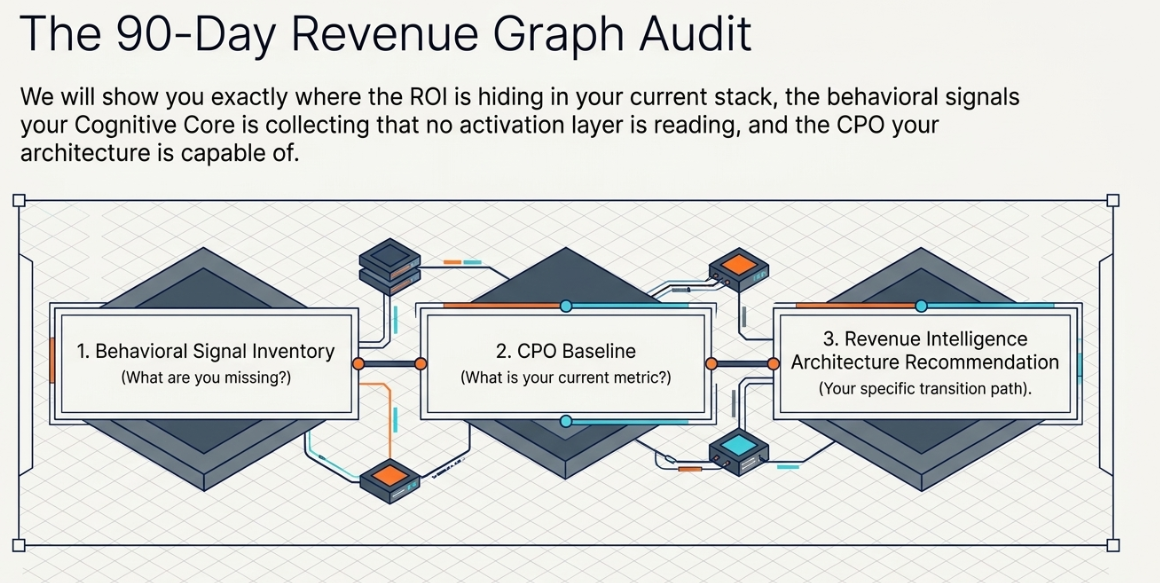



Leave a Comment