


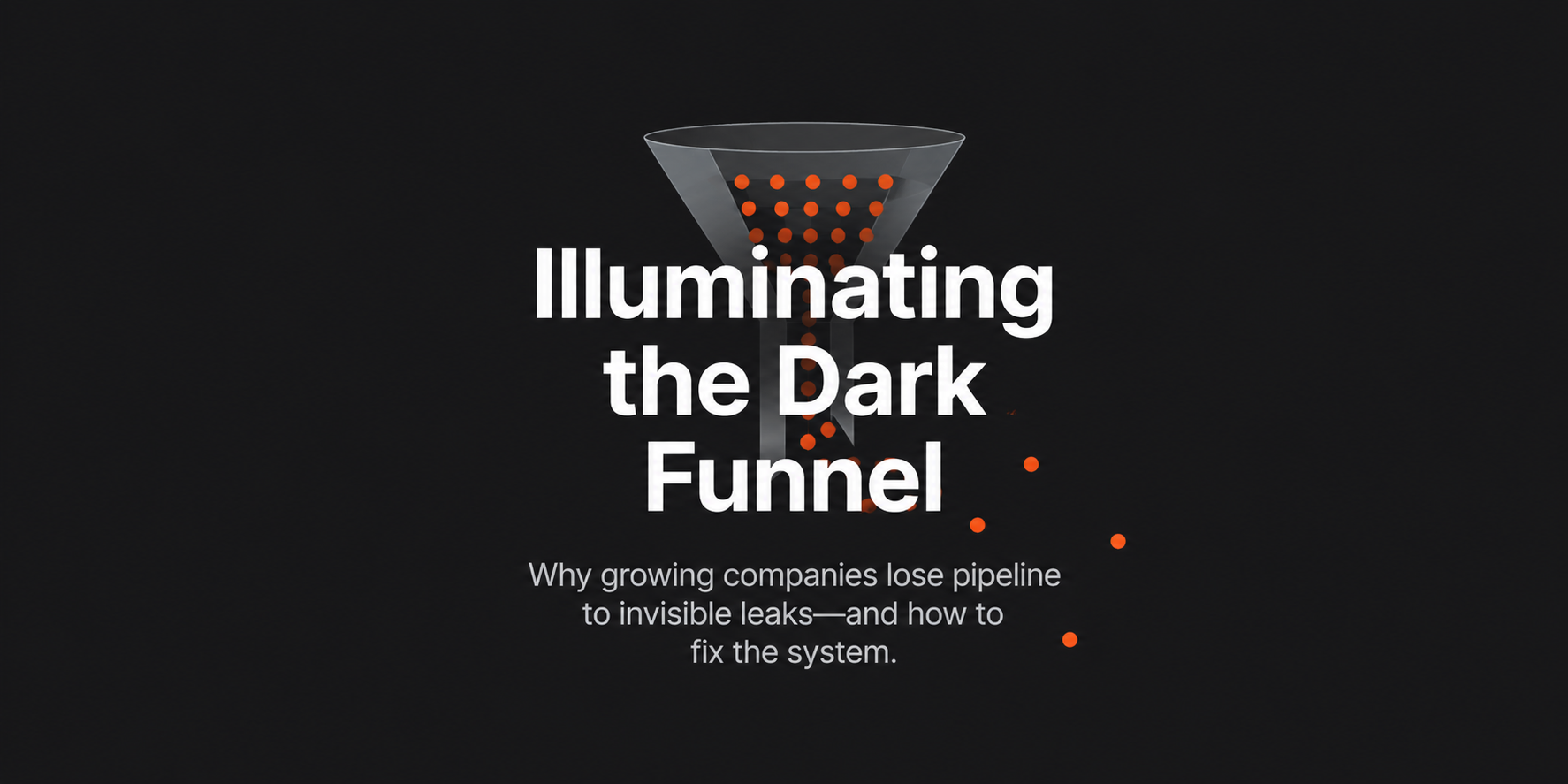
Growing companies lose pipeline for three reasons: leads arrive without a system to catch them, follow-up depends on people who are already stretched thin, and everything that should be tracked lives in someone's inbox or memory instead of a connected system. According to Harvard Business Review research on 2,241 US companies, firms responding within one hour are nearly seven times more likely to qualify a lead, yet the average US company takes 42 hours to respond. The gap between what's happening in your pipeline and what you can actually see is called the Dark Funnel. Most founder-led companies are losing more revenue to it than they realize.
It Happens While You're Running the Business
It's Tuesday morning. You're going through email before the day starts, and you see it: an inquiry that came in last Thursday.
Three days ago.
It's a warm one, a referral from a current customer, asking about pricing and availability for a project that would run about $18,000. You don't remember seeing it come in. You check the shared sales inbox: nobody answered it. You type a reply and hit send.
It bounces back as undeliverable.
Turns out the prospect booked with another provider on Friday. They found someone who responded within a few hours. You never knew you were competing for the deal. From your side, it just looked like a lead that didn't convert.
The part that stays with you isn't the $18,000. It's the question you can't shake: How many others went the same way last quarter that I also don't know about?
The answer, for most founder-led companies, is more than you'd expect. Not because the team isn't working. Because the system that was supposed to catch those leads was never built.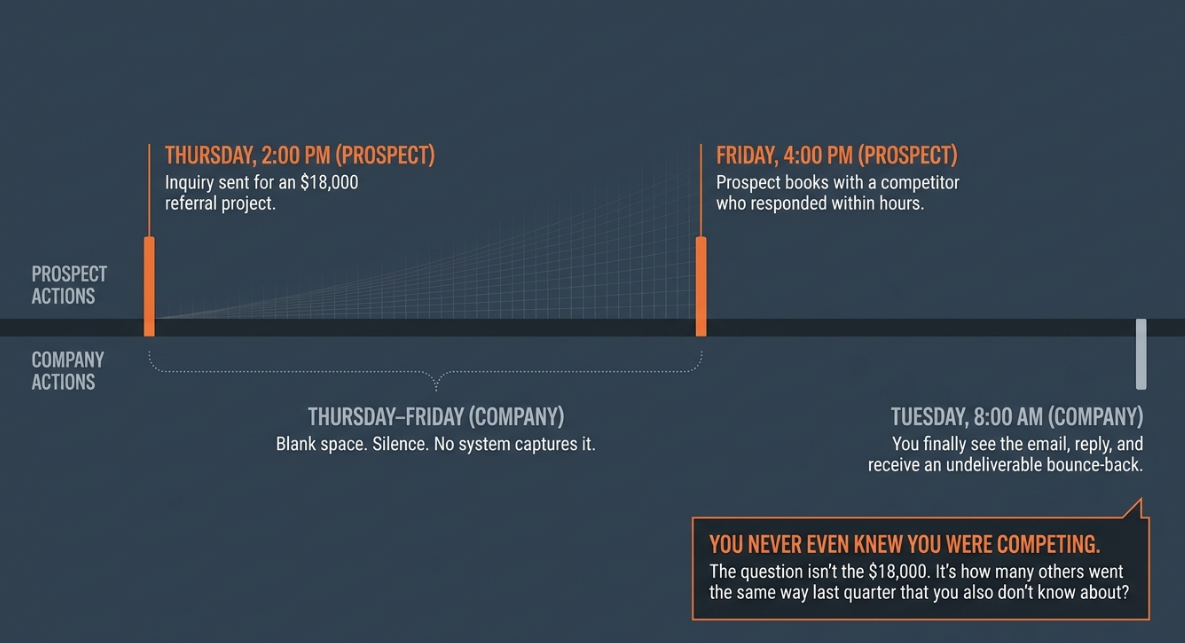
What the Data Says About How Companies Lose Pipeline
This doesn't happen because your salespeople are careless. It happens because most growing companies run revenue on infrastructure built for a business half their size.
The Dark Funnel is the gap between what's happening in your pipeline and what you can actually see happening in it. Revenue that moves through inboxes, Slack threads, and individual memory, instead of a connected system, disappears into that gap. By the time you notice it's gone, the deal is already closed. Just not by you.
The Saturday Inquiry You Never Saw
The most expensive version of this problem happens at the edges of the business week. When a prospect reaches out on a Thursday afternoon or a Saturday evening, the response-time clock starts immediately, whether or not anyone is watching.
Harvard Business Review's lead response time research studied 2,241 US companies and found that firms responding within one hour were nearly seven times more likely to qualify a lead than those that waited even a little longer, and more than 60 times as likely as companies that waited 24 hours or more. The average response time in that study was 42 hours. Separately, research from Peak Sales Recruiting puts 35–50% of all sales going to whichever vendor responds first.
The inquiry that sat in your inbox from Thursday to Tuesday? Someone else got there on Friday.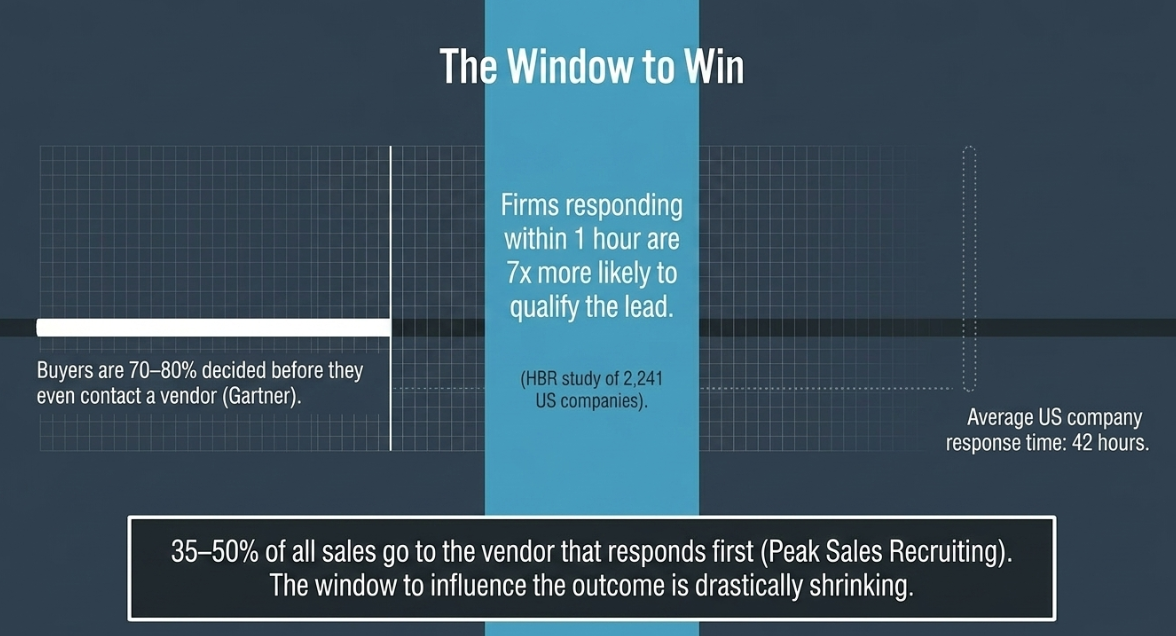
The Follow-Up That Never Happened
Response time is only half the problem. The other half is what happens, or doesn't, after the first contact.
Invesp's follow-up abandonment research finds that 48% of sales teams never make a single follow-up attempt after initial contact. At the same time, 80% of successful sales require five or more follow-up contacts before a deal closes. Nearly half of all leads receive zero follow-up from the company that first got the inquiry, while the data simultaneously shows that most deals require sustained follow-through to close.
That gap doesn't exist because salespeople give up on purpose. It exists because follow-up, in most growing companies, runs entirely on memory. When that memory gets overloaded by a busy week, a team vacation, or two new hires figuring out the job, the follow-up stops. Silently. Without anyone noticing.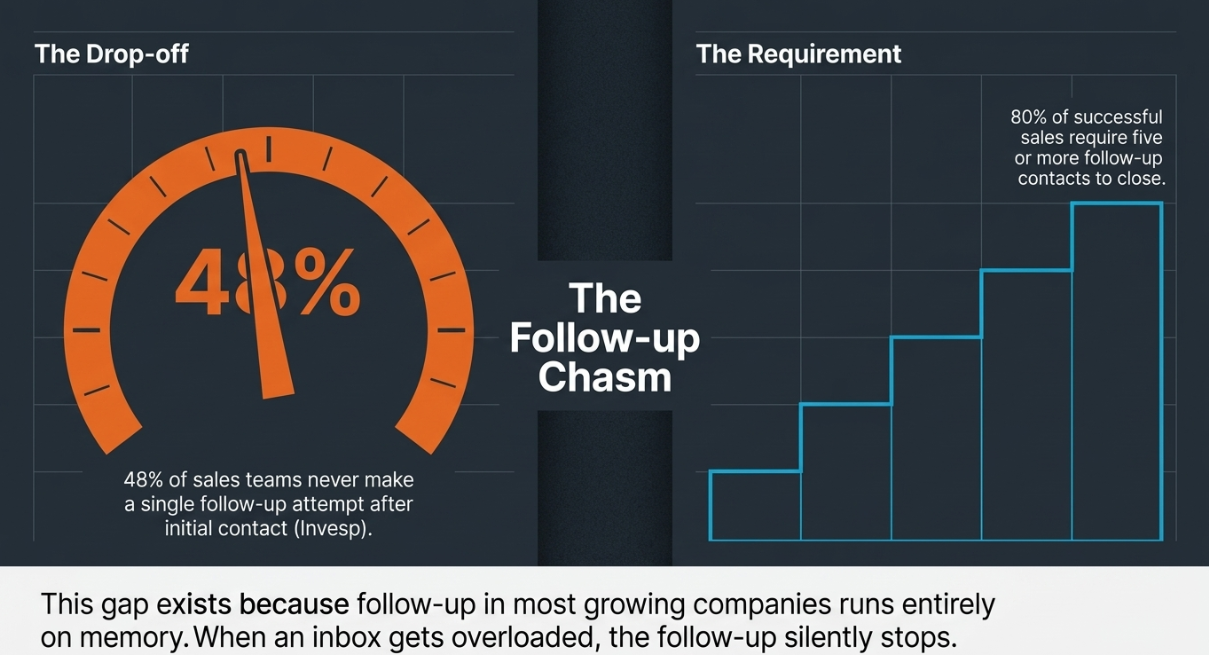
Who This Affects
If your company is somewhere between $5M and $50M in revenue and revenue has been growing faster than your systems, this problem is probably already live in your business.
The companies most exposed to this pattern share a few things in common. The founder is still directly involved in sales, either closing deals personally or managing the team that does. The CRM, if it exists, was set up by someone who left the company eighteen months ago and hasn't been meaningfully updated since. The pipeline "number" comes from whatever the reps reported in Monday's meeting, not from a system anyone can actually query. And new salespeople were hired in the last twelve months who are ramping more slowly than expected, though nobody can pinpoint exactly why.
A 2025 US sales process study by The Sales Collective found that 55% of companies report having lost revenue directly attributable to not having a defined sales process. That's not an edge case. It's the majority experience at this stage of growth.
The founder in this situation isn't failing. They grew the business to this point on instinct, relationships, and hustle. The problem is that the same operating model that worked at $5M starts producing invisible leaks at $20M. The leads are still coming in. The follow-up just isn't reliably happening anymore.
This Is Not a Motivation Problem
Here's the thing most founders get wrong when they first diagnose a pipeline problem: they assume it's about people.
It's not.
The system was never built. A company doing $30M in revenue often runs its sales function on the same tools it used at $5M: a shared Gmail inbox, a spreadsheet, a Slack channel, and an occasional Monday morning meeting. Those tools weren't designed to catch leads, track follow-up, or surface which deals are going quiet. They were designed for small-team communication. The team grew. The infrastructure didn't.
Tools that require more work than they return get abandoned. This is what Quiet Resistance looks like in practice: a salesperson who was asked to log every call and update every field in a CRM that doesn't help them do their job. No alerts. No pipeline view that means anything. No signal when a deal goes cold. Just more manual entry at the end of a long day. So, they stop logging. Not because they're resistant to technology. Because the tool costs them time and returns nothing useful. According to HubSpot's 2024 State of Marketing Report, 40% of sales professionals still use spreadsheets and email as their primary method of storing customer data, and sales reps in the same research lose an average of one hour per day to manual data entry. That's five hours of selling time per week, per rep, not recovered until the system changes.
Visibility depends on people who are already maxed out. When there's no connected system, "pipeline review" becomes "what did everyone remember to tell me this week?" The number you'd report to a board or an investor reflects whoever spoke up in the last standup, not what's actually moving. Three deals went quiet in the last six weeks. Nobody flagged them because nobody knew they were quiet. You'll find out when a competitor's name shows up in a LinkedIn notification.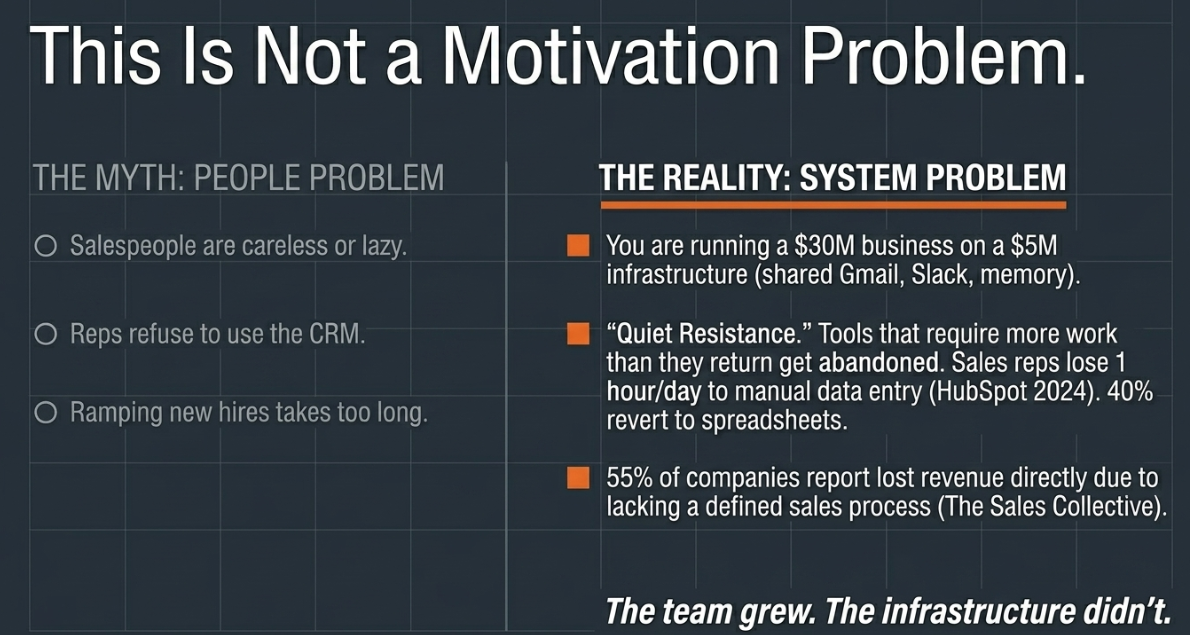
What This Looks Like in Practice — A Four-Row Diagnosis
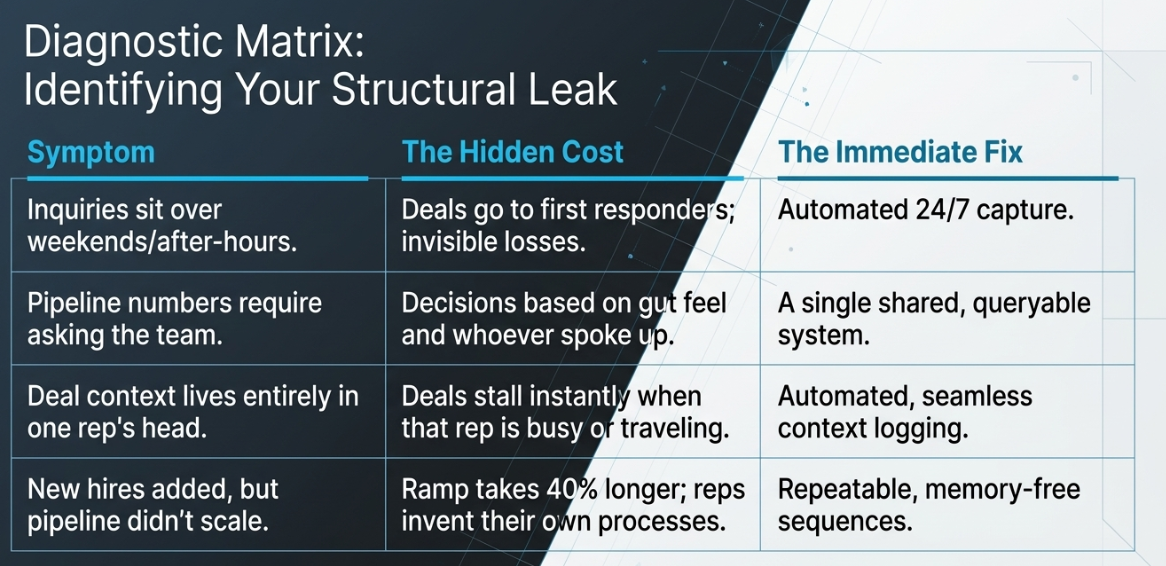
Before looking at solutions, it helps to name what's actually happening. If more than one of these rows describes your company right now, the pipeline leak is structural.
|
If this is happening in your company |
This is what it's costing you |
What to fix first |
|
Inquiries come in over weekends or after hours and sit until someone checks the inbox |
Deals going to whoever responded first, you lose without knowing you competed |
An automated first-response that captures the lead and holds the conversation until a human can follow up |
|
You can't give a reliable pipeline number without asking your team first |
Decisions made on gut feel; board conversations based on whoever spoke up in Monday's meeting |
A single shared system where every deal lives, visible to more than one person at any time |
|
Deal context, objections, pricing history, last conversation, lives in one person's head |
When that person is busy, traveling, or gone, deals stall without explanation |
A system that logs deal context automatically, not manually |
|
You hired salespeople, and the pipeline didn't grow proportionally |
Ramp takes 40% longer with no defined process (Aberdeen Group); new reps invent their own approach and miss deals in the gaps |
A repeatable follow-up sequence that doesn't depend on each rep figuring it out from scratch |
The Dark Funnel — The Revenue Your System Can't Show You
The Dark Funnel isn't a metaphor for deals you know you lost. It's the revenue you have no visibility into at all, the gap between "that lead was interested" and "they signed with someone else," with nothing in between that you could see or act on.
Think about what your sales motion looks like from a prospect's side. They find your company through a referral or a search. They visit your website, maybe two or three times over a few days. They read about what you do. They compare you to one or two alternatives. They reach out, or they don't. If they reach out and you respond quickly and follow up consistently, you have a shot. If they reach out and spend three days waiting for an answer, they've usually already moved on by the time you reply.
What makes this harder is that buyers today don't wait. Recent Gartner research on B2B buyer behavior found that buyers complete 70–80% of their purchase journey before they ever contact a vendor. The inquiry that lands in your inbox is often the tail end of a decision that's nearly made. Your response time and follow-up quality matter more in that moment than at any other point in the process, because the window where you can actually change the outcome is short.
The Dark Funnel is what fills the space between "they were interested" and "they went somewhere else." It is not a technology gap. It is a visibility gap. Every lead that arrives without a system to catch it, every follow-up that doesn't happen because it depended on memory, every deal that went quiet without anyone noticing, that's the Dark Funnel operating in your business.
Most founder-led companies have Darker Funnel than they think. The question isn't whether it exists. It's how much it's costing, and whether you're ready to see it.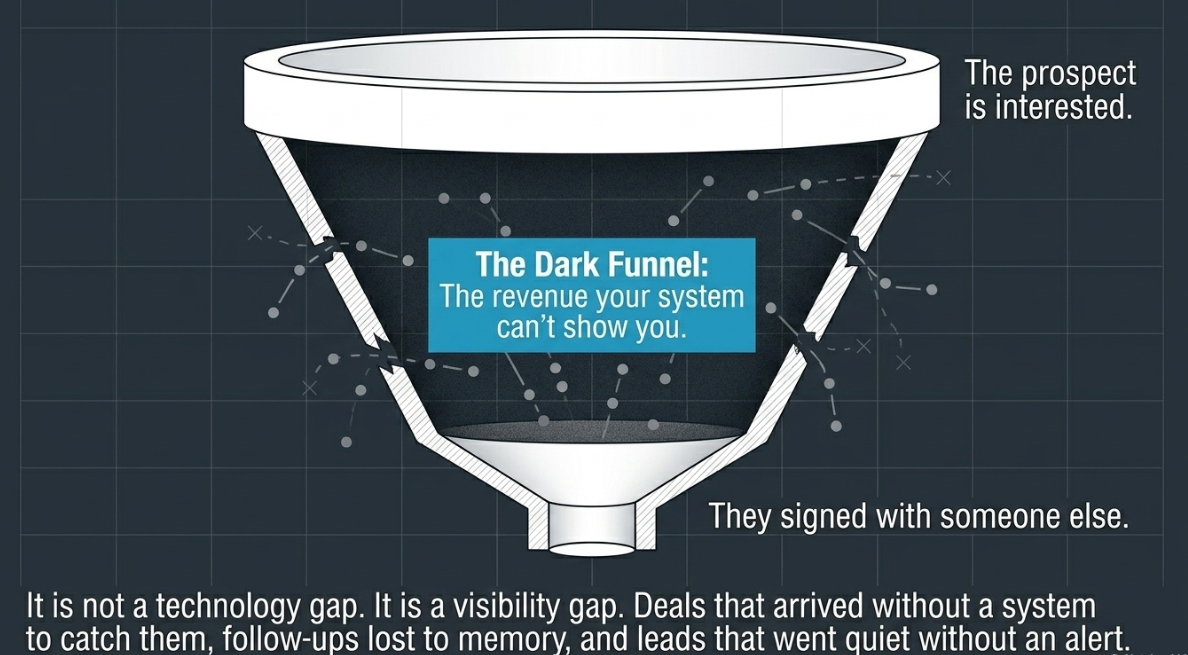
What to Do First
You don't need a 90-day implementation to start closing the Dark Funnel. The structural change that matters most at this stage is practical: put a system in place that catches lead, triggers follow-up automatically, and makes every deal visible to more than one person without requiring anyone to maintain a spreadsheet or remember to update a CRM.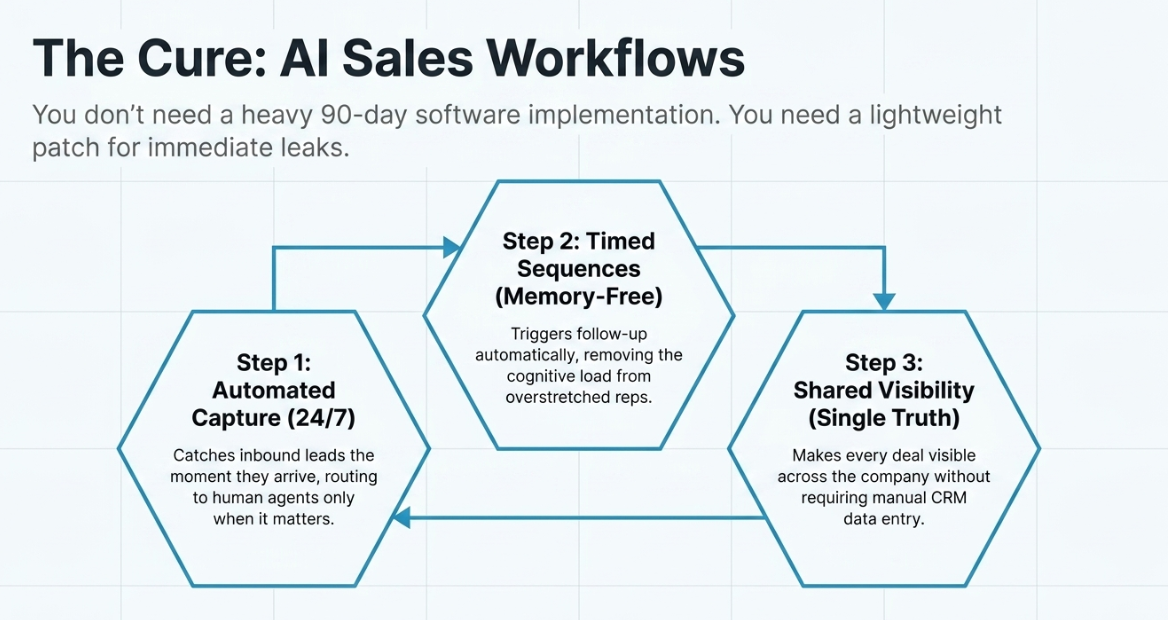
For most companies at this stage, that means starting with how AI sales workflows close the follow-up gap, specifically, the combination of automated lead capture, timed follow-up sequences, and a pipeline view that exists outside of anyone's memory.
If your primary leak is inbound calls and after-hours inquiries that go to voicemail and never get followed up, AI voice agents that answer every inbound inquiry often produce the fastest result, capturing the lead at the moment they reach out, qualifying basic fit, and routing to a human when it matters.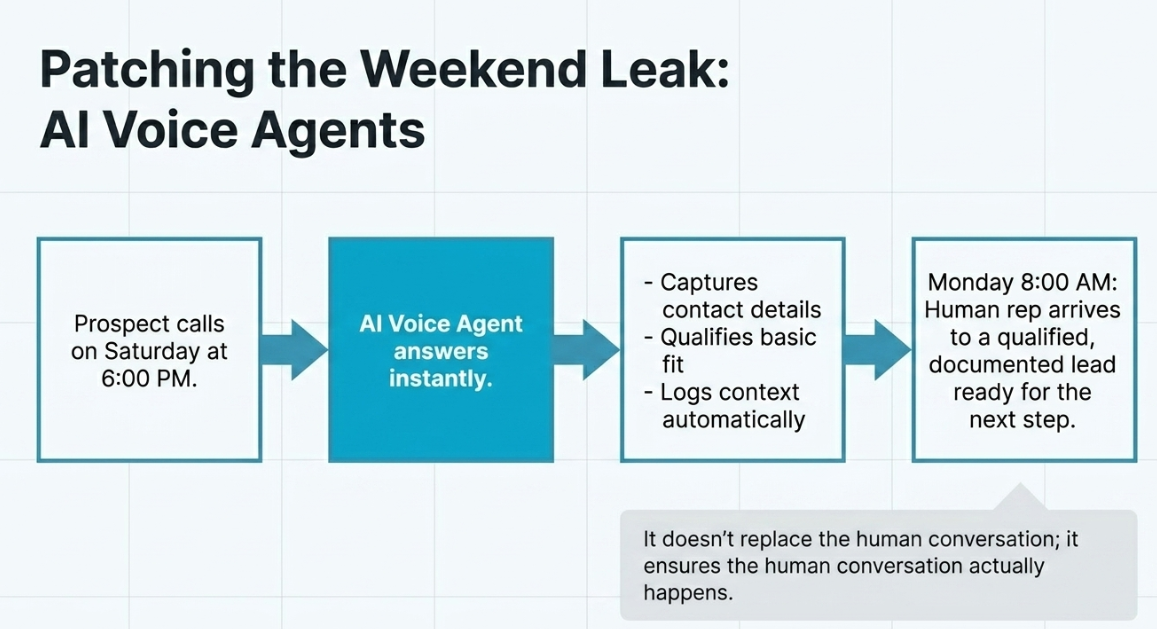
Not sure which problem is the biggest in your business right now? See how CETDIGIT engages before you book anything. And if you want to understand what a fix actually looks like before committing to a conversation, the case studies are worth reading first.
One thing that helps: be honest about which row in the diagnosis table above felt most familiar. That's usually where to start.
Frequently Asked Questions
Why do companies lose leads even when their sales team is working hard?
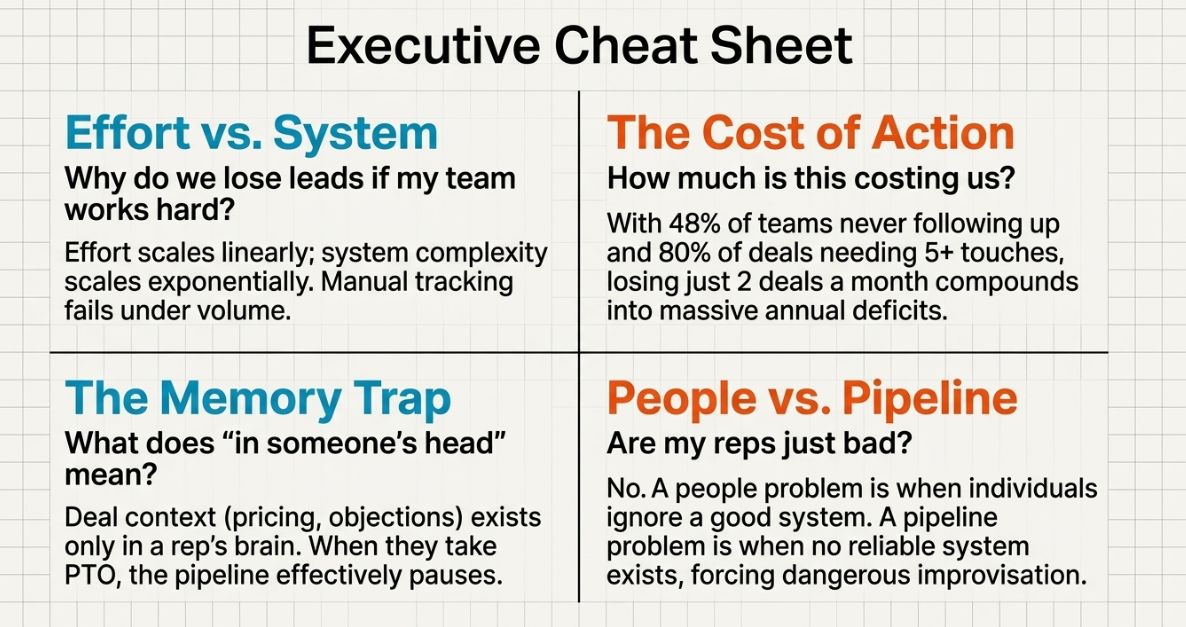
Most lead leakage isn't caused by lack of effort; it's caused by lack of system. When follow-up runs on memory and shared inboxes, it works when the team is small and fully present. As the company grows, the cognitive load of manually tracking every lead exceeds what any person can reliably handle. Leads that arrived on a Friday, during a busy stretch, or while someone was traveling fall out of the process without anyone choosing to ignore them, because there was no system keeping them visible.
How much pipeline does the average founder-led company lose to slow follow-up?
There isn't a single source figure specifically covering the $5M–$50M revenue band, but the directional evidence is significant. Harvard Business Review's research shows companies responding within one hour are nearly seven times more likely to qualify a lead. Separately, 48% of sales teams never follow up at all after initial contact, while 80% of deals require five or more touchpoints to close. If your company has 10 active inquiries per month and loses two of them to slow response or abandoned follow-up, the annual cost compounds quickly.
What does it mean that everything is "in someone's head" in sales?
It means the knowledge needed to move a deal forward, what the prospect asked in the last conversation, what pricing was discussed, and what follow-up was promised, lives in one person's memory rather than a shared system. When that person is fully present and not overloaded, it mostly works. When they go on vacation, change jobs, or have a busy week, that knowledge disappears with them. It's one of the most common causes of pipeline stall in founder-led companies, and it looks like an execution problem until you realize it keeps happening with different people.
How do I know if our pipeline is leaking?
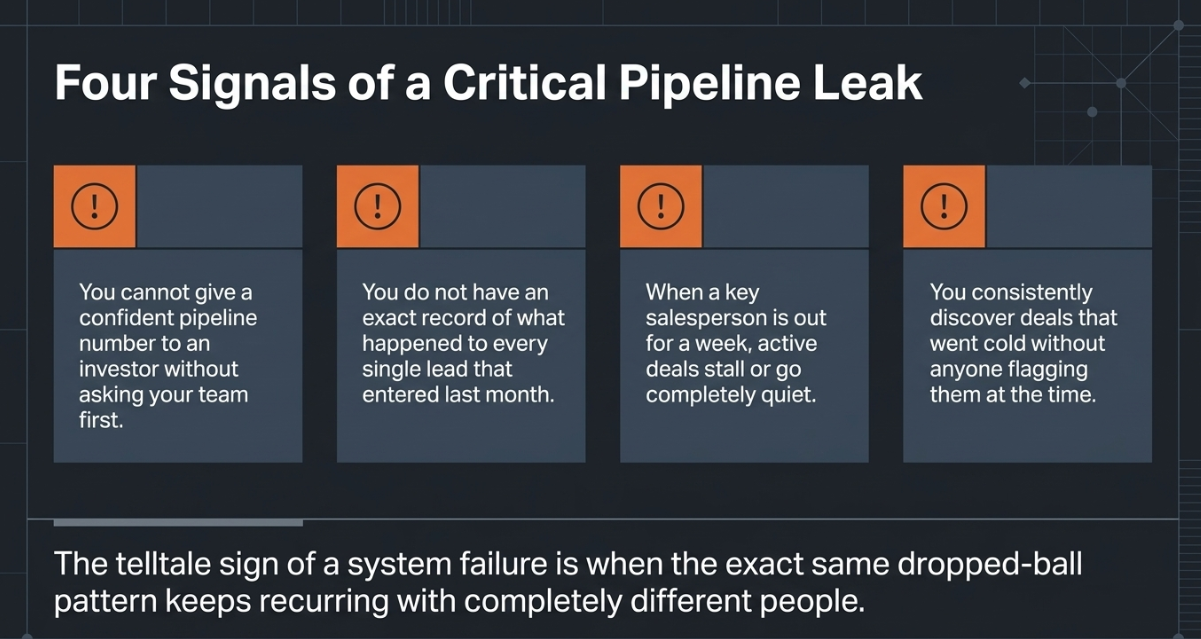
Four signals are worth checking. First: can you give a confident pipeline number right now, one you'd put in front of an investor, without having to ask your team first? Second: Do you know what happened to every lead that came in last month? Third: when a salesperson is out for a week, do deals stall or go quiet? Fourth: Have you ever discovered a deal that went cold without anyone flagging it at the time? If any of these are yes, there's a structural visibility problem, not just an execution one.
What's the difference between a pipeline problem and a people problem?
A people problem occurs when the right system exists, but individuals aren't following it. A pipeline problem occurs when no reliable system exists, so individuals improvise, and the improvisation breaks down at the edges of the business week, during high-volume periods, and as the team scales. Most founder-led companies that believe they have a people problem actually have a pipeline problem. The tell: the same dropped-ball pattern keeps recurring with different people in different roles.
How do we fix the follow-up problem without hiring more people?
The most effective fix is to remove follow-up from individual memory and put it into an automated sequence that doesn't depend on any one person's availability or initiative. An AI sales workflow sends timed follow-ups, tracks responses, flags deals that have gone quiet, and surfaces the right leads at the right moment. It doesn't replace the human conversation; it ensures the human conversation actually happens, rather than getting lost in a busy week. See how other companies have approached this before committing to a specific approach.
Revenue Leak Assessment
Book a 20-minute Revenue Leak Assessment. We'll walk through where the pipeline is going dark in your company and what to fix first.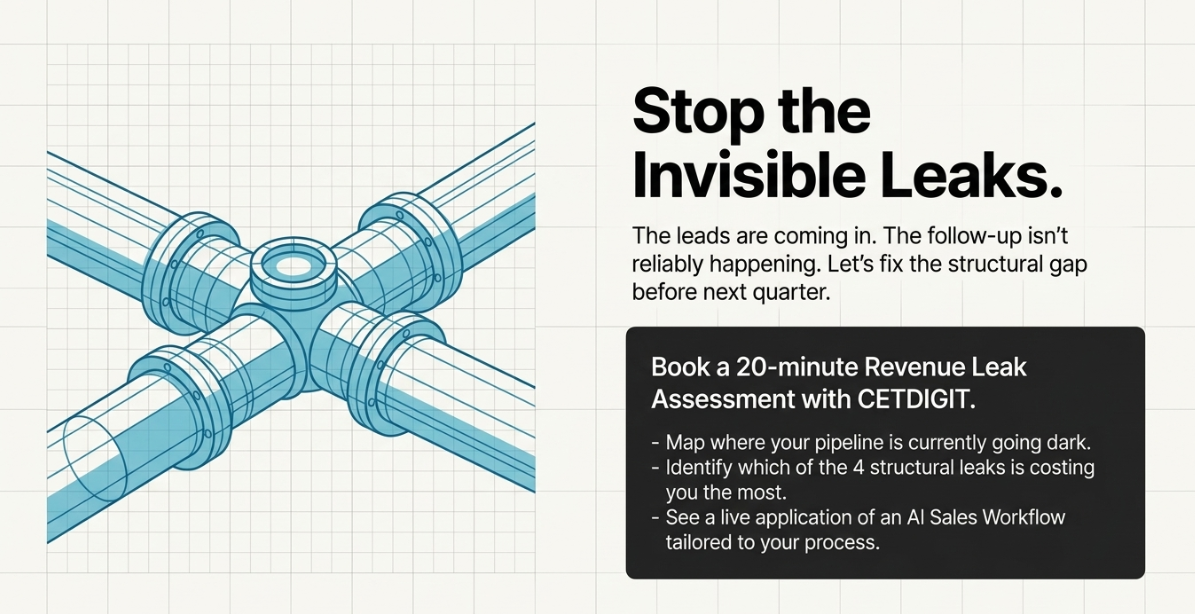



Leave a Comment