


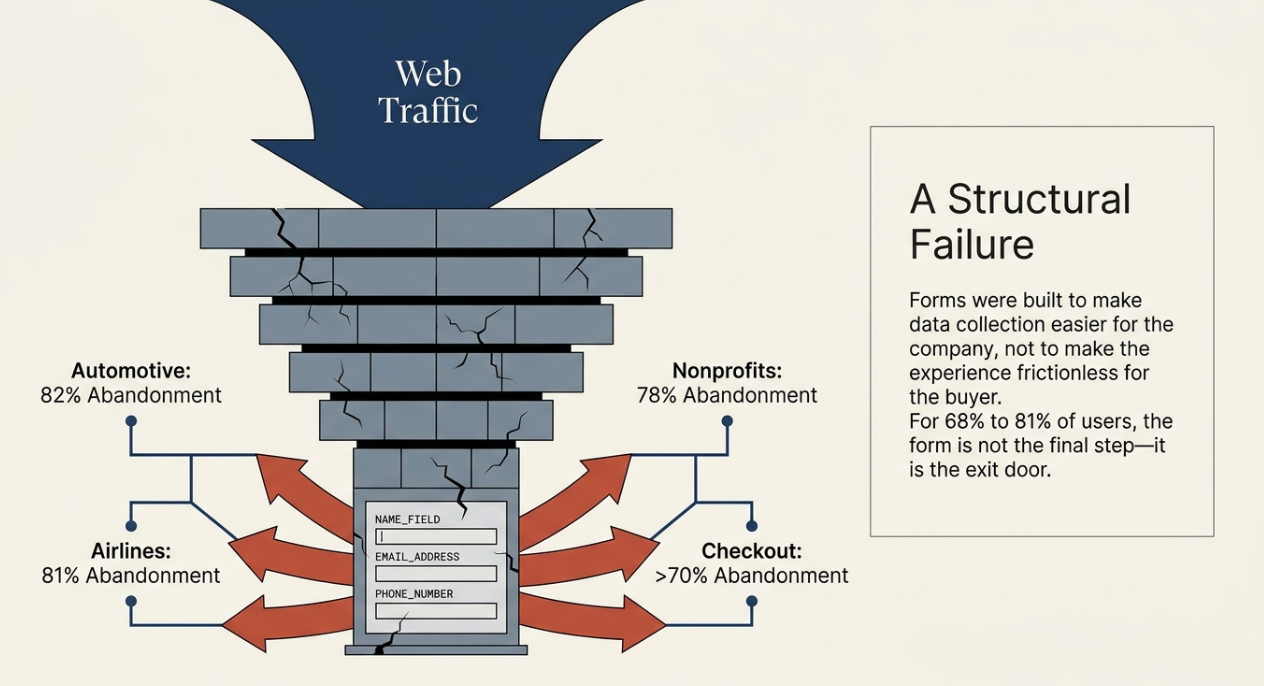
The average web form loses between 68% and 81% of the people who start filling it out. That's not a design problem or a copywriting problem. It's a structural one. Forms were built to make data collection easier for the company, not to make the experience easier for the person on the other side of the screen.
For decades, that trade-off was acceptable because there was no better alternative. There is now. Conversational AI, through chat agents, voice agents, and intelligent intake flows, is replacing forms at the highest-value moments in the lead generation process, and the performance gap is significant. The question for most revenue and marketing leaders isn't whether the shift is happening. It's whether their pipeline is set up to benefit from it.
| Dimension | Traditional Form | Conversational AI |
| Conversion Rate | Average conversion rate of 2−5% | Average conversion rate of 20−40% |
| Abandonment Rate | Average abandonment rate of 68−81% | Significantly lower abandonment rate |
| User Experience | Static fields with no feedback; high friction on mobile | Adaptive dialogue with real-time responses; natural on mobile |
| Data Collection | Limited to basic fields (name, email, dropdowns) | Captures intent, urgency, sentiment, and preferences |
| Lead Qualification | Post-submission, manual review required | Automated qualification during the conversation |
| Personalization | None; every visitor sees the same fields | Dynamic; questions adapt based on prior responses |
| Availability | Passive; collects data without active engagement | Active; engages, qualifies, and routes leads 24/7 |
| CRM Output | Flat field values requiring manual review | Enriched records with scoring and next-step triggers |
| Mobile Experience | High friction and high abandonment rates | Thumb-friendly and natural interaction |
The Structural Problems with Web Forms
The case against forms isn't primarily aesthetic. It's economic.
Abandonment is the default outcome. Across industries, most people who start a form do not finish it. Automotive: 82%. Airlines: 81%. Nonprofits: 78%. Even checkout forms, where the visitor has already decided to buy, see abandonment rates above 70%. The form isn't the last step in a conversion; for most visitors, it's the exit.
Every additional field reduces conversion. Research consistently shows that asking for a phone number reduces conversions by approximately 5%. Adding a street address costs another 4%. The optimal number of form fields for a lead-generation page is approximately 3. The average lead generation form has eleven. The gap between those two numbers represents a significant and largely invisible conversion loss.
Mobile users have even less tolerance. Mobile devices now account for more than 60% of web traffic, but mobile form abandonment runs approximately 17 percentage points higher than desktop. Forms were designed for keyboards, not touchscreens, and the friction compounds on small screens.
Forms don't adapt. A form presents the same fields to every visitor regardless of who they are, what they already know, or where they are in their evaluation process. If a visitor has a question before submitting, the form offers no answer. If they're on the fence, there's nothing to engage them. The interaction is entirely one-directional, and in a market where buyers have conditioned themselves to expect immediate, relevant responses, that passivity is a competitive liability.
What Conversational AI for Lead Generation Actually Means
Before evaluating the shift, it helps to be precise about what conversational AI in a lead generation context actually is, because the category is broader than most implementations suggest.
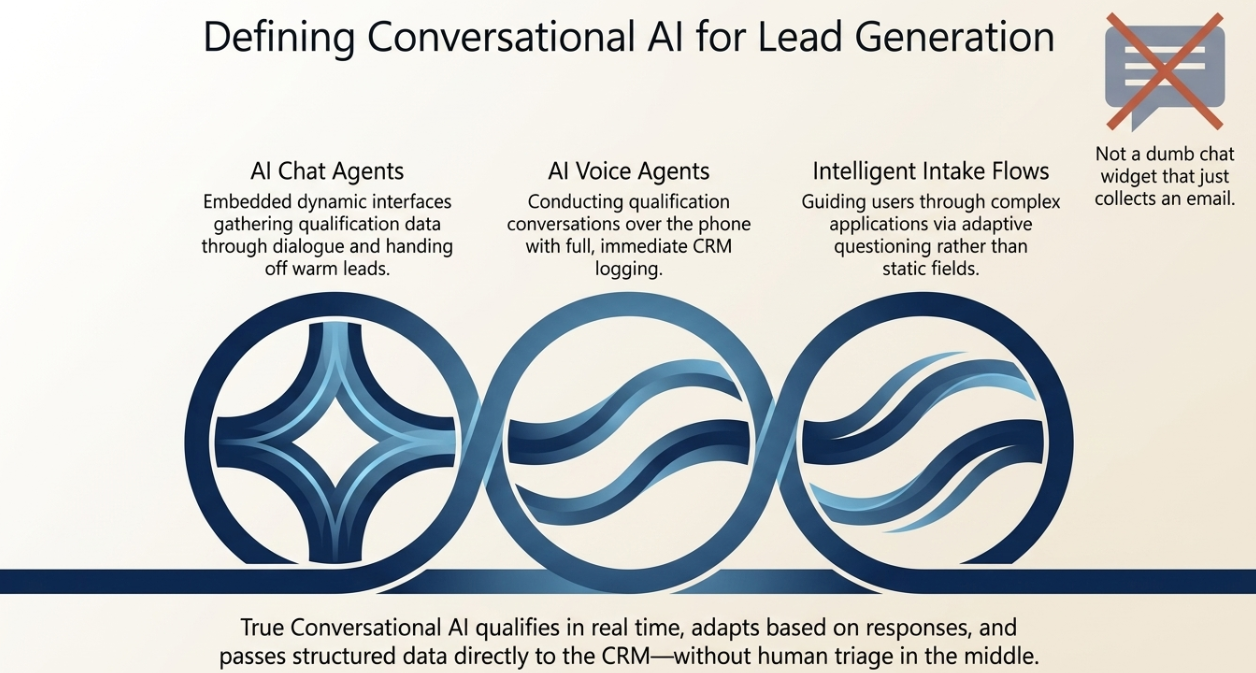
Conversational AI for lead generation refers to dynamic, dialogue-based interfaces that collect lead information, qualify prospects, and route them to appropriate next steps through natural conversation rather than structured form fields. This includes:
- AI chat agents embedded on websites that respond to visitor questions, gather qualification data through dialogue, and hand off warm leads to sales teams or CRM workflows
- AI voice agents that conduct qualification conversations over the phone, either inbound or outbound, with full CRM logging
- Intelligent intake flows that guide visitors through complex intake processes (support, onboarding, applications) using adaptive questioning rather than static fields
What this is not: a chat widget that collects an email address before connecting to a human. The distinction matters. True conversational AI for lead generation qualifies in real time, adapts its questions based on responses, and passes structured, enriched data into the CRM, without human triage in the middle.
The Value-First Conversation Model
The fundamental reason conversational AI outperforms forms is not speed or aesthetics. It's the sequence in which trust is established.
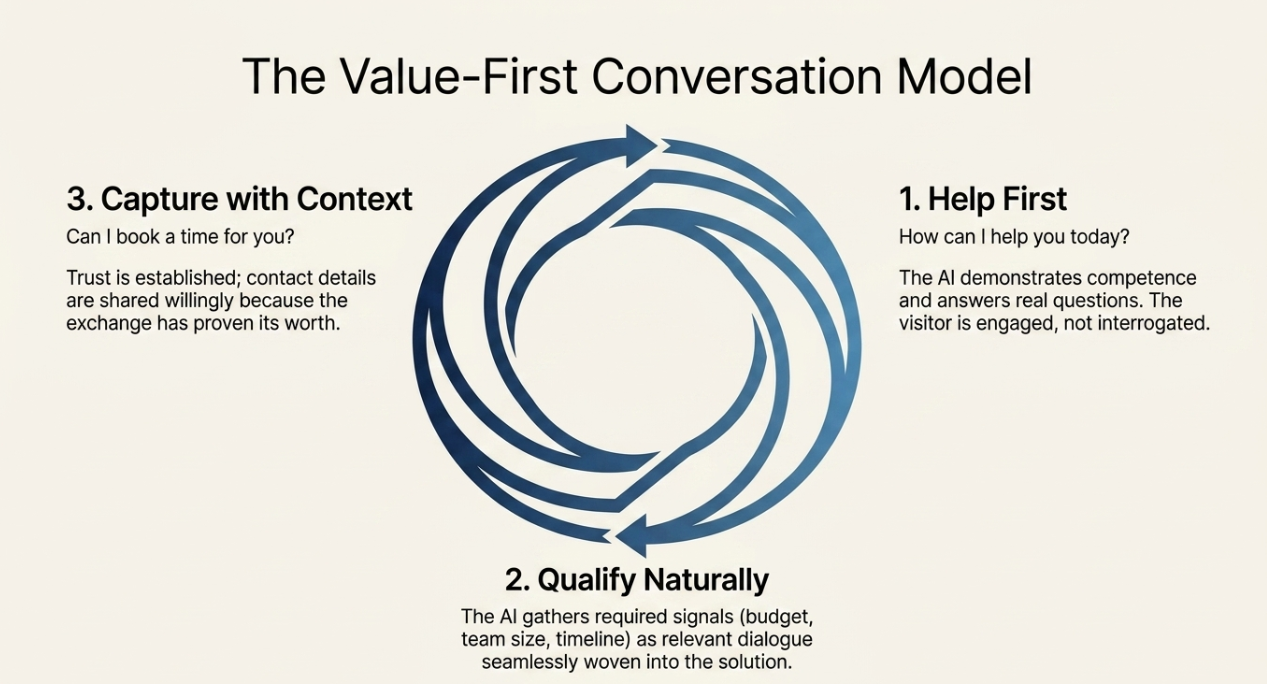
A form asks for trust before delivering any value: give us your contact information, and maybe we'll follow up with something useful. Conversational AI inverts this. It delivers value first, and collects lead data as a natural byproduct of a genuine exchange. This is the mechanism behind what we call the Value-First Conversation Model, which operates in three stages:
Stage 1, Help First. The conversation opens not with "Please enter your name" but with "How can I help you today?" The agent answers real questions, provides relevant context, and demonstrates competence. The visitor is engaged, not interrogated.
Stage 2, Qualify Naturally. As the conversation progresses, the agent gathers the signals your sales team needs, budget range, team size, use case, timeline, and competitive context, through questions that feel relevant to the visitor because they serve the conversation, not just the CRM. No visitor thinks of "What's your approximate budget?" as a form field when it arrives in the context of a useful dialogue.
Stage 3, Capture with Context. By the time a name, email address, or phone number becomes relevant, "Would you like me to send you a summary of what we covered?" or "Can I book a time with our team for you?", trust has already been established through demonstrated value. The visitor shares contact details willingly, because the exchange has already proven its worth.
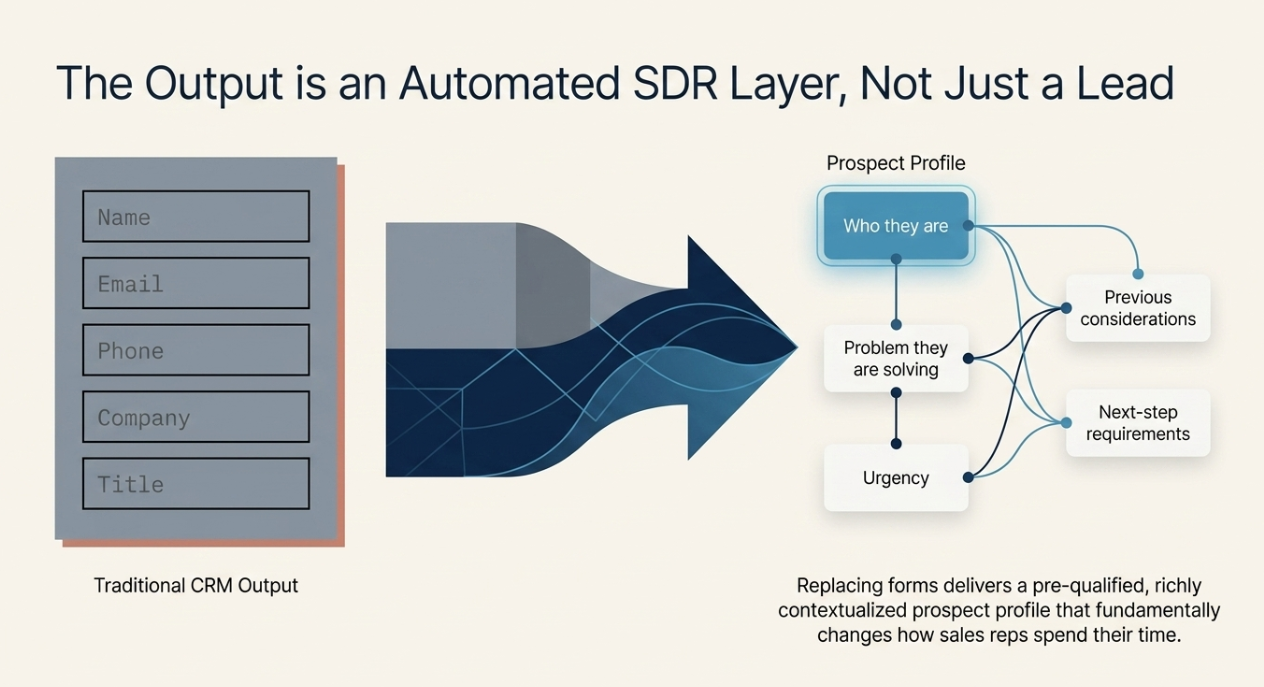
The result for the CRM is materially different from a form submission. Instead of a contact record with five flat fields, the system receives a prospect profile: who they are, what problem they're solving, what they've already considered, how urgently they need a solution, and what they need to see from a sales conversation to move forward.
Form vs. Conversational AI: A Structured Comparison
|
Dimension |
Traditional Form |
Conversational AI |
|
User experience |
Static fields, no feedback |
Adaptive dialogue, real-time responses |
|
Qualification |
Post-submission, by a human |
During the conversation, automatically |
|
Personalization |
None, every visitor sees the same fields |
Questions adapt based on prior responses |
|
Data collected |
Name, email, optional dropdown |
Intent, urgency, sentiment, objections, preferences |
|
Average conversion rate |
2–5% |
20–40% (higher in some sectors) |
|
Mobile experience |
High friction, high abandonment |
Natural, thumb-friendly interaction |
|
Availability |
Passive, collects but doesn't engage |
Active, engages, qualifies, and routes 24/7 |
|
CRM output |
Flat field values requiring manual review |
Enriched record with scoring and next-step triggers |
|
Follow-up speed |
Hours to days |
Immediate qualification and handoff |
The shift is structural, not incremental. Forms demand information before delivering value. Conversational AI earns information by delivering value first.
Where to Replace Forms First
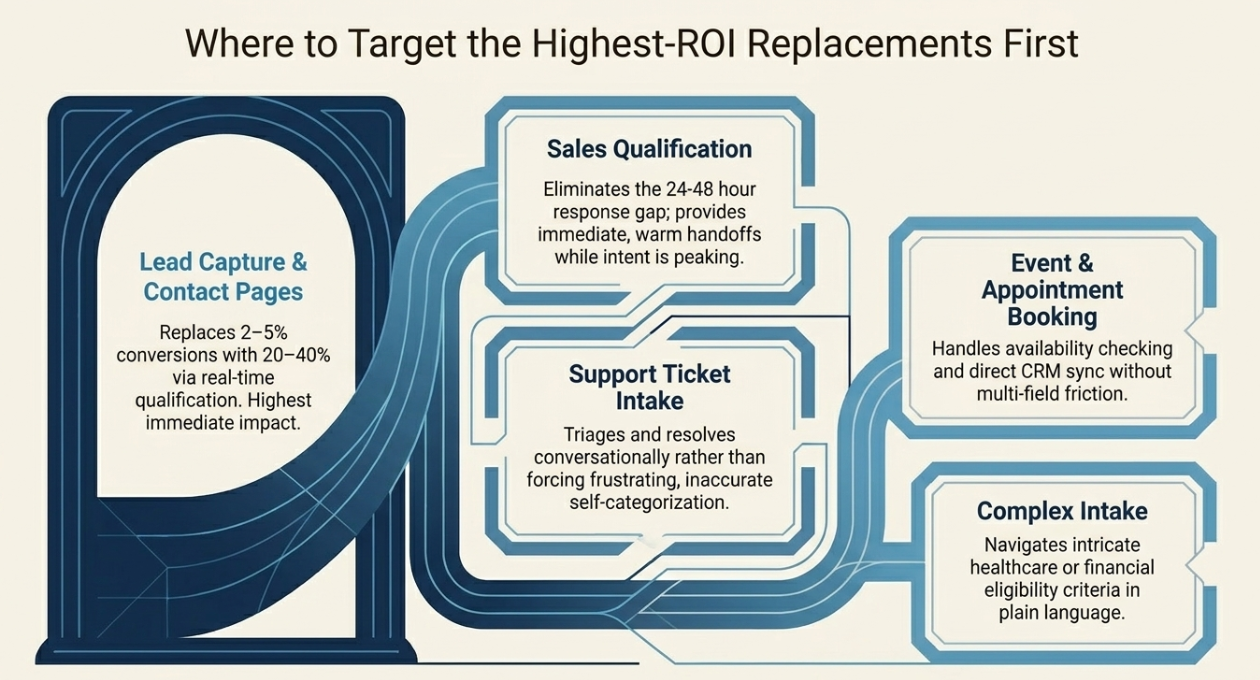
Replacing every form on day one isn't necessary or practical. The highest-ROI starting points are the interactions where forms are currently losing the most value:
Lead capture and contact pages. These are the highest-intent pages on your site and often the most form-heavy. Replacing a standard "Contact Us" form with a conversational agent that qualifies in real time, answers objections, and books meetings directly typically moves conversion rates from the 2–5% range into the 20–40% range. The delta is large enough that most teams see clear ROI within the first month.
Sales qualification. When a prospect fills out a "Request a Demo" form, submits it, and then waits 24–48 hours for a response, the window of peak interest has often closed. A conversational agent handles the same qualification conversation, budget, timeline, use case, and decision-maker status in real time, and hands off a warm, contextualized lead to the right sales rep without delay.
Support ticket intake. Asking customers to self-categorize their issue and describe it in a text box produces incomplete tickets and frustrated customers. A conversational agent triages through dialogue, asking clarifying questions, checking account status, attempting resolution, and escalating only when necessary, with full context already attached.
Event registration and appointment booking. Registration forms are friction at a moment when the visitor is already interested. A conversational agent handles availability checking, confirmation, and CRM sync without requiring a visitor to navigate a multi-field form.
Complex intake processes. For healthcare, nonprofits, financial services, and government applications, intake forms are notoriously long and confusing. Conversational AI can walk applicants through eligibility criteria, explain requirements in plain language, and gather documentation, while maintaining the compliance and audit trail requirements these industries demand.
When a Form Is Still the Right Tool
The argument for conversational AI is strong, but it is not universal. There are genuine use cases where a form remains the appropriate mechanism:
|
Scenario |
Recommended Approach |
Reason |
|
Legal and compliance documents requiring explicit user confirmation |
Form or structured e-sign |
Audit trail and explicit consent requirements |
|
Payment processing |
Secure payment form |
PCI compliance; conversation is not the right container for card data |
|
Medical intake with regulatory field requirements |
Form (potentially with conversational pre-screening) |
HIPAA-mandated data structure requirements |
|
User-initiated self-service data updates |
Form |
User prefers control over their own record; no qualification needed |
|
Simple single-field subscriptions (newsletter, alert opt-in) |
Form |
Conversation adds unnecessary complexity to a low-friction action |
The practical test is this: does this interaction require qualification, context, or trust-building to deliver value? If yes, conversational AI is the stronger tool. If the interaction is purely transactional and the user already knows exactly what they are submitting, a clean form is appropriate.
How Conversational AI Connects to Salesforce and HubSpot
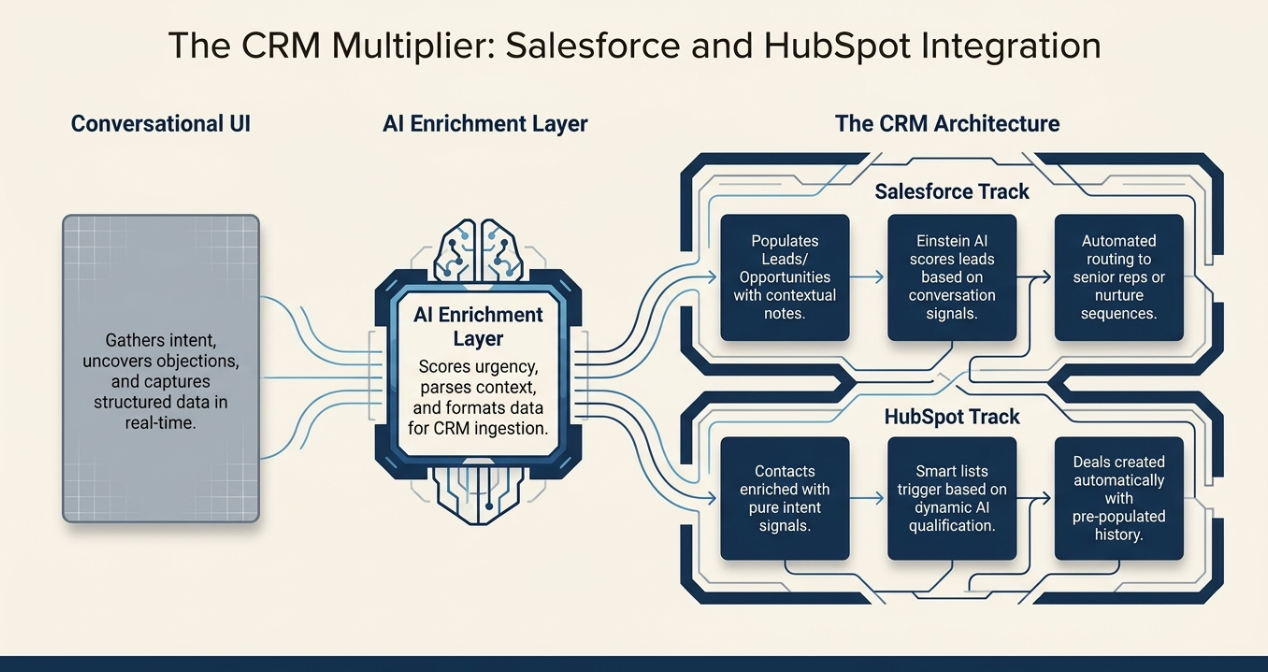
For teams running on Salesforce or HubSpot, the performance case for conversational AI is amplified by what happens after the conversation ends. With a form, data arrives as flat field values that require manual review, scoring, and routing. With conversational AI, the data arrives pre-qualified and ready to act on.
In Salesforce:
- Conversation data flows into Leads, Contacts, and Opportunities with contextual notes already populated
- AI-generated summaries and intent signals populate custom fields, reducing manual data entry for reps
- Einstein AI can score and prioritize leads based on conversational signals rather than waiting for a form submission
- Automated workflows trigger based on qualification outcomes, routing high-intent leads to senior reps, lower-intent leads to nurture sequences, without manual triage
In HubSpot:
- Contacts are created or enriched with conversational context, intent signals, and recommended next steps
- Smart lists and workflows trigger based on AI-captured qualification data, not just form field values
- Deals can be created automatically with pre-populated fields derived from the conversation
- Sales reps receive contextualized handoffs with full conversation history, so no discovery call starts cold
The practical result in both platforms is the same: reps spend less time on data entry and lead sorting, and more time on the conversations that actually advance deals.
Voice Agents, When Chat Isn't Enough
Chat-based conversational AI handles the majority of lead capture and qualification use cases effectively. Voice agents address the scenarios where typing is inconvenient, where the audience strongly prefers phone interaction, or where conversation complexity exceeds what a text interface can comfortably handle.
The most common voice agent use cases in a lead generation context:
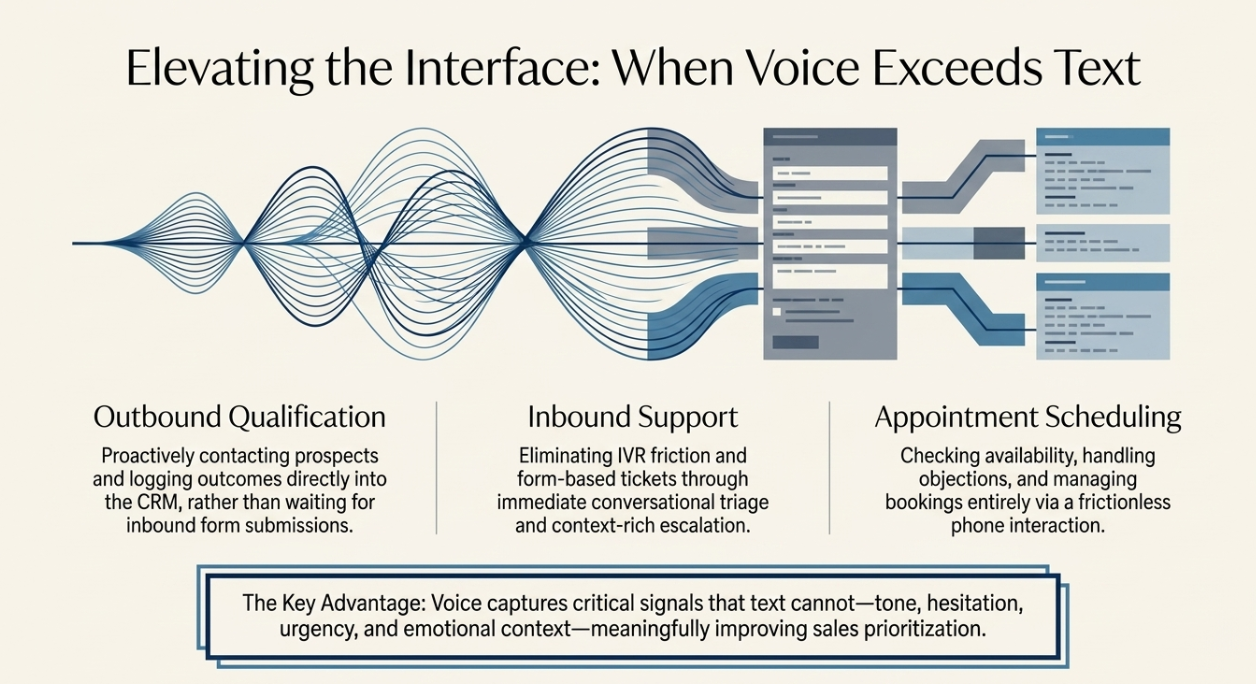
- Outbound qualification: Rather than waiting for a form submission, voice agents proactively contact prospects, qualify them through natural conversation, and log outcomes directly into the CRM
- Inbound support intake: Callers describe their issue conversationally; the agent triages, attempts resolution, and escalates with full context, eliminating IVR friction and form-based ticket creation
- Appointment scheduling: Agents check availability, confirm bookings, send follow-ups, and handle rescheduling without any form interaction
Voice also captures signals that text cannot: tone, hesitation, urgency, and emotional context. These signals can meaningfully improve how sales teams prioritize follow-up and how AI agents route conversations in real time.
How to Make the Shift: A Practical Starting Point
The transition from forms to conversational AI doesn't require replacing everything at once. A disciplined sequence reduces risk and accelerates time to measurable results.
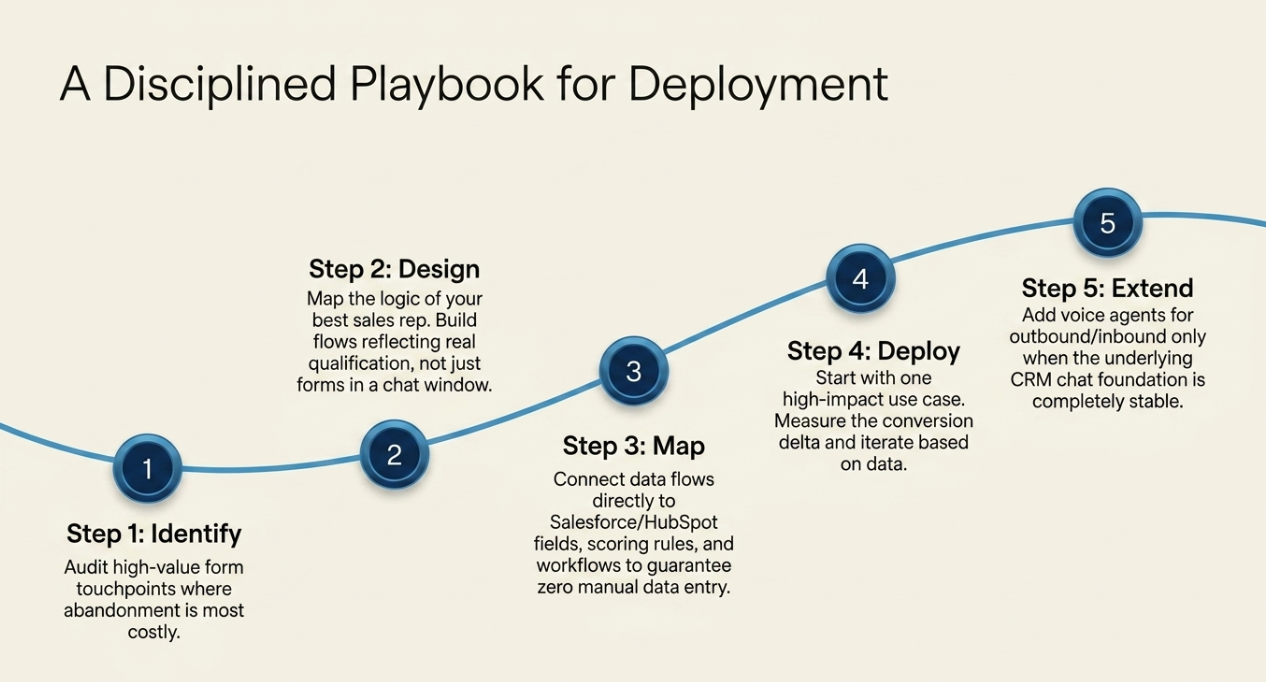
1. Identify your highest-value form touchpoints. Audit the forms currently sitting at critical conversion moments: lead capture pages, demo request pages, support intake, and appointment booking. These are where abandonment is most costly and where conversational AI will deliver the fastest performance improvement.
2. Design the conversation before the technology. Think through what your best sales or support person would ask in a live conversation: what qualifies a lead, what objections typically surface, and what information the CRM actually needs. The conversational flow should reflect that logic, not replicate the form fields in dialogue format.
3. Map data to your CRM before deployment. Ensure that the conversational data flowing into Salesforce or HubSpot is mapped to the right fields, triggers the right scoring rules, and activates the right workflow logic. The goal is zero manual data entry on the back end.
4. Start with one high-impact use case. Deploy, measure conversion rate, lead quality, and sales team feedback. Iterate based on what the data shows. Once the model is working, expansion is straightforward.
5. Extend to voice when the chat foundation is stable. Voice agents add a meaningful layer for outbound qualification and inbound support, but they require the same underlying CRM integration logic to be solid first.
From Data Collection to Intelligent Qualification
The shift from web forms to conversational AI is not a technology trend to evaluate for next year's roadmap. It is a present-day performance gap. Businesses that have made the transition are capturing more leads from the same traffic, qualifying them faster, and entering sales conversations with richer context than their form-dependent competitors.
For revenue teams operating on Salesforce or HubSpot, the integration advantage compounds this further. Conversational AI doesn't just improve the front end of your lead capture process; it improves the quality of every downstream workflow, scoring model, and sales handoff that depends on accurate, complete lead data.
Forms had a legitimate role when static data collection was the only option available. In a market where AI can qualify, contextualize, and route in real time, that role has narrowed considerably.
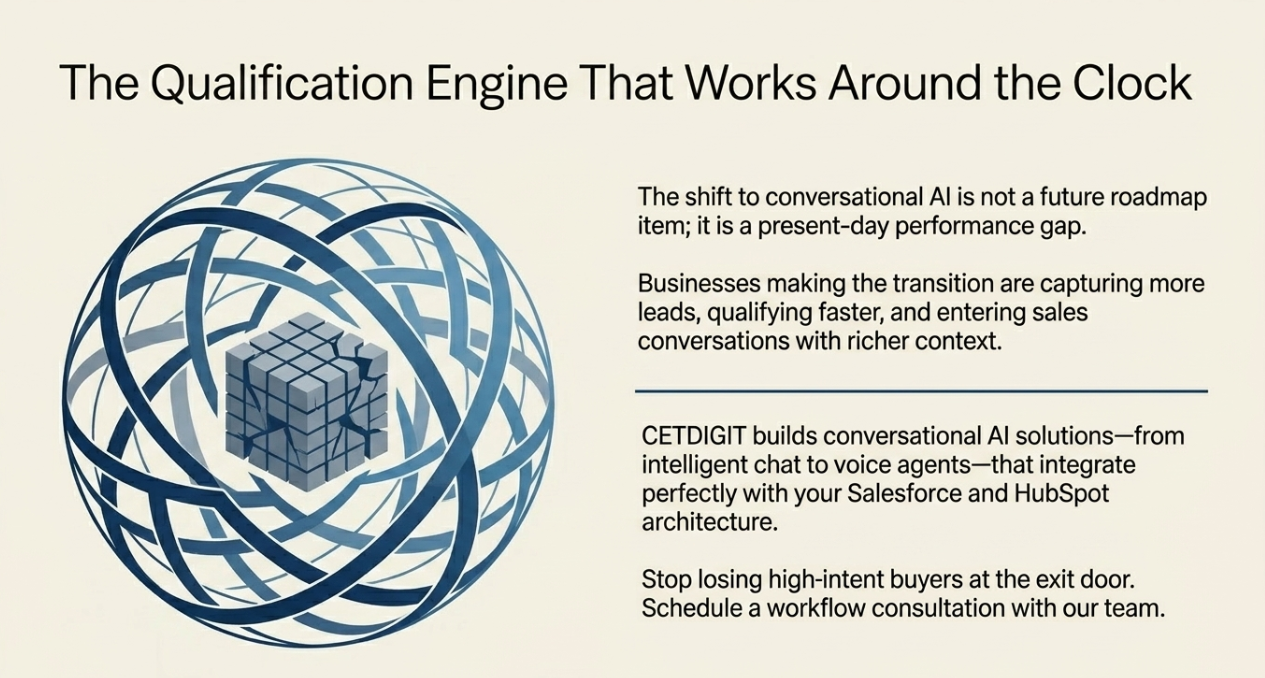
CETDIGIT builds conversational AI solutions that integrate directly with Salesforce and HubSpot, from intelligent chat agents to voice agents to full workflow orchestration. If you're ready to replace high-abandonment forms with a qualification engine that works around the clock, schedule a consultation with our team.
Related Reads
- Beyond Standard RAG: How Agentic RAG Is Transforming Enterprise AI
- The Complete Guide to AI Voice Agents for Sales & Support
- How AI Agents Are Reshaping CRM Automation
- Salesforce vs. HubSpot: Choosing the Right CRM for AI Integration


Leave a Comment