


A data foundation for AI is the connected, consistent, AI-ready data layer beneath your tools, one reconciled view of your customers, deals, and activity that AI can actually act on. Without it, every AI initiative inherits the Silo Tax of fragmented systems: models trained on data that doesn't line up, producing activity instead of revenue. The foundation is what makes a System of Action possible. Build it first, then activate AI.
Everyone's Buying AI. Almost No One Checks the Data First.
A RevOps lead at a mid-market company has customer data in five places: the CRM, the billing system, the support tool, the marketing platform, and a spreadsheet someone maintains by hand. Each system has its own definition of "customer." None of them reconciles. When she launches an AI initiative, a scoring model, an agent, or a forecasting tool, it stalls within weeks because the model can't get a clean, consistent view to work from. Her words: "Our data is scattered across five systems, and none of it lines up, and every AI thing we try chokes on it."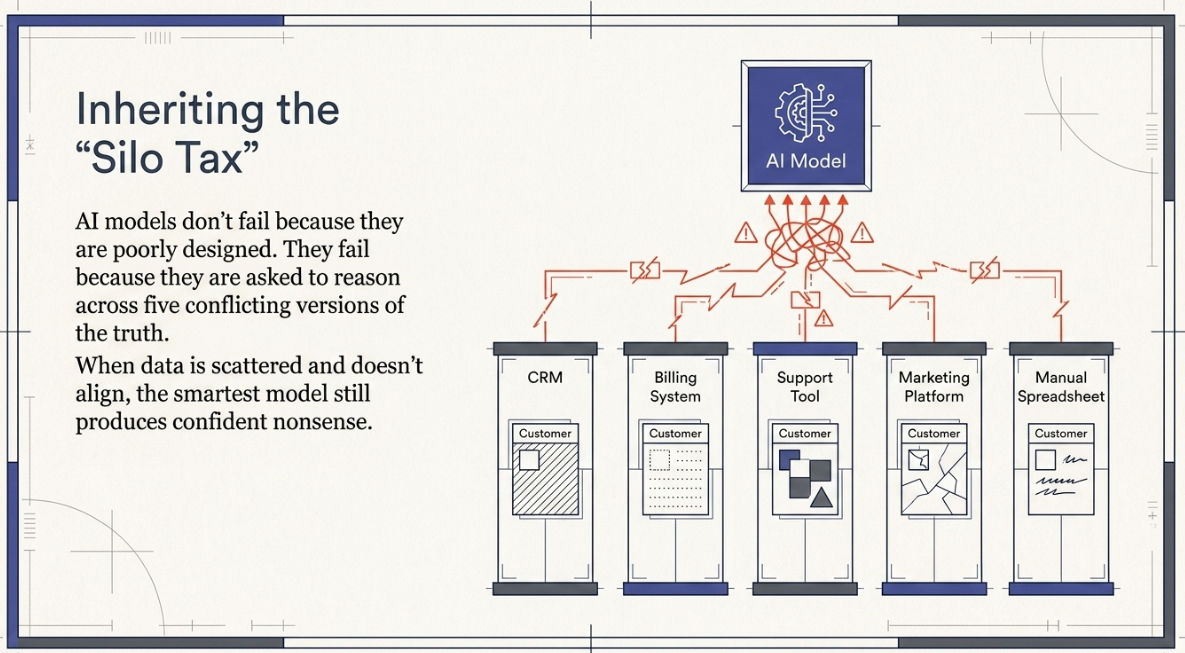
She is not behind on AI adoption. She's ahead of it. Investment keeps climbing, Deloitte found data is a primary barrier to scaling generative AI, with two-thirds of leaders increasing spend even as value at scale gets harder to reach. The tools arrived. The results didn't. McKinsey reports the same gap from the other side: more than 80% of organizations see no tangible enterprise-level EBIT impact from generative AI, despite adoption near 78%. The spend is real. The return is missing. The thing in between is the data.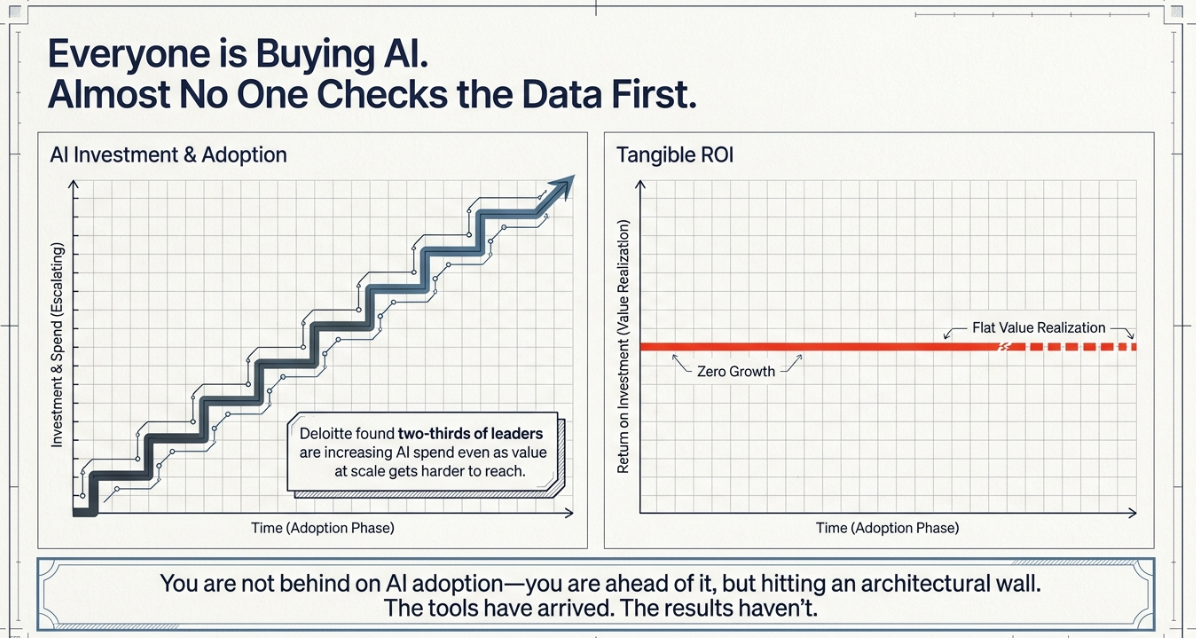
What a Data Foundation for AI Actually Is
A data foundation for AI is the layer that makes your data connected, consistent, and ready for a model to act on. Connected means your systems share one reconciled view instead of five conflicting ones. Consistent means "customer," "deal," and "active" mean the same thing everywhere. AI-ready means the model can trust what it reads without a human cleaning up behind it.
Most mid-market companies skip this layer because it's invisible until it fails. You don't see it on a feature list. You see it when the AI tool you bought produces confident nonsense, or nothing at all. That failure has a name: the Silo Tax that accumulates when AI tools layer on top of disconnected systems without a shared data layer underneath. The Silo Tax is an architectural problem with two halves: a tool layer and a data layer. The data layer is what a foundation fixes. This is also where a data foundation for AI earns its place: not as another tool, but as the precondition for every tool you already bought. To see how the full AI services architecture fits together, the foundation is the layer on which everything else sits.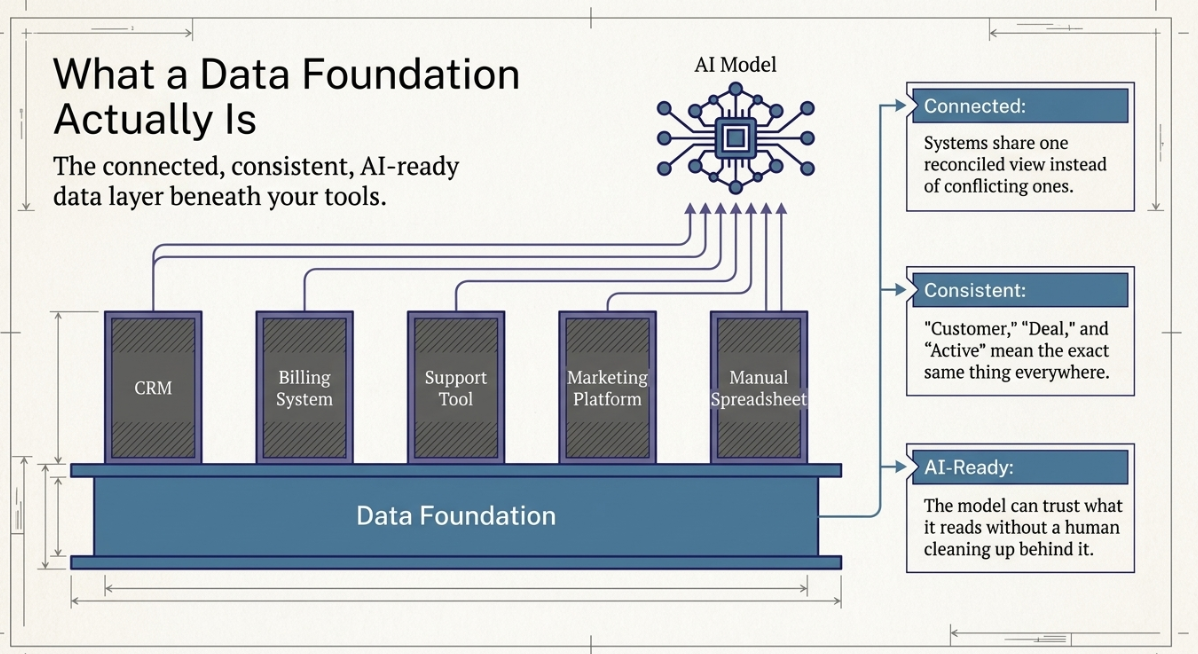
Who This Affects
This is a Segment 2 problem; the company is in transition, not starting from zero. If you're a RevOps lead, a Marketing Ops manager, a Head of Growth, or a CTO who has approved more than one AI tool that hasn't moved a revenue number, this is you. The pattern is consistent: you have HubSpot or a partial CRM, several point solutions stitched together by exports and connectors, and AI experiments that generate activity metrics nobody can tie to the pipeline.
The tell is fragmentation, not absence. You're not short on tools. You're short on a layer that makes them agree. McKinsey's data lands hardest here: even among high performers, integrating data into AI models is a primary obstacle to capturing value. The companies feeling this most are the ones who did the most, bought the tools, ran the pilots, and hit the wall where none of it reconciles.
The Symptoms of a Missing Data Foundation
The symptoms are recognizable before the diagnosis is. Each one traces back to fragmentation.
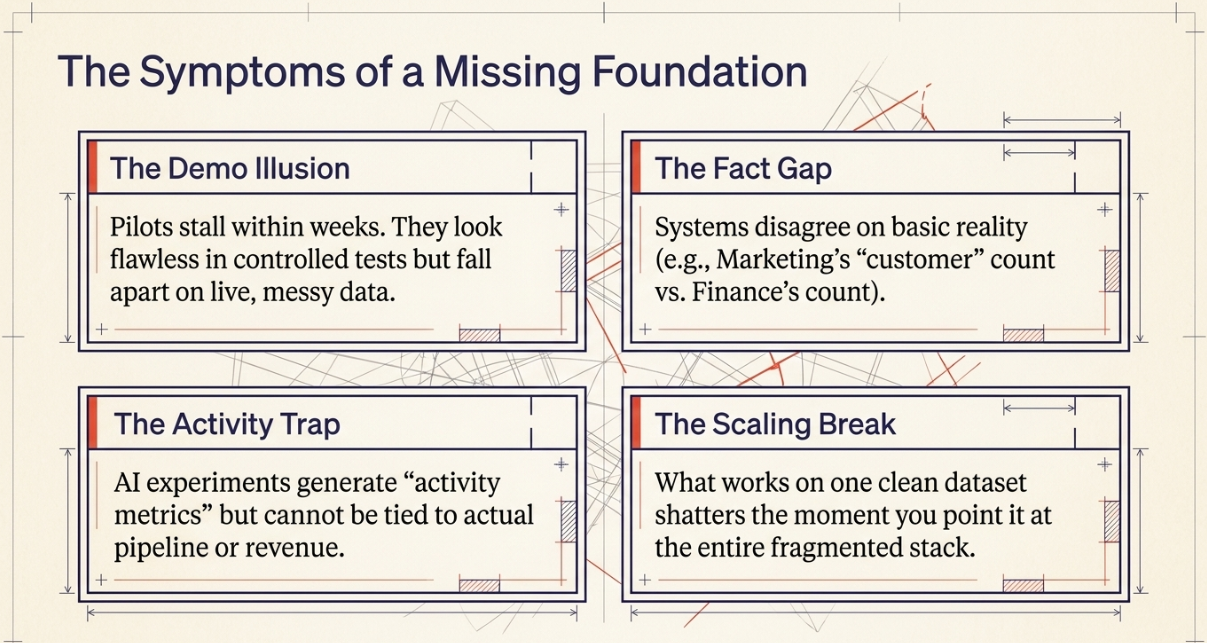
- Your AI pilots stall after the demo. They look good in a controlled test and fall apart on live data. Gartner predicts poor data quality is the leading reason generative AI projects are abandoned, with at least 30% scrapped after proof of concept by the end of 2025.
- Your systems disagree about basic facts. Marketing's "customer" count and finance's don't match, because the definitions live in different tools and were never reconciled.
- The failure rate is structural, not occasional. RAND found over 80% of AI projects fail — twice the rate of non-AI IT projects, and the failure sits upstream of the model.
- Scaling makes it worse. What works on one clean dataset breaks the moment you point it at the whole fragmented stack.
Why It Happens — The Root Causes
The root cause is rarely the model. It's the data feeding it. RAND's interviews with 65 data scientists and engineers put it plainly: the bulk of the work is the dirty work of data engineering, not model selection. When that work is skipped, the smartest model in the category still acts on data it can't trust.
MIT's Project NANDA reached the same conclusion from a different angle. In its 2025 study, the core issue was the integration gap, not model quality, tools that don't connect to workflows or adapt to organizational context and data. Roughly 95% of enterprise gen AI pilots delivered no measurable P&L impact; the ~5% that broke through were the ones whose data and workflows were actually wired together.
This is the Silo Tax applied to the data layer. Point solutions accumulate, each one holding a partial view, and the AI is asked to reason across data that was never reconciled. The model isn't wrong. It's working from five versions of the truth. McKinsey's finding closes the loop: data difficulty, specifically, integrating data into AI models, is what blocks value capture for the companies trying hardest to capture it.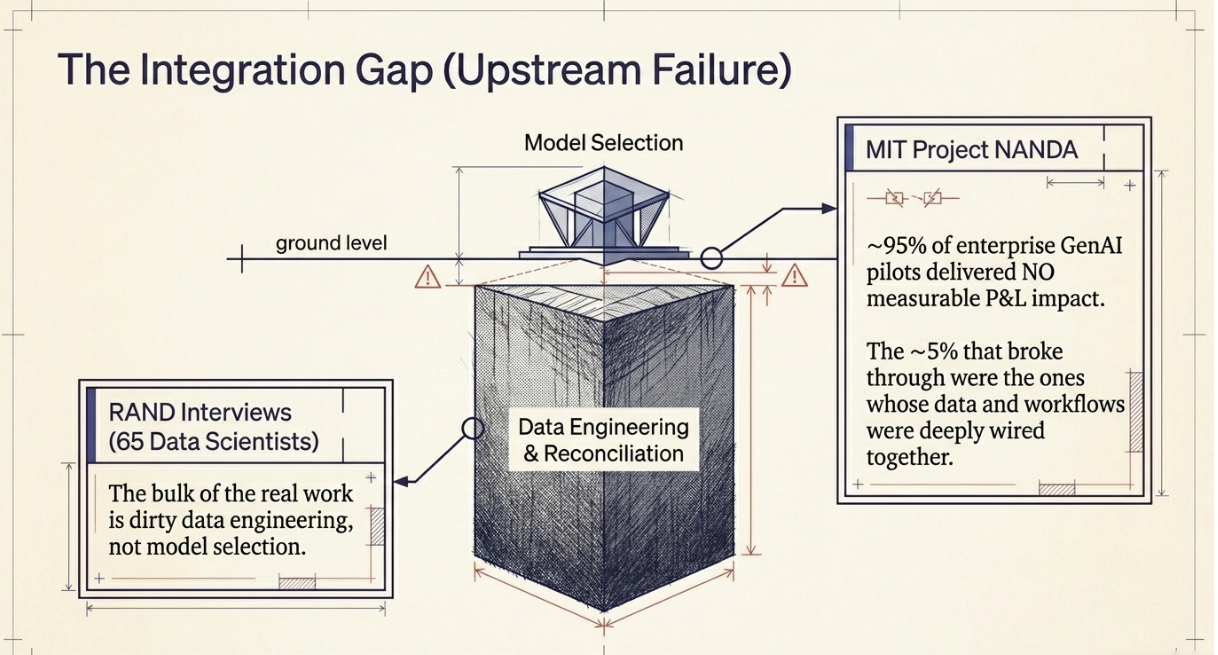
Build the Foundation vs. Bolt on More AI
When the next AI tool gets proposed, the real decision is whether to add capability on top of fragmentation or fix the layer underneath first.
|
Situation |
Add another AI tool |
Build the data foundation first |
|
Data lives in 3+ disconnected systems |
The tool inherits the fragmentation; the pilot stalls |
One reconciled view: the tool has clean inputs |
|
AI pilots producing activity, not revenue |
Adds a fourth pilot to the three that already stalled |
Activation becomes possible on data that the model can trust |
|
Leadership is asking where the ROI is |
Spend rises, EBIT impact stays flat (McKinsey) |
Spend routes to the layer that gates every downstream result |
|
The goal is autonomous revenue action |
No System of Action to act on |
The foundation makes a System of Action possible |
The pattern across all four rows is the same one Gartner, RAND, McKinsey, and Deloitte converge on independently: capability bolted onto fragmentation produces abandonment, not outcomes. Build the data foundation first, then activate.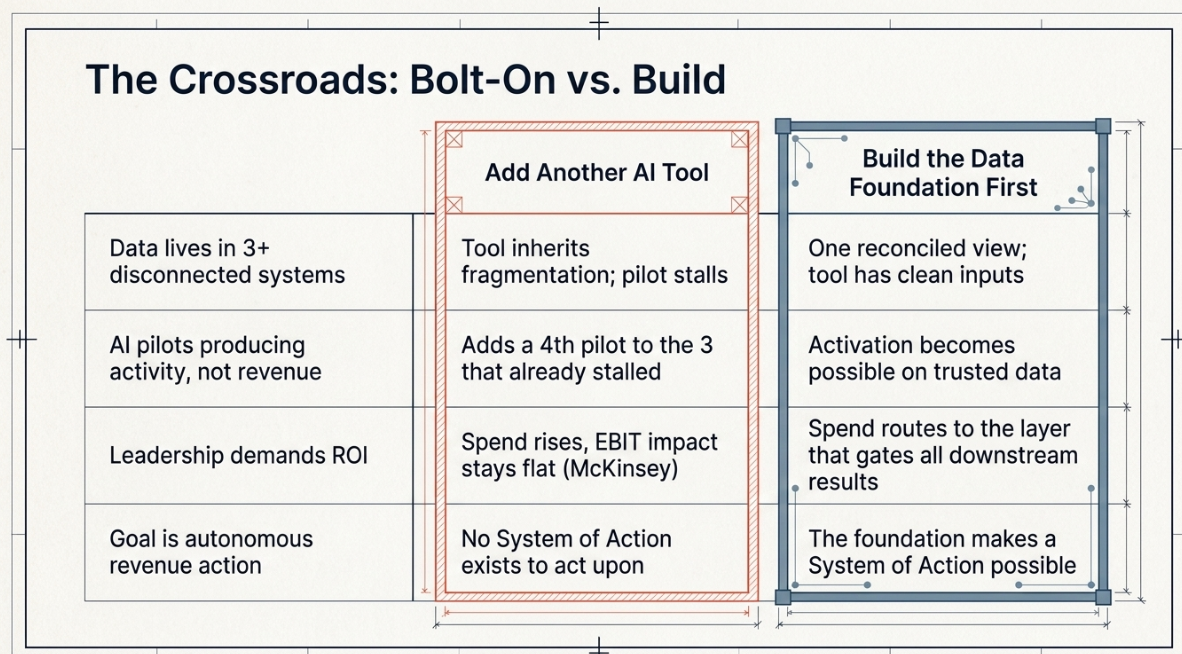
How CETDIGIT Thinks About the Data Foundation
CETDIGIT treats the data foundation as the layer that turns a pile of tools into a system that acts. A foundation isn't valuable because it's tidy. It's valuable because it makes Revenue Intelligence possible, the measurement layer that reads what's actually happening across your revenue motion in real time instead of in a retrospective report. Without a reconciled data layer, there's nothing coherent for Revenue Intelligence to read.
That foundation is also what a System of Action runs on. A CRM that waits for a human to move every deal is a system of record. A System of Action sweeps for revenue opportunities and triggers behavior on its own, but only if the data beneath it is connected and trustworthy. This is why the foundation feeds the AI Revenue Engine architecture: the engine is the activation; the foundation is the fuel. MIT's research underlines the order. The pilots who worked were the integrated ones. The foundation is the integration.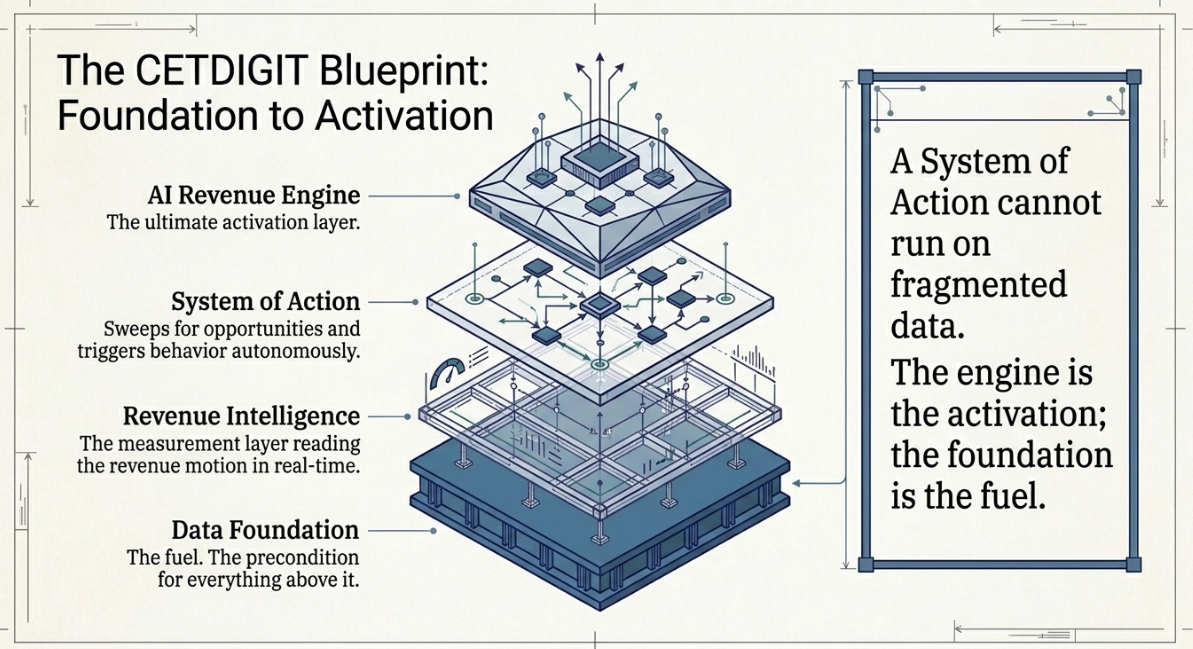
Where to Start
Start by mapping where your definitions diverge, where "customer," "deal," and "active" mean different things in different systems. That reconciliation is the foundation work, and it's the precondition for everything you've already bought to start producing revenue rather than activity. As part of CETDIGIT's broader AI services framework, the data foundation is the first layer, not an optional one; the AI Revenue Engine sits on top of it.
The practical move is a diagnostic: find where the stack is leaking before you spend on another tool to sit on top of the leak.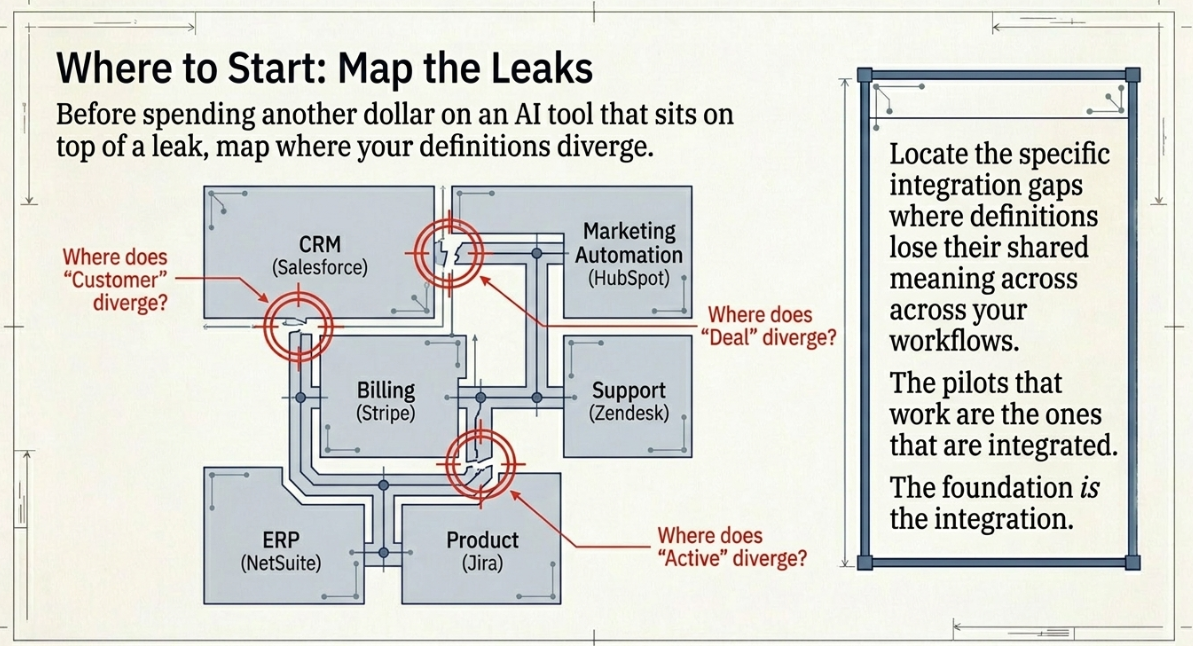
Frequently Asked Questions
Why do AI projects fail without good data?
RAND found over 80% of AI projects fail, twice the rate of non-AI IT projects, and the leading causes sit upstream of the model, in inadequate data infrastructure and data that isn't ready to be used. The model is rarely the problem; the data feeding it is. Most of the real work in a successful AI project is data engineering, not model selection. When that layer is skipped, even a strong model acts on data it can't trust, and the project stalls after the demo.
What data do you need before deploying AI?
You need a connected, consistent, reconciled view of your core revenue objects, customers, deals, and activity, which means the same thing across every system. Before deployment, the practical bar is that your tools agree on basic definitions and the model can read clean inputs without a human cleaning up behind it. You don't need a perfect data warehouse. You need the fragmentation resolved enough that the AI isn't reasoning across five conflicting versions of the truth.
Do I need a data foundation before AI?
Yes, in practice. McKinsey reports that more than 80% of organizations see no enterprise-level EBIT impact from generative AI, and data difficulty is a primary reason. Gartner names poor data quality as the leading cause of abandoned projects. Building the foundation first is what separates the pilots that scale from the ones that get scrapped. The alternative, bolting AI onto fragmented systems, is the most common and most expensive way to skip it.
What does AI-ready data mean?
AI-ready data is connected across systems, consistent in its definitions, and trustworthy enough for a model to act on without manual correction. It's the difference between data that exists and data a model can use. The test is simple: if your systems disagree about who a customer is or what counts as an active deal, the data isn't ready, no matter how much of it you have.
How does the data foundation fit with everything else?
The data foundation is the bottom layer of the architecture. Revenue Intelligence reads it; a System of Action runs on it; the Revenue Engine activates on top of it. You can see CETDIGIT's broader AI services framework for how the layers connect, but the order doesn't change: the foundation comes first, because every layer above it inherits whatever state the data is in.
Stack Unification Audit
Book a Stack Unification Audit, a diagnostic of where your AI investment is leaking. We'll show you where your data is fragmented across systems, what it's costing your AI initiatives, and how to connect the stack before you activate AI on top of it.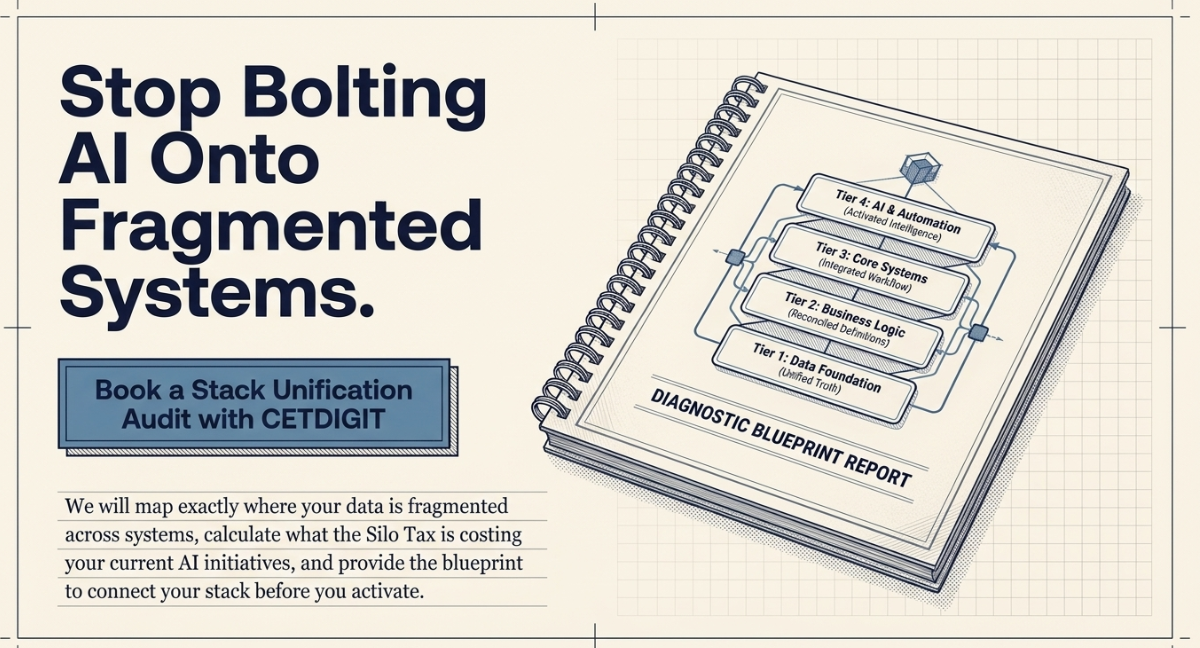



Leave a Comment