


An AI Revenue Engine is the architectural layer that connects a company's intelligence system, the CRM, and data layer where buying signals live, with its execution layer, where autonomous agents act on those signals. It replaces disconnected AI tools with a System of Action: a connected architecture where signals trigger revenue behavior automatically, measured by Cost per Outcome rather than activity volume. The result is a Revenue Graph, a real-time map of where revenue is moving, not a retrospective report of what happened last quarter.
The Meeting That Exposes the Gap
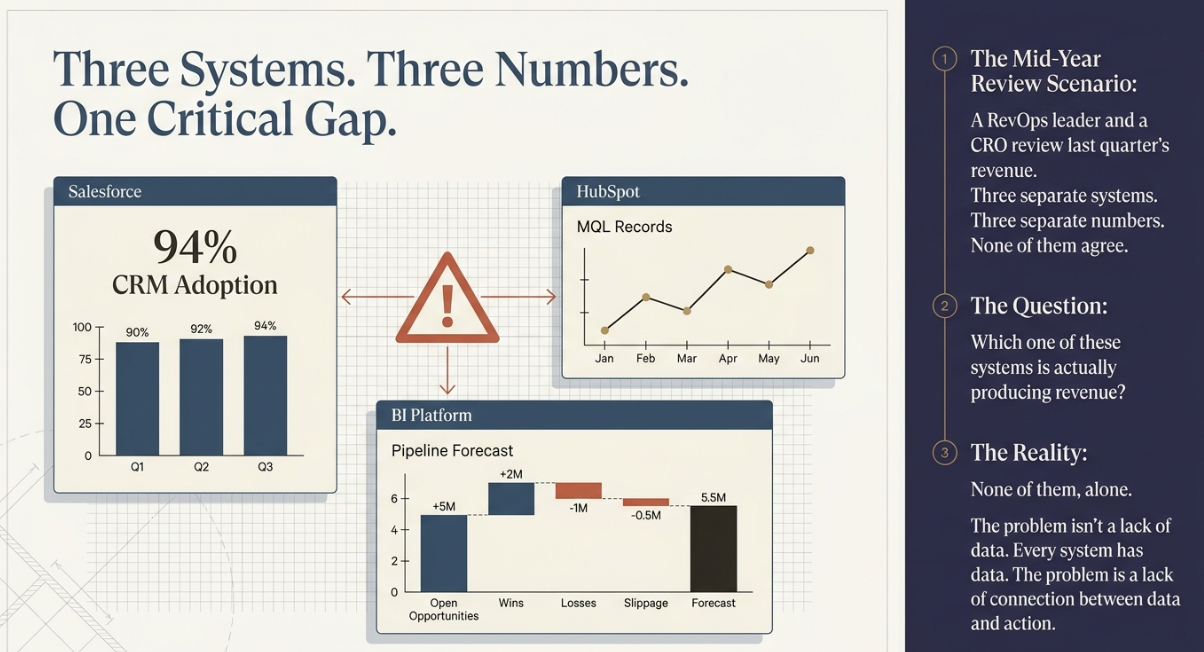
A RevOps leader and a CRO sit down for a mid-year strategy review. Three windows are open on the screen: a Salesforce dashboard showing 94% CRM adoption, a HubSpot report showing MQL records, and a BI tool showing the pipeline. Three separate systems. Three separate numbers. None of them agree on what drove revenue closed last quarter.
The CRO asks the question that ends the meeting: "Which one of these systems is actually producing revenue?"
The RevOps leader knows the answer. None of them, alone. The problem isn't the data. Every system has data. The problem is that there's no layer connecting data to action, no architecture that takes a signal from the CRM and automatically triggers the next revenue move. The tools are doing their jobs. The architecture between them is not.
This is the gap the AI Revenue Engine is designed to close.
What an AI Revenue Engine Is (and What It Is Not)
The AI Revenue Engine is not a CRM, a prospecting tool, or a BI platform. It is the orchestration layer that connects all three, so they act as a single, signal-driven system rather than three separate instruments producing three separate reports.
Gartner formally defined this architectural category in October 2024 as "Revenue Action Orchestration", technology that captures "revenue signals into one normalized data model, creating an AI-ready commercial dataset" and serves as "the primary system of seller action and a single source of truth for sales interactions." The inaugural Gartner Magic Quadrant for this category was published in December 2025, signaling analyst-level recognition that connected revenue architecture is a distinct, measurable market category, not a vendor invention.
Forrester reached the same conclusion from a different angle. Their Q3 2024 Wave evaluation of Revenue Orchestration Platforms defined the category around four core processes: Engagement, Capture, Analysis, and Improvement, and stated the problem plainly: "Frontline productivity and adoption of technology has been held back by siloed solutions across the tech stack that force users to jump from one platform experience to another to complete their work."
Both definitions name the same mechanism. Disconnected tools produce fragmented revenue behavior. A connected architecture produces a system that acts on a compound signal.
The Cognitive Core and the Activation Edge
An AI Revenue Engine operates through two connected systems, each with a defined role.
The Cognitive Core is the intelligence layer, typically Salesforce or an equivalent enterprise CRM. It holds complex account logic, multi-stakeholder relationship maps, long-cycle deal memory, and compliance workflow management. It is where the institutional knowledge of every customer interaction lives. It is not designed for speed. It is designed for depth and persistence.
The Activation Edge is the execution layer, typically HubSpot or an equivalent high-velocity platform. It handles autonomous prospecting, content delivery, real-time engagement, outreach sequencing, and inbound qualification. It is designed for speed. It is not designed to hold the depth of account context that the Cognitive Core maintains.
The AI Revenue Engine is the orchestration layer that connects the two. Signal detected in the Cognitive Core triggers action in the Activation Edge. Context maintained in the Cognitive Core travels with the agent into the Activation Edge interaction. The two systems stop being separate tools and start acting as one architecture.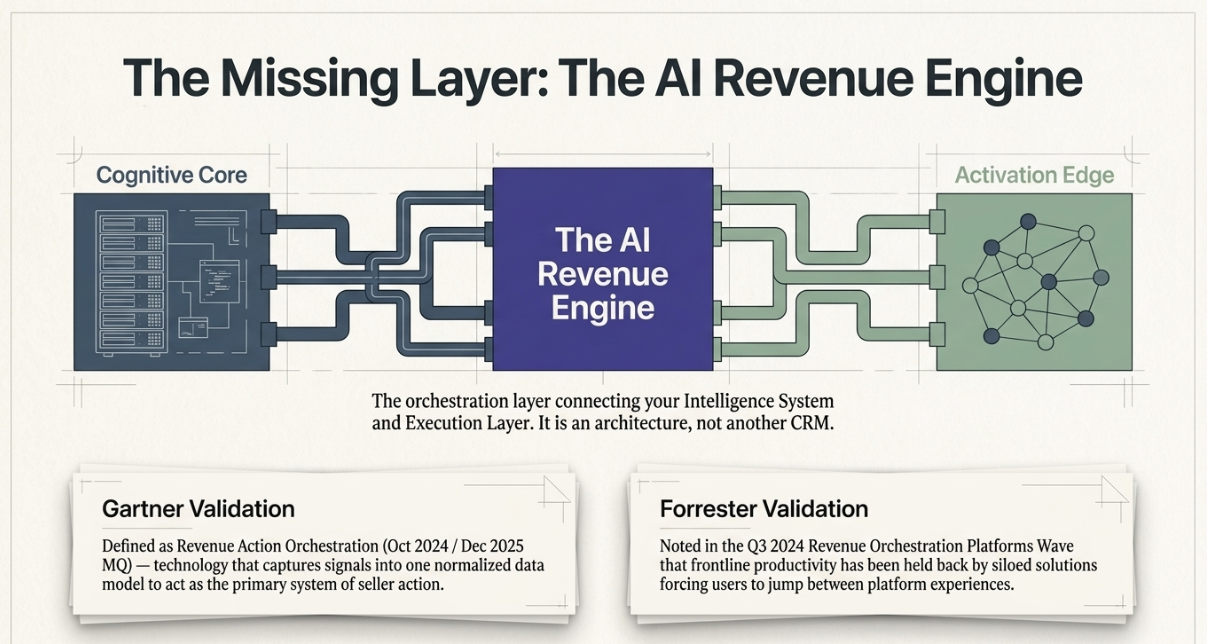
System of Record vs. System of Action
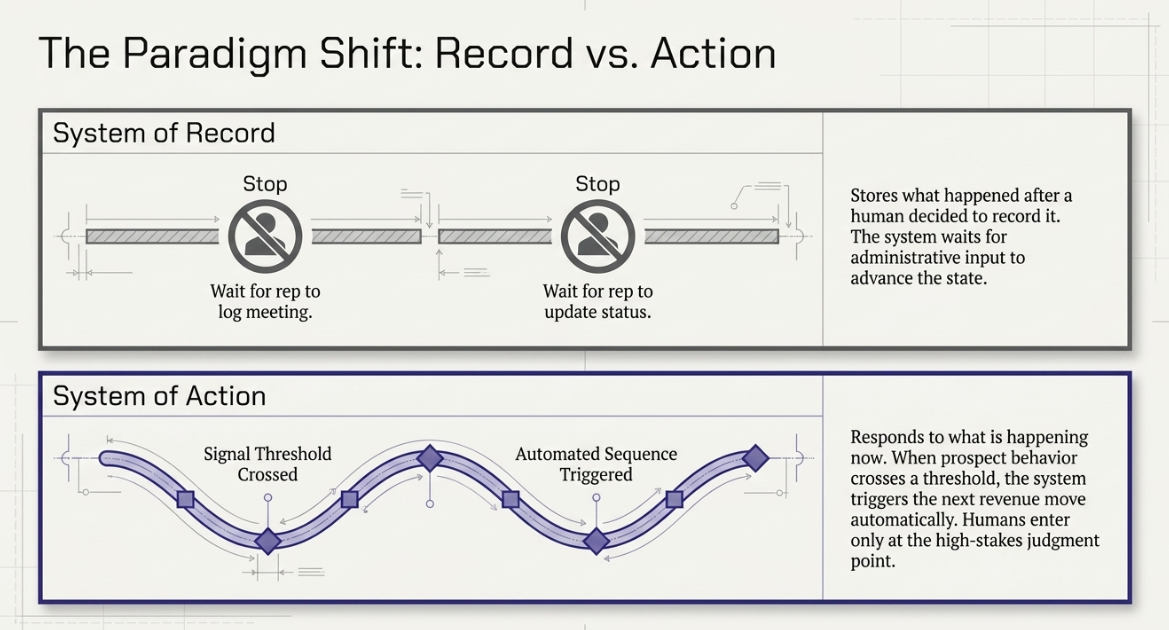
A system of record stores what happened after a human decided to record it. A sales rep closes a meeting, updates the CRM, and the record reflects the meeting. The system waited for the human.
A System of Action responds to what is happening without waiting for a human to advance the state. When a prospect's behavior crosses a signal threshold, re-engaging with product pages after six months of silence, visiting pricing, or asking a question in a chatbot, the System of Action triggers the next revenue move automatically. A rep is notified. A sequence activates. The interaction is logged. The human enters the workflow at the judgment point, not at every administrative step before it.
Most mid-market AI stacks are built on top of a system of record. The AI Revenue Engine adds the System of Action layer above it.
Who This Affects
Two reader types are most likely arriving at this article, and they're at different points in the same progression.
The first is the operator whose tools don't talk to each other. They have HubSpot or a partial CRM, multiple AI tools that each generate activity, and a data picture that looks busy but doesn't translate to a clear revenue number. This is Segment 2 territory, the AI Transition operator who solved the pipeline visibility problem described in why pipeline goes dark in growing companies, bought tools to address it, and now has a fragmentation problem instead of a visibility problem. The specific cost of that fragmentation, what we call the Silo Tax.
The second is the executive whose stack is mature but not producing board-presentable ROI. They have Salesforce with high adoption rates, a BI layer, a dedicated RevOps function, and AI pilots that stalled. They can see the data. They cannot explain to the board why the data hasn't moved the revenue number.
Both readers are in the same architectural gap. The tools exist. The connection between them does not.
Gartner's RevOps maturity research maps this progression directly. Gartner's analysis identifies three maturity stages, Developing, Intermediate, and Advanced, and finds that advanced-maturity organizations are twice as likely to exceed revenue goals and 2.3 times as likely to exceed profit goals compared to organizations at intermediate or developing maturity. The AI Revenue Engine is the architectural layer that operationalizes the transition from intermediate to advanced maturity.
What Disconnected AI Is Costing You
These five patterns indicate an architecture problem rather than a tool quality problem:
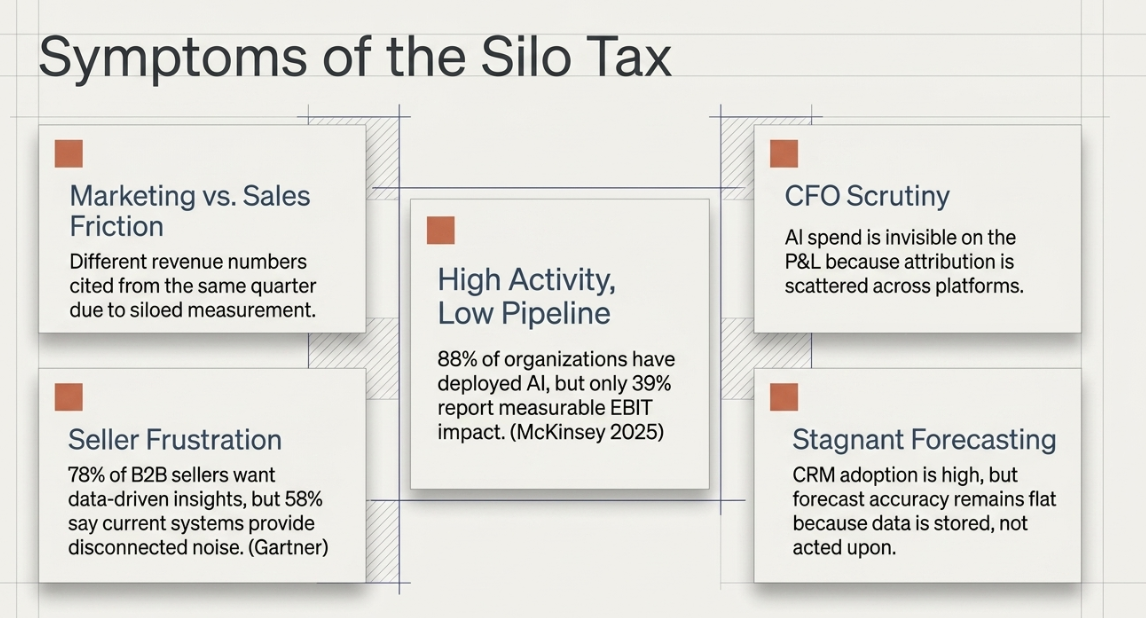
- Your marketing team and your sales team cite different revenue numbers from the same quarter, from the same CRM environment, because each team's tools measure a different slice of the same data.
- Your AI tools generate high activity volume, sequences sent, content published, and agents engaged, but the pipeline number is not moving in proportion. McKinsey's 2025 research found that only 39% of organizations report any measurable EBIT impact from AI, despite 88% having deployed it across at least one business function.
- Each AI tool does what it was designed to do, but no tool knows what the others are doing. Gartner found that 78% of B2B sellers are willing to use data-driven insights to improve their jobs, but 58% say their current systems provide unnecessary or disconnected information rather than actionable signals.
- The CFO is asking why AI spend hasn't shown up in the P&L, and the answer requires explaining three different systems rather than citing one number.
- Forecast accuracy has not improved despite better CRM adoption and more data visibility, because the data is there, but nothing is being acted on it.
Why the Architecture Is the Variable, Not the Tools
The tools are not broken. That is the critical starting point. Each tool was designed to do something specific, and each one is doing it. The failure is structural: the tools don't share a normalized data model, none of them trigger actions in the others, and none of them measure the same revenue outcome in the same way.
McKinsey's 2025 State of AI survey identified the single variable separating high-performing AI organizations from the rest: high performers are 2.8x more likely to have redesigned workflows around AI rather than layering AI onto existing processes. Companies that layer tools get "micro-productivity", marginal time savings that stay local to each tool and don't compound into revenue outcomes. Workflow redesign is what produces enterprise-level AI impact.
The Revenue Engine is the workflow redesign layer. It is not a new tool added to the stack. It is the architectural change that makes the existing stack act differently.
What a Normalized Revenue Signal Model Is
Every AI tool in a fragmented stack reads a different slice of data about the same prospect. The CRM has the account history. The prospecting tool has the engagement signals. The BI platform has the pipeline analysis. None of these views is complete. None of them is connected to the others in real time.
Gartner's Revenue Action Orchestration category definition centers on a "normalized data model, creating an AI-ready commercial dataset", a single unified view of all revenue signals that every agent, every rep, and every layer of the system reads from. Revenue Intelligence is what this normalized model produces: not a retrospective report pulled on Friday afternoon, but a real-time signal that the next revenue action should happen now.
Why Adding Another Tool Does Not Solve This
Forrester's analysis of Revenue Orchestration Platforms names the failure mode explicitly: tool proliferation compounds fragmentation rather than resolving it. Each new tool added to a disconnected stack adds another data silo, another integration to manage, and another attribution model to reconcile. The problem is not the number of tools. It is the absence of a layer that normalizes their signals and connects their actions.
The Revenue Engine is that layer.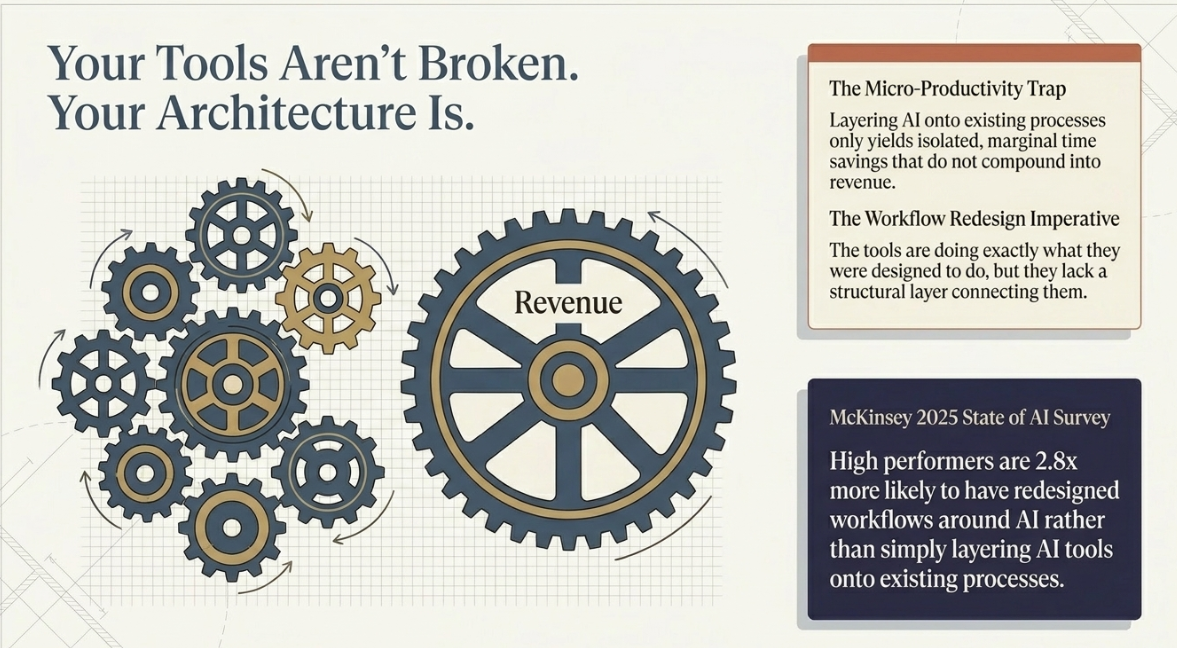
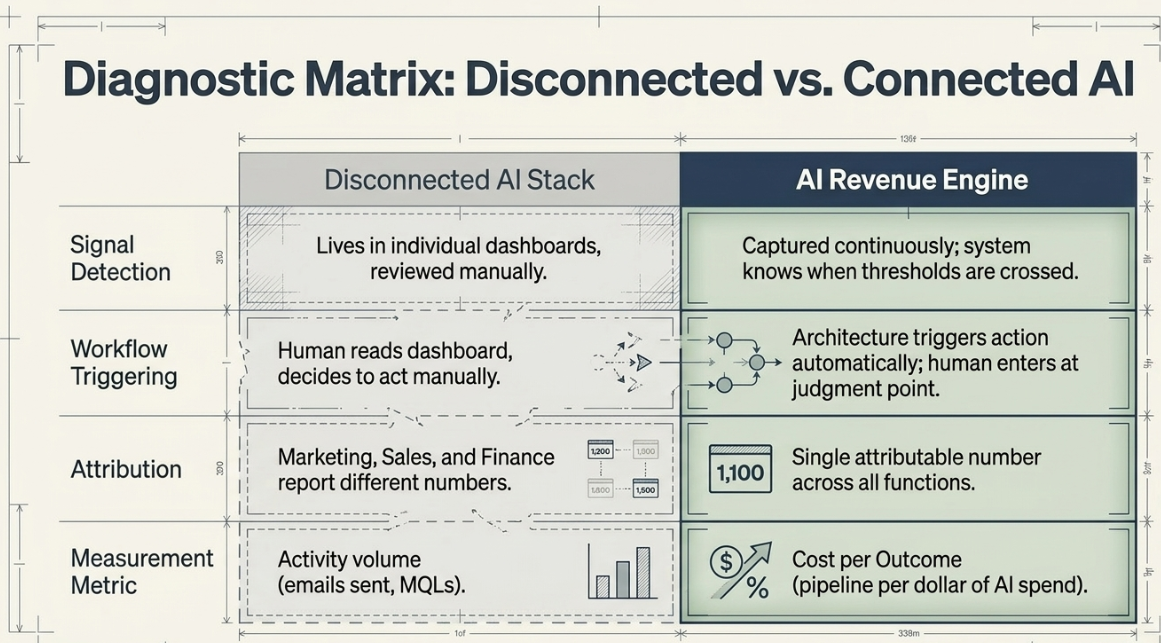
Connected vs. Disconnected — The Decision Table
|
Dimension |
Disconnected AI stack |
AI Revenue Engine |
|
Signal detection |
Signals live in individual tool dashboards, reviewed manually when someone opens the right report |
Signals are captured in a normalized data model and monitored continuously; the system knows when a threshold is crossed |
|
Workflow triggering |
A human reads the dashboard, decides whether to act, and initiates the next step manually |
The architecture triggers the next revenue action automatically when the signal crosses the defined threshold; the human enters at the judgment point |
|
Attribution |
Marketing, sales, and finance each report a different revenue number from the same quarter, from different tools |
Revenue Intelligence layer produces a single attributable number, one source of truth across all functions |
|
Measurement metric |
Activity volume: emails sent, meetings booked, sequences completed, MQLs generated |
Cost per Outcome: qualified leads produced, conversations resolved, pipeline generated per dollar of AI spend, board-presentable, and falsifiable |
The CETDIGIT Perspective — The Four Components of an AI Revenue Engine
An AI Revenue Engine has four required components. Remove any one of them, and the architecture produces partial results.
1. A Unified Data Model. One normalized view of all revenue signals across CRM, BI, and execution layers, the Cognitive Core, and the Activation Edge, reading from the same dataset. This is the foundation. Without it, every other component acts on an incomplete picture.
2. An Orchestration Layer. The rules, agents, and triggers that connect signal to action. This is what the CETRAI platform handles in a CETDIGIT architecture, the execution layer that takes a signal from the Cognitive Core and triggers the appropriate action in the Activation Edge without waiting for a human to initiate it.
3. Revenue Intelligence. The measurement layer that replaces retrospective reporting with real-time sensing. Revenue Intelligence is not a dashboard. It is the layer that knows, in real time, which accounts are showing buying behavior, which deals are at risk, and where the next revenue opportunity is sitting in the Revenue Graph, the architectural model of how buying decisions actually occur across multiple signals and touchpoints, not in a linear sequence.
4. A Cost per Outcome measurement framework. The metric that makes AI spend board-defensible. Effective April 14, 2026, HubSpot shifted two Breeze AI agents to outcome-based pricing, $0.50 per resolved conversation, $1 per qualified lead, on the logic that "businesses are being asked to make big bets on AI right now. Too often, that means paying for potential rather than performance." This pricing shift confirms that the market has validated CPO as the operational measurement standard. CETDIGIT's Revenue Intelligence layer produces the data that makes CPO calculable, connecting each AI action to a specific, attributable revenue outcome.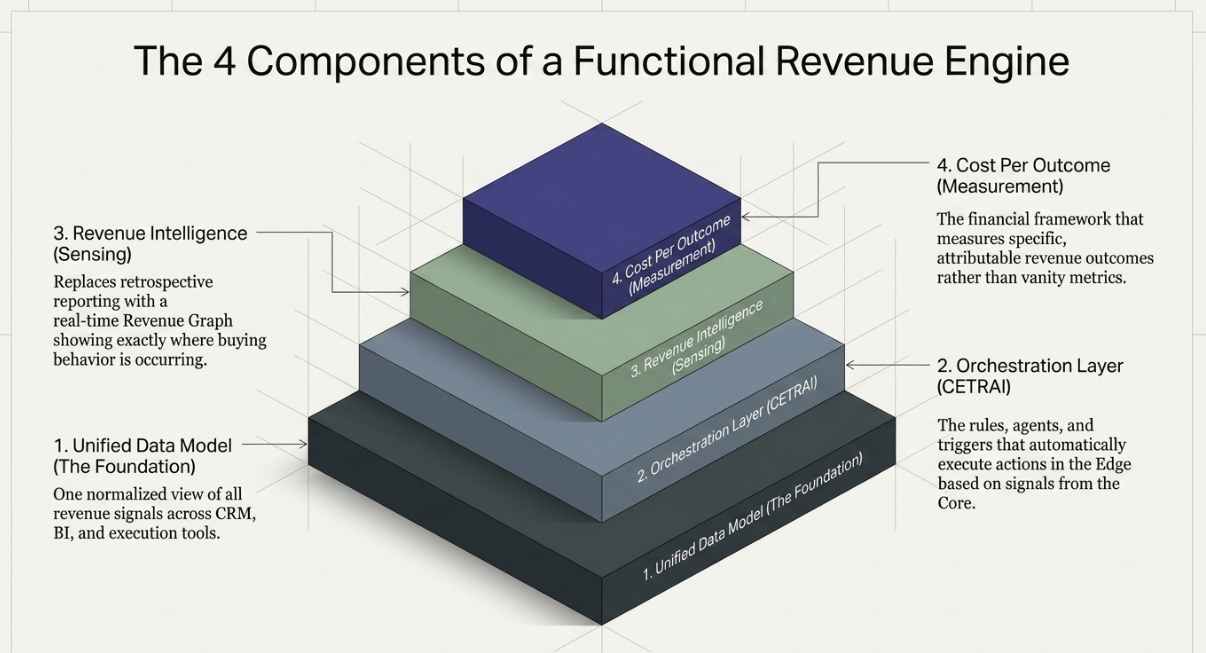
Gartner's RevOps maturity research shows what these four components produce at the organizational level: companies with advanced-maturity revenue architecture, the state this framework operationalizes, are twice as likely to exceed revenue goals as those at intermediate maturity. That is not a marginal improvement. It is an architectural one.
This four-component architecture is the core of CETDIGIT's AI Revenue Engine solution, and one component of CETDIGIT's broader AI services framework, the layer that connects every solution to measurable revenue outcomes.
Your Next Step
The AI Revenue Engine is not a product you buy. It is an architecture you build, by connecting what you already have, normalizing the signals those systems generate, and adding the orchestration layer that turns signals into action.
The Stack Unification Audit is how that process begins. It identifies where your AI investment is leaking, where the data-sharing gap is, where the handoffs are breaking the signal chain, and what a connected architecture would change about your Revenue Intelligence picture. From there, the path to CETDIGIT's AI Revenue Engine is a sequence of architectural decisions, not a tool replacement.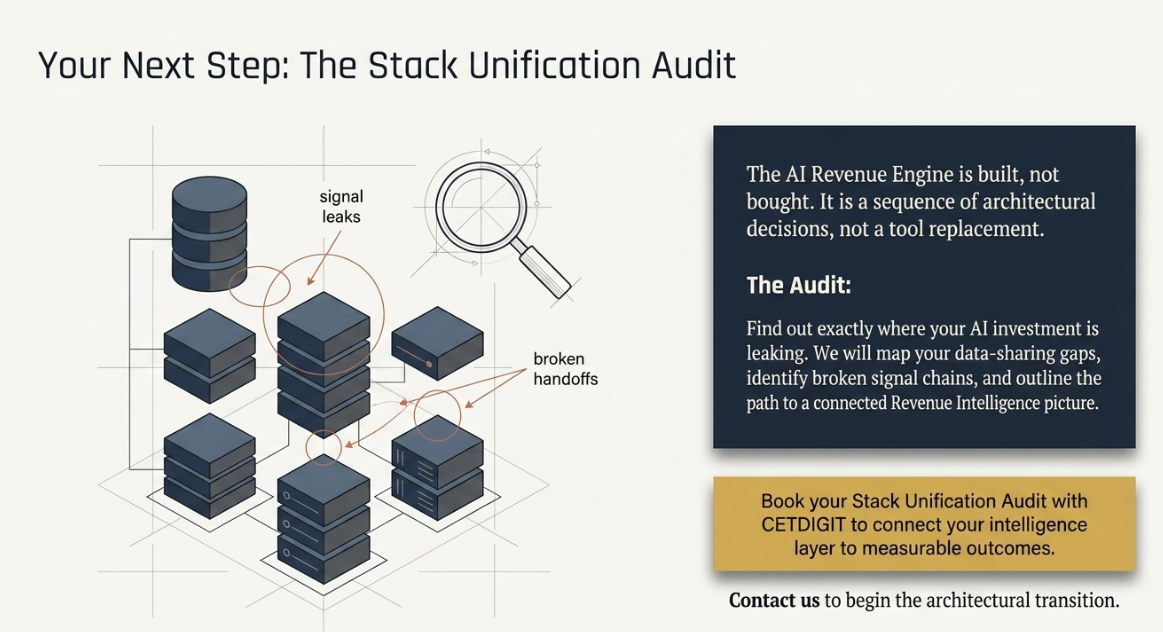
Frequently Asked Questions
What is the difference between an AI revenue engine and a CRM?
A CRM is a system of record; it stores what happened after a human recorded it. An AI Revenue Engine is the orchestration layer above the CRM; it normalizes signals from the CRM alongside signals from every other tool in the stack, and it triggers revenue actions automatically when those signals cross a defined threshold. Gartner's Revenue Action Orchestration category definition frames it this way: the RAO layer creates "an AI-ready commercial dataset" and serves as "the primary system of seller action." The CRM is the Cognitive Core where intelligence lives. The Revenue Engine is what makes that intelligence act.
How does an AI revenue engine work?
It works in four stages. First, a unified data model normalizes signals from the CRM, BI layer, and execution tools into a single view. Second, Revenue Intelligence monitors those signals continuously and detects when a threshold is crossed, a prospect re-engaging after six months, a deal showing at-risk behavior, or an inbound inquiry requiring immediate qualification. Third, the orchestration layer triggers the appropriate action automatically, activating a sequence, routing a lead, and alerting a rep with full context. Fourth, Cost per Outcome measurement attributes each action to a specific revenue result, giving the CFO a board-presentable number rather than an activity report.
What does "system of action" mean in a revenue context?
A system of action is a revenue architecture that responds to signals autonomously rather than waiting for a human to advance the deal state. In a system of record, a traditional CRM, the deal moves forward only when a rep decides to update it. In a System of Action, the architecture sweeps continuously for revenue signals: prospect behavior, account risk indicators, inbound intent. When a signal crosses the defined threshold, the system triggers the next revenue action without human initiation. The human enters the workflow at the judgment point, the high-stakes conversation, not at every administrative step between signals.
How do you measure the ROI of an AI revenue engine?
The measurement metric is Cost per Outcome, the dollar cost of each specific revenue action the architecture produces. This replaces activity-volume metrics (emails sent, meetings booked) with outcome-denominated metrics (qualified leads generated, conversations resolved, pipeline created per dollar of AI spend). HubSpot's April 2026 shift to outcome-based pricing for its Breeze AI agents, $1 per qualified lead, $0.50 per resolved conversation, confirms that the market has validated CPO as the operational standard. In CETDIGIT's client engagements, the Revenue Intelligence layer produces the attribution data that makes CPO calculable from day one of a connected architecture.
What is the Cognitive Core and Activation Edge?
The Cognitive Core is the intelligence system, typically Salesforce, where complex account logic, relationship maps, long-cycle deal memory, and compliance workflows live. It is built for depth, not speed. The Activation Edge is the execution system, typically HubSpot, where high-velocity prospecting, real-time engagement, content delivery, and inbound qualification happen. It is built for speed. The AI Revenue Engine is the orchestration layer that connects them: signal from the Cognitive Core triggers action in the Activation Edge, and context from the Cognitive Core travels with every agent interaction, so no handoff starts cold.
Who needs an AI revenue engine — and who doesn't?
Companies that have CRM data, multiple AI tools, and a revenue number that doesn't reflect what those tools are producing need a Revenue Engine. That describes most mid-market companies between $10M and $300M that have moved past the initial pipeline-visibility problem and into tool fragmentation. Companies that don't yet have a functioning CRM or basic sales process, the Revenue Chaos stage, need foundational infrastructure first. Gartner's RevOps maturity research is a useful diagnostic: Developing-maturity organizations need process and tooling. Intermediate-maturity organizations have the tooling and need the orchestration layer. Advanced-maturity organizations, twice as likely to exceed revenue goals, have the Revenue Engine running.
Stack Unification Audit
Find out exactly where your AI investment is leaking, and what it would take to connect it to revenue. A Stack Unification Audit maps where the data-sharing gap is, where handoffs are breaking the signal chain, and what a connected AI Revenue Engine architecture would change about your revenue outcomes. Book a Stack Unification Audit.



Leave a Comment