


Riverside City Hall, 9:14 AM.
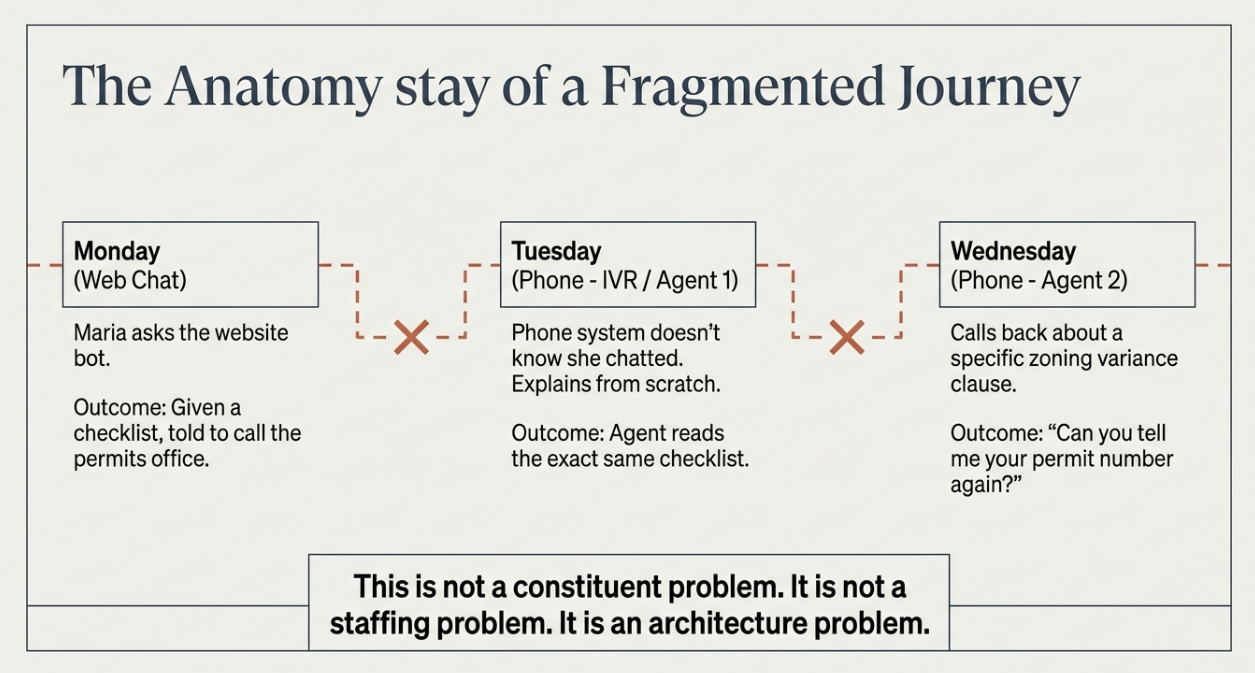
Maria has been trying to get a straight answer about her small business permit renewal for three days. On Monday, she used the city's website chat. The bot gave her a document checklist and told her to call the permits office directly for processing questions. On Tuesday, she called. The phone system had no idea she'd chatted. She explained everything again from the beginning. The agent read from the same checklist. On Wednesday, she called back with a specific question about the zoning variance clause. New agent. No context. "Can you tell me your permit number again?"
Maria is not a difficult constituent. She is a small business owner trying to do the right thing. The city has three different tools: a chat widget, an IVR, and a phone support team, and none of them know what the others said.
This is not a staffing problem. It is an architecture problem. And it has a name.
This article introduces Context Collapse as a canonical CETDIGIT concept — the systematic loss of conversation history and customer intelligence that occurs when users move between disconnected channels. For the foundational Voice Agents architecture and decision framework, see "What Is an AI Voice Agent for Websites and When Does Your Business Need One," the canonical Voice Agents cluster hub.
What Is the Context Collapse Problem?
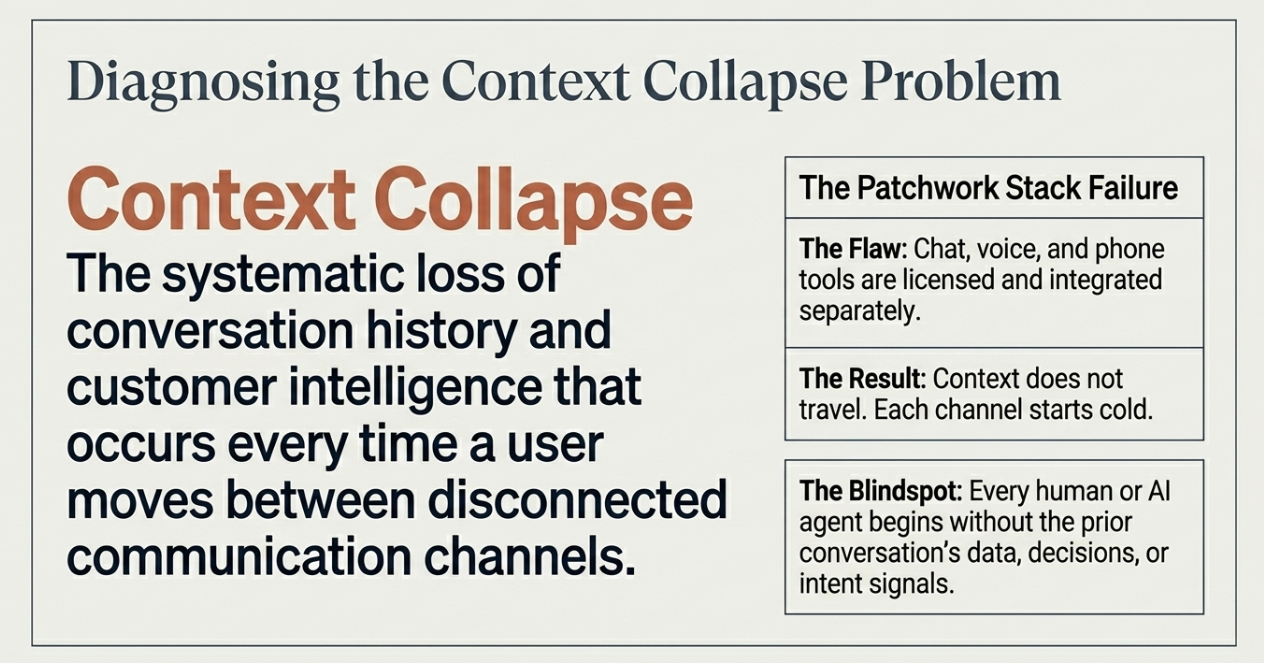
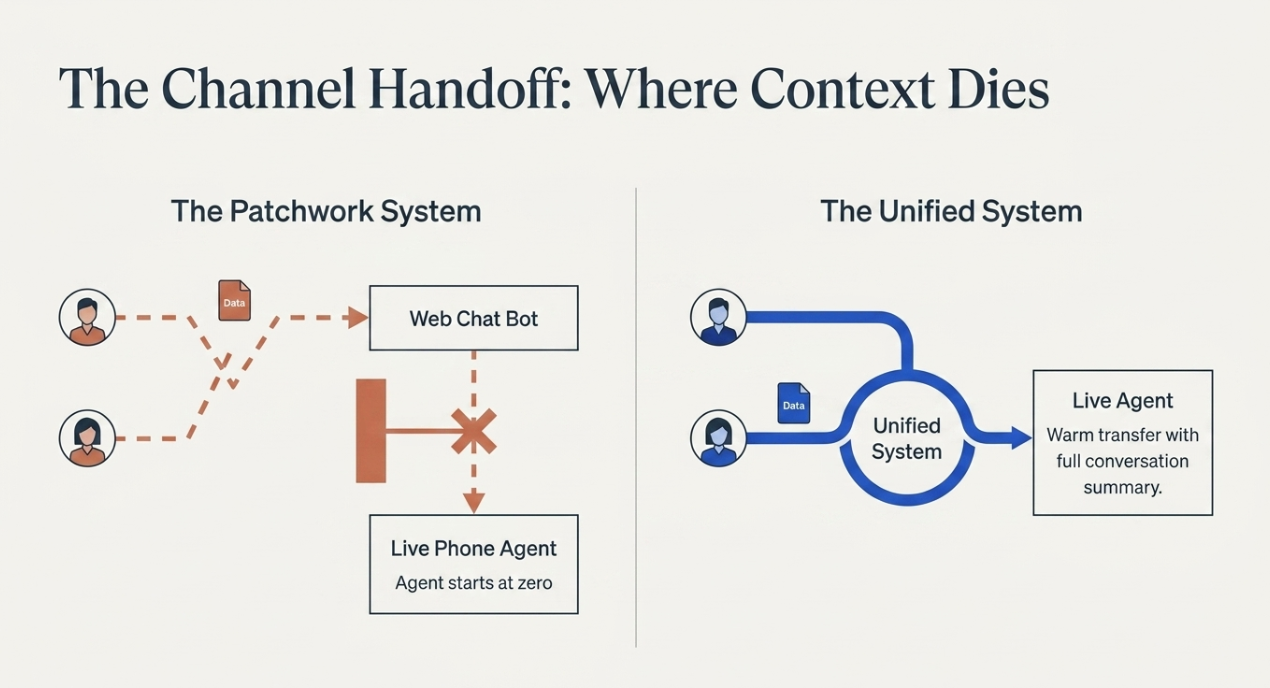
Context Collapse is the systematic loss of conversation history and customer intelligence that occurs every time a user moves between disconnected communication channels. In a patchwork architecture, where chat, voice, and phone tools are licensed and integrated separately, context does not travel with the user. Each channel starts cold. Each agent, human or AI, begins without the prior conversation's data, decisions, or intent signals.
The cost is not just frustration. It is the repeat contact rate, the handle time, the escalation volume, and the erosion of institutional trust. For a government agency, it means constituents give up on services to which they are entitled. For a university, it means prospective students go to a competitor who answers faster. For a business, it means a qualified buyer disappears during a channel handoff.
Context Collapse is the systematic loss of conversation history and customer intelligence that occurs every time a user moves between disconnected communication channels.
What Is a Unified Conversational AI Agent?
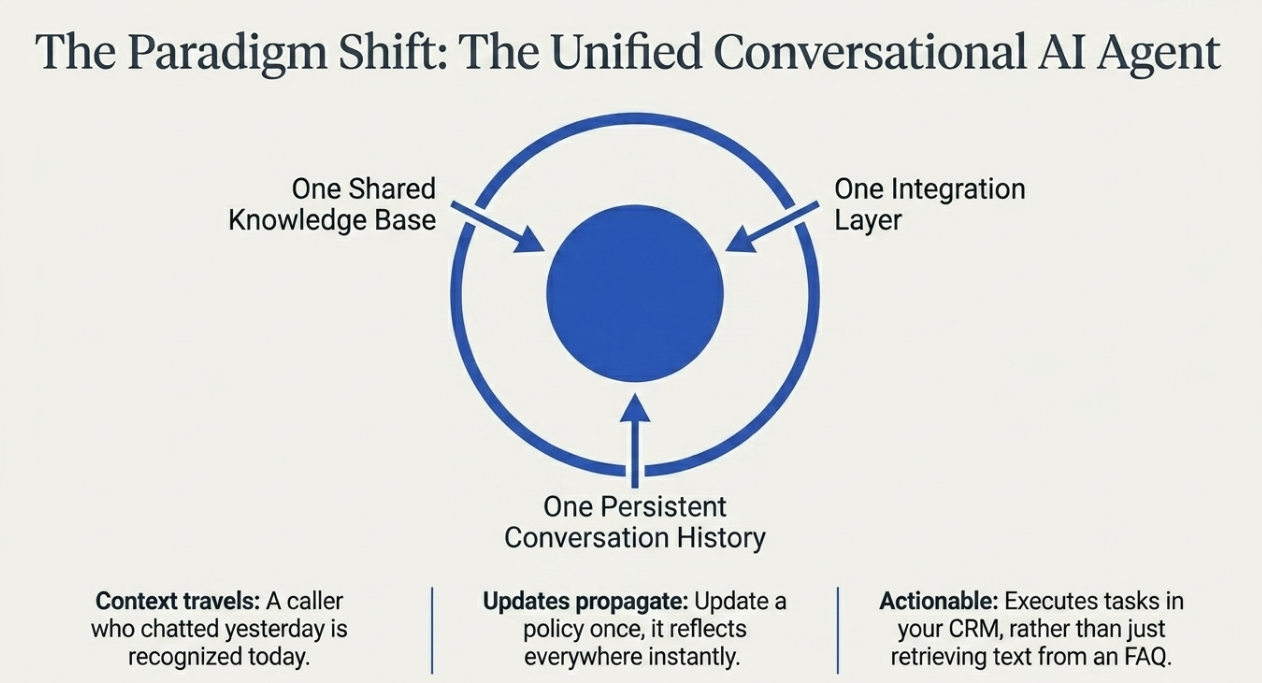
A unified conversational AI agent is a single AI system that handles interactions across web chat, browser-based voice, and inbound or outbound phone calls, using a shared knowledge base, an integration layer, and a persistent conversation history. Unlike bolted-together architectures, a unified agent retains full context when a user switches channels. A policy update propagates instantly everywhere. A caller who chatted yesterday is recognized today. The system can take action in your CRM, scheduling platform, or case management system, not just retrieve text from an FAQ.
CETRAI Chat and CETRAI Call, built by CETDIGIT, are the system. Two-channel interfaces. One intelligent agent behind both.
Organizations evaluating unified conversational AI can explore CETDIGIT's AI Voice Agents capabilities, which include CETRAI Chat and CETRAI Call as the unified-agent platform. Deployment follows the AI Implementation Model, part of the broader AI Services framework.
How CETRAI Chat and CETRAI Call Solve Context Collapse
|
What Breaks in a Patchwork Stack |
What Changes with a Unified Agent |
|
Context is lost at every channel transition |
Single conversation history persists across chat and phone |
|
Policy updates must be made in 3+ systems |
Update the knowledge base once; all channels reflect it instantly |
|
Separate CRM integrations per tool |
One integration layer; both channels read and write the same records |
|
Siloed analytics, no full-journey view |
Unified dashboard: chat, voice, and phone in one report |
|
Separate vendor contracts, SLAs, and engineering overhead |
One deployment, one support relationship, one timeline |
|
AI agent on web, human agent on phone, no handoff briefing |
Warm transfer with full conversation summary delivered to the live agent |
This is not a marginal improvement in convenience. Eliminating context collapse changes the structural economics of your support and engagement operations.
CETRAI Chat vs. CETRAI Call: Two Channels, One Brain
For clarity: CETRAI Chat and CETRAI Call are not two separate products. They are two-channel interfaces running on the same intelligent agent.
|
Capability |
CETRAI Chat |
CETRAI Call |
|
Primary Channel |
Web, text, and browser voice |
Phone, inbound and outbound |
|
Deployment |
Embed on any website or portal |
Connect to any business phone number |
|
Conversation Style |
Text, voice, or both |
Natural voice |
|
Knowledge Base |
Shared unified brain |
Shared unified brain |
|
CRM / System Integration |
Full stack, read and write |
Full stack, read and write |
|
Handoff |
Live chat agent, email, or phone transfer |
Live agent with full prior-context briefing |
|
Languages |
50+ languages |
50+ languages, voice-native |
|
Analytics |
Unified cross-channel dashboard |
Unified cross-channel dashboard |
The operational implication: you connect your systems once. You train your knowledge base once. You set your escalation logic once. Both channels inherit everything.
What the Platform Does, Capabilities That Matter for Decision-Makers
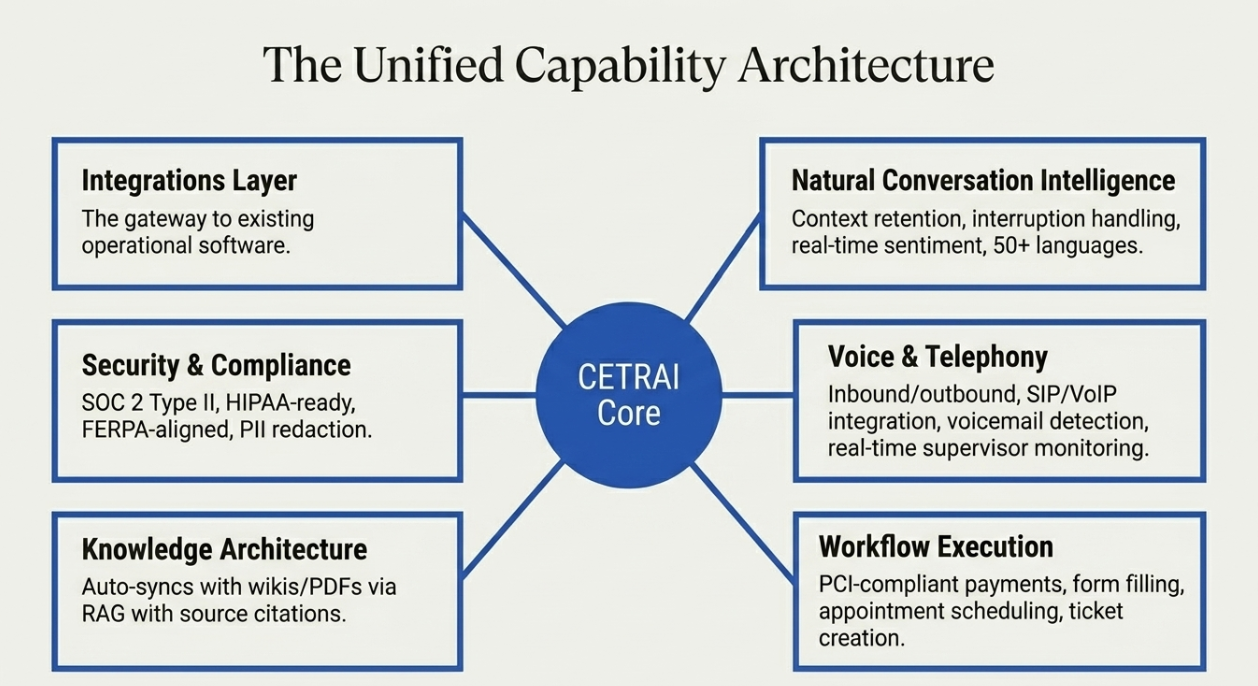
Rather than reproduce every feature, here is the capability architecture organized by what it changes operationally.
Natural Conversation Intelligence. The agent understands natural language in 50+ languages with automatic language detection, context retention across multi-turn conversations, real-time sentiment and intent signals, and interruption handling, meaning a caller can talk over it naturally without triggering a system error.
Voice and Telephony. Inbound call handling, outbound dialing for campaigns and reminders, SIP and VoIP integration with existing phone infrastructure, warm transfer with full call summary briefing, voicemail detection, call recording and transcription, and real-time supervisor monitoring.
Workflow Execution. The agent does not just answer questions. It fills forms, schedules appointments, creates tickets, processes payments (PCI-compliant), updates case records, and fires automated follow-up sequences, within the conversation, in your existing systems of record.
Knowledge Architecture. Upload documents, PDFs, websites, and structured data. Connect to wikis and document repositories with auto-sync. Retrieval-augmented generation grounds every answer in your actual content, with source citations so users can verify its origin.
Security and Compliance. SOC 2 Type II certified. HIPAA-ready deployments for healthcare and human services. FERPA-aligned for higher education. GDPR and CCPA data privacy controls. PII redaction in transcripts. On-premise and private cloud deployment available. [Author note: Confirm current certification status before publishing.]
Integrations. Salesforce, HubSpot, Microsoft Dynamics, Zoho, Zendesk, ServiceNow, Microsoft Teams, Slack, Google Calendar, Outlook, Stripe, Banner, PeopleSoft, Canvas, Tyler Technologies, Granicus, n8n, Zapier, Power Automate, and any REST or GraphQL API.
Where It Works, Use Cases by Sector
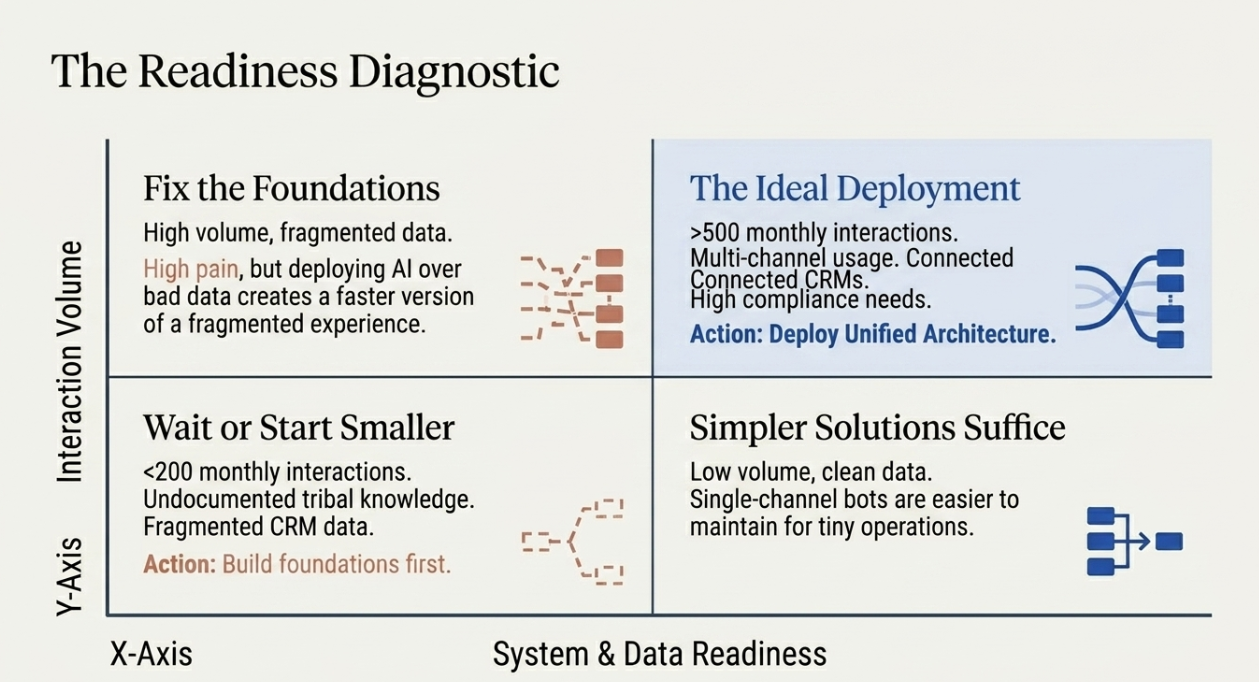
Government and Citizen Services
Riverside's Maria problem is not unique. It plays out in every permit office, benefits department, and DMV in the country.
CETRAI gives government agencies a force multiplier without adding headcount. Citizens can call or chat to report service issues, check permit status, pre-screen for SNAP or housing eligibility, schedule caseworker appointments, pay fees, or get tax-filing guidance in their preferred language at any hour. Non-emergency call volume is absorbed by the agent, freeing dispatchers and staff for situations that require human judgment. Constituent interactions are logged automatically in your case management system, with no manual entry required.
The specific win for government: constituents from multilingual communities get consistent, accurate answers without the agency having to staff bilingual agents on every shift.
Universities and Higher Education
Admissions offices face a structural mismatch: peak inquiry volume arrives at exactly the moment staff are most stretched. CETRAI handles that surge. Prospective students get answers about the program, tuition, and financial aid instantly via chat or phone. The system can make proactive outbound calls to nurture applicants as they progress through enrollment milestones. During financial aid season, FAFSA guidance and award letter explanations run 24/7 without burning out aid counselors.
For student services: IT password resets, course registration questions, degree requirement lookups, and mental health resource referrals are handled on first contact. Sensitive escalations go to trained human counselors with full prior conversation context delivered in advance.
Enterprise Business and Operations
For sales and service teams, the most direct impact is on lead response time and support volume. Website visitors are engaged the moment they arrive, qualified, and routed to the right rep with full context, not passed through a generic chatbot before hitting a cold inbox. Support teams field fewer repeat contacts because agents resolve common issues completely rather than partially. Outbound call campaigns for collections, reminders, and renewals run without manual dialing. Field service coordinators stop playing phone tag with technicians and customers.
Who This Is For, and Who Should Wait
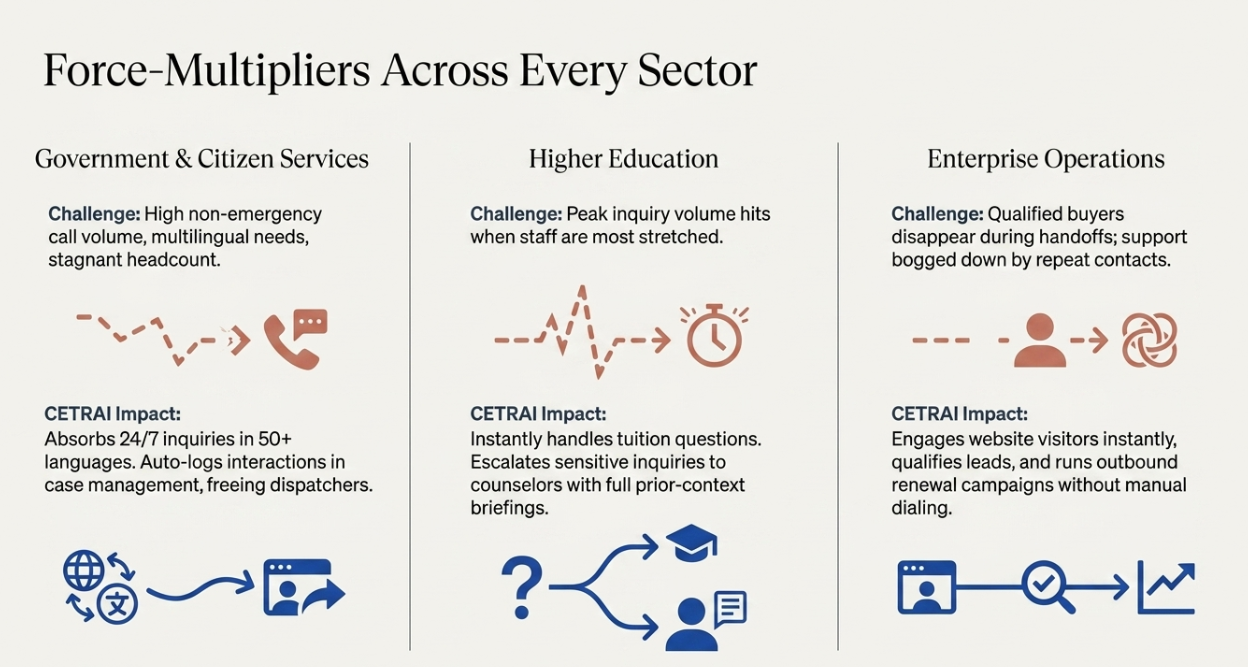
Not every organization needs a unified conversational AI platform. Here is the honest decision logic.
Deploy a unified agent when:
- You operate across two or more communication channels (web chat and phone are the most common), and users regularly move between them
- Your teams are handling more than 500 monthly interactions, and a meaningful percentage require action in a back-end system, not just a FAQ answer
- Context loss at channel transitions is producing measurable downstream cost, repeat contacts, escalation volume, or constituent/customer dissatisfaction
- You have at least one CRM, case management, or scheduling system that a connected agent could read from and write to
- Compliance requirements (HIPAA, FERPA, GDPR) mean you need a single governed platform rather than multiple vendor relationships with separate compliance postures
Wait, or start smaller, when:
- You handle fewer than 200 monthly interactions on a single channel, a simpler single-channel bot is sufficient and easier to maintain
- Your knowledge base is not yet documented, and unstructured tribal knowledge will not train an effective AI agent, regardless of platform sophistication
- Your CRM or core operational systems have data quality problems; a unified agent amplifies whatever data quality exists; if the data is fragmented, the agent's answers will be too
- You do not have a designated owner for escalation logic and knowledge base maintenance. AI agents require ongoing governance, not a one-time setup
The blunt reality: a unified conversational AI platform is infrastructure, not a plug-in. Organizations that treat it as a quick deployment will produce a faster version of the same fragmented experience. Organizations that treat it as a system design project will produce something whose value compounds over time.
What Changes When Context Doesn't Break
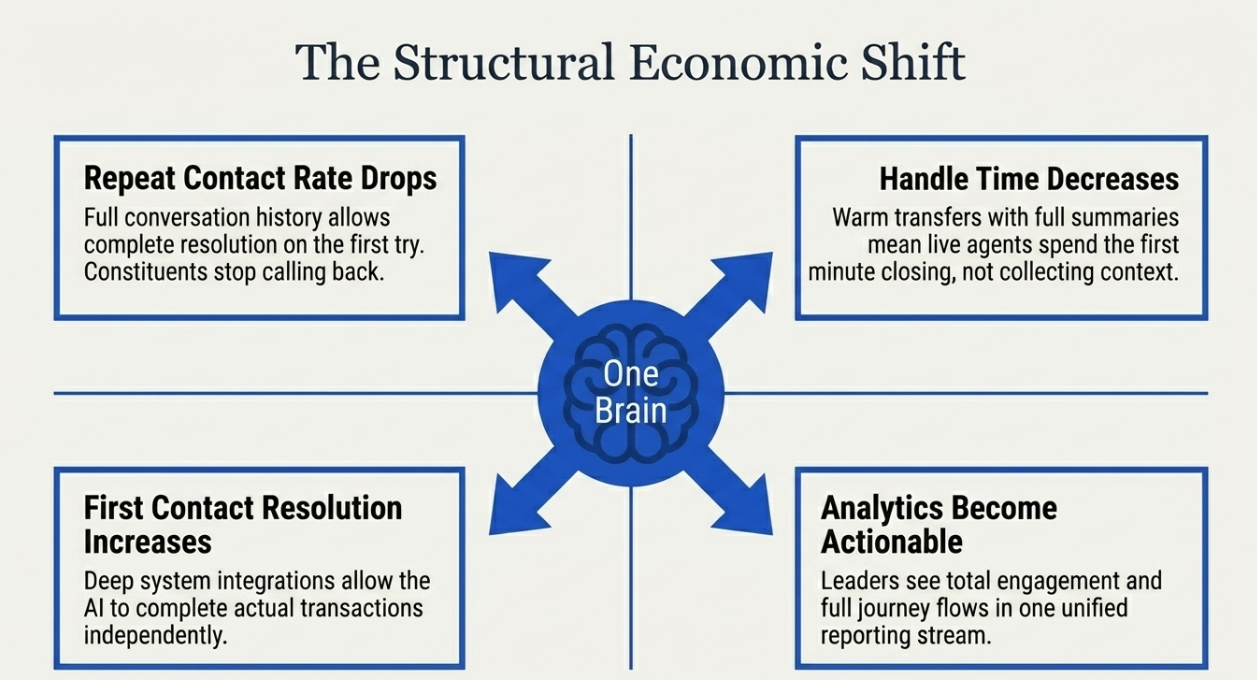
When the unified architecture is in place, four operational metrics shift in ways that justify the investment to a CFO.
Repeat Contact Rate Drops. When the agent has a full conversation history and can actually take action in your systems, it resolves interactions completely rather than partially. Constituents and customers stop calling back to restart.
Handle Time Decreases. Warm transfers with full conversation summaries mean live agents spend the first minute closing, not collecting context they should already have.
First Contact Resolution Increases. An agent connected to your scheduling, case management, and payment systems can complete transactions in the conversation. It does not hand off tasks that the system could finish to a human.
Analytics Become Actionable. Leaders see total engagement, resolution rates, topic clusters, and channel mix in one place. They stop managing three separate reporting streams and start seeing the actual journey.
[Author note: If directional metrics or client-referenced performance data exist, insert here for maximum credibility. Even anonymized ranges strengthen this section considerably.]
How Deployment Works: The Phased Rollout Model
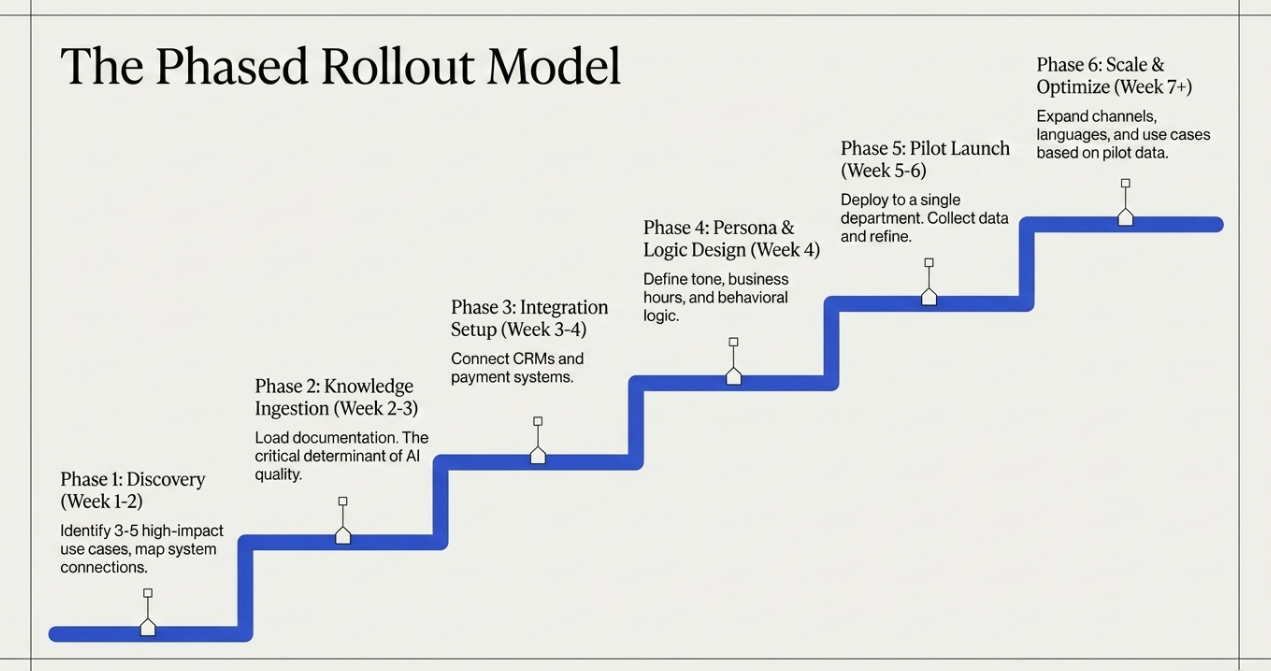
Most organizations are live in production within weeks, not months. The path follows a consistent phased logic.
Phase 1, Discovery (Week 1–2). Identify the three to five highest-impact use cases. Map the systems the agent will need to connect to. Define escalation criteria and compliance requirements.
Phase 2, Knowledge Ingestion (Week 2–3). Load existing documentation, FAQs, policies, and structured data. The quality of this phase determines the quality of every answer the agent gives.
Phase 3, Integration Setup (Week 3–4). Connect to CRM, case management, scheduling, and payment systems. This is where the agent moves from an answering machine to an operational participant.
Phase 4, Persona and Logic Design (Week 4). Define tone, escalation rules, business hours behavior, and agent name. This is not cosmetic, persona design determines how users respond to the system at high-stakes moments.
Phase 5, Pilot Launch (Week 5–6). Deploy to a single department or user segment. Collect interaction data, identify gaps, and refine before full rollout.
Phase 6, Scale and Optimize (Week 7+). Expand to additional channels, departments, languages, and use cases. Performance data from the pilot drives prioritization.
The organizations that compress this timeline unnecessarily are the ones that end up with a sophisticated tool producing the same inconsistent answers as the system it replaced.
One Agent, Every Conversation
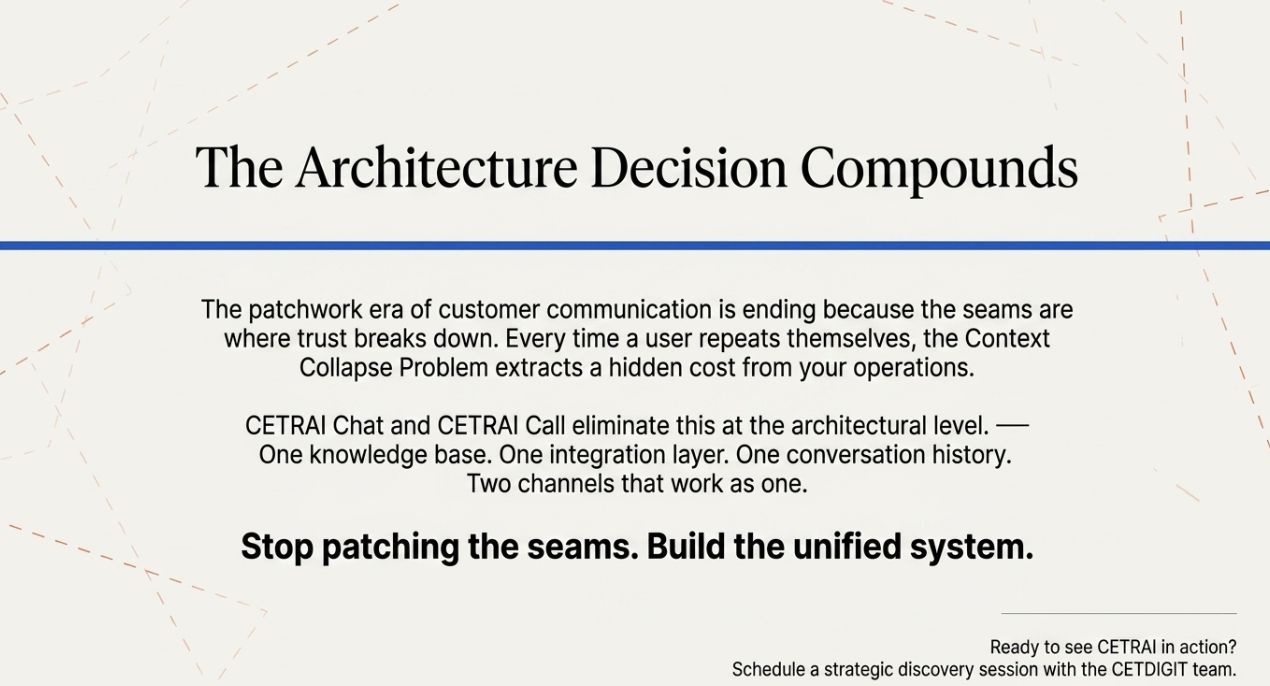
The patchwork era of customer and constituent communication is not ending because the tools are expensive. It is ending because the seams between the tools are where trust breaks down. Every time a caller is asked to repeat themselves, every time a chatbot sends someone to a phone line that has no idea they chatted, every time a policy update takes three weeks to propagate across four systems, that is the Context Collapse Problem, extracting a cost that rarely appears as a line item on the P&L but shows up everywhere in the business.
CETRAI Chat and CETRAI Call are built to eliminate that problem at the architectural level. One knowledge base. One integration layer. One conversation history. Two channels that work as one.
For government agencies, that means serving more constituents without adding staff. For universities, it means better student experiences without burning out the people delivering them. For businesses, it means 24/7 engagement that actually resolves, not just responds.
At CETDIGIT, we design, deploy, and optimize CETRAI implementations tailored to your workflows, compliance requirements, and existing technology stack. Whether you are consolidating fragmented tools or deploying conversational AI for the first time, the architecture decision you make now will compound, in either direction, for years.
Stop patching the seams. Build the unified system.
Ready to see CETRAI in action?
Voice Agent Fit
Book a 30-minute Voice Agent Fit Check. We will identify where context collapse is costing your organization and whether a unified agent is the right fix.
FAQ
What is the difference between CETRAI Chat and CETRAI Call? CETRAI Chat handles web-based interactions, text chat, and browser voice. CETRAI Call handles inbound and outbound phone. Both run on the same knowledge base, integrations, and conversation history. They are two-channel interfaces, not two separate products.
What CRM systems does CETRAI integrate with? CETRAI integrates natively with Salesforce, HubSpot, Microsoft Dynamics, and Zoho, as well as service platforms such as Zendesk, ServiceNow, and Freshdesk, and automation layers such as Zapier, n8n, and Power Automate. Any REST or GraphQL API can also be connected.
Is CETRAI HIPAA compliant? CETRAI supports HIPAA-ready deployments for healthcare and human services organizations, including data encryption, PII redaction, and configurable retention policies. Confirm current certification status with the CETDIGIT team for your specific use case.
How long does a CETRAI deployment typically take? Most organizations reach a working production deployment within four to six weeks using the phased rollout model. Timeline depends on integration complexity and knowledge base readiness.
Who is CETRAI not suited for? Organizations handling fewer than 200 monthly interactions on a single channel, teams without a documented knowledge base, or operations with significant CRM data-quality problems should address these foundations before deploying a unified conversational AI platform.


Leave a Comment