


Introduction
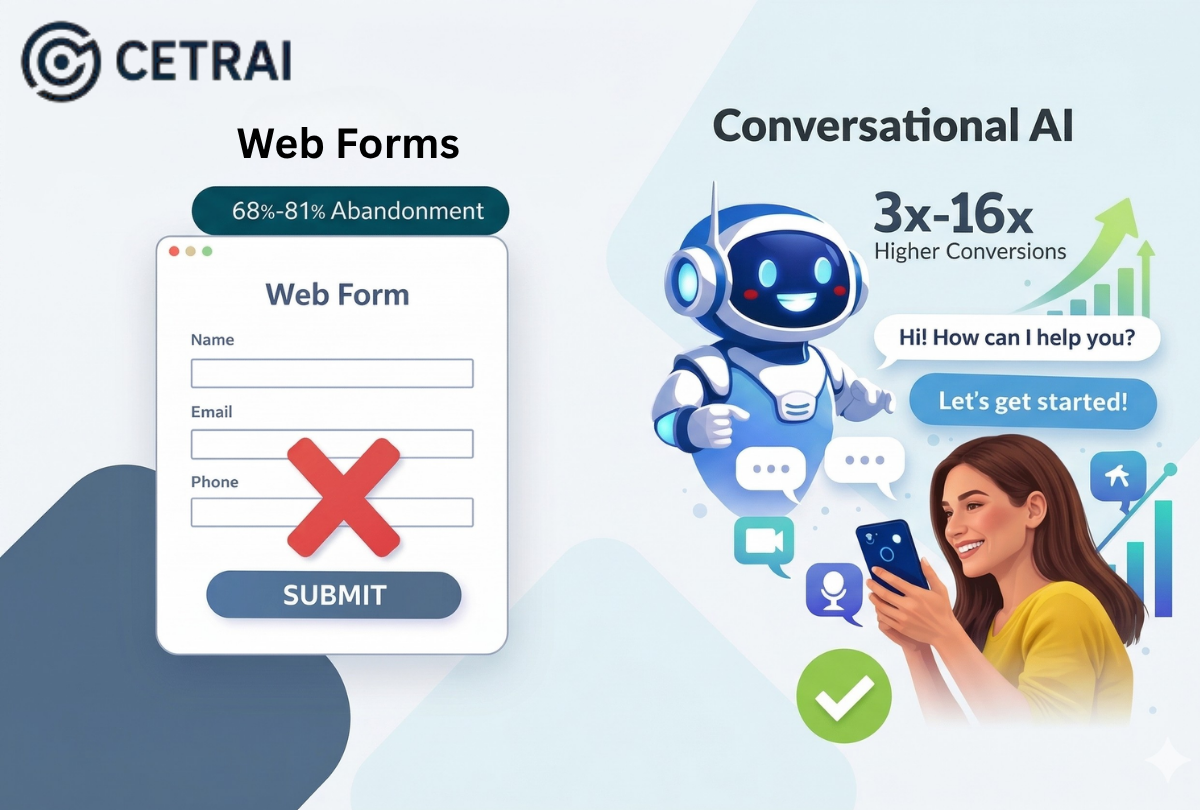
Let's be honest: nobody likes filling out forms. Not your customers, not your leads, not your support requesters—nobody. And the data proves it. The average form abandonment rate across industries sits between 68% and 81%, meaning the vast majority of people who start filling out your carefully crafted form never hit "Submit."
For decades, web forms have been the default mechanism for capturing leads, collecting customer information, and gating content. But forms were designed for databases, not for humans. They were built to make life easier for the company collecting the data—not for the person providing it.
Now, with the rise of conversational AI, voice agents, and intelligent chat interfaces, there's a better way. And early adopters are seeing conversion rates 3x to 16x higher than traditional forms. The form is dead. Here's why—and what's replacing it.
The Case Against Forms: Death by a Thousand Fields
The problems with forms aren't subtle. They're structural, well-documented, and getting worse as user expectations evolve:
🔴 Abandonment Is the Norm, Not the Exception
81% of people have abandoned a form after starting to fill it out. For specific industries, it's even worse—the automotive sector sees 82% abandonment, airlines hit 81%, and nonprofits aren't far behind at nearly 78%. Even checkout forms, where someone has already decided to buy, suffer abandonment rates above 70%.
🔴 Every Field You Add Costs You Leads
Research consistently shows that asking for a phone number reduces conversions by up to 5%. Adding a street address drops it another 4%. Asking for age costs 3% more. The optimal number of form fields for a landing page? Three. Yet the average lead generation form has 11 fields. That's not a form—it's a wall.
🔴 Mobile Makes It Worse
Mobile users now account for over 60% of web traffic, but mobile form abandonment rates soar to 85% compared to roughly 68% on desktop. Small screens, fiddly fields, autofill misfires, and slow load times turn every form into an exercise in frustration. Forms were designed for keyboards and mice—not thumbs.
🔴 Forms Are One-Way Conversations
A form says: "Give me your information, and maybe I'll get back to you." There's no dialogue, no adaptation, no personalization. If a prospect has a question before submitting, they're out of luck. If they don't understand a field, they leave. If they're on the fence, there's nothing to nudge them forward. It's the digital equivalent of handing someone a clipboard and walking away.
What's Actually Replacing Forms
The replacement isn't a better form. It's not a shorter form. It's not a multi-step form with a progress bar. It's a fundamentally different approach: conversation.
Conversational AI—whether through chat agents, voice agents, or intelligent intake flows—replaces the static, one-size-fits-all form with a dynamic, adaptive dialogue that collects the same information (and more) while feeling natural to the user.
Here's what this looks like in practice:
| Dimension | Traditional Form | Conversational AI |
|---|---|---|
| User Experience | Static fields, no feedback | Dynamic dialogue, real-time responses |
| Qualification | Happens after submission (by a human) | Happens during the conversation (instantly) |
| Personalization | None—every visitor sees the same form | Adapts questions based on responses |
| Data Richness | Name, email, maybe a dropdown | Intent, urgency, sentiment, context, preferences |
| Conversion Rate | 2–5% average | 20–40%+ (up to 70% in some industries) |
| Availability | 24/7 (but no engagement) | 24/7 with active engagement and follow-up |
| CRM Integration | Basic field mapping | Rich data with scoring, routing, and next-step actions |
| Follow-Up Speed | Hours or days | Instant qualification and handoff |
The shift is fundamental: forms demand information before delivering value. Conversations earn information by delivering value first.
The Value-First Model: How AI Collects Every Detail Without Asking for a Single "Form Field"
Here's what makes conversational AI fundamentally different from a form: it doesn't start by asking. It starts by helping.
When a visitor lands on your site and engages with an AI agent, the conversation doesn't begin with "Please enter your name and email." It begins with "How can I help you today?" That single shift changes everything. The visitor feels heard, not harvested. And in the process of receiving genuine value—answers to their questions, guidance on their problem, recommendations tailored to their situation—they naturally share all the details your team needs.
Think about how this works in practice:
- A visitor asks about pricing. The AI provides relevant pricing context, asks about their team size and use case to give a more accurate answer, and now you have budget signals, company size, and product interest—without a single form field.
- A prospect asks how your solution compares to a competitor. The AI walks them through key differentiators, asks what matters most to their decision, and now you have competitive context, evaluation criteria, and purchase timeline—all captured naturally.
- A support visitor describes a problem. The AI troubleshoots step by step, asks about their setup, and now you have product usage data, account context, and satisfaction signals—while the visitor actually got their problem solved.
In every one of these scenarios, the visitor received value before they were asked for anything. The AI answered questions, provided insights, and demonstrated competence. By the time the conversation reaches a point where a name, email, or phone number is relevant—"Would you like me to send you a summary?" or "Can I book a time with our team for you?"—the visitor is willing to share because trust has already been established.
This is the trust dynamic that forms fundamentally cannot replicate. A form asks for trust upfront, before the visitor has received anything in return. Conversational AI earns trust incrementally, through every helpful response, every smart follow-up question, and every moment where the visitor feels like they're talking to someone who actually understands their needs.
The result is twofold: you collect more complete information (because the visitor is engaged and willing), and the information you collect is richer (because it includes context, intent, and preferences that no form field could capture). Your CRM doesn't just get a name and an email. It gets a story—who this person is, what they need, why they need it, and how ready they are to move forward.
The Data Quality Argument: Why Conversations Win
Here's a truth that rarely gets discussed in form-vs-conversation debates: the quality of data you capture through a conversation is categorically different from what a form produces.
A form gives you structured data: a name, an email, maybe a company name, and whatever the person typed into that dreaded "Tell us about your needs" text box. It's surface-level. It tells you who someone is, but almost nothing about what they actually want, how urgently they need it, or where they are in their buying journey.
A conversation gives you all of that plus:
- Intent signals: What are they actually trying to solve? A conversation naturally reveals pain points, priorities, and decision criteria that no dropdown menu can capture.
- Urgency indicators: Are they researching for next quarter, or do they need a solution this week? The language and pace of a conversation surfaces this naturally.
- Sentiment and tone: Are they frustrated with their current solution? Excited about a specific feature? Skeptical? This context shapes how your sales team should follow up.
- Objections and hesitations: A conversation can surface and address objections in real time, rather than losing the lead to silent doubt.
- Qualification depth: Budget, timeline, decision-making authority, and specific requirements can be explored conversationally without the friction of a 15-field form.
In CRM terms, a form submission gives you a contact record. A conversation gives you an opportunity with context. That's the difference between a name in a spreadsheet and a qualified deal in your pipeline.
Where Forms Should Be Replaced First
You don't need to replace every form on day one. Start where forms are costing you the most:
🔹 Lead Capture / "Contact Us" Pages
These are the highest-intent pages on your site, and they're often protected by the longest forms. Replace them with a conversational agent that qualifies leads in real time, asks smart follow-up questions, and books meetings on the spot. Companies making this switch see conversion rates jump from the typical 2–5% to 20–40%.
🔹 Support Ticket Creation
Instead of asking customers to categorize their own issue, describe it in a text box, and hope someone reads it, let an AI agent triage the issue through conversation. It can ask clarifying questions, check account status, attempt resolution, and only escalate when necessary—with full context attached.
🔹 Event Registration and Appointment Booking
Registration forms are pure friction. A voice or chat agent can handle the entire process conversationally, check availability in real time, send confirmations, and sync to your CRM and calendar systems automatically.
🔹 Intake Processes (Healthcare, Nonprofits, Government)
Complex intake forms are notoriously long and confusing. Conversational AI can walk applicants through eligibility criteria step by step, explain requirements in plain language, and collect documentation—all while maintaining compliance and audit trails.
🔹 Sales Qualification
Why make a prospect fill out a form, wait for a call, then repeat everything they already typed? An AI agent can qualify in real time: budget, timeline, use case, and decision-maker status—then hand off a warm, contextualized lead directly to the right rep.
The CRM Connection: How Conversations Flow Into Salesforce and HubSpot
One of the biggest advantages of conversational AI over forms is what happens after the interaction. With traditional forms, data arrives as flat field values that need to be manually reviewed, scored, and routed. With conversational AI, the data arrives pre-qualified, pre-scored, and ready for action.
In Salesforce environments:
- Conversation data flows directly into Leads, Contacts, and Opportunities with full context
- AI-generated call summaries and intent signals populate custom fields
- Einstein AI can score leads based on conversational data, not just form submissions
- Automated workflows trigger based on qualification outcomes—no manual triage required
In HubSpot environments:
- Contacts are enriched with conversational context, engagement scores, and next-step recommendations
- Smart lists and workflows trigger based on AI-captured intent signals
- Deal creation is automated with pre-populated fields from the conversation
- Sales teams receive contextualized handoffs with full conversation history
The result is a CRM that doesn't just store data—it acts on it. Your reps spend less time on data entry and more time closing deals.
AI Voice Agents: The Next Frontier Beyond Chat
Chat-based conversational AI is powerful, but voice agents take it even further. For use cases where typing is inconvenient, where the audience prefers phone interaction, or where the complexity of the conversation demands real-time dialogue, AI voice agents are replacing both forms and traditional IVR systems.
Here's how voice agents are eliminating forms in practice:
- Outbound lead qualification: Instead of waiting for a form submission, voice agents proactively call prospects, qualify them through natural conversation, and log outcomes directly into the CRM
- Appointment scheduling: Voice agents check availability, book meetings, send confirmations, and handle rescheduling—all without a single form field
- Customer support intake: Callers describe their issue naturally, and the agent triages, resolves, or escalates with full context—no "Press 1 for billing" or ticket forms
- Post-sale follow-up: Voice agents handle satisfaction surveys, renewal conversations, and upsell opportunities through dialogue rather than survey forms
The key advantage of voice: it captures nuance that text cannot. Tone, hesitation, excitement, confusion—these signals help AI agents respond more intelligently and give sales teams richer insights than any form could provide.
Real Results: What Happens When You Kill the Form
The shift from forms to conversational AI isn't theoretical. The numbers are striking:
| Metric | Traditional Forms | Conversational AI |
|---|---|---|
| Average Conversion Rate | 2–5% | 20–40% (up to 70% in some sectors) |
| Lead Quality | Unqualified, needs manual review | Pre-qualified with intent and context |
| Response Time | Hours to days | Instant |
| Cost Per Lead | Higher (more volume needed) | Lower (higher conversion from same traffic) |
| Data Collected | 5–15 flat fields | Behavioral, contextual, and intent data |
| Mobile Experience | Frustrating (85% abandonment) | Natural and thumb-friendly |
| Availability | Passive, no engagement | Active, 24/7 with real-time follow-up |
Businesses report that AI chatbots and voice agents generate 55% more high-quality leads, while some see up to a 3x improvement in overall conversion rates compared to static web forms. In industries like real estate, SaaS, and e-commerce, the gap is even wider.
But Wait—Are Forms Really Dead Dead?
To be fair: forms won't disappear entirely overnight. There are legitimate uses where a structured form still makes sense—legal compliance documents, medical intake with specific regulatory requirements, payment processing, or situations where the user explicitly prefers self-service data entry.
But for the high-value interactions that drive revenue—lead capture, sales qualification, customer support, appointment booking, and onboarding—the form is no longer the best tool for the job. It's a relic of an era when websites were digital brochures and "Submit" was the only call to action available.
The question isn't whether forms will be replaced. It's how quickly your competitors will replace theirs.
Getting Started: How to Make the Shift
If you're ready to retire your forms, here's a practical roadmap:
1. Audit Your Highest-Value Forms
Identify the forms that sit at critical conversion points: lead capture, demo requests, support tickets, and appointment booking. These are where conversational AI will deliver the fastest ROI.
2. Map the Conversation Flow
Think about what your best salesperson or support agent would ask in a live conversation. What qualifying questions matter? What objections need to be addressed? What information does the CRM need? Design the conversational flow around these answers.
3. Integrate With Your CRM
Ensure that conversational data flows directly into Salesforce or HubSpot with proper field mapping, lead scoring rules, and automated workflow triggers. The goal is zero manual data entry.
4. Start With One Use Case
Don't try to replace every form at once. Pick your highest-impact use case, deploy, measure, and iterate. Once you see the conversion lift, expanding becomes an easy decision.
5. Add Voice When Ready
Once your chat-based conversational flows are working, extend to voice for outbound qualification, appointment setting, and support intake. Voice agents add another layer of engagement and data richness.
Conclusion: From Data Capture to Intelligent Conversation
The shift from forms to conversational AI isn't about technology for technology's sake. It's about recognizing a fundamental truth: people don't want to fill out forms. They want to have conversations. They want to be heard, understood, and helped—not interrogated by a grid of empty fields.
For businesses running on Salesforce or HubSpot, this shift is even more powerful. Conversational AI doesn't just replace the form—it transforms the entire front door of your revenue engine. Better data, faster qualification, higher conversion, and richer CRM intelligence.
Forms had a good run. But in a world where AI can listen, understand, qualify, and act in real time, the clipboard-and-submit model is officially obsolete.
Ready to replace your forms with intelligent AI agents? CETRAI builds conversational AI solutions that integrate seamlessly with Salesforce and HubSpot—from chat agents to voice agents to full workflow orchestration. Let's talk about what's possible. Schedule a consultation today.
Related Reads
- Beyond Standard RAG: How Agentic RAG Is Transforming Enterprise AI
- The Complete Guide to AI Voice Agents for Sales & Support
- How AI Agents Are Reshaping CRM Automation
- Salesforce vs. HubSpot: Choosing the Right CRM for AI Integration
.png?width=352&name=lg%20(1).png)

Leave a Comment