


Customer service has changed more in the last three years than in the previous two decades. What started as keyword-matching scripts has become something genuinely different: AI systems that understand context, reason through complexity, take action in your CRM, and know when to hand the conversation to a human. The question facing service leaders today is not whether intelligent agents belong in their operations. It is whether their current infrastructure and their platform choice are positioned to make the transition work.
For the canonical current-state CETDIGIT architecture that this evolution leads toward, see "What Is an AI Revenue Engine?" and the Voice Agents cluster hub.
This post traces the evolution from first-generation chatbots to today's autonomous agents, examines how Salesforce Agentforce and HubSpot Breeze are implementing this differently, and gives you a clear framework for deciding which approach fits your organization.
What Separates an Intelligent Agent from a Chatbot
An intelligent AI agent is an autonomous system that understands a customer's goal, plans a response across multiple steps, retrieves live data from CRM records and knowledge bases, takes action within those systems, updating records, issuing refunds, scheduling follow-ups, and determines when the situation requires a human. It does this without a script.
A traditional chatbot does none of that. It matches input against a decision tree. If the customer phrases the request in an unexpected way, the bot fails. Every new scenario requires manual scripting. Maintenance is expensive, and the ceiling is low.
The distinction matters because these are not points on the same spectrum. They are different categories of software with different architectures, different data requirements, and different operational implications.
The Three-Generation AI Service Model
Understanding where these platforms are today requires understanding how the technology arrived here. AI in customer service has moved through three distinct generations, each defined by what the system could actually do, not what the vendor claimed.
Generation 1 — Rule-Based Chatbots (2015–2020)
The first generation ran on decision trees and keyword triggers. These systems were useful for deflecting the most repetitive inquiries, password resets, store hours, and FAQ responses, but brittle everywhere else. They could not handle follow-up questions, manage multi-turn conversations, or adapt when a customer said something outside the script. Every edge case required a human developer to write a new branch.
Generation 2 — NLP Virtual Assistants (2020–2024)
The second generation introduced natural language processing and machine learning. These systems could recognize intent rather than just keywords, handle more complex queries, and improve over time. Sentiment analysis, intent classification, and basic context retention became standard. Salesforce Einstein Bots and HubSpot's early chatbot builder represented this era. They were a genuine step forward, but they still operated reactively. They answered when asked. They did not plan, reason, or initiate action.
Generation 3 — Autonomous Intelligent Agents (2024–Present)
The current generation is powered by large language models, retrieval-augmented generation, and agentic architectures. These agents understand goals, plan multi-step workflows, retrieve and verify information from multiple data sources, take action within your CRM, and hand off to humans with full context when needed. Salesforce Agentforce and HubSpot Breeze Agents are operating at this level today. These are not chatbots with better language skills. They are systems capable of executing end-to-end service workflows without human intervention.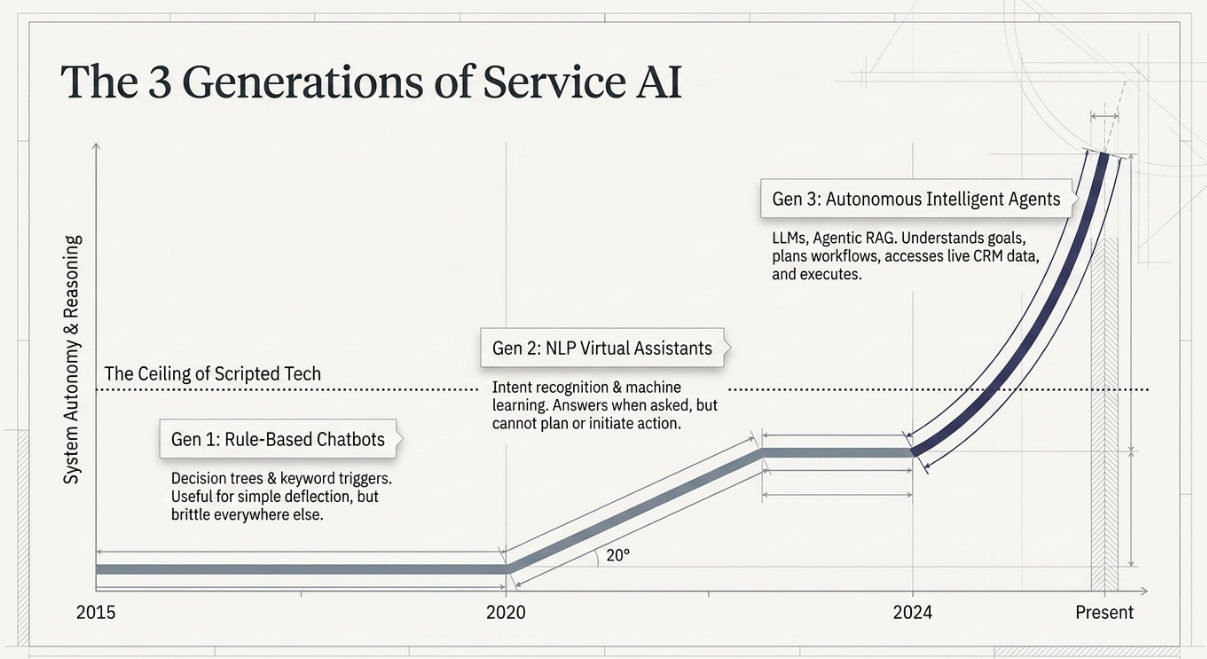
Chatbots vs. Intelligent Agents: A Capability Comparison
|
Capability |
Traditional Chatbots |
Intelligent AI Agents |
|
Understanding |
Keyword matching or basic intent |
Contextual reasoning across multi-turn conversations |
|
Conversation Flow |
Pre-scripted decision trees |
Dynamic, adaptive dialogue |
|
Data Access |
Limited to pre-configured content |
Live CRM, knowledge base, and API access |
|
Actions |
Surface information only |
Update records, trigger workflows, and resolve issues |
|
Learning |
Static unless manually updated |
Continuous improvement from interaction data |
|
Escalation |
Basic routing rules |
Intelligent handoff with full context transfer |
|
Personalization |
Template-based |
Real-time personalization from CRM data |
|
Setup |
Extensive scripting required |
Low-code configuration with natural language instructions |
|
Accuracy |
Prone to dead ends |
Grounded in verified data with self-correction |
The operational implication of this table is significant. A chatbot is a tool you configure once and maintain constantly. An intelligent agent is a system you train, configure with guardrails, and then trust to execute, within defined boundaries, without requiring a human for every interaction.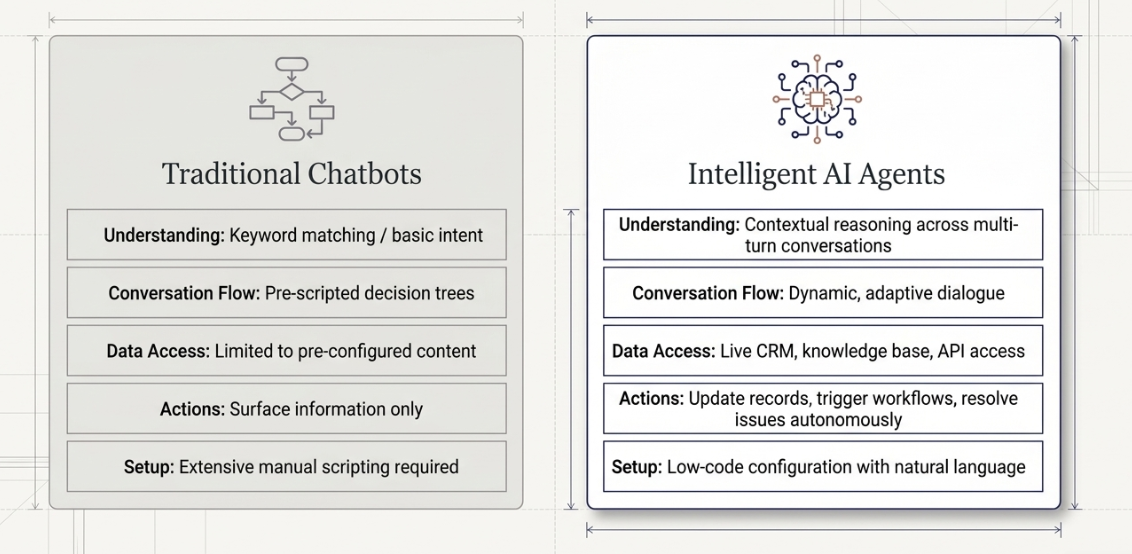
Salesforce Agentforce: Autonomous Service at Enterprise Scale
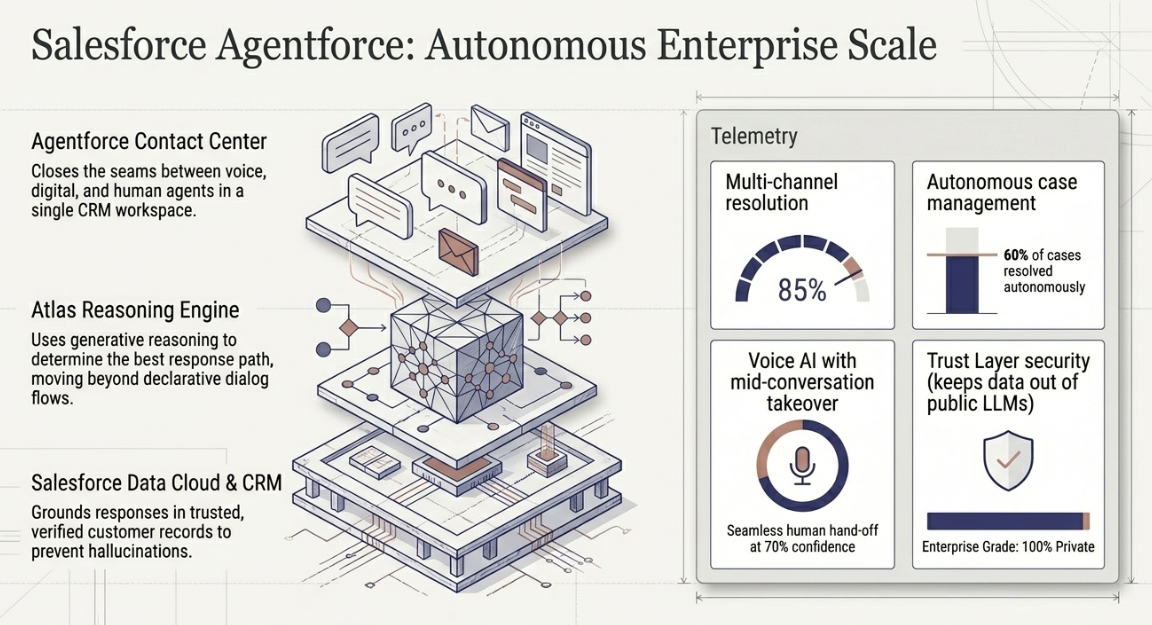
Salesforce has moved faster and further into agentic AI than any other enterprise CRM. Agentforce, built on the Einstein 1 Platform and powered by the Atlas Reasoning Engine, is the most comprehensive implementation of autonomous service AI in the enterprise market today.
The Atlas Reasoning Engine and Why It Matters
The Atlas Reasoning Engine is what makes Agentforce different from its predecessor, Einstein Bots. Rather than following declarative dialog flows and intent maps, Agentforce agents use generative reasoning to understand queries, determine the best response path, and take action, all grounded in trusted data through Salesforce Data Cloud. That grounding is critical: it prevents hallucinations by anchoring every response to verified CRM records, knowledge articles, and case history. When the agent resolves a billing inquiry, it does so based on the customer's actual account data, not a generic script.
Agentforce Contact Center: Closing the Seams
In early 2026, Salesforce launched Agentforce Contact Center, a solution that unifies voice, digital channels, CRM data, and AI agents into a single system. Most legacy contact center setups are patchworks: separate telephony, separate CRM, separate AI tools, loosely integrated. Agentforce Contact Center eliminates those seams. Human agents and AI agents operate from the same CRM workspace, sharing context in real time. When an AI agent resolves an issue, the case is updated and the customer record reflects it. When a complex situation requires a human, the handoff includes full conversation context, customer history, and the AI agent's preliminary analysis.
What Agentforce Delivers for Service Teams
- Multi-channel resolution across chat, SMS, email, voice, and self-service portals
- Autonomous case management for Tier-1 and Tier-2 issues, including returns, refunds, account updates, and scheduling
- Voice AI with live transcription and mid-conversation human takeover capability
- Trust Layer security ensures customer data never passes through public LLM infrastructure
- Low-code configuration through Agent Builder, with topics and instructions defined in natural language
HubSpot Breeze: Intelligent Service for Growing Organizations
Where Salesforce targets enterprise complexity, HubSpot has taken a different but equally deliberate approach with Breeze AI. The philosophy is accessibility: intelligent automation for growing businesses that cannot staff dedicated AI engineering teams.
The Breeze Customer Agent
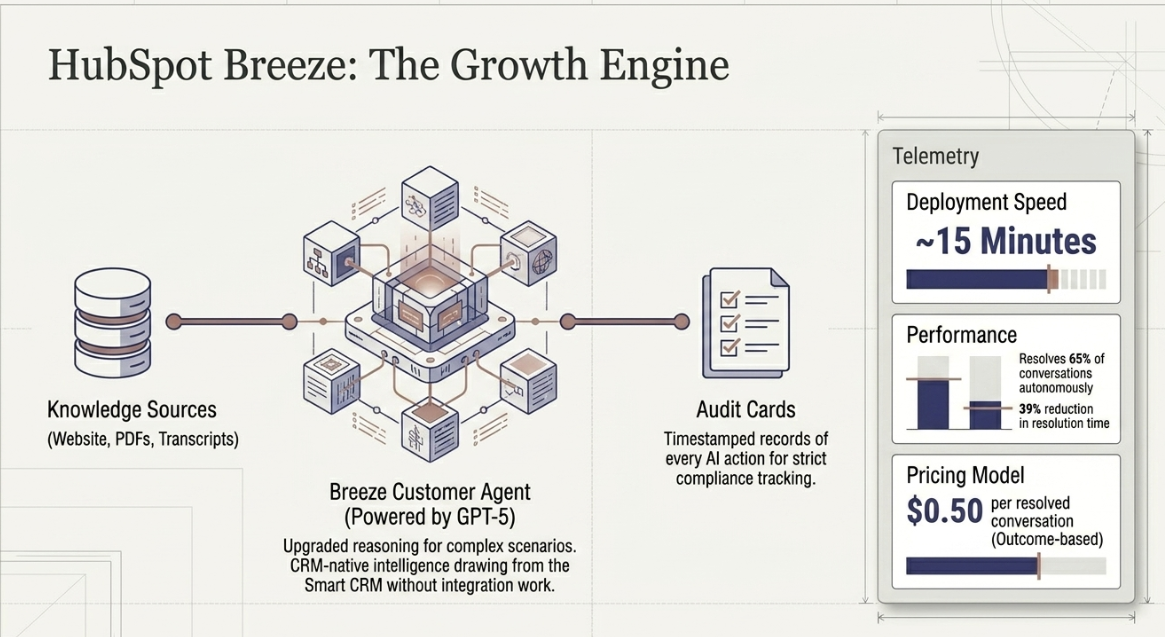
HubSpot's Customer Agent is the service-specific component of the Breeze platform. It automates support responses continuously, trained on your knowledge base, website content, and documentation. It works natively within HubSpot's Smart CRM, giving it immediate access to the full customer record, contact history, deals, tickets, and marketing interactions, without integration work.
The practical differentiator is deployment speed. HubSpot reports that teams with an existing knowledge base and configured channels can stand up a working Customer Agent in under 15 minutes. The setup sequence is straightforward: name the agent, define its role and tone, connect knowledge sources, assign channels, test, and go live.
2026 Updates: GPT-5, Audit Cards, and Outcome Pricing
HubSpot has made substantive advances in 2026 that are worth understanding as decision inputs, not just product notes.
Breeze Studio agents now default to GPT-5, upgraded from GPT-4.1, which improves reasoning quality and response accuracy across complex support scenarios. The platform introduced Audit Cards, timestamped records of every AI action, showing exactly which CRM properties changed and what data informed each decision. For organizations in regulated industries, this is not a nice-to-have; it is a compliance requirement that was previously absent.
On performance: HubSpot reports that Breeze Customer Agent resolves 65% of conversations autonomously and reduces resolution time by 39% across more than 8,000 activations. The pricing shift is equally significant, from a flat per-conversation fee to $0.50 per resolved conversation, aligning cost directly with value delivered. If the agent does not resolve the issue, you do not pay for a resolution.
What Breeze Delivers for Service Teams
- Omnichannel deployment across live chat, email, WhatsApp, Facebook Messenger, and voice
- CRM-native intelligence drawing from the complete customer record for every interaction
- Workflow integration through the Run Agent action, connecting AI reasoning to the full HubSpot automation stack
- Intelligent escalation with full conversation context passed to human agents
- Flexible knowledge training on articles, website pages, PDFs, meeting transcripts, and other unstructured data
How to Choose: Agentforce vs. Breeze Decision Framework
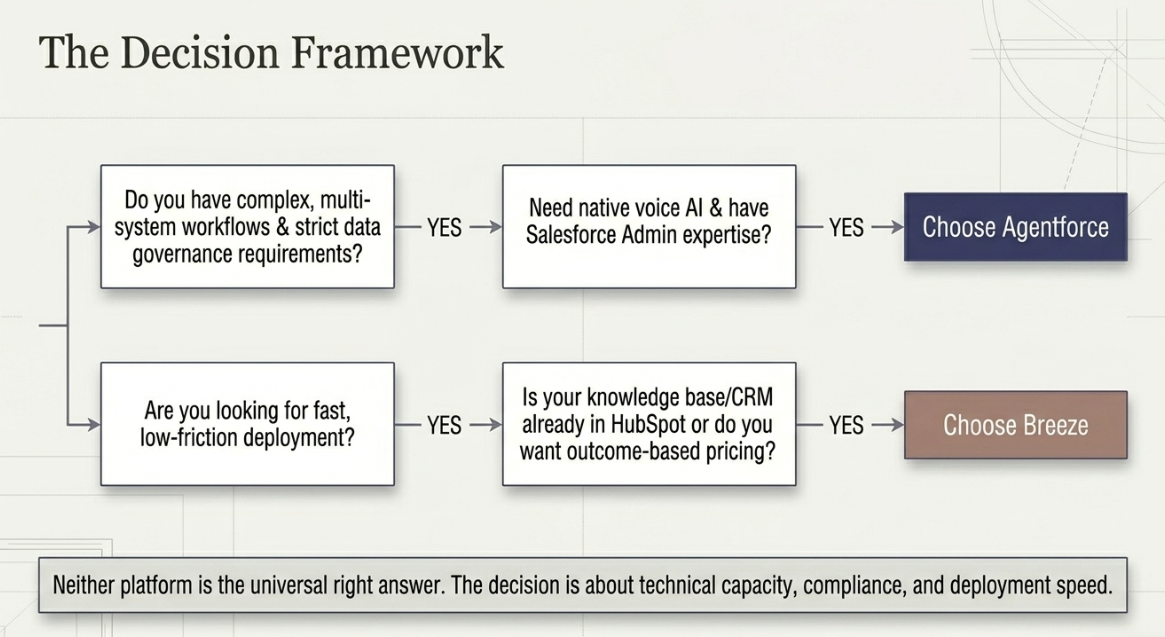
The comparison table below captures the primary differentiators. But a table requires interpretation. Here is the conditional logic that should drive your decision.
Choose Agentforce if:
- Your organization runs at enterprise scale with complex, multi-system service workflows
- You have compliance requirements that demand deep data governance and a Trust Layer
- You need native voice AI as a production capability, not a beta feature
- Your team has Salesforce admin expertise and can configure Apex, Flows, and Prompt Builder
- You are integrating across Sales Cloud, Service Cloud, and Data Cloud simultaneously
Choose Breeze if:
- You are an SMB or mid-market organization that needs fast, low-friction deployment
- Your existing knowledge base and CRM are already in HubSpot
- You want outcome-based pricing that ties AI cost directly to resolved conversations
- Your team does not have dedicated AI engineering resources
- You need omnichannel coverage quickly and can tolerate voice being in beta
Neither platform is the universal right answer. The decision is about fit, to your team's technical capacity, your compliance environment, your existing stack, and how quickly you need to move.
|
Factor |
Salesforce Agentforce |
HubSpot Breeze |
|
Target Market |
Mid-market to enterprise |
SMB to mid-market |
|
Setup Complexity |
Moderate (requires Salesforce admin) |
Low (no-code, ~15 min) |
|
AI Architecture |
Atlas Reasoning Engine + Trust Layer |
GPT-5 + Audit Cards |
|
Channel Coverage |
Comprehensive, including native voice |
Broad voice in beta |
|
CRM Integration |
Deep (Data Cloud, Service Cloud, Sales Cloud) |
Native (Smart CRM, all Hubs) |
|
Customization |
Extensive (Apex, Flows, APIs, Prompt Builder) |
Moderate (Breeze Studio, workflows) |
|
Pricing Model |
Flex Credits |
$0.50 per resolved conversation |
|
Best For |
Complex operations, high compliance needs |
Fast deployment, clear ROI |
Three Implementation Scenarios from the Field
The following cases are drawn from CETDIGIT client deployments. They are included because the transition from chatbot to intelligent agent looks different depending on the operational context, and the specifics matter more than general principles.
Scenario 1: AI Voice Agent for Inbound Qualification (Professional Services)
A consulting firm integrated an AI voice agent with its Salesforce CRM to handle inbound client inquiries. The agent qualifies callers, retrieves live account data, answers questions about service offerings and engagement status, and books meetings with the appropriate consultant. When a conversation requires human attention, it transfers with full context.
Outcome: 40% reduction in missed calls, 3x improvement in lead response time, consistent CRM data capture across every inbound interaction.
Scenario 2: Omnichannel Support Automation (B2B SaaS)
A mid-market SaaS company deployed HubSpot's Breeze Customer Agent across live chat and email, trained on over 500 knowledge base articles and product documentation. The agent resolves account access issues, billing questions, and feature configuration guidance without human intervention.
Outcome: 60% of support tickets resolved autonomously, average resolution time reduced by 45%, customer satisfaction scores improved as response times dropped from hours to seconds.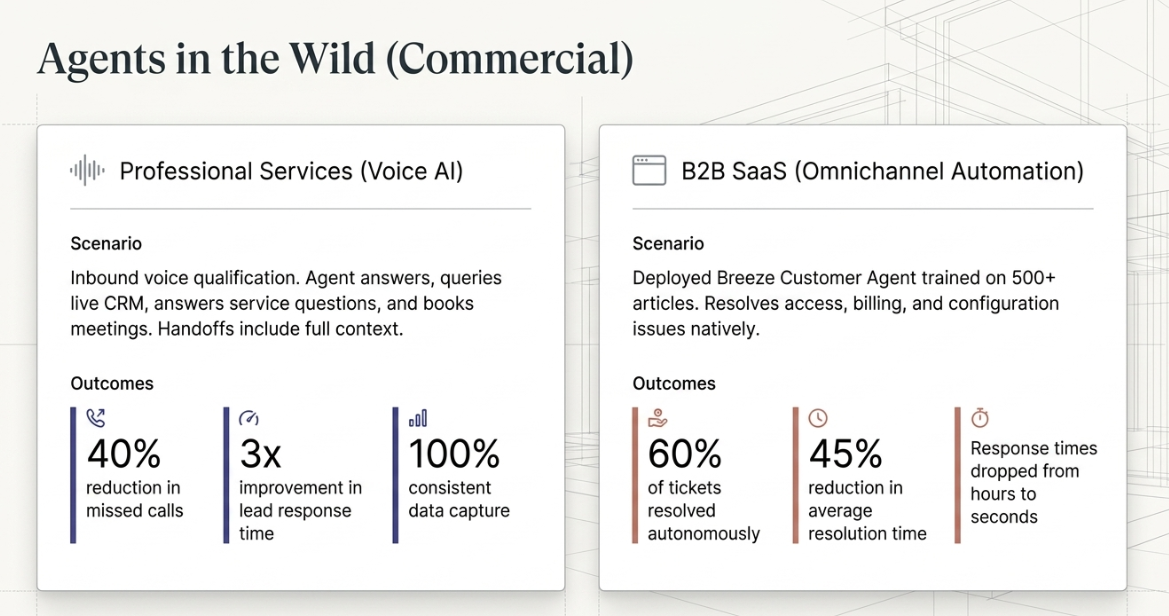
Scenario 3: Agentic RAG for Knowledge-Intensive Case Work (Nonprofit)
A social services nonprofit integrated Agentic RAG with Salesforce Service Cloud to assist caseworkers. The system retrieves eligibility rules from policy documents, accesses client history, reasons through qualification logic step by step, and provides caseworkers with recommended actions and supporting documentation — rather than replacing the caseworker, it makes them faster and more consistent.
Outcome: Caseworkers recovered 15+ hours per week on eligibility determinations. Decision quality became consistent across the team, and compliance audit readiness improved significantly.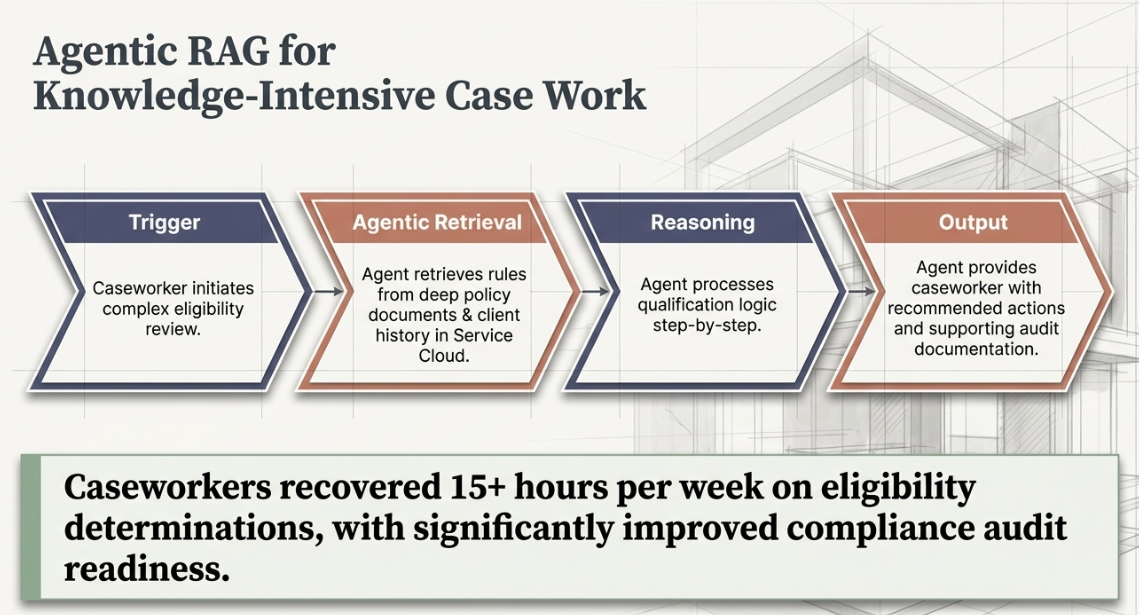
Intelligent Agent Readiness: Five Conditions That Determine Success
Organizations that deploy intelligent agents on a weak foundation amplify their problems, not their productivity. Before initiating deployment on either platform, assess these five readiness conditions honestly.
1. Data quality and CRM hygiene. Intelligent agents access and act on CRM data in real time. If your records are fragmented, stale, or inconsistent, the agent will produce fragmented, stale, or inconsistent outputs. Data cleanup before deployment is not optional — it is the precondition. The agent amplifies whatever state your data is in.
2. Knowledge base completeness and structure. Your knowledge base becomes the agent's primary reasoning resource. Audit existing content for gaps, outdated articles, and conflicting information. Structure articles around specific customer intents and common scenarios. Thin or poorly organized knowledge bases are the most common cause of poor agent performance at launch.
3. Integration architecture. Intelligent agents need real-time access to customer data, product information, billing systems, and internal tools. Plan your integration layer before deployment, not during. An agent that cannot access the systems it needs will escalate everything, defeating the purpose.
4. Governance and guardrails: Define explicitly what the AI agent can and cannot do before it touches a customer. Establish escalation rules, data access policies, and compliance requirements. Both Salesforce and HubSpot provide guardrail frameworks, but those frameworks require your business logic to function correctly.
5. Change management Your service team needs to understand how to work alongside AI agents, when to trust AI outputs, and when to intervene. Organizations that treat AI deployment as a technology project and skip change management consistently underperform those that treat it as an organizational transition. The human-AI partnership model — AI handles volume and data retrieval, humans handle judgment and relationships, and it works when the human side is prepared for it.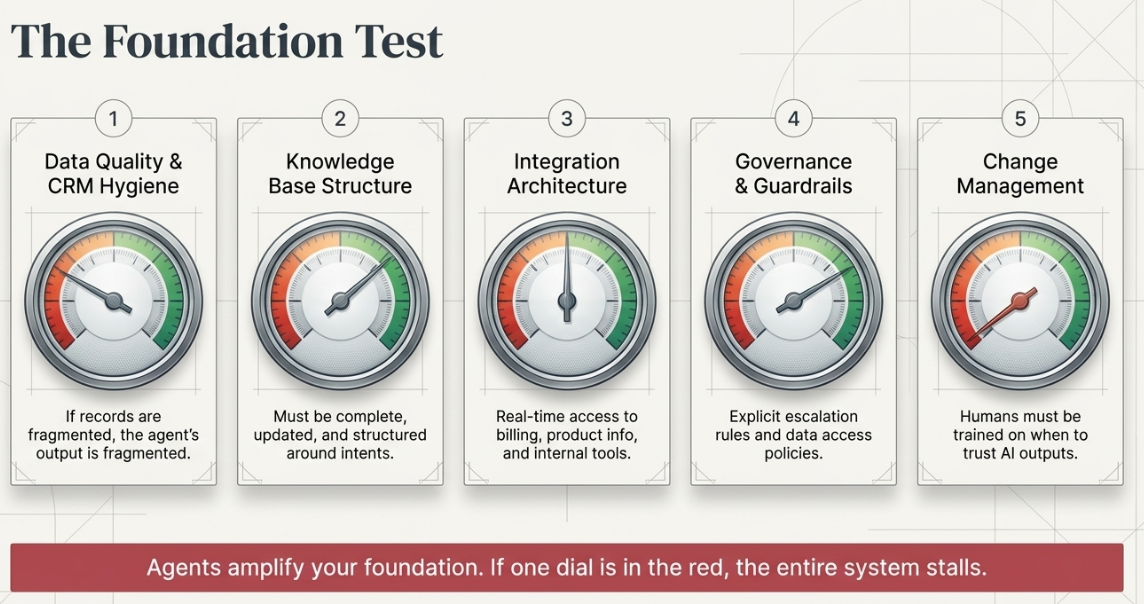
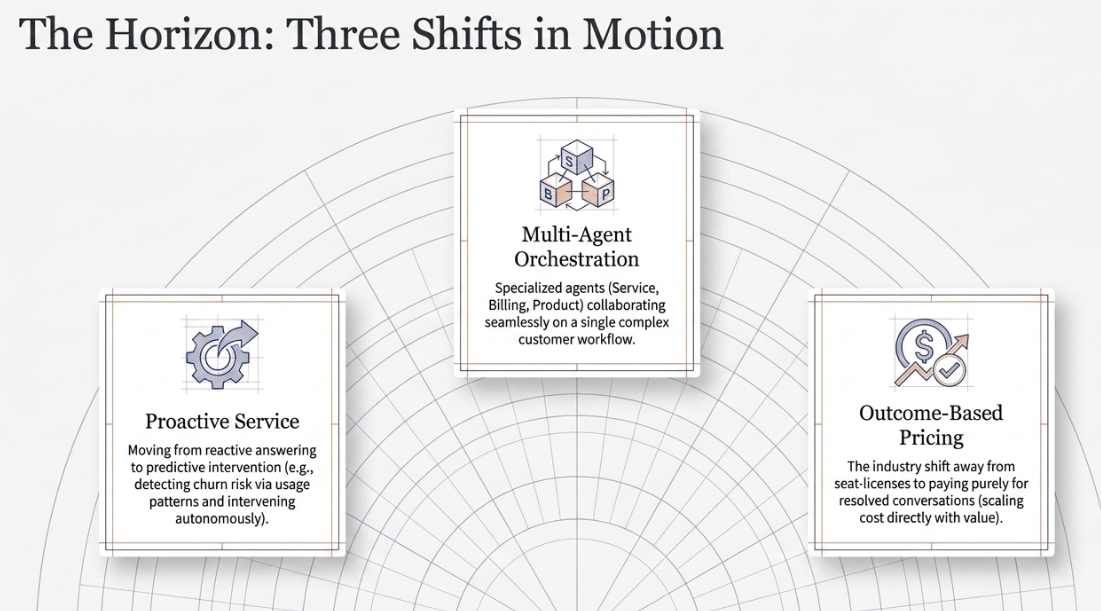
What Comes Next: Three Shifts Already in Motion
Proactive service. Today's agents are reactive. The next iteration identifies potential issues before customers surface them, a subscription approaching lapse, a usage pattern suggesting churn risk, and acts on them. This is not a future concept; it is in development on both platforms.
Multi-agent orchestration. Complex customer inquiries increasingly require coordination across specialized agents, service, billing, and product. The orchestration layer that allows multiple agents to collaborate on a single workflow is the next architectural frontier for both Salesforce and HubSpot.
Outcome-based pricing normalization. HubSpot's move to $0.50 per resolved conversation is not an outlier. It signals a broader industry shift from seat-count pricing to outcome pricing. For buyers, this is structurally favorable, cost scales with value delivered, not usage volume.
The architectural foundation that makes intelligent agents possible in production — including the System of Action that triggers agent activity from buying signals — is detailed in CETDIGIT's Revenue Engine cluster.
The Transition Is Not Gradual
Here is the blunt version: organizations still running first or second-generation chatbot logic are not simply operating inefficiently. They are delivering a measurably worse customer experience than competitors who have made the transition, and the gap is widening, not narrowing.
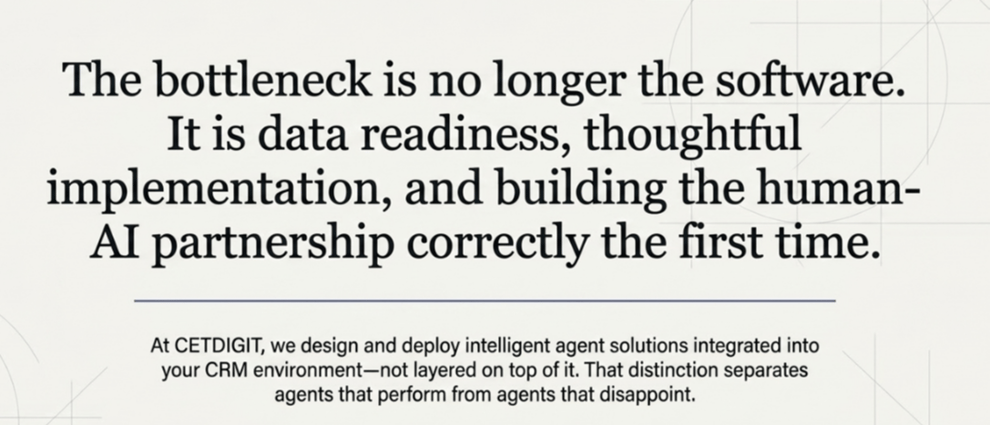
The technology is not experimental. Agentforce and Breeze are production-ready platforms with documented results. The bottleneck is not the software. It is data readiness, thoughtful implementation, and a commitment to building the human-AI partnership correctly the first time.
At CETDIGIT, this is the work we do as a Salesforce and HubSpot partner. We design and deploy intelligent agent solutions that are integrated into your existing CRM environment, not layered on top of it, because that distinction is exactly what separates agents that perform from agents that disappoint.
Ready to move past chatbots? Schedule a consultation with our team to assess your readiness and identify the right deployment path for your organization.
Leave a Comment