


Most conversations about AI focus on what you gain. Very few talk honestly about what it costs to wait.
If you're a business owner who hasn't committed to AI yet, you're probably not being unreasonable. You've seen the hype cycles before. You've been pitched tools that promised transformation and delivered a subscription fee. You have a business to run, a team to pay, and no appetite for an expensive science experiment.
That caution is healthy. But there's a difference between being cautious and being stationary. Every quarter you delay, a cost accrues quietly in the background — not as a line item on your P&L, but as slower responses, lost deals, burnt-out staff, and competitors who are simply cheaper to run than you are.
This article isn't about convincing you to "adopt AI." It's about showing you what the delay actually costs, and how to start in a way that doesn't require faith, a budget you don't have, or a rebuild of everything you've already invested in.
The Costs You Can't See on a Spreadsheet
The reason AI hesitation feels safe is that the cost of waiting never arrives as an invoice. It shows up in places you've stopped noticing.
The lead that went cold. A prospect fills out your form at 7:40 PM. Nobody responds until 10:15 the next morning. By then, they've had a conversation with a competitor whose system answered in ninety seconds. You never knew that deal existed to lose.
The time your best people spend on work beneath them. Your senior salesperson spends six hours a week updating CRM records, writing follow-up emails, and chasing information across three systems. That's a quarter of their week not spent selling. You're paying senior rates for administrative output.
The knowledge that lives in one person's head. When your most experienced employee is out or leaves, the answers leave with them. Everyone else guesses, escalates, or stalls.
The customer who didn't complain. They just didn't come back. Slow support, an unanswered question, and an inconsistent answer from two different reps. Silent churn is the most expensive kind because you never get the chance to fix it.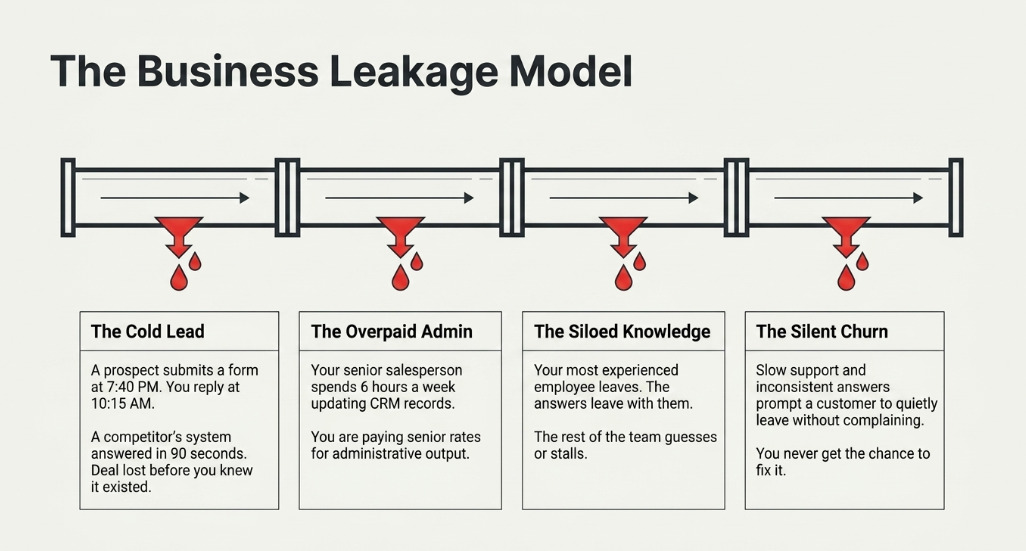
None of these shows up as an AI problem. They show up as "that's just how it is." That's exactly what makes them expensive.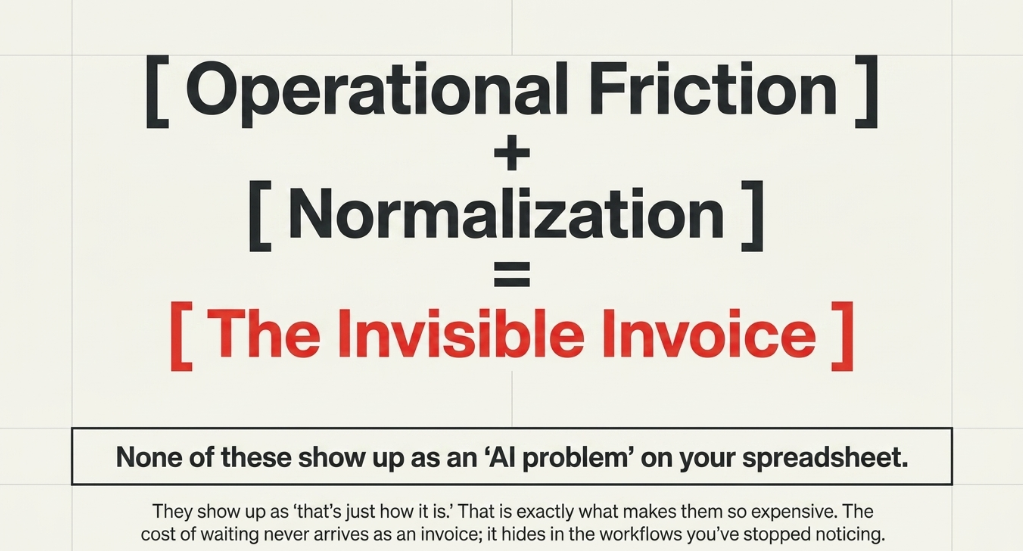
The Widening Gap
Here's the part that matters most for a business owner weighing timing.
AI adoption doesn't create a one-time advantage. It creates a compounding one. A competitor who automates lead response this year doesn't just get faster replies — they get more conversations, which generate more data, which improves their targeting, which lowers their cost per acquisition, which funds more growth. Twelve months later, they're not slightly ahead. They're operating with a structurally lower cost base than you are.
Meanwhile, the entry price keeps falling. The businesses adopting AI now aren't the ones with the biggest budgets. They're the ones who picked one problem and solved it. The gap isn't opening between large and small companies. It's opening between the ones who started and the ones who are still deciding.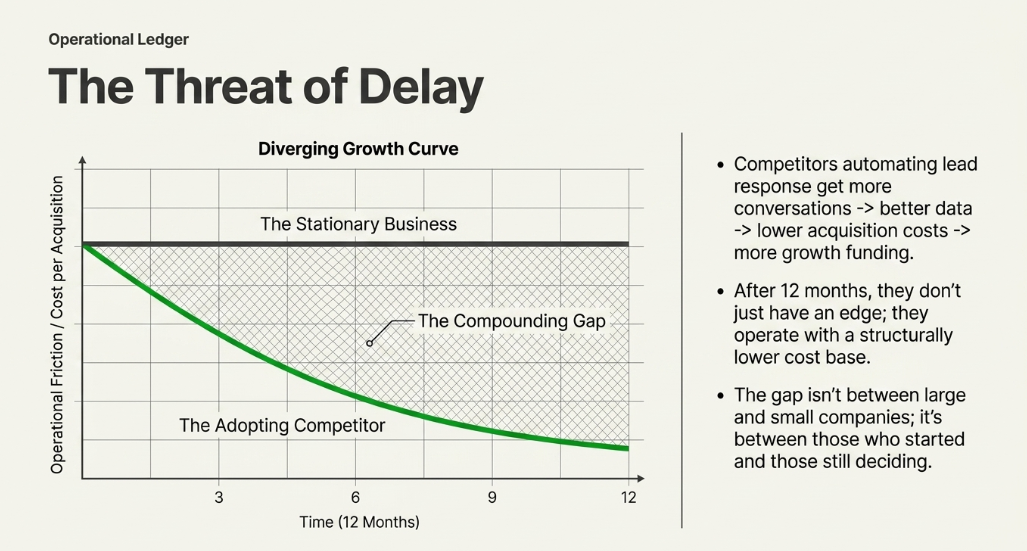
The uncomfortable truth is that "waiting until the technology matures" was a reasonable position three years ago. Today, the technology is mature enough. What's still immature is most organizations' willingness to use it.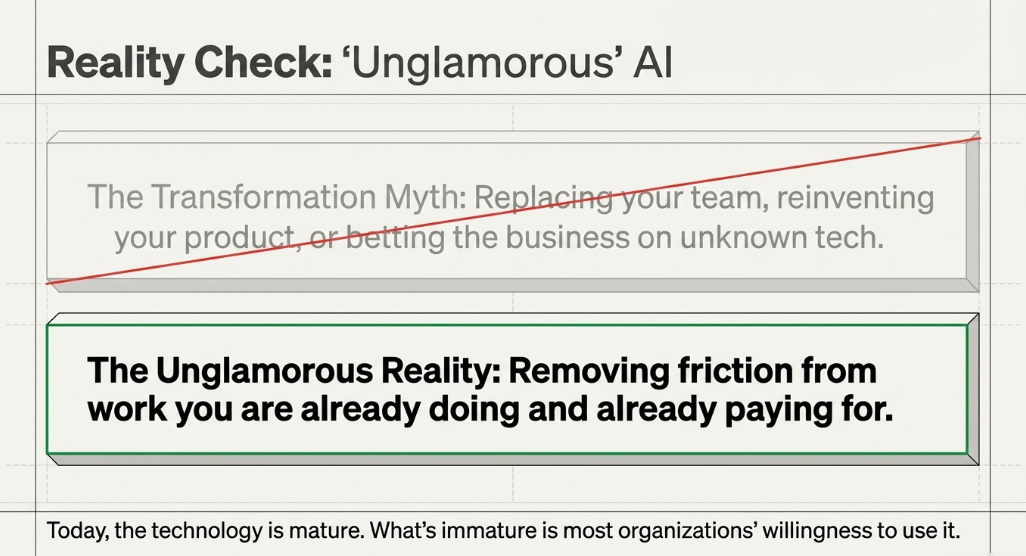
What AI Actually Does for a Business Like Yours
Set aside the language of "transformation." Here is what these systems concretely do, in terms that a business owner can evaluate.
|
Business Problem |
What AI Changes |
What It's Worth |
|
Slow lead response |
Every inquiry is answered instantly, day or night, qualified before a human touches it |
Higher conversion on leads you already paid to generate |
|
Manual CRM data entry |
Records, notes, and next steps are logged automatically after every call and email |
Selling hours returned to your sales team |
|
Repetitive support tickets |
Common questions resolved instantly; complex ones routed to the right person with context attached |
Lower cost per ticket, faster resolution, fewer escalations |
|
Knowledge trapped in silos |
Contracts, policies, product docs, and history are searchable in plain language |
Any employee performs like your most experienced one |
|
Inconsistent follow-up |
Every prospect and customer nurtured on schedule, with relevant context |
Fewer deals lost to neglect rather than competition |
|
No visibility into pipeline risk |
Patterns flagged before deals stall or customers churn |
Problems addressed while they're still fixable |
Notice what isn't in that table: replacing your team, reinventing your product, or betting your business on a technology you don't understand. AI adoption, done properly, is unglamorous. It removes friction from work you're already doing and already paying for.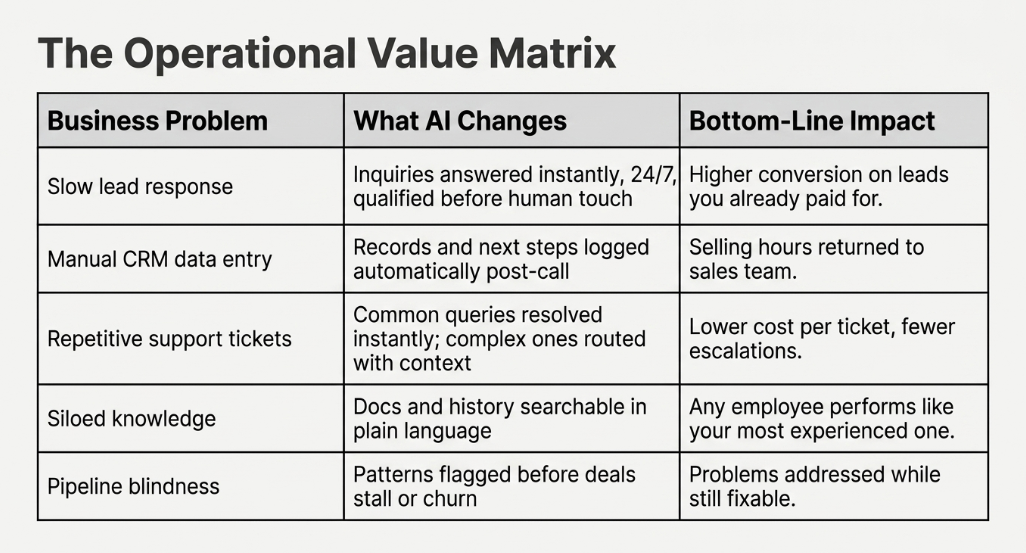
The Objections Worth Taking Seriously
The hesitations business owners raise are usually legitimate. They just have answers.
"It's too expensive."
The relevant comparison isn't AI versus zero. It's AI versus the cost you're already absorbing. If two employees spend a combined ten hours a week on work that a system could handle, you're already paying for that automation; you're just paying for it in salary and getting a slower version. Most meaningful first projects cost less than a fraction of a single hire.
"My business is too small."
Small businesses benefit disproportionately, because they have the least slack. When you have four people instead of forty, giving each of them back five hours a week is a larger relative gain, not a smaller one.
"My data is a mess."
It probably is. That's true of nearly every organization, including large ones. Data quality matters, but it's a reason to scope your first project carefully, not a reason to postpone indefinitely. Waiting for perfectly clean data is waiting for something that never arrives on its own.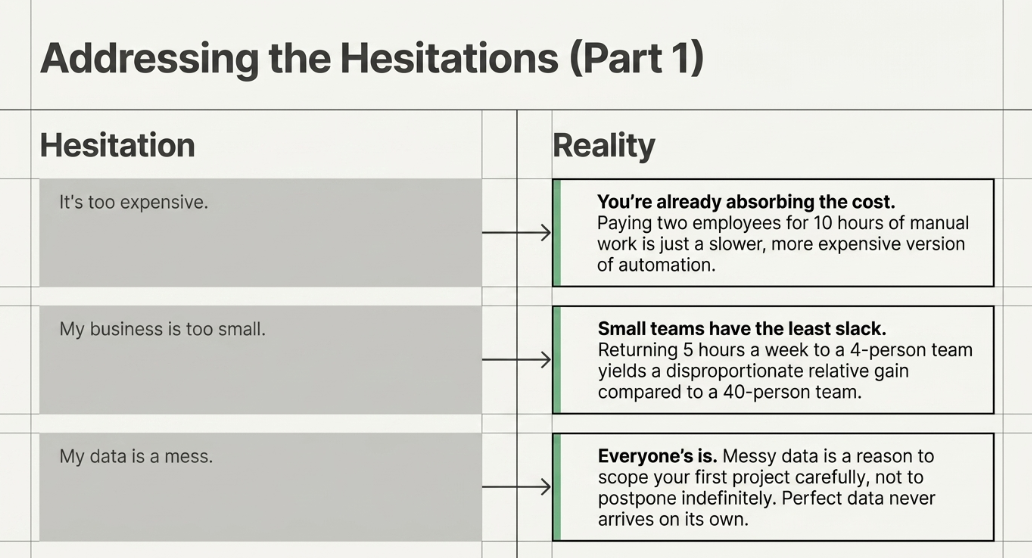
"I don't trust it to be accurate."
You shouldn't trust it blindly, and a well-built system doesn't ask you to. Modern implementations retrieve answers from your actual documents and records, cite where the information came from, verify against multiple sources, and escalate to a human when confidence is low. The question isn't whether AI is perfect. It's whether it's more consistent than a tired employee at 4:45 on a Friday, with an audit trail attached.
"What about security and compliance?"
A fair concern, and one with established answers: controlled data access, defined permissions, logged actions, and human approval gates on anything consequential. These are engineering decisions, not unknowns. They should be part of the design from day one, and if a vendor can't explain their approach to them clearly, that tells you something about the vendor.
"My team will resist it."
Some will, until the first week, they don't have to write call notes. Resistance almost always tracks to a fear of replacement. It fades when people discover the AI took the part of the job they hated.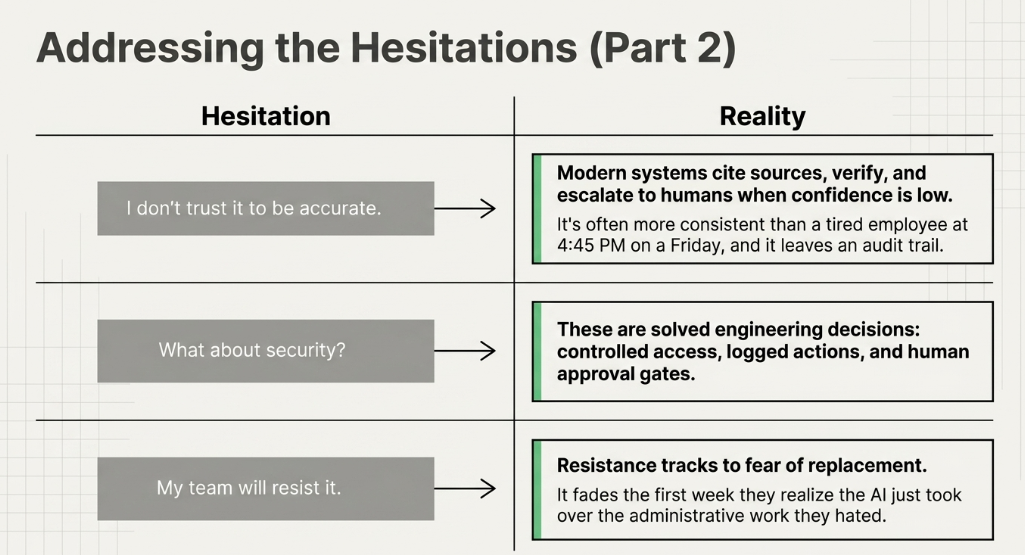
What Starting Actually Looks Like
The most common mistake isn't adopting AI too early. It's adopting it too broadly — launching an initiative, forming a committee, evaluating twelve platforms, and producing a strategy document instead of a result.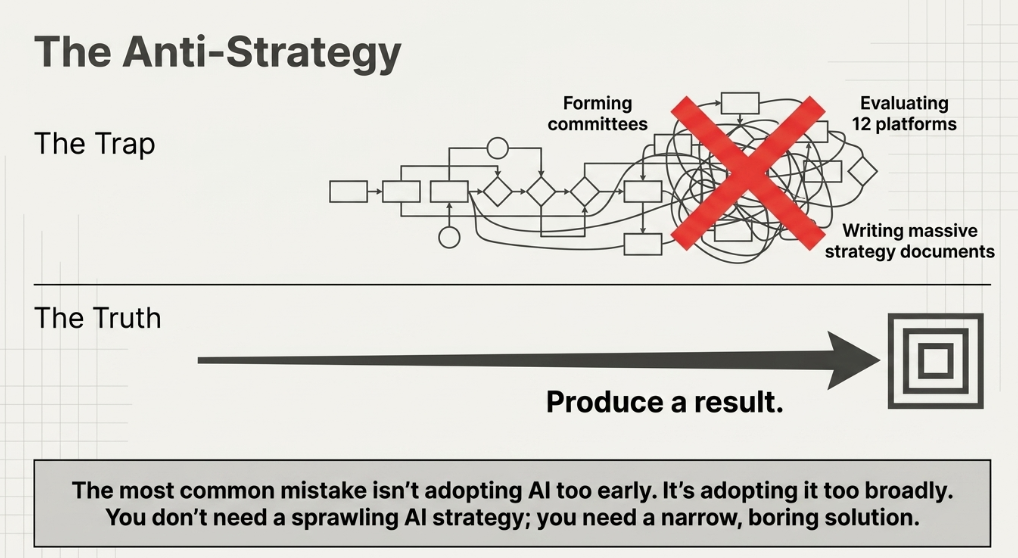
A better path is narrow and boring:
Pick one bottleneck that costs you money. Not the most interesting problem. The most expensive one. Lead response time. Support ticket volume. Sales admin hours. Something with a number attached.
Measure what it costs you today. Hours, dollars, conversion rate, whatever you can count. Without a baseline, you'll never know whether it worked.
Solve that one thing, connected to systems you already own. If you run Salesforce or HubSpot, your CRM is already the center of your operation. The right first project extends what you have rather than replacing it.
Give it ninety days and check the number. If it moved, expand. If it didn't, you've spent one quarter and a modest budget learning something concrete about your business, which is more than a year of deliberation will teach you.
That's the whole method. It doesn't require you to believe anything about the future of AI. It requires you to run one measurable experiment.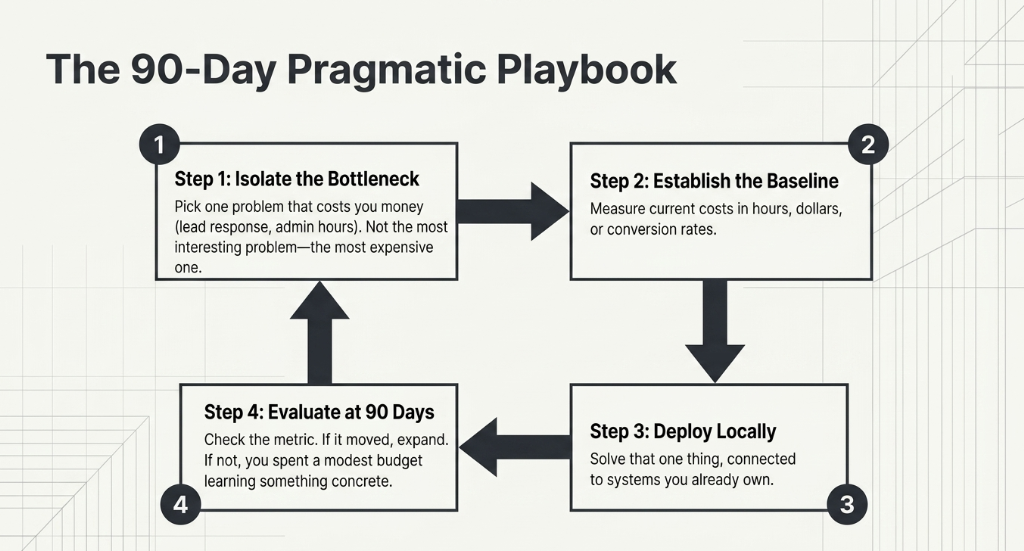
The Question That Actually Matters
Business owners who are undecided about AI usually frame the decision as: is this worth the risk?
The more useful framing is: what does another year of the status quo cost me, and am I comfortable paying it?
If your answer is that the status quo is working fine, that your response times are fast, your team isn't drowning in admin, your knowledge isn't trapped in three people's heads, and your competitors aren't getting cheaper to run, then waiting is rational. Genuinely.
But if you read that list and recognized your own business in it, the risk isn't in moving. It's in standing still while the ground shifts under you.
Conclusion
AI isn't a leap of faith anymore. It's an operational decision with measurable inputs and measurable outputs, and like any operational decision, the cost of not making it is real even when it's invisible.
You don't need an AI strategy. You need one bottleneck removed, one number improved, and one proof point that makes the next decision easier.
At CETDIGIT, we've spent years helping businesses do exactly that, building practical AI and automation solutions inside the Salesforce and HubSpot environments our clients already rely on. We start with the problem that's costing you the most, not the technology that's trending. And we measure the result, so you're never asked to take our word for it.
If you're undecided, that's the right time to talk. Schedule a consultation, and we'll help you identify where AI would pay for itself first, and where it wouldn't.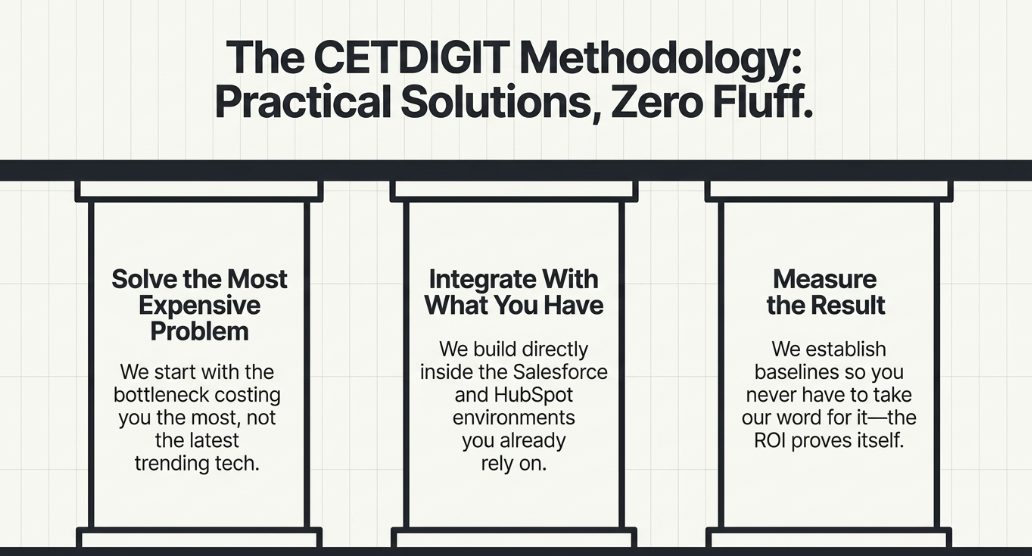



Leave a Comment