


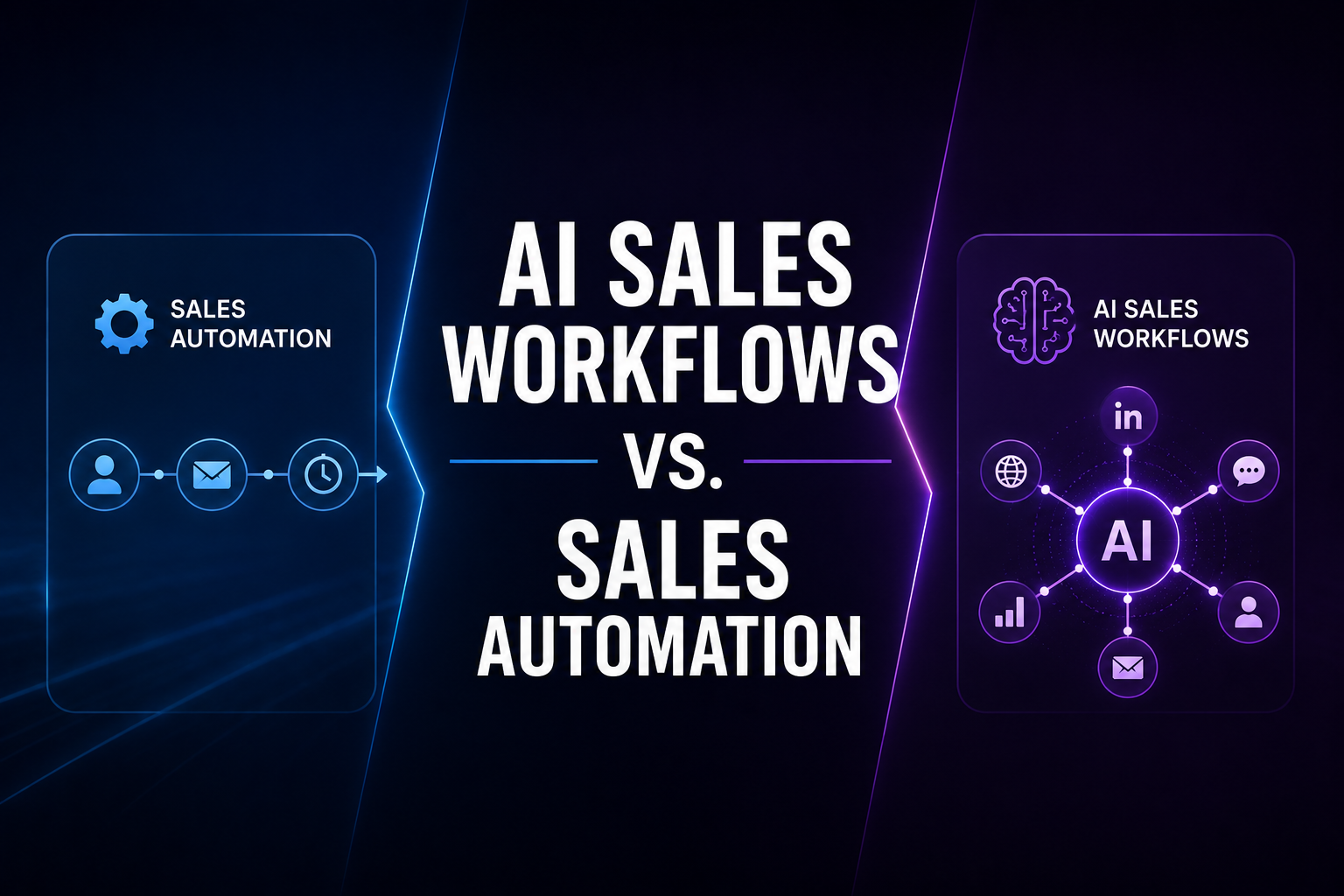
AI sales workflows differ from sales automation in one architectural way: sales automation runs inside the CRM on the leads it already sees, while AI sales workflows run at the Activation Edge, reading Dark Funnel signals automation cannot see, and triggering actions automation cannot orchestrate.
A $40,000 Deal That the Sequence Worked Perfectly On
Wednesday afternoon. The proposal you sent two weeks ago has been opened, downloaded, and replied to. The reply read: "Still thinking about it, let me come back to you next week."
That was Thursday. By Friday, your HubSpot Sequence had already done its job. Three follow-up emails scheduled: Day 4, Day 7, Day 14. Each one is written to be helpful without being pushy. Each one fired on the day it was supposed to. Then the deal went quiet.
Three weeks later, you opened LinkedIn and saw it. A post from the buyer, thanking a competitor for "an amazing onboarding experience." The deal had closed against you, and the engagement history on the competitor's company page started the same Friday your buyer said, "still thinking about it."
The competitor had been visible on your buyer's LinkedIn feed for three weeks. Your Sequence had been visible nowhere. The Sequence worked perfectly. The deal was lost anyway, because the Dark Funnel — the activity automation can't see, was where the actual buying decision happened.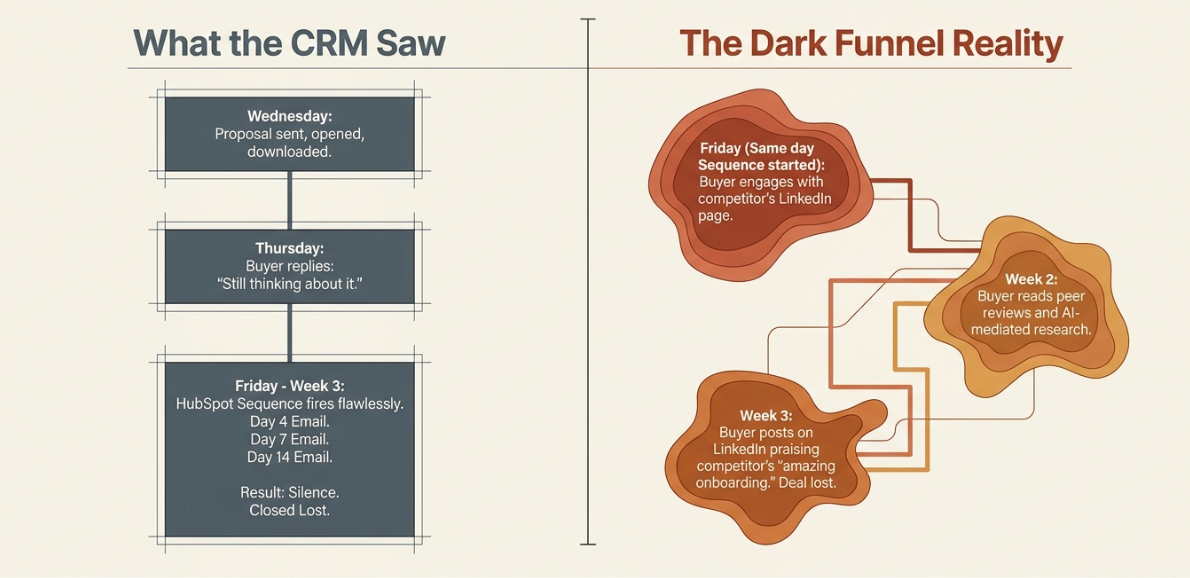
What Sales Automation Actually Is, and Where It Stops
Sales automation was built to solve a specific, well-documented problem. In 2011, Harvard Business Review published the now-canonical study auditing 2,241 US companies: the average web-lead response time was 42 hours, and firms that contacted potential customers within an hour of receiving a query were nearly 7 times more likely to qualify the lead than those that contacted them an hour later. The five-minute rule was born from this research, and an entire category of tools, Sequences, cadences, and drip campaigns, was built to enforce it.
For the lead that filled out your form on Monday morning, that automation works. The contact lands in the CRM. The trigger fires. The first email goes out before you've finished your second cup of coffee.
But sales automation is a rule-runner, not a decision-maker. It can only act on signals it can see, and it can only see what the CRM already knows. The contact is in the right list, the form is filled out on the right page, and the deal stage is moving on schedule.
That covers a shrinking slice of how buyers actually behave. Which is exactly why a new category emerged.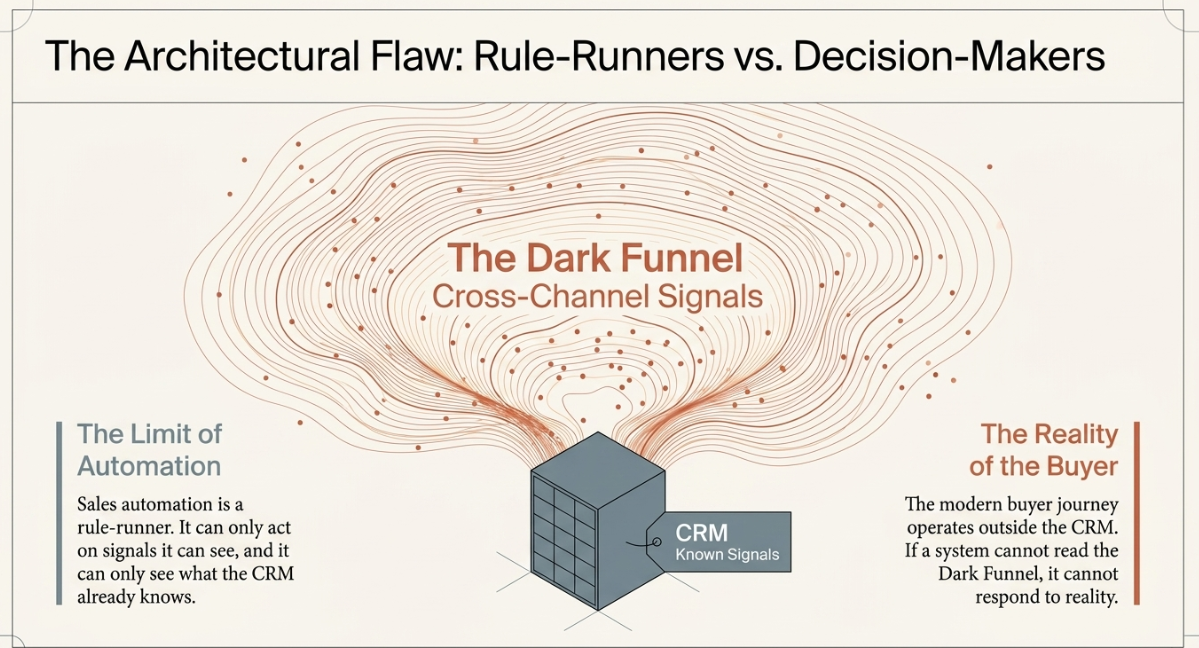
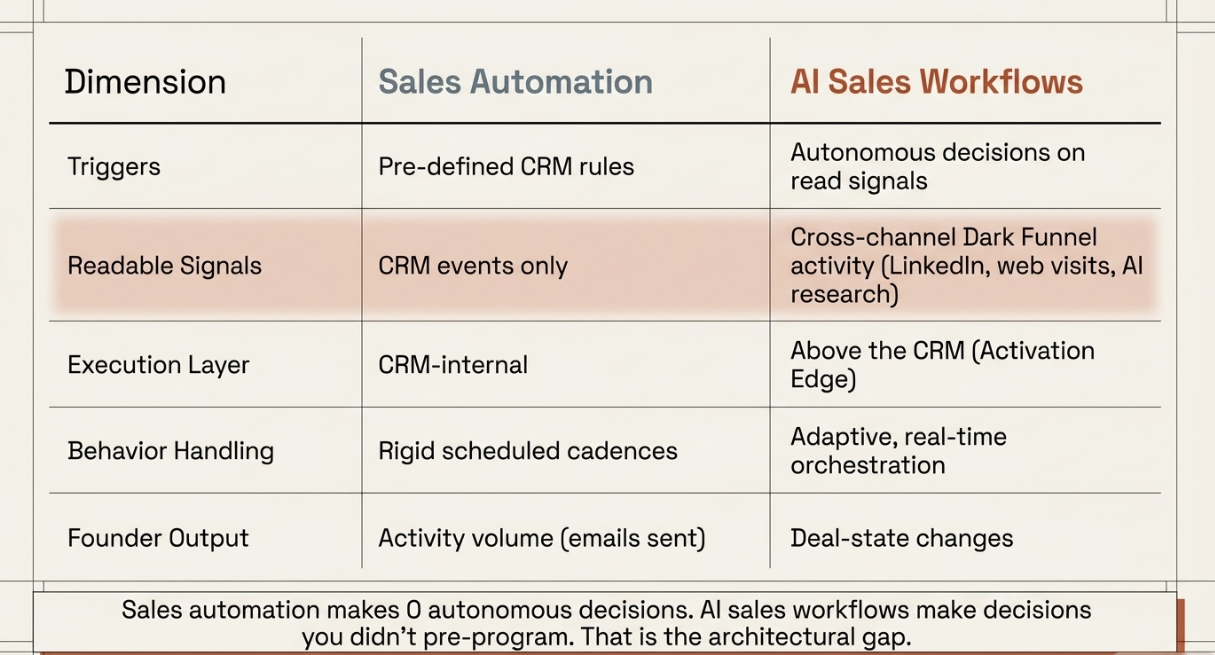
The Five Architectural Differences Between Sales Automation and AI Sales Workflows
|
Dimension |
Sales Automation |
AI Sales Workflows |
|
What triggers action |
Pre-defined rules and CRM events (form fill, stage change, scheduled time) |
Autonomous decisions on read signals (Dark Funnel activity, intent shifts, behavioral patterns) |
|
What signals can it read? |
CRM events only, what your contacts and deals do inside your system |
Cross-channel signals, including LinkedIn engagement, anonymous web visits, peer-conversation references, and AI-mediated research |
|
Where the workflow runs |
CRM-internal, the workflow is bound by what the CRM stores |
In the execution layer above the CRM, where orchestration decisions happen in real time |
|
How it handles new buyer behavior |
Rigid cadence runs the same sequence whether or not the buyer behavior changes |
Adaptive orchestration adjusts the next action based on what the signals actually say |
|
What it produces for the founder |
Activity volume (emails sent, tasks completed, deals touched) |
Deal-state changes (deals that move because the right action is fired at the right moment) |
The line on the table that matters most is the second one. Per Gartner's June 2025 projection, 15% of day-to-day work decisions will be made autonomously through agentic AI by 2028, up from 0% in 2024. Sales automation makes 0 autonomous decisions. AI sales workflows make decisions the founder didn't pre-program, that's the architectural gap the comparison really turns on.
Who Should Be Asking This Question
You're the right reader for this comparison if you've run sales automation for two years or more and are starting to notice the same pattern. The leads that match your Sequence triggers get worked. The leads that don't sit somewhere. The deals that follow your stage progression get touched. The deals that go sideways, that download the proposal, reply "still thinking about it," then disappear, don't.
You've probably hired one or two SDRs since you set up the Sequences, and the pipeline didn't grow proportionally to the headcount. You've had at least one deal review where you couldn't say cleanly what was in the pipeline and what wasn't. And you've watched a competitor close at least one deal that should have been yours, found out about it only after the fact, on LinkedIn or in a customer email.
That's the founder this article is for: HubSpot Sequences, Outreach, or Salesloft already running, and a growing suspicion that the Sequence is no longer where the bottleneck lives.
Signs You've Hit the Automation Ceiling
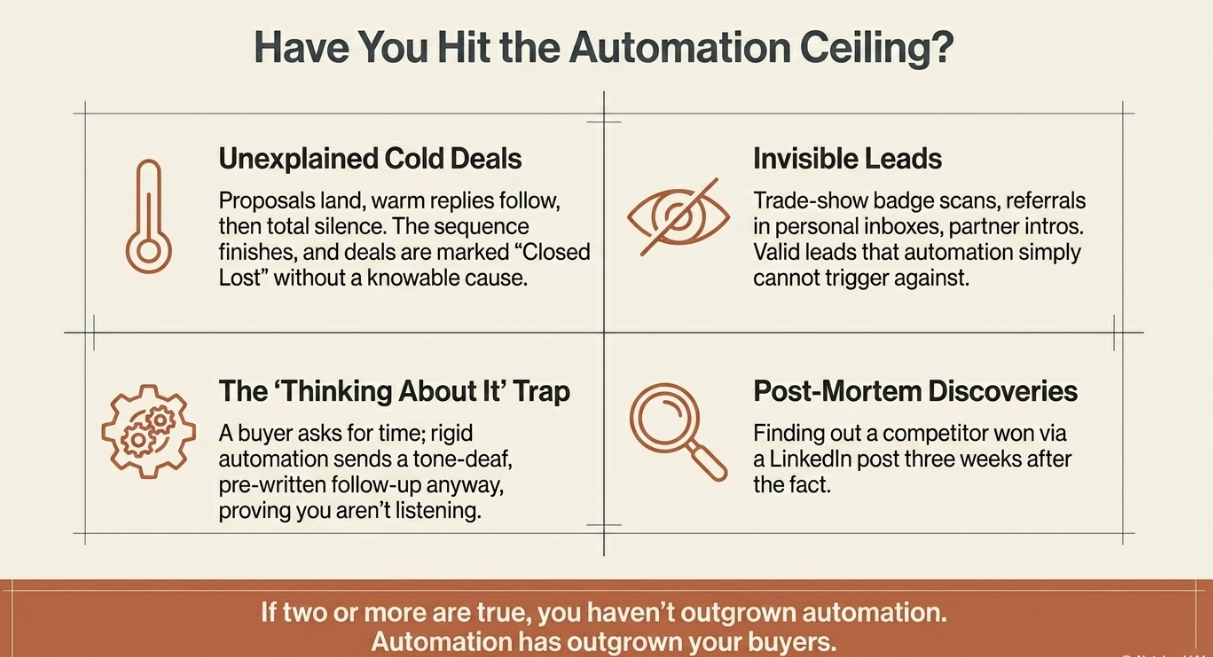
The symptoms cluster around four patterns.
- The deals that go cold for no obvious reason. The proposal lands, the reply comes back warm, and then nothing. The Sequence runs its full course. The deal is marked Closed Lost without anyone ever knowing why.
- The leads that don't match any trigger. The trade-show prospect who scanned a badge but didn't fill out the form. The referral that landed in a personal email. The contact that came in through a partner intro. None of them are wrong leads; they're just leads automation can't see.
- The buyers who say "still thinking about it" and disappear. Sales automation reads this signal as "send the next email in the Sequence." A buyer reading the next pre-written email when they said they were thinking about it learns that you weren't really listening, and deals that go cold over the weekend follow the same architecture, just compressed in time.
- The LinkedIn engagement you only notice after the deal is lost. Per McKinsey's 2024 B2B Pulse Survey of 3,000+ decision-makers, B2B buyers now use an average of 10.2 channels during their purchasing journey, up from 5 channels in 2016. Your Sequence covers two or three of those channels. The other seven are where the actual decision gets made.
If two or more of these patterns sound familiar, you haven't outgrown sales automation; sales automation has outgrown what your buyers do.
Why Sales Automation Hit Its Ceiling
Three forces produced the gap, and they accumulated in the same five-year window.
The first is the buyer-behavior shift. The McKinsey survey above documented it most clearly: 5 channels in 2016, 10.2 in 2024. Sales automation was designed for the era when a buyer's journey ran through a contact form, an email exchange, a phone call, and a signed contract. When the journey now runs through anonymous web visits, LinkedIn engagement, peer reviews, AI-mediated research, dark-social conversations, and a half-dozen other surfaces, the CRM-internal trigger model can't keep up.
The second is the analyst category formalization. Gartner formally defined Revenue Action Orchestration (RAO) in October 2024 as a category that "merges capabilities across sales engagement, revenue intelligence, and SFA markets into a unified, AI-driven solution." A few weeks earlier, Forrester independently formalized the same category as the Revenue Orchestration Platform, calling it a convergence of three previously separate categories into a new revtech supergroup. Two leading analyst firms arrived at the same conclusion within twelve months of each other. That doesn't happen for a rebrand. It happens for a structural shift.
The third is the maturation of the underlying agentic capability. The technology that lets a workflow read a Dark Funnel signal and decide what to do about it only became commercially viable in 2024–2025. Before that, "AI sales workflows" was an aspirational phrase. Now it's a deployed category.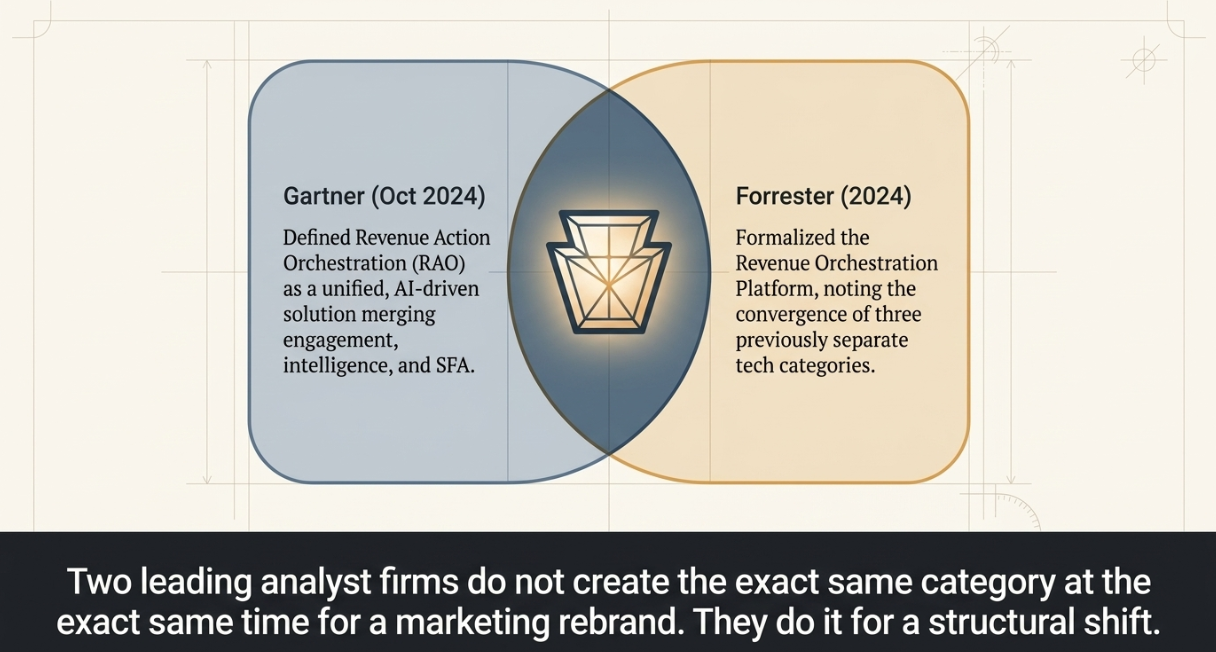
How CETDIGIT Sees This Distinction
There's a simpler way to read what just happened: sales automation hit its ceiling, the agentic layer became operational, and a different kind of workflow filled the gap.
But the way most founders are being sold this transition is wrong. The pitch, "add AI to your sales automation", produces exactly what Gartner's November 2025 projection warns against: by 2028, AI agents will outnumber sellers tenfold, but fewer than 40% of sellers will report that AI agents improved their productivity. Gartner names this directly: "AI agents are everywhere, but there's a value ceiling."
The ceiling exists because adding AI agents on top of sales automation, without a layer that orchestrates them, doesn't produce more revenue. It produces more activity, faster, with the same architectural gap underneath. More emails were sent into the same Dark Funnel that the system already couldn't see.
The architectural fix is different. AI sales workflows operate at the Activation Edge — the layer where automation ends and orchestration begins. That's the layer where a signal, a LinkedIn comment, an anonymous web visit on the pricing page, a "still thinking about it" reply, gets read, interpreted, and turned into the right next action for that specific deal. Not a pre-written email. The action the signal actually called for.
This sits one architectural layer above the system-of-record question, the difference between a system of record and a system of action, and inside the broader AI Revenue Engine architecture above sales workflows, which is part of CETDIGIT's broader AI services framework. Where automation kept the CRM honest about what already happened, AI sales workflows decide what should happen next.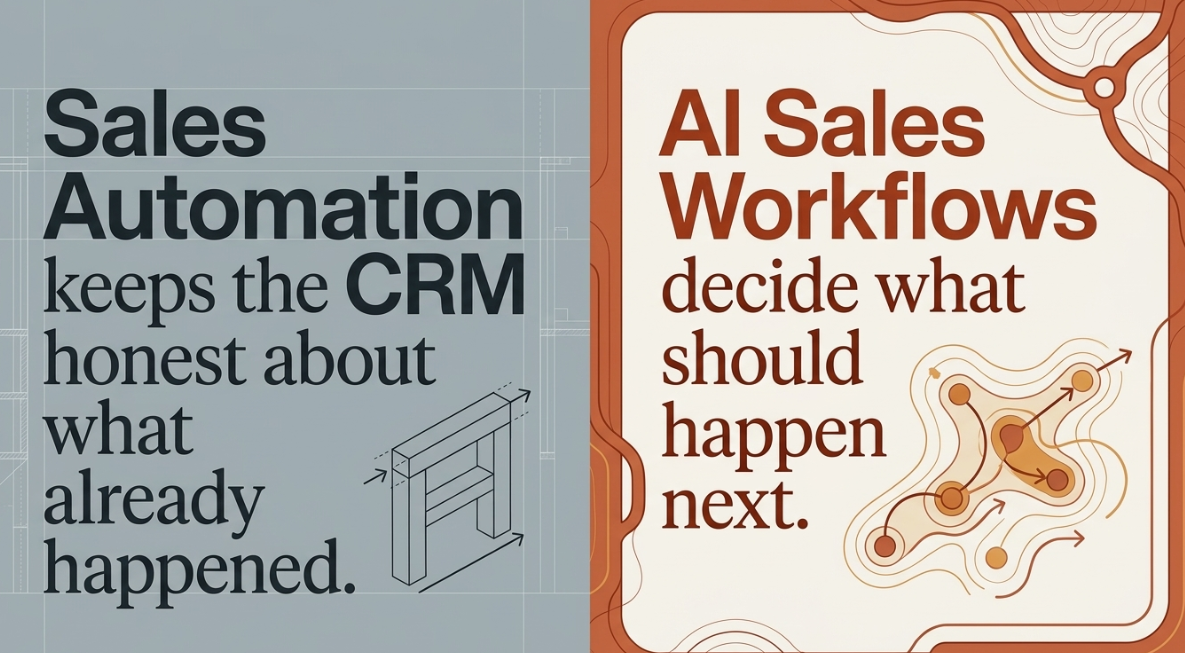
The Path from Sales Automation to AI Sales Workflows
You don't replace sales automation. You keep the Sequences that actually fire, the welcome series, the post-meeting follow-ups, and the contract renewal reminders. They're still doing useful work for the slice of buyer behavior they were built to handle.
What you add is the layer above them: AI sales workflows that read the signals your Sequence can't see. The workflows that pick up Dark Funnel activity, decide what action that specific signal calls for, and either fire the action autonomously or hand it to a human with full context. The Sequence remains the bottom layer for predictable, rule-based motions. The AI workflow becomes the top layer for adaptive, signal-driven motions.
For most $5M–$50M founders, the right starting point is a one-pass diagnostic, a Revenue Leak Assessment engagement that maps the signals automation is missing, before any new tool gets purchased. You don't need more software. You need to see which deals you're losing in the Dark Funnel, and what architecture would have caught them.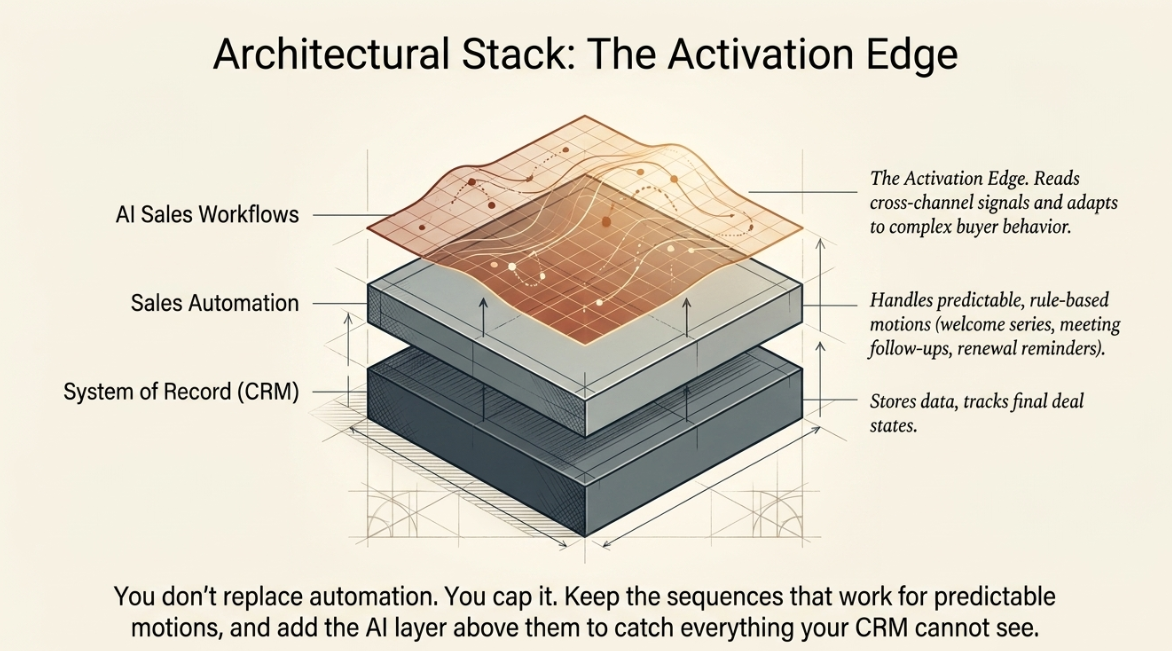
Frequently Asked Questions
Are AI sales workflows just rebranded sales automation?
No, and the analyst record settles it. Gartner formally defined Revenue Action Orchestration as a new sales technology market in October 2024, and Forrester independently formalized the Revenue Orchestration Platform category in the same year. Two leading analyst firms don't create the same category at the same time for a marketing rebrand; they do it for a structural shift. Gartner does warn about "agent washing", vendors slapping AI labels on legacy automation, so the buyer's skepticism is healthy. The architectural test cuts through it: if the workflow only reads CRM events, it's automation; if it reads signals automation cannot see, it's something else.
Do I need AI sales workflows if I already have sales automation?
Probably yes, if your buyers behave as the average B2B buyer documented in McKinsey's 2024 B2B Pulse Survey, using 10.2 channels in their purchase journey. Sales automation covers the two or three channels inside your CRM. AI sales workflows cover the seven or eight outside of it. If your deals consistently go cold for no obvious reason, the gap is almost certainly architectural, not effort-based.
What can AI sales workflows do that sales automation can't?
Three things specifically. They read signals outside the CRM, LinkedIn engagement, anonymous web visits, intent data, and peer-conversation references. They make autonomous decisions on those signals rather than running a preset rule. And they adapt the next action to what the signal actually said rather than what the cadence was scheduled to send.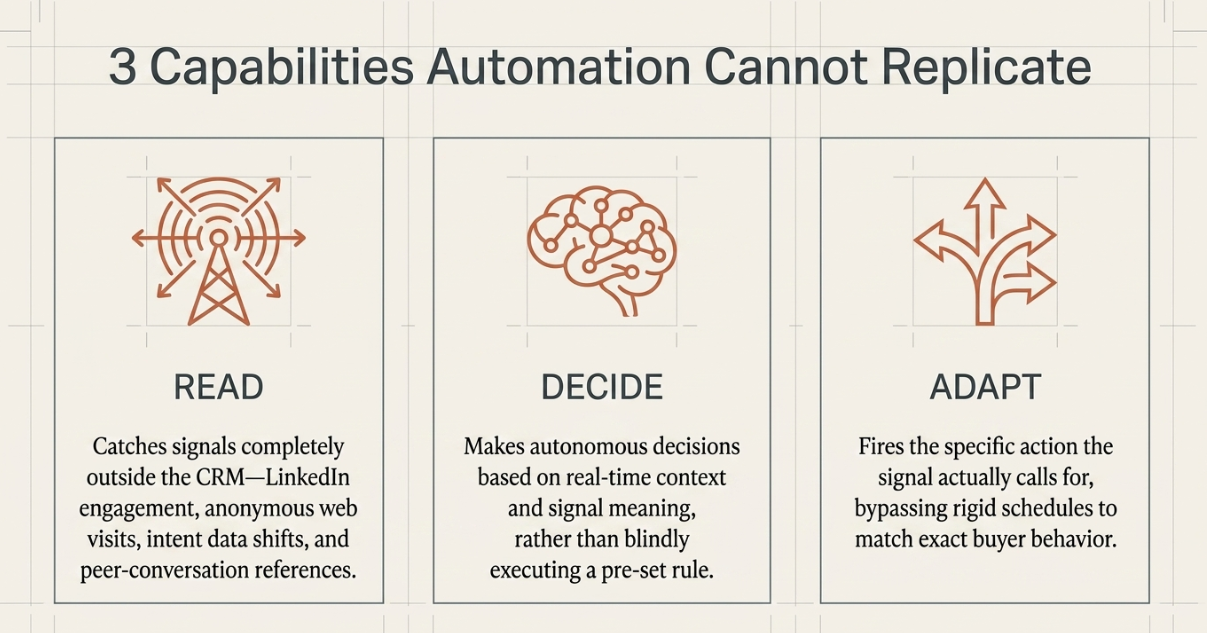
Can I keep my sales automation and add AI sales workflows?
Yes, and that's typically the right move. The Sequences that work continue running. The AI workflow sits one layer above them, orchestrating signals automation can't see and firing actions automation can't trigger. The two layers don't compete; they cover different slices of buyer behavior.
How do I know if I've hit the automation ceiling?
The clearest tell is that deals go cold without a knowable cause. Your Sequence ran. Your team showed up. The buyer disappeared anyway, and you found out three weeks later that a competitor had closed them. If that pattern is happening more than once a quarter, you're not running sales automation badly; you're running it past its design limit.
Is this the same as RevOps automation?
No, but it includes it. Gartner's RAO category absorbs sales engagement, revenue intelligence, and SFA into one AI-driven layer. RevOps automation, Zapier-style integrations, manual data syncs, and attribution mapping are one input to that layer, not the layer itself. The category sits above your RevOps stack, not inside it.
Revenue Leak Assessment
If the deals going cold sound like the ones you're losing, a Revenue Leak Assessment is the place to start. Twenty-minute call, no pitch, we'll walk through where the Dark Funnel signals are firing in your pipeline and which deals your current automation can't see.



Leave a Comment