


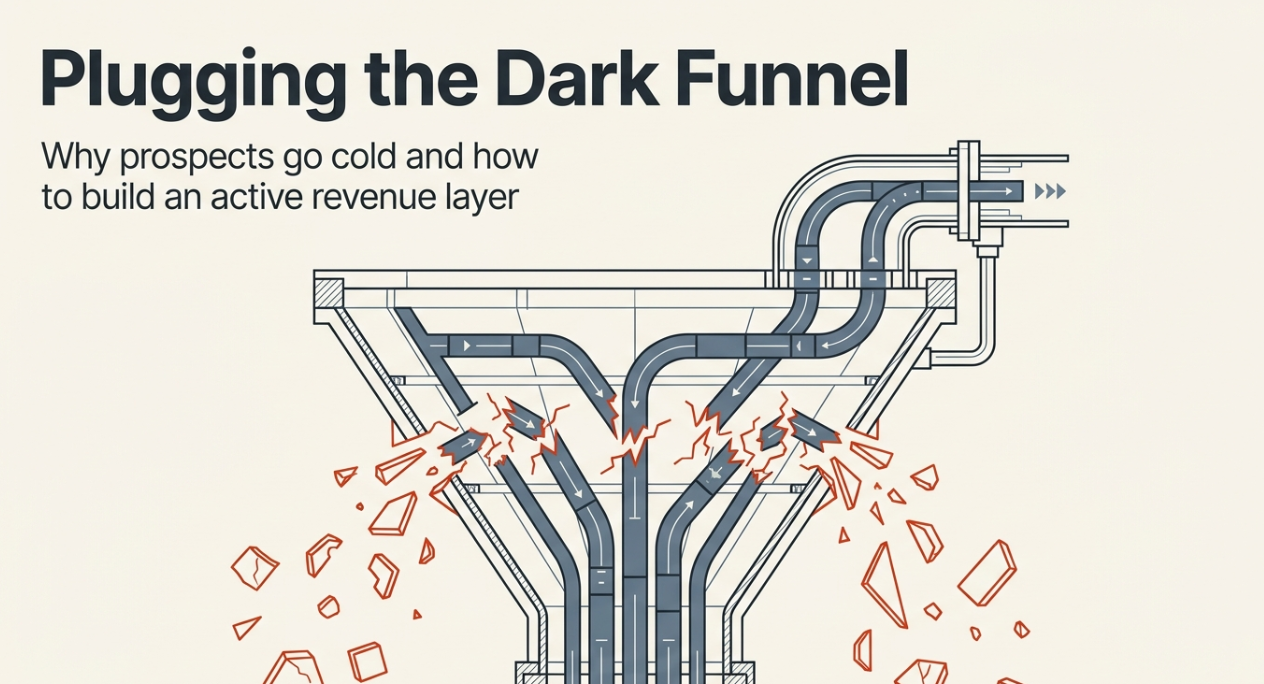
Prospects go cold for two reasons: you responded too slowly, or you stopped following up too soon. Research from Harvard Business Review shows that companies that respond within the first hour are 7x more likely to qualify a lead than those that wait, and that 80% of deals require five or more follow-up touches before closing. The fix is a system that monitors every inbound channel and automatically triggers follow-up, so no inquiry sits overnight, and no prospect is abandoned after one email.
The Sunday Evening Inquiry
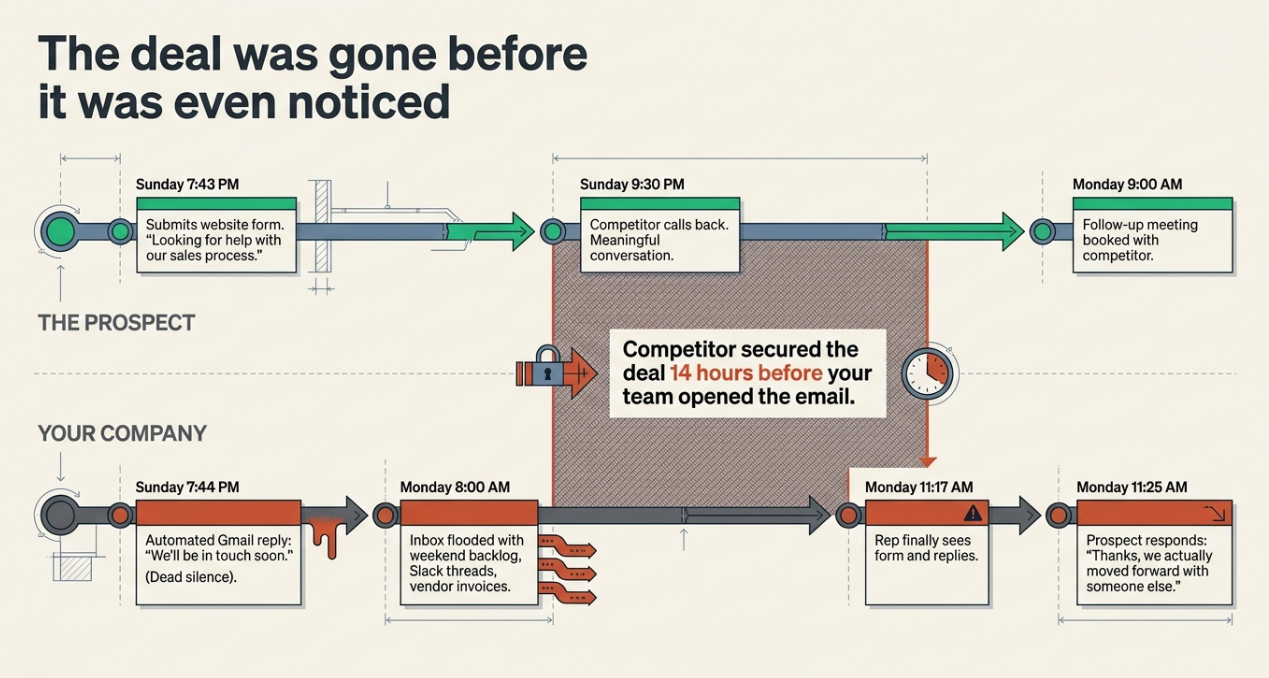
It's Sunday evening, 7:43 PM. Someone finds your website, maybe through a referral, maybe because they'd been searching for thirty minutes, and they fill out the contact form. Subject line: "Looking for help with our sales process." They hit submit and go to bed.
Your shared Gmail inbox receives it. Nobody's watching on Sunday evening. An auto-reply fires: "Thanks for reaching out, we'll be in touch soon."
Monday morning arrives with its usual pile. Three customer emails that needed answers by Friday. A vendor invoice. Two Slack threads from the weekend. The inquiry from Sunday evening is somewhere in the queue. By 11 AM, a team member finally sees it and starts drafting a reply.
By that time, the prospect had called three companies after submitting their form. One called back Sunday night, within two hours. They had a conversation. A follow-up call was already scheduled for Monday morning.
Your reply lands at 11:17 AM on Monday. The prospect is polite: "Thanks, we actually just moved forward with someone else."
The deal was gone before it was even noticed.
Why Deals Go Cold: The Two Failure Modes
There are exactly two points where an inquiry dies. Understanding which one is killing your deals tells you what to fix.
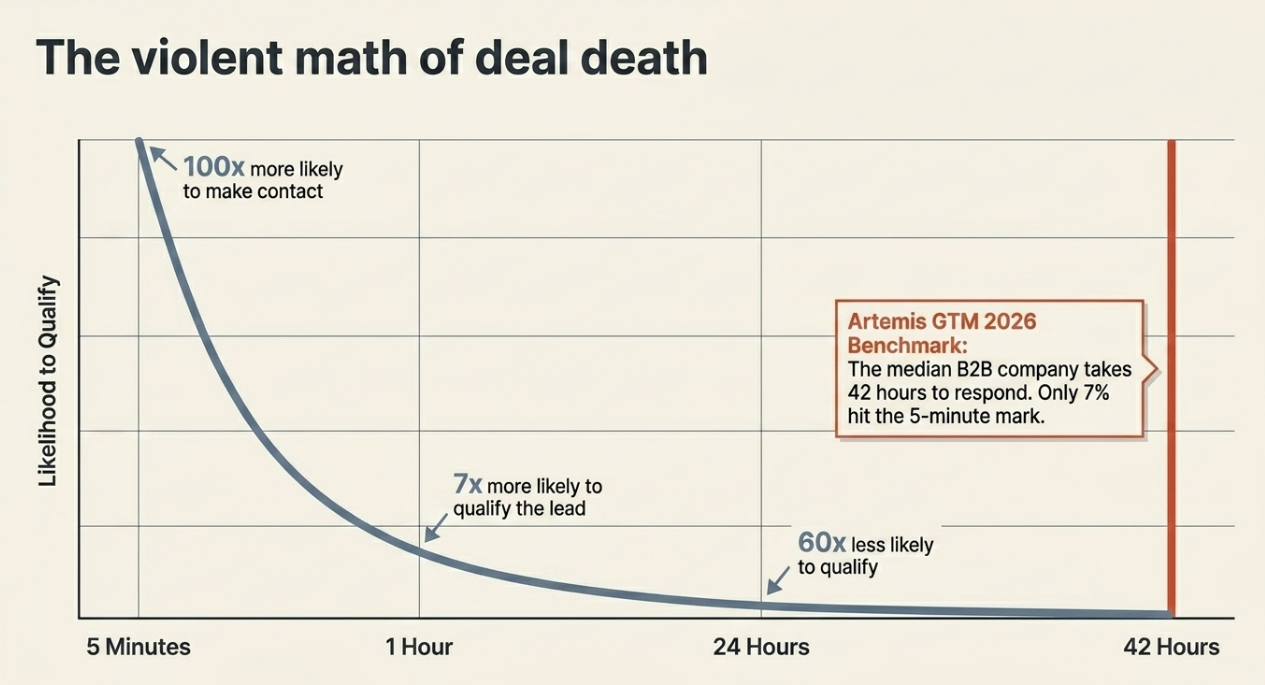
The first-response gap. Research published in the Harvard Business Review, based on the original MIT and InsideSales.com study tracking 2,241 US companies, found that firms responding within one hour of an inquiry were nearly 7x more likely to qualify the lead than those who waited. Wait 24 hours, and that number drops to 60x worse. The 2026 benchmark study from Artemis GTM, covering 253,817 B2B lead submissions, confirms the math still holds: the median B2B company takes 42 hours to respond, and only 7% respond consistently within 5 minutes.
The reason this gap persists isn't laziness. It's that a human-dependent system has no mechanism for monitoring channels at 7 PM on a Sunday.
The multi-touch abandonment gap. Even when the first response happens, most follow-up systems collapse after one attempt. According to Invesp's research on sales follow-up behavior, 48% of salespeople never make a single follow-up attempt after initial contact. Yet 80% of successful sales require five or more touches. The deals don't go cold because prospects say no. They go cold because both sides assumed the other had moved on.
This is what's called the Dark Funnel, the gap between what's actually happening in your pipeline and what you can see. The Sunday inquiry, the unanswered second email, the rep who stopped following up: none of it shows up anywhere. It's just revenue that disappeared.
Who This Is Happening To
If any of these patterns sound familiar, this article was written for you.
You missed a deal you later heard went to a competitor, who responded the same day you were still drafting your first reply. You've hired one or two salespeople, and the pipeline didn't grow the way you expected. You've had a conversation with an investor or a board member where you couldn't give a clean answer on what's in the pipeline. Or a rep left, and somewhere in their email and their memory were deals you didn't know the status of.
You're not running a broken operation. You're running a human-dependent follow-up system that was never designed to monitor all channels, at all hours, with persistent follow-through. The two failure modes above aren't behavioral; they're structural.
The Four Patterns Where Deals Go Cold
|
If this is happening |
What does it cost you |
What to fix first |
|
Inquiries arrive on weekends or after business hours, and nobody sees them until the next business day |
The first-responder wins 35–50% of B2B sales (Peak Sales Recruiting data). You're starting every Monday behind competitors who answered Sunday night. |
A system that monitors the inquiry channel continuously and sends an initial response within the hour, regardless of time of day. |
|
You or your rep sends one email after a call, gets no reply, and assumes they weren't interested |
Research from RAIN Group shows it takes an average of 8 touchpoints to earn an initial meeting, yet most teams stop at 1 or 2. Every abandoned follow-up is a potential deal written off prematurely. |
A persistence layer: the system schedules the next touch automatically when the first one goes unanswered, not when someone remembers to do it. |
|
A rep leaves (or goes on leave), and the deals they were managing live in their personal email and memory |
The incoming rep starts cold. The prospect, who's had two warm conversations, gets a first-contact email with no context. That's not a follow-up. That's starting over. |
All deal context is captured in a shared, searchable system, not in one person's inbox. Handoffs include full conversation history. |
|
The first follow-up is delayed by two or three days and arrives after the prospect has already made a decision |
Speed matters more in the first 24–48 hours than at any other point. A delayed first reply doesn't just lose time; it signals that the vendor isn't organized. |
First-response automation tied to the inquiry channel, not to a rep's availability or inbox triage. |
Why It Keeps Happening: The Root Cause
Here's the thing: this problem has been documented since 2007. The original MIT/InsideSales.com research was published nearly fifteen years before the 2026 benchmark study that found the same median response time, 42 hours, still holding.
The tools to fix it have existed for years. The data is clear. And yet 66% of B2B companies still take over an hour to respond to a new inquiry, according to the Artemis GTM 2026 benchmark.
Why? Because the system was built for humans to act, not for systems to act.
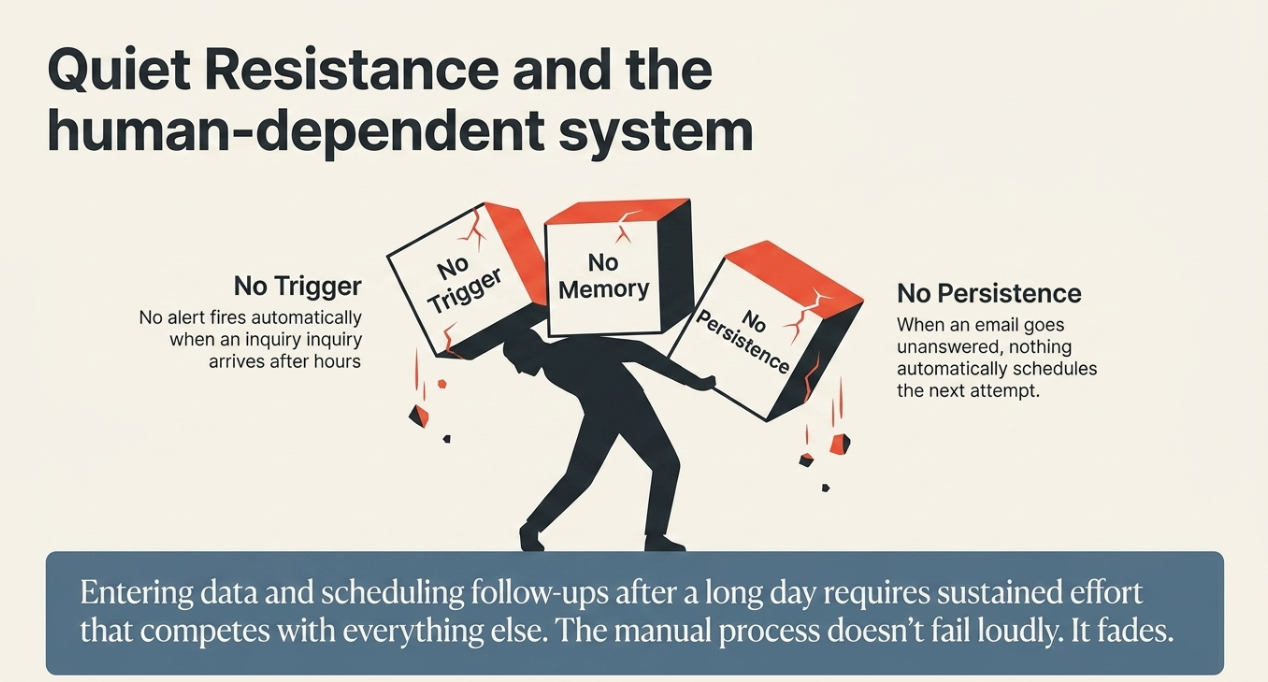
A human-dependent follow-up process has three structural weaknesses: no memory, no trigger, and no persistence. The rep doesn't know about the Sunday inquiry until Monday. No trigger fires automatically when an inquiry arrives at 7 PM. And when one email goes unanswered, there's nothing that schedules the next one; it requires a human to remember, decide it's worth another try, and sit down to write it.
This is what Quiet Resistance looks like in practice. Nobody decided to stop following up. Nobody announced that the CRM wasn't being used. The system just quietly got abandoned, because entering data and scheduling follow-ups after a long day requires sustained effort that competes with everything else demanding attention. The manual process doesn't fail loudly. It fades.
RAIN Group's prospecting research shows top performers achieve first meetings in around 5 touches on average; most deals require 8. No human-only system reliably executes 8 touches across every active prospect without something falling through. And according to Qwilr's 2026 sales follow-up analysis, high-growth organizations run up to 16 touchpoints over a 2–4 week span. That's not a rep's job. That's a system's job.
The 5-minute response window isn't a behavioral standard; it's a structural requirement. You can't train a person to be available within 5 minutes across every channel at all hours. You build a system that is.
What to Fix First: A Decision Table
(See table in Symptoms section above, the four patterns map directly to the four fixes.)
Expanded decision summary:
|
Scenario |
Root cause |
First fix |
|
Weekend/after-hours inquiry gap |
No monitoring; human-only coverage |
Automated channel monitoring + instant first response |
|
Multi-touch abandonment |
No persistence layer; rep discretion |
Automated follow-up sequence triggered on non-response |
|
Rep hand-off failure |
Deal context lives in personal email/memory |
Shared system captures all conversation history before handoff |
|
Delayed qualification |
Response depends on rep availability |
First-response automation decoupled from rep schedule |
The CETDIGIT Perspective
The 2026 benchmark data is worth sitting with for a moment.
The original research was published in 2007. Replicated by HBR in 2011. The finding: respond within 5 minutes, and you're 100x more likely to make contact than if you wait 30 minutes. Wait 24 hours, and you're 60x less likely to qualify the lead. The numbers were striking enough that they circulated across every sales training program for a decade.
And then the 2026 study of 253,817 B2B lead responses found that the median response time is still 42 hours.
The data didn't change the behavior. Better tools didn't change the behavior. More training didn't change the behavior. What has actually changed in the last fifteen years of sales software is that the CRM got better at recording what happened, not at making sure the right thing happened.
That distinction matters. A CRM is a system of record. It shows you what occurred. It doesn't monitor, trigger, or follow through. That's why the Sunday evening inquiry sits unnoticed until Monday midday, even in companies that have Salesforce or HubSpot fully deployed. The system knows the inquiry came in. It just didn't do anything about it.
This isn't a failure of tools. It's a failure of architecture. The question isn't "do we have a CRM?" Most companies do. The question is: does the system act, or does it only record?
If the follow-up depends on a human to notice, decide, draft, and send, the deal that arrives at the wrong moment will go cold. Not because of bad intentions. Because of how human-dependent systems work.
Where to Go from Here
The fix isn't a new CRM. It's the activation layer that makes your existing infrastructure actually respond.
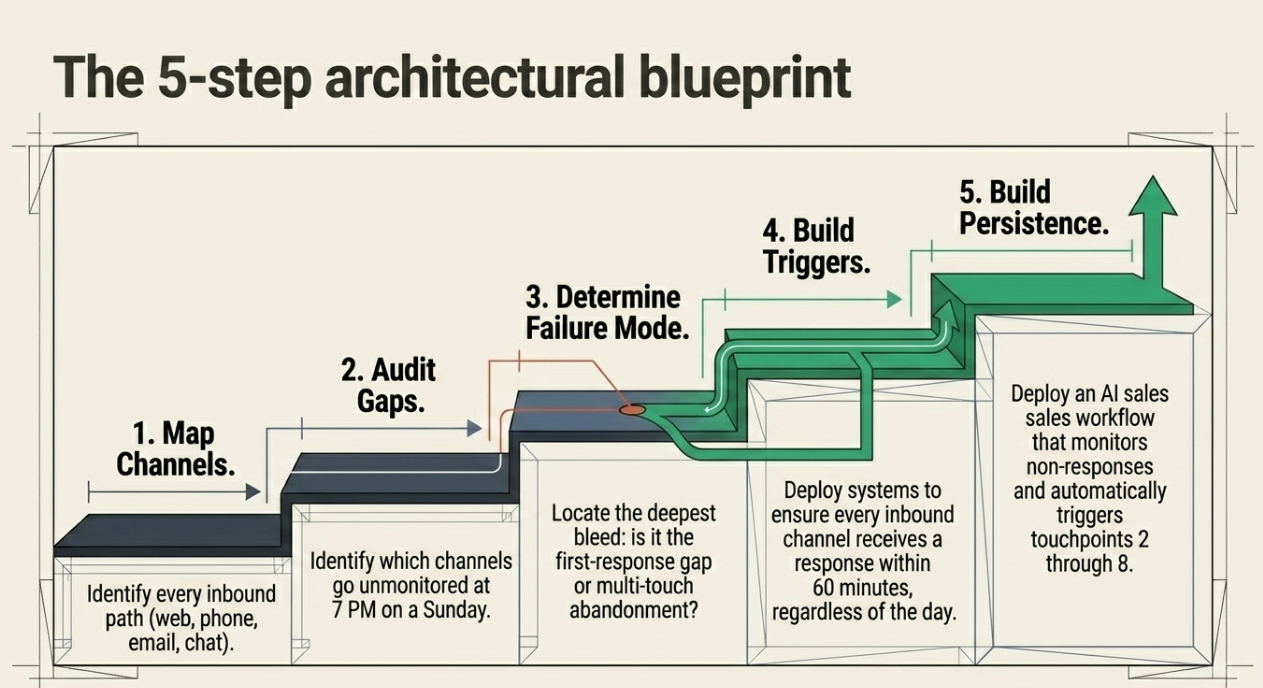
Five steps, in order:
Step 1. Map every channel where an inquiry can arrive: web form, phone, email, chat. All of them.
Step 2. Identify which of those channels is unmonitored at any hour. That's your first-response gap.
Step 3. Determine which failure mode is costing you more deals, the first-response gap or the multi-touch abandonment gap. Most companies have both, but one dominates.
Step 4. Build a trigger: the system responds to every inbound channel within the first hour, regardless of whether it's Tuesday at 2 PM or Sunday at 7 PM. AI voice agents handle after-hours inquiry capture in real time; the call that would have gone to voicemail on a Sunday evening gets answered.
Step 5. Build a persistence layer: if the first response gets no reply, the system schedules the second touch automatically, not when a rep remembers. The AI sales workflow system that monitors every inbound channel is where this architecture lives.
If you want to understand what the connected system looks like beyond fixing the follow-up gap, what a connected revenue architecture looks like is where that conversation starts. And for the broader framework that places these solutions in context, CETDIGIT's broader AI services framework shows how each piece fits.
These aren't sequential projects. You can start with Step 2 this week, identifying the unmonitored channels, without any system change at all. That single audit tells you exactly where the deals are going cold.
FAQ
Q1: How long does it take for a lead to go cold?
According to MIT and InsideSales.com research, contacting a lead within 5 minutes makes a sales team 100x more likely to make contact than waiting 30 minutes, and 21x more likely to qualify the lead. The Harvard Business Review validation study found that companies waiting even one hour (not one day, one hour) are 7x less likely to qualify the lead. After 24 hours, that ratio is 60x worse. Practically speaking, a lead that doesn't hear from you within the first few hours on a business day has often started talking to someone else. On weekends, the window is the same, it doesn't pause because your office is closed.
Q2: Why don't salespeople follow up more than once?
According to Invesp, 48% of salespeople never make a single follow-up attempt after initial contact, and among those who do follow up, time is cited as the biggest obstacle. The structural reality is that a single unanswered email produces no visible signal; the inbox shows silence, not "prospect still interested but busy." Without a system that interprets non-response as a trigger for the next touch, the rep's default interpretation is that the prospect isn't interested. That interpretation is wrong in the majority of cases where the prospect was simply busy, distracted, or hadn't yet decided.
Q3: How many times should I follow up before giving up?
Invesp's research shows 80% of successful sales require 5 or more follow-up touches, and RAIN Group's data shows top-performing reps earn initial meetings in an average of 5 touches, while the standard is 8. The answer isn't a fixed number; it's a system. Persistence is not the same as pestering. A well-structured follow-up sequence varies the channel (phone, email, voice message), varies the message (value, question, resource), and stops when the prospect explicitly opts out, not when silence feels like rejection.
Q4: Can AI really respond to an inquiry faster than a human?
Yes, and that's the point. An AI voice agent or automated response system doesn't take breaks, doesn't watch football on Sunday afternoon, and doesn't have an inbox backlog on Monday morning. The 5-minute response window that dramatically increases qualification rates is a structural requirement that human-only systems can't meet consistently. AI handles the first response, so the human conversation happens at the right time, with the right context, not 42 hours later, cold.
Q5: What's the difference between a CRM and an automated follow-up system?
A CRM records what happened. It shows you that the inquiry came in, that the first email was sent, and that the call was logged. It does not monitor channels, trigger responses, or schedule the next touch when one goes unanswered. This is why Quiet Resistance sets in; the CRM becomes a data-entry burden rather than a system that does work. An automated follow-up system uses the CRM's data to trigger actions: when an inquiry arrives, the system responds; when a response goes unanswered, the system schedules the next touch. The CRM stores the record. The activation layer makes things happen.
Q6: What does an automated follow-up system actually do?
It monitors every channel where inquiries arrive, including web form, phone, email, and chat. When an inquiry comes in, it sends an acknowledgment and an initial qualifying response within the first hour. When that response gets no reply within a defined window, it schedules a second touch automatically. If the second touch gets no reply, it schedules a third, via a different channel if possible. It captures every interaction in a shared, searchable context so a rep who picks up the conversation has the full history, not just a name in a spreadsheet. The system's job is to keep the conversation alive until the prospect either qualifies themselves out or says yes.
Q7: We tried automating follow-up once, and it felt spammy. What did we do wrong?
Automation that feels spammy is automation without context. A generic blast, "Hi [First Name], just following up on my previous email," sent to every non-responder on the same day, feels like spam because it is. It treats every inquiry the same, regardless of what was asked, what was said, or how much time has passed. Effective automated follow-up calibrates the message to the inquiry type, uses the right channel for the right moment, and spaces the sequence in a way that mirrors how a thoughtful human rep would actually follow up. The AI sales workflow isn't a mass-email tool. It's a context-aware trigger system.
Revenue Leak Assessment
Book a 20-minute Revenue Leak Assessment. No pitch, we'll walk through exactly which deals you're losing right now and what to fix first.



Leave a Comment