


A CRM stack delivers clean dashboards and accurate reports. What it was not built to do is autonomously detect revenue signals and act on them. The ROI gap in most mid-market Salesforce environments is not a data problem or a user-adoption problem; it is an activation problem. Revenue Intelligence, the measurement layer that converts behavioral data into autonomous revenue action, was absent from the implementation. That layer builds on top of what you already own. Only 33% of AI initiatives meet their ROI goals. The stack was right. The activation layer is what is missing.
The Q3 Board Question That Doesn't Have a Clean Answer
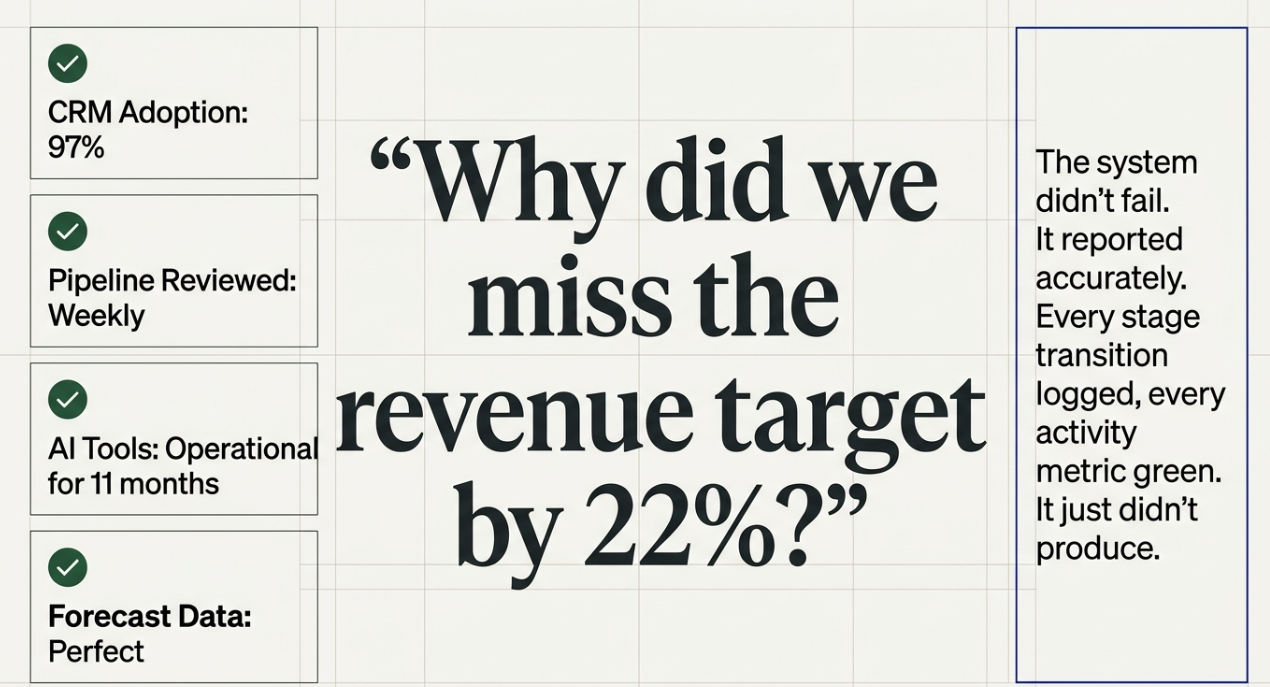
October 14th, 2025. A VP of Revenue Operations at a $90M software company walks into the Q3 board review carrying one of the cleanest performance packages she has presented in three years. CRM adoption across the sales organization: 97%. The pipeline is reviewed weekly. AI tools have been deployed and operational for eleven months. The dashboards are immaculate, stage-by-stage, rep-by-rep, region-by-region.
The CFO looks up from the package. "Why did we miss the revenue target by 22%?"
The question sits in the room. The VP has no clean answer, not because the data is wrong, but because the data is correct. The CRM reported accurately. The system operated exactly as designed. Every stage transition logged, every forecast call documented, every activity metric green. The system simply did not produce.
This is the moment that defines the Segment 3 condition. Not chaos, not broken tools, not a data crisis. A system that runs perfectly and delivers less than the board expected.
Before any architecture conversation begins, one thing must be established: the stack was the right decision. The Salesforce implementation was executed correctly. The data model is sound. The RevOps function that built it made no professional errors. What is missing is the activation layer, the component that converts behavioral data into autonomous revenue action, that no one builds at implementation time, because it requires eighteen months of live behavioral data, a mature signal detection architecture, and an AI orchestration layer sitting on top of the existing system rather than replacing any part of it.
Revenue Intelligence, the measurement layer that replaces retrospective reporting with real-time sensing, is that activation component. It knows in real time which accounts are showing buying behavior. The Salesforce instance reports what happened. Revenue Intelligence identifies what is happening and triggers action before a human has to log in to find out.
According to McKinsey's 2025 State of AI survey, 88% of organizations regularly use AI in at least one business function. Only approximately 6% qualify as high performers, achieving more than 5% EBIT impact from AI. The 82-point gap between deployment rate and performance rate is the Segment 3 condition expressed in numbers. Deployment is mature. Activation is not.
What Optimization Debt Actually Costs
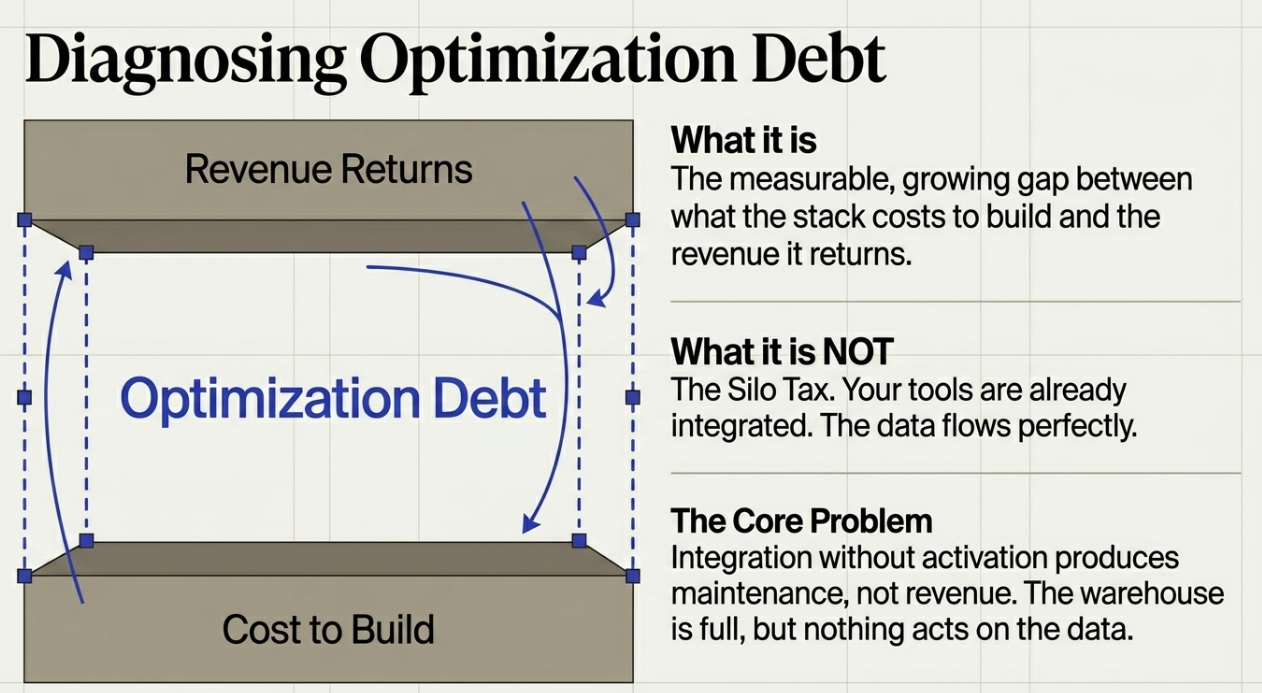
Optimization Debt is the gap between what the stack costs to build and what it is returning in revenue, measurable, specific, and growing every quarter. The activation layer is absent.
It is distinct from the Silo Tax, the Segment 2 cost of disconnected AI tools, adding rework rather than accelerating revenue. The Segment 2 reader's problem is integration. The Segment 3 reader's stack is integrated. The problem is that integration without activation produces maintenance, not revenue. The tools are connected. The data flows. Nothing acts on it.
Two data dimensions quantify Optimization Debt precisely.
The Data Activation Gap
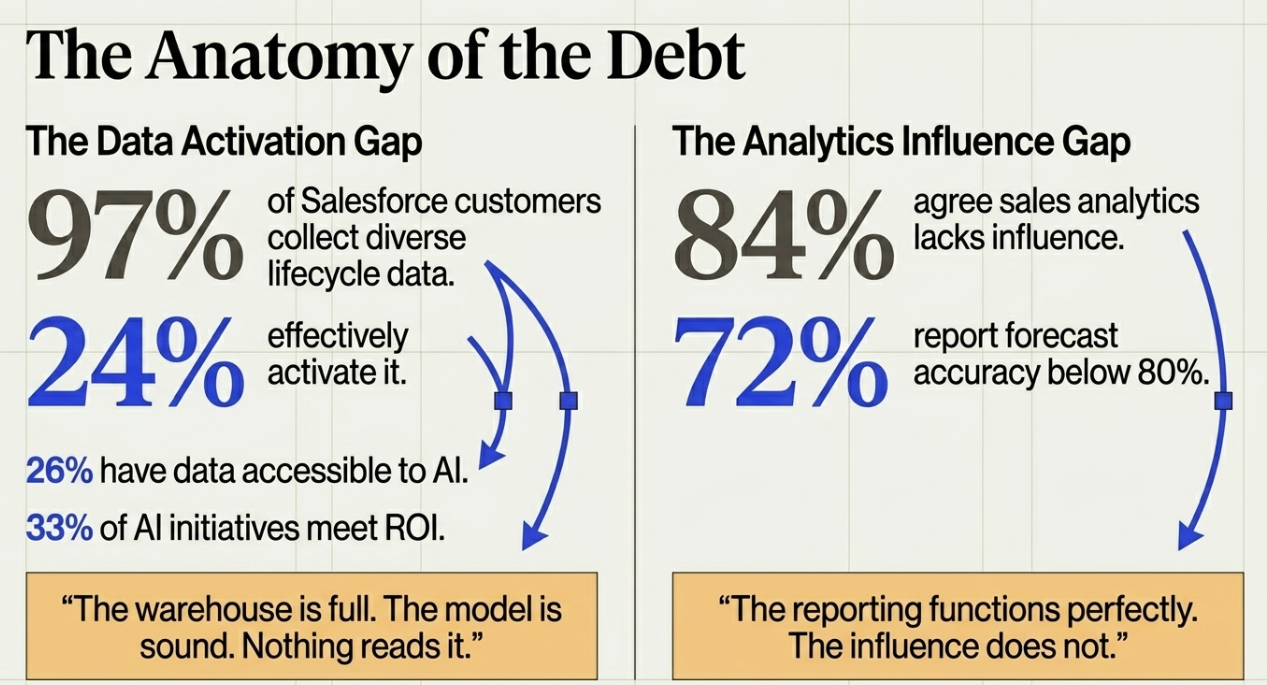
IBM's State of Salesforce 2025–26 research found that 97% of Salesforce customers collect diverse data across their customer lifecycle, yet only 24% effectively use it to transform customer experiences. The same research found that only 33% of AI initiatives meet their ROI goals, and only 26% of respondents report having most of their customer data actually in Salesforce and accessible to AI systems.
Read those figures together: nearly every Salesforce customer collects the data. Only one in four can access it for AI action. One in three AI initiatives produces the ROI the business projected.
This is Optimization Debt at the data layer. The warehouse is full. The model is sound. The signal that an account's three stakeholders visited the pricing page in the past 72 hours exists in the system, and nothing reads it as a buying trigger. That gap compounds every quarter.
The Analytics Influence Gap
Gartner's 2024 survey of sales leaders found that 84% agreed sales analytics has had less influence on sales performance than their leadership expected. In the same population, 72% of sales organizations reported forecast accuracy below 80%.
The implication is precise: the reporting infrastructure is functioning. The influence is not. Analytics describes performance after the fact. It does not trigger revenue behavior before the opportunity closes. Optimization Debt lives in that gap, between what the analytics layer knows and what the activation layer does.
Who This Describes Precisely
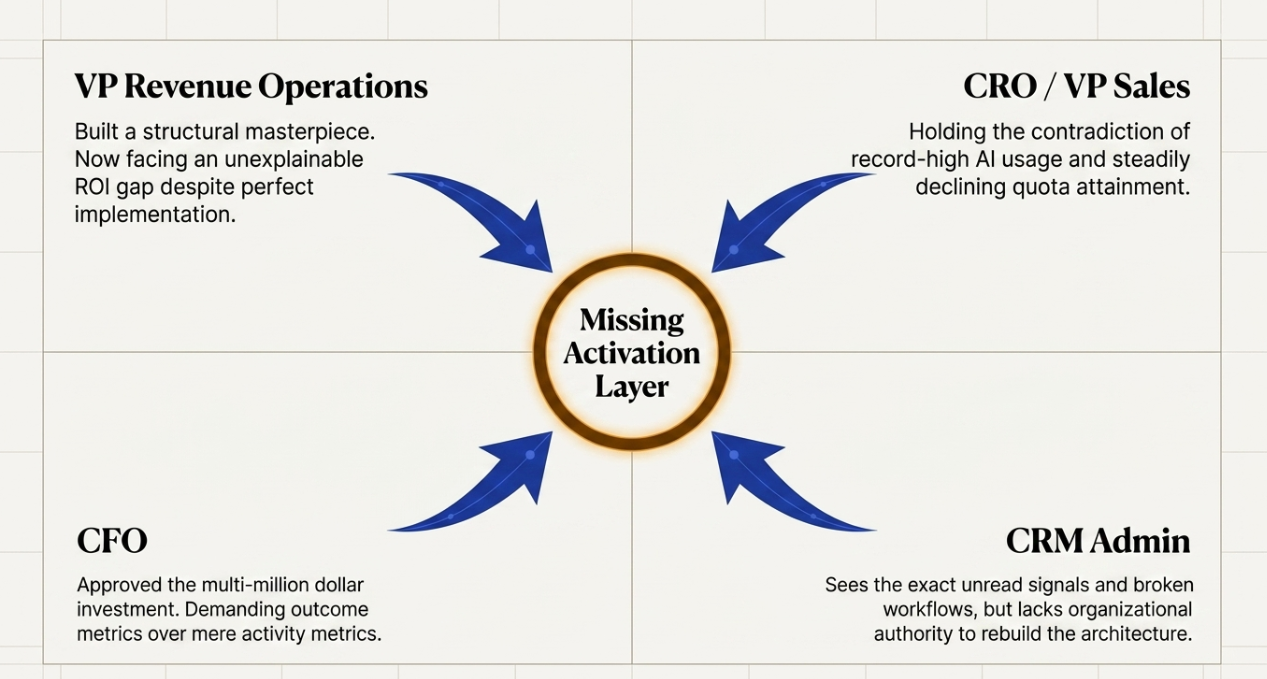
This article is written for four people in the same organization.
The VP Revenue Operations built the system. The CRM architecture, the data model, and the reporting infrastructure are professional achievements that required significant organizational capital to execute. The ROI gap is not a reflection of poor execution. It is the predictable result of implementing a system without the activation layer that requires eighteen months of live data before it can exist.
The CRO or VP of Sales is watching quota attainment decline in a quarter when AI adoption is at record levels. Salesforce's 2024 State of Sales data captured this precisely: 81% of sales teams have implemented or are experimenting with AI, while 67% of reps do not expect to meet their quota. High adoption, declining outcomes. The CRO is holding the contradiction and has no clean language for it in a board meeting.
The CFO approved a multi-million dollar technology investment that was well-argued and correctly scoped. The ROI question is not about whether the investment was right. It is about whether the organization built everything that the investment required to produce returns.
The Salesforce Admin or CRM Manager knows precisely where the gaps are, the workflows that don't trigger, the signals that go unread, and the attribution conflicts that produce three different revenue numbers from the same environment. They have the operational clarity. They lack the organizational authority to fix the architecture unilaterally.
These four people are not in conflict. They have the same problem, viewed from different vantage points. Companies at an intermediate RevOps maturity level use the same tools as advanced-maturity companies; the difference, per Gartner's RevOps maturity research, is that advanced-maturity organizations have built the end-to-end activation layer that converts data into revenue behavior. The stack did not need to be different. The activation needed to be built.
Five Symptoms of a Stack with Optimization Debt
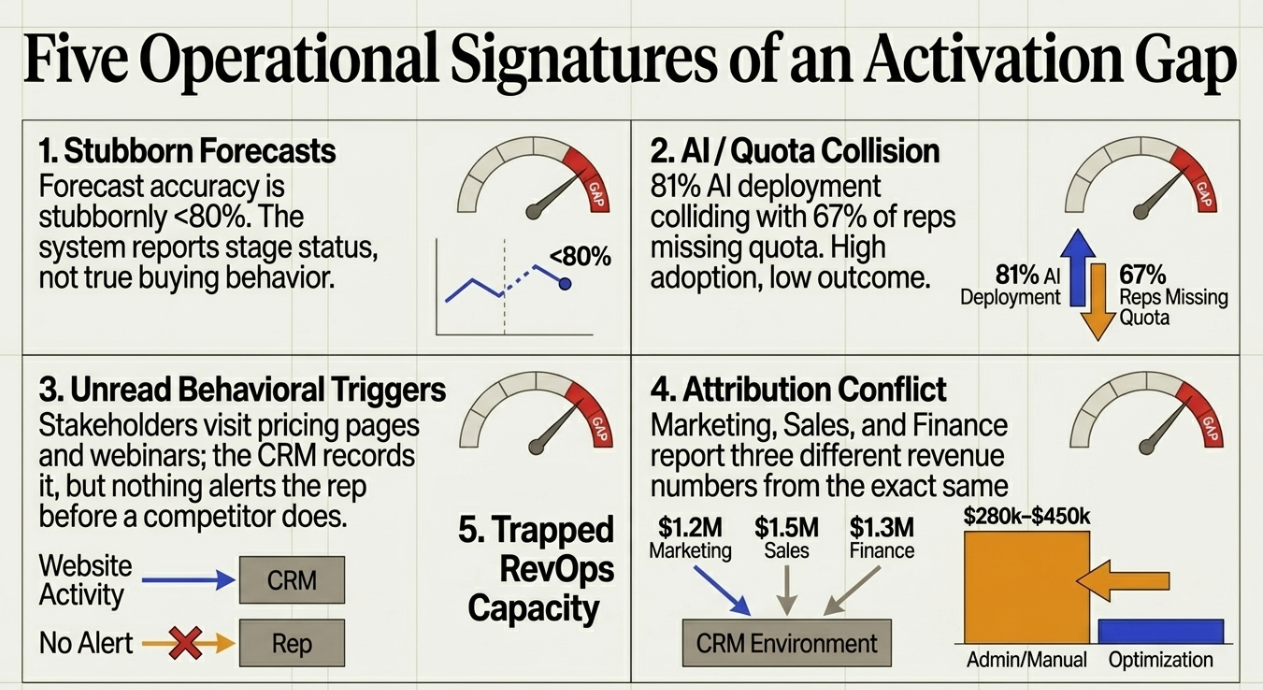
1. Forecast accuracy is consistently below 80%. The pipeline review is confident. The close rate at quarter-end does not match the pipeline number that entered the quarter. Gartner's 2024 Revenue Analytics Roadmap found 72% of sales organizations reporting forecast accuracy below 80%, attributing the gap to inaccurate and incomplete data activation, not to inaccurate data collection.
2. AI adoption is high; quota attainment is declining. Eighty-one percent AI deployment alongside 67% of reps not expecting to meet quota is not a technology problem. It is the precise signature of an activation gap: tools deployed, signals unread, revenue behavior unchanged.
3. Behavioral data exists in the system, and nothing acts on it. An account's stakeholders have visited the pricing page, opened two case study links, and attended a webinar in the past two weeks. The CRM contains that history. Nothing in the system reads it as a buying trigger and surfaces it to the relevant rep before a competitor does.
4. Marketing, sales, and finance report different revenue numbers from the same Salesforce environment. Attribution conflict is a diagnostic indicator of an activation gap, not a data-quality problem. When the activation layer is absent, every function applies its own rules to the same underlying data. The conflict is structural.
5. RevOps capacity is consumed by CRM administration rather than revenue optimization. CETDIGIT's observations across mid-market Salesforce deployments put the administrative overhead range at $280k–$450k annually, capacity deployed in maintaining the system rather than activating it. The system requires maintenance because the activation layer that would make it self-directing was never built.
Why the Stack Was Right, and the Activation Layer Is What's Missing
What Gets Built at Implementation
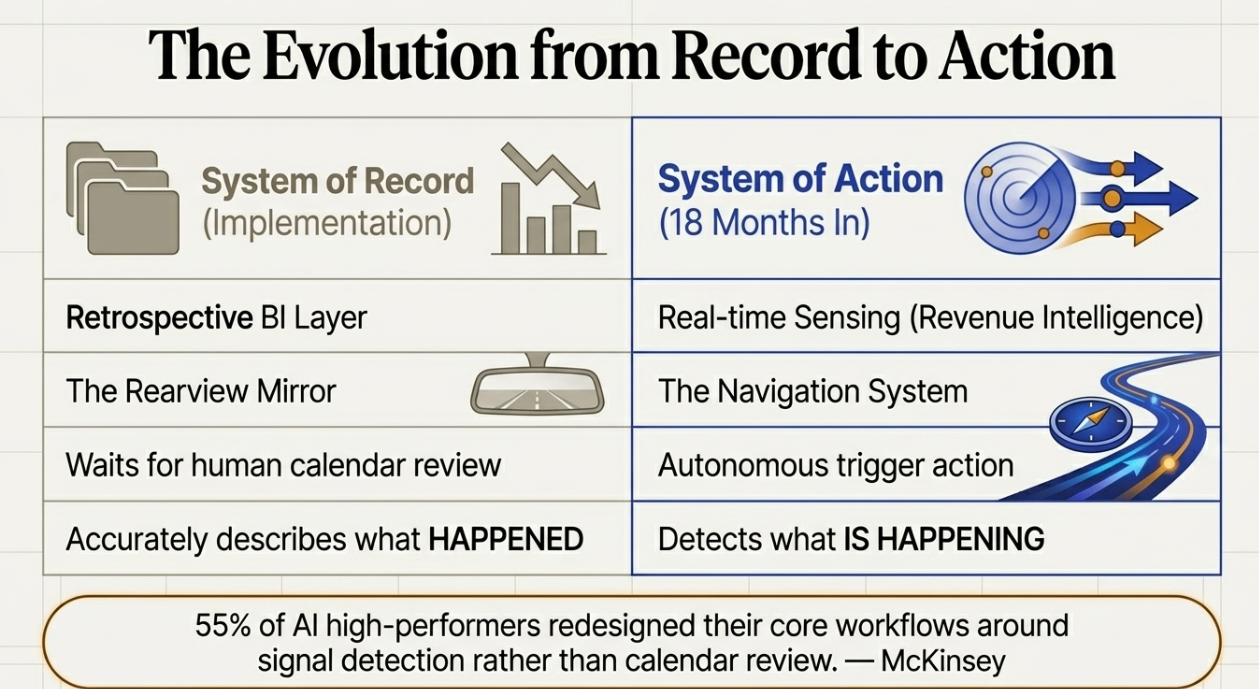
A Salesforce implementation delivers a system of record. Every contact, every account, every opportunity, every stage transition, logged, searchable, reportable. The data model correctly captures the business's revenue motion. The reporting layer surfaces pipeline status with precision. The adoption metrics are strong because the system is genuinely useful for its designed purpose.
This is a correct implementation. The RevOps function did its job. The vendor did its job. The outcome is a system that tells you, with considerable accuracy, what has happened to your pipeline.
What Doesn't Get Built Until Eighteen Months In
What does not get built at implementation time is the Signal of Action architecture: the layer that reads behavioral signals from the data and triggers autonomous revenue action without waiting for a human to log in and notice.
This layer cannot be built at implementation time. Not because the implementation team failed, but because the data required to calibrate it did not exist at the time of implementation. Eighteen months of live behavioral data, account-level, contact-level, signal-by-signal, is the minimum dataset needed to build a signal detection architecture that performs. The implementation installs the data collection infrastructure. The activation layer is built from what the infrastructure produces over time.
McKinsey's 2025 State of AI research identified the differentiator precisely: high performers are 2.8 times more likely to report fundamental workflow redesign, rebuilding the activation layer around AI signal detection rather than around human calendar review. Fifty-five percent of AI high performers had redesigned core workflows, compared to 20% of the broader population. They did not have better tools. They built a different activation architecture on the same tools.
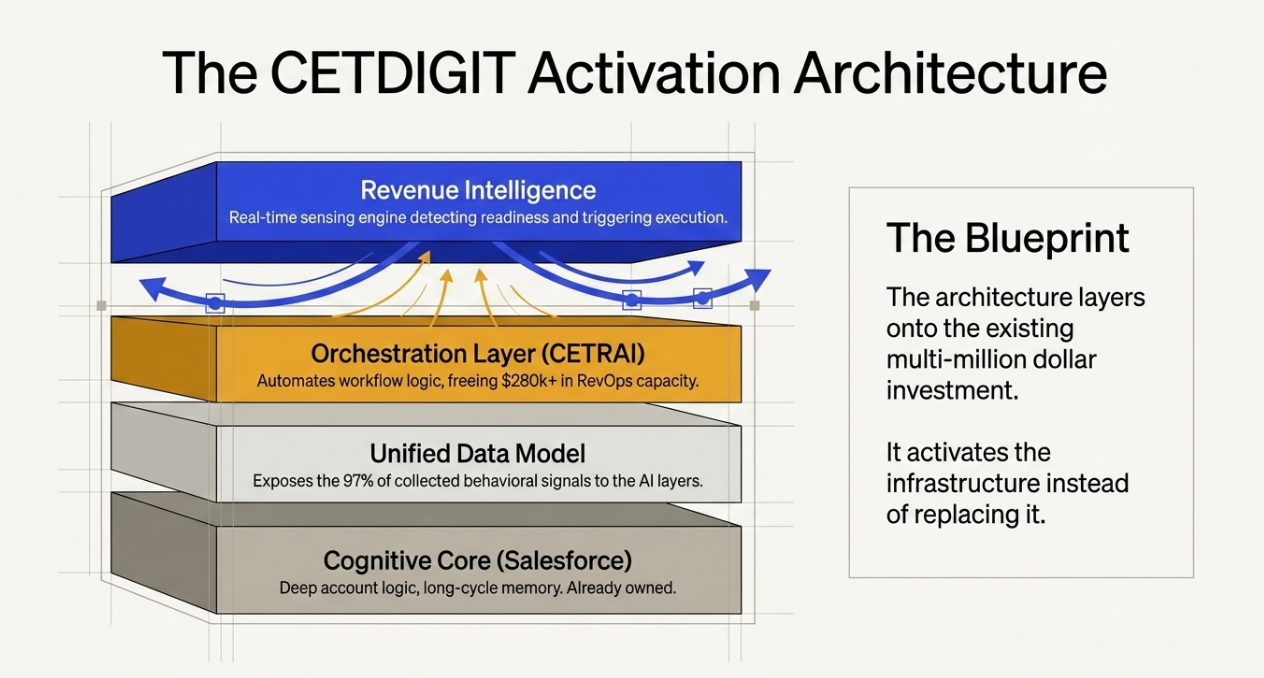
This is the structural distinction between a System of Record and a System of Action, the architecture that sweeps for revenue opportunities continuously rather than waiting for a rep to move a deal forward. The Salesforce instance is the Cognitive Core: deep account logic, long-cycle deal memory, complex relationship mapping. The activation layer sits on top of it, connecting signal detection to autonomous action without requiring the rep to be the intermediary.
Gartner's RevOps maturity framework confirms the performance differential: advanced-maturity organizations are twice as likely to exceed revenue goals and 2.3 times as likely to exceed profit goals compared to intermediate-maturity organizations. The tools are the same. The activation architecture is different.
Diagnosing Your Optimization Debt: A Decision Table
|
If your current state is... |
The Optimization Debt indicator is... |
What to address first |
|
Forecast accuracy is below 80% despite complete pipeline data |
Signal detection gap: the system reports stage status, not buying behavior |
Build the behavioral signal layer that reads real-time account activity and surfaces it before the forecast call |
|
AI adoption above 75%, quota attainment below 65% |
Activation gap: tools are deployed but not connected to revenue-triggering workflows |
Redesign the workflow layer around AI signal outputs, not human calendar review |
|
97% data collection, sub-30% data activation in AI systems |
Data access gap, behavioral data exists in the environment, but is not accessible to the AI layer |
The Unified Data Model works to expose behavioral signals to the orchestration layer |
|
Attribution conflict across marketing, sales, and finance |
Attribution architecture gap: each function applies its own rules to unconnected data |
Implement Revenue Intelligence as the single measurement layer; attribute outcomes to signal-triggered actions |
|
RevOps capacity consumed by CRM maintenance, not revenue optimization |
Overhead structure gap, the system requires human maintenance because it does not self-direct |
Introduce the orchestration layer (CETRAI) that automates maintenance workflows and frees RevOps capacity for activation work |
The CETDIGIT Perspective, Revenue Intelligence as the Activation Layer
The four-component architecture CETDIGIT builds, Unified Data Model, Orchestration Layer, Revenue Intelligence, Cost per Outcome, was described in detail in the foundational Revenue Engine architecture article. What is specific to the Segment 3 condition is how that architecture relates to a system that already exists and is performing correctly by every measure except revenue outcome.
The Unified Data Model does not replace the Salesforce data model. It exposes the behavioral signals already in the system to the activation layer. The 97% of the data that Salesforce customers collect, but only 24% activate, becomes the input to a Revenue Intelligence layer that reads it in real time, detects buying signals, and triggers revenue action without waiting for a weekly pipeline review.
Revenue Intelligence is not a BI layer. It does not produce reports about what happened. It detects what is happening, which accounts are in a Moment of Readiness, which deals are at risk before the forecast call, and which prospects have shown enough signal concentration to warrant autonomous outreach. The difference between a BI layer and a Revenue Intelligence layer is the difference between a rearview mirror and a navigation system.
The Cost per Outcome (CPO) framework is the board-level proof. When the activation layer is operating, every revenue action, outreach triggered, meeting booked, opportunity advanced, is attributed to a specific signal event. CPO replaces activity-based ROI measurement with outcome-based measurement. The board question shifts from "why are we missing the target" to "what is the cost of producing each closed deal through the Revenue Graph architecture, and how does that compare to our human-baseline cost?"
CETDIGIT's AI Revenue Engine is the architectural layer that connects signal detection to autonomous action for companies in this position, those with a correct Salesforce implementation that has not been extended to include the activation layer. The CETRAI orchestration platform is the specific component that sits between the Cognitive Core and the execution layer, triggering revenue actions from signal inputs without requiring RevOps to maintain the workflow logic manually. As part of CETDIGIT's broader AI services framework, both components sit within a full architecture designed for companies whose stack is correct and whose activation layer is missing.
Recommended Path, Where to Start If This Describes Your Stack
The entry point depends on where the Optimization Debt is concentrated.
If the primary gap is data activation, the signals exist in Salesforce but are not accessible to the AI layer, the starting point is the Data and AI Foundation work that exposes behavioral data to the orchestration layer. This is a precondition for everything above it.
If the primary gap is orchestration, the data is accessible, but nothing connects signal detection to revenue-triggering action. The starting point is the CETRAI platform, the orchestration layer that routes signals to autonomous action without requiring RevOps to manage workflow logic manually.
If the primary gap is the full Revenue Intelligence architecture, behavioral data, signal detection, and autonomous action are all absent or fragmented, the starting point is the AI Revenue Engine, which builds all three components on the existing Salesforce environment.
If the primary question is where to begin, if the scope of Optimization Debt is unclear, and the board conversation needs a framing before an architecture conversation, an AI strategy diagnostic establishes the specific gap before any architecture work begins.
CETDIGIT's Revenue Graph Audit engagement is a structured 90-day framework that initiates all the routing paths mentioned above. For most Segment 3 companies, the audit provides board-level evidence that clearly shows, through specific attribution and CPO measurement, that the activation layer was absent. Furthermore, building this layer is viewed as a recoverable ROI event rather than a new investment.
FAQ
Why does my CRM have high adoption, but we're still missing revenue targets?
Eighty-one percent of sales teams have implemented or are experimenting with AI, while 67% of reps do not expect to meet their quota, according to Salesforce's 2024 State of Sales research. High adoption and missed targets coexist when the system is a record-keeper, not an action-taker. The CRM logs every stage transition accurately. What it does not do is detect a Moment of Readiness, three stakeholders on the pricing page, a contract downloaded, a competitor reviewed, and trigger autonomous action before a human has time to notice. Adoption is a measure of usage. Revenue is a measure of activation. They are different metrics, and optimizing the former does not produce the latter.
What is the difference between a CRM system of record and a system of action?
A system of record captures what has happened: contacts, accounts, opportunities, activities, and stage transitions. It is a high-quality reporting infrastructure. A System of Action detects what is happening in real time, buying signals at the account level, and triggers revenue behavior autonomously, without waiting for a rep to advance the deal. Most Salesforce environments are systems of record built to become systems of action when the activation layer is added. The architectural definition and the full four-component framework that enables the transition are covered in the AI Revenue Engine category explainer.
What is Optimization Debt, and how do I measure it?
Optimization Debt is the gap between what the stack costs to build and what it is currently returning in revenue. It is measurable along two axes: the data activation gap (what percentage of collected behavioral data is accessible to your AI systems, IBM's research puts the industry average at 24% for Salesforce environments) and the forecast accuracy gap (Gartner's 2024 Revenue Analytics Roadmap found 72% of sales organizations reporting forecast accuracy below 80%). If your organization is in the majority on both measures, you have Optimization Debt. The quarterly cost is the revenue the activation layer would have produced if it existed, attributable, estimable, and growing.
Why did our AI pilot in Salesforce not produce measurable ROI?
McKinsey's 2025 State of AI survey found that only approximately 6% of organizations achieve more than 5% EBIT impact from AI, despite 88% deploying it. The most consistent differentiator in that research was fundamental workflow redesign, building the activation layer around AI signal detection rather than around human calendar review. AI pilots fail to produce measurable ROI when they are measured against activity metrics rather than outcome metrics, when they are connected to insufficient or inaccessible behavioral data, and when they operate without a Revenue Intelligence layer that attributes specific revenue outcomes to specific signal events. The pilot was not wrong. The measurement and activation architecture around the pilot was absent.
How do we prove AI ROI on our CRM investment to the board?
The board-defensible frame is Cost per Outcome (CPO): the fully loaded cost of producing each closed revenue unit through the AI architecture, compared to the human-baseline cost of producing the same unit. When Revenue Intelligence attributes specific revenue actions to specific signal events, this account reached a Moment of Readiness. This autonomous outreach triggered a booked meeting, this meeting converted at this rate, the CFO's question becomes answerable with a number rather than a narrative. The prerequisite is the Revenue Intelligence layer itself; without it, AI ROI remains a projection rather than a measurement.
What is Revenue Intelligence, and why do we need it if we already have a BI layer?
A BI layer produces retrospective reports: what happened last quarter, what the pipeline looked like entering the month, and where deals stalled. Revenue Intelligence is the real-time sensing layer: which accounts are showing buying behavior right now, which deals are at risk before this week's forecast call, which prospects have reached a Moment of Readiness that warrants autonomous action. BI is a rearview mirror. Revenue Intelligence is forward-sensing. In a Salesforce environment where 97% of behavioral data is collected but only 24% is activated, the BI layer is accurately describing an underperforming system. Revenue Intelligence activates what the BI layer can only report on.
Should we replace our CRM or activate what we already own?
The CRM is the Cognitive Core, deep account logic, complex relationship mapping, long-cycle deal memory, and replacing it destroys the eighteen months of behavioral data that is the precondition for building the activation layer. The architecture recommendation for every Segment 3 company with a correct Salesforce implementation is activation, not replacement. The activation layer sits on top of the existing system, reads the behavioral data the system has been collecting, and converts it into autonomous revenue action. The Dark Funnel problem that precedes a structured stack requires different remediation, missing data, and missing process, but that is a Segment 1 condition. Segment 3 companies do not need more data or a different CRM. They need the activation architecture built on top of what they own.
What does a 90-day Revenue Graph Audit actually produce?
The Revenue Graph Audit maps the gap between the behavioral signals your current Salesforce environment contains and the revenue actions those signals should be triggering. In 90 days, it produces: a complete behavioral signal inventory (what data exists, what is accessible to the AI layer, what is not); a CPO baseline (the current cost per closed revenue unit through your existing process, against which the activation architecture is measured); a Revenue Intelligence architecture recommendation (the specific signal detection and workflow triggering configuration that converts accessible behavioral data into autonomous revenue actions); and an attribution model that makes the board conversation about AI ROI answerable with a specific number. The output is a board-ready package, not an assessment deck.
Revenue Graph Audit
Book a 90-day Revenue Graph Audit. We will show you exactly where the ROI is hiding in your current stack, the behavioral signals your system is collecting that no activation layer is reading, the CPO your architecture is capable of once Revenue Intelligence is running, and the specific gap between what your Salesforce investment has built and what it needs to produce board-level returns.


Leave a Comment