


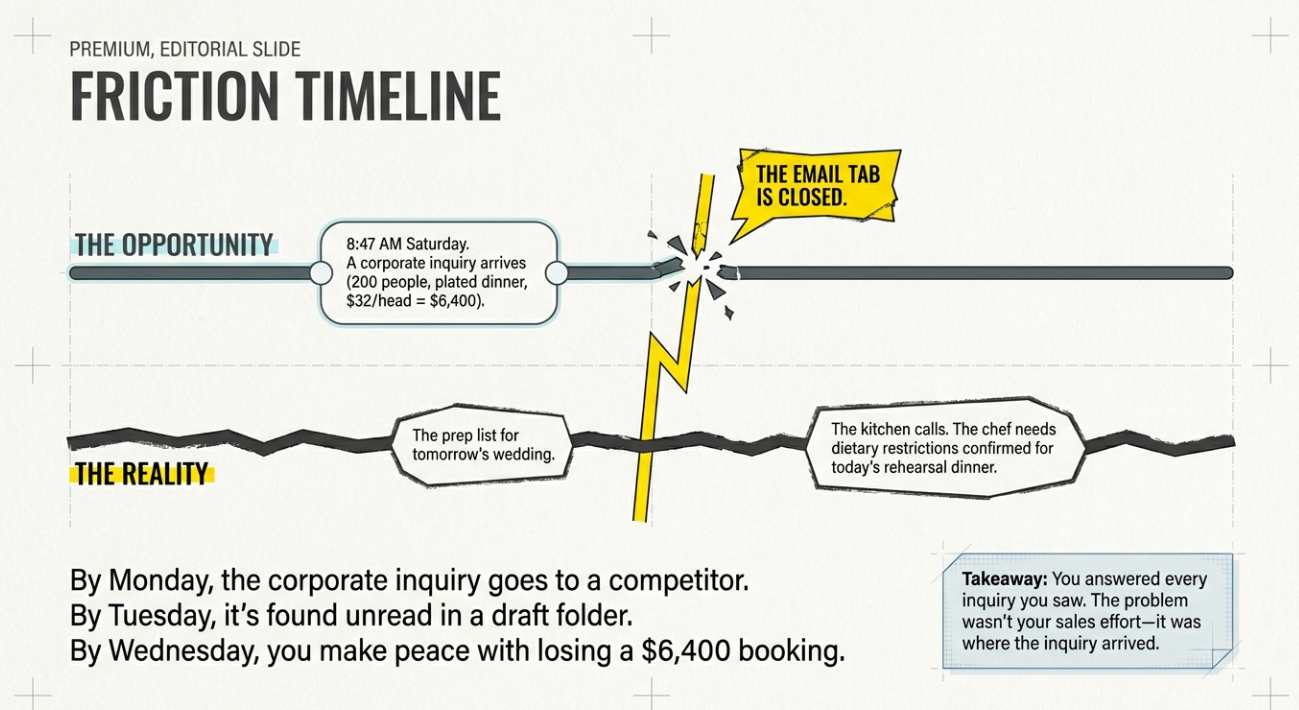
Saturday, 8:47 AM. You are reviewing the prep list for tomorrow’s wedding when an email comes through. A corporate inquiry, 200 people, three weeks out, plated dinner, $32 per head. The kind of booking that funds Q4.
You start to reply. The kitchen calls. The chef needs to confirm dietary restrictions for the rehearsal dinner that’s being prepped today. You close the email tab.
By Monday morning, the corporate inquiry will have gone to your competitor. By Tuesday, you find the unread email in a draft folder, marked but never sent. By Wednesday, you have made peace with losing that $6,400 booking.
This is not a sales problem. You answered every inquiry you saw. The inquiry you missed arrived at the intersection of your booking inbox, your kitchen production board, your staff schedule, and your attention, four systems that do not share state. There was no single place where the new inquiry, the current kitchen load, and the available staff existed simultaneously. There was only you, holding all of it in your head, until something more urgent took over.
|
There’s a name for what you’re describing. It’s called Operational Fragmentation, the state where your tools do their individual jobs, but the coordination layer between them runs on manual effort, memory, and luck. When coordination cost grows faster than revenue, you’ve crossed into Operational Fragmentation territory. |
Every catering operator who has run a busy Saturday has felt it. What this article provides is the diagnosis.
Operational Fragmentation is the state of running catering operations across disconnected tools, manual handoffs, and tribal knowledge, where coordination cost grows faster than revenue. It is the root cause of missed inquiries, reconciliation errors, and scaling constraints in catering businesses that have the right tools but no coordinated layer connecting them.
Operational Fragmentation is not caused by bad software. Every tool a catering operation typically runs, the booking platform, the kitchen production system, the staff scheduling app, and QuickBooks, does its individual job correctly. The fragmentation is in what happens between the tools, not inside them.
Five structural reasons explain why catering operations fragment even as they invest in better software:
1. Each tool was built for a discrete job.
Booking platforms book. Kitchen production tools produce. Staff scheduling apps schedule. Accounting software accounts. None was architected to share state with the others in real time. According to Zapier research, the average small business now runs 5.4 software tools simultaneously, and catering operations above $1M annual revenue typically rely on at minimum five: a booking platform, a kitchen production tool, a staff scheduling app, QuickBooks, and some form of CRM or inquiry management. Each was added to solve a specific problem. None was designed to coordinate with the others.
2. The coordination gap compounds as volume grows.
At $1M annual revenue, the owner can hold the coordination in their head. At $2M, attention starts to crack. At $3M and above, it fails. The problem does not stay constant; it accelerates. Each new event adds new intersections where booking data, kitchen data, and staffing data must be reconciled. Each manual reconciliation is a point where an error can enter and compound.
3. Catering’s operational rhythm has no low-cost recovery path.
The BEO is typically locked 72 hours before the event. An error discovered after BEO lock-in, a menu change the kitchen didn’t receive, a final headcount the staff schedule didn’t reflect, cannot be cheaply corrected. The coordination failure’s cost is paid in kitchen chaos, guest-facing service failures, and recovery labor. Unlike a billing error that can be fixed the following week, a catering execution error is paid during the event itself.
4. Tool fragmentation is the default outcome of how software gets adopted.
57% of small businesses cite “too many disconnected systems” as their primary automation obstacle, per HubSpot’s 2025 technology adoption survey. The fragmentation is not an accident; it is the natural result of adding tools over time to solve specific problems. Most catering operations were built the same way: booking tool first, then kitchen tracking, then QuickBooks, then a staff app. Each addition solved a real problem. None was designed to coordinate with what came before. What looks like a technology problem is actually an architectural consequence of how operational needs accumulate. This is also what happens when disconnected communication tools fail together; the coordination failure extends beyond software into the communication channels that carry catering inquiries.
5. The coordination layer lives in the owner’s head, and that is the bottleneck.
The owner who can hold 40 events in working memory has built a $1M catering business. The owner who needs to hold 80 events in working memory is approaching the ceiling of what attention can sustain. Operational Fragmentation is not a technology failure. It is the point where the coordination capacity of any one person is insufficient for the volume the business needs to run.
| Catering Operational Fragmentation Symptoms and Impacts | |
| Symptom or Metric | Statistical Value or Sign |
| System disconnect obstacle | 57% cite too many disconnected systems |
| Coordination of labor overhead | 9+ hours per week per operations employee |
| Client response time expectation | 83% expect a reply within one business day |
| Average software tools used | 5.4 to 6 tools |
| Manual data entry error rate | 1–5% |
| Missed inquiry cost (example) | $6,400 booking loss |
| Attention failure threshold | Occurs at $2M – $3M annual revenue |
| New lead/captain onboarding time | 2–4 weeks working alongside the owner |
| Financial reconciliation gap | Booking platform vs. QuickBooks mismatch |

What Operational Fragmentation Actually Costs
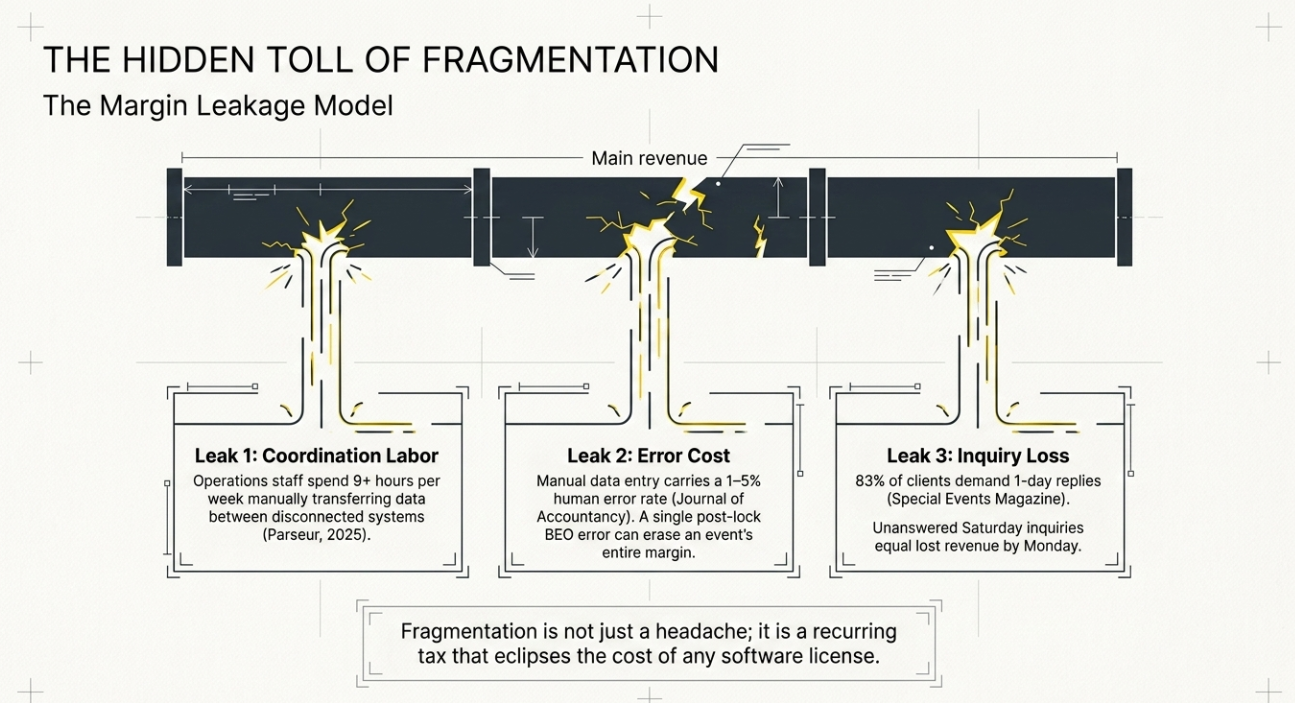
The cost of Operational Fragmentation shows up in three places, each of which appears in different line items, which is one reason it is hard to see clearly.
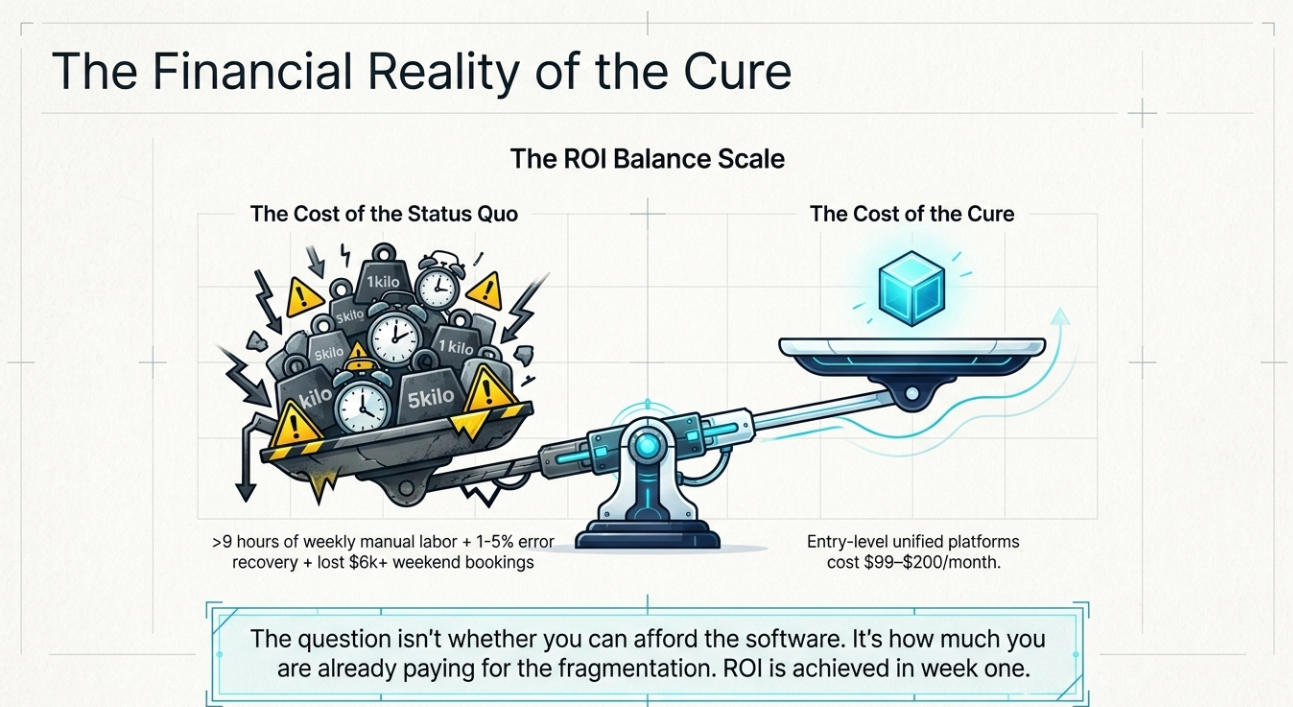
Coordination of labor. Employees in operations roles spend an average of 9+ hours per week transferring data between disconnected systems, according to industry research by Parseur (2025, survey of 500 US professionals). For a catering owner-operator, this is not an abstract figure; it is the hours per week spent re-entering booking data into the kitchen prep sheet, reconciling the staff schedule with the final headcount, and chasing menu changes across three tools after a client call. At any operational wage rate, 9+ hours per week of coordination overhead is a significant annual cost, one that typically exceeds the licensing cost of a unified platform many times over.
Error cost. Every manual handoff introduces error risk. Per the Journal of Accountancy, manual data entry carries a 1–5% human error rate depending on complexity. In catering operations, a single BEO error after lock-in has recovery costs measured in staff overtime, food waste, and client relationship damage that can outweigh the entire margin on that event. The error rate is not a rounding problem; it is a structural feature of any coordination layer that depends on manual re-entry.
Inquiry loss. Per Special Events Magazine, 83% of event clients expect vendors to reply within one business day. An inquiry that arrives at 8:47 AM on a Saturday and sits unanswered while the owner manages a kitchen call does not wait until Monday. By the time the reply is ready, the client has typically moved on. The $6,400 corporate booking in the opening scene is not hypothetical; it is the recurring cost of a coordination layer that does not exist in any system, playing out across every busy season.
Five Signs Your Catering Operation Is Running on Operational Fragmentation
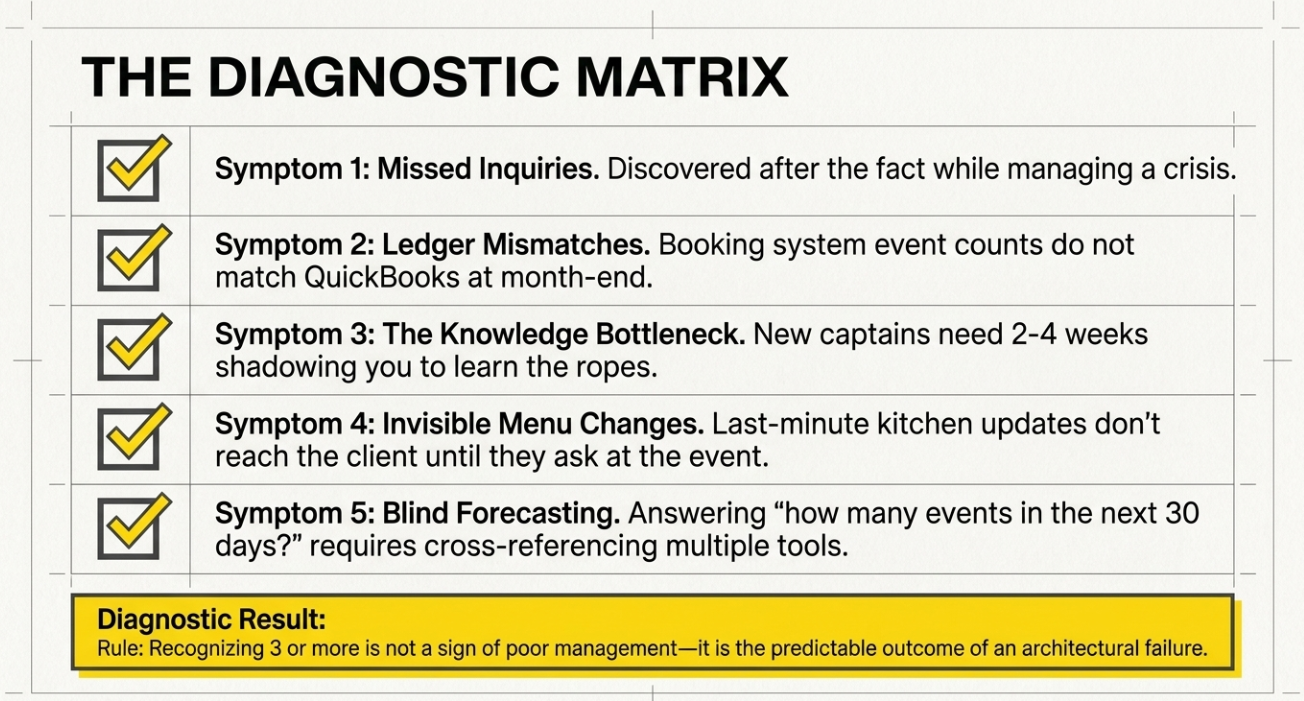
Operational Fragmentation is most clearly diagnosed through the specific moments where the coordination gap becomes visible. If three or more of the following feel like your Monday morning, your operation is experiencing Operational Fragmentation:
1. You regularly discover a missed inquiry after the fact, because you were managing something else when it arrived, and by the time you replied, the client had already gone to a competitor.
2. Your event count, as reported by your booking platform, does not match your event count as reported by QuickBooks at the end of the month. Reconciling the difference takes time every week.
3. A new event captain or kitchen lead needs 2–4 weeks working alongside you before they feel confident running an event independently. The learning curve is not the role; it is the institutional knowledge living in your head instead of a system.
4. When the kitchen makes a last-minute menu change, the client does not hear about it until they ask at the event, because there is no single place where menu changes, client communication, and kitchen production share a state.
5. You cannot answer the question “How many events do we have confirmed in the next 30 days?” without opening at least two tools and comparing their outputs.
|
Recognizing three or more of these is not a sign of poor management. It is the predictable outcome of building a catering operation on tools that were each designed to do their job without coordinating with the others. The fragmentation is architectural, not operational. |
What Catering Operations Look Like When the Coordination Layer Exists in a System
When booking, kitchen production, delivery, staffing, and accounting share state in real time, what a unified operational data architecture provides, several things stop requiring manual effort:
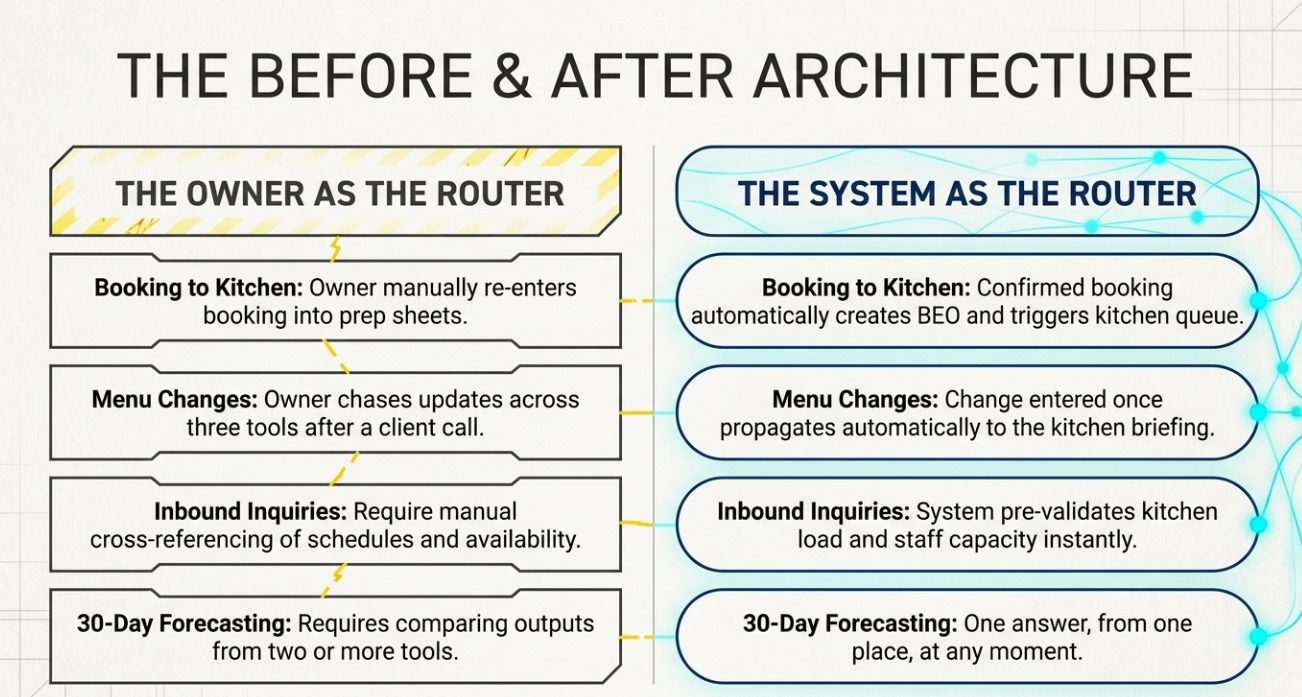
- A confirmed booking creates the BEO and triggers the kitchen production queue without re-entry. The booking record and the kitchen record are the same record, viewed differently.
- A menu change entered after a client call appears in the kitchen briefing that afternoon, not because someone remembered to update it, but because the update propagated automatically.
- The Saturday morning inquiry arrives in a system that already knows the current kitchen load, staff availability, and upcoming events. The owner can reply with confidence, or the system can route the inquiry to a response queue, without interrupting the prep day.
- The event count question, “how many confirmed events in the next 30 days?”, has one answer, from one place, at any moment.
There is also something that becomes possible over time in a unified operation that has no equivalent in a fragmented one: what we call Operational Memory. When event history, client preferences, production decisions, and pricing logic live in a system rather than in employees’ heads, the operation accumulates knowledge that survives turnover. A new event captain brought into a unified system does not start from zero; they start from the institutional record. That is a different kind of operational capability than any single tool can provide, and it is what the resolution of Operational Fragmentation makes possible over time.

The Next Step If These Symptoms Feel Familiar
Operational Fragmentation is a structural problem, and the fix is architectural. Adding another tool to a fragmented stack does not reduce the coordination cost; it adds another handoff point. The structural response is a platform designed from the ground up as a unified operational layer: one where booking, kitchen, staffing, delivery, and accounting share state in real time, and the coordination layer lives in the system rather than in the owner’s head.
If the five symptoms above feel familiar, the practical next step is seeing what unified catering operations actually look like in practice. The unified catering operations platform is where the architectural argument becomes concrete.
For a broader look at the catering software landscape and how to evaluate your options, see the full catering software comparison.
How CaterSuite Approaches the Coordination Problem
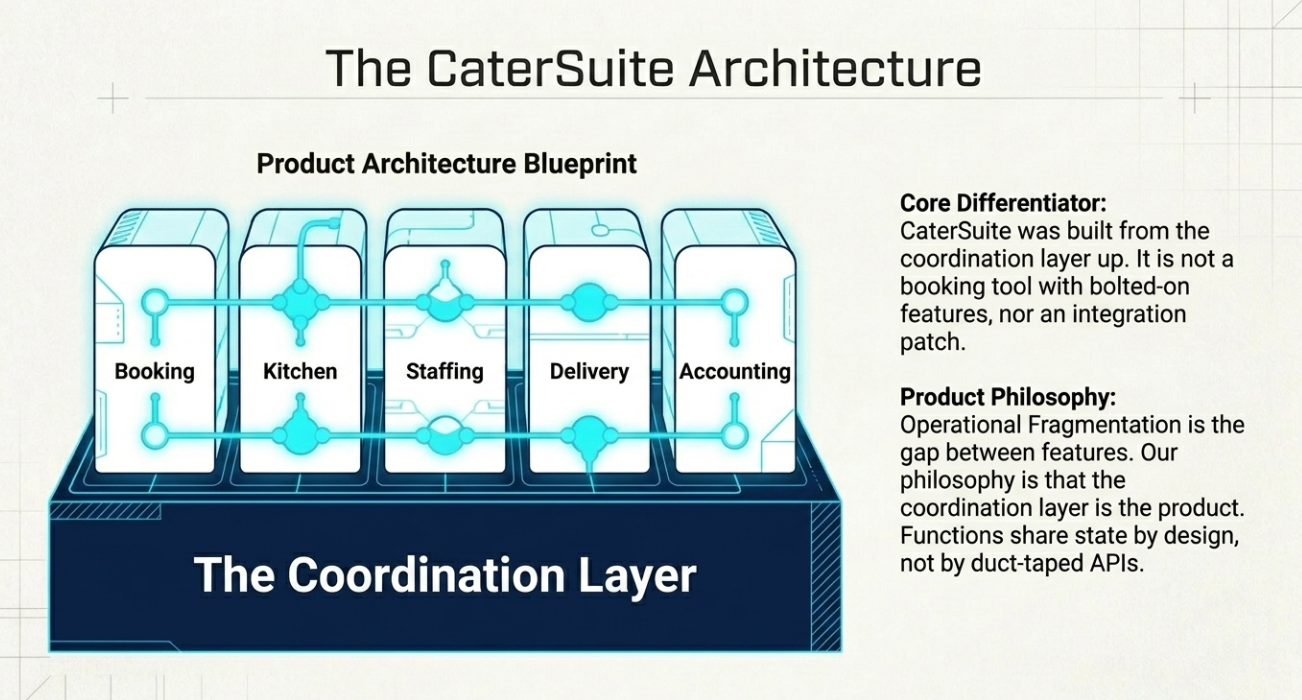
CaterSuite was built from the coordination layer up, not by adding features to a booking platform, and not by connecting existing tools through an integration layer. The architectural starting point was the fragmentation problem itself: what does an operation need for a confirmed booking, a kitchen production record, a staff assignment, and a client invoice to share state in real time without any manual step?
Operational Fragmentation is not a feature gap. It is the gap between features, the coordination layer that single-purpose tools leave empty. The CaterSuite product philosophy is that the coordination layer is the product. Building on top of it with booking, kitchen, staffing, delivery, and accounting functions means those functions share state by design, not by integration.
Frequently Asked Questions: Operational Fragmentation in Catering
Why does running a catering business feel so chaotic, even when I have software?
Most catering software solves one job well, booking, kitchen production, or staff scheduling, but was not designed to coordinate between jobs. The chaos is the coordination layer between disconnected tools running in the owner’s head: the mental overhead of knowing which system has the current version of the headcount, which tool has the final menu, and which schedule reflects the most recent staff change. That experience has a name: Operational Fragmentation. It is the predictable outcome of building an operation on tools that each solve their own problem without sharing state.
What is operational fragmentation?
Operational Fragmentation is the state of running catering operations across disconnected tools, manual handoffs, and tribal knowledge, where coordination cost grows faster than revenue. It is the root cause of missed inquiries, reconciliation errors, and scaling constraints in catering businesses that have the right individual tools but no coordinated layer connecting them. The concept applies across operation sizes: at $1M revenue, it shows up as personal exhaustion; at $5M, it becomes expensive coordination labor; at $10M and above, it becomes a structural constraint on growth.
How many software tools does the average catering operation use?
Most catering operations above $1M annual revenue rely on at minimum five to six tools: a booking platform, a kitchen production system, a staff scheduling app, QuickBooks, a CRM or inquiry management approach, and a payment processor. Zapier’s research on small business software adoption found the average SMB runs 5.4 tools simultaneously, and catering operations are typically at or above that figure. Each tool was likely added to solve a specific problem. The coordination cost between those tools is what Operational Fragmentation names and measures.
What is the real cost of managing catering operations across disconnected tools?
Three costs accumulate simultaneously. Coordination labor: employees in operations roles spend an average of 9+ hours per week transferring data between disconnected systems (Parseur, 2025). Error cost: manual data entry carries a 1–5% human error rate per the Journal of Accountancy, and in catering, a single BEO error after lock-in can cost more than the entire event margin to recover. Inquiry loss: 83% of event clients expect a vendor response within one business day (Special Events Magazine), and an unanswered Saturday morning inquiry is frequently a lost booking by Monday. Together, these costs typically exceed the annual licensing cost of a unified catering platform many times over for operations above $1M revenue.
How do I know if my catering operation has an Operational Fragmentation problem?
Five symptoms reliably signal it: (1) you regularly discover missed inquiries after the fact; (2) your event count in your booking system does not match your event count in QuickBooks at month-end; (3) new event captains or kitchen leads need weeks of working alongside you before they can run events independently; (4) last-minute menu changes do not reach the kitchen and the client simultaneously; (5) answering “how many confirmed events in the next 30 days?” requires opening more than one tool. Three or more of these symptoms indicate Operational Fragmentation is structurally present.
What does a catering operation look like when Operational Fragmentation is resolved?
When booking, kitchen production, staffing, and accounting share state in real time, the coordination layer moves from the owner’s head into the system. A confirmed booking creates the BEO and triggers the kitchen queue without re-entry. A menu change propagates automatically. An inquiry arrives in a system that already knows the available capacity. Over time, this also builds what we call Operational Memory, the institutional knowledge that survives staff turnover, because it lives in the system rather than in the employee who handled the last 40 events.
Can small catering operations afford to fix Operational Fragmentation?
The relevant cost comparison is not “can I afford the software?” but “what am I already spending on the fragmentation?” At 9+ hours per week of coordination labor (Parseur, 2025), a catering operation above $1M revenue is spending more annually on manual reconciliation than most unified catering platform licenses cost. The question is not whether to fix Operational Fragmentation; it is which platform to use. For operations under $2M, entry-level unified platforms are available at $99–$200 per month. The coordination cost they eliminate typically pays the licensing cost within the first month.
The Saturday morning inquiry at 8:47 AM was not a sales failure. You answered every inquiry you saw. What you could not do, because no system made it possible, was to see the inquiry, know your available kitchen capacity, and know your current staff load in the same place at the same moment. The operator who resolves Operational Fragmentation does not necessarily work faster or sell better. They simply stop being the coordination layer of their own business. The inquiry gets answered. The kitchen knows. The booking is confirmed. And none of that depends on the owner’s attention being free at 8:47 AM on a Saturday.
See What Unified Catering Operations Looks Like
CaterSuite is built as a unified operational data layer for catering: booking, kitchen production, delivery, staffing, and accounting sharing state in real time, so the coordination layer lives in the system, not in the owner’s head. If the symptoms in this article feel familiar, a single platform that unifies catering operations is the structural answer



Leave a Comment