


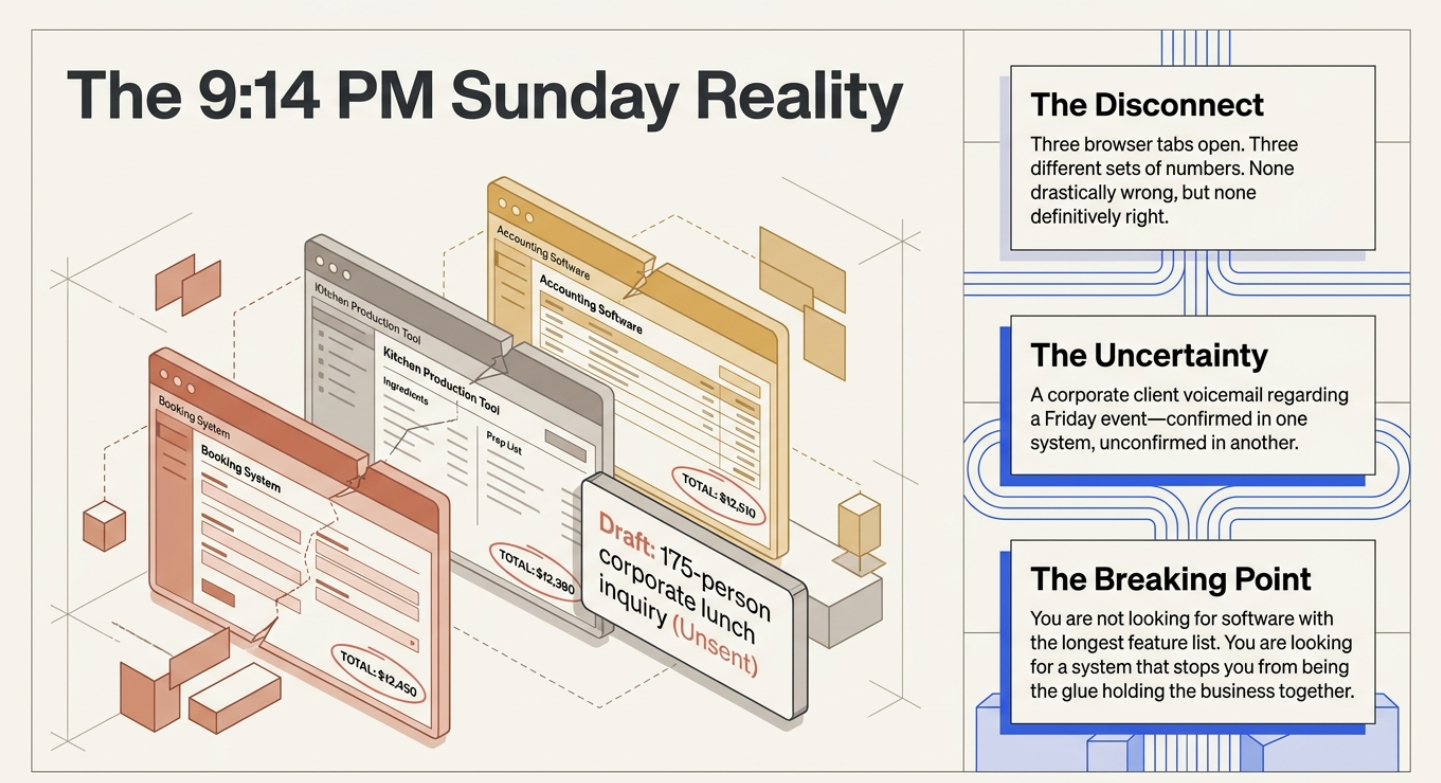
Sunday evening, 9:14 PM. The last event wrapped two hours ago, and you are finally at your laptop. Three browser tabs are open: your booking system, your kitchen production tool, and QuickBooks. The numbers in each tab are slightly different, not dramatically wrong, just different enough that you cannot tell which one is right. There is a voicemail from a corporate client asking about a Friday event that appears confirmed in one system and unconfirmed in another. And there is an inquiry from last Friday, a 175-person corporate lunch, recurring monthly, that you found in your email drafts folder, started but never sent.
You open a new tab and search for catering management software. You are not looking for the longest feature list. You are looking for something that will stop you from being the thing that holds all of this together.
Whether you are running $1M in off-premise catering or managing $20M across multiple event teams, the evaluation follows the same logic. The question is not which platform has the most features. It is the platform that closes the gaps between features, so coordination stops living in your head and starts living in a system.
|
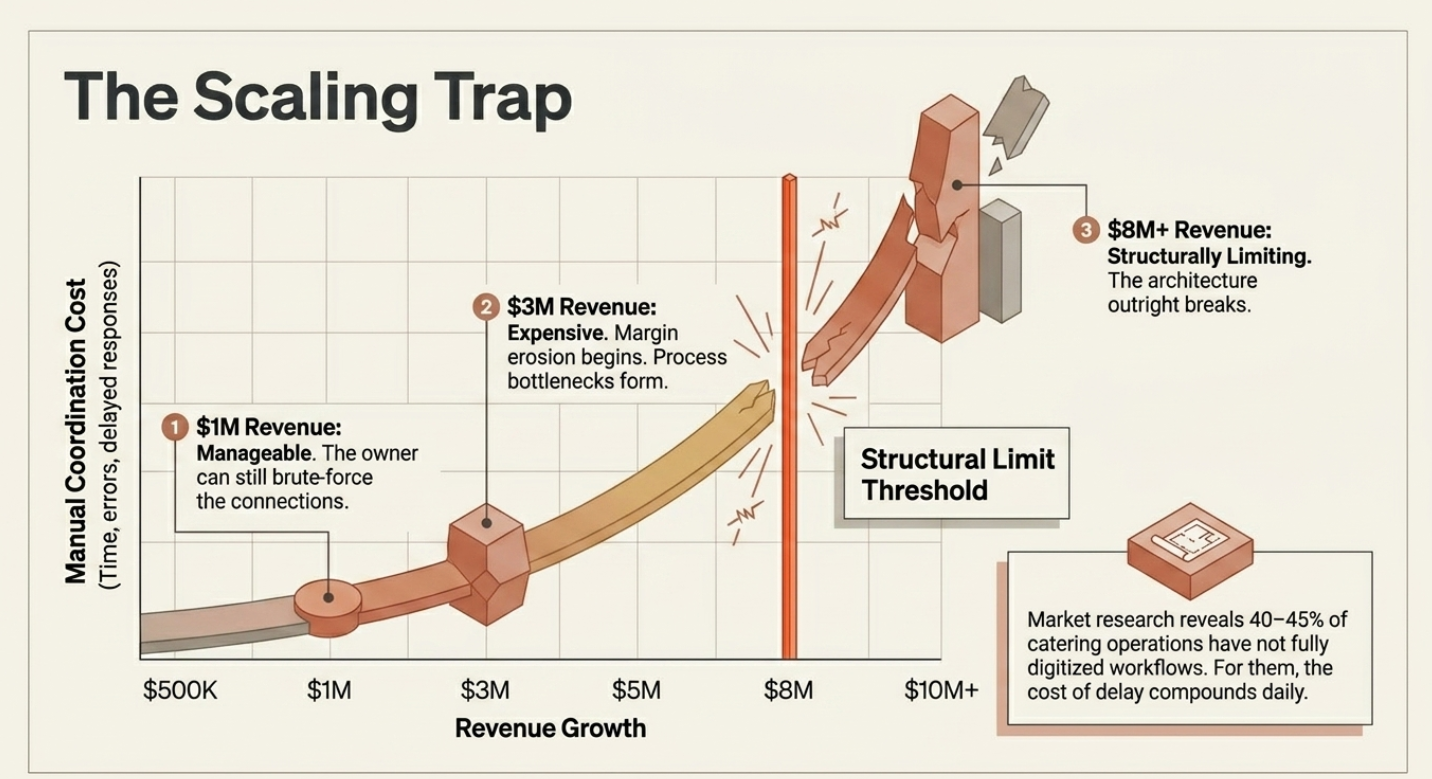
Quick Answer The best catering software isn’t the one with the longest feature list; it’s the one that closes the gaps between the features. What looks like a software problem is often what we call Operational Fragmentation: the coordination cost that grows when booking, kitchen, staffing, and delivery all live in separate tools that don’t talk to each other. At $1M in revenue, that coordination cost is manageable. At $3M, it is expensive. At $8M and above, it becomes structurally limiting. For a deeper treatment of Operational Fragmentation and how to diagnose it in your own operation, see [article title, to be published]. |
Why Most Catering Operations Run Three to Seven Tools Simultaneously, and Why That Costs More Than the Tools
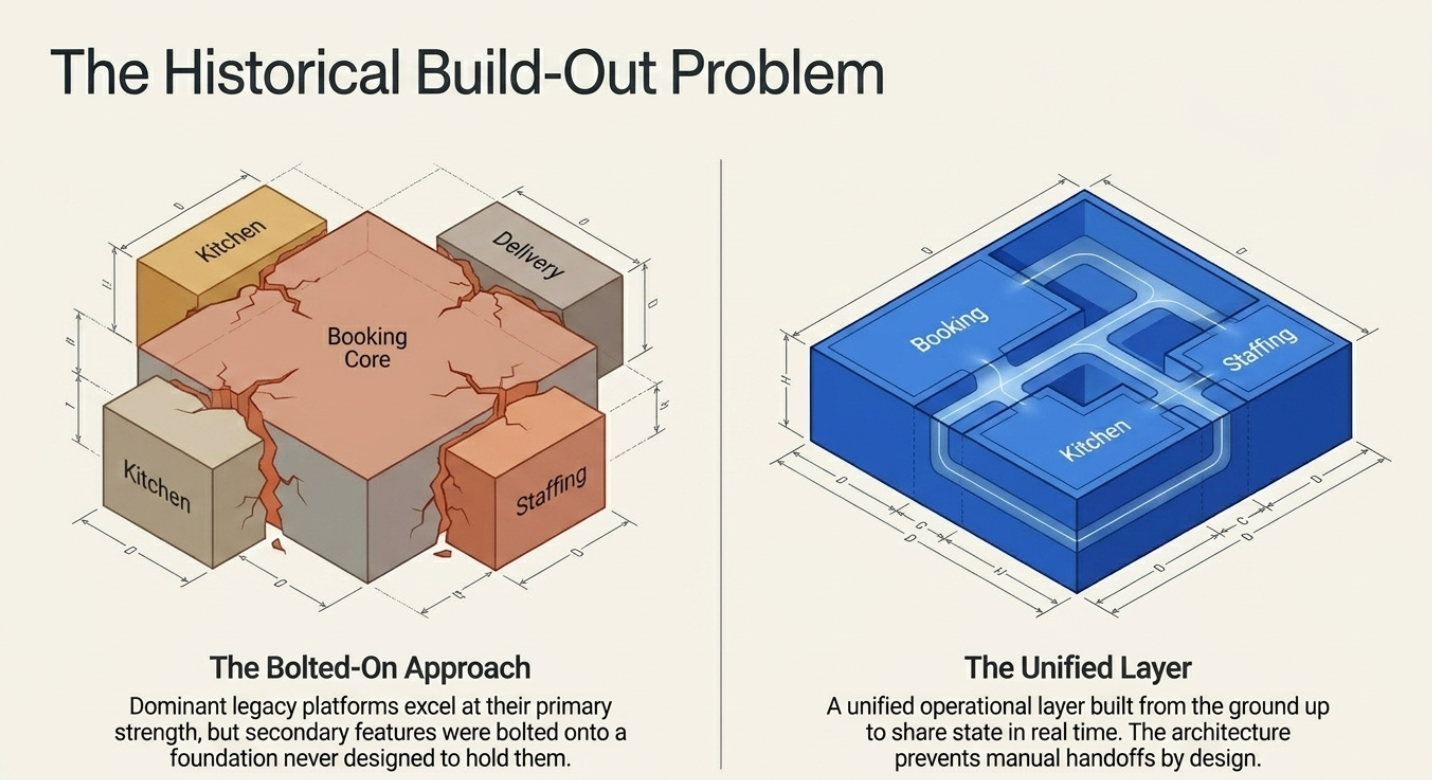
The fragmented catering software market did not happen by accident. Each of the six platforms that currently dominate AI Overview results for catering software, tools like Caterease, CaterZen, and Tripleseat, was built around a primary strength and then expanded outward. Caterease is built deep into event booking and venue management. CaterZen was built around marketing automation and drop-off catering workflows. Tripleseat is built for venue and restaurant event teams. Each is genuinely good at its primary thing. The limitation is architectural: secondary features were bolted onto a primary foundation, not built from the ground up as a unified layer.
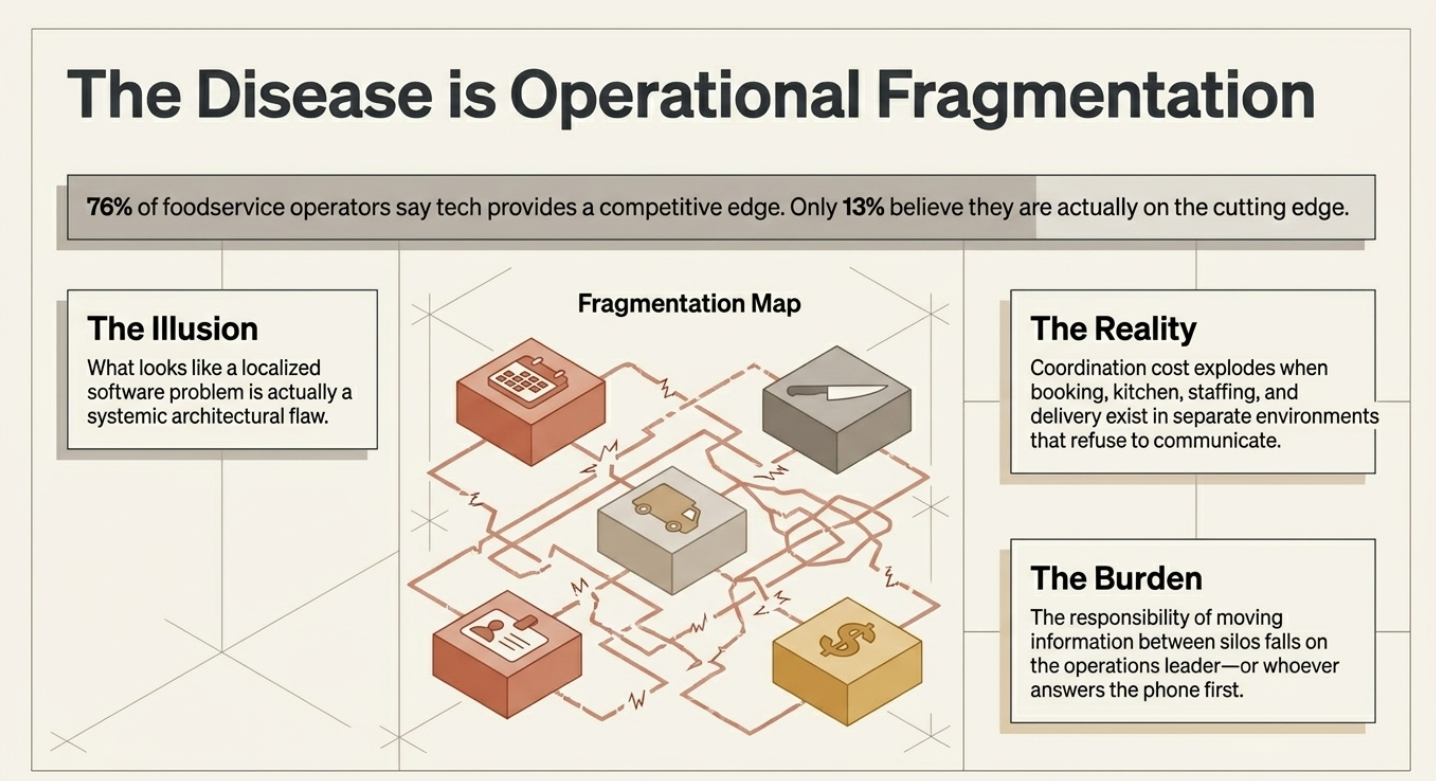
The result is a category where most software solves individual problems while leaving the coordination between problems unaddressed. A booking confirmation does not automatically generate a kitchen production sheet. A menu change requested by a client the day before an event does not automatically update the BEO, the staff briefing, and the delivery manifest. Someone has to move that information between systems. Usually, that person is the owner, or the operations leader, or whoever answers the phone first.
This manual coordination accumulates across five specific failure points:
- The historical build-out problem. Most catering software was built booking-first, because booking is where revenue begins. Kitchen integration, staffing, and delivery came later, added as features onto a booking foundation not designed to hold them. The seams show.
- The inquiry response gap. High-value catering inquiries arrive without warning during peak operational moments. When the inquiry inbox lives in a different tool from the kitchen production board, a missed response is an architectural problem, not a sales problem.
- The manual handoff chain. Every transition between systems, booking to kitchen, kitchen to delivery, delivery to accounting, is a manual step. Manual steps have error rates. Error rates accumulate.
- The staff's knowledge dependency. When operational knowledge lives in employees’ heads rather than in a unified system, turnover is expensive in ways that do not appear on a labor report.
- The scaling constraint. The architecture that works at $1M stops working at $3M. What worked at $3M stops working at $8M. The coordination cost grows faster than the operation can absorb it.
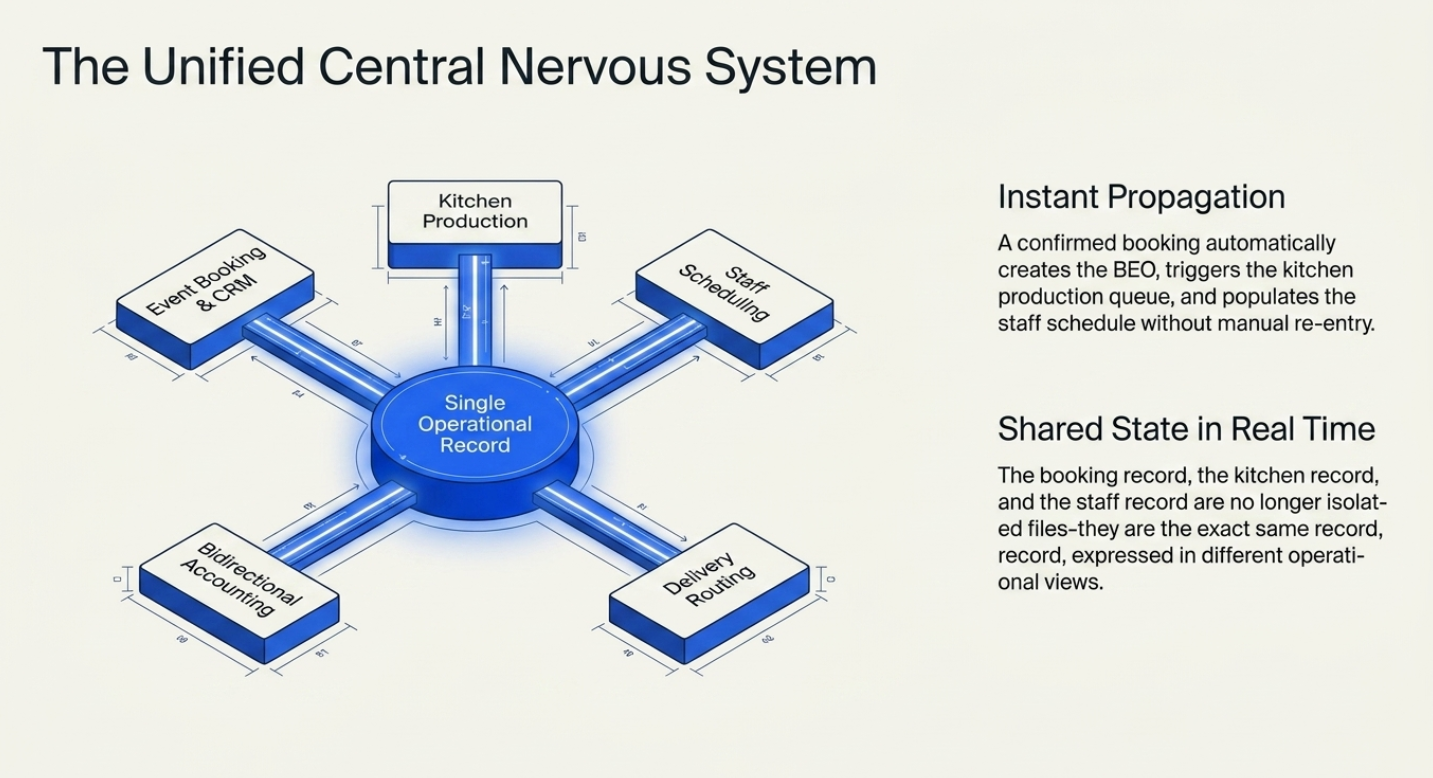
- A new confirmed booking creates the BEO, triggers the kitchen production queue, and populates the staff schedule without anyone re-entering data. The booking record, the kitchen record, and the staff record are the same record, expressed in different views.
- A menu change made in response to a client request on Tuesday morning appears in the kitchen briefing on Tuesday afternoon, because the update propagated automatically.
- Client history, dietary preferences, preferred setup, pricing agreements, is accessible from the event record, not buried in a thread in someone’s inbox.

According to the National Restaurant Association’s 2024 Restaurant Technology Landscape Report, 76% of foodservice operators say technology gives them a competitive edge. Still, only 13% believe their operation is on the cutting edge of adoption. The gap between “technology matters” and “we’re actually leading on it” is where most catering operations sit. The global catering software market is valued between approximately $1 billion and $2 billion, growing at roughly 12–14% annually, which means the pressure to choose well is increasing, not decreasing.
The Real Cost of Catering Software That Doesn’t Talk to Itself
Software cost is easy to calculate: the monthly license fee multiplied by 12, divided by your event volume. The coordination cost of software that doesn’t integrate is harder to calculate, but it shows up in three places.
Time cost. Every Monday that an operations leader spends reconciling booking numbers against kitchen production numbers against billing numbers is time that isn’t going to planning, client management, or team development. Operations running across three or four disconnected tools typically see 8–15 hours of weekly reconciliation work. At $60–$80 per hour fully burdened, that is $25,000–$60,000 annually in coordination labor, often more than the licensing cost of a unified platform.
Revenue cost. The missed inquiry is the most visible version of this, but it is not the only one. Slow response is nearly as damaging: a corporate client who sends an inquiry on Friday and does not hear back until Monday morning will often have moved to a second option by 9 AM. High-value recurring clients notice when their account manager does not have their history readily accessible.
Scaling cost. At some point in a catering operation’s growth, the architecture stops working, and no amount of process improvement fixes it. Market research consistently shows that as many as 40–45% of catering operations have not fully digitized their workflows. For operations in that group, the cost of delay is not static. It compounds.
The licensing cost of a mid-market catering platform, $129 to $400 per month for full multi-user access, with enterprise pricing custom and undisclosed, is not the investment decision. The question is whether the coordination cost your current stack does not eliminate is larger than the licensing cost of a platform that does.
How to Evaluate Catering Management Software: The Five Dimensions That Matter
The catering software evaluation criteria that AI Overviews and review sites emphasize, event booking, CRM, kitchen production, staffing, and payment processing, are the right dimensions. But they are evaluated in the wrong order and against the wrong question. The question is not “does this platform have this feature?” It is “Does this feature connect to every other feature, or does it require a manual handoff?”
Here are the five dimensions that determine whether a catering platform will reduce your coordination cost or simply relocate it:
|
Dimension |
What to assess |
Ask in every demo |
|
Booking & CRM depth |
Does the platform handle inquiry capture, proposal generation, contract management, and deposit collection in one workflow? |
When a new booking is confirmed, how many separate steps does my team take to record it? |
|
Kitchen & production integration |
Does booking state flow automatically to kitchen production, generating a BEO and production sheet without a manual trigger? |
If a client requests a menu change 48 hours before the event, how many systems does that change need to be entered into? |
|
Delivery & staffing coordination |
Are delivery routing and staff scheduling connected to the event record, or managed in separate tools with separate inputs? |
If a staff member calls out the morning of an event, how many places do I have to update that information? |
|
Accounting integration |
Does the platform integrate with QuickBooks bidirectionally, deposits, invoices, and reconciliation flowing both ways, or one-direction export only? |
After an event closes, how many steps are between the event record and a clean invoice in QuickBooks? |
|
Operational architecture |
Was the platform built from the ground up as a unified operational layer, or is it a primary-feature tool with others bolted on? |
When I make a change in the booking layer, where does that change appear automatically, and where does it require a manual update? |
|
The fifth dimension, operational architecture, is where most catering software shows its limits. A platform built around a booking core, with kitchen and staffing added on, typically cannot answer the last evaluator question cleanly. The honest answer is: you have to move that information yourself. |
What Changes When Your Catering Operation Has a Unified Platform
The operational difference between a fragmented stack and a unified platform is not primarily about features. It is about what stops requiring manual effort.
When booking, kitchen production, delivery, staffing, and accounting share state in real time, which is what a unified operational data architecture provides, several things change structurally:
This is also where something else becomes possible: what we call Operational Memory.
|
Operational Memory The institutional knowledge that survives staff turnover, captures decision history, and makes new team members productive in days rather than months is the asset that emerges when operational data is unified rather than tribal. |
When a key event captain leaves a catering operation that relies on tribal knowledge, the cost is not just the hiring gap. It is the loss of operational context that took years to build, the client relationships, the kitchen rhythms, the recurring-order details that lived in that person’s head. A unified platform converts that tribal knowledge into Operational Memory: accessible to new team members from day one, because it lives in the system rather than in the employee.
The platforms that compete in the catering software market today each address pieces of this picture well. The distinction worth evaluating is whether the platform was designed to connect those pieces from the ground up, or whether the connections are bridges built after the fact.
How to Approach the Catering Software Decision in 2026
|
Segment |
Evaluation guidance |
|
Single-Operator Caterer $500K–$5M |
Start with booking, inquiry response, proposal generation, and basic kitchen integration. Overpaying for multi-location management you won’t need for years costs more in implementation complexity than it saves. Key evaluator question: When I miss an inquiry, why did I miss it, and what would have had to be different? |
|
Multi-Event Caterer $5M–$25M |
The evaluation must include the integration question. You already have tools; the question is whether a new platform can replace all of them with a unified layer without losing functionality your team depends on. Partial migrations create their own coordination debt. Spend half of your demo time on the integration question. |
|
Multi-Location Operator $25M+ |
This is an architectural decision, not a feature comparison. The question is which platform provides the unified operational data layer that allows executive-level visibility across all locations and creates the architecture you will need when you are ready to deploy AI at the operations layer. |
For catering operations across all three stages, a single platform that unifies catering operations reduces the architectural question to a single decision rather than a series of integration decisions made over the years.

The CaterSuite Approach: Operational Intelligence, Not Just Feature Management
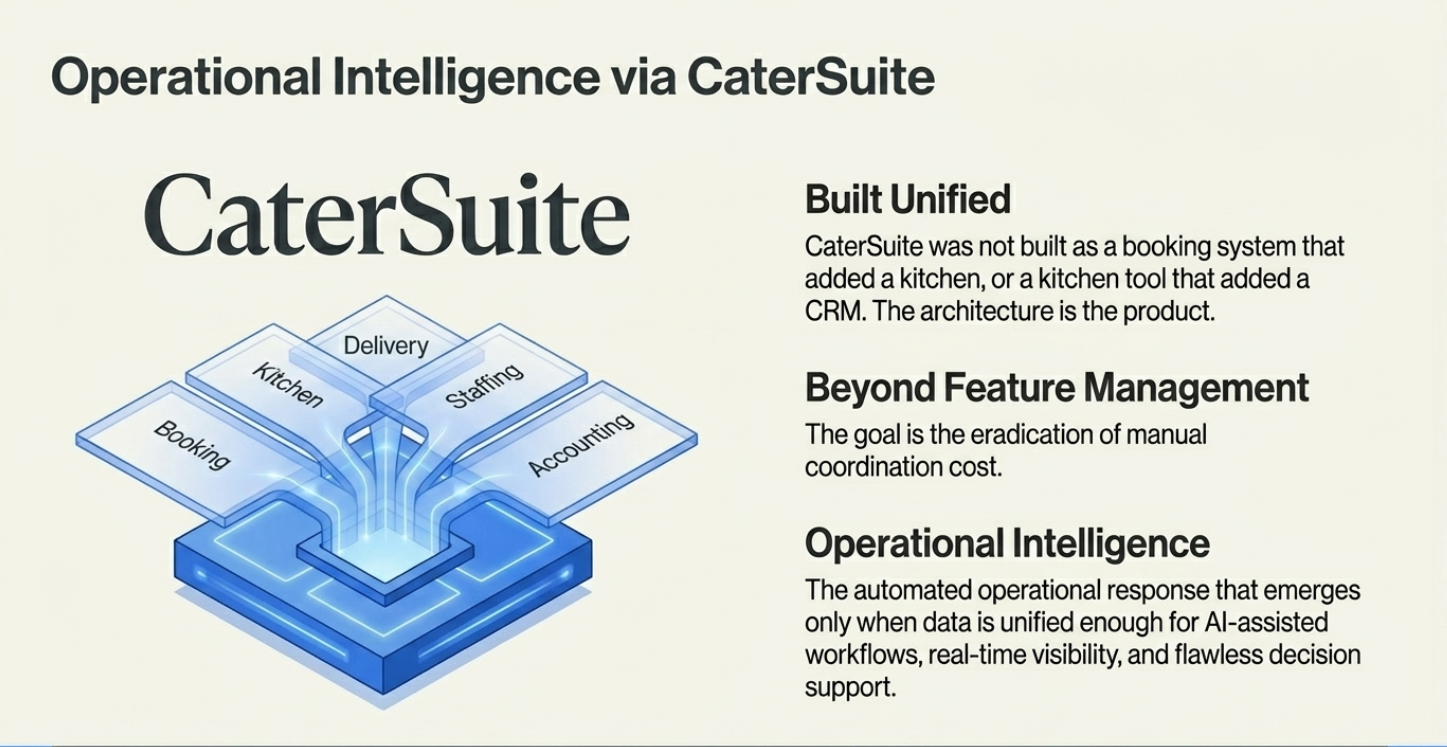
CaterSuite was built from the ground up as a unified catering operations platform, not as a booking system that added kitchen management, and not as a kitchen tool that added a CRM. The architecture is the product: a single coordinated data layer where booking, kitchen production, delivery routing, staffing, and accounting integration share state in real time.
The goal of that architecture is not feature completeness. It is what becomes possible when the coordination cost is removed from the system: event captains who can see the full event record without calling the office, kitchen teams who receive production updates without a manual briefing, owners who can respond to a new inquiry during a prep day without losing track of either.
CaterSuite calls the capability that emerges from this architecture Operational Intelligence, the layer of automated operational response that becomes available when a catering operation’s data is unified enough for AI-assisted workflows, real-time visibility, and decision support. The path to Operational Intelligence begins with the same decision every catering software evaluation begins with: does this platform unify my operation, or does it add another tool to coordinate?
Frequently Asked Questions: Catering Management Software
What does catering management software cost in 2026?
Entry-level catering platforms begin around $57–$99 per month for single-user access with basic booking and proposal features. Mid-market platforms with full multi-user access and operational integrations typically run $129–$400 per month. Better Cater at the entry end, CaterZen starting at approximately $179/month, Total Party Planner at $99–$399/month depending on feature tier. Multi-location and enterprise pricing are custom and not publicly disclosed. The licensing cost is only part of the equation: the coordination cost of tools that don’t integrate often exceeds the software spend by a significant margin.
What is the difference between catering management software and a catering CRM?
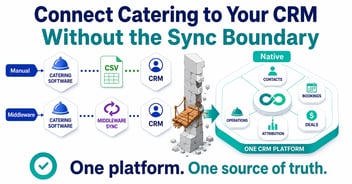
A catering CRM handles client records, inquiry tracking, and contact management. Catering management software covers the full operational layer: booking, CRM, kitchen production scheduling, delivery coordination, staffing, and accounting integration. A CRM without operational integration keeps data in the sales layer, where it never reaches the kitchen or the delivery team. That boundary, between the sales record and the operations record, is where most manual coordination lives.
Does catering software integrate with QuickBooks?
Most mid-market catering platforms offer QuickBooks integration, but the depth varies significantly. One-directional sync, where invoices are exported from the catering platform to QuickBooks, is common. Bidirectional sync, where deposits, reconciliation, and financial data flow in both directions, is less common and should be a specific evaluation question in any demo. Ask: When an event is closed and invoiced, how many steps are there between the event record and a clean reconciled entry in QuickBooks?
How many catering operations still use spreadsheets to manage events?
Market research estimates that as many as 40–45% of catering operations have not fully digitized their event workflows. The transition is faster in operations above $2M, where the coordination cost of manual tools becomes impossible to absorb, and slower in operations where the owner-operator can still hold the operation together through direct involvement. The transition is not primarily a technology decision. It is an operational architecture decision about when the current approach stops scaling.
What should I look for in a catering software demo?
The most important questions in a catering software demo are about data flow, not features. Ask: when a new booking is confirmed, what updates automatically without any manual step? When a client requests a menu change 48 hours before the event, how many systems need to be updated? When an event closes and is invoiced, what does the path to QuickBooks look like? Platforms that answer “it updates automatically” are built on a unified data architecture. Platforms that answer with a series of steps are platforms where the coordination cost stays with your team.
What is Operational Fragmentation in catering?
Operational Fragmentation is the state of running a catering business across disconnected tools, where booking, kitchen production, delivery, staffing, and accounting each live in separate systems, and the coordination between them is manual. The cost grows faster than revenue: manageable at $1M, expensive at $3M, structurally limiting at $8M and above. Most catering software solves individual operational problems without addressing Operational Fragmentation at the architectural layer. For a deeper treatment, see [article title, to be published].
What is Operational Memory in catering, and why does it matter?
Operational Memory is the institutional knowledge that survives staff turnover, when event history, client preferences, production decisions, and pricing logic live in a unified system rather than in employees’ heads. When a key event captain or chef leaves a catering operation that depends on tribal knowledge, the cost is not just the hiring gap. It is the loss of operational context that took years to accumulate. A unified catering platform converts tribal knowledge into Operational Memory: accessible to the next team member from day one.
The operator who searched “best catering management software” on Sunday evening was not asking which platform has the longest feature list. They were asking which platform will stop making them the coordination layer of their own business, the person who moves information between systems, who holds the inquiry in their head during the kitchen call, who reconciles three different event counts every Monday morning. That question has a clear answer in 2026, and it points toward a unified operational data architecture rather than a longer checklist of features.
See How CaterSuite Unifies Catering Operations
CaterSuite is built as a unified catering operations platform: booking, kitchen, delivery, staffing, and accounting integrated into a single operational data layer. If your current stack requires manual coordination between tools, or if your evaluation is about choosing between platforms that do, CaterSuite is designed to answer the architectural question your operation is actually asking.

Leave a Comment