



An AI solutions architecture is the orchestration layer, the System of Action, that connects your AI tools, data, and workflows into one system that acts on revenue signals, rather than a stack of separate tools that each act alone. Buying more AI adds capability without connection. The architecture is what resolves the Silo Tax: the rework and stalled value that accumulate when AI tools layer on top of one another without a shared system to orchestrate them.
Everyone Is Buying AI. Almost No One Is Architecting It.
Over the last eighteen months, a mid-market company we'll keep anonymous bought four AI tools. A content generator for the marketing team. A prospecting AI for the SDRs. A meeting-notes assistant that transcribes every call. And the AI features that came switched on inside their CRM. Four purchases, four logins, four dashboards.
None of them know the other three exist.
The activity numbers look great. More emails sent, more notes captured, more drafts produced. But the revenue number hasn't moved. When the founder pulls the team together to ask why, the answer comes out almost word for word: "We keep buying AI tools, and nothing is actually connected; it's not adding up to anything."
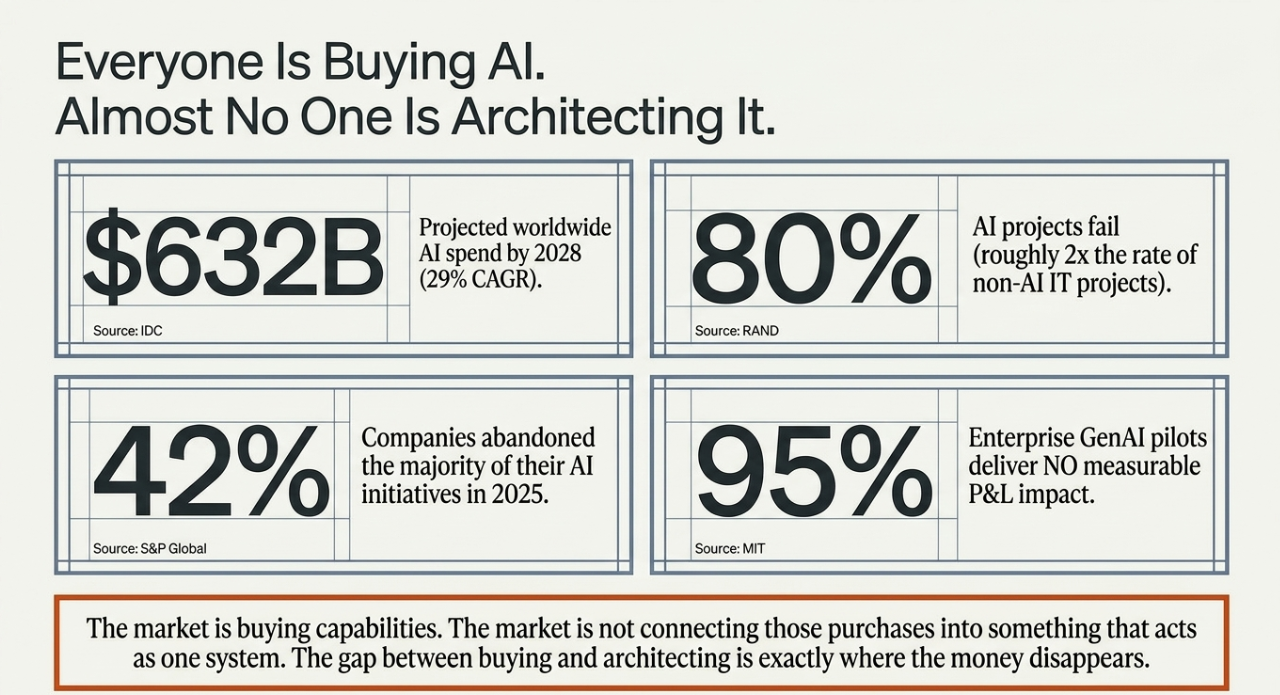
That pattern is not rare, and it is not a budget problem. The spend is real and rising. IDC's 2024 forecast projects worldwide AI spending will more than double to $632 billion by 2028, a 29% compound annual growth rate, with AI-enabled software the largest single category. The market is buying. What the market is mostly not doing is architecting, connecting those purchases into something that acts as one system. And the gap between buying and architecting is exactly where the money disappears.
What "AI Solutions Architecture" Actually Means
An AI solutions architecture is a system that acts. A toolstack is a set of tools that each act in isolation. That single distinction is the whole article.
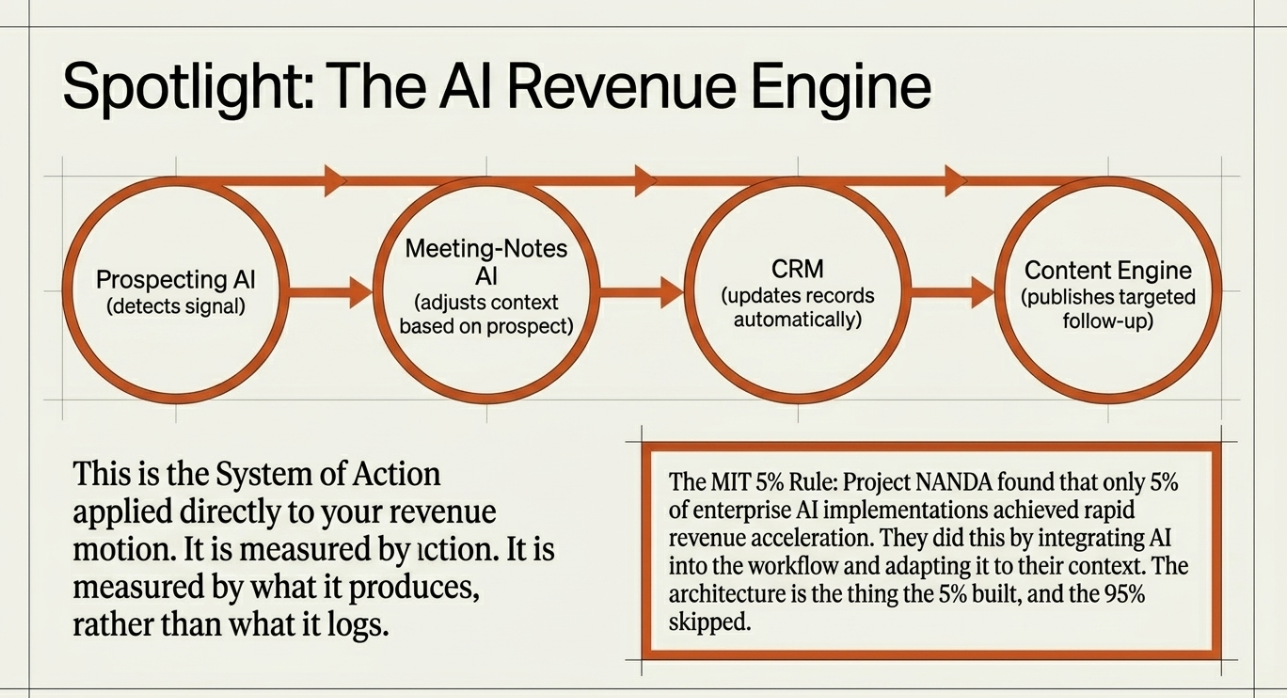
When you buy an AI tool, you buy a capability: drafting, transcribing, prospecting. When you build an architecture, you connect those capabilities to your data and your workflows so a signal in one place can trigger an action in another. The prospecting AI learns who the meeting-notes AI just spoke to. The CRM acts on what the content engine published. The system stops waiting for a human to carry information from one box to the next.
CETDIGIT calls that connective layer the System of Action, the contrast to a system of record. A system of record stores what happened. A System of Action sweeps for revenue opportunities and moves on them without waiting to be asked. (This is the system-of-record-to-system-of-action shift we've written about as the structural change underneath all of this.)
The cost of skipping that layer has a name too: the Silo Tax. The Silo Tax is what you pay when AI tools layer on top of each other without orchestration: the latency, the rework, the duplicated effort, and the revenue that quietly never materializes because no tool is responsible for the whole. It is, as we've put it before, the Silo Tax that accumulates when AI tools layer without orchestration, an architectural problem with both a tool layer and a data layer, not a problem with any single tool.
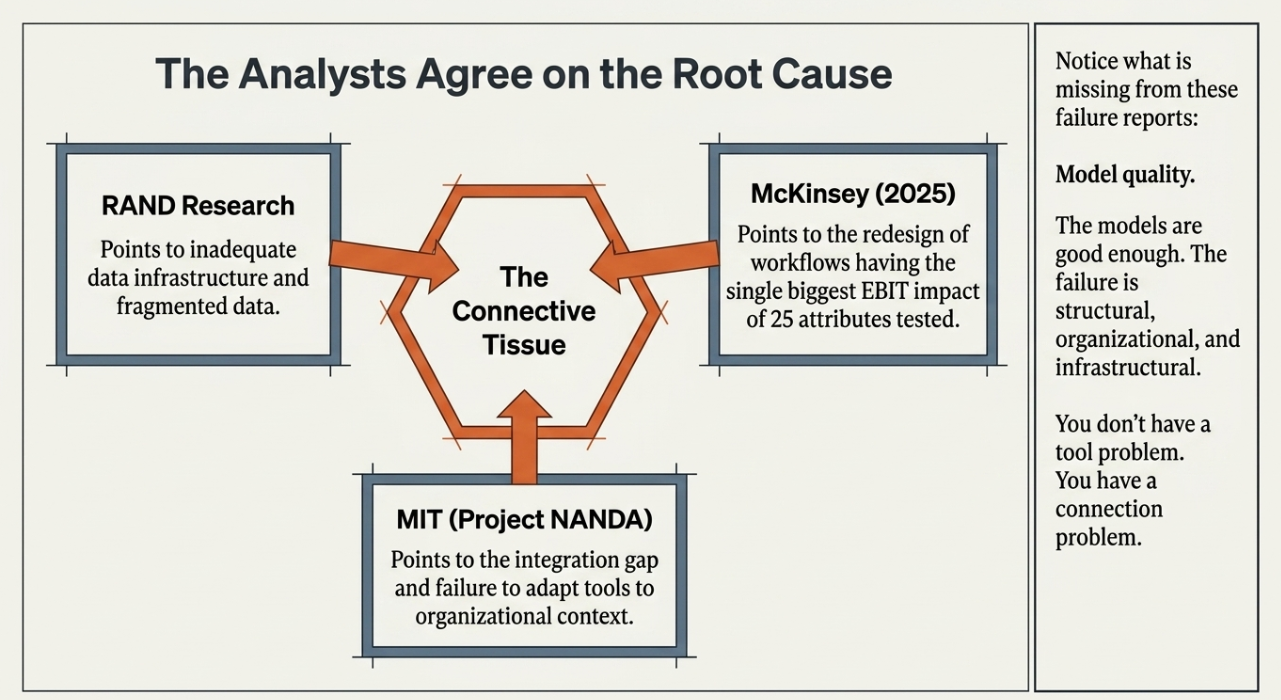
The external evidence lands on the same point. McKinsey's 2025 state-of-AI survey found that the redesign of workflows had the single biggest effect on whether organizations saw EBIT impact from generative AI, a bigger effect than any of the other 25 attributes it tested. Value came from rewiring how the company runs, not from acquiring more tools. That is the System of Action thesis stated in someone else's words.
Who This Affects
This is for the mid-market company at the orientation stage, the one that has tools but no architecture. The founder who approved three of those four purchases. The VP of RevOps watching integration work eat the team's week. The CRO who has to explain to the board why the AI line item hasn't shown up in the revenue line.
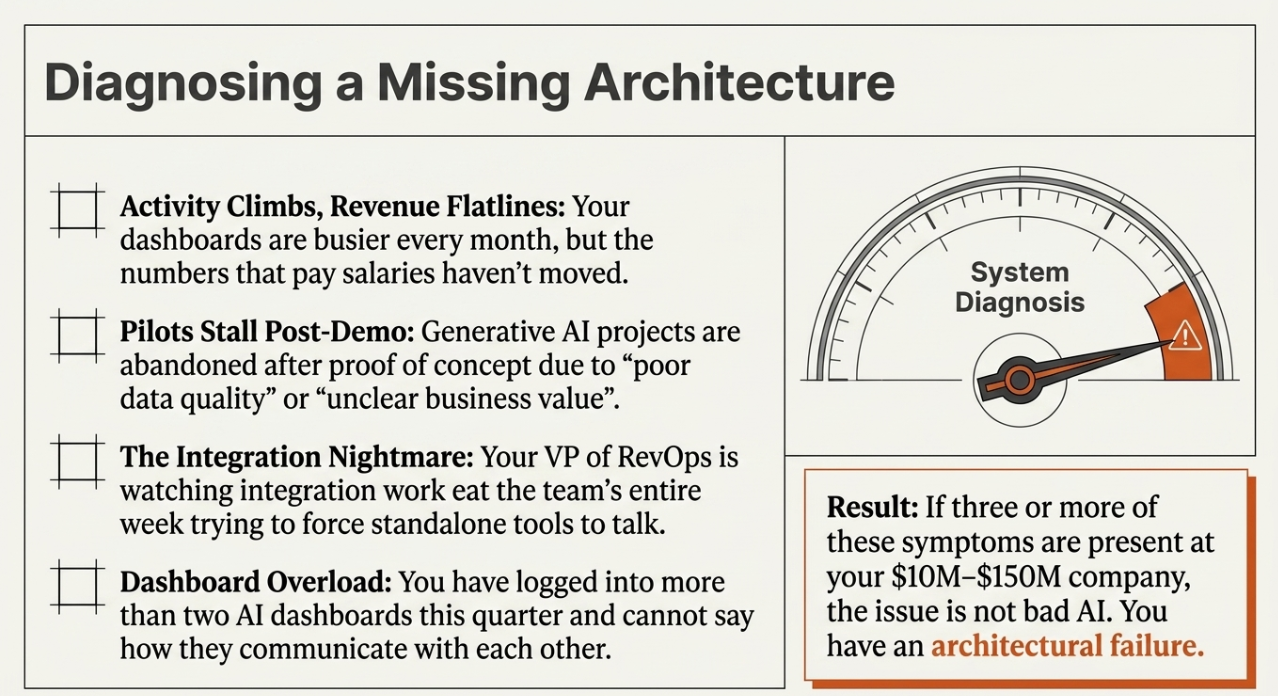
It tends to land hardest on companies between roughly $10 million and $150 million in revenue, where there's enough budget to buy several AI tools but not yet a deliberate plan connecting them. McKinsey's data shows adoption is now near-universal: 78% of organizations use AI in at least one function, but the value gap is widest in exactly this band, where buying outpaced architecting. If you have logged into more than two AI dashboards this quarter and could not say how they talk to each other, this article was written about your situation specifically.
The Symptoms of a Missing Architecture
A missing architecture shows up as a recognizable set of symptoms. Each one traces back to the Silo Tax, tools accumulating without a connecting layer.
- Activity climbs, but revenue is flat. The dashboards are busier every month. The number that pays salaries is not.
- Pilots stall after the demo. Gartner projects that at least 30% of generative AI projects will be abandoned after proof of concept by the end of 2025, citing poor data quality, escalating cost, and unclear business value- all fragmentation symptoms rather than model failures.
- Proofs of concept get scrapped at scale. S&P Global's 2025 survey, as widely reported, found 42% of companies abandoned the majority of their AI initiatives in 2025, up sharply from 17% the year before. Adding more tools is making the problem worse, not better.
- Most projects simply fail. RAND's 2024 research found that more than 80% of AI projects fail, roughly twice the rate of non-AI IT projects, and the leading causes are organizational and infrastructural, not the sophistication of the model.
If three or more of these look familiar, the issue is almost certainly architectural. You don't have a tool problem. You have a connection problem.
Why It Happens: The Root Causes
The root cause is structural, and it is consistent across every credible study of the failure. Tools get bought as point solutions, each one solving a narrow problem for a single team, and nobody builds the layer that makes them act together. Data stays fragmented across systems. Workflows never get redesigned. The AI gets bolted onto the old process instead of changing it.
RAND traced the dominant failure causes to misframed problems, inadequate data infrastructure, and fragmented data, the organizational and architectural layer, not the model. MIT's Project NANDA reached the same conclusion from a different angle. In its 2025 report The GenAI Divide, NANDA found that despite an estimated $30–40 billion in enterprise generative-AI spending, roughly 95% of enterprise pilots delivered no measurable P&L impact, while about 5% achieved rapid revenue acceleration. MIT's research points to the integration gap, not model quality: tools that never integrate into the workflow or adapt to the organization's context.
Notice what is not on any of these lists. Model quality. None of the three independent research bodies, RAND, MIT, McKinsey, locates the failure in the intelligence of the AI. They locate it in the architecture around the AI. The models are good enough. The connective tissue is missing.
That is the mechanical reason buying more tools doesn't help. A fifth tool added to four disconnected tools produces five disconnected tools. The marginal purchase increases the Silo Tax; it does not pay it down. Only an orchestration layer does that.
Architecture vs. More Tools, A Decision View
Here is the contrast as a decision, framed by what the research actually shows about each path.
|
Dimension |
Buying more AI tools |
Building an AI solutions architecture (System of Action) |
|
What you add |
Another standalone capability |
A layer that connects existing capabilities |
|
Effect on the Silo Tax |
Increases it, one more disconnected system |
Pays it down, tools begin acting as one |
|
What moves |
Activity metrics |
Revenue actions tied to signals |
|
Evidence base |
~95% of pilots show no P&L impact (MIT); 30%+ abandoned post-POC (Gartner) |
Workflow redesign had the single largest EBIT effect of 25 attributes tested (McKinsey) |
|
Failure mode |
Fragmentation, rework, stalled pilots |
Requires deliberate orchestration; not a plug-in |
|
Who it suits |
Teams solving one narrow task in isolation |
Companies whose AI spend has outrun their connective layer |
The table is not a vendor comparison. It is a fork in how you spend the next AI dollar.
How CETDIGIT Thinks About the Architecture
CETDIGIT's view starts from the same place the research lands: the architecture is a layer that sits on top of what you already own, not a rip-and-replace. The System of Action connects your CRM, your data, and your AI tools so that signals trigger actions, rather than sitting in dashboards waiting for someone to read them. You don't throw out the four tools. You connect them so the whole acts as one.
One concrete instance of this is what we call the AI Revenue Engine. The AI Revenue Engine architecture is the version of this layer built specifically for connected revenue outcomes. It is the same idea applied to one domain: a system of action for the revenue motion, measured by what it produces rather than what it logs.
This is also why MIT's 5% matters more than its 95%. The minority that succeeded were the ones that integrated AI into the workflow and let it adapt to their context; they built the connective layer the other 95% skipped. The architecture is not a guarantee of the 5% outcome. But it is the thing the 5% had and the 95% did not. If you want to understand how the full picture fits together, that broader view lives in CETDIGIT's AI solutions architecture, the hub that holds the individual solution layers in one place.
Where to Start
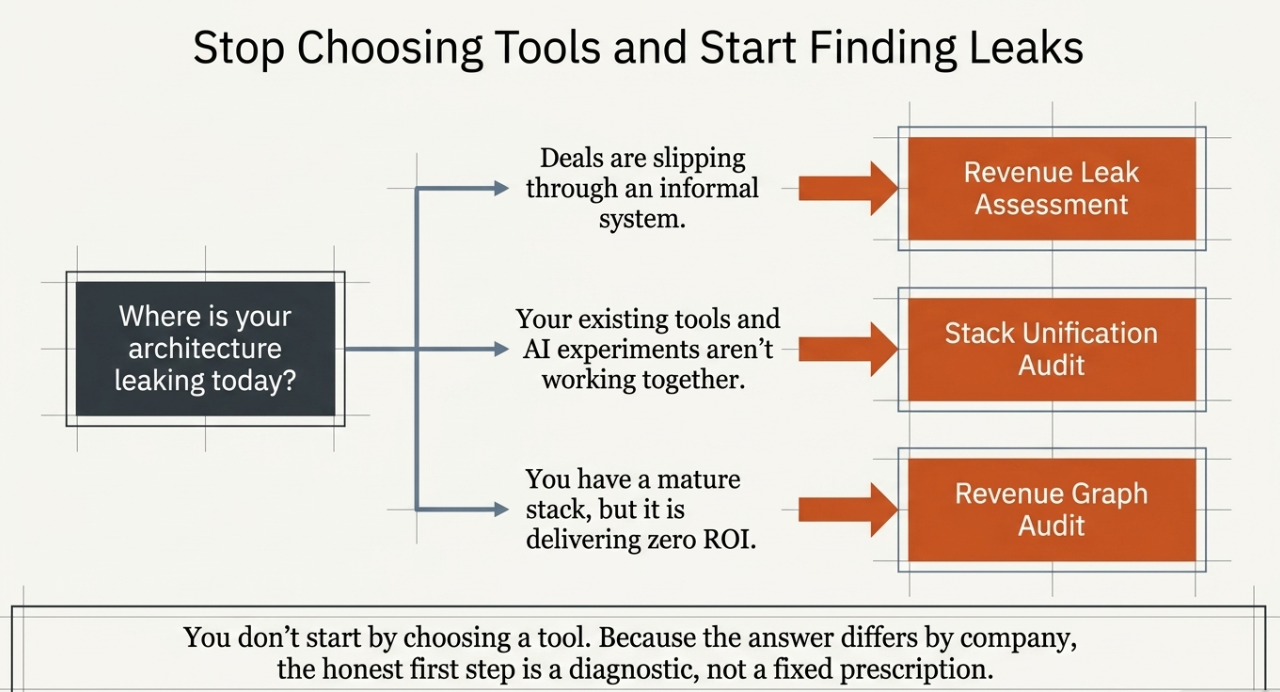
You don't start by choosing a tool. You start by finding out where your current architecture is leaking, which signals are firing with no action attached, where the Silo Tax is heaviest, and which connection would move revenue first.
Because that answer differs by company, the honest first step is a diagnostic rather than a fixed prescription. The diagnostic determines which of CETDIGIT's three assessments fits your situation: a Revenue Leak Assessment if deals are slipping through an informal system, a Stack Unification Audit if your tools and AI experiments aren't working together, or a Revenue Graph Audit if you have a mature stack that isn't delivering ROI. Each routes to a different starting point because each company sits at a different place in the same problem. You can see how the full AI services architecture fits together before deciding which assessment matches where you are.
Frequently Asked Questions
AI solutions architecture vs. buying AI tools, what's the difference? Buying AI tools adds isolated capabilities; an AI solutions architecture connects them into one system that acts. McKinsey's 2025 survey found workflow redesign, connecting and rewiring how work runs, had the single largest EBIT effect of 25 attributes tested, larger than acquiring tools. A tool does one task. An architecture makes your tools, data, and workflows act together on revenue signals. The practical test: if no single layer is responsible for what happens after a signal fires, you have tools, not an architecture.
Do AI tools work together without an architecture? Mostly, no. By default, each tool runs in its own dashboard with its own data, unaware of the others. RAND's 2024 research found over 80% of AI projects fail, with the leading causes being fragmented data and inadequate infrastructure rather than the model itself. Without an orchestration layer connecting them, tools accumulate the Silo Tax, rework, and latency that grow with each addition. Integration is the thing you have to build deliberately; it does not arrive in the box.
What is the difference between AI tools and an AI system? An AI tool is a single capability: drafting, transcribing, prospecting. An AI system is those capabilities connected so that an action in one place triggers an action in another without a human relaying it. MIT's Project NANDA found that roughly 95% of enterprise generative-AI pilots produced no measurable P&L impact, and the dividing line was integration: the ~5% that succeeded wove AI into the workflow. The system is the integration. The tools are the parts.
Why isn't my AI stack producing results? Because the stack is a collection of tools, not a system that acts, the Silo Tax. The research is consistent: RAND, MIT, and McKinsey all locate AI failure in fragmentation and missing integration, not in model quality. If your activity metrics are climbing while revenue stays flat, that is the signature symptom. The fix is an orchestration layer, a System of Action, that connects what you already own so signals turn into revenue actions.
Where does this fit in CETDIGIT's broader offering? The AI solutions architecture is the top-level picture; the individual solution layers sit beneath it. You can explore CETDIGIT's AI services framework to see how the System of Action connects to specific layers like the AI Revenue Engine. Most companies don't need all of it at once; the right entry point depends on where your architecture is leaking today, which is what the diagnostic determines.
Your Next Step
Find out where your AI spend is leaking before you spend another dollar on a tool. Take the diagnostic; it determines whether your starting point is a Revenue Leak Assessment, a Stack Unification Audit, or a Revenue Graph Audit, and shows you which connection would move revenue first.


Leave a Comment