


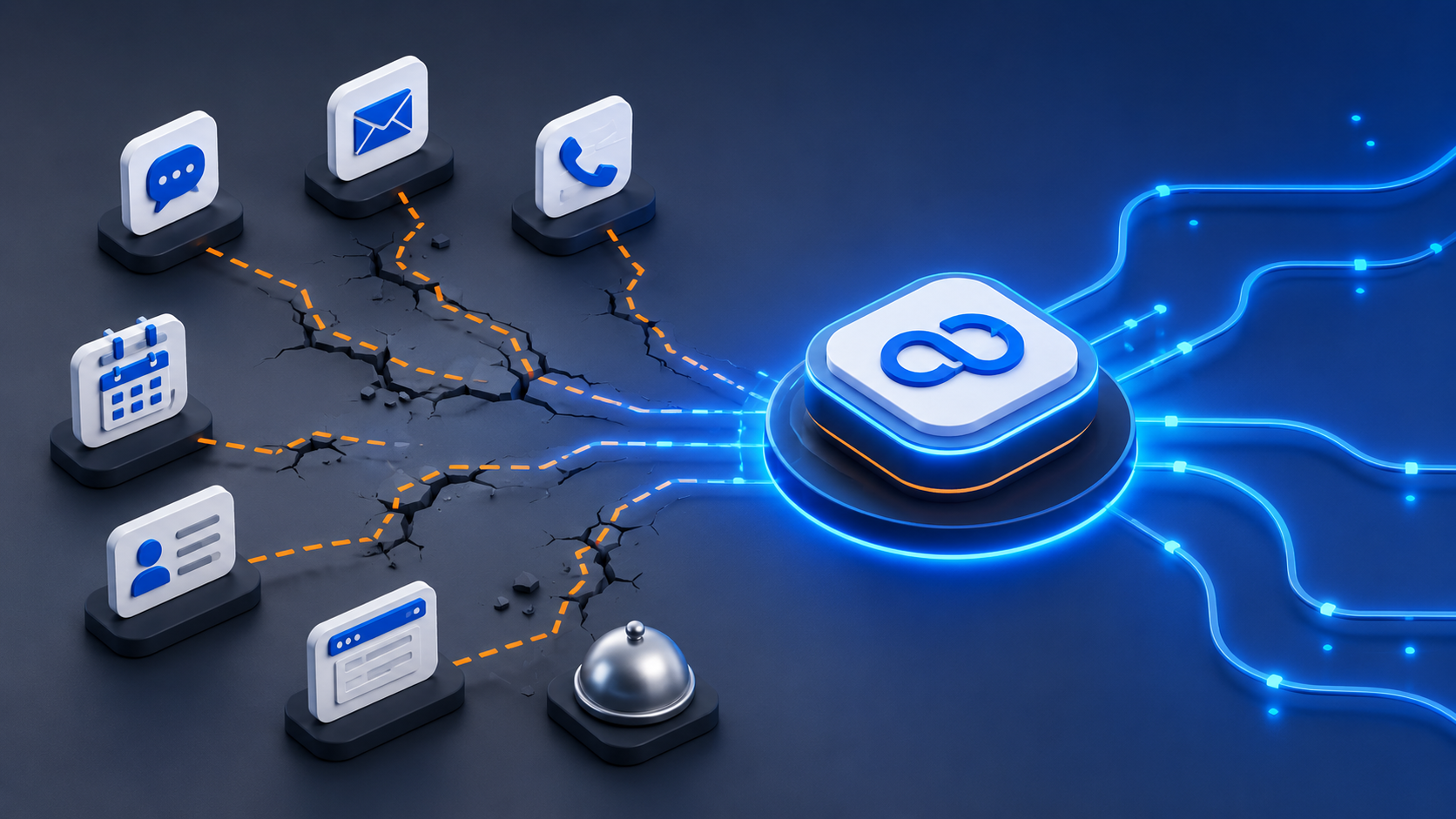
Catering inquiries slip through the cracks because of The Disconnect — the gap between disorganized marketing, fragmented sales, and legacy catering operations where each runs in its own system and nothing talks to anything else. The inquiry from Instagram lands in one place. The voicemail at 4:47 on Friday lands in another. The website form goes to a Gmail account that filed it under Promotions. By Tuesday, the booking that mattered most went to the caterer who saw it first. The fix is structural: marketing, sales, and operations on one platform.
Think about how a Saturday actually goes.
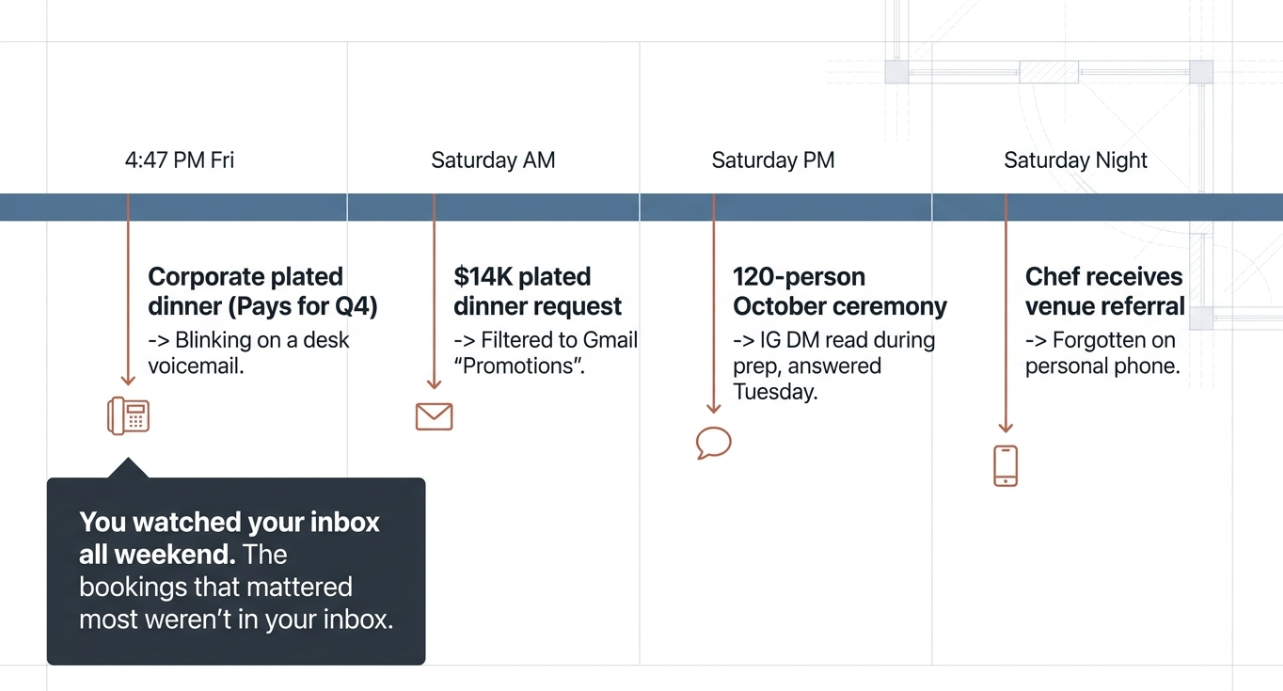
You're in the prep area, somewhere between racking the crudités and printing tomorrow's BEO. Someone from yesterday's bridal show sends an Instagram DM asking about a 120-person ceremony in October. You read the first line and decide you'll write back after service.
You don't write back after service. You write back on Tuesday. By then, she has three quotes and a tasting scheduled with the caterer who answered her Saturday afternoon.
That's one inquiry. There were three others. The voicemail light has been blinking since 4:47 Friday — a corporate inquiry, plated dinner, three weeks out, the kind of booking that pays for Q4. The website form sent a $14,000 plated-dinner request to a Gmail address that filtered it into Promotions because the contact-form service it came through looks like a marketing email. A venue partner texted your chef directly with a referral, and your chef forgot to forward it.
You watched your inbox all weekend. The bookings that mattered most weren't in your inbox.
This Isn't a Follow-Up Problem
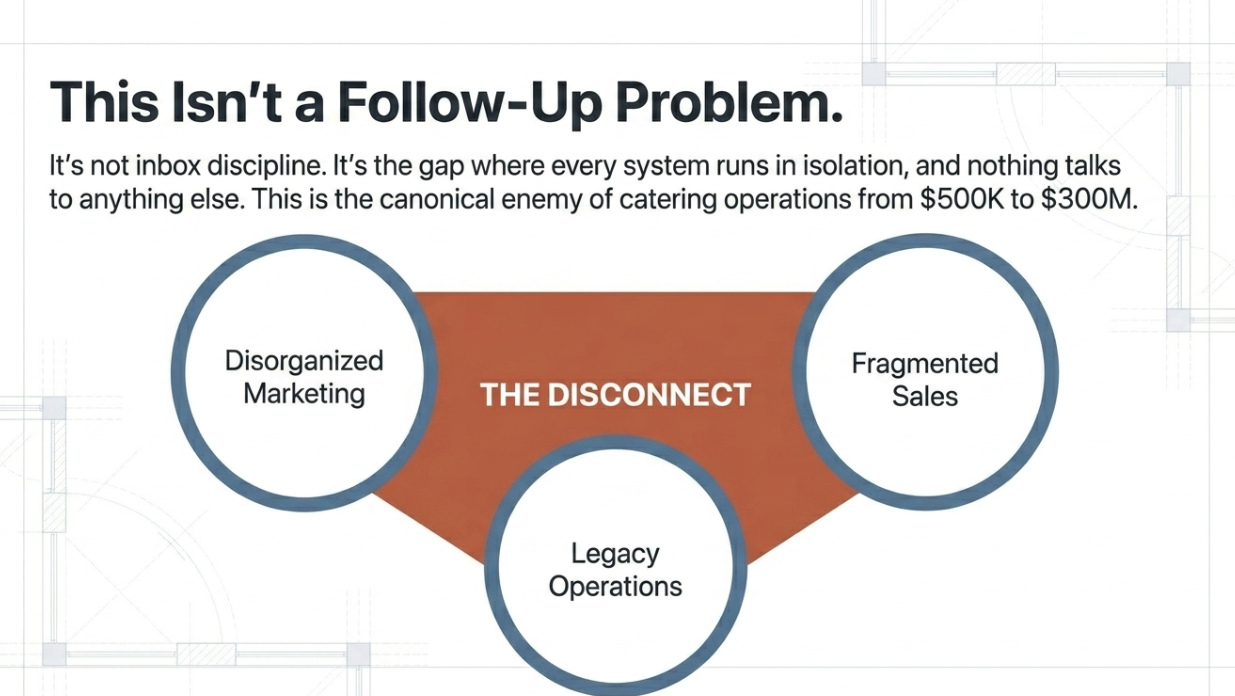
It isn't an inbox-discipline problem. It's The Disconnect — the gap between disorganized marketing, fragmented sales, and legacy catering operations, where each runs in its own system and nothing talks to anything else.
Inquiries land in seven different places. Follow-ups live on sticky notes. Marketing leads never reach the inquiry-taker. Bookings happen that the kitchen doesn't know about until the production briefing. This is the canonical enemy of every catering operation between $500K and $300M — and it doesn't get smaller as you grow. It gets more expensive.
Why The Disconnect Persists
Four reasons it stays — even after you've bought catering software, even after you've hired a coordinator, even after you've promised yourself this is the quarter you fix it.
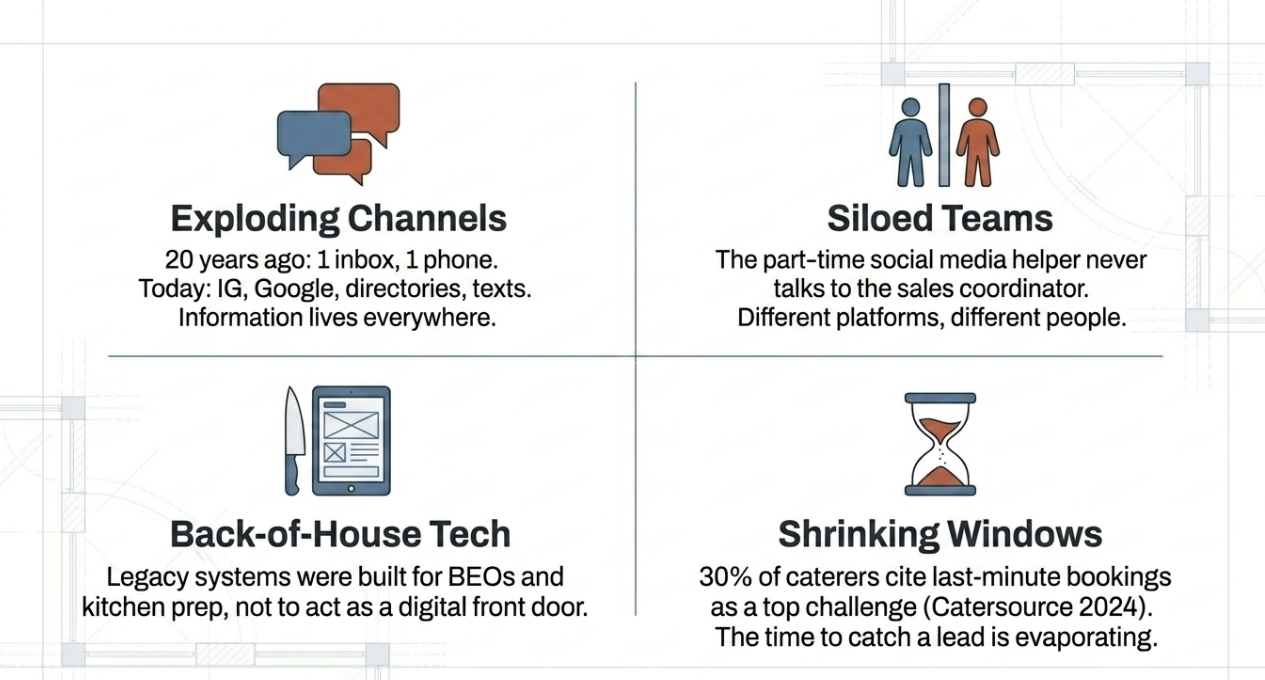
The channels grew faster than the systems did. Twenty years ago, inquiries came in through phone, fax, and walk-ins. One inbox, one phone line, one paper book on the front desk. Now they come in through Instagram, Facebook, the website form, the email alias the venue partner has, the voicemail, the text the chef gets on his personal phone, the Google Business listing, the bridal show lead list, and the wedding directory you pay $400 a month for. Each channel was added on top of the others without anything connecting them. That's where catering inquiries live now.
Marketing is run by someone who doesn't talk to whoever takes inquiries today. The owner posts to Instagram — or hires a part-time helper to run Google Business and the wedding directory. The inquiries those platforms generate land somewhere different from the inquiries the website generates. Different platforms, different inboxes, different people. Your sales coordinator never sees the Instagram DM. The part-time helper never sees the email inquiry. Each one assumes the other has it covered.
The booking system was never built to be the front door. Caterease, CaterZen, Tripleseat — whatever catering software you use — was designed to handle the booking after the inquiry has been captured and qualified. It was built to manage BEOs, production sheets, kitchen schedules, and deposits. It was never built to be the place an Instagram DM lands. Asking it to is asking a kitchen scheduling app to do customer relationship management. That's not what it does.
The window is shrinking. Catersource's 2024 State of the Industry survey reported 45% of caterers saw an increase in events over the prior year, and 30% cited last-minute booking requests as one of their greatest challenges. The time you have to catch an inquiry before the client books someone else is shrinking from days to hours.
Every caterer who came up through the industry recognizes the older version of this — The Whiteboard Problem. Decades ago, there was an actual whiteboard by the walk-in. The schedule was on it. The headcounts were on it. The staff assignments were on it. Then it became a spreadsheet. Then an app. Then, a catering software product. The fundamental problem didn't move with it: information still lives in different places, and the people who aren't in front of it don't know what's happening. The Disconnect is the modern Whiteboard Problem with more screens — and now those screens include your marketing platforms, which the original whiteboard never had to.

What The Disconnect Is Actually Costing You
Three costs. Each operator pays all three, even if they only see one.
Bookings that book somewhere else. Harvard Business Review's foundational research on lead response time — Oldroyd, McElheran, and Elkington tracking 2,241 U.S. firms — found that companies responding within an hour were nearly seven times as likely to qualify the lead as those responding even an hour later, and more than 60 times as likely as companies that waited 24 hours or more. The average response time in that study was 42 hours. Twenty-three percent of companies never responded at all.
That's B2B generally. The catering numbers are sharper. WeddingPro — The Knot Worldwide's vendor-facing platform, which lists wedding caterers as one of its primary business categories — reports that up to 50% of all bookings go to the vendor who responds first, and that following up within five minutes makes you nine times more likely to convert. Seventy-six percent of couples say they prefer quick messages over long calls.
The Saturday inquiry that wasn't followed up until Tuesday is, statistically, the booking you never had. The $14,000 plated dinner that Gmail filed under Promotions didn't lose because the food was wrong. It lost because by the time you saw it, the client had already heard back from someone else.
Leads you didn't even know existed. The Instagram DM that went to the part-time helper's account. The venue-partner referral that the chef got on his personal phone and forgot to forward. The Google Business inquiry that disappeared into the algorithm. You can't follow up on leads you don't know you have. The wedding directory you pay $400 a month for sent twelve inquiries last quarter; your coordinator told you yesterday she's only ever seen four.
Owner exhaustion. The 9 pm inbox check. The Sunday-night cross-checking of which channels were watched today. The mental load of holding "Mrs. Henderson's sticky note on the espresso machine" as the only record of a real booking. You came up through the industry because you love the work — the food, the line, the events that come together right. The hours you spend reconciling inquiries across seven channels aren't the work you signed up for. They're the work The Disconnect makes you do.
A missed $6,400 wedding booking is a Saturday's revenue that didn't happen. A missed $14,000 plated dinner is two weeks of payroll. Over a year, the cost compounds. Most operators don't see the full number because the lost bookings never enter their tracking — they're invisible by definition.
| The Impact and Financial Cost of Lead Response Disconnects | ||
| Cost Category or Statistic | Data Value | Impact Description |
| Lost Bookings (Direct Revenue) | $14,000 plated dinner / $6,400 wedding | Missed inquiries represent specific lost revenue; one dinner can equal two weeks of payroll, and one wedding represents a Saturday's lost income. |
| Unknown Leads | 8 out of 12 leads missed | Leads from directories or social media often never reach the coordinator, creating invisible costs that bypass tracking systems. |
| Owner Exhaustion | 9 pm inbox checks / Sunday cross-checking | The mental load of tracking inquiries across seven channels leads to burnout and takes owners away from core business passions. |
| HBR Lead Response Research | 60x higher qualification rate | Responding within one hour makes a firm 60 times more likely to qualify a lead compared to waiting 24 hours. |
| WeddingPro Conversion Metric | 9x more likely to convert | Following up within five minutes increases conversion probability ninefold, as 50% of bookings go to the first responder. |
| Industry Response Average (HBR) | 42 hours | The average company takes 42 hours to respond, while 23% of companies never respond at all, leading to significant lost opportunities. |
| Catersource Industry Trend | 30% cite last-minute requests | A significant portion of the industry struggles with shrinking booking windows, requiring faster operational response times. |
| HubSpot CRM Alignment Statistic | 35-point effectiveness gap | 87% of marketers with connected CRMs feel effective versus only 52% without, highlighting the cost of disconnected systems. |
| Source of Truth Impact | 56% more likely to align | Teams with a single source of truth are significantly more likely to have sales and marketing alignment, reducing operational friction. |
What Ends The Disconnect — and Why Most Catering Software Can't
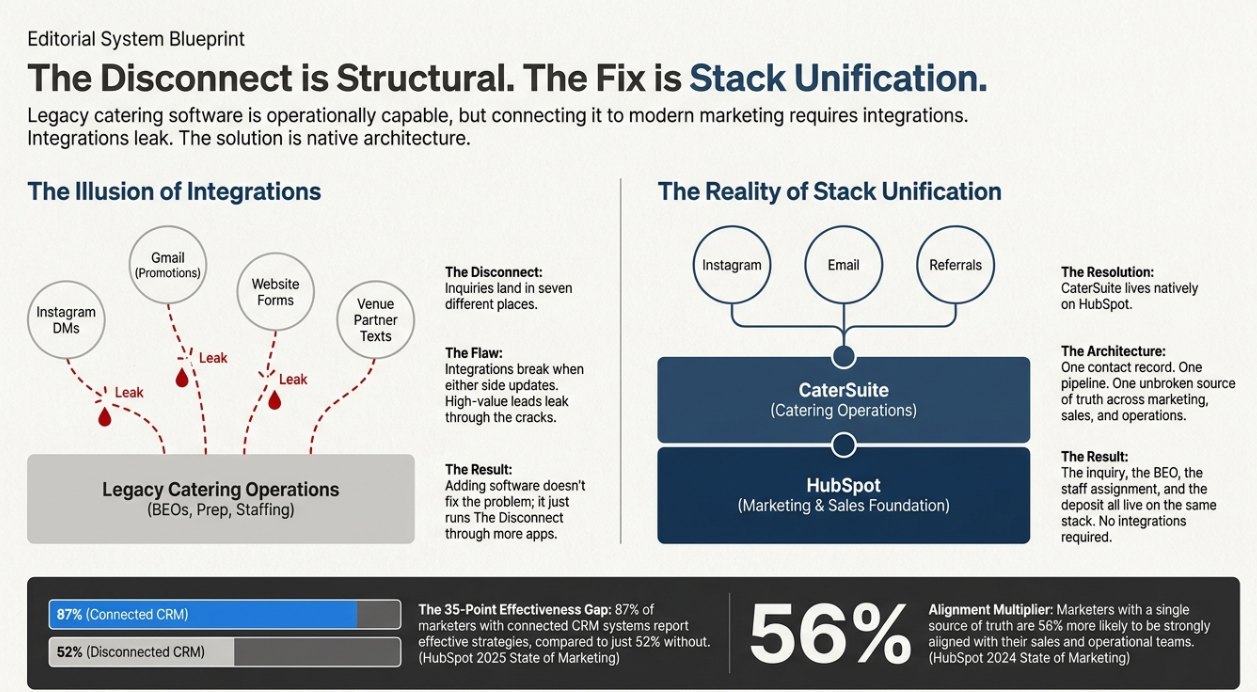
Every catering platform built before stack unification was a buying criterion that solved the same operational layer: bookings, BEOs, kitchen production sheets, staff assignments, deposits, and invoicing. The legacy catering products are operationally capable. The problem isn't that they're bad at catering operations — the problem is that they were never built on the platform your marketing and sales already use.
To connect them to marketing requires integrations. Integrations leak. They break when either side updates. The wedding directory leads still don't land where your sales coordinator is working. The Instagram DM still goes to someone else's account. The website form still gets filed under Promotions in a Gmail nobody is watching. You've added software, but the Disconnect is still there — it just runs through more apps now.
CaterSuite is built differently. CaterSuite lives on HubSpot. That's the architectural difference. The Instagram inquiry, the email inquiry, the website form, the corporate request that came through a HubSpot workflow, the referral from a venue partner — they all land in the same place. One contact record. One pipeline. One source of truth across marketing, sales, and operations.
HubSpot's own research makes the structural case in numbers. HubSpot's 2025 State of Marketing Report found that 87% of marketers using connected CRM systems felt their marketing strategies were effective in 2024 — compared to 52% without a connected CRM. That's a 35-point gap, and it is exactly the gap The Disconnect imposes on a catering operation that runs marketing in one place and operations in another. The 2024 State of Marketing Report found marketers with a single source of truth are 56% more likely to be strongly aligned with their sales teams — and only 35% of marketers say their sales and marketing teams are currently strongly aligned at all. Even the marketers don't think they're aligned. The disconnect is structural everywhere; CaterSuite is the catering-industry resolution.
This is what we call Stack Unification — marketing, sales, and catering operations on one platform, talking to each other natively rather than through fragile integrations. It's the structural advantage competitors cannot enter without rebuilding their products from scratch, because their products were built before stack unification was the buying criterion.
Stack Unification ends the Disconnect. Not by being a better booking system. By being the system that brings the inquiry, the lead, the booking, the production schedule, the staff assignment, the deposit, the follow-up, and the customer history onto the same platform that marketing and sales are already on — or are moving to.
The Path Forward
What you do next depends on where you are now.
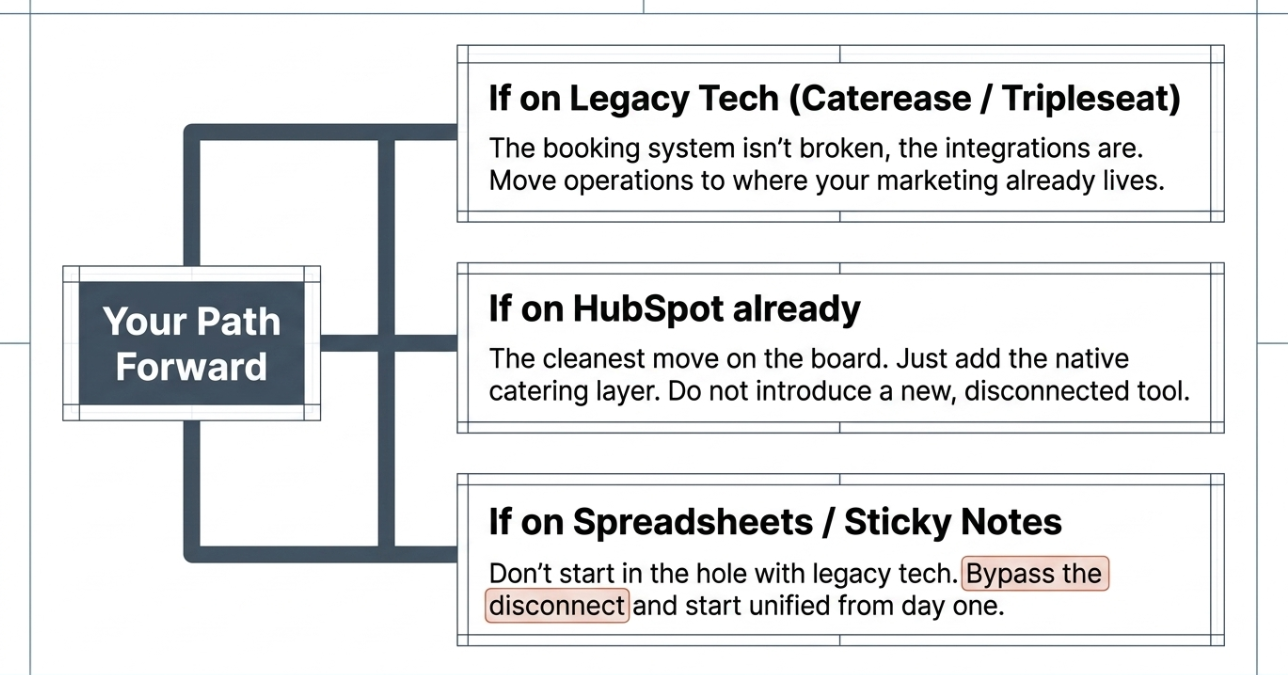
If you're running Caterease, CaterZen, Tripleseat, or another standalone catering platform plus separate marketing tools, the booking system isn't broken. The integrations are. Bring catering operations onto the same platform as marketing and sales. See the catering operations system built on HubSpot. The conversation is whether your stack stays disconnected or stops being disconnected — not whether to swap one catering app for another.
If you're already on HubSpot for marketing and sales, you have most of the platform already. Adding the catering operations layer that lives on the same stack is the cleanest move on the board. You don't need a new tool. You need the catering layer that doesn't introduce a new disconnect.
If you're not on catering software yet — still spreadsheets, sticky notes, and the inbox at 9 pm: don't repeat the legacy mistake. The catering platforms that look like the obvious next step were built before stack unification mattered. Starting on a platform that already includes the disconnect is starting in the hole. Start on the HubSpot-native catering platform instead.
For a broader context on how the major catering platforms compare on conventional operational features, the full catering software comparison walks through Caterease, CaterZen, Tripleseat, and the rest. This article is about the criterion most of those comparisons miss.
A CaterSuite Perspective
Catering has always been physical work. Clipboards. BEOs in Sharpie. The line at 6 pm. The walk-in. The chef who knows the menu by heart and the captain who knows where the linens are kept. That doesn't change, and it shouldn't. The judgment that runs an event is human judgment — it earns the booking, and it delivers the dinner.
What changes is whether the rest of the operation — the inquiries, the leads, the bookings, the follow-ups, the customer history, the marketing leads from Instagram, and the wedding directory — lives in one place or in seven. CaterSuite was built on HubSpot because that's where marketing and sales already are. Bringing catering operations onto the same stack ends The Disconnect at the architectural level, so the human team can focus on the parts that genuinely require human judgment.
Common Questions
Why am I losing catering bookings even though I check my inbox?
You're not losing them because of your inbox discipline. You're losing them because of The Disconnect — your inquiries don't all land in your inbox. Instagram DMs, website forms filed under Promotions, voicemails, venue-partner texts to your chef's personal phone, Facebook messages, Google Business inquiries — they're scattered. Catching them depends on you checking the right channel at the right time, which no operator does consistently. The fix is structural, not behavioral.
How fast do I actually need to respond to catering inquiries?
Faster than most caterers do. Harvard Business Review research tracking 2,241 firms found that those responding within an hour were more than 60 times as likely to qualify the lead as those waiting 24 hours or more. WeddingPro reports that up to 50% of all wedding bookings go to the vendor who responds first, and following up within five minutes makes you nine times more likely to convert. The window is shrinking.
Won't a different catering software solve this?
Most catering software products solve booking and operations well — Caterease, CaterZen, and Tripleseat are operationally capable. None of them was built on the platform that your marketing and sales already use. The disconnect that's losing you inquiries lives in the gap between catering software and marketing/sales — switching from one catering app to another doesn't change that gap.
Does this work for caterers who already use HubSpot?
Yes — CaterSuite is built on HubSpot. If your marketing or sales already run on HubSpot, catering operations can join the same platform without integrations. The inquiry from a Google form, the referral from your sales team, and the corporate request from a HubSpot workflow all land in one place. One contact record. One pipeline. One source of truth across marketing, sales, and operations.
What if my "marketing" is just me posting to Instagram?
That's still marketing. The DMs on Instagram generate a need to land in the same place as the website inquiries and the referrals. The reason inquiries slip through the cracks isn't that you're marketing wrong — it's that the channels you market through and the system you book through don't talk to each other. CaterSuite is built so they do.
How much of this can I really fix without changing tools?
Some. Faster follow-up habits help. Auto-responders help. A shared inbox helps. None of those fixes the structural problem of inquiries landing in seven different systems. The Disconnect is a stack problem. Habits won't close it.

The Reframe
You are not failing at follow-up. The system the industry built for caterers — booking software here, marketing tools there, the inbox somewhere else, the venue partner's text to the chef's personal phone, the Gmail Promotions filter — was never built to keep inquiries connected. The Disconnect is what you're losing inquiries to, not your own discipline.
The bride from the bridal show, the corporate plated dinner that went to Promotions, the venue-partner referral that lived on your chef's personal phone: what changes when marketing, sales, and operations live on one platform is that there is no channel, nobody is watching. The inquiry that mattered most is where you'll see it, because the system is built to bring it there.
See How CaterSuite Ends The Disconnect
CaterSuite is the catering operations system built on HubSpot — marketing, sales, and operations on one platform, so the inquiry that matters lands where you'll see it. See how CaterSuite ends The Disconnect.



Leave a Comment