


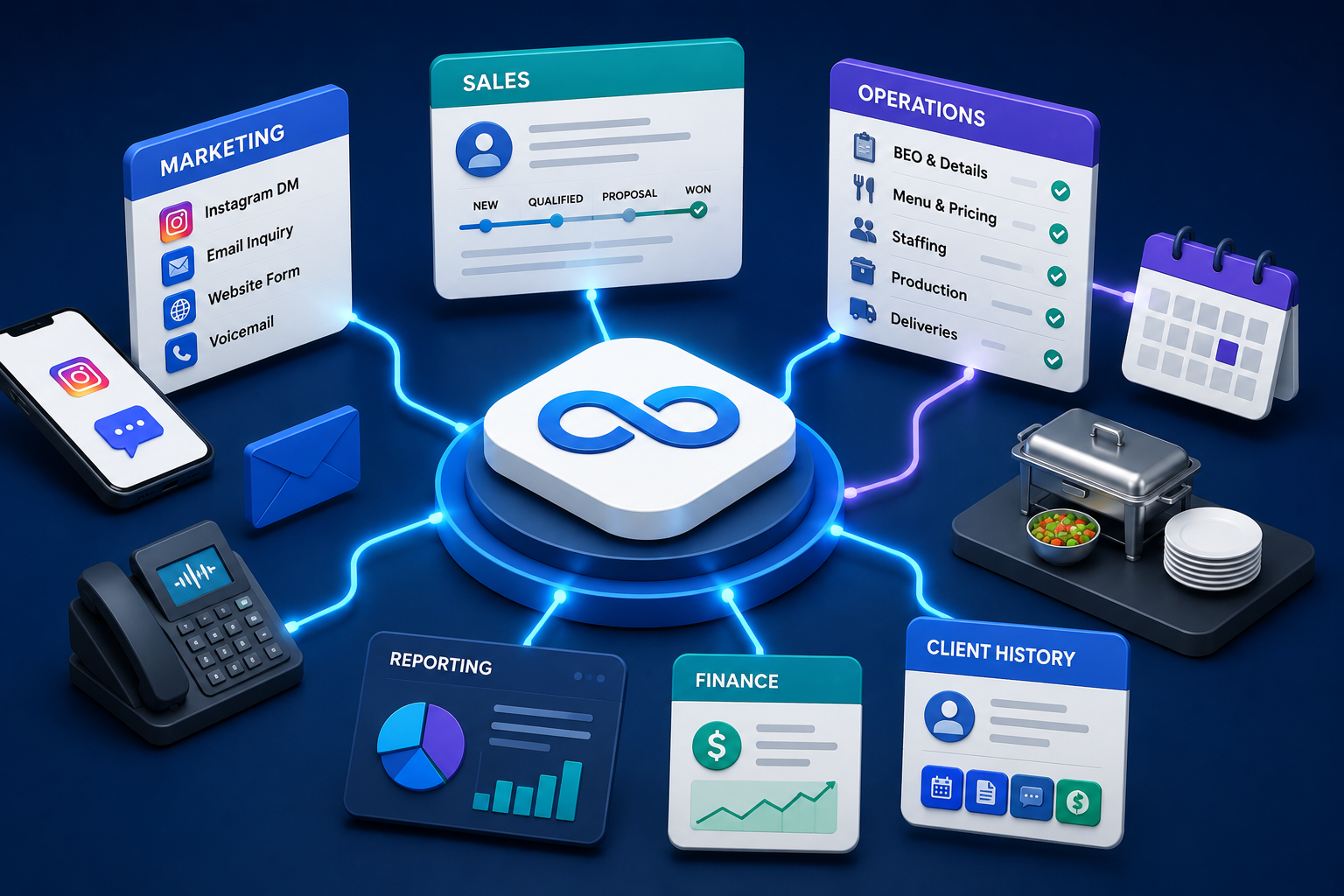
CaterZen is an owner-operator catering platform built around online ordering and delivery, starting at $179/month, with a built-in CRM, branded ordering portal, and driver routing. CaterSuite is HubSpot-native: it unifies marketing, sales, and catering operations on the platform marketing and sales already use. The two solve different layers. CaterZen runs the ordering lane well; CaterSuite connects the inquiry, the marketing, the booking, and the follow-up in one system rather than across several.
You just sat through the CaterZen demo. Two tabs are still open on the laptop: the demo recording in one, your notes in the other. And the truth is, it looked good. The branded online-ordering page where corporate clients place their own drop-off orders without calling you. The delivery screen with route mapping and a driver app. The proposals that go out with an e-signature line built in. For taking orders and getting food out the door, it's a real system, not a toy.
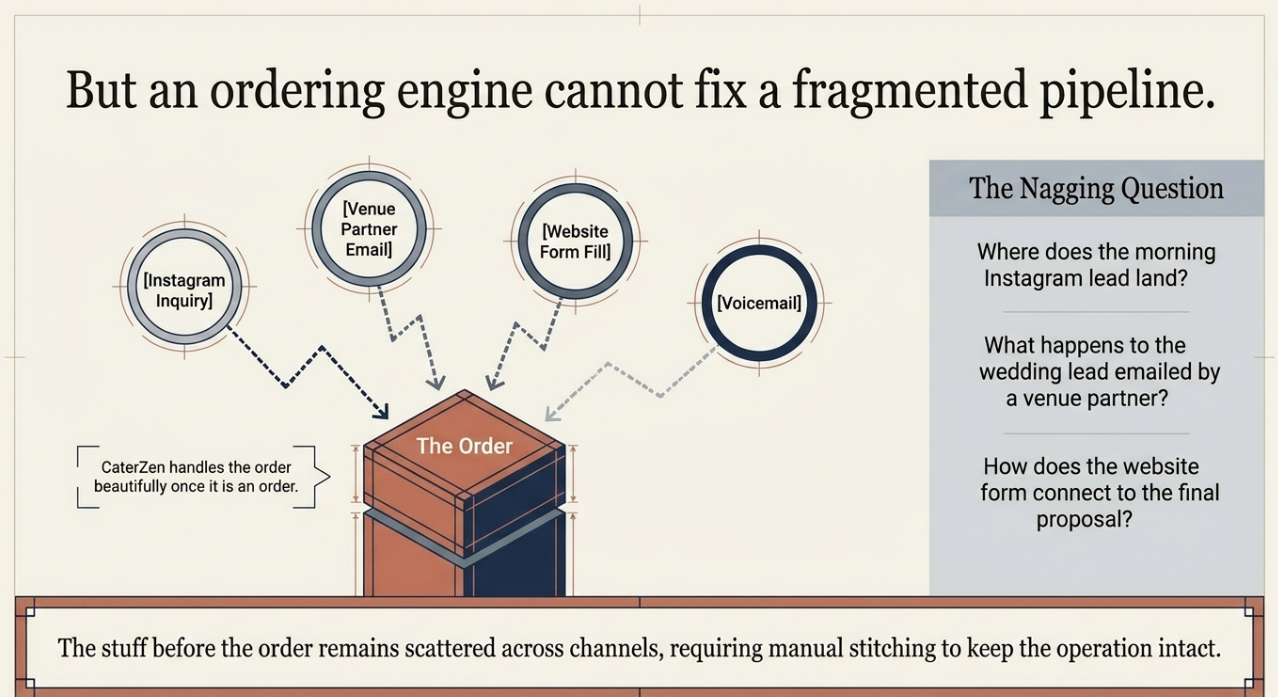
Then the nagging question. The inquiry that came in through Instagram this morning, where does that land? The wedding lead from the venue partner who emails you directly? The form fill from the website your marketing person built? CaterZen handles the order once it's an order. But the stuff before the order- the inquiries scattered across five channels, the follow-ups, the marketing that's supposed to feed all of it- does any of that connect? Or are you about to buy a great ordering tool and keep stitching it to everything else by hand?
That question is the whole comparison. So let's answer it honestly.
What This Comparison Is Actually Measuring
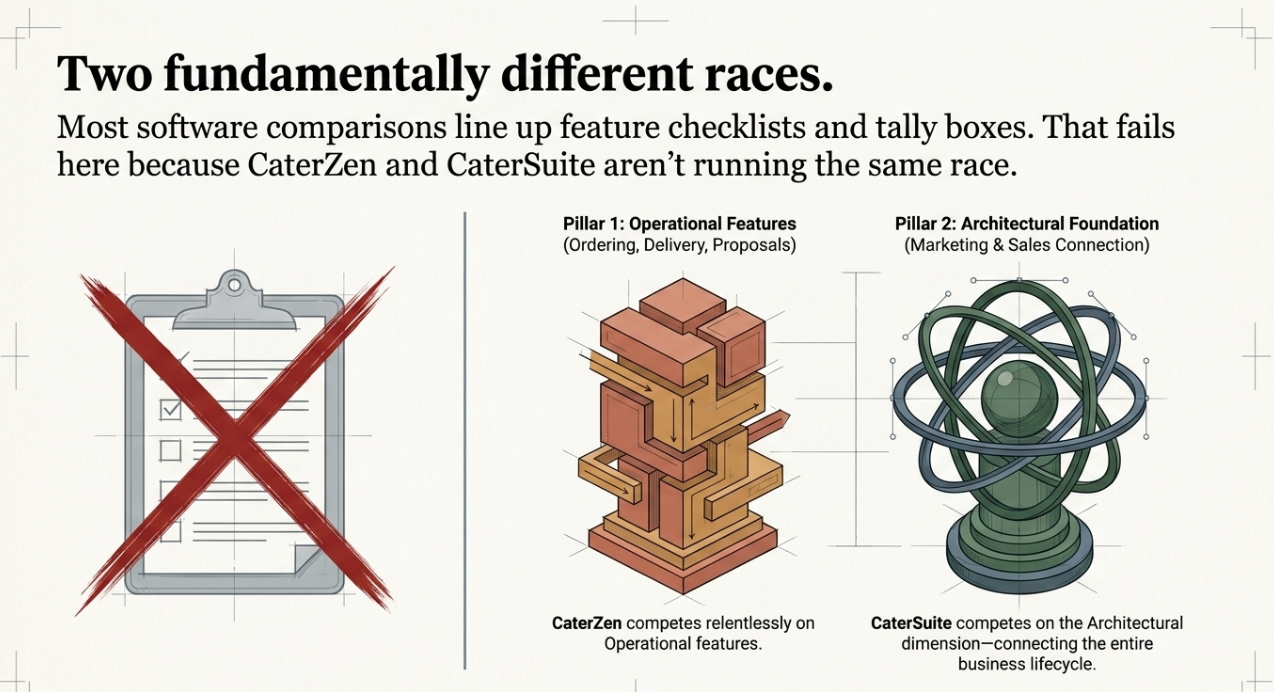
Most catering software comparisons line up feature checklists and tally who has more boxes ticked. That's not useful here, because CaterZen and CaterSuite aren't built to win the same race.
The dimensions that matter for this decision: online ordering and delivery depth, the built-in CRM, proposal and BEO tools, pricing and total cost of ownership, and the one that separates the two products, native connection to marketing and sales. The first four are operational features. The last one is architectural. CaterZen competes hard on the operational features. On the architectural dimension, it isn't competing at all, not because it's weak, but because it was built for a different job.
Keep that distinction in mind through the table below. A row CaterZen wins is a real win. A row where the answer is "requires integration" versus "native" isn't a feature gap; it's a difference in what the product fundamentally is.
Side-by-Side Comparison
|
Dimension |
CaterZen |
CaterSuite |
|
Built around |
Online ordering & delivery for owner-operators |
HubSpot-native stack unification |
|
Online ordering / branded portal |
Strong (Pro Plus tier and up) |
On HubSpot |
|
Delivery routing/driver app |
Strong (Marketing Pro Plus tier) |
Via platform |
|
CRM |
Built-in catering CRM |
HubSpot CRM (shared with marketing & sales) |
|
Native marketing + sales connection |
Requires integration |
Native, same platform |
|
Entry pricing |
From $179/mo |
(see /CaterSuite) |
|
User rating |
4.8 (55 reviews, Capterra) |
— |
Two notes so this table stays honest. First, CaterZen's online ordering unlocks at the $199/month Pro Plus tier, and delivery management plus email marketing sit at $229/month (Marketing Pro Plus), not on the $179 entry plan. If ordering and delivery are why you're looking at CaterZen, price it at the tier that includes them. Second, that 4.8 rating across 55 reviews on Capterra is real, with Value for Money scored at 4.5. CaterZen users are genuinely happy. Any comparison that pretends otherwise is lying to you.

Where Each Product Wins
CaterZen wins for the owner-operator who wants strong drop-off, takeout, and delivery ordering in one affordable system. If most of your volume is corporate drop-off and recurring orders, and you want clients placing those orders themselves through a branded page, CaterZen does that well. The delivery routing and driver app are practical, not marketing fluff. The built-in CRM tracks your clients. The proposals go out clean with e-signature. At $179–$229/month depending on tier, it's priced for a single operation, and the 4.8 rating says operators who buy it tend to keep it. For a caterer whose pain is "I need ordering and delivery handled in one place," CaterZen is a legitimate answer.
CaterSuite wins where the operation's pain isn't the ordering tool; it's everything around the ordering tool. When the inquiries come in through Instagram, email, voicemail, the website form, and the referral partner, and none of them land in the same place. When marketing runs in one system and whoever takes the booking works in another, and they never talk. That's not a problem a better ordering page fixes, because it isn't an ordering problem.
Here's the honest framing: CaterZen and CaterSuite are not really competing on the same plane. CaterZen is an owner-operator ordering and delivery platform. CaterSuite is a HubSpot-native operation that unifies marketing, sales, and catering operations. You can run both lanes well and still have the second problem completely unsolved, which is exactly the gap the next section is about.
The HubSpot-Native Advantage
Here's the structural difference, and it's the reason this comparison exists.
CaterZen runs the ordering lane well. But its CRM and its marketing tools are its own, a self-contained system. The moment you want the order data, your marketing, and your sales follow-up to live together, you're connecting CaterZen to something else through an integration. Integrations work until they don't. They leak. They lag. They break on an update, and nobody notices until a lead falls through. The inquiry that came in this morning, the campaign that produced it, and the booking it eventually becomes still live in separate systems that you, or a paid integration, are responsible for keeping in sync.
That gap has a name. It's The Disconnect, the gap between disorganized marketing, fragmented sales, and legacy catering operations, where each runs in its own system and nothing talks to anything else. A standalone ordering platform, however good, leaves it intact. The order gets handled beautifully, but the inquiry that never became an order, the marketing lead that went to a different inbox than the sales lead, the follow-up that lived on a sticky note: all of that is still scattered.
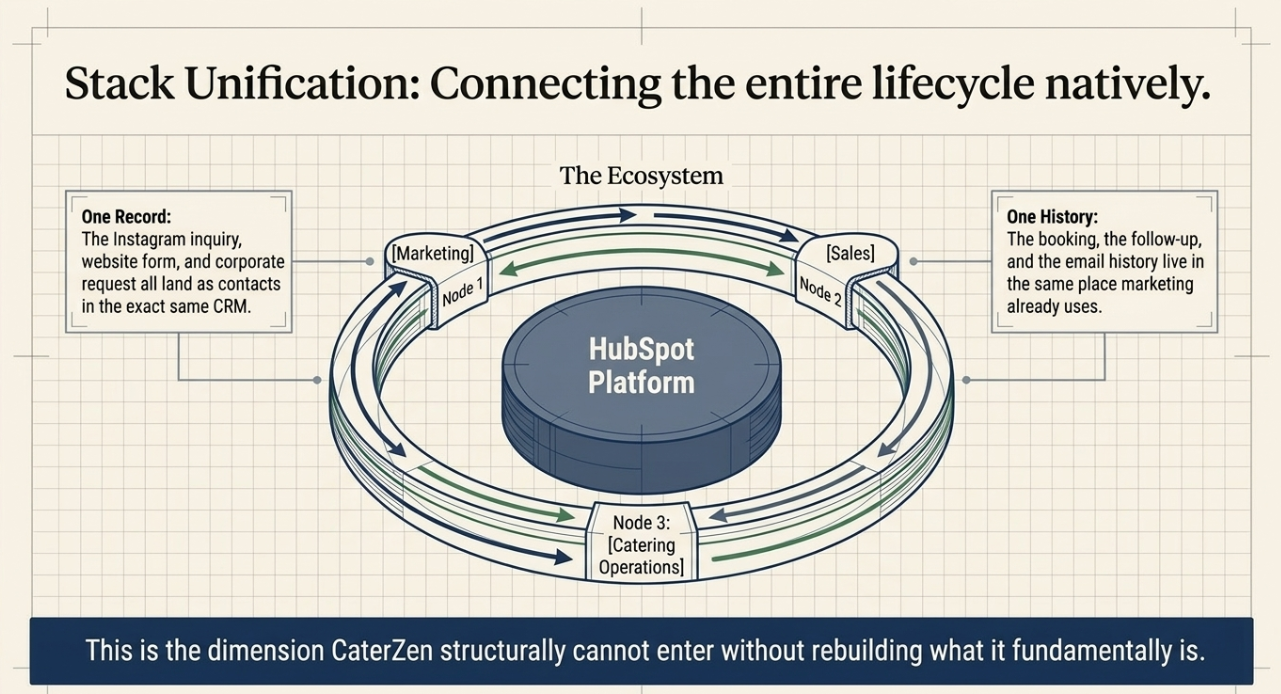
CaterSuite closes it by being built on HubSpot, the platform a growing number of caterers' marketing and sales teams already run on. The Instagram inquiry, the website form fill, the referral, and the corporate request all land as contacts in the same CRM your marketing and sales already use. The booking, the follow-up, the email history, same place. That's Stack Unification: marketing, sales, and catering operations on one platform, talking natively rather than through fragile integrations. It's the dimension CaterZen structurally can't enter without rebuilding what it is.
This isn't a CaterSuite opinion. HubSpot's own 2026 State of Marketing research found that marketers point to disconnected data sources and company silos among their top challenges, with data-sharing difficulty named directly. And HubSpot's 2024 State of Marketing finding that only 35% of marketers say sales and marketing are strongly aligned traces the same root cause: no single source of truth. The Disconnect isn't a CaterSuite invention; it's the documented default state of running your operation across tools that don't share data.
Recommended Path
If you're choosing today, start with an honest read of your own pain. If it's genuinely "I need better online ordering and delivery in one affordable system," and your marketing and inquiry flow are already manageable, CaterZen is a fair shortlist pick; demo it at the tier that includes the features you actually need.
If the pain is the scatter, inquiries everywhere, marketing disconnected from sales, follow-ups falling through, then the ordering tool was never the bottleneck, and buying a better one won't fix it. That's the case to look at how a HubSpot-native platform handles the whole flow, from first inquiry to booked event, on the same system your marketing and sales live on. For the broader field beyond these two, how the major catering platforms compare is the wider view.
The CaterSuite Perspective
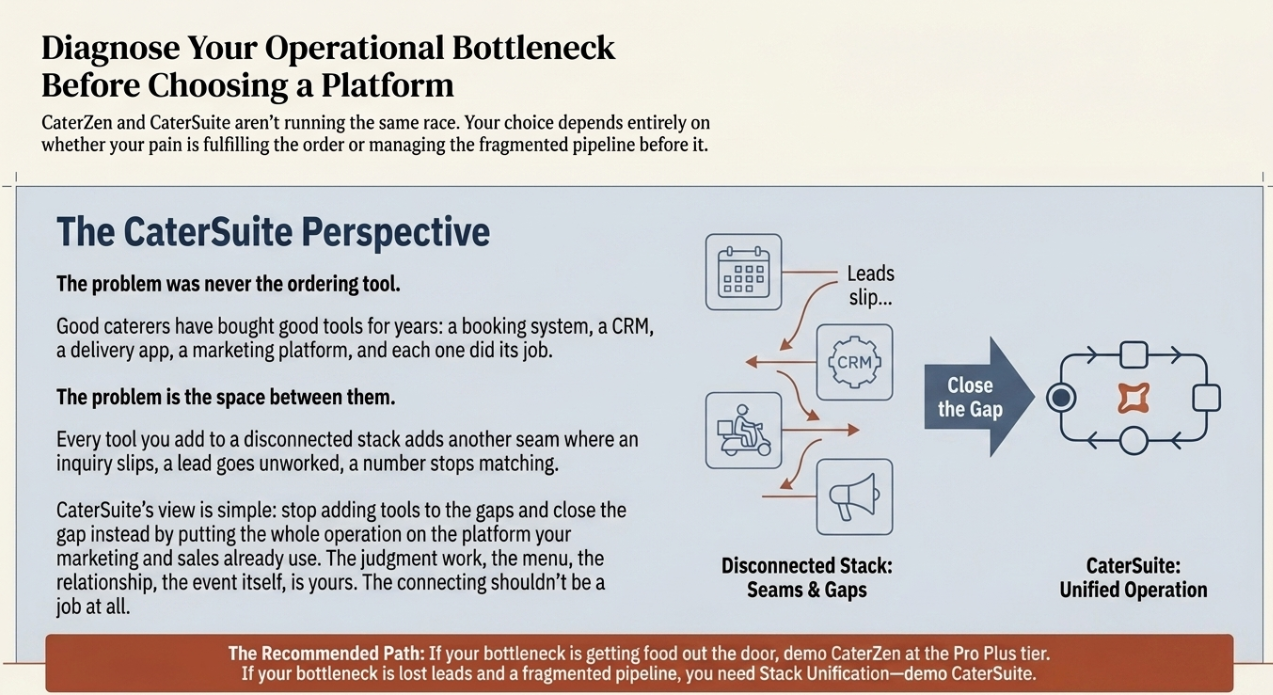
The problem was never the ordering tool. Good caterers have bought good tools for years: a booking system, a CRM, a delivery app, a marketing platform, and each one did its job. The problem is the space between them. Every tool you add to a disconnected stack adds another seam where an inquiry slips, a lead goes unworked, a number stops matching. CaterSuite's view is simple: stop adding tools to the gaps and close the gap instead by putting the whole operation on the platform your marketing and sales already use. The judgment work, the menu, the relationship, the event itself, is yours. The connecting shouldn't be a job at all.
Frequently Asked Questions
Is CaterZen good catering software? Yes. CaterZen holds a 4.8 rating across 55 reviews on Capterra, with Value for Money at 4.5 and strong satisfaction. It's a capable owner-operator platform built around online ordering, delivery (with route mapping and a driver app), e-signature proposals, and a built-in CRM. For caterers whose core need is ordering and delivery in one affordable system, it's a legitimate choice.
How much does CaterZen cost? CaterZen starts at $179/month (Pro tier, flat rate). Online ordering unlocks at $199/month (Pro Plus), and delivery management plus email marketing sit at $229/month (Marketing Pro Plus). There's a free trial but no free version. Price it at the tier that includes the features you actually plan to use, not the entry plan.
What's the difference between CaterZen and CaterSuite? They solve different layers. CaterZen is an ordering and delivery platform with its own CRM. CaterSuite is HubSpot-native; it unifies marketing, sales, and catering operations on one platform. CaterZen handles the order; CaterSuite connects the inquiry, the marketing, the booking, and the follow-up in a single system.
Does CaterSuite work for caterers who already use HubSpot? Yes, CaterSuite is built on HubSpot. If your marketing or sales already runs on HubSpot, catering operations join the same platform without integrations. An inquiry from a web form lands in the same place as a referral from your sales team and a corporate request from a HubSpot workflow. One contact record, one pipeline, one source of truth across marketing, sales, and operations.
Can CaterZen connect to my marketing and CRM? CaterZen has its own built-in CRM and, on higher tiers, email marketing. Connecting it natively to a broader marketing and sales platform like HubSpot is a different matter; that requires an integration rather than living on the same system. That difference is The Disconnect: the order is handled, but the marketing and sales flow around it stay in separate places.
Which is better for a multi-location caterer? For multi-location operations that need real-time visibility across sites, and marketing spend traced through to booked revenue, the deciding factor is whether the systems share data natively. A HubSpot-native platform gives one view across locations; a standalone ordering tool plus separate marketing means stitching reports together each quarter.

Closing Reframe
Back to those two tabs on your laptop. The CaterZen demo did look good, because it is good, at the thing it's built for. The nagging question wasn't whether the ordering works. It was whether the inquiry from this morning, the marketing that produced it, and the booking it might become will ever live in the same place. A standalone ordering platform leaves that question open no matter how well it runs the order. Closing it is what Stack Unification means, and it's the one dimension worth deciding on, because it's the one a better ordering page can't fix.
See How CaterSuite Unifies the Whole Operation
CaterZen runs the ordering lane. If the rest of your operation- the inquiries, the marketing, the follow-up- is still scattered, see how a HubSpot-native catering platform connects all of it on one system. One contact record from first inquiry to booked event.



Leave a Comment