


Tuesday, 7:40 AM. Last night’s proposal is the best-looking document the shop has ever sent: a photo menu and one link for the menu, the contract, and the payment. The client paid the deposit before midnight.
The operations director opens the weekly numbers to put the event on the board and finds three versions of the quarter:
- Marketing’s report shows 31 inquiries.
- The proposal tool shows 12 proposals sent.
- Accounting shows 9 deposits.
Every number is right about the system it came from. But nobody can say which of the 31 inquiries became the 12 proposals, or what happened to the other 19. And none of the three numbers tells her what the kitchen is actually producing Saturday.
The short answer: Curate is a strong catering proposal, recipe-costing, and production tool with its own inquiry forms and pipeline, but it runs separately from a caterer’s marketing and sales systems. CaterSuite puts marketing, sales, and catering operations in one system — the inquiry, quote, booking, BEO, and follow-up — so the whole business works from one version of the truth. It is built on HubSpot, the CRM your marketing and sales teams may already run.
The question isn’t which tool writes the better proposal. It’s whether your marketing, your sales, and your kitchen are looking at the same booking. Right now, many caterers aren’t.
That gap has a name: The Disconnect. It’s the gap between disorganized marketing, fragmented sales, and legacy catering operations, where each runs in its own system and nothing talks to anything else. Marketing leads never reach the inquiry-taker. Bookings happen that the kitchen doesn’t know about until the production briefing. The pattern is laid out in why catering inquiries slip through the cracks.
In 2026, that’s the losing position. No single tool in the stack has to be weak for it to happen. Three good tools that don’t share a system still leave someone reconciling three numbers every Monday.
What This Comparison Actually Measures
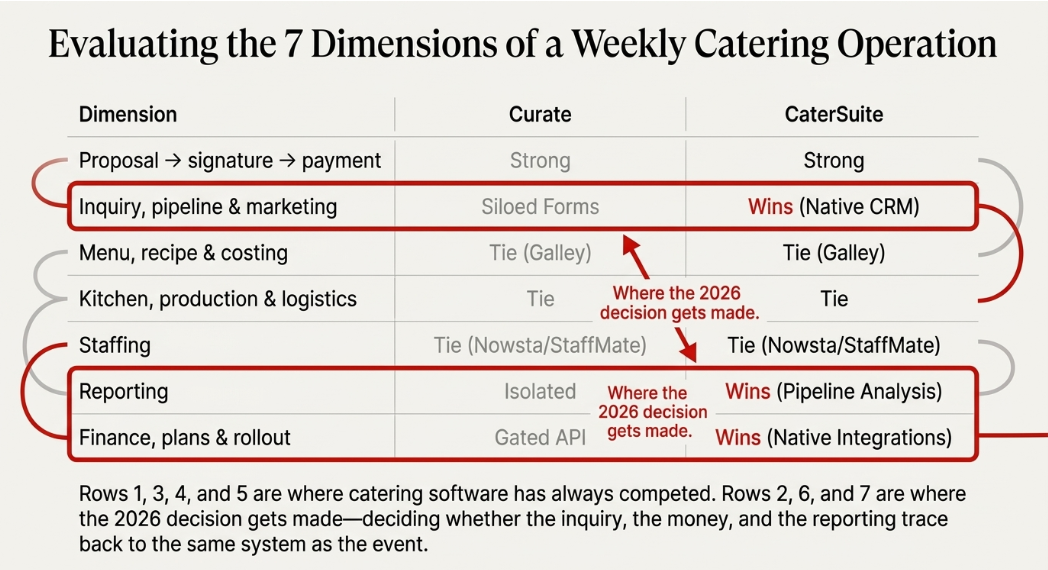
Seven dimensions, drawn from what a catering operation runs every week:
- Proposal → signature → payment
- Inquiry, pipeline & marketing
- Menu, recipe & costing
- Kitchen, production & event logistics
- Staffing
- Reporting
- Finance, plans & rollout
Rows 1, 3, 4, and 5 are where catering software has always competed, and where Curate does its best work. Rows 2, 6, and 7 are where the 2026 decision gets made. Those rows decide whether the inquiry, the money, and the numbers sit in the same system as the event.
The Side-by-Side
|
Dimension |
Curate |
CaterSuite |
|
Proposal → signature → payment |
Proposal builder and branded client portal. Contracts with e-signature on every plan. Stripe payment. Proposal, contract, and payment from one client link. |
HubSpot Quotes on the deal, with CPQ on Revenue Hub Professional. E-signature on the quote (25 per user per month, more purchasable). The contract can be created automatically when the quote is accepted. Online payment by card or ACH. PandaDoc supported. |
|
Inquiry, pipeline & marketing |
Inquiry forms and a built-in pipeline inside Curate. Curate Texting. No CRM or marketing-platform integration listed. |
Web inquiries captured into HubSpot contacts. Deal pipelines for catering stages. Lead scoring and qualification. Automated follow-ups and SMS/email reminders. Meeting scheduling, email tracking, mobile CRM. Landing pages, nurture funnels, and social campaign management (Marketing Hub). |
|
Menu, recipe & costing |
Recipes with costs that scale to guest count. Linked line items that move with headcount (both Growth and up). Galley sync on Partnership. |
Menu and package selection on the event. Guest count management. Dietary restriction tracking. Automatic portion and yield calculation. Ingredient and purchasing lists. Galley (tie). Restaurant365 and Meez integrations. |
|
Kitchen, production & event logistics |
Configurable prints, including BEOs and packing lists. Shopping lists, purchase orders, and production notes (Growth and up). Projects, calendar, and timelines. |
Automated BEO generation. Kitchen prep sheets. Menu-driven production planning. Kitchen task lists. Automated event creation. Event timeline tracking. Venue and logistics details. Automated task creation across teams. |
|
Staffing |
Staffing add-on app. Nowsta (tie). StaffMate (tie). |
Staff requests generated from event size. Role assignments. Shift notifications. Staffing across multiple events. Nowsta (tie). StaffMate (tie). |
|
Reporting |
3 custom reports on Growth; no cap listed on Partnership. |
Revenue dashboards. Event profitability and margin. Labor, staffing, and kitchen workload forecasts. Lead-source performance. Pipeline and conversion analysis. Revenue analytics on Revenue Hub Professional. |
|
Finance, plans & rollout |
QuickBooks (tie, Growth and up). No published prices; three plans. Basic is annual-only, with no integrations. API on Partnership only. Several modules are add-on apps. Onboarding call on every plan. |
QuickBooks (tie), Xero, NetSuite, Sage. Runs on HubSpot Sales Hub Professional at minimum, with quote-to-payment on Revenue Hub Professional. Phased delivery; first phase live in 3–5 weeks. |
Curate wins or ties the proposal, recipe, and production rows. The shared integrations are ties: Galley, Nowsta, StaffMate, and QuickBooks. The split is in rows 2, 6, and 7: where the inquiry lives, what the reports can trace back to, and whether marketing is in the same system as the kitchen.
Where Each Product Wins
Curate is built around the proposal. A client gets one link for the menu, the contract with e-signature, and the Stripe payment. Curate supports split deposits, milestones, and final balances with reminders. Recipes carry ingredient costs and scale to the guest count, and linked line items move with the headcount. Production notes, purchase orders, shopping lists, and configurable prints come off the same job. For a shop where the proposal is the sales process, that’s a full toolset.
The trade-offs start with the design. Curate is one product for caterers, florists, venues, rental companies, and event professionals. Capterra files it primarily under Florist Software, where it holds 4.7 out of 5 on 218 reviews, and five of the seven free resources on its catering page are floral. That’s a design choice, not a flaw. The plans are gated:
- Prices aren’t published.
- Basic is annual-only, and it drops recipes, production notes, purchase orders, shopping lists, and every integration.
- Growth caps custom reports at 3 and custom properties at 10.
- Multi-location, staffing, rentals, room management, ecommerce, and an AI Assistant are add-on apps.
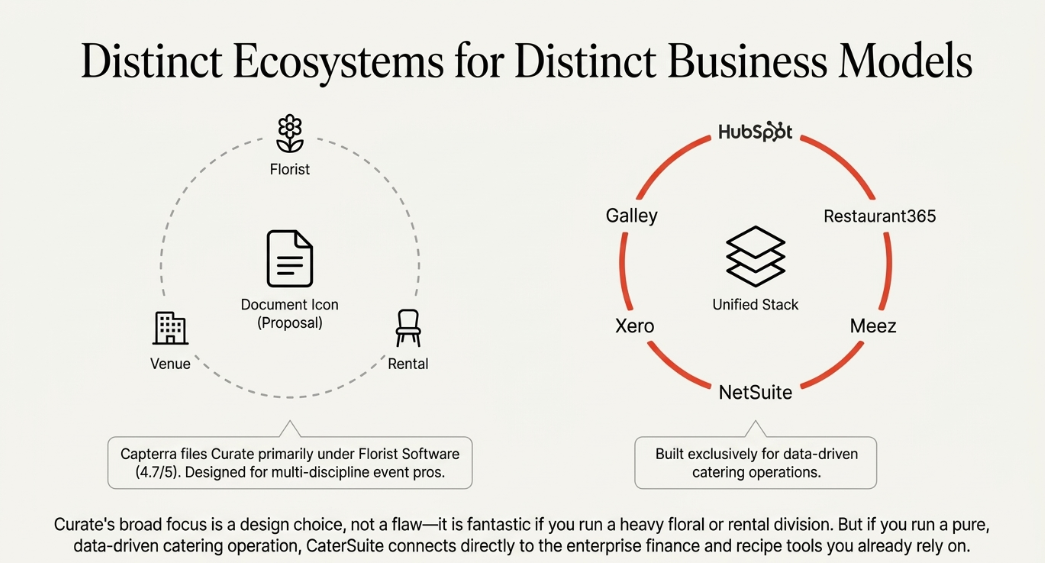
Curate lists seven integrations, and none of them is a CRM or marketing platform.
Three ordinary weeks show where that line falls.
Scene 1: The corporate account
A corporate lead fills out the form on your website. Marketing runs HubSpot, so the contact lands there, tied to the campaign that brought it in.
In Curate, someone opens Curate, creates the client, and re-keys the contact to build the proposal. Curate’s own FAQ explains why: there is “no native integration with other CRM systems like HubSpot.” From there, Curate’s path works well: a template-built proposal and one client link.
But the booking now lives in two systems, and every change after this gets typed twice. That’s Double Entry, and the full cost is in why the same booking gets typed three times.
In CaterSuite, the lead is already a HubSpot contact with a deal in the catering pipeline. The quote is built on that deal, and the event, BEO, and staff request are created in the same system. Nobody re-keys the contact. Marketing can see the campaign it started turn into a booking.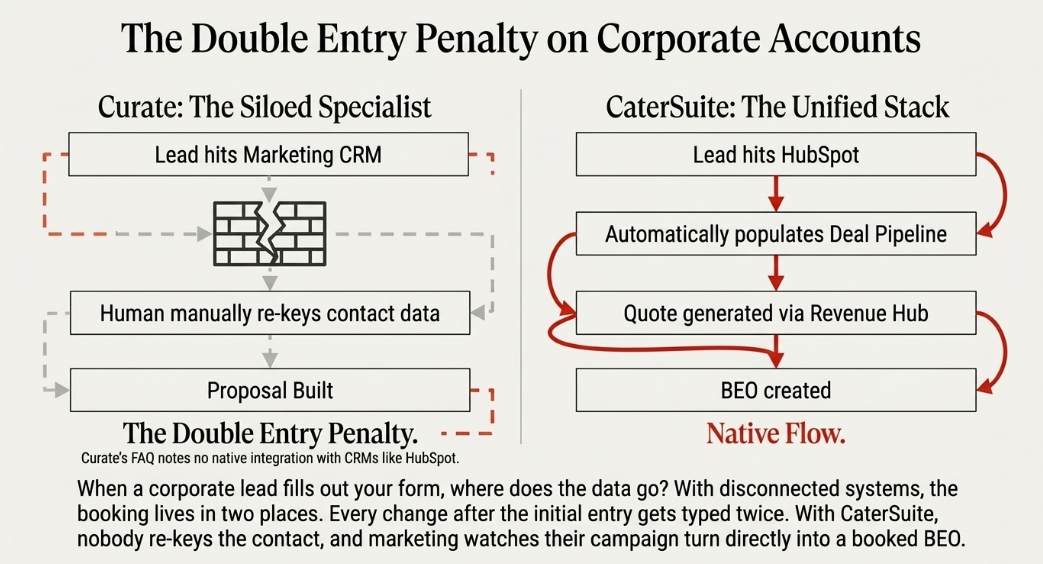
Scene 2: Headcount goes from 150 to 175 on Thursday
On Growth or above, Curate’s recipes and linked line items scale to the new count. Curate says changes carry across proposals, prep, and packing. Inside Curate, that’s the right result, and it’s a real strength.
The question is who outside Curate finds out. If the account also lives in HubSpot, the deal there still says 150 until someone updates it, and so does the event value marketing reports on.
In CaterSuite, guest count management, portion and yield calculation, purchasing lists, kitchen prep sheets, and event-size staff requests sit in the same system as the deal sales works and the contact marketing reports on. The 175 is entered once, in the system everyone uses.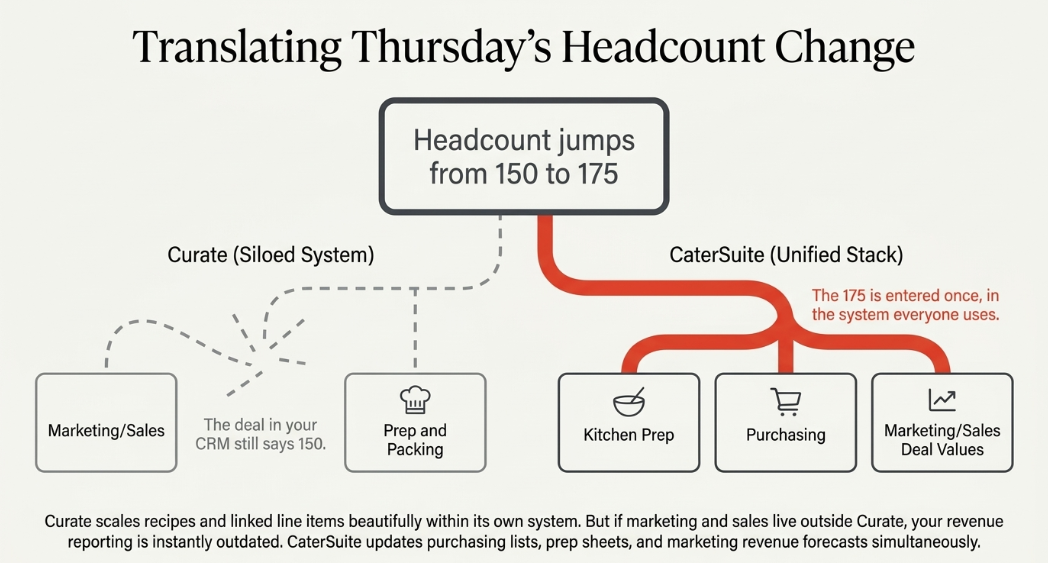
Scene 3: The stalled proposal
A proposal went out ten days ago. No signature yet.
In Curate, automations can send reminders, and the client portal holds the follow-up, so the nudge goes out. The stall is visible in Curate’s pipeline to whoever works in Curate.
In CaterSuite, automated follow-ups and reminders run from the CRM. The stalled deal shows up in the same pipeline marketing reads, next to its pipeline and conversion analysis. Both tools send the reminder. The difference is who can see the stall, and whether marketing can tell that it’s one client or a whole campaign’s worth of proposals sitting unsigned.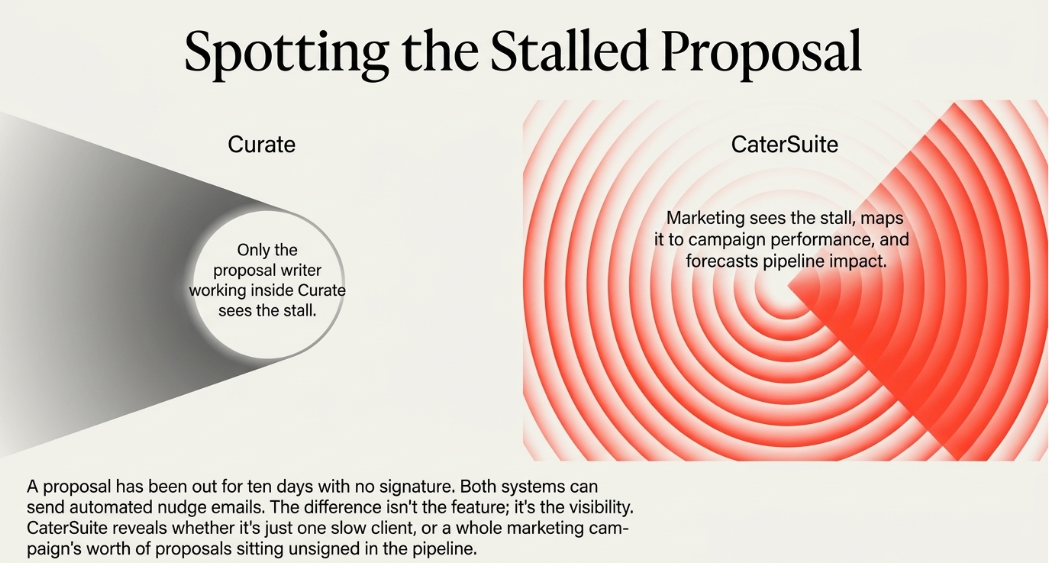
The HubSpot-Native Difference
All three scenes come down to the same point. When marketing, sales, and operations share one version of the truth, nobody spends Monday reconciling three numbers. No inquiry waits in a system the next person doesn’t open.
The cost of the opposite shows up well outside catering. Classic Harvard Business Review research (2011) audited 2,241 US companies:
- Firms that contacted a lead within an hour were nearly 7 times as likely to qualify it as firms that waited even one hour longer.
- They were more than 60 times as likely to qualify it as firms that waited 24 hours or more.
A data-driven catering inquiry doesn’t get more patient than that.
HubSpot’s 2026 State of Marketing points the same way. 27.6% of marketers name sales–marketing alignment a top challenge. Only 65% say they have high-quality audience data, and the report points to disconnected data sources and silos. Those are cross-industry numbers, but a catering shop with marketing and sales in separate tools will recognize them.
Curate agrees with the premise. Its integrations page says it directly: “Disconnected tools create profit leaks.” Its FAQ makes the case for all-in-one software, arguing that fewer tools mean less duplication and lower error risk. The difference is where the “all” ends. Curate’s all-in-one covers the catering job. Marketing and sales stay on the other side of the line.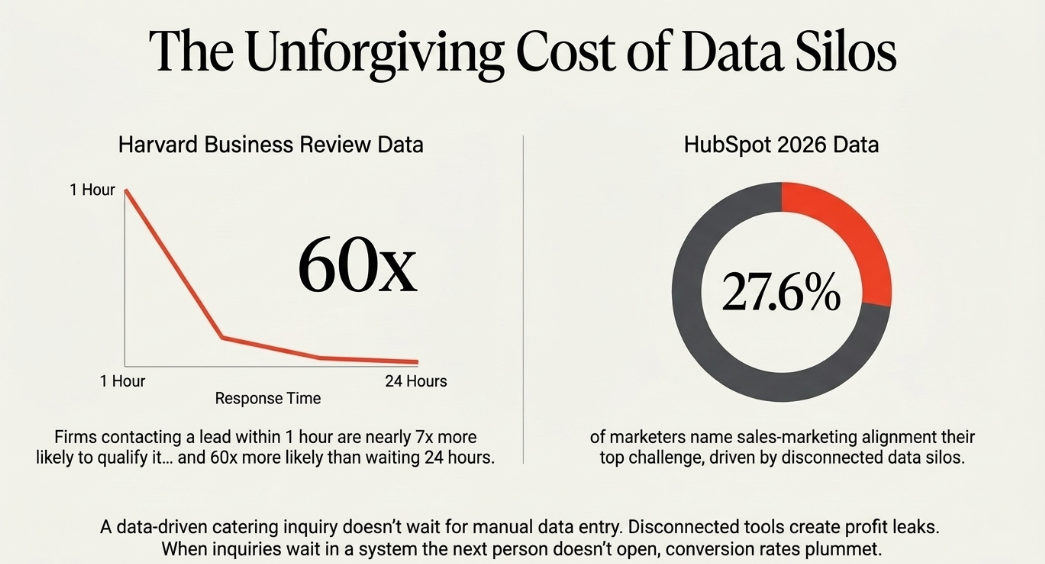
CaterSuite moves that line. That’s Stack Unification: marketing, sales, and catering operations all on one platform (HubSpot), so they talk to each other natively rather than through fragile integrations. In practice, that means the HubSpot-native catering platform: the inquiry, the quote, the BEO, and the follow-up in the same CRM.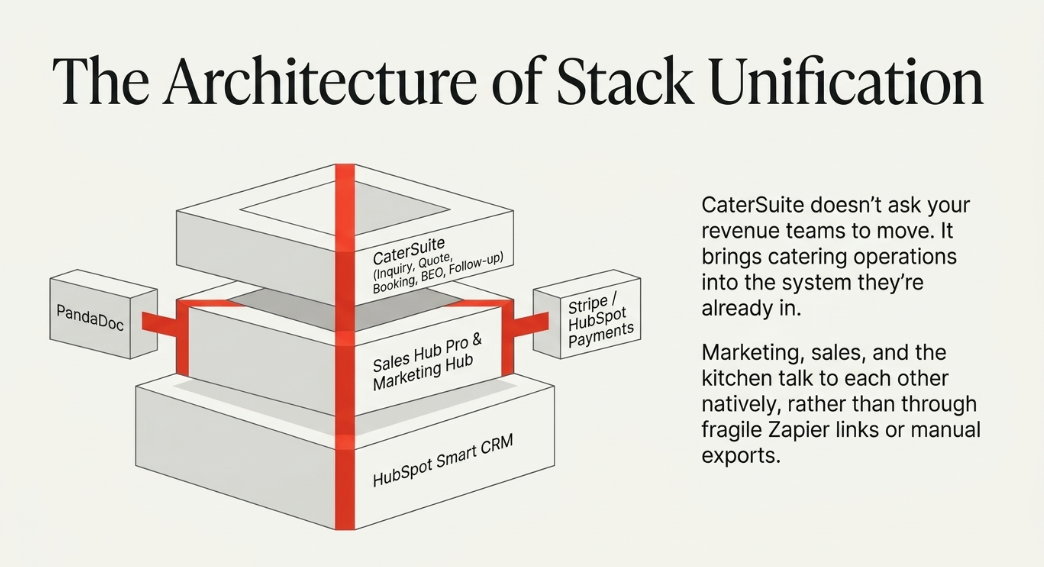
The foundation underneath is one plenty of businesses already run. HubSpot’s Smart CRM comes with every paid HubSpot subscription. HubSpot reported 306,446 customers across all industries as of June 30, 2026. If your marketing and sales already work in HubSpot, CaterSuite doesn’t ask them to move. It brings catering operations into the system they’re already in.
Which One Is Right for You
Curate fits if:
- The proposal is your sales process, and you want recipe costing and production prints built around it.
- You’re willing to keep marketing and sales in a separate system and re-key between them.
- You also run floral, venue, or rental lines, which Curate was designed to serve.
CaterSuite fits if:
- You want the inquiry, quote, booking, BEO, and follow-up in one system, so marketing, sales, and the kitchen work from the same numbers.
- Your marketing and sales teams already run HubSpot, or you’re planning to move them there.
If you’re weighing a tool built around a large integration catalog instead, read the full CaterSuite vs Caterease breakdown. For the whole field, start with the full catering software comparison. If the deciding question is whether your whole business can run from one system, see how CaterSuite handles this.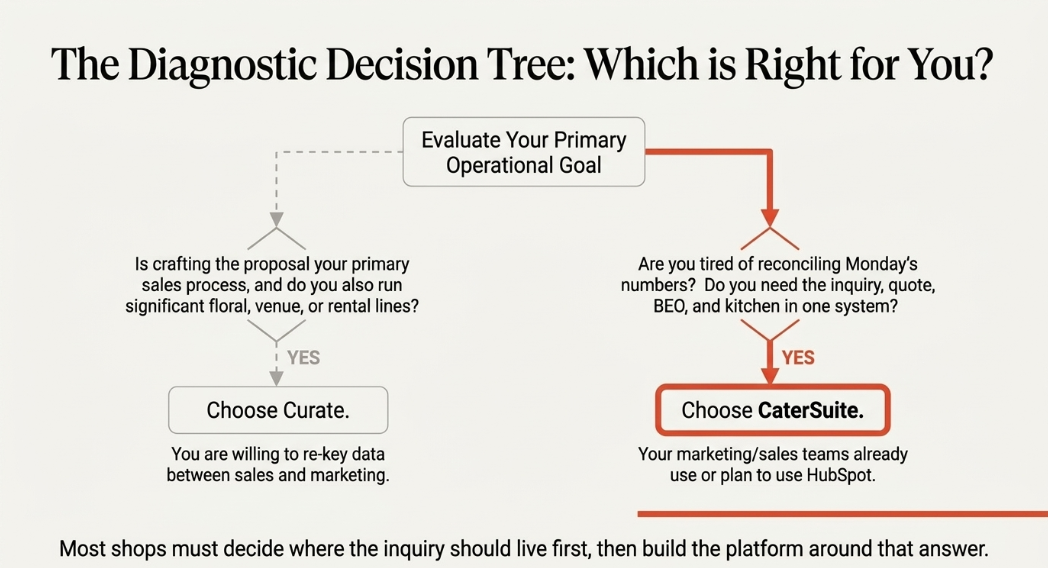
The CaterSuite Perspective
Proposal tools don’t make weak proposals. Curate makes good ones. The 2026 problem is what happens around the proposal:
- the inquiry that arrived somewhere the proposal tool can’t see
- the headcount change sales hears about before marketing does
- the stall nobody outside one system notices
Caterers rarely lose an event because the document looked wrong. They lose time, and sometimes the booking, in the space between systems. CaterSuite is built so there’s no space between them: marketing, sales, and catering operations in one system, on HubSpot.
FAQ
How much does Curate cost?
Curate doesn’t publish prices. Its pricing page lists three plans (Basic, Growth, and Partnership), and each one ends in “Let’s Chat.” Basic is annual-only. Capterra’s listing shows $275 a month for Growth and $500 a month for a plan called “Scale.” Those tier names don’t match Curate’s current site, so treat them as a reference point, not a quote. Add-on apps cost extra; Curate’s help center lists the staffing module at $100 a month or $1,000 a year. Extra users are an upgrade.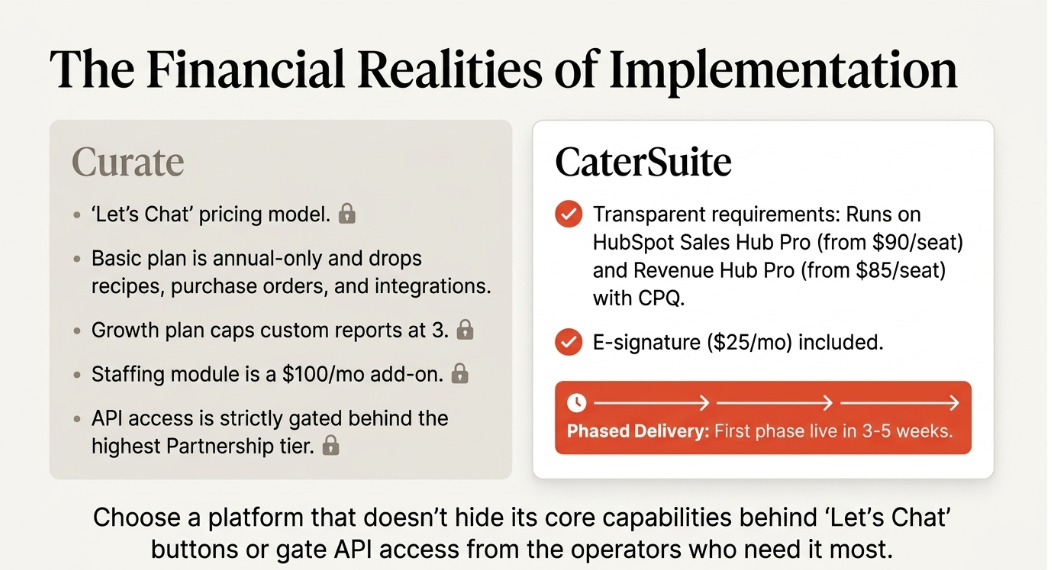
Does Curate integrate with HubSpot?
No. Curate’s own FAQ says it has no native integration with CRM systems like HubSpot. It lists seven integrations: Curate Texting, QuickBooks, Stripe, Google Calendar, Nowsta, Galley, and StaffMate. None is a CRM or marketing platform, and no Zapier connection is listed. Basic includes no integrations, and API access is on the Partnership plan only.
What does CaterSuite use for proposals, contracts, and deposits?
CaterSuite uses HubSpot Quotes on the deal, with CPQ on Revenue Hub Professional.
- Signature: e-signature is included on the quote (25 per user per month, with more available to purchase).
- Contract: when the setting is on, HubSpot creates the contract automatically from the accepted quote.
- Payment: collected on the accepted quote by card or ACH, through HubSpot Payments in the US, UK, and Canada, or Stripe elsewhere. Quotes support payment schedules.
- Proposals and contracts: PandaDoc is also supported.
Does CaterSuite generate BEOs and prep sheets?
Yes. CaterSuite includes:
- automated BEO generation
- kitchen prep sheets
- menu-driven production planning
- automatic portion and yield calculation
- ingredient and purchasing lists
- kitchen task lists
It integrates with Galley, Restaurant365, and Meez for recipe and kitchen data. Galley is an integration that both CaterSuite and Curate offer.
What HubSpot tier does CaterSuite need?
If you already run HubSpot, CaterSuite works on your existing account. It needs Sales Hub Professional at minimum: HubSpot lists $90 per seat per month billed annually ($100 month-to-month), plus one-time onboarding. Quote-to-payment runs on Revenue Hub Professional, from $85 per seat per month billed annually ($95 month-to-month). Landing pages, nurture funnels, and social campaign management run on Marketing Hub Professional. These are HubSpot’s list prices, not CaterSuite pricing.
Can I run Curate proposals and keep HubSpot as my CRM?
Yes, but with no native connection between them. Each inquiry gets re-keyed from HubSpot into Curate to build the proposal. After that, changes to the booking get typed in both places, or one system falls behind. That’s Double Entry, paid every week the two run side by side. Most shops decide where the inquiry should live first, then choose the platform around that answer.
I run floral and catering — which fits?
Curate was built for both. It serves florists, caterers, venues, and rental companies from one product, and much of its resource library is floral. CaterSuite is built for catering operations and doesn’t document floral-specific tools. If floral is a major part of your business, Curate is designed for that mix. If catering is the business and floral is occasional, the question is the same one this comparison asks: where should the inquiry live?
The Choice, in One Line
Go back to Tuesday, 7:40 AM: 31 inquiries, 12 proposals, 9 deposits.
The proposal was never the weak link. Curate makes a good proposal, and that one got paid before midnight. The weak link is three systems that each tell the truth about themselves and nothing about each other.
Curate makes the job inside the catering tool better. CaterSuite puts the 31, the 12, and the 9 in one system, so the next time someone asks what happened to the other 19, there’s an answer.
See How CaterSuite Connects Marketing, Sales, and Operations on HubSpot
If your proposals are good and your Monday numbers still don’t match, the gap is between systems. Book a 30-minute call to see a single platform that unifies catering operations: marketing, sales, and the kitchen in one system.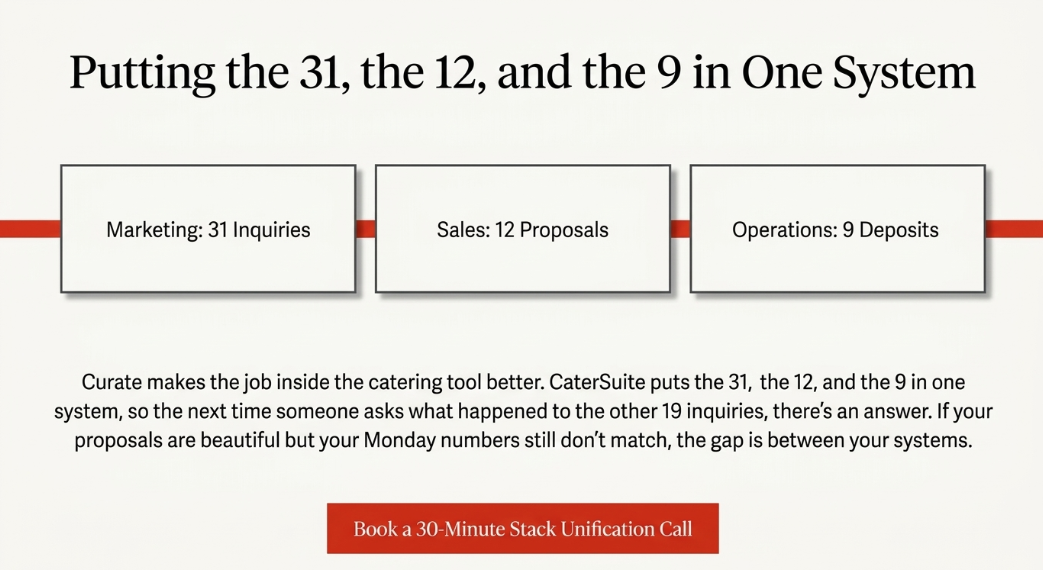


Leave a Comment