


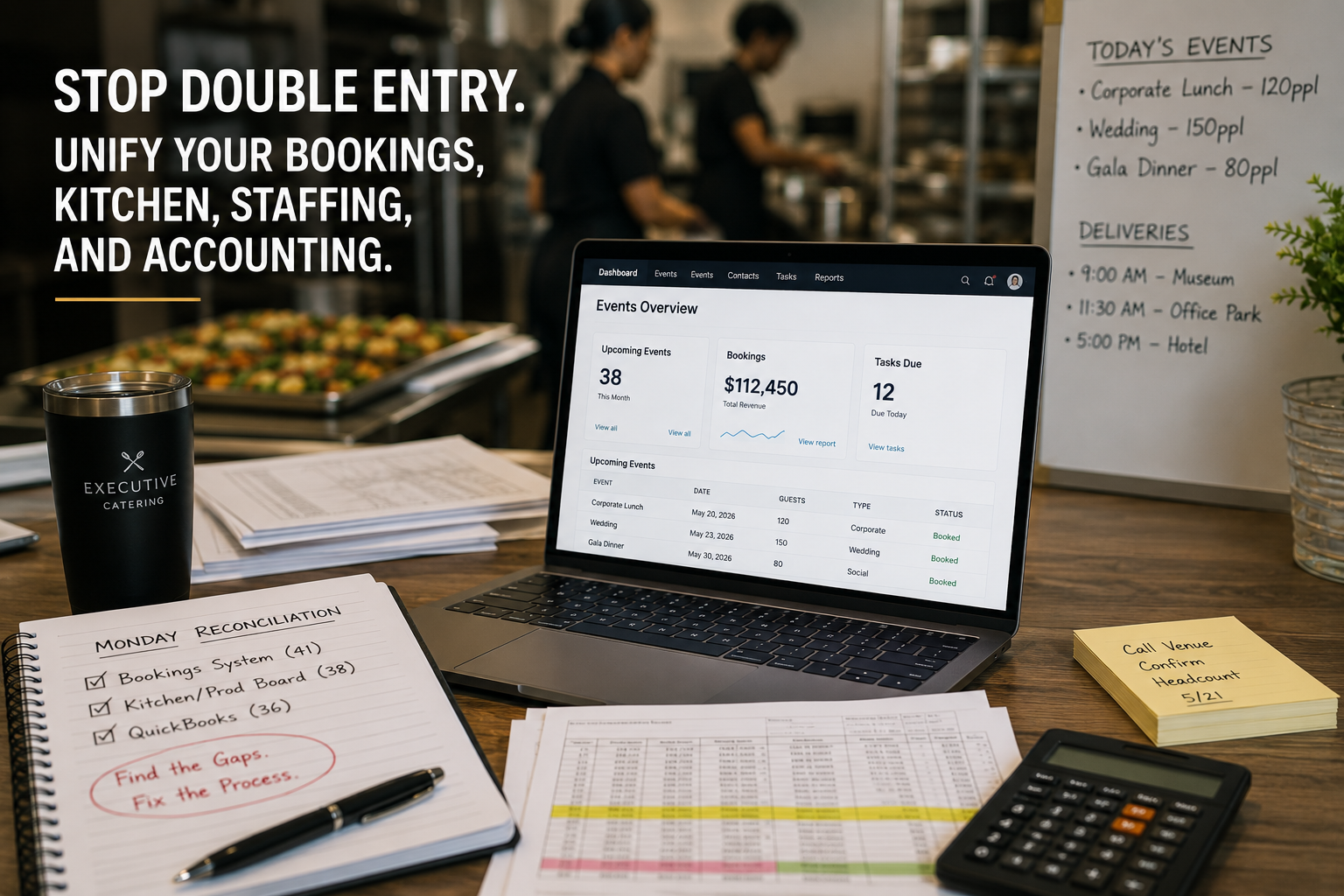
A catering team enters the same booking twice because its systems are disconnected: the booking software, the accounting tool, and the staff schedule don't share data, so someone rekeys the same event into each one. This is Double Entry: the cost of operational fragmentation, paid in reconciliation hours and handoff errors. It isn't a discipline problem your staff can fix by being more careful. It's structural: three systems each hold their own copy of the booking, so the numbers drift apart, and someone spends Monday reconciling them.
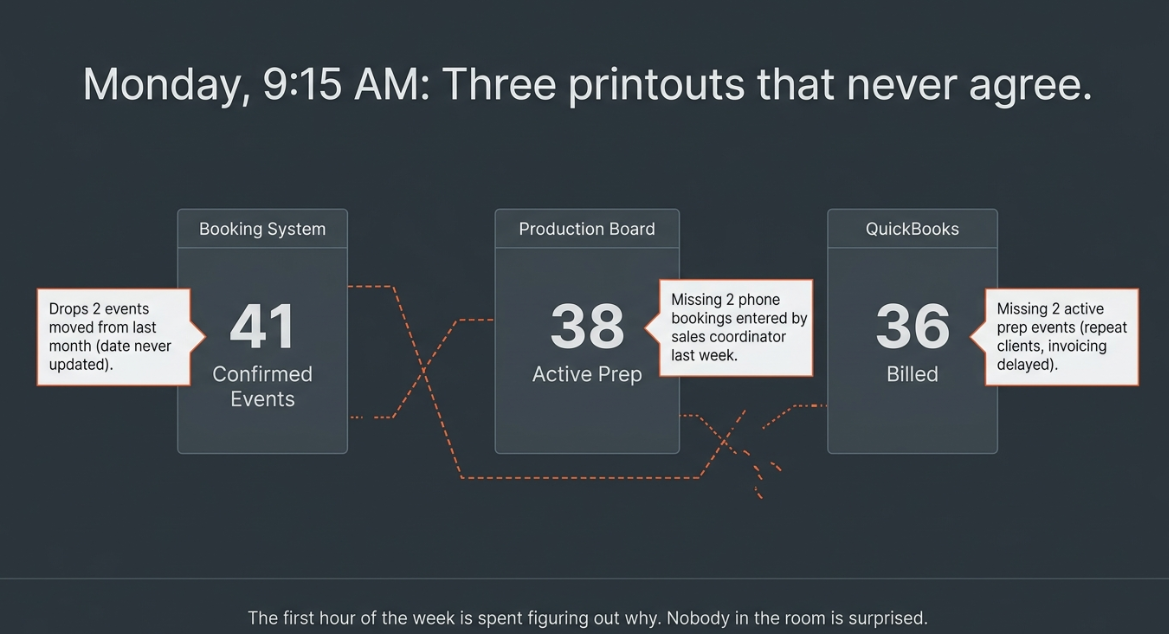
Monday, 9:15 AM. The operations meeting starts the same way it always does, with three printouts that don't agree.
The booking system shows 41 events confirmed for the month. The production board shows 38. QuickBooks shows revenue billed for 36. Nobody in the room is surprised, because the numbers never match. The first hour goes to figuring out why. Two events in the booking system that the kitchen has never heard of, phoned in last week, entered by the sales coordinator, and never carried over to the production tracker. Two events the kitchen is prepping that aren't in QuickBooks: repeat clients, deposits cleared, and invoicing not caught up. Two accounting events that the booking system dropped and moved from last month; the date was never updated.
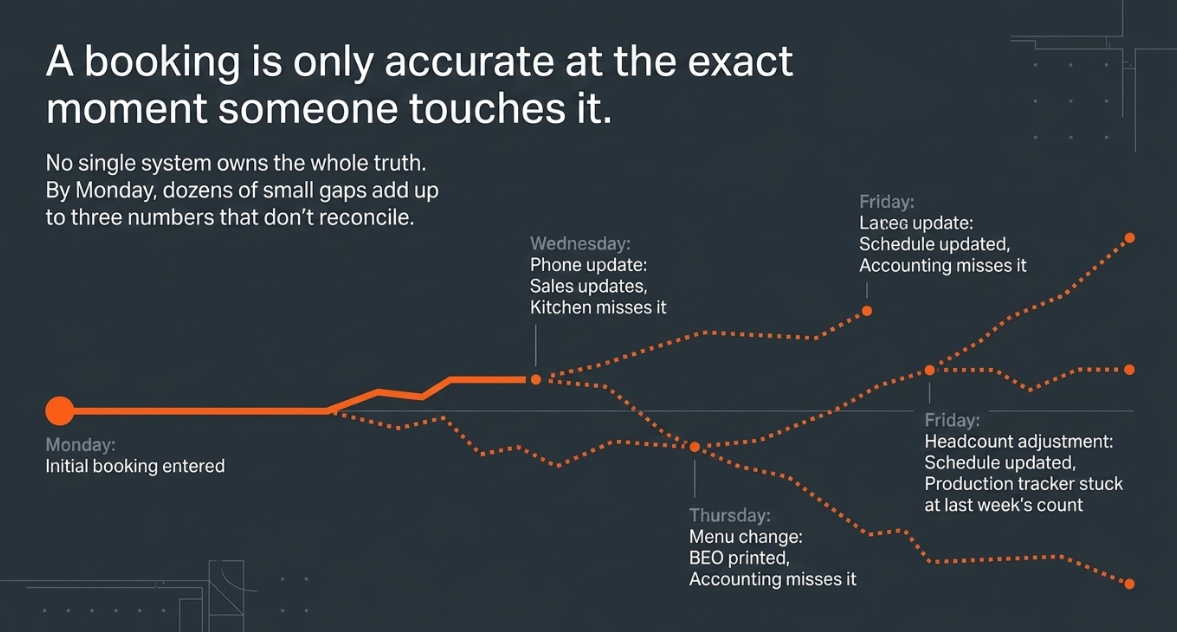
You reconcile it. You'll do it again next Monday. Because by Wednesday someone will book another event by phone, by Thursday a client will change a menu after the BEO is printed, and by Friday someone will be added to a staff schedule for an event the production tracker still has at last week's headcount.
This isn't your team being careless
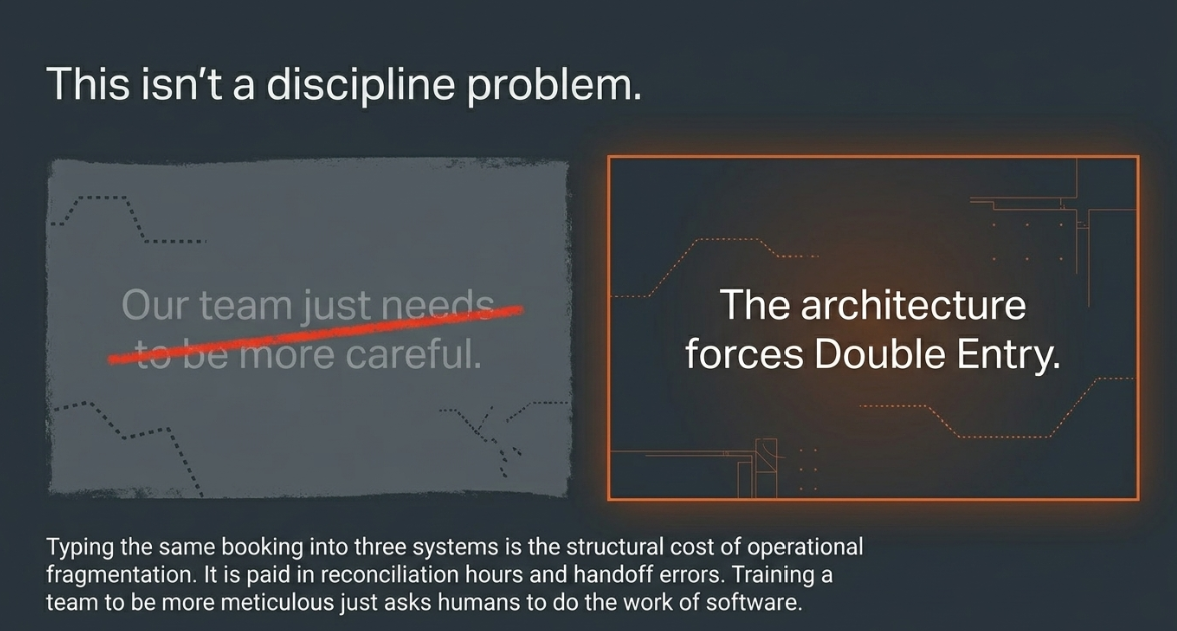
Here's the part worth saying plainly, because most operations leaders quietly blame their staff for this: typing the same booking into three systems isn't a discipline problem your team can fix by being more careful. It's Double Entry, the cost of running disconnected tools, paid in reconciliation hours and handoff errors. And it only ends when the tools are no longer disconnected.
Double Entry is a symptom of a bigger pattern. It's the gap between your disorganized marketing, your fragmented sales, and your catering operations, where each runs in its own system, and nothing talks to anything else; why catering inquiries go unanswered even when the inbox is being watched, walks through how that gap opens at the front door. Double Entry is what that same gap costs you once the booking is already in the building. The inquiry slips at intake; the booking gets re-keyed at every handoff after.
It's worth knowing the term isn't something invented here; catering software discussions already talk about integrations that "save on double-entry" when a booking tool connects to QuickBooks. Operators feel this pain. Most just haven't had a name for the shape of it as a whole.
Why does it happen, structurally?
The reason the same booking gets typed three times is that no single system owns the whole booking. Each tool owns its own copy.
Your booking software stores the event details, including the date, client, headcount, and menu. Your accounting tool needs the deposit, the invoice, and the final total. Your staff schedule needs the date, call time, headcount, and captain assignments. Three systems, three different jobs, three separate copies of the same event. None of them was built to hand its copy to the next one.
So your team becomes the integration layer. A human reads the booking out of one system and types it into the next. Someone rekeys the event into accounting. Someone re-keys it into the schedule. Every time, there's a chance the number that gets typed is slightly off, or slightly old, or never gets typed at all because the chef walked in with a question, and the tab got closed.
That's why the three counts diverge. It isn't that one system is wrong and the others are right. It's that each one holds a version of the booking that was accurate at the moment someone last touched it, and nobody touched all three at the same moment. The booking that moved from last month got updated in accounting, but not in the booking system. The phone booking got entered in sales but not in production. Each gap is small. There are dozens of them a month. By Monday, they've added up to three numbers that don't reconcile, and the only way to find out which is right is to do it by hand.
What Double Entry actually costs
The cost shows up in three places, and none of them is a line item you can see directly.
The first is the reconciliation hours themselves. The Monday meeting runs for three hours instead of one. The sales coordinator who spends part of every day typing the same information into a second and third system. That's payroll spent on data entry instead of on running events or winning new ones, and it scales with you. At 40 events a month, it's an annoyance. At 100, it's a job someone holds full-time without it ever being written into a job description.
The second is handoff errors. The booking that didn't reach the kitchen until the production briefing. The deposit was logged in accounting but not reflected in the booking record, so a client got a second deposit request. The headcount was updated in one place but not another, and now the kitchen is prepped for 150, even though the final count was 175. Each one is a small fire. Each one costs more than the few minutes of re-keying that would have prevented it.
The third is slower than the other two but real: the cost of a handoff that doesn't happen in time. The established research on response-time decay, Dr. James Oldroyd's Lead Response Management Study, written up in Harvard Business Review in 2011, found that firms contacting an inbound lead within an hour were about seven times more likely to qualify it than those who waited an hour longer, and roughly sixty times more likely than those who waited a day. That's cross-industry data from the early 2010s, not a catering figure, but the mechanism is the same one that bites you internally: when a booking has to be manually carried from one system to the next, it moves at the speed of whoever remembers to carry it. Slow handoffs lose events the same way slow lead response loses leads.
None of this needs a precise dollar figure to be obvious in your own operation. You already know roughly how many hours Monday eats.
| What Double Entry actually costs | ||||
| Cost Category | Description | Operational Impact | Scaling Consequences | Inferred Dollar Impact (Inferred) |
| Reconciliation Hours | Time spent by staff (like sales coordinators) re-typing information into multiple systems and attending lengthy reconciliation meetings. | Payroll is spent on manual data entry instead of running events or winning new business; meetings run three hours instead of one. | At 40 events/month it is an annoyance; at 100 events/month it becomes a full-time job that was never written into a job description. | High overhead costs equivalent to a full-time salary at scale, plus lost opportunity costs from sales staff not selling. |
| Handoff Errors | Information gaps where bookings or updates fail to reach the kitchen, accounting, or production in a timely or accurate manner. | Manifests as "small fires" such as double-billing clients for deposits or the kitchen prepping for the wrong headcount (e.g., 150 vs 175). | Increased frequency of operational failures and client friction as event volume rises, potentially leading to reputational damage. | Variable but high; includes the cost of wasted food, labor for "firefighting," and potential refunds or lost repeat business. |
| Delayed Handoffs | The cost of information moving at the speed of human memory rather than real-time system updates during internal transfers. | Slow internal handoffs mirror slow lead response; bookings are lost because information does not move fast enough to qualify leads. | The business becomes less competitive; firms responding within an hour are $7\times$ more likely to qualify than those waiting two hours. | Potentially the most expensive cost; represented by lost revenue from leads that go cold or choose competitors due to response lag. |

How much Double Entry is in your operation
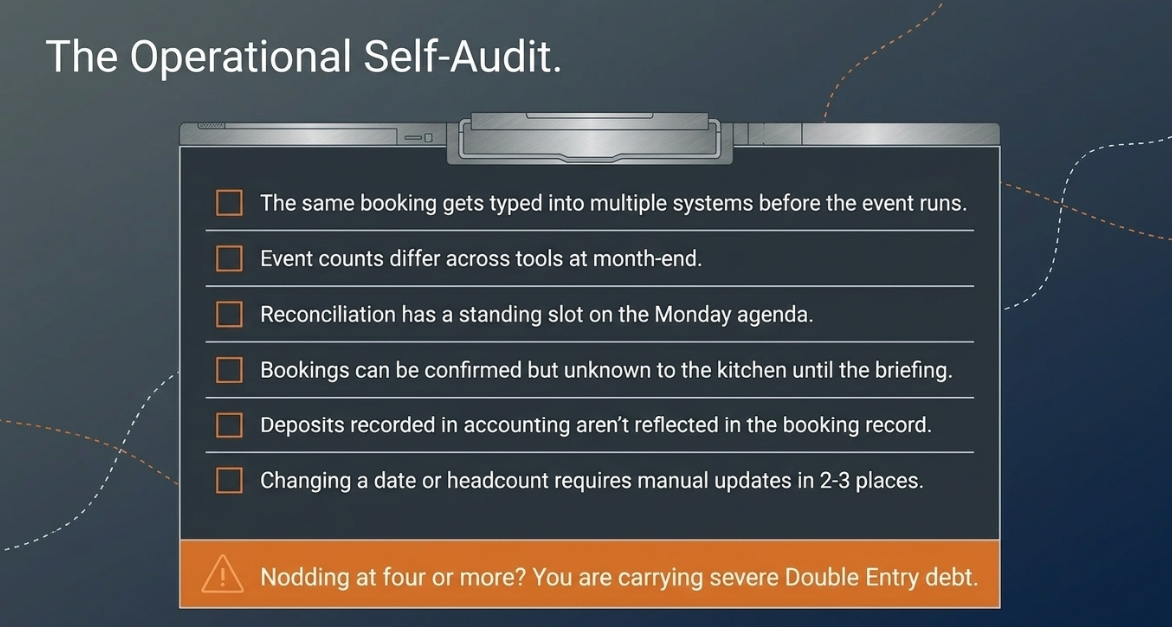
A quick self-audit. The more of these that are true, the more Double Entry you're carrying:
- The same booking gets typed into more than one system before the event runs.
- Your event counts differ across tools at month-end; the booking system, production board, and accounting don't agree.
- Reconciliation has a standing slot on your Monday agenda, formal or not.
- A booking can be confirmed in one system and remain unknown to the kitchen until the production briefing.
- A deposit or payment can be recorded in accounting and not reflected in the booking record.
- When something changes- a date, a headcount, a menu- it has to be updated in two or three places by hand, and sometimes one gets missed.
If you're nodding at four or more of these, the problem isn't that your team needs to be more careful. The problem is that the work of being careful is being asked of people instead of being done by the systems.
Where Double Entry actually ends
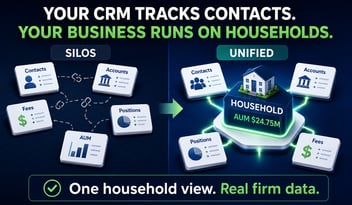
Double Entry ends when the booking is entered once, and every function reads from that same entry. Not "entered once and synced" through an integration that lags and occasionally drops a record, entered once, into a record that marketing, sales, and operations all share natively.
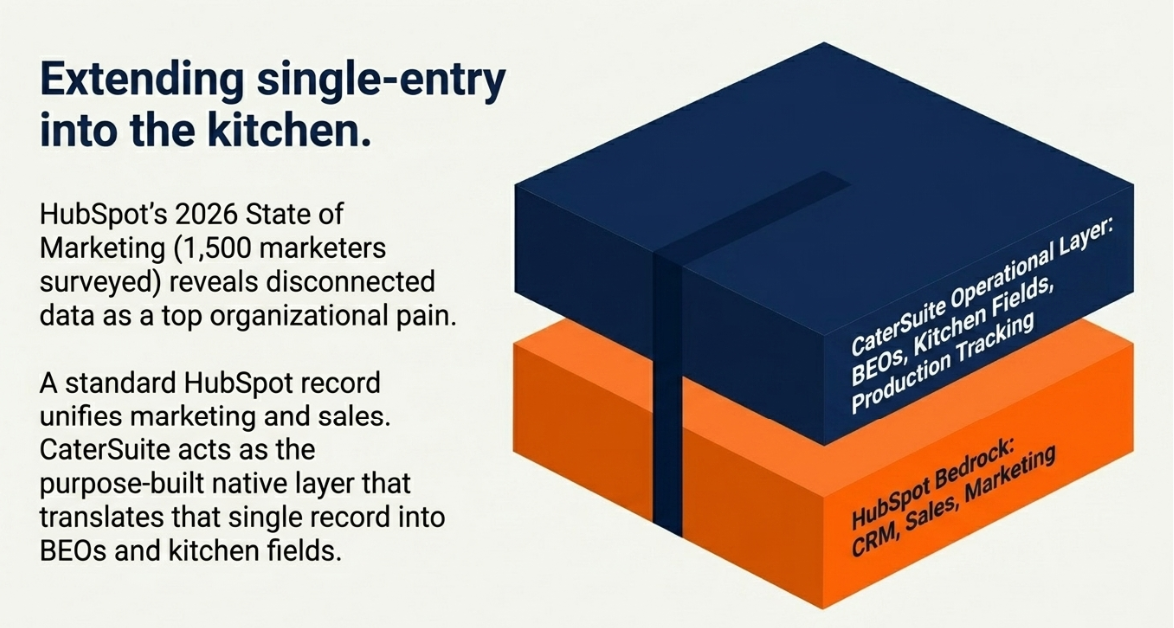
That's Stack Unification: marketing, sales, and catering operations on one platform, talking natively rather than through fragile integrations. What Stack Unification means for catering is the fuller version, but the core of it is simple: when the booking lives on the platform your marketing and sales already run, there's no second system to re-key it into, because there's no second system. The booking is one record. The deposit attaches to it. The headcount lives on it. Change the count once, and it changes everywhere because there's only one place it exists. HubSpot's own 2026 State of Marketing research, surveying more than 1,500 marketers, found disconnected data sources and the absence of a centralized customer information hub among the top operational pain points organizations report. The fix isn't a better integration between your three systems. It's not having three systems.
Here's the honest boundary. A single HubSpot record already gives you a single entry across marketing and sales; that mechanism is native to the platform. What plain HubSpot doesn't do out of the box is know what a BEO is, or carry catering-specific production and kitchen fields. CaterSuite is the purpose-built HubSpot-native catering layer that extends single-entry into catering operations specifically: BEOs, production, the catering fields the booking actually needs, so the booking entered once at intake is the same record the kitchen works from and accounting bills against. That's what one system that remembers every booking, deposit, and headcount in one place actually looks like in practice.
The recommended path
If the Monday reconciliation is a permanent fixture of your week, the question isn't how to do it faster. It's whether it needs to exist at all. It only exists because the booking lives in three places. Put it in one, and the meeting changes from reconciling three counts to reviewing one.
For an operations leader who recognizes Double Entry as structural rather than a staffing failure, the fix is a single platform that unifies catering operations, one entry, read by every function, instead of one event re-keyed three times. If you're weighing that against the broader field, the full catering software comparison puts the options side by side.
The CaterSuite perspective
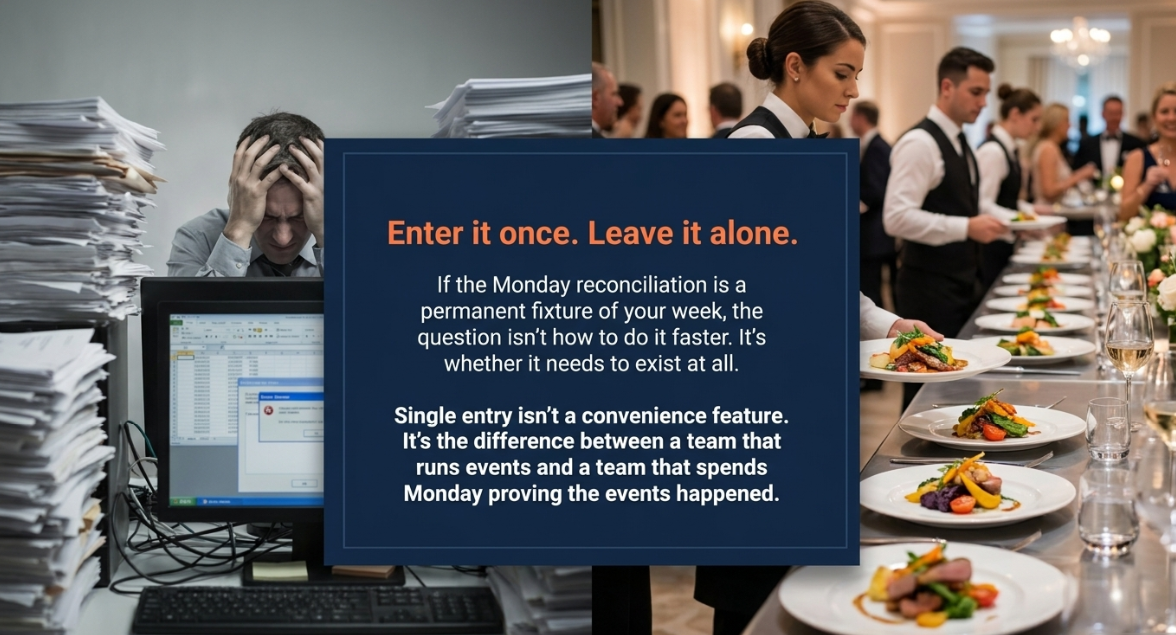
Re-keying a booking is not a people problem, and treating it as one is how operations leaders burn out good coordinators. It's an architecture problem. When three systems each hold their own copy of an event, somebody has to be the wire between them, and that somebody will occasionally be tired, interrupted, or out sick, and the count will drift. The belief behind CaterSuite is that the booking should be entered once on the platform, where the rest of the operation already runs, and then left alone. Single entry isn't a convenience feature. It's the difference between a team that runs events and a team that spends Monday proving the events happened.
FAQ
Why does my catering team enter the same booking twice?
Because the systems are disconnected. The booking software, accounting, and staff schedule don't share data, so a person rekeys the same event into each. That's Double Entry, a structural cost of running separate tools, not a sign your team is careless. It ends only when the booking lives in one shared record instead of three separate ones.
What is Double Entry in catering operations?
Double Entry is when the same booking gets typed into multiple systems, typically booking software, accounting, and scheduling, and the numbers still don't match. It's the cost of operational fragmentation, paid in reconciliation hours and handoff errors. The divergence occurs because each system maintains its own copy of the event, updated at different times by different people.
Why don't my catering software and accounting numbers match?
Because each system holds a separate copy of each booking, updated independently. An event moved to a new month gets fixed in one tool and not the other; a deposit clears in accounting before the booking record reflects it. No single system owns the whole truth, so the counts drift until someone reconciles them by hand. That's the visible symptom of Double Entry.
How do you prevent double-entry between catering systems?
You stop it by entering the booking once into a record that every function shares, rather than re-keying it into each tool. That requires the systems to actually be one system: Stack Unification, marketing, sales, and operations on a single platform. Integrations that sync separate tools reduce some re-keying but still cause records to lag and drop; one shared record removes the second entry entirely.
Is double-entry a training problem?
No. You can train a team to be meticulous, and they'll still lose ground because the work of carrying a booking between disconnected systems is being asked of people rather than handled by software. Better discipline slows the drift; it doesn't end it. Only removing the second and third system to type into ends it.
Does CaterSuite work for caterers who already use HubSpot?
Yes, CaterSuite is built on HubSpot. If your marketing or sales already runs on HubSpot, catering operations join the same platform without integrations. The booking is entered once and shared across marketing, sales, and operations. One contact record, one pipeline, one source of truth, which is exactly what removes the re-keying that causes Double Entry.
End the Monday reconciliation
If your event counts never match across systems and Monday starts with three printouts that disagree, see how CaterSuite connects marketing, sales, and operations on one HubSpot-native platform, where bookings are entered once and every function reads the same record.


Leave a Comment