


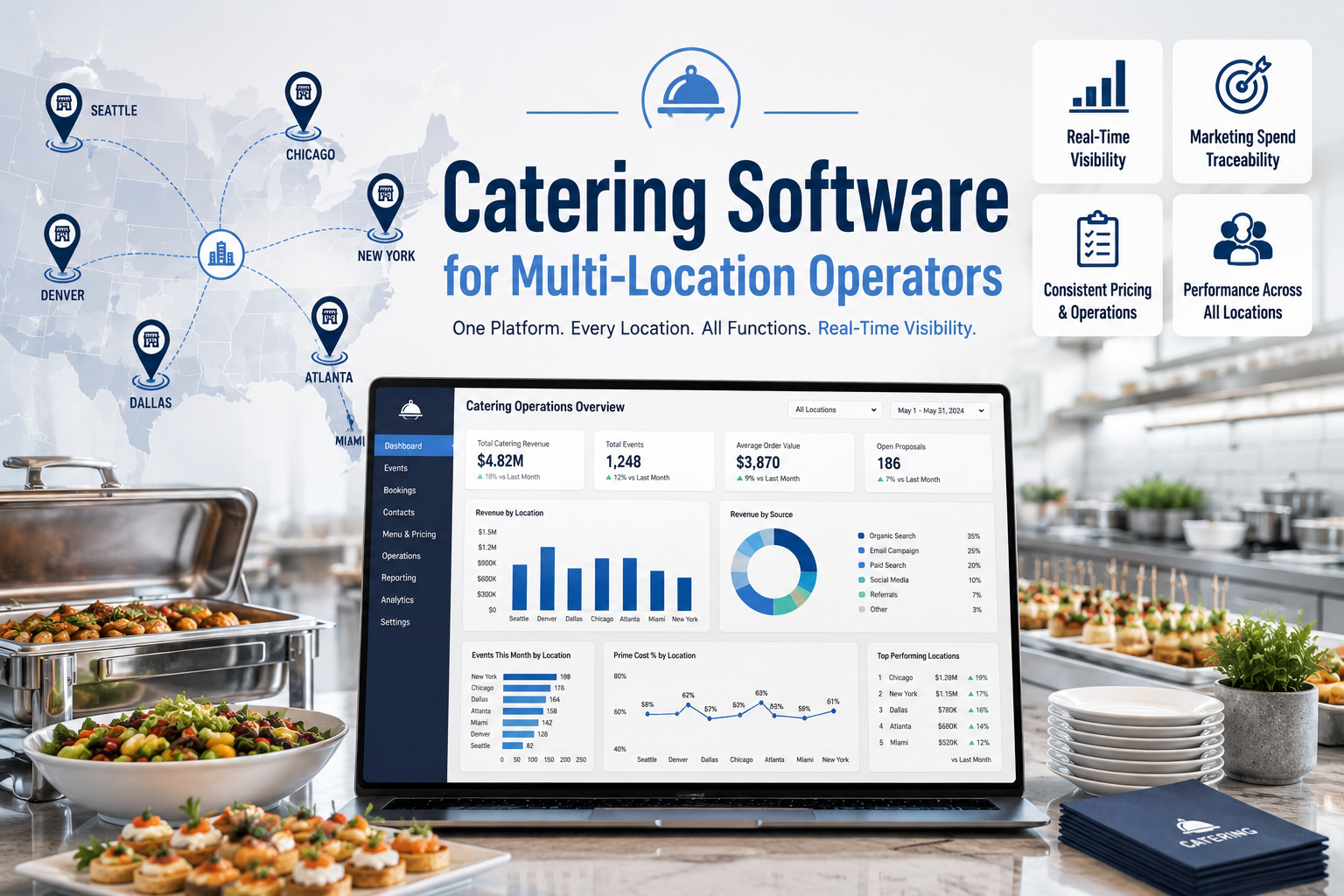
Catering software for multi-location operators must give corporate a real-time view of every location at once, not month-end aggregations that arrive too late to act on. It must unify marketing, sales, and operations data so marketing spend can be traced through to catering revenue by location, and it must keep pricing and operations consistent across sites. Those requirements point to one platform spanning every location and all three functions, not separate location tools whose reports get stitched together after the fact.
Quarterly review, Tuesday morning. The catering division runs across seven locations, somewhere north of $48M in annual revenue, and the room is full of people who know their numbers cold.
Then the CFO asks a straightforward question: what's actually happening across all our locations right now, today, this week, and how does last quarter's marketing spend trace through to the catering revenue it produced, by location?
Nobody can answer it. Not because the people in the room aren't good at their jobs. The answer lives across five or six systems that don't share data. Each location runs its own operations. Corporate sees the picture at month-end, in aggregate, after the moment to act on it has already passed. By the time the report lands on the conference table, it's describing a quarter that's already over.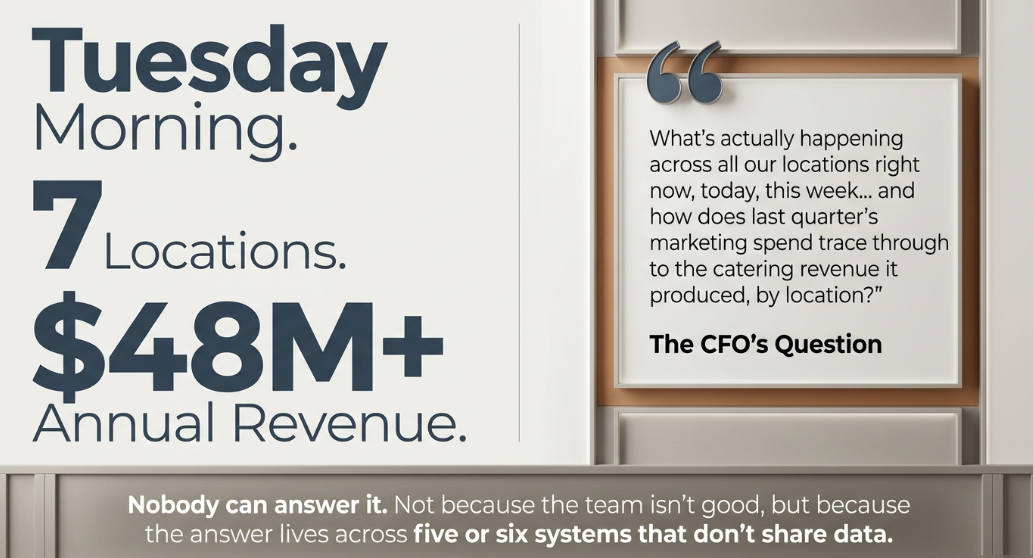
The problem isn't the cadence of the reports
It's tempting to treat this as a reporting problem, close the books faster, get the dashboards out sooner, and push the month-end aggregation to a weekly. But faster reports on the same fragmented data don't fix it. What's missing isn't speed. It's the thing itself: Knowing What's Going On, the real-time view of catering operations across every location that disconnected systems simply cannot produce, no matter how fast you run them.
That distinction matters because it changes what you're shopping for. If the problem were cadence, you'd buy a faster reporting tool. Because the problem is that the underlying data lives in systems that were never built to talk to each other, the only thing that produces a real-time cross-location view is a single platform that spans marketing, sales, and operations across all of it.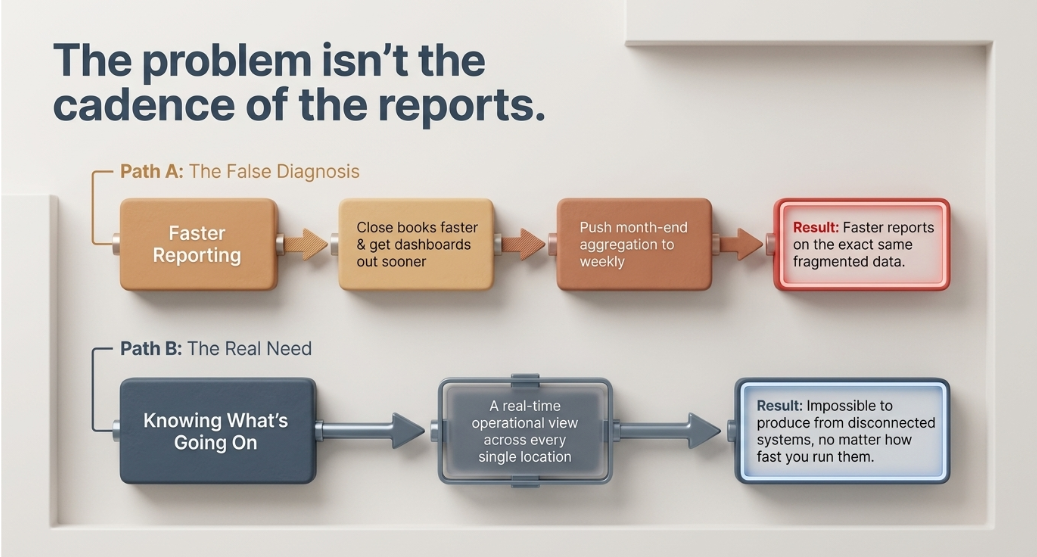
Why corporate can't see across locations
Here's the structural reason, and it's worth being precise about, because it leads directly to the fix.
Each location runs its own operations on its own tools. That's how multi-location catering grew up; locations were opened or acquired over the years, each one set up the systems it needed, and they did the job. To produce a corporate view, somebody has to aggregate across all of those systems. And those systems were not built to hand their data to each other or to a central view. So aggregation happens the slow way: batch exports, emailed spreadsheets, and a corporate analyst reconciling formats from seven locations into one deck. Real-time visibility is nearly impossible when the data only moves in batches and email attachments, a finding well-documented across multi-unit operations, and one that lands exactly the same in catering.
This is the part to say plainly, because Segment 3 executives have heard too many vendors imply they bought wrong. Your operations team built the right thing for the era it was built in. No individual system in that stack is broken. The catering software does what catering software was supposed to do. The marketing platform does what marketing platforms do. Accounting does what accounting does. Each one works. The problem isn't that any of them failed; it's that none of them were built to talk to each other, and the world moved while they sat in their lanes. Competitors who started on a unified platform are now operating with end-to-end visibility that your team can't get without an Excel marathon, and that gap isn't a verdict on your people. It's a verdict on an architecture that was correct when it was assembled and has been overtaken since.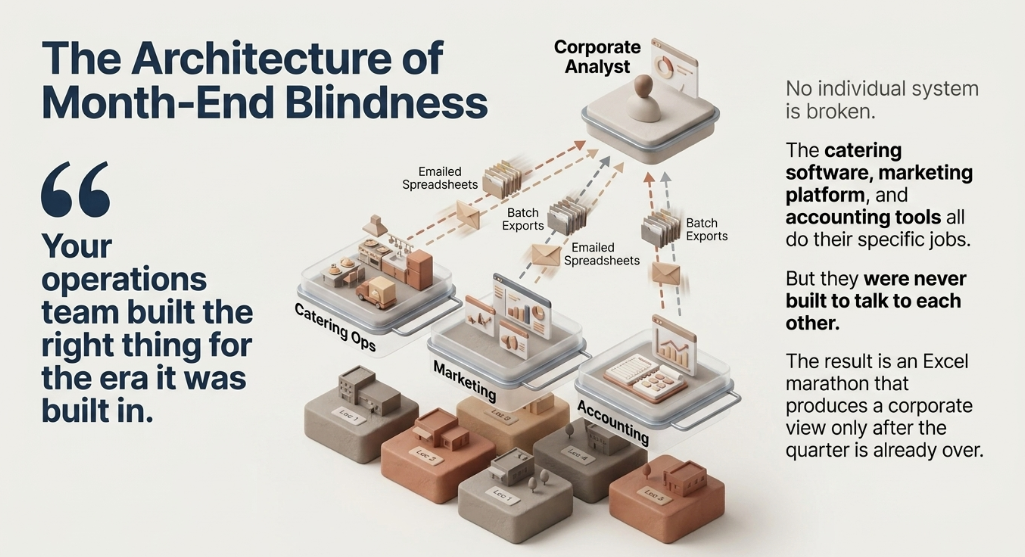

What the blind spot costs
The cost shows up in two places, and both are the kind that surface in a QBR instead of in time to do anything about them.
The first is marketing-spend traceability. When the marketing platform doesn't share data with the catering operation, the corporation can't follow the dollar from campaign to booked catering revenue. You know what you spent. You know, separately, what you booked. What you can't see is the line between them, which location's catering revenue came from which marketing investment. So marketing-budget decisions get made on instinct and aggregate gut feel rather than on traced return, and a campaign that's quietly carrying one location while doing nothing for another looks identical from corporate.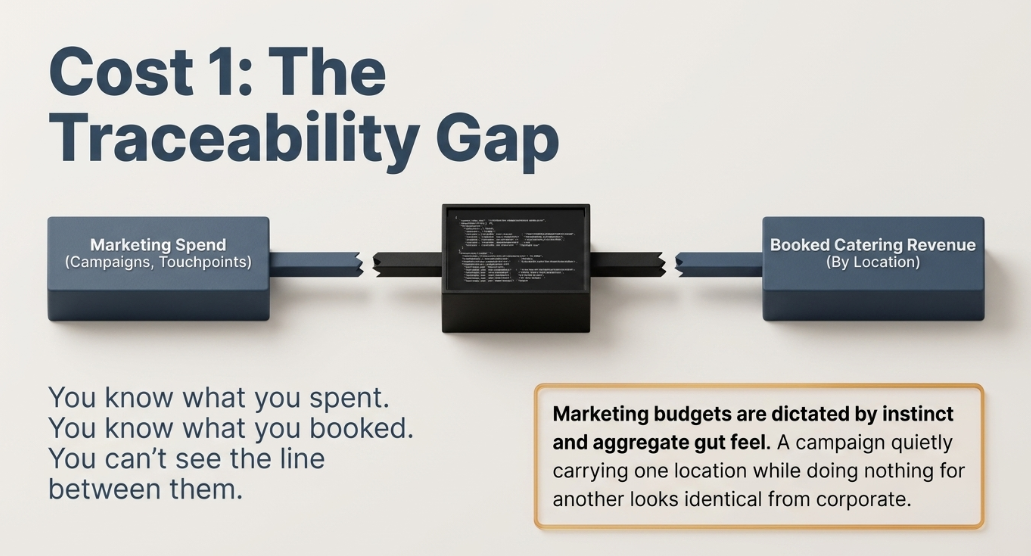
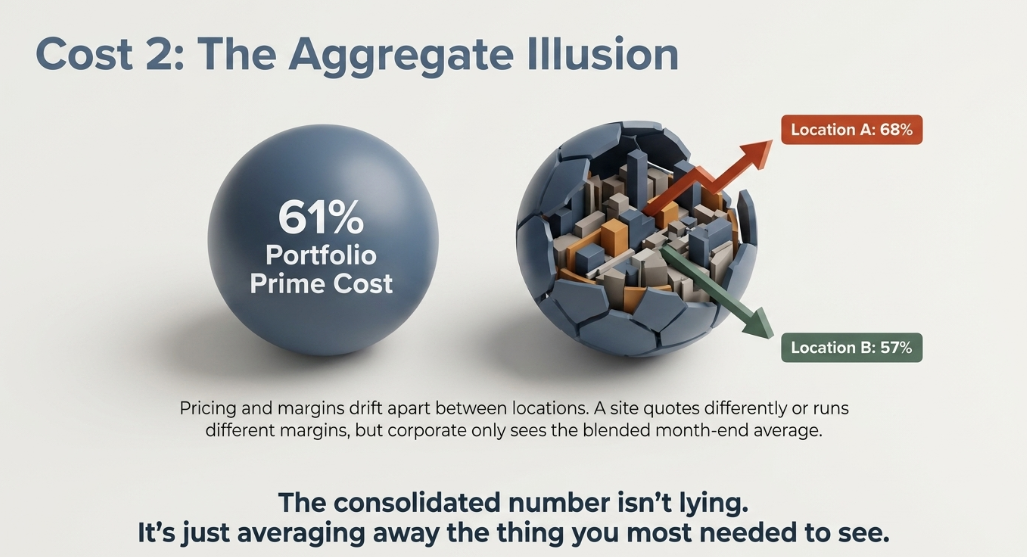
The second is location-level inconsistency hidden inside consolidated numbers. This is the one that bites hardest, because the aggregate looks fine. A multi-unit group might see a portfolio-level prime cost of 61% and nod, until you learn one location is running 68% and another 57%, and nobody at corporate knew, because performance was only ever visible at the aggregate, at month-end. Pricing drifts apart between locations in the same way. A site quotes differently, runs different margins, discounts differently, and it surfaces in a quarterly review, months after the moment when a corrective word would have mattered. The consolidated number isn't lying. It's just averaging away the thing you most needed to see.
What can your corporate team see across locations, right now?
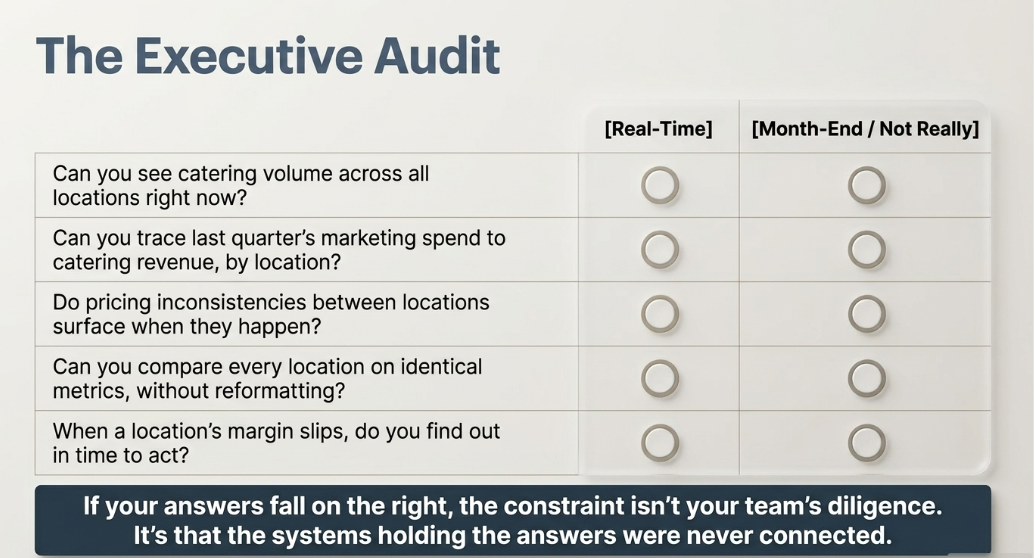
A short executive audit. Answer each for today, not for month-end:
- Can you see catering volume across all locations in real time, right now, or only when the month closes?
- Can you trace last quarter's marketing spend through to catering revenue, broken out by location?
- Do pricing inconsistencies between locations surface when they happen, or in the QBR?
- Can you compare every location on identical metrics, or does each report in its own format?
- When a location's margin slips, do you find out in time to act, or after the quarter is closed?
If most of those answers are "month-end" or "not really," the constraint isn't your team's diligence. It's that the systems holding the answers were never connected to each other.
Where the real-time view actually comes from
Real-time cross-location visibility and marketing-to-revenue traceability are achievable for one structural reason: marketing, sales, and catering operations share one platform. That's Stack Unification, marketing, sales, and catering operations on one platform, talking natively rather than through fragile integrations. What Stack Unification means for catering lays out the full argument, but the multi-location version is direct: when every location's catering operation runs on the same platform that runs marketing and sales, corporate isn't aggregating across systems anymore. It's reading one system that already holds every location.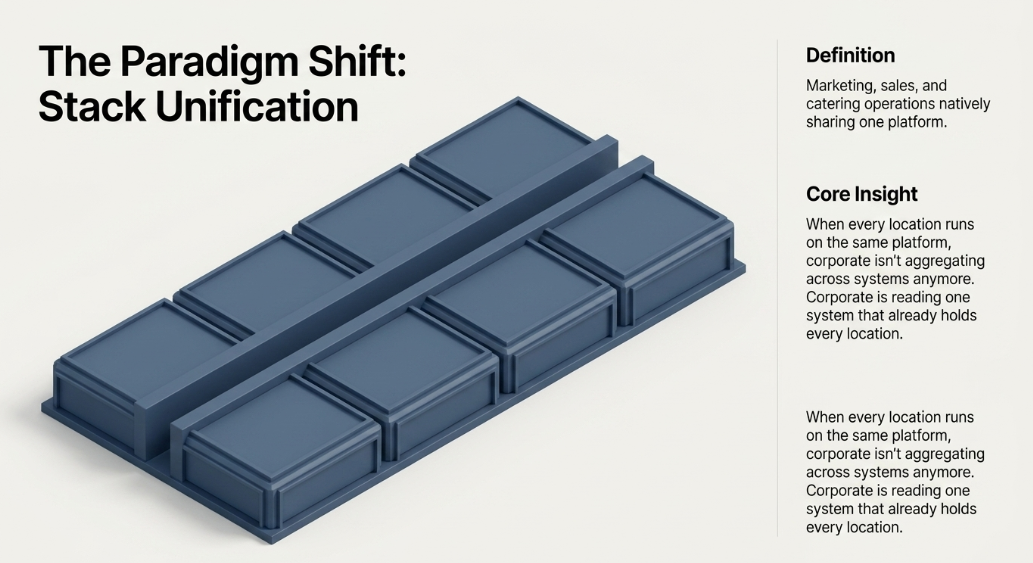
On that platform, the marketing dollar is traceable to the catering revenue it produced because both live in the same place. HubSpot's multi-touch revenue attribution links closed-won revenue back to the specific marketing touchpoints, pages, campaigns, and emails that influenced it. That's the mechanism behind tracing spend to catering revenue by location. The honest caveat, and it matters for an executive evaluating this seriously: full multi-touch revenue attribution sits in Marketing Hub Enterprise, not the lower tiers. It isn't free or automatic at every level, and any vendor who implies otherwise is selling past the truth.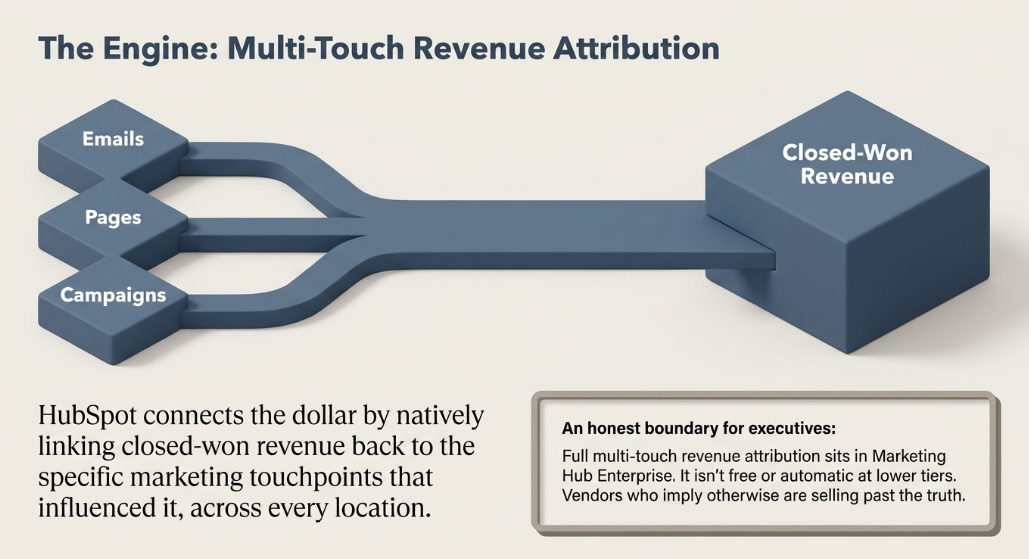
This connects to a larger pattern worth naming, because multi-location operators feel it before they can describe it: the catering scaling ceiling, the point where a catering program's manual processes can no longer support its revenue potential, not as a sudden collapse but as a slow erosion of margin, speed, and client confidence caused by a stack that has outgrown its architecture. Cross-location blindness is what that ceiling looks like from the corner office.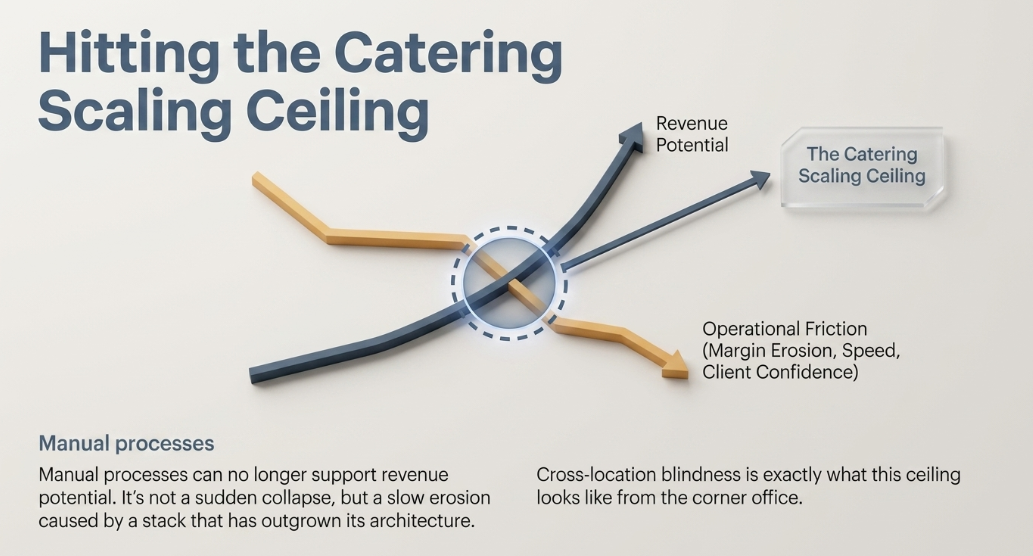
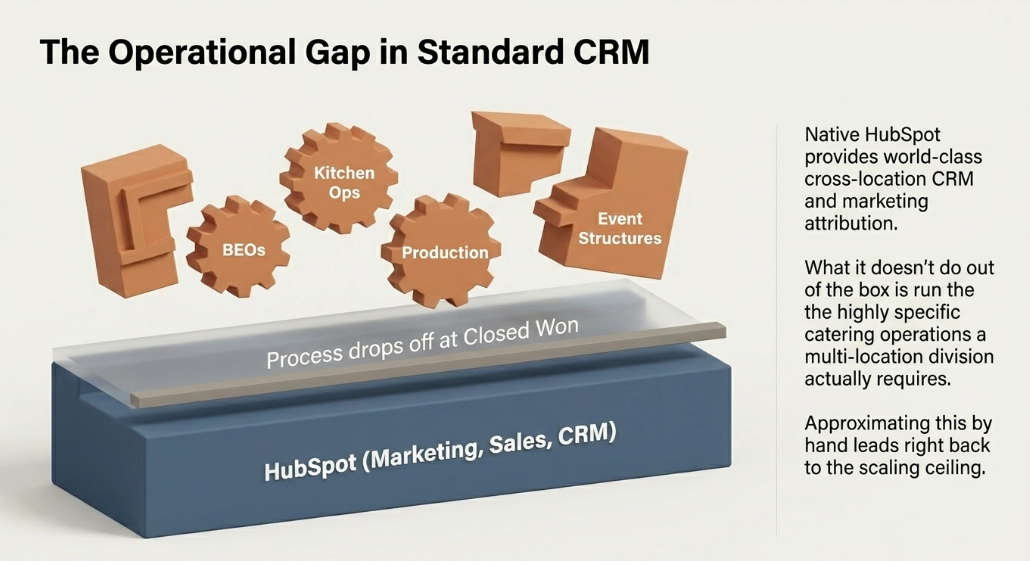
Here's the honest boundary on the fix. Native HubSpot already gives you cross-location CRM and, at the Enterprise tier, the revenue attribution that makes marketing-to-catering-revenue traceable. What it doesn't do out of the box is run catering-specific operations, BEOs, kitchen and production, the catering fields, and event structures that a multi-location catering division actually runs on. CaterSuite is the purpose-built HubSpot-native catering layer that extends that single-platform visibility into catering operations specifically, so the corporate gets one operational view across locations rather than seven stitched-together ones. Same platform the marketing and sales already run on; built for catering across every site.
The recommended path
If the QBR keeps producing questions your systems can't answer in real time, the requirement isn't a better reporting layer on top of the same fragmentation. It's one platform underneath all of it. The executives who can answer the CFO's question in real time can do it because the answer lives in one system, not five.
For a multi-location operator who needs real-time visibility across locations and marketing-spend traceability through to catering revenue, the path is catering operations software built for multi-location operators, every location, and all three functions, on one platform. If you're also mapping the broader landscape before you commit, the full catering software comparison sets out the options side by side.
The CaterSuite perspective
Corporate visibility is not a reporting-cadence problem, and the operators who treat it as one spend years buying faster dashboards that describe the same fragmented data a little sooner. It's a single-platform problem. You cannot see across locations in real time if the locations were never on the same system, and no reporting tool sitting on top of seven disconnected stacks will change that. The belief behind CaterSuite is that the view an executive needs, every location, every function, right now, only exists when the operation that produces it is unified at the foundation, on the platform that marketing and sales already run. The world changed underneath stacks that were correct when they were built. The move now is to bring catering onto the unified ground that the rest of the business is already standing on.
FAQ
What should multi-location catering software do?
It should give corporate a real-time view of every location at once, rather than month-end aggregations, unify marketing, sales, and operations data so marketing spend traces through to catering revenue by location, and keep pricing and operations consistent across sites. Those requirements point to a single platform spanning all locations and all three functions, not separate per-location tools whose reports get reconciled after the fact.
How do multi-location caterers get real-time visibility across locations?
By running every location's catering operation on one shared platform rather than aggregating across separate systems. When the data already lives in one place, the corporate reads a live cross-location view instead of waiting for batch exports and emailed spreadsheets to be reconciled into a month-end deck. Faster reports on fragmented data don't produce real-time visibility; one platform does.
Can you trace marketing spend to catering revenue across locations?
Yes, when marketing, sales, and operations share a platform. HubSpot's multi-touch revenue attribution links closed-won revenue to the marketing touchpoints that influenced it, which is the mechanism for tracing spend through to catering revenue by location. Note that full multi-touch revenue attribution requires Marketing Hub Enterprise; it isn't available at every tier.
Why do pricing inconsistencies between locations go unnoticed until the quarterly review?
Because corporate sees aggregated numbers at month-end, not real-time location-level state. A consolidated figure can look healthy while one location runs well above it and another well below, and the average hides both. Without a real-time cross-location view, the inconsistency only becomes visible when someone breaks the numbers apart in the QBR, after the window to correct it has closed.
Does CaterSuite work for caterers who already use HubSpot?
Yes, CaterSuite is built on HubSpot. If your marketing or sales already runs on HubSpot, catering operations can join the same platform without integrations, across every location. One contact record, one pipeline, one source of truth across marketing, sales, and operations, which is what makes a real-time cross-location view possible instead of a stitched-together one.
What's the difference between native HubSpot and CaterSuite for multi-location operators?
Native HubSpot provides cross-location CRM and, at the Enterprise tier, the revenue attribution that traces marketing spend to revenue. What it doesn't do out of the box is run catering-specific operations, BEOs, kitchen and production, and catering event structures. CaterSuite is the HubSpot-native catering layer that adds those, so multi-location operators get one operational view built for catering rather than a general-purpose CRM approximated by hand.
See every location on one platform
If your corporate team can only see across locations at month-end and can't trace marketing spend to catering revenue, a single view of catering operations across locations puts every site and all three functions on one HubSpot-native platform, so the question the QBR couldn't answer becomes one you answer in real time.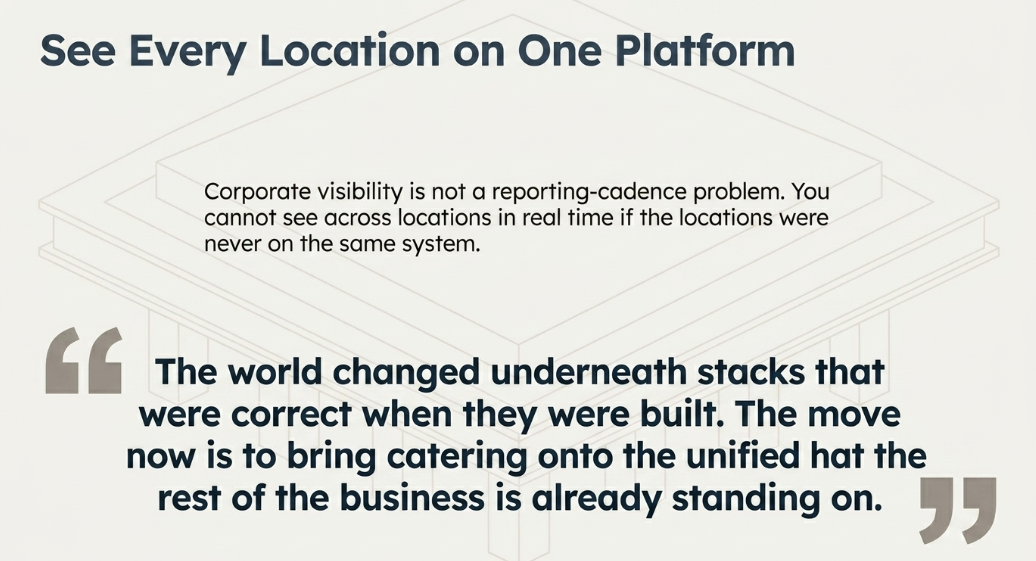

Leave a Comment