


The biggest challenge in scaling catering operations is not demand, it is infrastructure. Multi-unit franchise operators hit a ceiling when their booking systems, kitchen workflows, CRM, and staffing tools operate in isolation. Fragmented technology forces teams to manually bridge gaps between every handoff, and at volume, those gaps become revenue leaks. Unified catering operations platforms solve this by connecting sales, kitchen, and guest engagement into one system, making consistent, high-margin execution possible across every location.
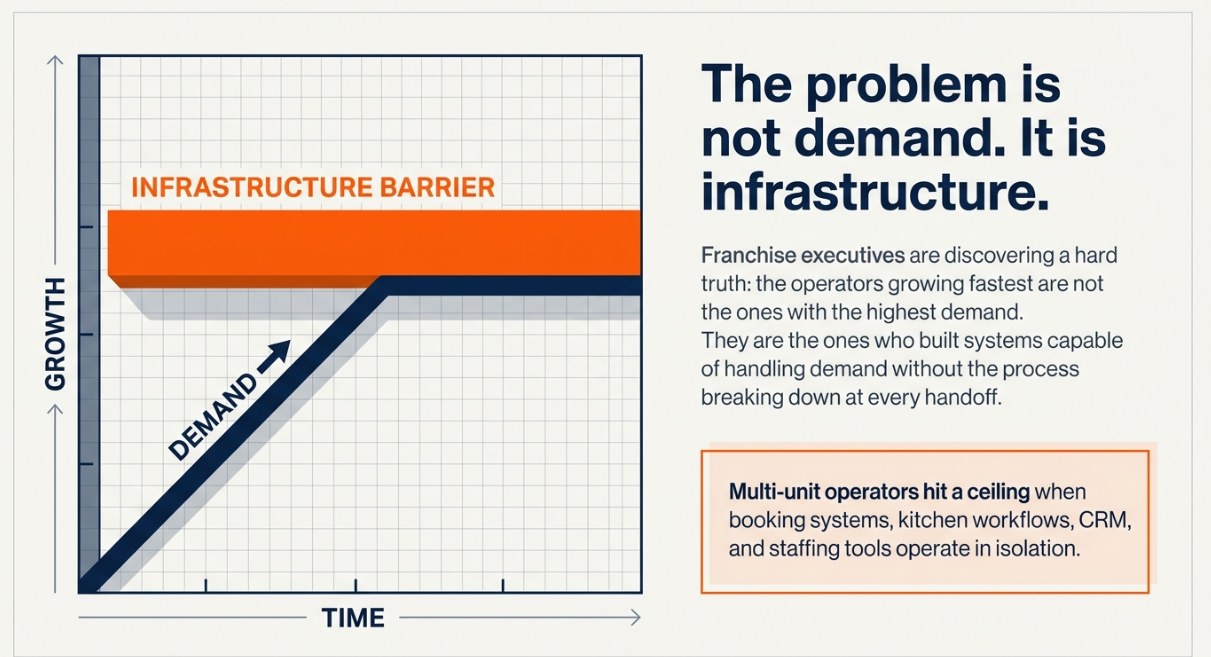
The Problem Isn't Demand. It's Infrastructure.
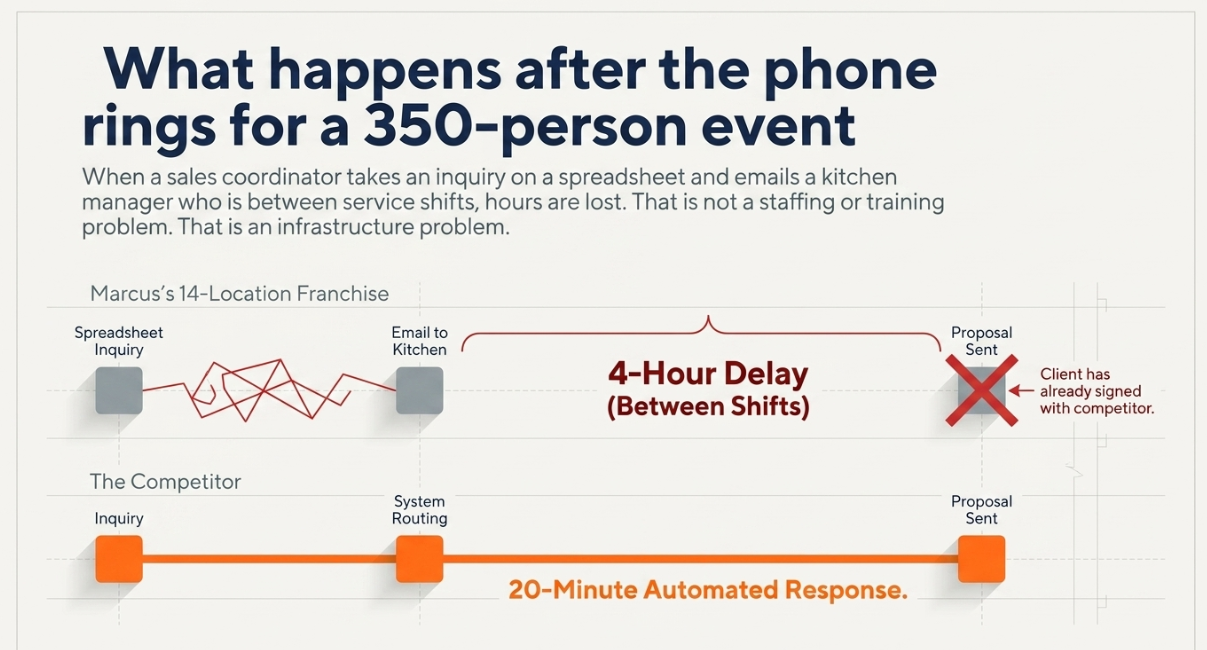
Picture Marcus. He runs catering for a 14-location fast-casual franchise. His program generates real revenue, hundreds of corporate events a year, a steady stream of office lunch accounts, and a growing line of private dining bookings. Demand isn't his problem.
His problem is what happens after the phone rings.
A corporate client calls about a 350-person event. The sales coordinator takes the inquiry on a spreadsheet. She emails the kitchen manager at the relevant location. The kitchen manager is between service shifts and sees the message four hours later. By the time Marcus's team sends a proposal, the client has already signed with a competitor who responded in twenty minutes.
That's not a staffing problem. That's not a training problem. That's an infrastructure problem.
Coming out of leadership forums like the Restaurant Franchising & Innovation Summit, one theme has emerged consistently among franchise executives: the operators growing fastest aren't the ones with the highest demand. They're the ones who built systems capable of handling that demand without the process breaking down at every handoff.
What the Catering Scaling Ceiling Looks Like
The Catering Scaling Ceiling is the point at which a catering program's manual processes can no longer support its revenue potential. It is not a sudden collapse; it is a slow, expensive erosion of margin, speed, and client confidence.
You have likely hit it if:
- Your team is copying information between a booking tool, a spreadsheet, and an email chain to confirm a single event
- A kitchen team at one location has no visibility into what was promised to the client by the sales coordinator at another location
- You cannot tell, in real time, where a catering inquiry is in your pipeline across all locations
- Your response time on high-value corporate inquiries is measured in hours, not minutes
- Your best clients are the ones your most experienced coordinator happens to remember to follow up with
These are not signs of a team working hard enough. They are signs of a stack that has outgrown its architecture.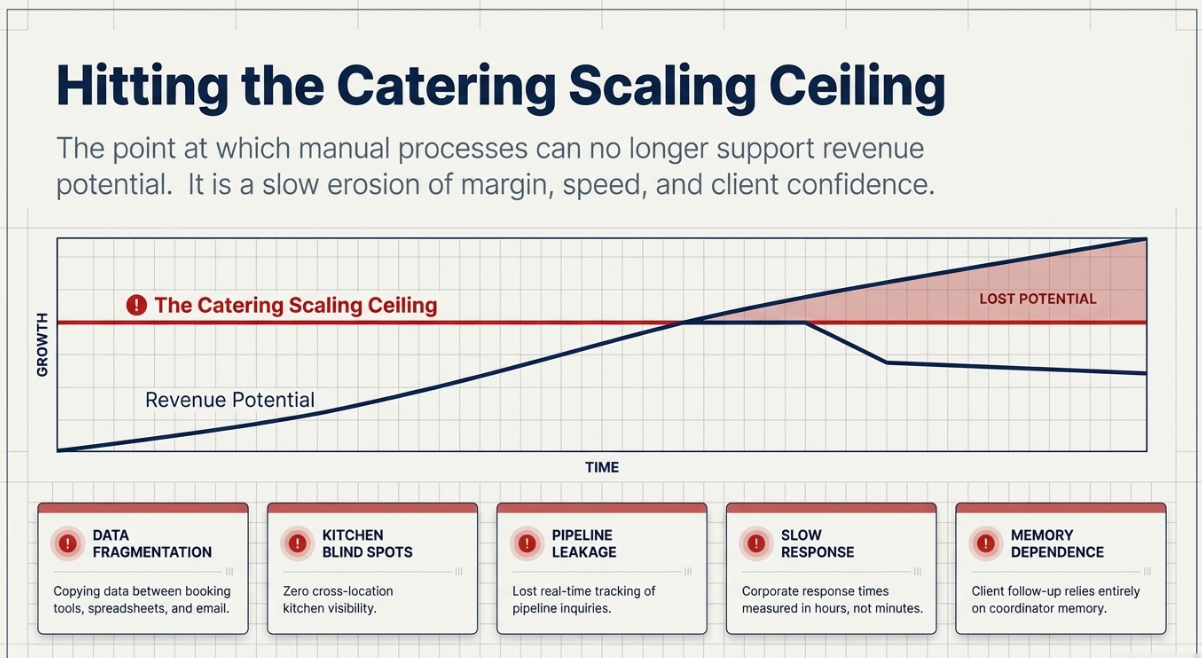

Why Fragmented Tools Break Down at Multi-Unit Scale
The technology problem in catering is not a shortage of software. Most franchise operators have plenty of tools. The problem is that none of them is talking to each other.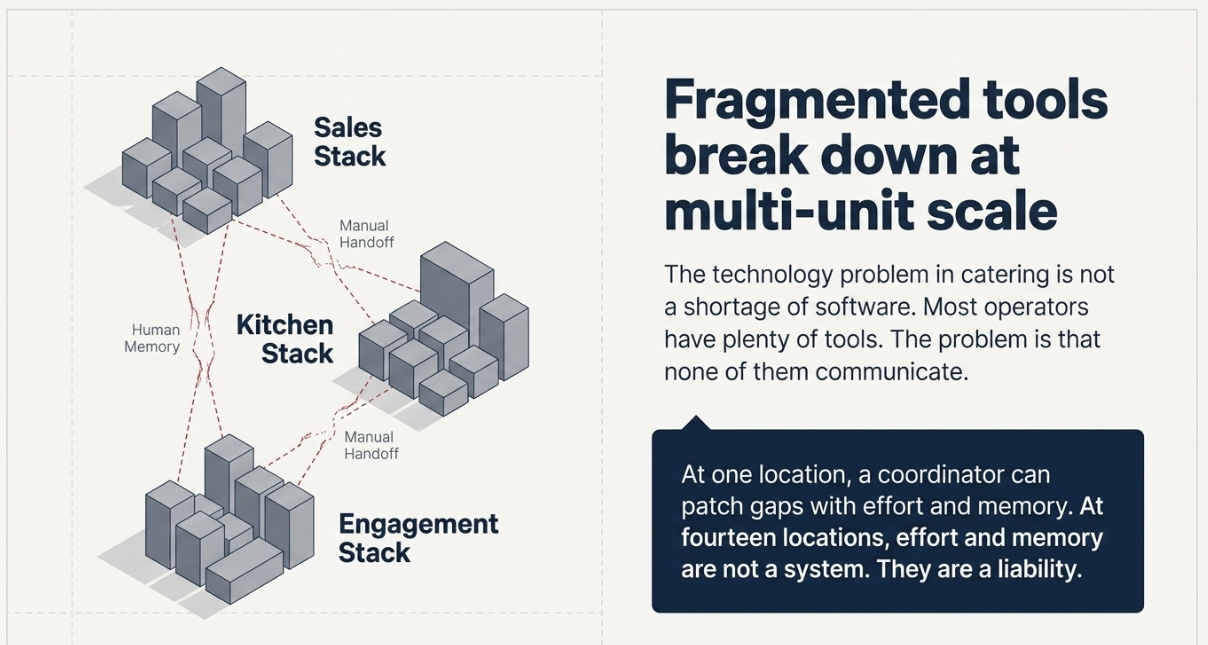
Here is what fragmented operations look like compared to a unified system:
|
Dimension |
Fragmented Stack |
Unified Platform |
|
Inquiry intake |
Email, phone, manual entry |
Centralized intake with automatic CRM record creation |
|
Kitchen visibility |
Separate notification chain |
Real-time order visibility across all locations |
|
Proposal speed |
Hours to days |
Automated templates triggered on inquiry |
|
Brand consistency |
Dependent on the individual coordinator |
Standardized workflows across every location |
|
Client follow-up |
Manual reminders, sticky notes |
Automated touchpoints tied to the event lifecycle |
|
Performance visibility |
Spreadsheet summaries |
Live pipeline and revenue dashboard |
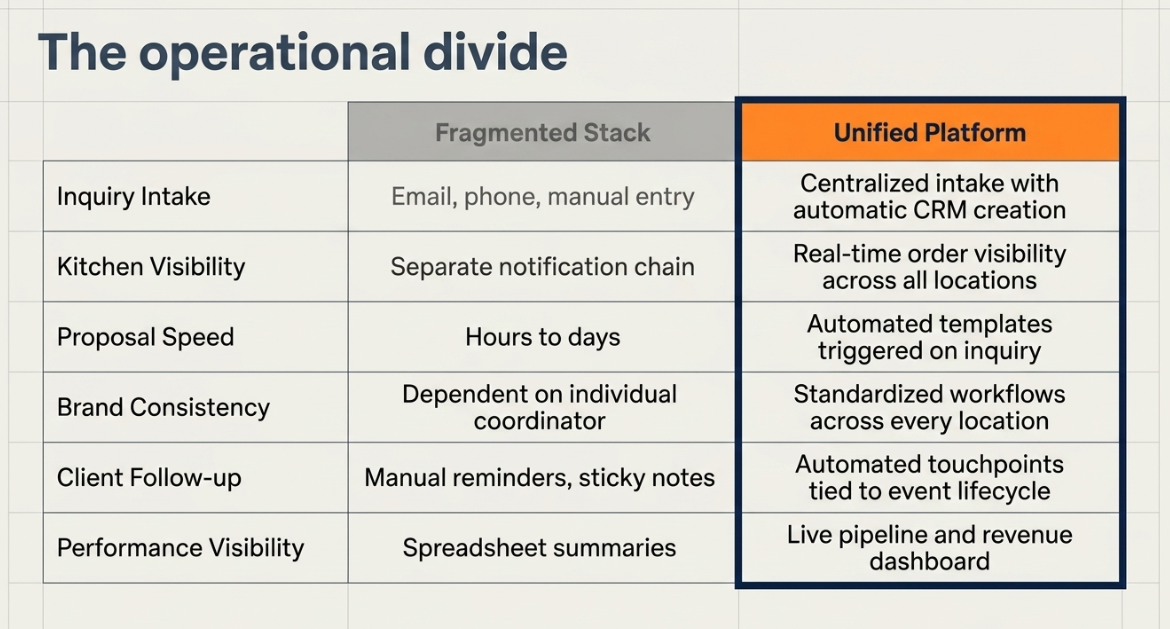
At one location, a coordinator can patch these gaps with effort and memory. At fourteen locations, effort and memory are not a system. They are a liability.
What a Unified Catering Operations Platform Does Differently
A unified catering operations platform does not just replace individual tools with a single login. It connects three layers of the catering business that are typically siloed: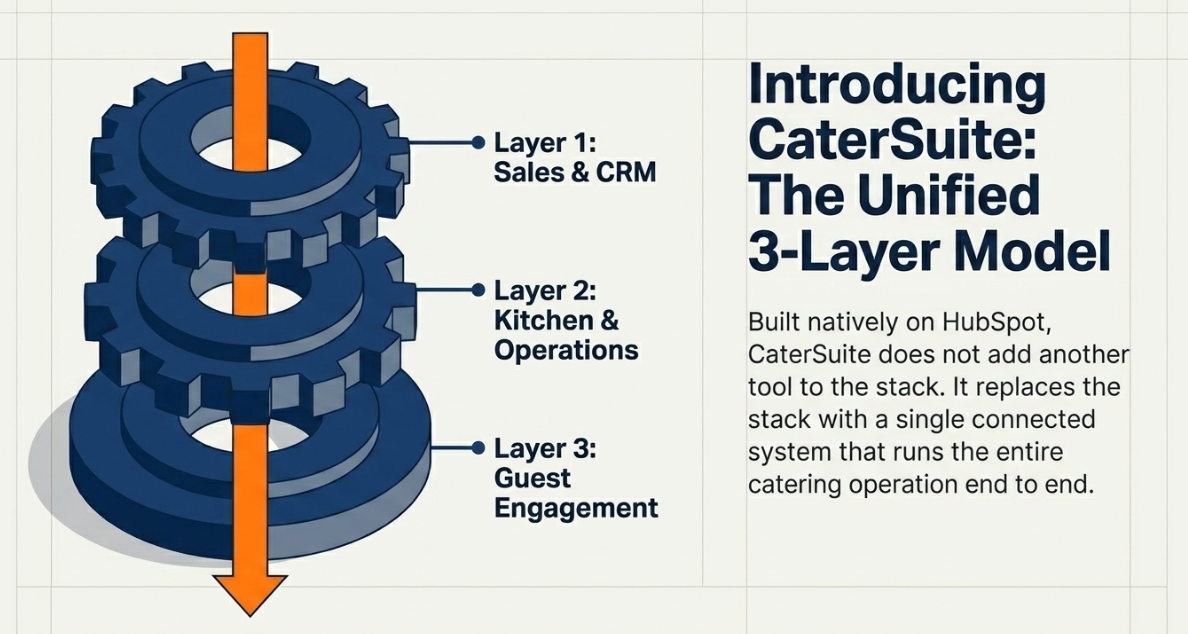
Layer 1: Sales and CRM
Every inquiry, proposal, contract, and client communication lives in one place. The system tracks the full client journey from the first contact to the final invoice, and it does not require a coordinator to remember to update anything manually.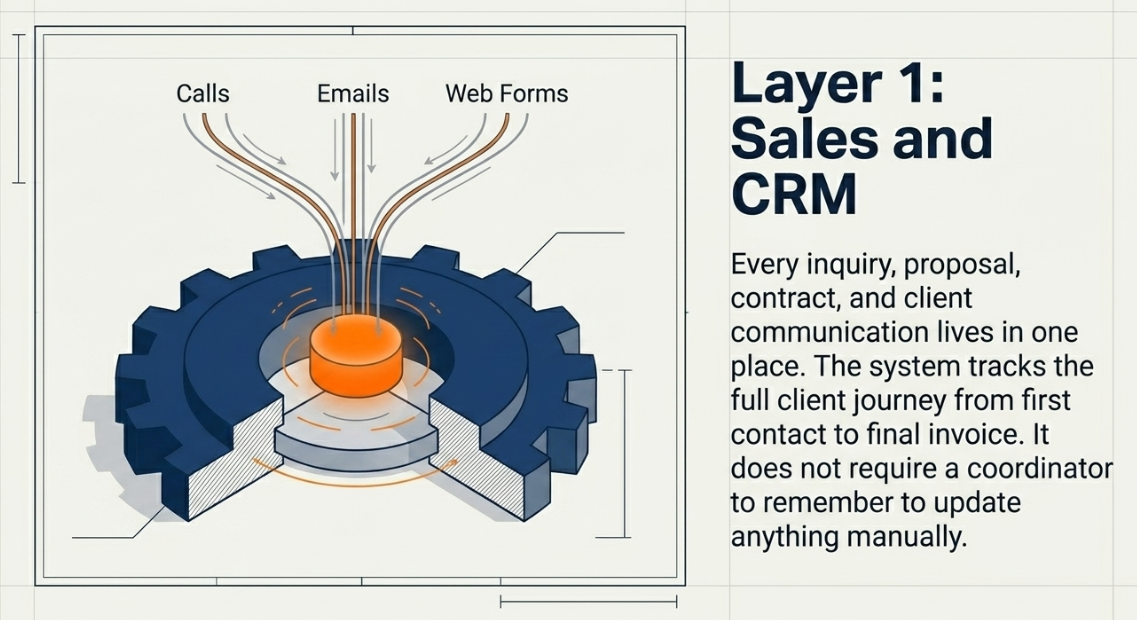
Layer 2: Kitchen and Operations
The moment a booking is confirmed, the relevant kitchen team and staffing coordinator receive the order details automatically. There is no email chain. There is no risk of the information not arriving. Production schedules, headcount requirements, and dietary specifications are visible to every stakeholder who needs them.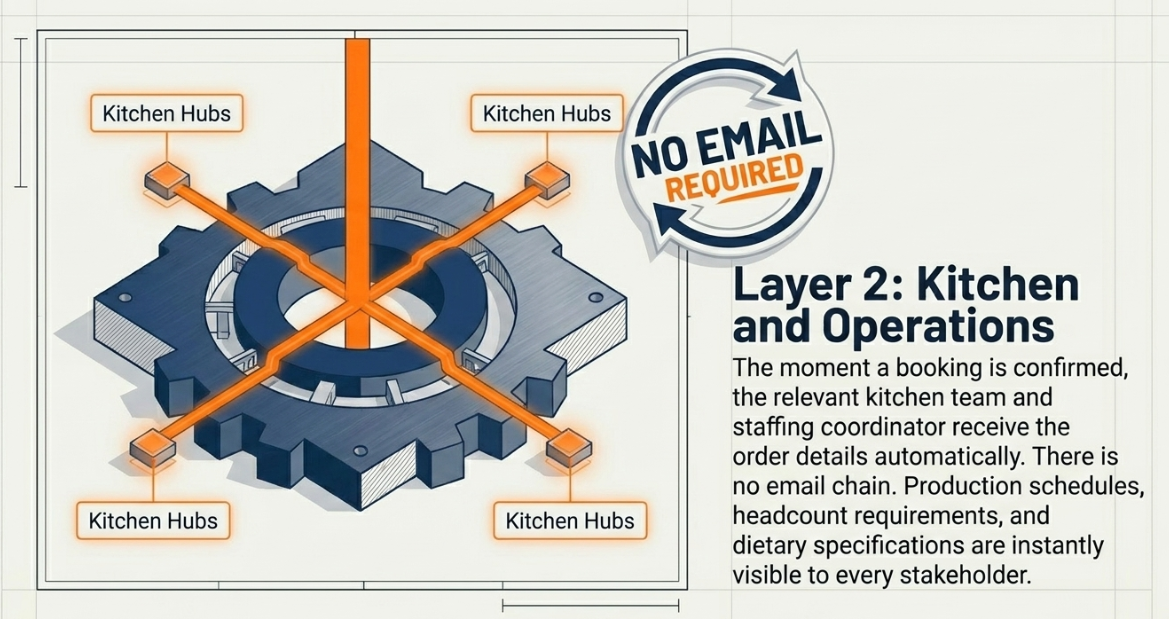
Layer 3: Guest Engagement
After the event, the system keeps the relationship alive. Automated follow-up sequences, satisfaction surveys, and re-booking prompts run without anyone in the front office lifting a finger. A one-time corporate client becomes a repeat account because the system is engineered to treat them that way.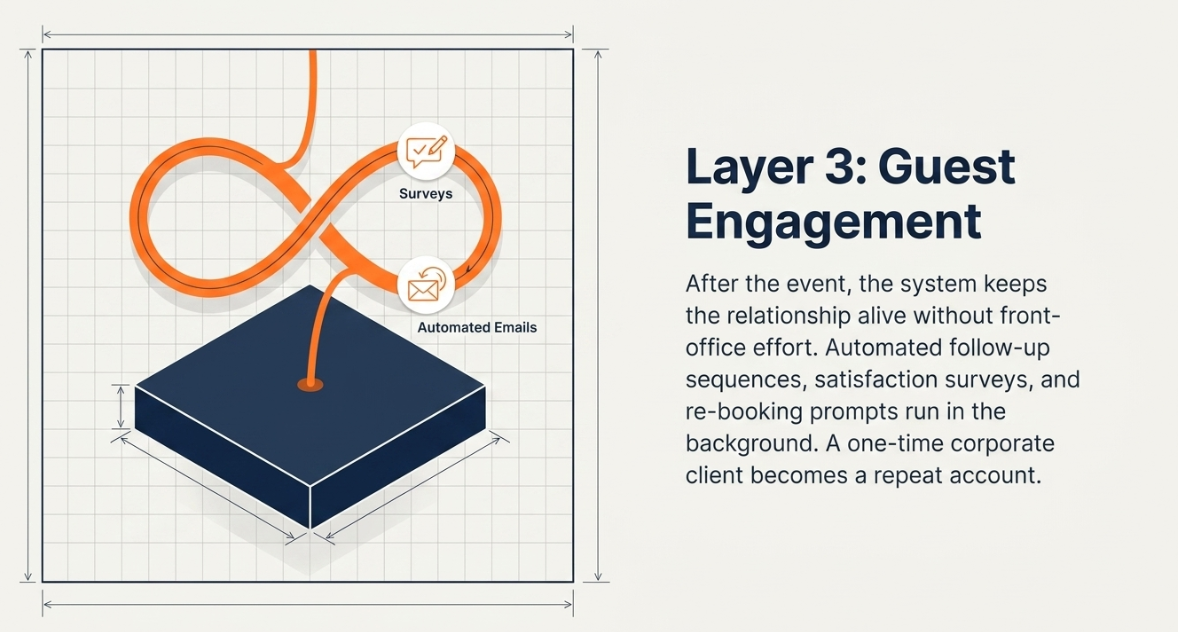
CaterSuite, built natively on HubSpot, is designed around this three-layer model. The goal is not to add another tool to the stack — it is to replace the stack with a single connected system that runs the entire catering operation end to end.

Who This Is For — And When You're Ready
This type of platform is built for franchise operators and catering directors who are already running a real catering program and have hit a ceiling on what manual coordination can handle.
It is the right conversation if:
- You are operating across multiple locations, and catering consistency is a documented problem
- Your team's response time on high-value inquiries is slower than you know it should be
- You are losing corporate accounts, or failing to win them, because your proposal process is too slow or too inconsistent
- Your catering revenue is meaningful enough that fixing the infrastructure will pay for itself within a quarter
It is not the right fit if your catering operation runs through a single location with a small, consistent event calendar that a skilled coordinator can manage manually. At that scale, the overhead of a unified platform may outweigh the benefit.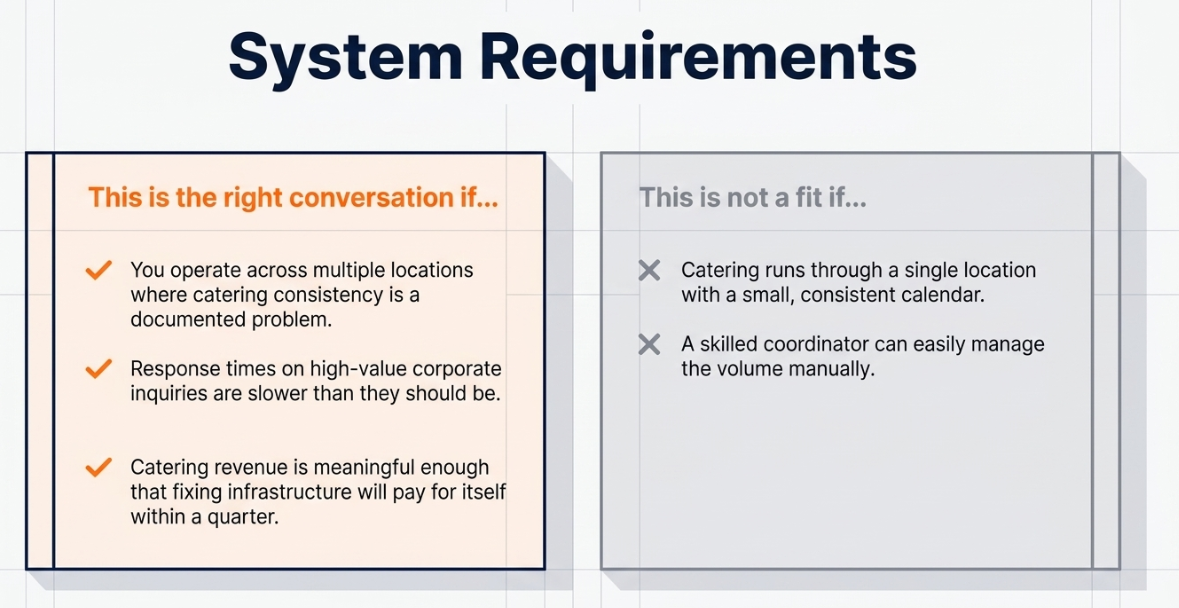
The Shift from Operator to Architect
The operators winning in franchise catering right now are not working harder than their competitors. They are working on a different kind of problem. Instead of managing the process, they are managing the system that runs the process.
When Marcus's team stops manually bridging gaps between tools and starts working inside a connected platform, something changes. The 350-person inquiry doesn't fall through the cracks. The proposal goes out in twenty minutes. The kitchen team at the right location already has the order before Marcus has finished his coffee.
That is not hustle. That is architecture.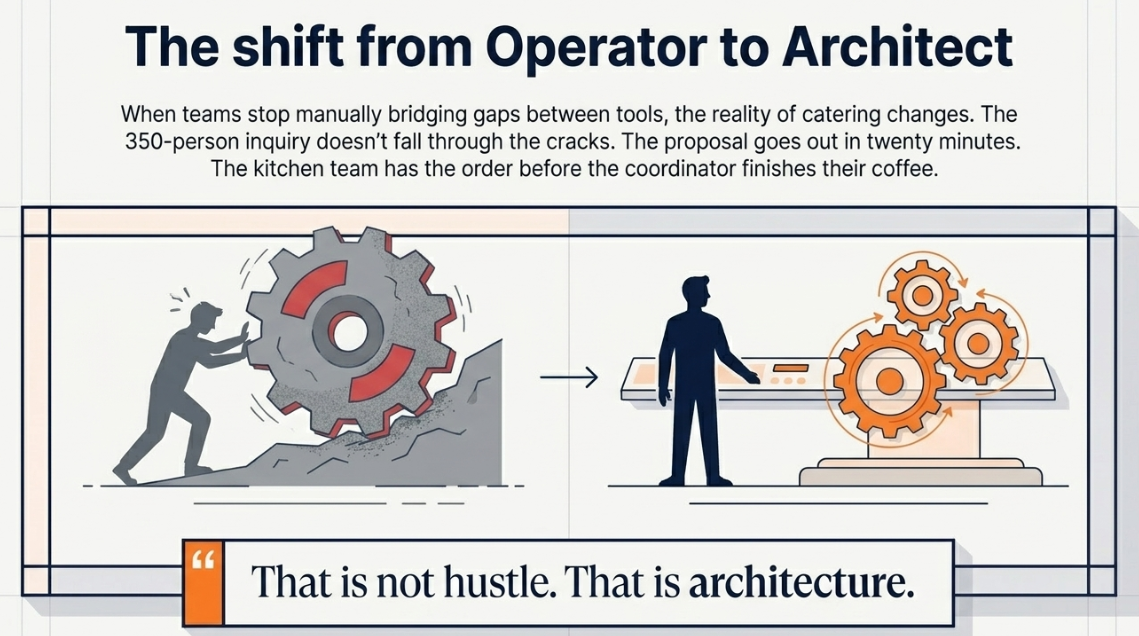
For franchise operators looking to capture high-value catering revenue at scale, the formula is clear: move away from disjointed tools and build the infrastructure that your demand deserves.
See CaterSuite in Action
If your catering operation is hitting the Catering Scaling Ceiling, the point where manual coordination can no longer support your revenue, CaterSuite is built for exactly this moment. See how the platform connects sales, kitchen, and guest engagement into one system built on HubSpot. See how CaterSuite handles this


Leave a Comment