


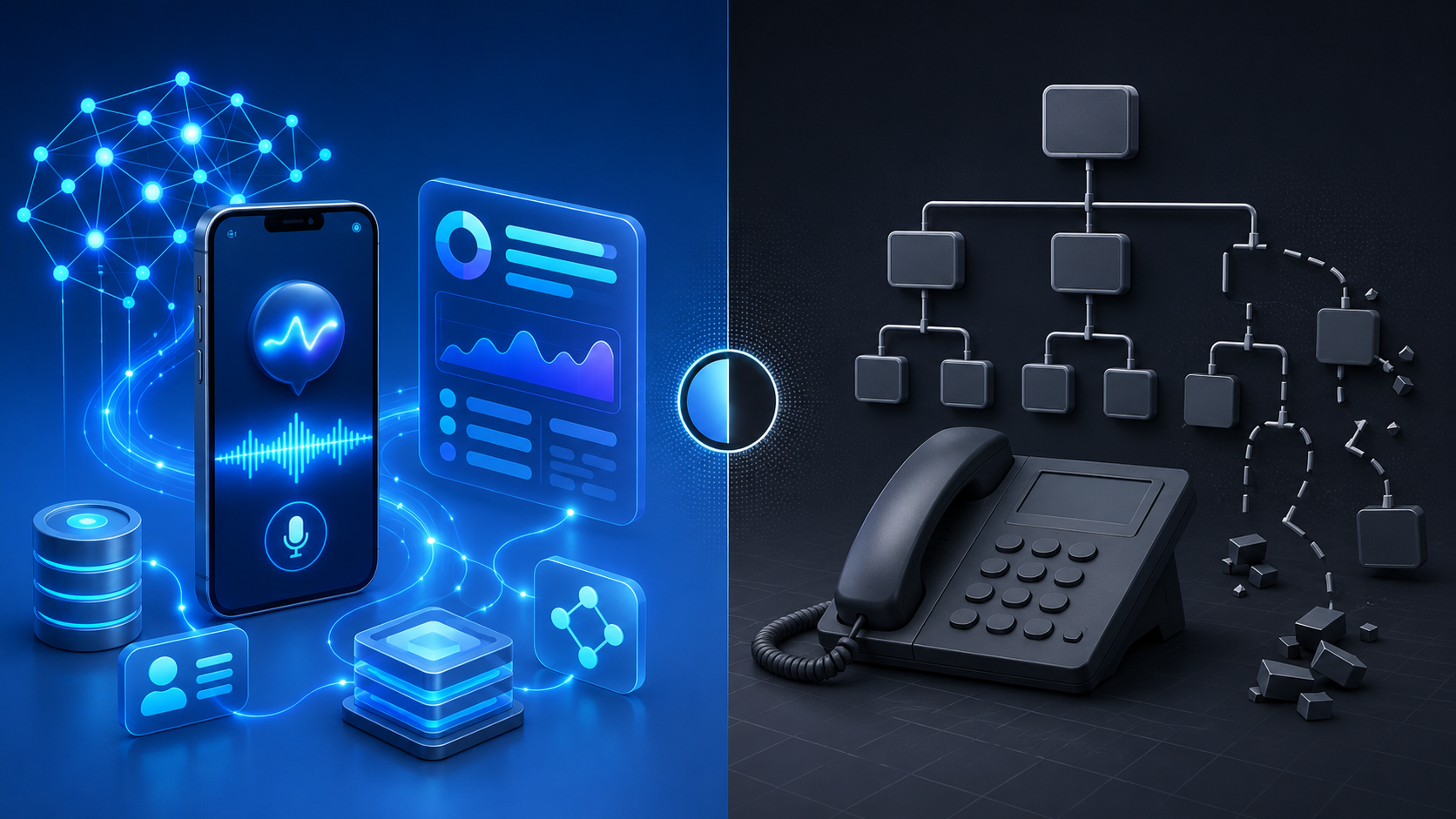
An AI voice agent differs from an IVR phone system in one architectural way: an IVR forces callers through a fixed menu and resets their context at every step, Context Collapse by design, while an AI voice agent holds the entire conversation in memory, answers in natural language, and passes the full context into the CRM as a qualified lead.
The Caller Who Pressed 1, Then 3, Then 2, Then 0, and Hung Up
It's Wednesday afternoon when you spot it in the call log. Another missed call. Another hang-up. You scroll the timeline.
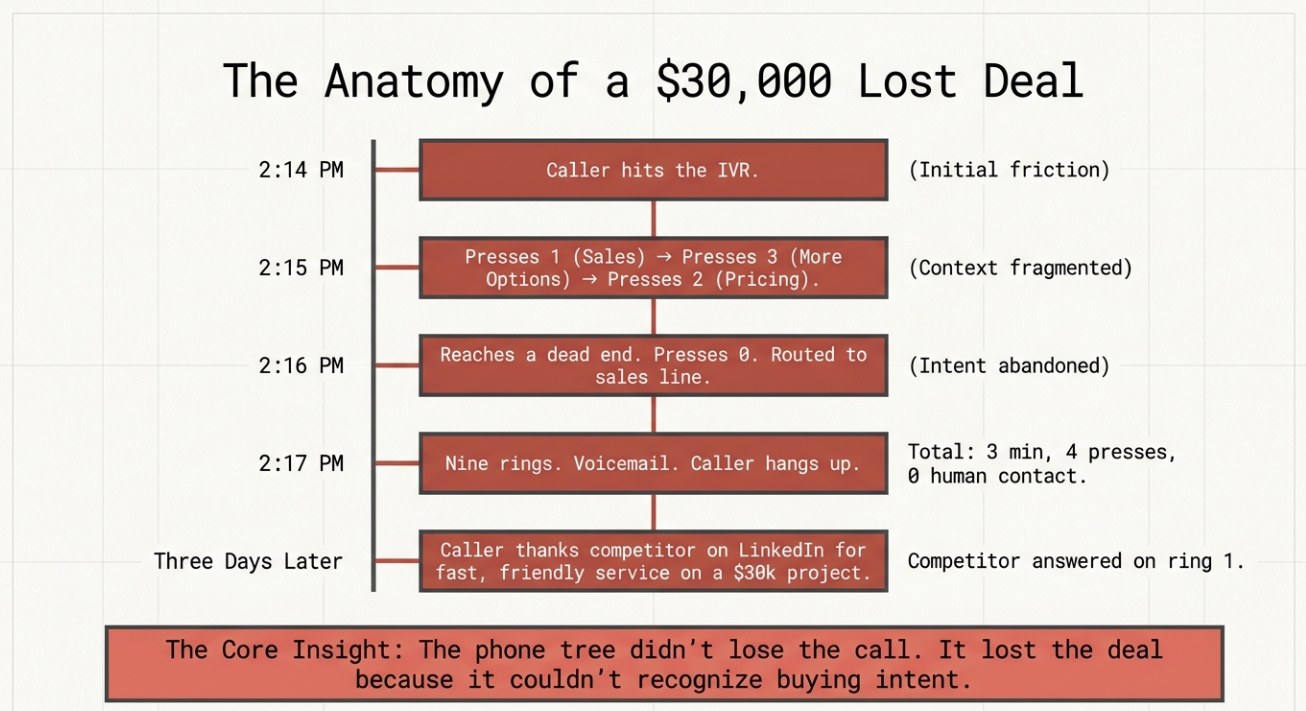
The caller hit your IVR at 2:14 PM. Pressed 1 for sales. Then 3 for "more options." Then 2 for "speak with someone about pricing." Then 0. The call was routed to your sales line. The sales line rang nine times. It went to voicemail. The caller hung up at 2:17 PM.
Three minutes. Four menu presses. No human voice on the other end.
Three days later, you find out who they were. A LinkedIn post, the same caller, thanking a competitor for "fast, friendly service" on a $30,000 project. The competitor that picked up on the first ring.
Your phone tree didn't lose the call. It lost the deal because the IVR couldn't tell that "more options, pricing, talk to someone" was already a buying intent, and because by the time anyone could have called back, the caller had already moved on.
What an IVR Actually Does, and Where It Stops
The IVR was built to solve a real problem. Phone calls were expensive, labor-wise, and a single receptionist trying to route calls for a 50-person business was a bottleneck. The auto-attendant solved it. Press 1 for sales, press 2 for service, press 3 for billing. The call reaches the right department without a human in the middle.
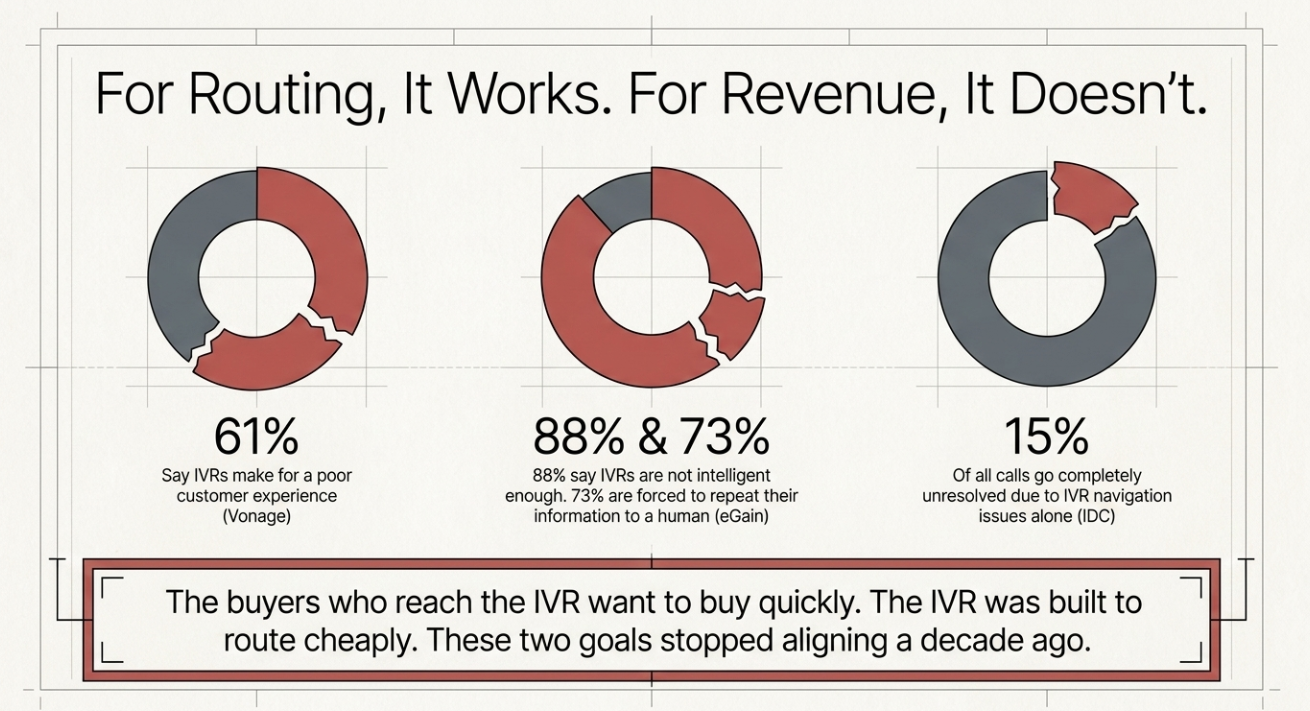
For routing, it works. For revenue, it doesn't.
The category data is unambiguous. In Vonage's 2019 survey of 2,010 US consumers, 61% said IVRs make for a poor customer experience, and 51% had abandoned a business altogether after reaching an IVR menu. eGain's 2021 research found that 88% of US consumers say IVRs are "not intelligent enough," and 73% must repeat their information when they finally escalate to a human. IDC's 2025 contact-center study found that 15% of calls go unresolved because of IVR navigation issues alone.
The 73%-must-repeat-information stat is the lived definition of Context Collapse, what happens every time a caller has to start the story over. Every menu press is a context reset. The IVR doesn't know that pressing 1, then 3, then 2, means "I'm trying to buy something, and your tree won't let me." It only knows that 2 came after 3 came after 1. By the time the caller reaches a human, if they reach one, the human starts cold.
That's the architectural ceiling. The IVR was built to route calls cheaply. The buyers who reach the IVR want to buy something quickly. Those two goals stopped pointing in the same direction about a decade ago.
The Five Architectural Differences Between an IVR and an AI Voice Agent
|
Dimension |
IVR Phone System |
AI Voice Agent |
|
What triggers the system |
Button press / DTMF tone, caller selects from a preset menu |
Natural-language intent, the caller speaks, the system understands |
|
What can it understand |
Preset menu options only ("Press 1 for sales, 2 for billing") |
Open conversation, including questions, hesitation, and follow-up |
|
What context survives across the call |
None, every menu press is a reset; escalation forces the caller to start over |
Full conversation memory, passed forward to a human or written into the CRM |
|
How it handles the unexpected |
Dead end, "Press 0 for an operator", and the operator starts blind |
Intelligent escalation with full context, or autonomous resolution if the question is in scope |
|
What it produces for the business |
A routed call (or a hang-up) |
A qualified lead with a CRM record, a transcript, and a follow-up trigger |
The line on the table that matters most is the third one. Per Gartner's November 2025 projection, AI agents will outnumber sellers tenfold by 2028, but the productivity gains will come from the ones that hold context and act on it, not from the ones bolted onto legacy routing. The IVR is built to forget the conversation. An AI voice agent is built to remember it.
Who Should Be Asking This Question
You're the right reader for this comparison if your business runs on phone-driven inquiries and you've had an IVR or auto-attendant in place for at least two years. Services businesses, mostly, anywhere a prospect calls before they buy. The owner has a $5M–$50M operation and a phone system that worked fine when the team was eight people, but now feels like it's working against the revenue every Friday afternoon.
You've probably heard the customer complaints already. You may have asked your team whether the menu options are correct. You've maybe even shortened the tree from six options to four. The complaints didn't stop, because the problem isn't the menu. The problem is the architecture under the menu.
If you're comparing across more channels, voice plus chat plus chatbot, the comparison between AI voice agents, live chat, and chatbots is its companion. Together, they cover the four channel choices most service businesses are evaluating right now.
Signs Your IVR Is Costing You More Than It Saves
The symptoms cluster around four patterns.
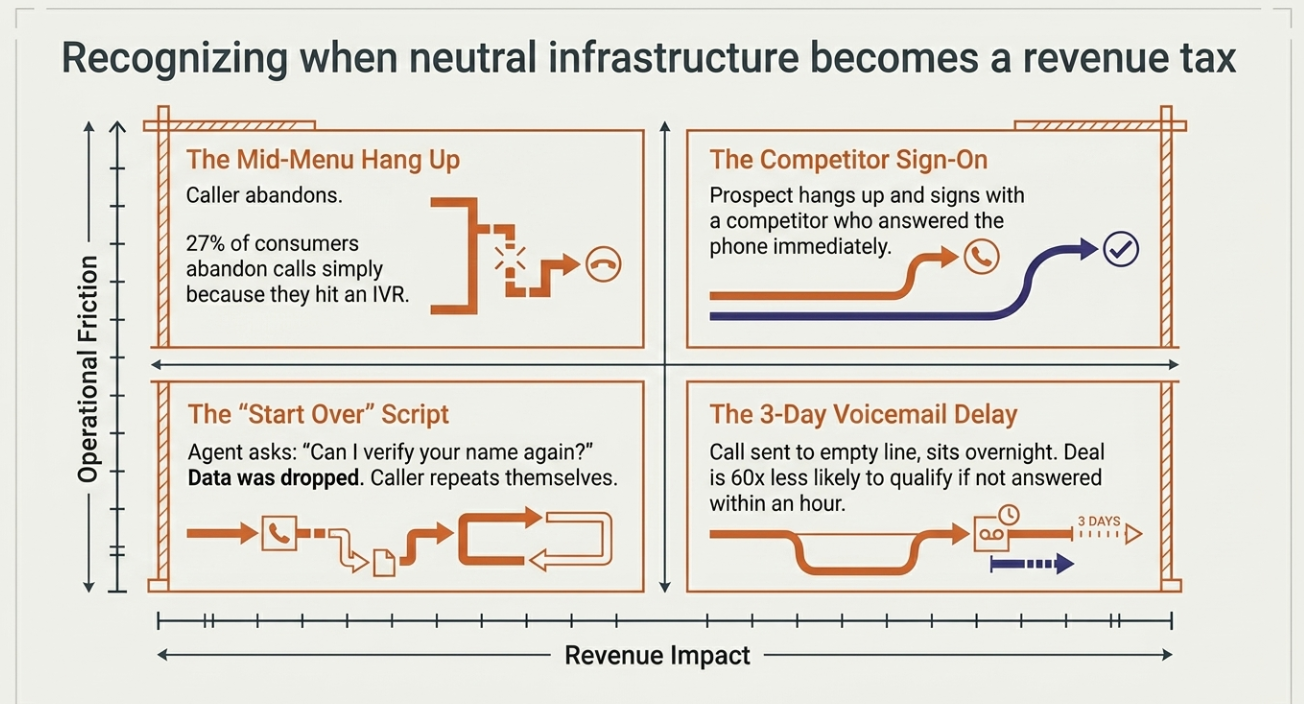
- The caller who hung up mid-menu. Vonage's research found consumers abandon 27% of calls to businesses because they reached an IVR. If your call log shows three or four hang-ups a day during business hours, you're not looking at a phone-system glitch. You're looking at deals, walking away.
- The voicemail returned three days later. The call that went to voicemail and was never logged is the second-order failure of the IVR. The menu sent the caller to a line that didn't pick up, the voicemail sat overnight, the callback happened Monday, by which point, per HBR's foundational research on lead response, the deal was already more than 60 times less likely to qualify than if you'd answered within an hour.
- The prospect who signed with the competitor who picked up. The competitor doesn't always have a better product. Sometimes they just have a human answering on the first ring while your IVR is still reading menu options.
- The agent script that starts with "Can I have you verify your name and account number again?" That sentence is the audible sound of Context Collapse. The caller already gave the information to the menu. The information went nowhere. The agent starts from zero.
If two or more of these are happening in your operation, the phone system has stopped being neutral infrastructure and started being a revenue tax.
Why Phone Trees Hit Their Ceiling
Three forces converged to make the IVR untenable as a revenue tool.
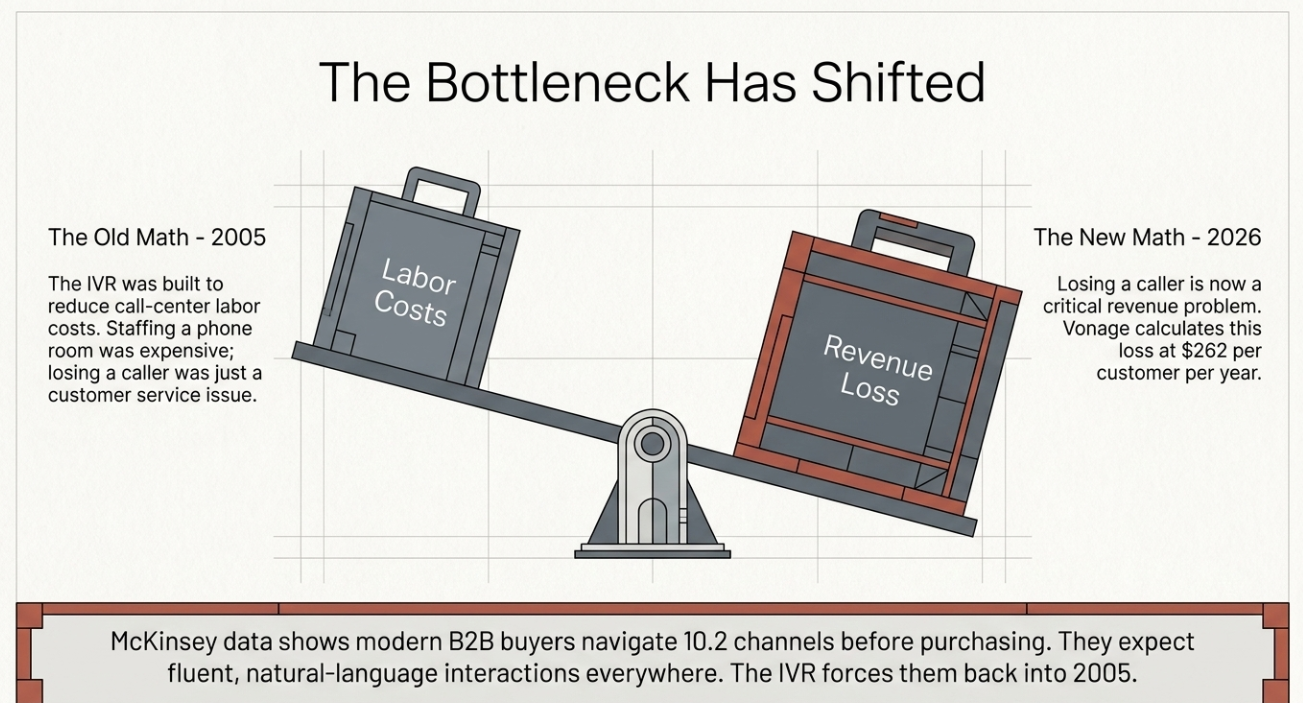
The first is what buyers now expect. Per McKinsey's 2024 B2B Pulse Survey of 3,000+ decision-makers, buyers now interact across an average of 10.2 channels during their purchasing journey, up from 5 channels in 2016. They're getting natural-language conversations from search engines, from AI assistants, from chatbots on competitors' websites. The IVR was designed for a world where a phone call was a phone call. That world is gone. Buyers expect the same conversational fluency on the phone that they get everywhere else.
The second is the shift in agentic capability. The technology that makes a real conversation possible- not voice recognition reading a menu, but natural-language understanding tied to a customer record- only matured at production scale in 2024–2025. Before that, "AI voice agent" was a category trying to find a product. Now it's a deployed category with measurable outcomes.
The third is the economic math. The IVR was built to reduce call-center labor costs. That was the right tradeoff in 2005, when the cost of staffing a phone room was high, and the cost of losing a caller was a customer-service problem. In 2026, the cost of losing a caller is a revenue problem; Vonage put it at $262 per customer per year on average. The IVR was solving for a cost line that isn't the bottleneck anymore.
How CETDIGIT Sees This Distinction
The shortcut version of what just happened: phone trees solved a labor-cost problem from a decade ago, the conversational capability finally matured, and a different kind of system is filling the gap.
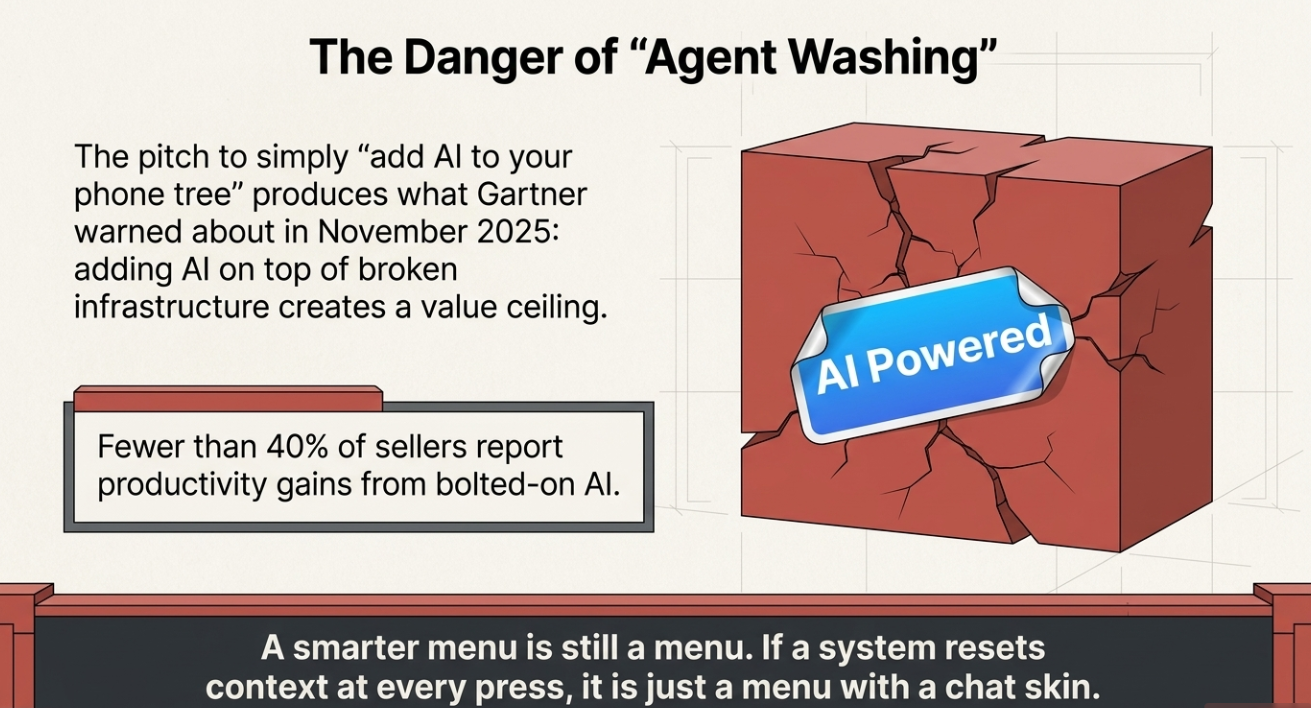
But the way most service businesses are being sold, this transition is wrong. The pitch, "add AI to your phone tree", produces exactly what Gartner warned about in November 2025: more AI on top of broken infrastructure, with fewer than 40% of sellers reporting that the AI actually improved productivity. Gartner calls it a "value ceiling." A smarter menu is still a menu.
The architectural fix is different. An AI voice agent operates at the Activation Edge, the layer where signals get read, decisions get made, and actions get triggered in real time. It holds the entire conversation in memory. It hands off to a human with the full transcript and the qualification status. It writes the CRM record before the call ends. The IVR was a routing layer with no Activation Edge function. The AI voice agent is the Activation Edge function for inbound calls.
Why this matters operationally: HBR's response-time research, plus more recent work on the 78% of buyers who purchase from the first responder, point to the same conclusion. The business that answers fastest, with context, wins. The IVR architecture cannot answer fastest with context, because the architecture itself was designed to strip context out.
This sits inside CETDIGIT's broader AI services framework; the IVR-to-AI-voice-agent decision is one piece of a wider question about which buyer signals your stack can actually see, hear, and act on.
The Path From IVR to AI Voice Agent
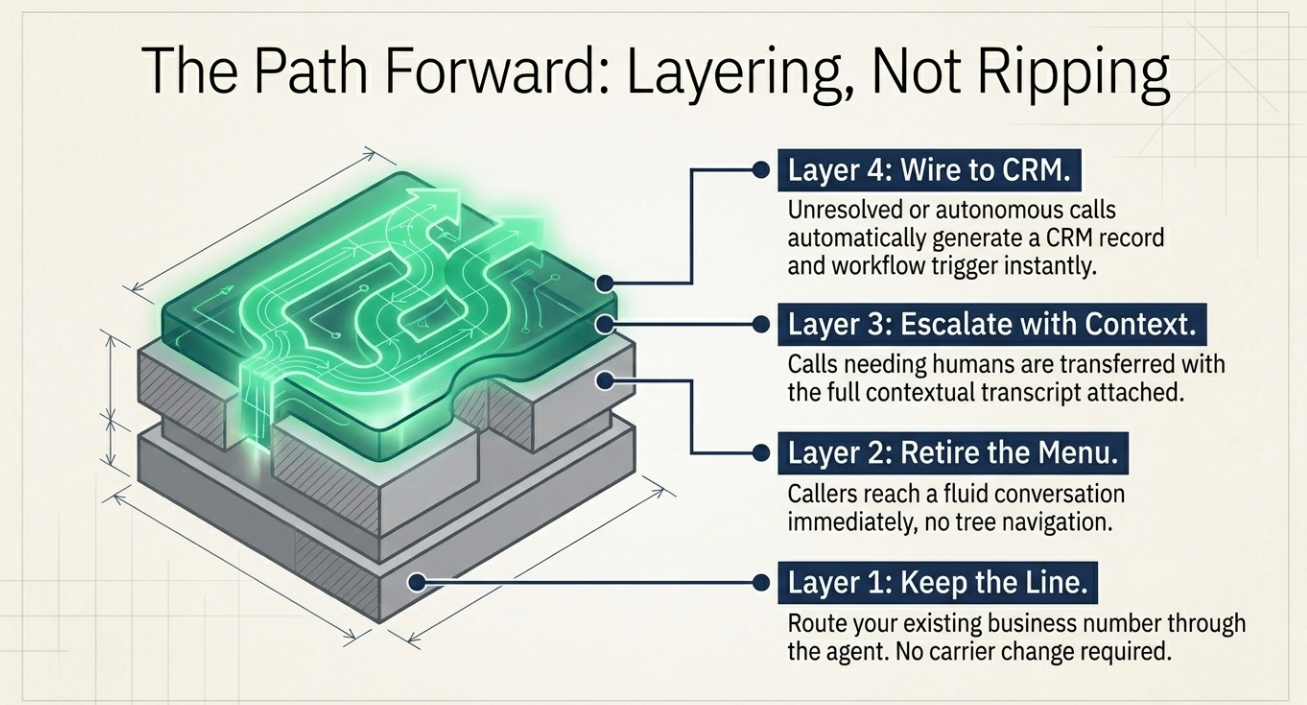
You don't have to rip out your phone system overnight. The path most services businesses take is to layer an AI voice agent that holds conversation context end-to-end on top of the existing number, keeping the line, retiring the menu, so callers reach a conversation, not a tree. Calls that need a human get escalated with full context. Calls that don't get resolved in the conversation itself, with a CRM record at the end.
From there, the agent wires into the sales workflows that route qualified callers into the pipeline, closing the loop between the call and the CRM, so the lead doesn't sit in a voicemail folder over the weekend.
For most $5M–$50M operators, the right starting point is mapping what the current phone system is missing before changing any infrastructure, a Revenue Leak Assessment engagement that maps the calls and inquiries your phone system is losing. You don't need to switch carriers. You need to see what the IVR is costing you, and what the AI voice agent would have caught instead. If you want the broader readiness framework first, the decision framework for whether your business needs AI voice agents covers the qualifying questions in more depth than this comparison can.
Frequently Asked Questions
Is an AI voice agent just a smarter IVR? No, the architectural test is whether the system holds context across the call. An IVR resets context at every menu press; an AI voice agent holds the full conversation in memory and passes it forward to a human or into the CRM. Gartner has warned specifically about "agent washing", vendors slapping AI labels onto legacy menu trees, so the buyer's skepticism is appropriate. The test isn't "does it use AI?" The test is "does it remember what the caller already told it?" If yes, it's a voice agent. If no, it's a menu with a chat skin.
Should I replace my IVR with an AI voice agent? For most $5M–$50M services businesses with phone-driven inquiries, yes. The decision turns on whether your call volume contains revenue, sales inquiries, qualifying conversations, booking requests, or just routing between internal departments. If your phone is a buying channel, the IVR is leaving money on the table. If your phone is only an internal routing tool, the IVR may still do the job.
What can an AI voice agent do that an IVR can't? Three things specifically. It can understand natural-language intent. The caller says, "I'm looking for pricing on the renovation package," and the agent responds, instead of asking the caller to press 1, then 3, then 2. It can hold the conversation in memory across an entire call, including escalations to a human. And it can write a CRM record with the transcript, the qualification status, and the follow-up trigger before the call ends.
Are AI voice agents better than phone trees? For revenue capture, yes, by a wide margin, based on the available research. Vonage's data on IVR abandonment, eGain's data on context loss, and IDC's data on unresolved calls all describe the same architectural failure mode that AI voice agents are built to fix. The honest qualifier: AI voice agents cost more per call than an IVR. They also cost dramatically less per qualified lead. The comparison only feels close if you measure cost per call instead of cost per outcome.
Can I keep my existing phone number? Yes, most deployments route the existing business number through the AI voice agent without changing the line or the carrier. The caller doesn't know anything has changed except that the menu is gone.
How does an AI voice agent compare to live chat or a chatbot? That's the sibling comparison; the comparison between AI voice agents, live chat, and chatbots covers the digital channels in detail. The short version: voice agents handle inbound calls, chat handles text-based web inquiries, and chatbots handle FAQ deflection. They're complementary, not substitutes; most services businesses end up running voice plus one of the digital channels rather than picking one.
Will customers know they're talking to an AI? Most will, within the first thirty seconds, and that's fine. The data is consistent across surveys: callers don't object to talking to an AI voice agent when it actually understands them and gets them what they need. They object to menus that send them in circles. Honesty about the agent is the right policy. The customer experience problem isn't "Is this AI?" It's "Is this helpful?"
Revenue Leak Assessment
If the deals walking away from your phone system sound familiar, a Revenue Leak Assessment is the place to start. Twenty-minute call, no pitch, we'll show you exactly which calls your IVR is losing right now, and what an AI voice agent would have caught instead.



Leave a Comment