


A chatbot answers scripted questions. Live chat connects a visitor to a human agent during business hours. An AI voice agent engages callers and web visitors in real-time conversation, qualifies their intent, and logs the outcome directly to your CRM at any hour. The right tool depends on what kind of conversation your business needs to have. The more important question is whether that conversation can afford to wait until morning.
The Problem Nobody Admits Out Loud
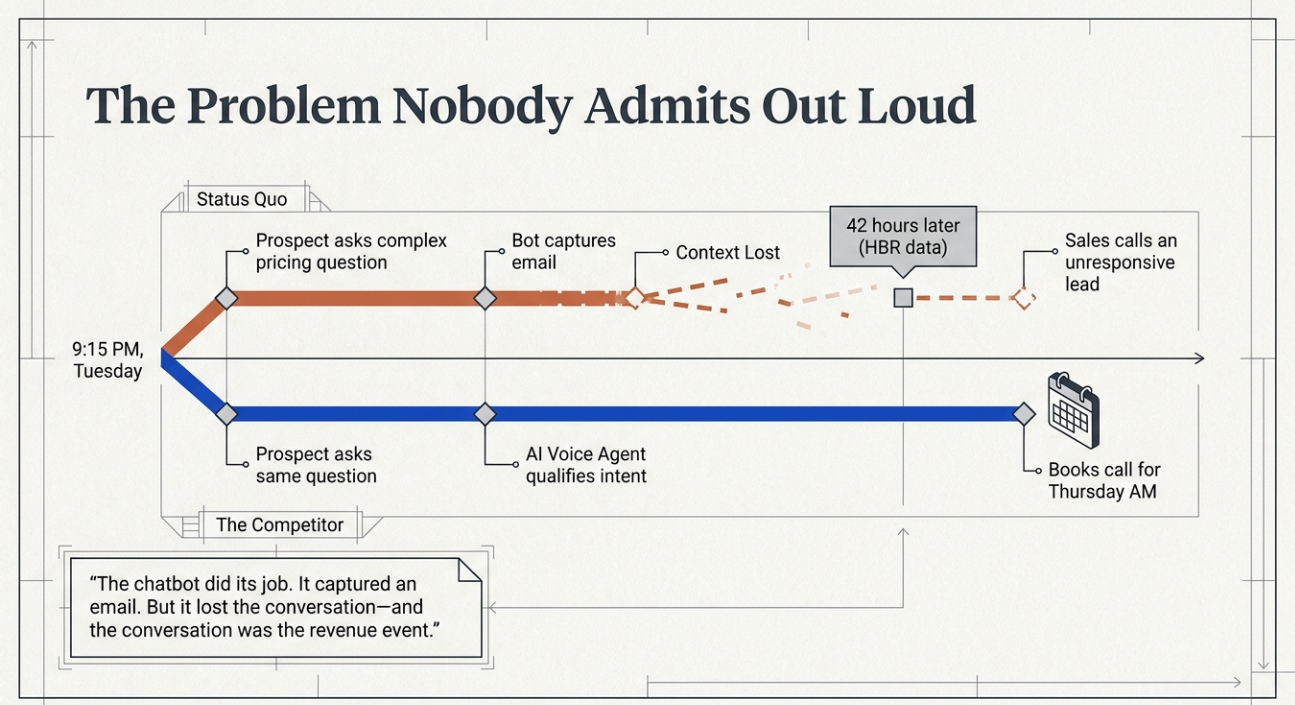
It's 9:15 PM on a Tuesday.
A prospect has been evaluating vendors for the past two weeks. Tonight, they have thirty minutes, a quiet house, and they're ready to make a decision. They go to your website. There's a chat widget in the corner. They click it.
A bot responds. "Hi there! What can I help you with today?" They type their question, something specific about pricing and implementation timelines. The bot doesn't have a good answer. It offers to have someone follow up. They type their email address and close the tab.
Your sales team sees the log the next morning. Name: unknown. Email: one they captured. Qualification: none. CRM record: not created. Context: gone.
By the time someone calls them back, according to Harvard Business Review research on lead response time, the average B2B response time is 42 hours, the buyer has already had a live conversation with a competitor whose AI voice agent answered the same question at 9:15 PM and booked a call for Thursday morning.
The chatbot did its job. It captured an email. But it didn't capture the conversation, and the conversation was the revenue event.
Who Does This Comparison Affect
The tool selection question appears in two places.
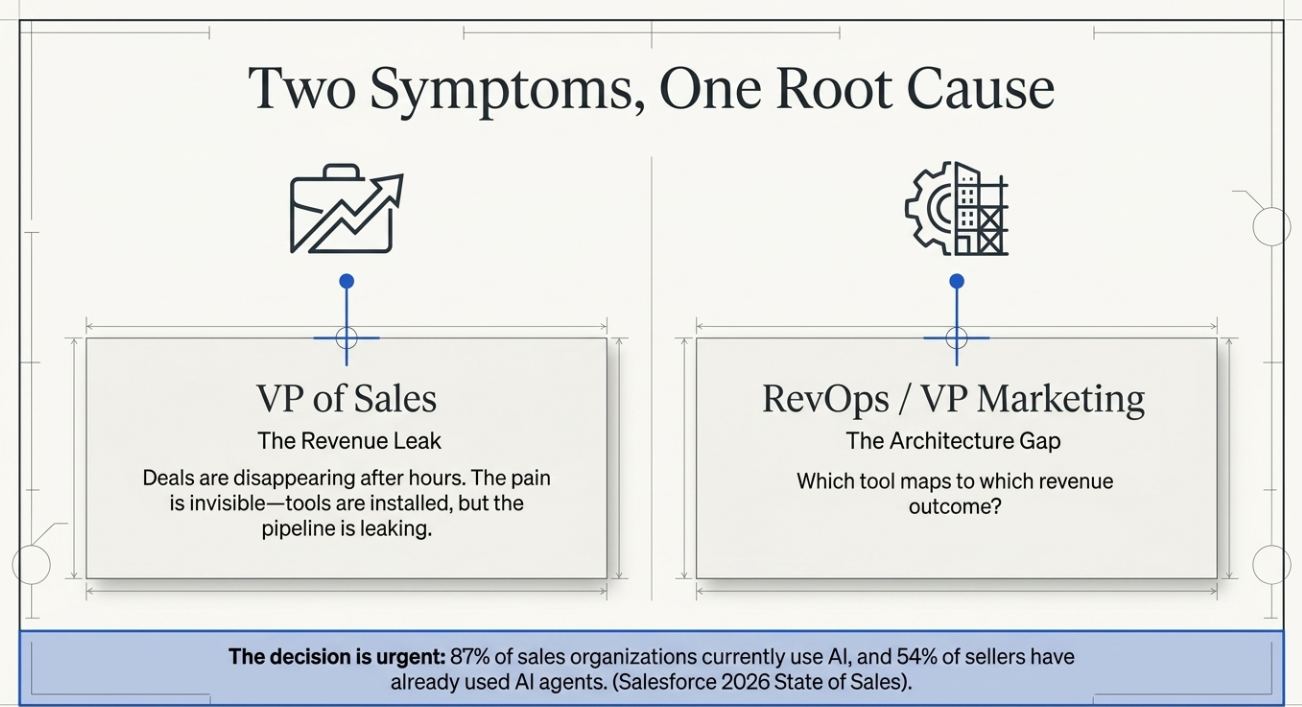
For a founder or VP of Sales, it shows up as a revenue leak: tools are installed, but deals are still disappearing after hours, and nobody can tell which tool is doing what. The pain is invisible, not "we have no tools" but "our tools aren't working, and we can't see why."
For a VP Marketing, Head of Growth, or RevOps lead, it shows up as an architecture decision: the company is actively deploying AI across the sales function, and the question is which tool maps to which revenue outcome. Salesforce's 2026 State of Sales report found that 87% of sales organizations currently use some form of AI, and 54% of sellers have already used AI agents, with 89% planning to by 2027. The tool comparison question is not theoretical. It is the decision most B2B sales teams are making right now.
The Three Tools Defined
What Is a Chatbot?
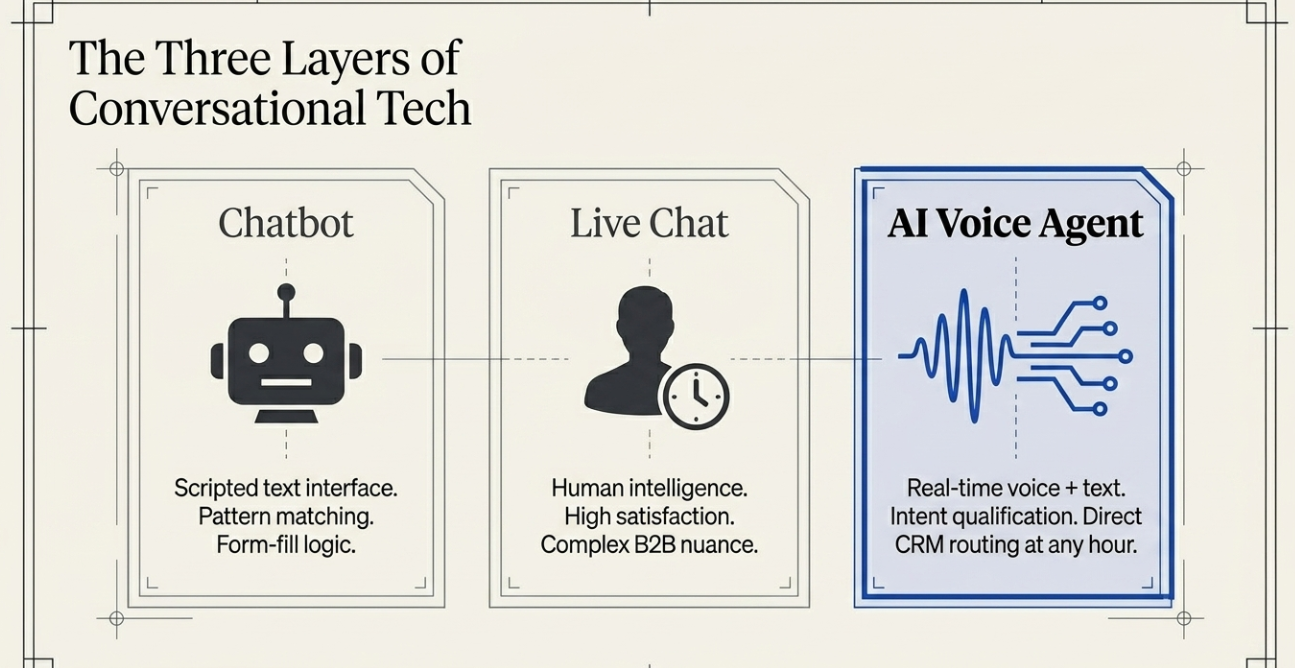
A chatbot is a scripted or rule-based text interface that handles predictable interactions, FAQs, pricing tiers, and basic routing. Modern chatbots can be AI-assisted, but their core function is text-based pattern matching: the visitor types something, and the bot retrieves a pre-configured response. They can operate outside business hours, and according to chatbot meeting data from Zoom and Salesloft research, 41% of meetings booked via chatbot happen outside standard business hours. But that coverage comes with a ceiling: chatbots cannot hold an unscripted qualification conversation, and most do not create structured CRM records that trigger next-step actions.
What Is Live Chat?
Live chat connects a website visitor to a human agent in real time. It has high satisfaction rates. Gartner's 2025 customer service survey found that customer service leaders predict live chat will overtake traditional channels as a top service technology by 2027. When a human agent is online, live chat is genuinely effective: it can handle complex questions, qualify intent, and convert real conversations. The constraint is structural. When the agent is offline, the chat is offline. Live chat is business-hours-limited by design, not by failure, but by the nature of what it is.
What Is an AI Voice Agent?
An AI voice agent engages callers and web visitors in real-time conversation, trained on your business context, available at any hour, capable of qualifying intent and routing the outcome to the right next step. For the full foundational treatment of what an AI voice agent is and when a business needs one, Article #6 in this cluster covers the definition and deployment readiness framework. This article builds on that, narrowing to how the AI voice agent compares to the tools most companies already have.
The key distinction: an AI voice agent for inbound qualification doesn't just log a conversation. It creates a structured CRM record and triggers the next action, without a human handoff required.
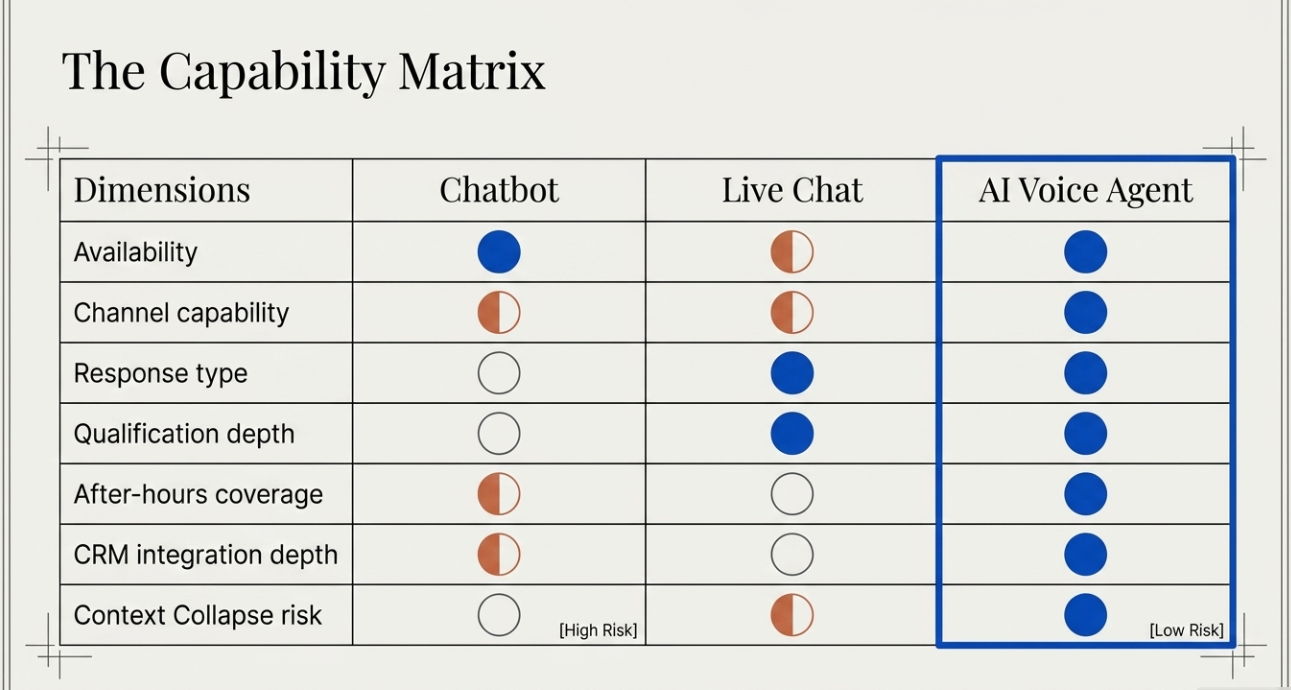
The Comparison Table
The architectural cost of keeping chat and voice tools separate, and what that separation costs in conversation history, is documented in depth in the Context Collapse problem. The table below shows where each tool sits on the dimensions that determine whether it captures revenue or just captures attention.
|
Dimension |
Chatbot |
Live Chat |
AI Voice Agent |
|
Availability |
24/7 |
Staffed business hours |
24/7 |
|
Channel |
Text only |
Text only |
Voice + text |
|
Response type |
Scripted / rule-based |
Human (intelligent) |
AI-driven (intelligent) |
|
Qualification capability |
Limited (form-fill logic) |
Yes, when staffed |
Yes, at any hour |
|
After-hours coverage |
Partial (text only) |
No |
Yes (full conversation) |
|
CRM integration |
Logs form data; limited trigger |
Logs transcript; depends on setup |
Creates a structured record; triggers next-step actions |
|
Context Collapse risk |
High, conversation ends at session close; context rarely flows downstream |
Medium, humans can log context, but rarely do so consistently |
Low, full conversation context captured and actionable |
Context Collapse is the most important row in this table. A chatbot conversation that disappears when the widget closes, or a live chat session that ends when the agent closes the ticket, leaves no structured intelligence in the system. The follow-up call starts cold. The buyer repeats themselves. The context, the specific question, the urgency signal, and the buying stage evaporate. An AI voice agent connected to CRM prevents this by design: every conversation creates a record and fires the next workflow step.
When to Use Which Tool
This is the operator-register version of the question. Not "which tool is best" in the abstract, but which tool maps to your specific revenue situation.
Use a chatbot when: inquiry volume is high, questions are predictable, and qualification depth is low. The buyer is looking for self-service information, pricing pages, FAQ content, and basic scheduling. A chatbot handles this efficiently, captures the contact, and lets a human pick up from there. Salesforce's 2024 State of Sales report found 81% of sales teams are using some form of AI, and chatbots are the lowest-friction entry point.
Use live chat when: your buying conversations require human judgment, and you have agents staffed at the hours when your buyers arrive. If your highest-intent visitors come during business hours, live chat converts well, especially for complex B2B deals where a human can handle the nuance the buyer needs. The gating condition is staffing. If agents are not online when buyers show up, live chat becomes a form with a chat wrapper.
Use an AI voice agent when: inbound happens outside business hours, qualification requires a real conversation rather than a form-fill, and CRM action is the required outcome, not just a log entry. The HBR research is unambiguous on speed-to-response: firms that contacted prospects within one hour were nearly seven times more likely to qualify the lead than those who waited longer. If your chatbot captures a contact at 9:15 PM and nobody calls until 11 AM the next day, the speed-to-lead math has already lost the deal.
The framing that clarifies the decision: a chatbot is a data-collection interface. A live chat is a human service channel. An AI voice agent connected to your sales workflow is an Activation Edge; it doesn't just record what happened, it triggers what happens next. That distinction, between a tool that records and a tool that acts, is the architectural difference between a system of record and a System of Action.
The CETDIGIT Perspective
The reason most companies reach this comparison question is that they already have a chatbot, sometimes live chat, and they're still missing revenue they cannot see. The tools are installed. The gap is that neither tool was designed to close the loop between a conversation and a CRM action that fires a follow-up.
The conversion gap isn't unique to any one tool type. The majority of website visitors never convert, regardless of which widget is installed. The question is whether the ones who do initiate contact get captured completely: qualified, logged, and routed. A scripted chatbot captures an email. A live chat session captures a transcript that the agent may or may not log. An AI voice agent captures the conversation, creates the record, and fires the next step, without anyone having to remember to do it.
Salesforce's 2026 State of Sales data is useful here: only 35% of sales professionals completely trust the accuracy of their organization's data. A chatbot that logs to a CRM nobody trusts or acts on has introduced Context Collapse at the data layer, not just the conversation layer.
CETRAI Chat and CETRAI Call implement this architecture, chat and voice unified into a single intelligent agent that captures context across both channels and routes it into a CRM-connected workflow. The full product treatment is in Article #9. This is the implementation of the recommended path; what matters for this comparison is the principle: one tool, full context, CRM action. That is what closes the gap the chatbot-plus-live-chat stack leaves open.
CETDIGIT's AI voice agent and workflow automation solutions sit within a broader AI services framework designed for exactly this stack integration challenge.
The Recommended Path
Find out which conversations your current tools are capturing, and which ones are falling through. The Revenue Leak Assessment is a 20-minute diagnostic that identifies where your chatbot, live chat, or contact layer is producing chat logs with no CRM record, and what a first-response layer that actually closes the loop would look like for your business.
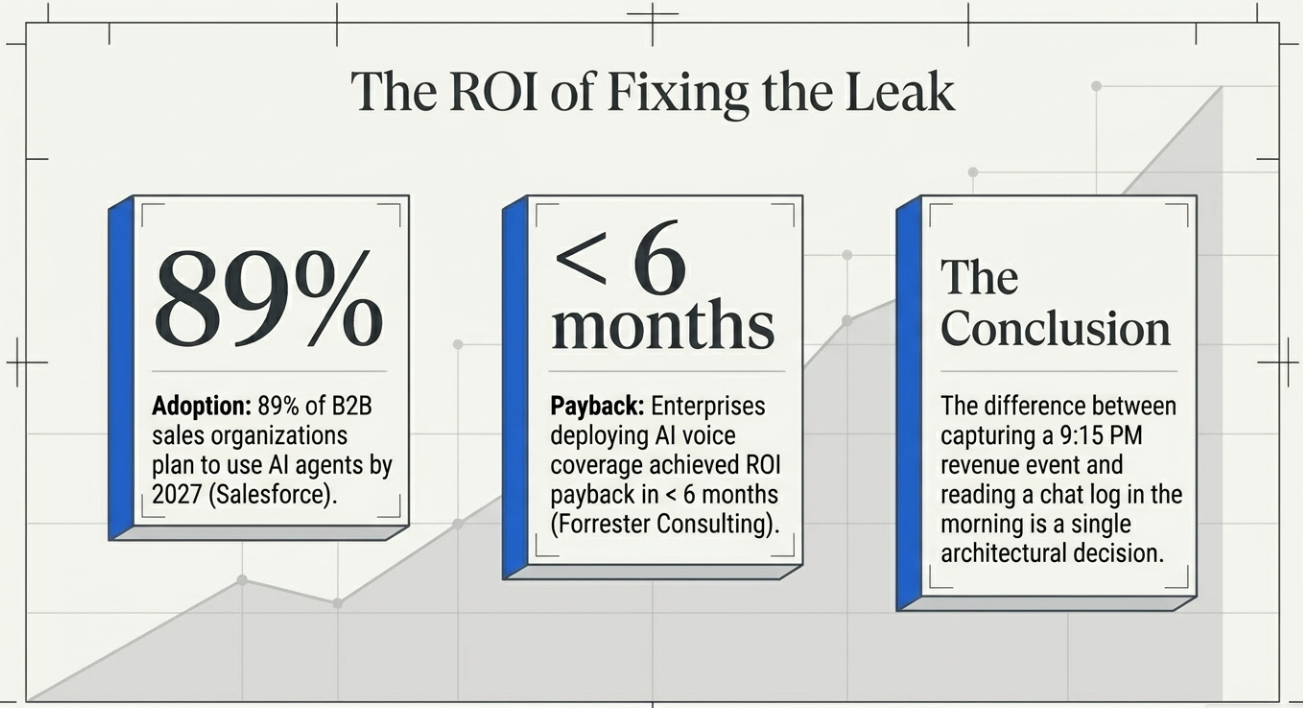
Salesforce's 2026 State of Sales data puts 89% of B2B sales organizations planning to use AI agents by 2027. The tool comparison question you're navigating now is the one every B2B company is navigating. The difference between the companies that capture the revenue event at 9:15 PM and the ones that see a chat log in the morning is an architecture decision, and it is one that pays back quickly. A Forrester Consulting study on voice AI ROI found enterprises deploying AI voice coverage achieved payback in under six months.
Frequently Asked Questions
What is the difference between a chatbot and an AI voice agent?
A chatbot is a scripted text interface that handles predictable questions and routes to forms, useful for high-volume, low-complexity inquiries. An AI voice agent conducts real-time voice conversations, qualifies intent, and creates structured CRM records that trigger follow-up actions. The core distinction: a chatbot collects data; an AI voice agent creates the downstream action. The foundational comparison starts with understanding what an AI voice agent is and when a business needs one.
Can a chatbot replace live chat for B2B sales?
For predictable, high-volume FAQ-type inquiries, chatbots can cover what live chat handles. For complex B2B qualification, multi-question, intent-sensitive, deal-stage dependent, chatbots hit a ceiling. They can capture contact information after hours (41% of chatbot-booked meetings happen outside business hours, per Zoom/Salesloft research), but cannot qualify in the way a real conversation does. Live chat handles complex questions well when agents are staffed; chatbots are its after-hours substitute, not its replacement.
What is the difference between live chat and an AI voice agent?
Live chat is a human channel; its quality depends on agent availability and skill, and it operates within staffed hours. An AI voice agent is available at any hour, conducts voice conversations, and logs structured data to CRM automatically. The critical operational difference: live chat goes offline when agents go home. An AI voice agent doesn't.
Do AI voice agents work after business hours?
Yes, that is one of their primary use cases. The HBR speed-to-lead research found that firms contacting prospects within one hour were nearly seven times more likely to qualify the lead. For companies whose buyers call or visit after 5 PM, an AI voice agent is the only tool that closes that qualification gap at the hour the buyer is present.
Does an AI voice agent connect to my CRM?
Yes, CRM integration is what separates an AI voice agent from a more sophisticated chatbot. When an AI voice agent handles an inbound inquiry, the conversation outcome is logged as a structured CRM record and triggers the next workflow action: a follow-up task, a sequence, an alert to the right rep. That is what makes it an Activation Edge rather than a recording tool.
When should a B2B company use a chatbot vs. a voice agent?
Use a chatbot when questions are predictable, and qualification depth is low, and the buyer wants self-service information. Use an AI voice agent connected to your sales workflow when inbound happens outside business hours, qualification requires a conversation, and CRM action is the required outcome. If your buyers arrive at night and your chatbot is the only thing that answers them, you are capturing their email but losing the revenue event.
What is Context Collapse in sales tools?
Context Collapse is what happens when a customer interaction takes place across a channel that doesn't feed intelligence back into the system. A chatbot conversation that ends when the widget closes, a live chat session the agent doesn't log to CRM, a call that goes to voicemail with no record created, each is a Context Collapse event. The conversation happened; the context didn't survive. An AI voice agent connected to CRM prevents Context Collapse by design: every conversation creates a structured, actionable record.
Revenue Leak Assessment
Find out which conversations your current tools are capturing, and which ones are falling through. Book a 20-minute Revenue Leak Assessment. We'll identify exactly where your chatbot, live chat, or call layer is producing logs without CRM action, and what it's costing you in pipeline.
Leave a Comment