


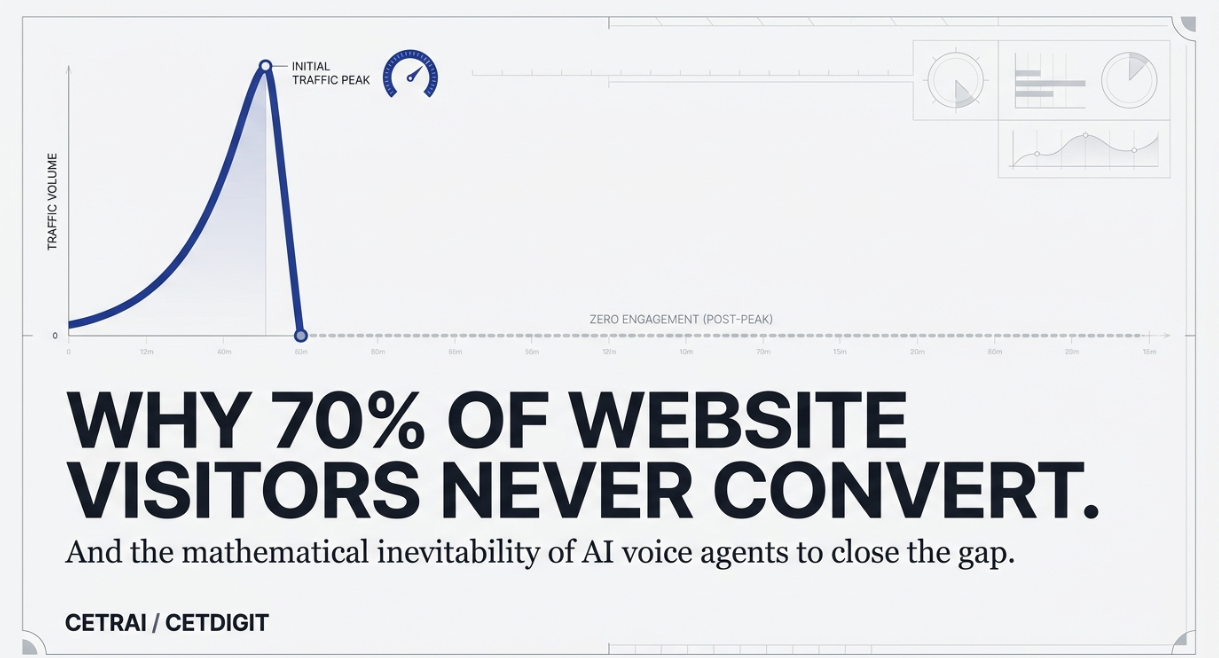
Your marketing is working. Ads are live. SEO is delivering organic traffic. Campaigns are pushing visitors to your website every hour of every day.
And most of them leave without doing anything.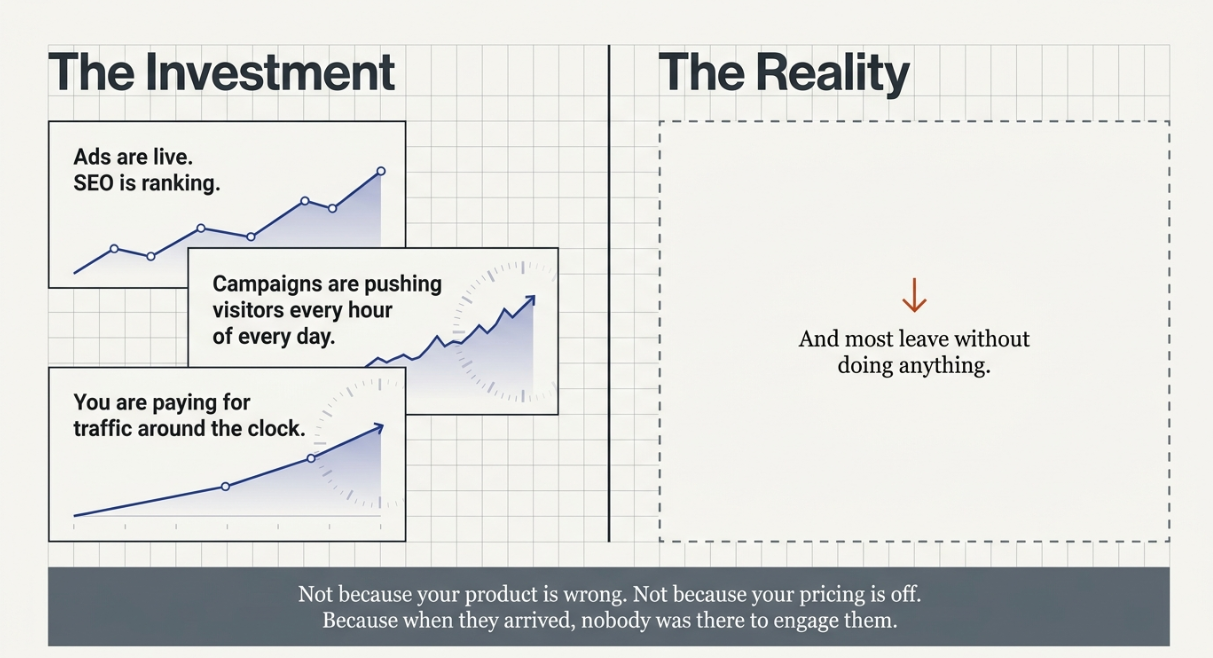
Not because your product is wrong for them. Not because your pricing is off. Because when they arrived, at 11 AM during a busy Tuesday, at 9 PM from their couch, at 8 AM from a different time zone, there was nobody there to engage them.
The engagement gap is not an after-hours problem. It is an all-hours problem. During business hours, your reps are in meetings. At lunch, the queue goes cold. After 5 PM, the website goes silent. On weekends, you're running a digital brochure with no one behind the counter.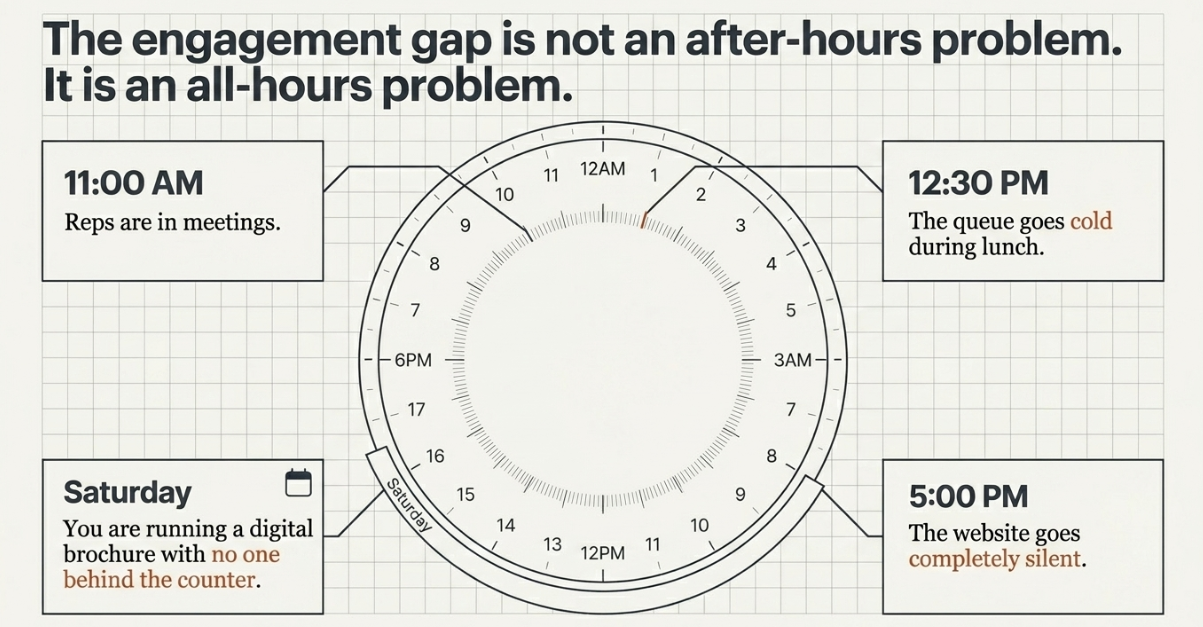
The data is unambiguous: research indicates that 78% of buyers purchase from the first company that responds to their inquiry. Responding within one minute can increase conversions by up to 391%. Yet the average business takes over 42 hours to respond to a new lead, and more than half of leads are never contacted.
You are paying for traffic around the clock. You are converting only a fraction of it. The gap between those two facts is where your revenue is disappearing.
This article focuses specifically on the website-visitor conversion gap that AI voice agents close. For the canonical Voice Agents architecture and decision framework — including when your business needs voice agents at all — see "What Is an AI Voice Agent for Websites and When Does Your Business Need One," the canonical Voice Agents cluster hub.
What Is an AI Voice Agent — And How It Differs from a Chatbot
Before examining the problem in depth, it helps to be precise about the solution.
An AI voice agent is software that engages website visitors in natural, real-time conversations, spoken or text-based, using large language models that reason through questions rather than follow scripts. It retrieves information dynamically from your product documentation, pricing data, and CRM records. It evaluates buying signals during the conversation. It books meetings against live calendar availability. And it writes structured, actionable data back to your CRM when the conversation ends.
This is categorically different from what most businesses already have:
|
Tool |
How It Works |
Core Limitation |
|
Contact Form |
Collects data, triggers email notification |
Passive; 42+ hour average response; 81% abandonment rate |
|
Rule-Based Chatbot |
Follows pre-written decision trees |
Breaks on unexpected questions; no real qualification; feels robotic |
|
Live Chat |
Human agent responds in real time |
Dependent on staffing; degrades under volume; unavailable after hours |
|
Scheduling Widget |
Offers calendar booking |
Defers the conversation; interest cools before the meeting |
|
AI Voice Agent |
Reasons through questions using live data |
Requires CRM integration and knowledge base setup to perform well |
The key distinction: a rule-based chatbot is a script. An AI voice agent is a reasoning system. The difference in output, lead quality, qualification depth, conversion rate, is significant.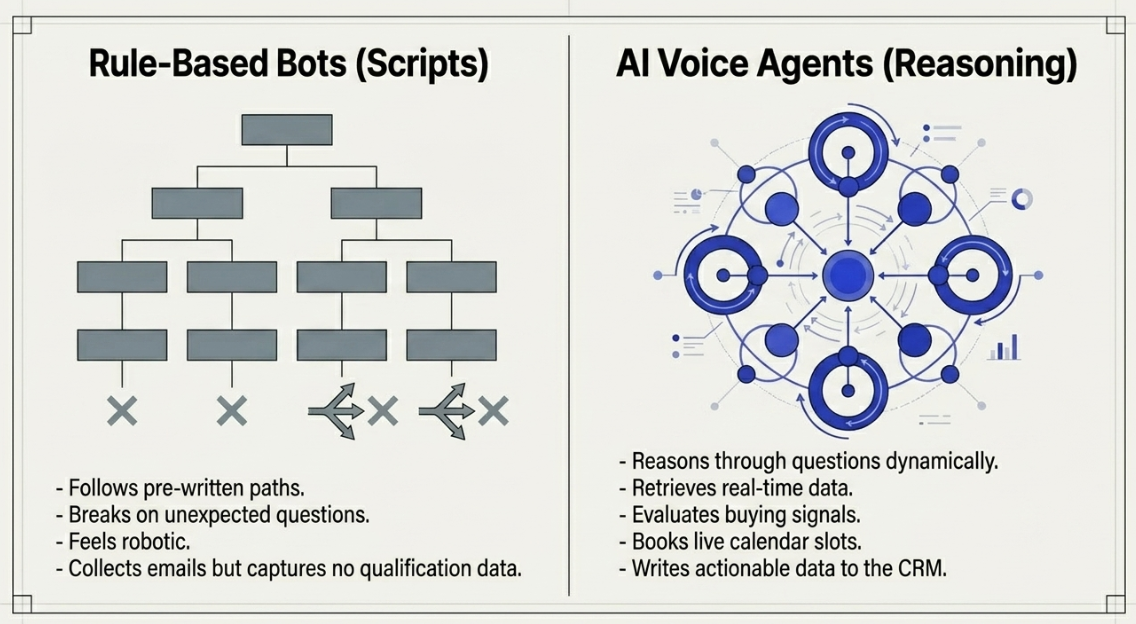
The Three Engagement Windows Where Revenue Leaks
Most businesses assume their conversion problem is an after-hours problem. In practice, visitor loss happens across three distinct windows, each with different causes and the same result.
Window 1 — Business Hours: Present but Not Available
Your team is online from 9 to 5. In theory, available. In practice, in meetings, on calls, updating CRM records, preparing proposals, and managing existing accounts.
A new visitor lands on your pricing page at 11 AM. What do they find? A contact form promising a callback. A live chat staffed by a rep juggling four other conversations. A phone queue with a six-minute hold. A demo booking link for next Thursday.
Research shows conversion rates drop 8x when follow-up is delayed by just five minutes, even during business hours. Your team is present. They are not fast enough. And in sales, speed is not a courtesy feature. It is the single biggest predictor of whether a lead converts or walks.
Window 2 — After Hours: The Silent Revenue Leak
A meaningful portion of B2B website traffic arrives in the evenings, typically between 7 and 10 PM. These are not casual browsers. Senior decision-makers don't have time to evaluate vendors during packed workdays. The evening is when they sit down with their laptop, read case studies, compare options, and decide who deserves a conversation.
They are your highest-value visitors. They are arriving at your least-staffed hours.
What you offer them: a form, an auto-responder promising a reply within 24 hours, and maybe a chatbot that loops through three scripted answers before suggesting they call back tomorrow.
By the time your sales rep sees the submission at 9 AM, that prospect has already visited two competitor websites, received a response from one of them, and mentally moved on.
Window 3 — Weekends and Holidays: The Forgotten 30%
Weekend traffic can account for 15–25% of total weekly visits, with higher shares in consumer-facing industries. Holiday periods often see traffic spikes as people use their time off to research and plan purchases, both personal and professional.
Almost no business staff have sales on weekends. The result is two to three full days every week where your most expensive digital asset operates as a static brochure.
Add it up: slow responses during business hours, no engagement after hours, and complete silence on weekends. That is a website that fails to convert the majority of its traffic every single day.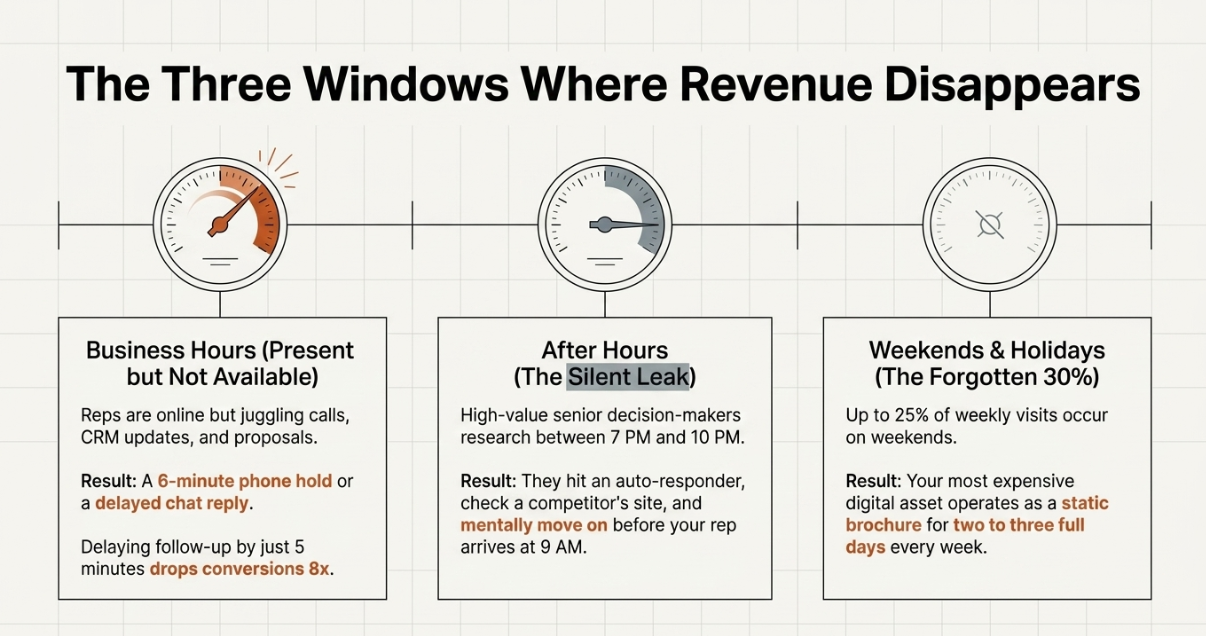
The Speed-to-Lead Data: What Every Minute of Delay Costs You
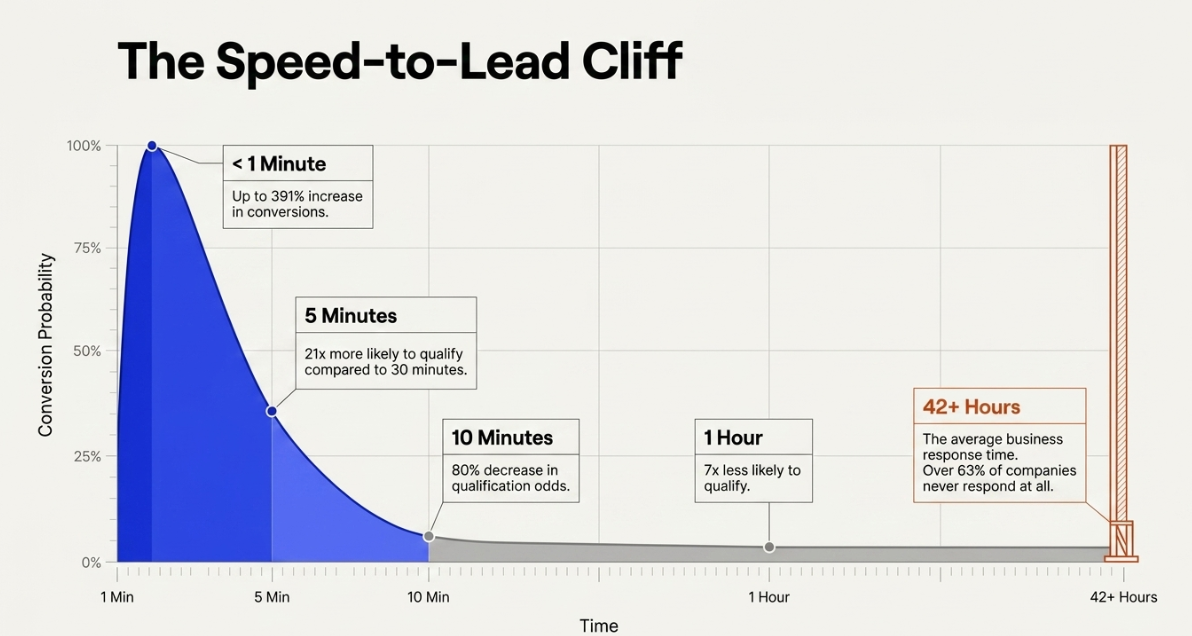
Research on lead response time is among the most consistently replicated findings in sales. Conversion probability doesn't decay gradually. It collapses.
|
Response Time |
Impact on Conversion |
|
Under 1 minute |
Up to 391% increase in conversions |
|
Under 5 minutes |
21x more likely to qualify vs. 30-minute response |
|
5–10 minutes |
80% decrease in qualification odds vs. under 5 minutes |
|
After 30 minutes |
Conversion drops up to 100x vs. 5-minute response |
|
After 1 hour |
7x less likely to qualify vs. within first hour |
|
Average business response |
42+ hours — nearly two full days of silence |
Note: The statistics above are drawn from widely cited sales research. Named sources are recommended for publication; see Content Gaps in section 3.5.
These numbers apply across all hours. A visitor submitting a form at 2 PM on a busy Tuesday gets lost in the queue just as easily as someone submitting at 10 PM. One study of over 1,000 companies found that more than 63% didn't respond to leads at all, not slowly, never.
The speed-to-lead problem is not an after-hours problem. Forms, chatbots, and manual processes are not solving it at any hour of the day.
Why Traditional Tools Fail Across All Hours
Businesses have tried to patch this problem with a predictable set of tools. Each has fundamental limitations that persist regardless of the time of day.
Contact Forms: Friction That Never Sleeps. Research shows 81% of users who begin a form abandon it before completing it. The phone number field alone causes 37% to drop off. Those who do submit face an average wait of 42 hours. Forms don't fail only after hours; they fail constantly because they demand trust before earning it.
Live Chat: Only as Good as Your Staffing. Live chat works when an agent is available and responsive. During peak hours, agents juggle multiple conversations, and quality degrades. After hours, most live chat tools revert to a bot or a form. The experience is human availability disguised as a digital channel, and visitors can tell.
Rule-Based Chatbots: Scripts Don't Qualify. Most chatbots handle three or four scenarios and break on anything outside them. Visitors know they're talking to a script within two exchanges. The tool collects a name and email but captures no real intelligence about what the visitor needs or whether they're worth pursuing.
Scheduling Widgets: Delay Built-In: A visitor who is engaged right now is offered a 30-minute meeting next Thursday. By then, their interest has cooled, a competitor has responded, or they've moved on to other priorities. The gap between intent and engagement is exactly where deals die.
Phone Lines: Friction at Both Ends During business hours, phone queues create friction. After hours, calls go to voicemail. Either way, the visitor's momentum is broken. 82% of consumers expect a reply within 10 minutes, not a voicemail callback within one business day.
Every one of these tools shares the same structural flaw: they either defer the conversation or deliver a diminished version of it. Visitor intent doesn't wait. It peaks in the moment they engage with your site, and every second of delay erodes it.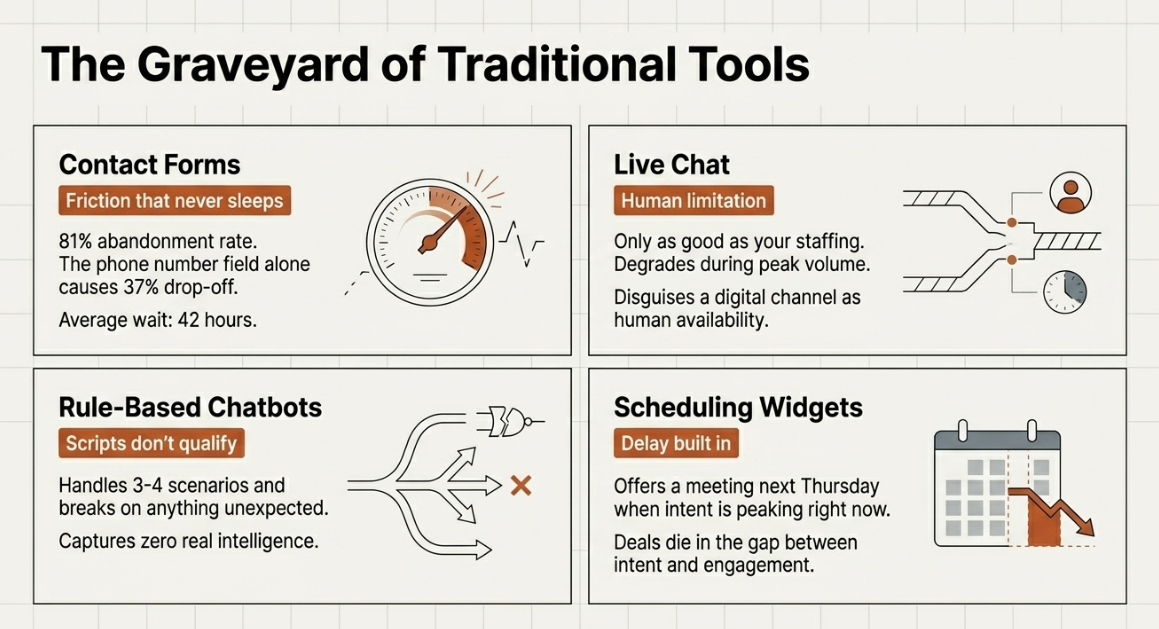
How AI Voice Agents Work: The Mechanics of Always-On Engagement
An AI voice agent deployed on your website operates on a fundamentally different model than any of the tools above.
Rather than following a script, it retrieves real-time information from your connected knowledge base, product documentation, pricing, case studies, integration specs, and reasons, and uses the visitor's questions to produce accurate, contextual answers. As the conversation develops, it evaluates buying signals: urgency, decision-making authority, budget indicators, timeline, and fit. It doesn't wait for a rep to follow up; when a qualified visitor is ready to book, it accesses your team's connected calendar and offers real-time availability.
When the conversation ends, the lead isn't in a queue somewhere. It's already in your CRM, structured, scored, and ready for your team to act on.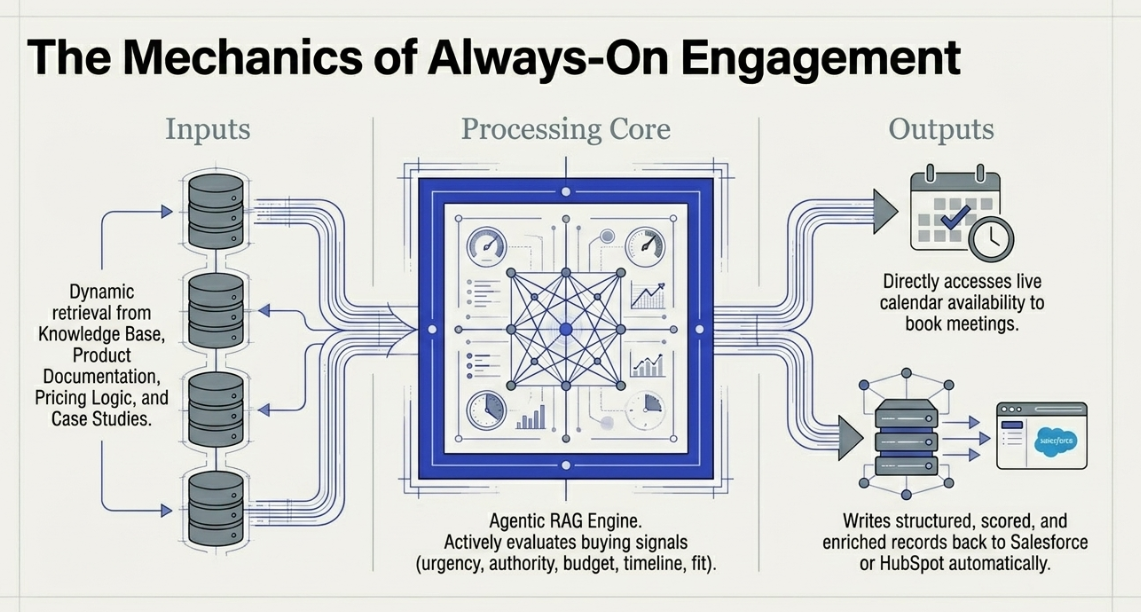
What this means in practical terms:
- A visitor at 11 AM who can't reach a rep gets an immediate, intelligent response, not a queue
- A visitor at 9 PM who finds a form gets a conversation, not a 24-hour wait
- A visitor on Saturday who wants to compare options gets qualified and booked, not a static brochure
- Every conversation, regardless of hour, writes enriched data back to Salesforce or HubSpot automatically
The technology powering the most capable implementations, including CETRAI, uses Agentic RAG (Retrieval-Augmented Generation), which allows the AI to retrieve information dynamically rather than rely on static training data. This is why the responses feel contextually accurate rather than generic.
A Day in the Revenue Gap — 24 Hours With and Without AI Engagement
This is what the engagement gap looks like in practice, across a single day.
6:00 AM — Early Morning International Traffic Without: A London prospect (11 AM their time) browses your product page, fills out a form, and waits. Your team won't see it for three hours. By then, they're in back-to-back meetings. With: The AI engages immediately, answers product questions from the knowledge base, qualifies the opportunity, and books a 2 PM GMT meeting, before your team arrives.
10:30 AM — Peak Business Hours Without: Your best rep is on a discovery call. Two visitors land on the pricing page. One submits a form; the other bounces. The form sits until 11:15 AM. By then, the visitor has opened a competitor's website. With: Both visitors get instant engagement. One is qualified and booked for the afternoon. The rep finds two enriched CRM records and a meeting already on the calendar.
12:30 PM — Lunch Hour Without: The team is out. Three visitors come and go. One form submitted. Addressed at 1:30 PM, a 60-minute gap during which qualification odds have dropped 7x. With: All three visitors are engaged. One is identified as a strong fit, qualified through conversation, and scheduled for 2:30 PM with the account executive for their industry.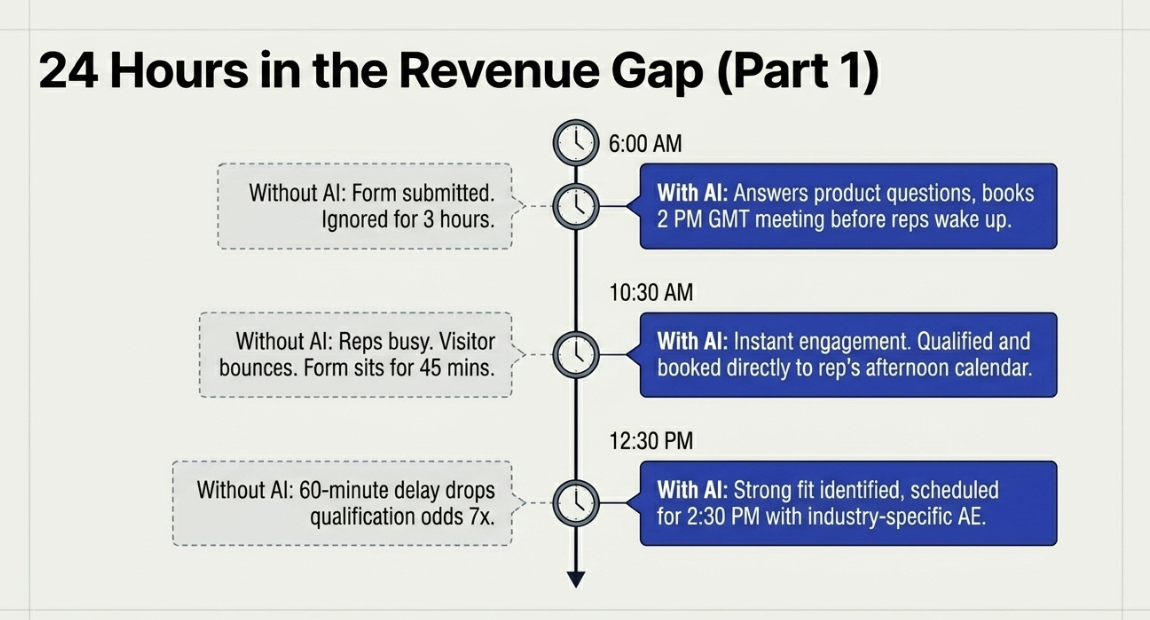
8:30 PM — Evening Research Wave Without: A VP of Operations browses after putting the kids to bed. Reads three case studies, checks your integrations page, and looks for someone to talk to. Finds a form. Decides to "come back tomorrow." Never does. With: The AI greets her, answers her integration questions, discusses how similar companies use the product, and books a 9 AM meeting with your solutions architect. She goes to bed knowing her evaluation is already in motion.
Saturday, 2:00 PM — Weekend Research Without: A business owner spends Saturday comparing three vendors. Two offer a form. The third has an AI agent that engages with her, answers her questions, and books a meeting on Monday. By Sunday evening, the decision is nearly made. With: You're the company with the AI agent. The conversation happens. The meeting is booked. Monday morning, your rep walks in with a qualified opportunity already on the calendar.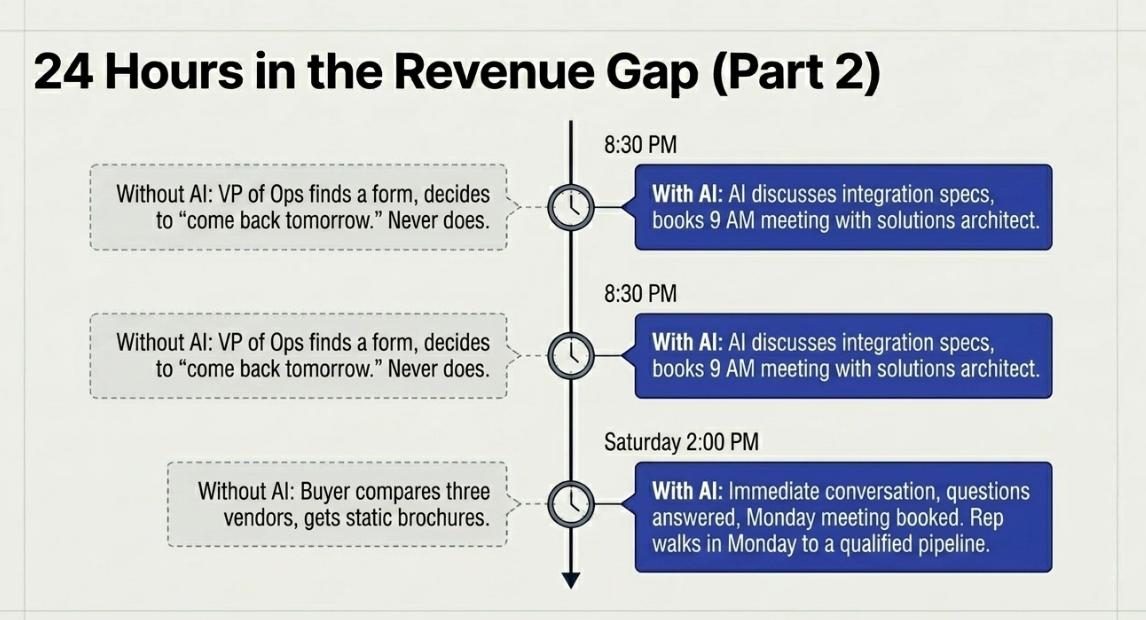
The Economics of Unengaged Traffic
To understand the revenue impact, consider a representative mid-market B2B company:
|
Metric |
Estimate |
|
Monthly website visitors |
10,000 |
|
Visitors leaving without engaging (all hours) |
~9,500 (95%+) |
|
Visitors with genuine buying intent |
~500–700 |
|
Leads currently captured (forms + chat) |
~50–80 |
|
Leads lost to slow response or no engagement |
~400–600 per month |
|
Average deal value |
$15,000 |
|
Estimated monthly revenue gap |
$150,000–$300,000+ |
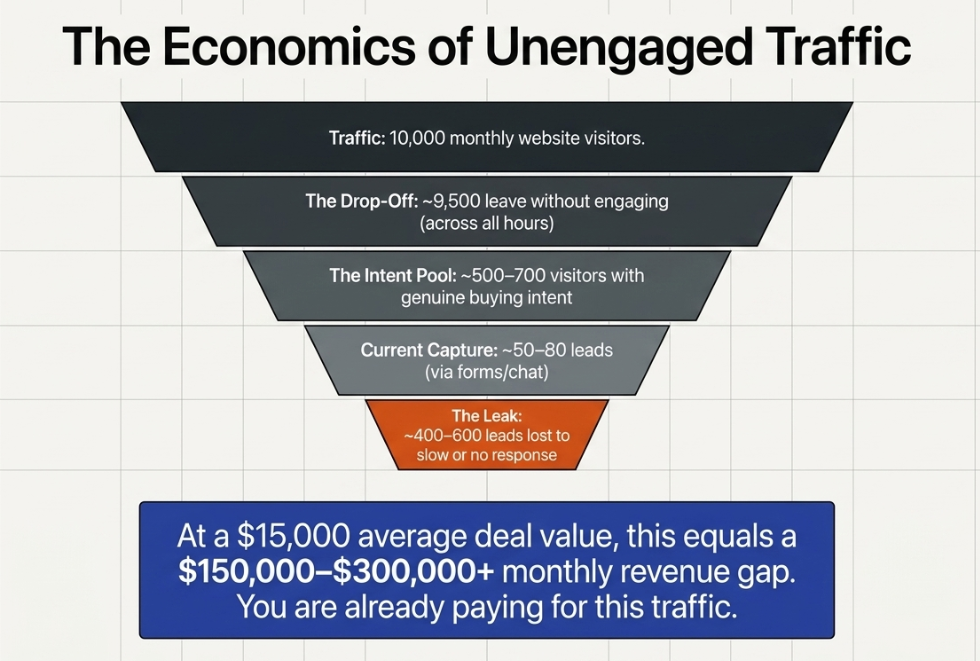
These figures are illustrative estimates based on the traffic and conversion assumptions above and are not guaranteed results. Your actual numbers will vary based on industry, deal size, and conversion baseline.
The revenue gap is not concentrated after hours. It is the 11 AM visitor who sat in the chat queue for 4 minutes and then left. The 3 PM form submission wasn't addressed until the next morning. The Saturday prospect who found someone more responsive. Every unengaged visitor, at every hour, represents revenue you have already paid to generate and failed to capture.
Who AI Voice Agents Are Right For — And Where They Won't Help
An AI voice agent is not the right tool for every business. Being clear about these matters for making a sound investment decision.
AI voice agents are well-suited for businesses that:
- Generate meaningful website traffic (generally 2,000+ monthly visitors) with documented lead conversion gaps
- Have a defined sales process and a CRM they actively use (Salesforce, HubSpot, or equivalent)
- Sell products or services with enough complexity that a visitor typically has qualifying questions before booking
- Operate in multiple time zones or have audiences that research outside of 9-to-5 hours
- Have a knowledge base or product documentation that can be connected to the agent
AI voice agents are less likely to deliver meaningful ROI when:
- Website traffic is very low (under ~1,000 monthly visitors), and the volume isn't there to justify the system
- The sales process is purely transactional with no discovery or qualification stage
- CRM data is inconsistent, or the team doesn't actively work from it, the agent's output is only as useful as the system it feeds
- The business lacks any structured content (FAQs, product docs, pricing logic) to connect to the agent
Businesses that want to close this conversion gap can deploy AI Voice Agents that integrate with their AI Sales Workflows for end-to-end inquiry capture and qualification. The deployment follows CETDIGIT's AI Implementation Model, part of the broader AI Services framework.
Industry Applications: Where the Engagement Gap Costs the Most
The visitor engagement gap exists across industries. The impact is most measurable in the following:
SaaS and Technology — Technical buyers evaluate across time zones and off-hours. They have deep questions about integrations, APIs, and security that a junior SDR can't answer, and a form can't capture. An AI voice agent that retrieves information from technical documentation, answers in depth, and routes to the right specialist.
Healthcare — Patients research providers around their own schedules, not yours. AI voice agents handle inquiries, check availability, and schedule appointments without requiring front-desk staffing at every hour.
Real Estate — Buyers browse listings after work and on weekends. Instant qualification and agent connection during those windows captures leads that otherwise disappear to better-staffed competitors.
Professional Services — Legal, accounting, and consulting prospects evaluate both during and outside business hours. The depth of engagement signals competence, which is precisely what these buyers evaluate before reaching out.
Financial Services — Insurance, mortgage, and investment inquiries spike in evenings and on weekends. AI voice agents guide initial qualification and book consultations without requiring a licensed advisor to be on call at all hours.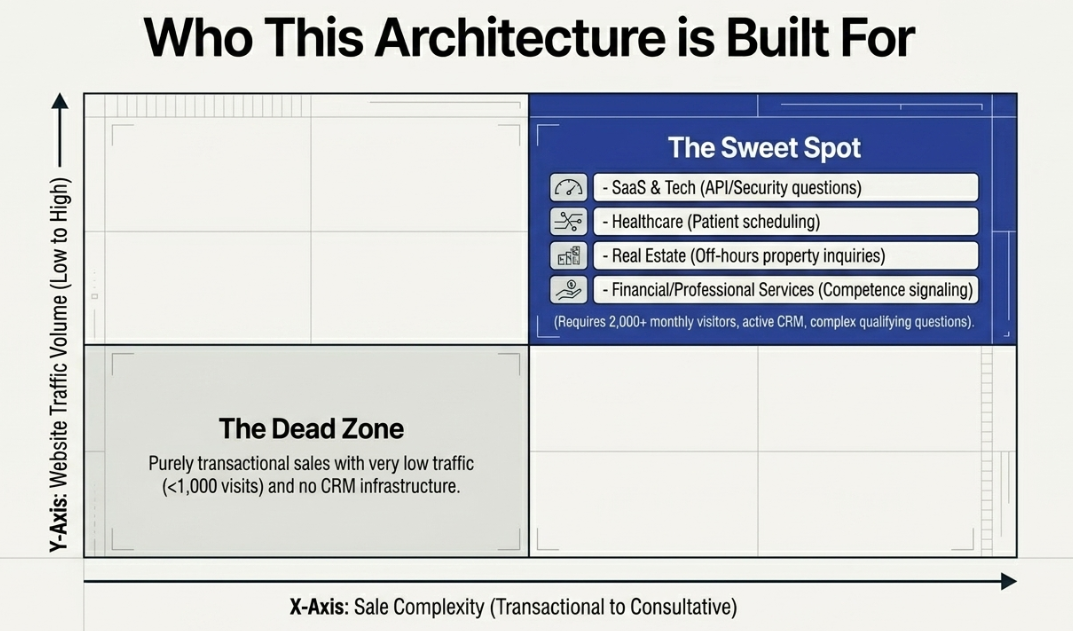
How to Close Your Website's Engagement Gap
If the gap described in this article is recognizable in your own analytics, here is a practical path forward.
Step 1: Audit your engagement gaps by hour and day. Open your analytics and examine traffic by time of day and day of week. Overlay your form submission and conversion data. Where are visitors arriving but not converting? The gaps will be wider than you expect, and they will not be limited to after hours.
Step 2: Estimate the revenue impact. Multiply your monthly estimate of unengaged visitors by your average deal value and close rate. Most businesses find the engagement gap costs multiples of what they spend on lead generation.
Step 3: Start with high-intent pages. Deploy on the pages that attract the most qualified traffic, pricing, product, contact, and demo request pages. A site redesign is not required.
Step 4: Connect your CRM and calendars. Integrate with Salesforce or HubSpot and your team's calendars. Every conversation at any hour enriches the lead record and, when appropriate, books a meeting for the earliest available slot.
Step 5: Measure across all hours — not just after hours Track engagement rates, lead quality, meetings booked, and pipeline influenced, broken out by hour and day. The impact during business hours, overflow engagement, and capturing leads your reps would have missed, is typically as significant as the after-hours impact.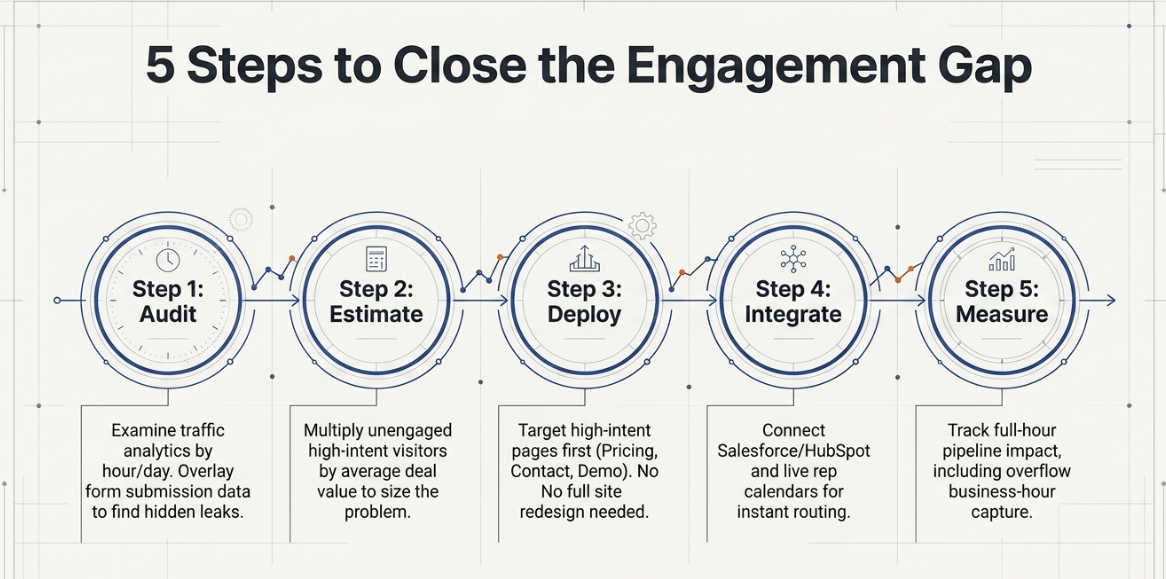
Your Website Shouldn't Be a Brochure
The traditional model of website conversion was built on a flawed assumption: that visitors would arrive during business hours, fill out a form, and wait patiently for a human to respond.
That model never worked particularly well. In 2026, it's broken completely.
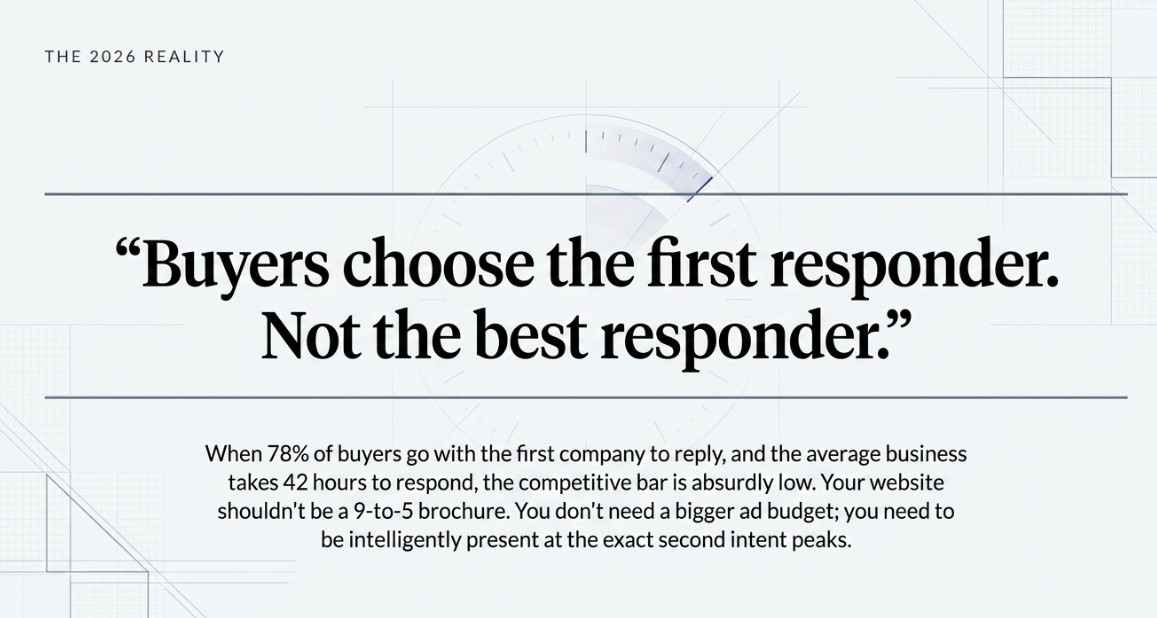
Visitors arrive around the clock, from every time zone, on every device, with high intent and zero patience. They will buy from whoever responds first, not whoever responds best, but whoever responds first. When 78% of buyers go with the first responder and the average business takes 42 hours to reply, the competitive bar is almost absurdly low.
You don't need a bigger team. You don't need a larger ad budget. You need to be present, responsive, and intelligent at every moment a prospect engages, morning, noon, night, and Saturday afternoon.
The pipeline visibility problem that produces these slow response times is examined in detail in "Why Are Leads Falling Through the Cracks at Our Company?" which introduces the Dark Funnel concept as the foundational Segment 1 pain framing.
CETRAI is built for exactly that. Every visitor. Every hour. Every conversation is captured, qualified, and converted into a pipeline.
You're already paying for the traffic. It's time to start converting all of it.
Ready to see the engagement gap in your own website data? Visit cetrai.com or schedule a consultation with the CETDIGIT team.
Voice Agent Fit
Book a 30-minute Voice Agent Fit Check. We will identify exactly which conversion gaps a voice agent can close on your website.


Leave a Comment