


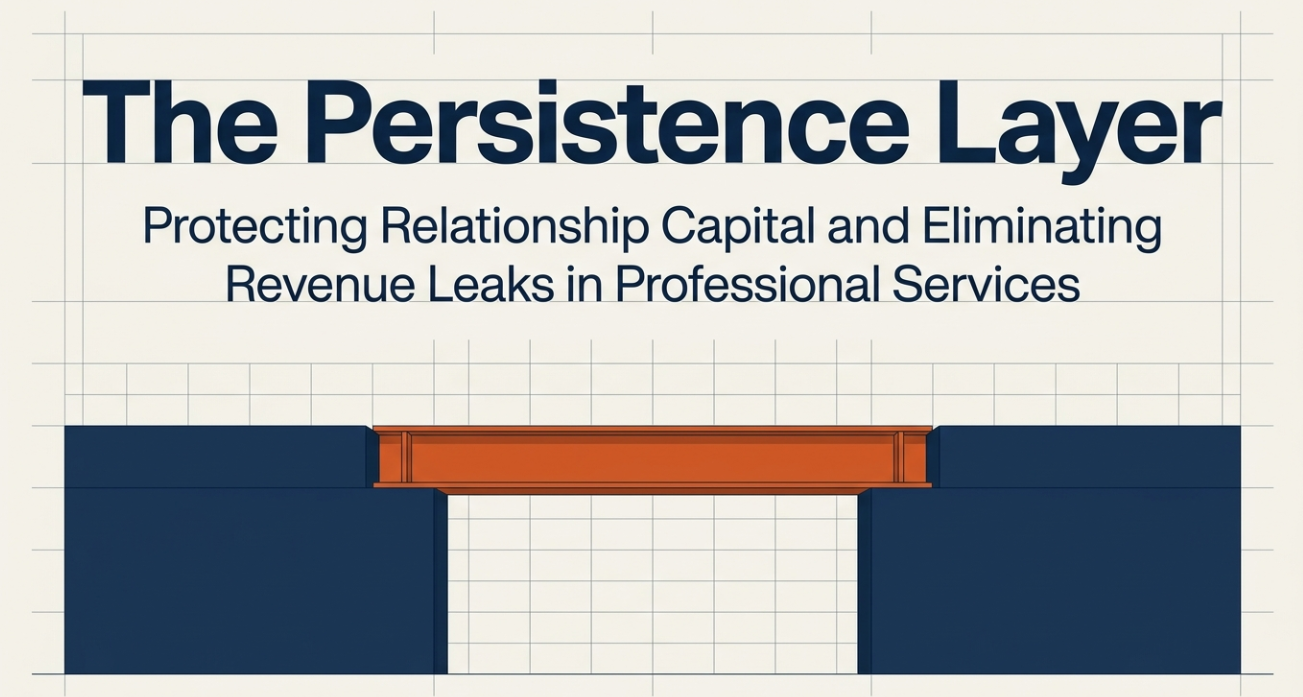
The answer for professional services firms is not a sales system. Partners don't need a pipeline; they need a persistence layer. One that remembers which referral conversations ended without a confirmed next step, schedules the follow-up on the matter before the engagement window closes, and automatically logs the contact record. That is what AI-enabled business development workflow automation does. It removes the BD work that competes with billable work, without making your firm feel like a sales organization.
The Referral That Was Yours to Win
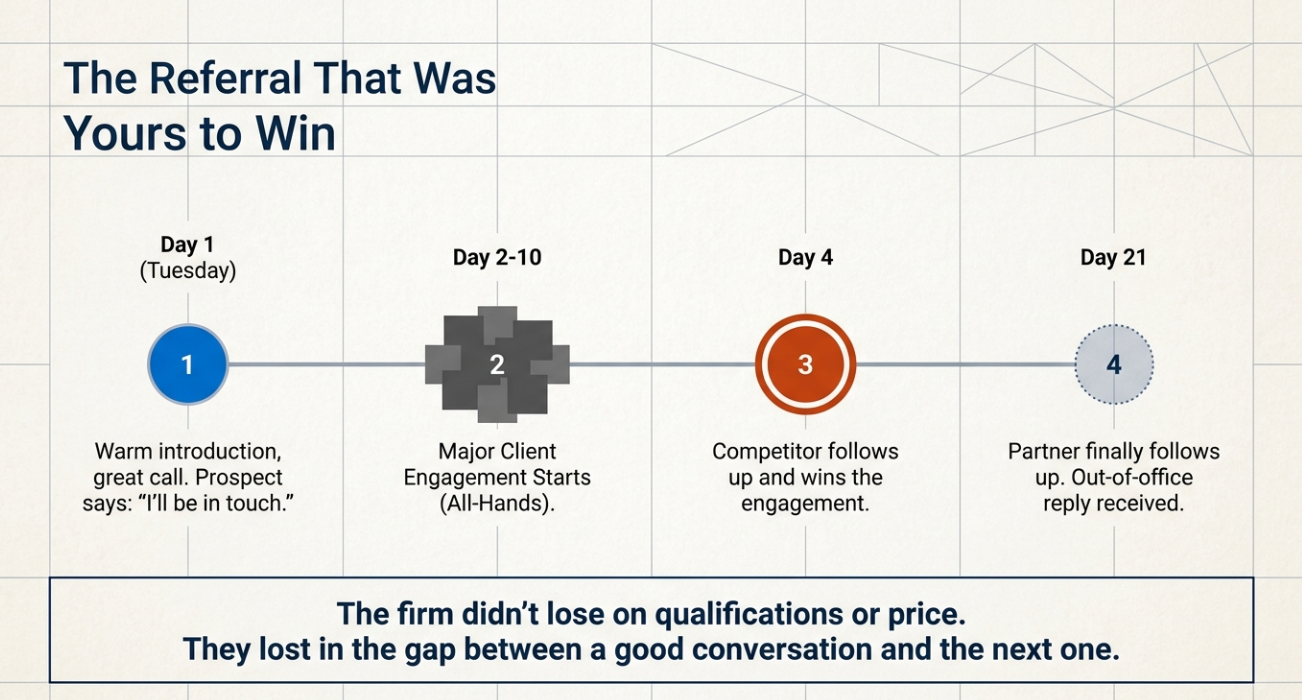
It's a Tuesday.
A partner at your firm gets an email from a long-standing client. Warm introduction. Someone from the client's network who needs exactly what your firm does, a matter that fits your practice perfectly, and the timing is right.
The partner replies that day. They schedule a call. The call goes well. The potential client says, "I'll be in touch after I review the retainer structure with my CFO."
That's a green light. That is not a rejection. That is a warm introduction, a good first conversation, and an open door.
Nobody at the firm schedules a follow-up. The partner means to reach out in a week. A major client engagement starts that Wednesday, and the next ten days are all-hands. The follow-up doesn't happen that week. Or the next.
Three weeks after the call, the partner sends a note. They get an out-of-office reply. The potential client started an engagement with a competing firm two weeks ago, which followed up three days after the initial call.
The firm didn't lose that engagement on qualifications. They didn't lose it on price. They lost it in the gap between a good conversation and the next one.
Why Professional Services Firms Lose Warm Referrals
The referral is not a marketing tactic for professional services firms. It is the business model.
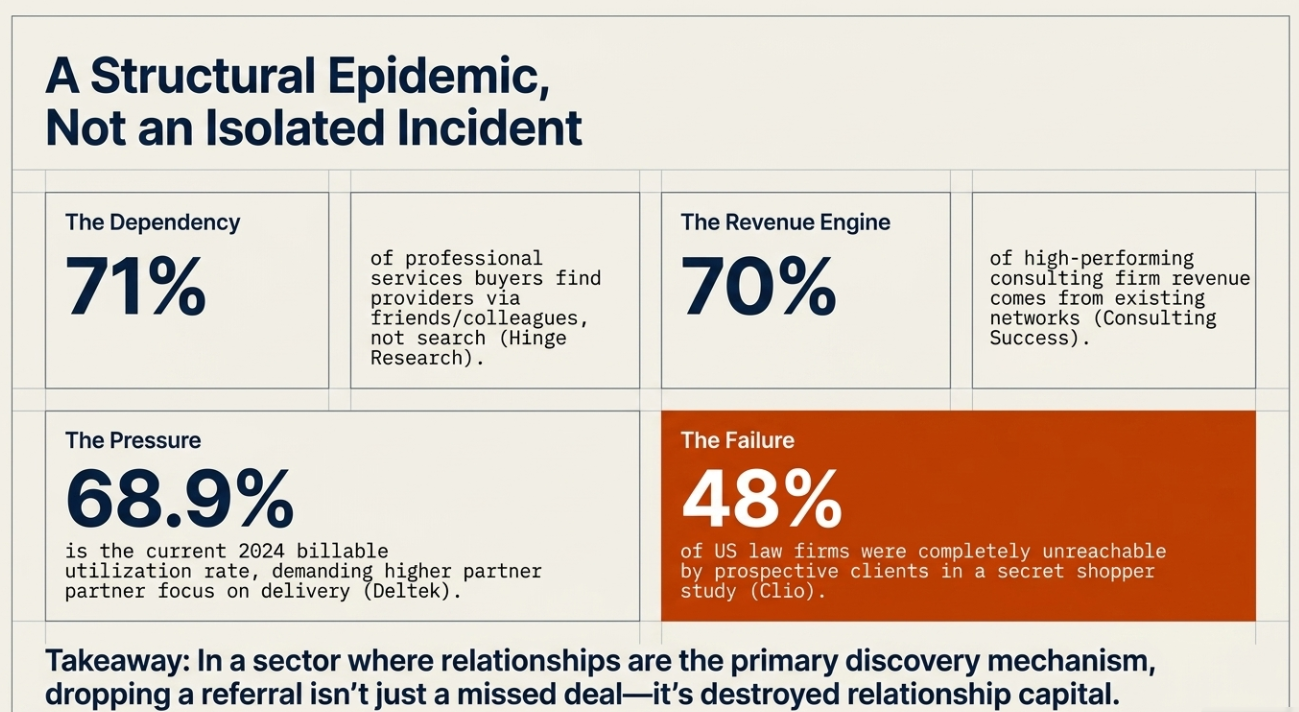
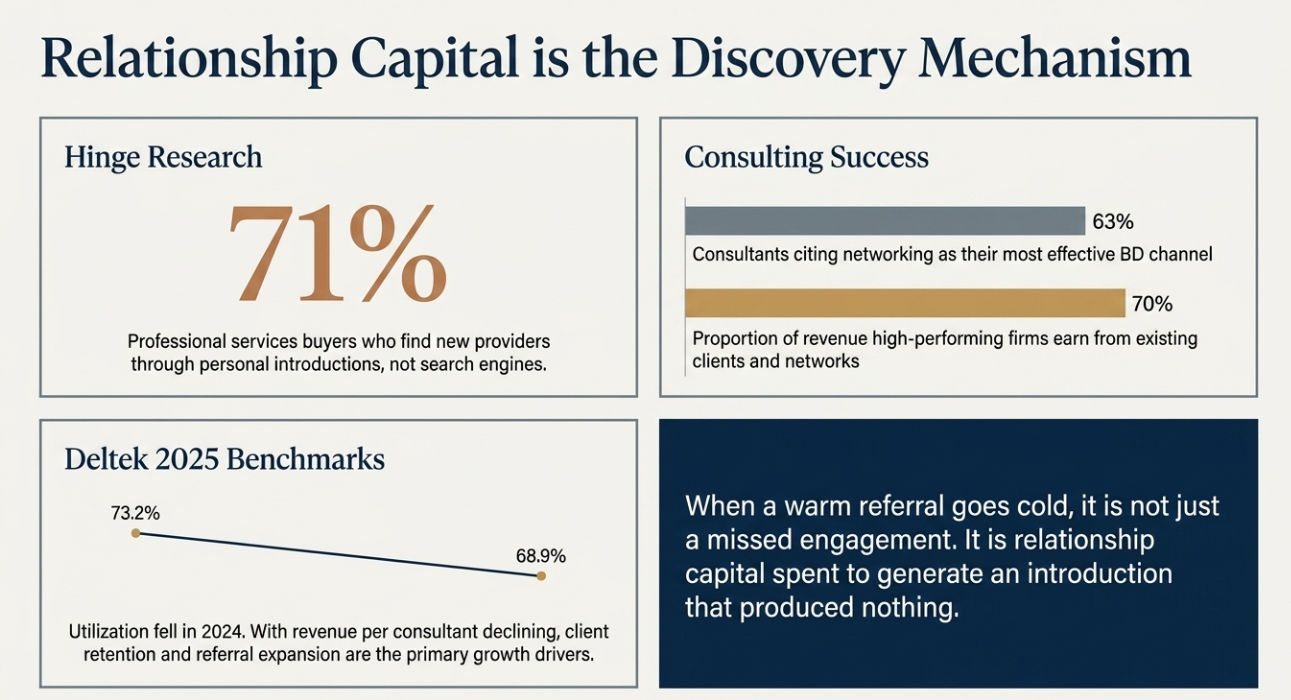
Hinge Research Institute's research on professional services referrals found that 71% of professional services buyers search for a new provider by asking friends and colleagues, not search engines, not LinkedIn, not directories. The relationship is the discovery mechanism. Which means when a warm referral goes cold, it is not just a missed engagement. It is relationship capital that was spent to generate an introduction that produced nothing.
Consulting Success research on consulting firm BD reinforces this: 63% of consultants cite networking and referrals as their most effective business development channel, and 70% of high-performing consulting firms earn the majority of their revenue from existing clients and their networks. The system that manages referrals, the follow-up, the scheduling of next steps, and the logging of contact history is not a support function. It is the revenue function.
Losing it to Quiet Resistance is expensive in ways that rarely show up on a single report.
Who This Affects
This is the managing partner, the practice lead, or the business development director at a firm that runs on relationship capital, a law firm, a consulting firm, an accounting practice, an architecture firm, or an agency.
Your firm has no dedicated sales team. Business development is distributed across partners who are also responsible for client delivery. The BD system, whatever it is, runs on intent, goodwill, and memory. When everyone is available, it works. When a major engagement starts, it quietly stops.
Deltek's 2025 Professional Services Benchmarks show billable utilization across professional services firms fell to 68.9% in 2024, down from 73.2% three years prior. Revenue per consultant has declined. In a market where client retention and referral expansion are increasingly the primary revenue drivers, the cost of a lost warm referral has never been higher.
Your average retained engagement is worth real money. If you lose one warm referral per month to no follow-up, one conversation that ended well but never had a second, the annual revenue exposure can run to hundreds of thousands of dollars. That's not a projection from a research report. That's your math. Run it against your own average engagement value.
The Pattern That Repeats
The engagement tracker nobody opens after week three
A firm decides to get serious about business development tracking. Partners agree to log every referral conversation, every follow-up, and every next step. For three weeks, it happens. The tracker is current.
Then a major client matter starts. Utilization climbs. Partners end long client days and don't open the tracker. Nobody announces they're stopping. Nobody decides the system isn't worth it. It just stops. The referral conversations continue, but they vanish from any record as they happen, and there are no follow-up fires because no one knows the follow-up is needed.
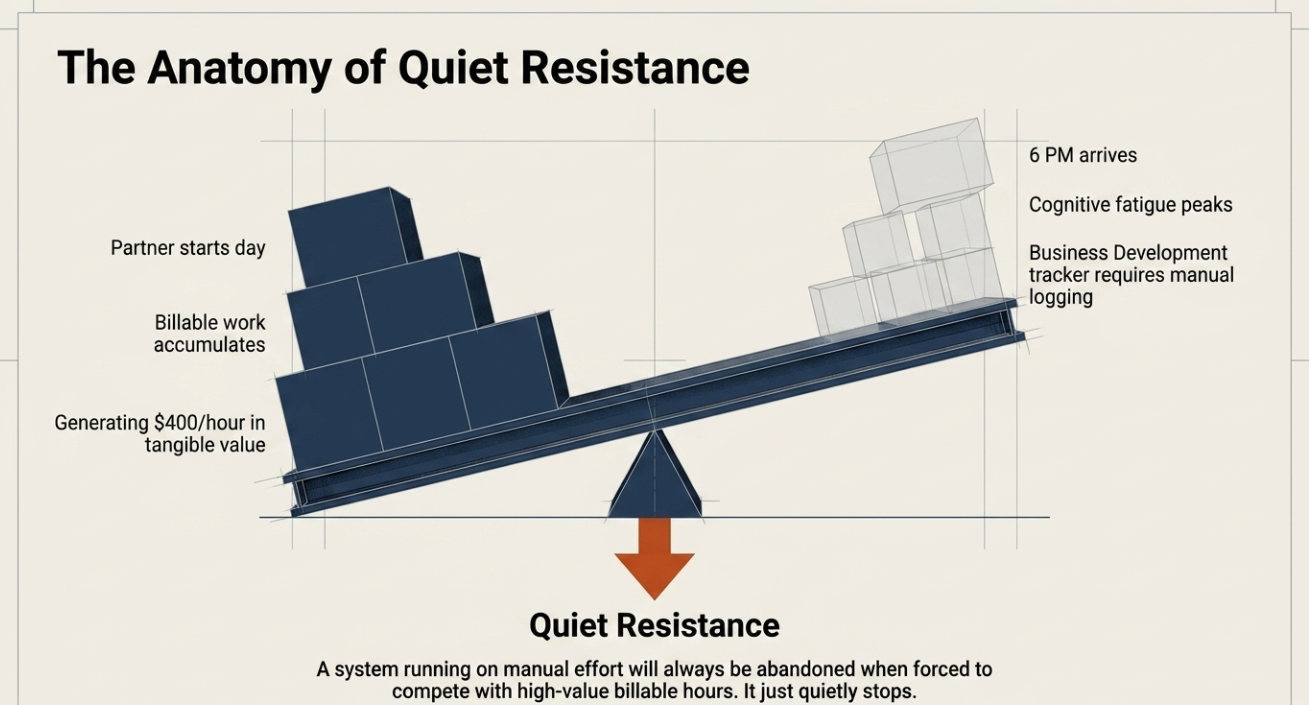
This is not a discipline failure. It is what happens when a system requires sustained manual effort that competes with billable work. The system erodes because the economics of daily BD logging versus daily billable activity are simply not comparable for a partner who bills $400 an hour.
What the data shows
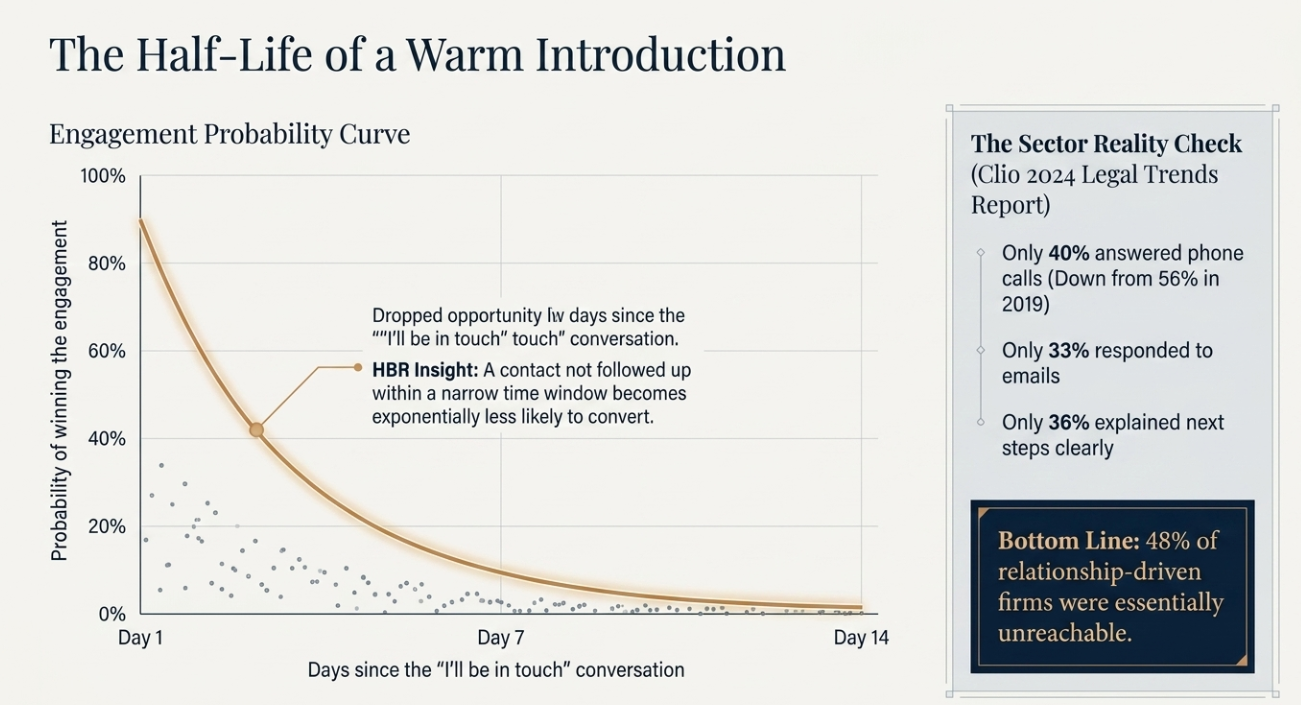
Clio's 2024 Legal Trends Report conducted a secret shopper study contacting 500 US law firms as prospective clients. The findings are a sector-level portrait of this exact failure: only 40% of firms answered phone calls, down from 56% in 2019. Only 33% responded to emails. In total, 48% of the firms contacted were essentially unreachable. Among the firms that did respond, only 36% explained the next steps clearly.
These are law firms. Relationships are their product. And nearly half of them didn't respond to a prospective client inquiry at all.
The follow-up decay logic is not specific to law. Harvard Business Review research on follow-up timing found that a warm contact not followed up within a narrow time window is exponentially less likely to convert than one followed up quickly. In professional services, the window is days, not minutes, but the principle holds. The referral who said "I'll be in touch" and doesn't hear from you within a week has already moved on in their evaluation, even if they haven't told you.
The Root Cause, Quiet Resistance
There is a name for what happens to BD systems in professional services firms. It is Quiet Resistance, and it is the answer to why follow-up fails even when everyone means to do it.
Quiet Resistance, as documented in CETDIGIT's foundational analysis of why pipelines go dark in growing companies, is the pattern where teams stop using a system that demands manual input without giving anything useful back, not through any decision, just through gradual abandonment. The pattern has a specific texture in professional services: tracking a referral conversation and scheduling the next follow-up on the matter requires focused attention at the end of a day when that attention has already been spent. The system asks for something the partner cannot give at 6 PM after a seven-hour client engagement.
The result is not a failed system. It is a system that was never going to survive on manual effort alone. The engagement tracker nobody opened after the third week is not a symptom of low commitment. It is a symptom of a design that required partners to choose between billing and BD, every day, indefinitely.
A warm referral that fell through because nobody followed up is also a Dark Funnel event; it happened, it generated real revenue exposure, and it left no trace in any system. The firm lost an engagement and has no record of how or when.
What It's Costing Your Firm
|
What's happening |
What does it cost you |
What to fix first |
|
Referral conversations that end without a confirmed next step |
The engagement goes to a competitor who followed up, often within days |
Set a system that schedules the follow-up on the matter the moment a referral conversation closes without a confirmed next step |
|
BD conversations that are never logged anywhere |
No contact history means no warm follow-up; every subsequent call starts cold |
Connect every referral conversation to a contact record so the next touch has context |
|
Follow-up that happens "when I remember" rather than on a schedule |
The window closes before the follow-up happens, Clio's data shows 48% of law firms were unreachable as prospective clients |
Build a follow-up schedule that doesn't live in a partner's memory |
|
A referral source who stopped sending introductions without explanation |
You lost a relationship multiplier with no record of why |
Log every referral source conversation to see which relationships are active and which have gone quiet |
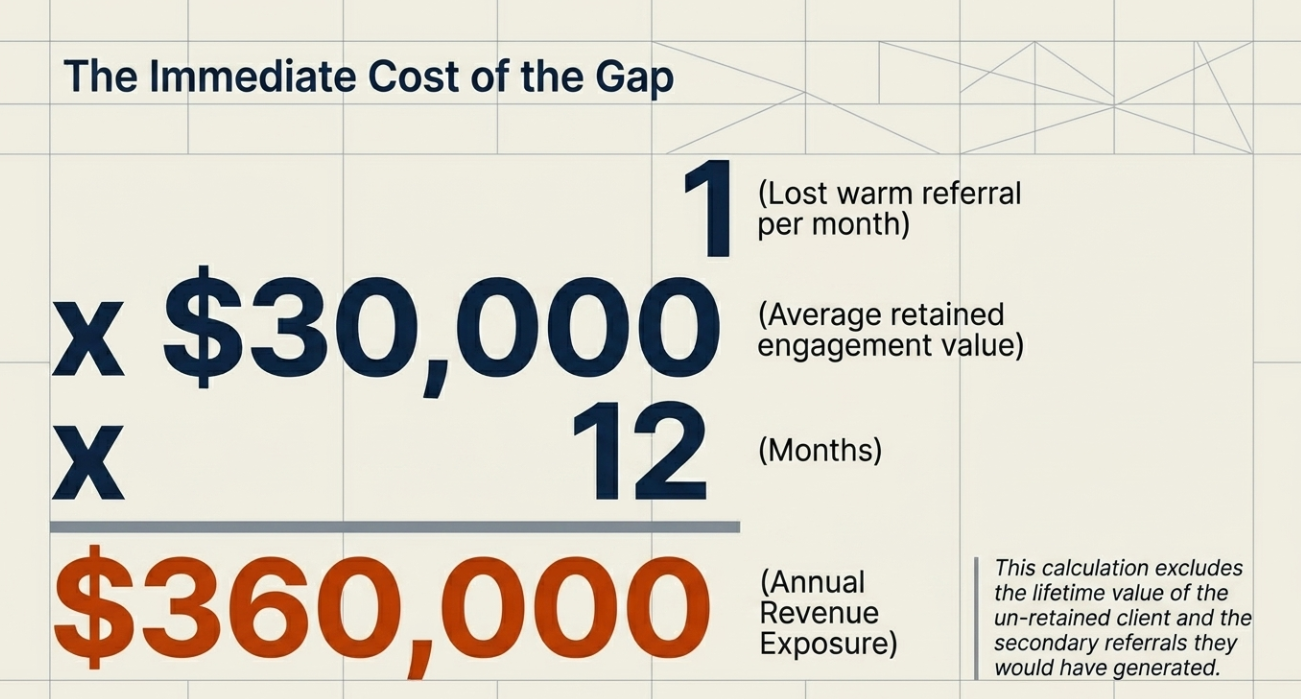
If your average retainer or engagement is worth $30,000 and you lose one warm referral per month to no follow-up, the annual revenue exposure is $360,000. That is before you count the lifetime value of the client you didn't retain, or the referrals they would have sent. Run this math with your own numbers.
The CETDIGIT Perspective
The professional services version of this problem requires a different frame than the typical sales automation pitch. The managing partner is not a sales rep. The firm is not running a cadence. What it needs is a persistence layer, a system that holds the follow-up obligation so the partner doesn't have to.
That is specifically what AI sales workflow automation for professional services firms does. When a referral conversation ends without a confirmed next step, the system schedules the follow-up on the matter. When a partner completes an intake call, the contact record is created automatically. The follow-up fires on schedule, whether or not the partner remembers to log it. The cross-sector follow-up architecture in this workflow framework is the same foundational system; this is its professional services translation, with the vocabulary of relationship management rather than sales process, and the follow-up logic adapted for the billable/BD tension that defines this sector.
For firms that also handle inbound intake calls, AI voice agents for inbound coverage answer every call and log every contact, so prospective clients who call to ask about availability before any referral conversation has happened don't have to repeat themselves. The two layers together, follow-up automation for warm referrals and voice coverage for inbound intake, connect into CETDIGIT's broader AI services framework and are part of the same architecture that connects AI workflows to a revenue engine at the firm level.
A Step-by-Step Framework for Follow-Up Without the Sales Feeling
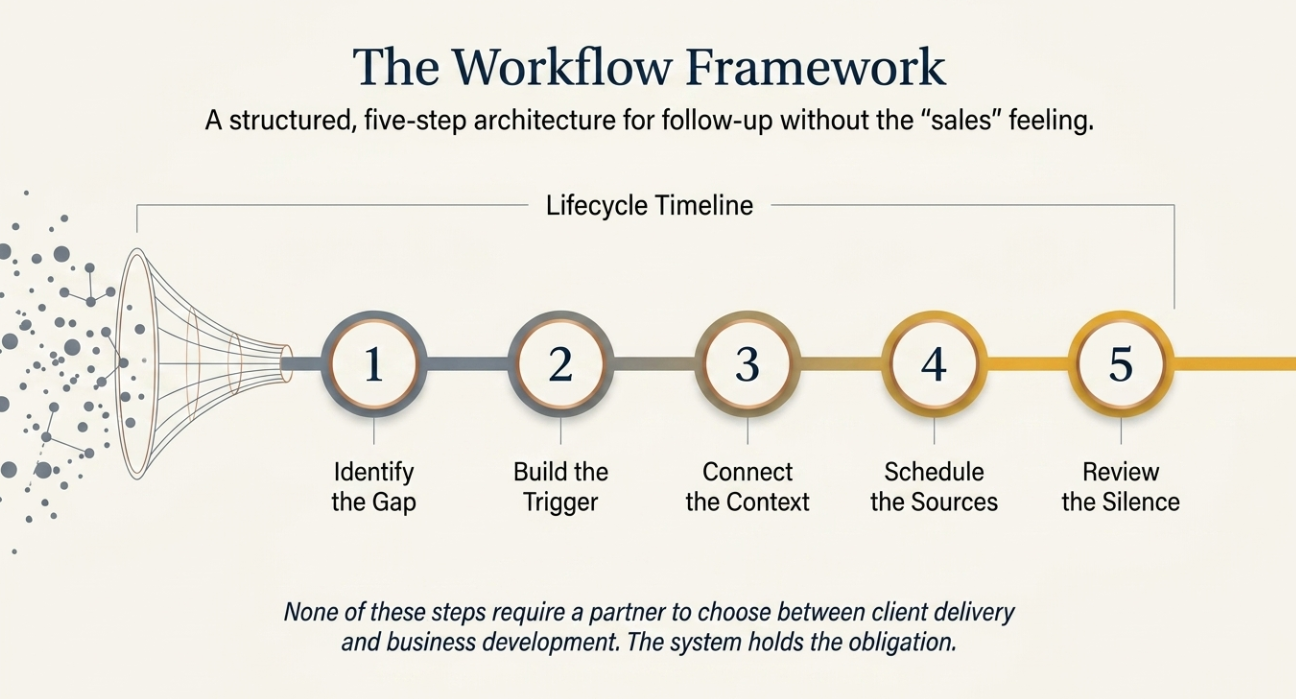
Step 1: Identify every referral conversation that ends without a confirmed next step. Walk back through the last 90 days of BD conversations. How many ended with "I'll be in touch" or "let me review and get back to you"? Those are the open engagements. For each one, ask: was a follow-up scheduled anywhere? If not, that is your gap inventory.
Step 2: Build a trigger that fires the moment a referral conversation closes without a confirmed next step. The trigger is not a reminder on a calendar. It is a system rule: when a referral conversation ends without a scheduled next step on the matter, a follow-up task is automatically created and assigned. The partner doesn't have to remember. The system holds it.
Step 3: Connect every BD conversation to a contact record so the next touch starts with context. A follow-up call that begins "I just wanted to check in" carries less weight than one that begins with specific context from the last conversation. Connecting every intake and referral conversation to a contact record means partners walk into follow-up calls knowing exactly where the last conversation ended.
Step 4: Assign a follow-up schedule to active referral sources, not just active referrals. The referral sources, the clients and partners who send introductions, are the highest-leverage relationships in the firm. A system that tracks only active referrals misses half the BD opportunity. Log every conversation with a referral source and establish a cadence of touches to keep those relationships active, without requiring partners to maintain a mental list.
Step 5: Review what went quite well every month. Once the system is running, the most valuable report is the list of referral conversations that entered the system and never converted to an engagement. That is where the revenue exposure is visible. That is also where the follow-up architecture can be refined, not by working harder, but by seeing where the persistence layer needs a shorter trigger window or a different follow-up format.
Frequently Asked Questions
Why do professional services firms lose referrals they never follow up on?
Hinge Research Institute's referral research establishes that 71% of professional services buyers find providers through personal introductions. The referral is the dominant discovery mechanism in this sector, which means when a warm introduction doesn't hear back, the prospect doesn't search harder; they take the next warm introduction that comes along. The firm that follows up three days after the initial conversation wins by default.
How do law firms and consultancies manage business development without a sales team?
Most manage it through partner memory and intent, which works when utilization is low and fails when a major engagement starts. Clio's 2024 Legal Trends Report found that 48% of law firms were essentially unreachable by prospective clients. The firms that do it well build a persistence layer that holds the BD obligation outside the partner's working memory, so the follow-up happens on schedule regardless of how full the client calendar is.
What is Quiet Resistance, and why does it affect professional services BD systems?
Quiet Resistance is the pattern in which a system stops being used not through any explicit decision but through gradual abandonment, because it demands manual effort that competes with higher-priority work. In professional services, the competing priority is billable work. The engagement tracker stops being updated not because partners don't care about BD, but because logging follow-up notes after a seven-hour client day is the lowest-value task of the day. The canonical definition lives here, in CETDIGIT's foundational analysis of why growing companies lose pipeline.
How can AI help with client intake and follow-up for professional services?
AI sales workflow automation removes the manual effort requirement from BD follow-up. When a referral conversation ends without a confirmed next step, the system automatically schedules the follow-up on the matter. Contact records are created without the partner having to log them. The persistence layer holds the BD obligation, so the partner can focus on the client engagement without the referral going cold in the background.
What is the best way to track and follow up on referrals for a professional services firm, without it feeling like sales?
The five-step framework in this article walks through the process: identify open engagement conversations from the last 90 days, build a trigger that fires when a referral conversation ends without a next step, connect every conversation to a contact record, build a follow-up schedule for referral sources (not just active referrals), and review what went quiet every month. The key is that none of these steps requires partners to choose between billable work and BD; the system holds the obligation, so the partner doesn't have to.
How much revenue do professional services firms lose from referrals that go cold?
A single lost warm referral at a $30,000 average engagement value, recurring monthly, produces $360,000 in annual revenue exposure, before accounting for client lifetime value or the referrals that the client would have sent. The actual number for your firm depends on your average engagement size and your current referral conversion rate. Consulting Success research shows that 70% of high-performing consulting firms' revenue comes from existing clients and their networks, which means the referral conversion rate is among the highest-leverage metrics in the firm and one of the least measured.
Revenue Leak Assessment
Find out exactly which referrals and client opportunities your firm is losing, and what to fix first. Book a 20-minute Revenue Leak Assessment. We'll identify where your BD follow-up is breaking down, which referral relationships have gone quiet, and what to build first.



Leave a Comment