


An in-house AI team is the group of people who own a System of Action: the layer where AI acts on what your CRM knows, within limits people set. It is a set of jobs, not a department: choosing the business number AI is for, setting limits, building agents, keeping CRM context accurate, and reviewing the work. Many teams start with those jobs as hats on existing people.
A Monday Question No One Can Answer
It is Monday, 9:10 a.m., and the weekly pipeline review has barely started on a video call. The VP of Marketing points at a deal that moved to a later stage over the weekend. Nobody on the call moved it. "Who approved that?"
The Head of RevOps opens the activity log. An AI agent made the change, following rules set three weeks earlier by someone who has since moved to another project. Marketing Ops assumed RevOps was watching. RevOps assumed marketing had signed off. Ten minutes later, the review is a search for a name.
This is an illustration, not a client story. Nobody was careless; the work belonged to no one.
Problem Definition: AI Is Switched On, and Nobody Owns It
An unowned AI deployment is one where agents and AI features run in HubSpot, but no named person sets their limits, reviews their work, or answers for the number they were meant to move. In its UNBOUND 2026 survey of 6,000 customers and prospects, HubSpot reported that 90% use AI and 6% see transformational results, and its CEO called this period the Maxing Phase. McKinsey's survey of 1,491 respondents, fielded in July 2024, found that AI governance is jointly owned by two leaders on average. That is shared accountability at the top. It does not say who reviews the work each week.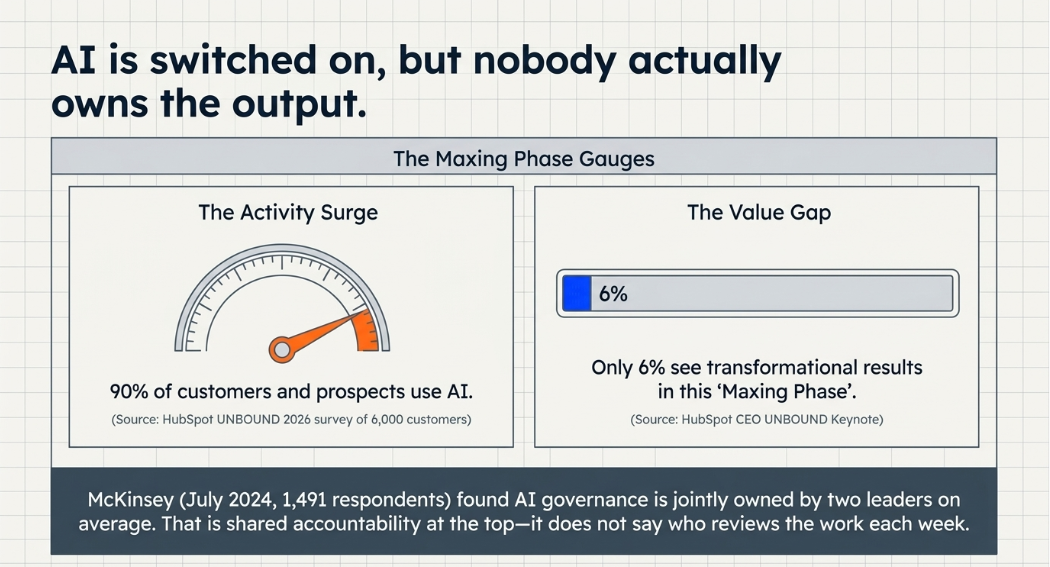
Ownership is one piece of getting AI working, and you can see where this fits in CETDIGIT's AI services. Any team should be judged by Cost per Outcome: the dollar cost of each result the business wanted, such as a qualified lead or a resolved conversation, rather than headcount or activity.
Who This Affects
This is for the Head of RevOps or Marketing Ops who ended up with AI because the CRM was already theirs, and for the VP Marketing, CMO, or Head of Growth deciding whether the answer is a hire, a reassignment, or a pause. In IAPP's research on the AI governance profession, larger companies can split the work across several roles, while smaller ones look for one professional who covers all of it. That smaller-company pattern is the one this piece plans for.
Symptoms
These situations show a System of Action running without an owner:
- Nobody can say who approved an agent's last change.
- Reviews of AI output happen when someone remembers, not on a schedule.
- The person who built an agent is also the only person who checks it.
- The weekly AI report counts activity, such as messages sent, and nobody can name the business result it was meant to move, the pattern behind why AI tools produce activity but not revenue.
- When someone changes teams, their agents keep running with no one assigned.
Root Causes
Four causes explain how this happens, and carelessness is not one of them.
AI touches every function and belongs to none. In a Gartner poll of webinar attendees (1,808 respondents, June 2024, not representative of the market), only about a quarter aligned accountability for AI to one clear role.
"Governance" is several jobs under one name. IAPP's AI Governance Skills Framework, published on 30 September 2026, sorts public job profiles into eight types of work: policy, governance, technical, product, ethics, risk, legal and assurance. IAPP adds that most organizations will not assign a different person to each, so one role will likely cover two or more.
The builder reviews their own work. NIST's AI Risk Management Framework Playbook, voluntary guidance last updated in June 2026, says roles and responsibilities should be documented and clear, and suggests separating AI development from testing. A one-person AI function has to build both on purpose.
Context goes stale, and nobody is told. HubSpot's CEO described context as the dynamic knowledge about your business, your customers, and your team, and argued that AI running on bad context does more harm than no AI. HubSpot did not name a role for keeping it accurate, so we add one as CETDIGIT's reading, not a HubSpot title.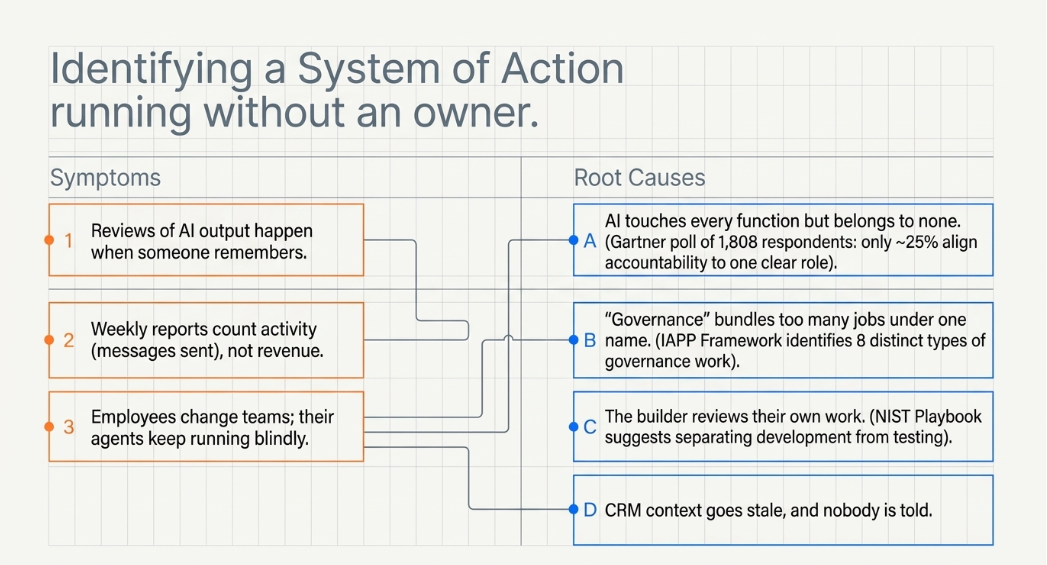
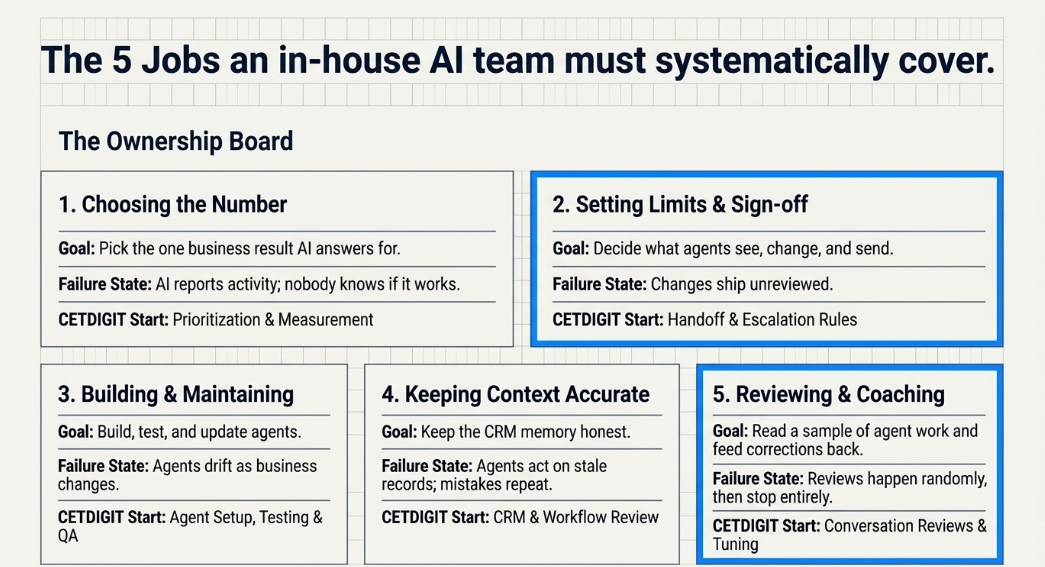
Decision Table: The Five Jobs an AI Team Covers
HubSpot's CEO named three roles in the UNBOUND 2026 opening keynote: AI specialists, Go-To-Market engineers, and governance experts. As far as we could find, HubSpot has not defined them, so any match below is CETDIGIT's reading.
|
Job |
HubSpot's name |
What it does |
What stalls when nobody owns it |
Where CETDIGIT would start (our perspective) |
|
1. Choosing the number AI is for |
Not a HubSpot-named role |
Picks the one business result AI answers for and sets its baseline |
AI reports activity, and nobody can say whether it works |
Use-case prioritization and measurement |
|
2. Setting limits and signing off |
Governance experts |
Decides what agents may see, change, and send, and what needs approval |
Changes ship unreviewed, and nobody can say who approved them |
Handoff and escalation rules |
|
3. Building and maintaining agents |
AI specialists; Go-To-Market engineers |
Builds, tests, and updates agents and workflows |
Agents drift as the business changes |
Agent setup, testing, and QA |
|
4. Keeping CRM context accurate |
Not a HubSpot-named role |
Keeps what AI reads about customers and the business correct |
Agents act on stale records, and mistakes repeat |
CRM and workflow review |
|
5. Reviewing and coaching |
Not a HubSpot-named role |
Reads a sample of agent work and feeds corrections back |
Reviews happen when someone remembers, then stop |
Conversation reviews and tuning |
For job 2, how HubSpot runs AI internally includes building permissions, audit trails, and escalation paths once agents owned whole steps of a workflow. For job 3, one analyst's review of 1,000 GTM-engineering job postings lists building and automating GTM workflows, integrating the stack, and owning the CRM among the top responsibilities, though the overlap with RevOps-engineer roles is contested. For job 5, McKinsey found that 27% of respondents said employees review all gen AI content before use, and a similar share said 20% or less is checked.
The CETDIGIT Perspective
The CETDIGIT perspective is a four-part lens, ours rather than HubSpot's: the CRM is the memory, workflows are the rules, agents do the reasoning, and people make the call. In the table, job 4 keeps the memory honest, job 3 builds the rules, and the agents and jobs 1, 2, and 5 are where people make the call.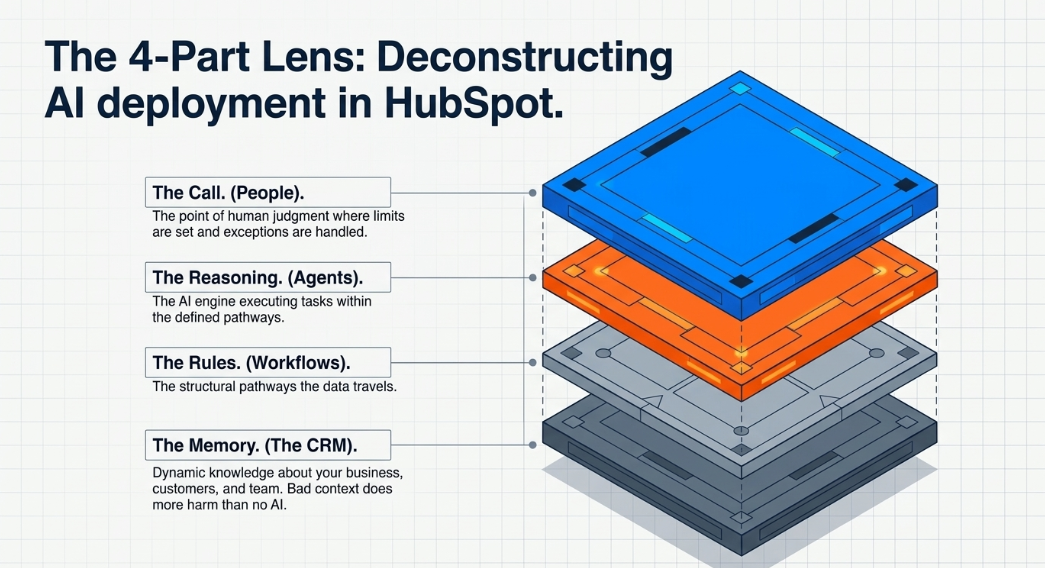
That lens reconciles two ideas that sound opposed. Our piece on how a system of action differs from a system of record describes the first as acting without waiting for a person to review every data point. HubSpot's emphasis is human oversight. Both hold. The system acts on its own on routine steps within limits people set and review, and people step in at the judgment point. Setting those limits is the governance job.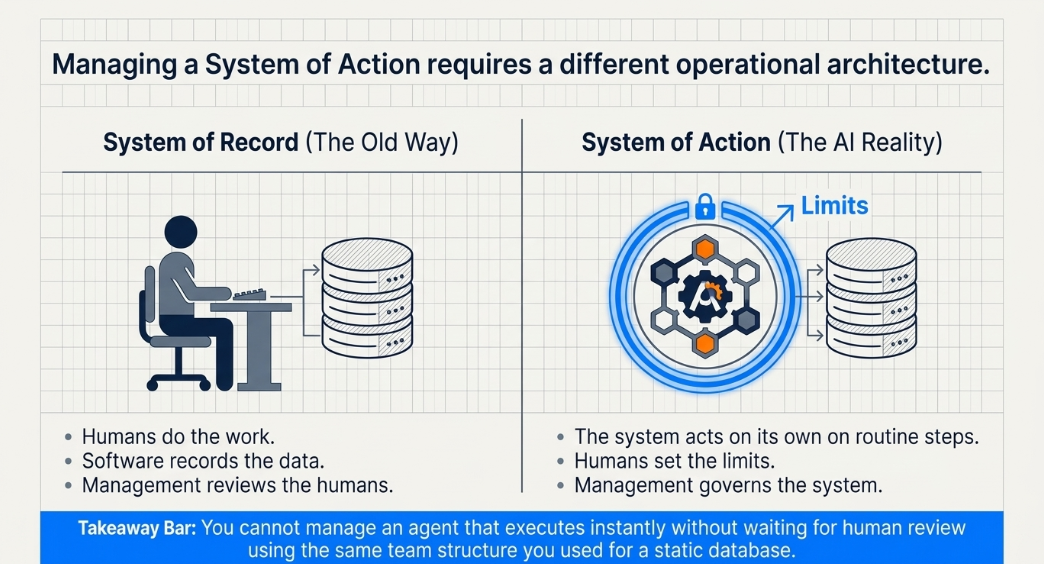
HubSpot's CEO said the floor on building has come down, but "the ceiling on thinking has gone up." The jobs that need thinking are 1, 2, and 5, so name owners for those first. On the UNBOUND customer panel, RevenueWell's Kim Cormier described having SDRs review every outgoing AI email at first. That is a HubSpot customer's practice, not CETDIGIT proof.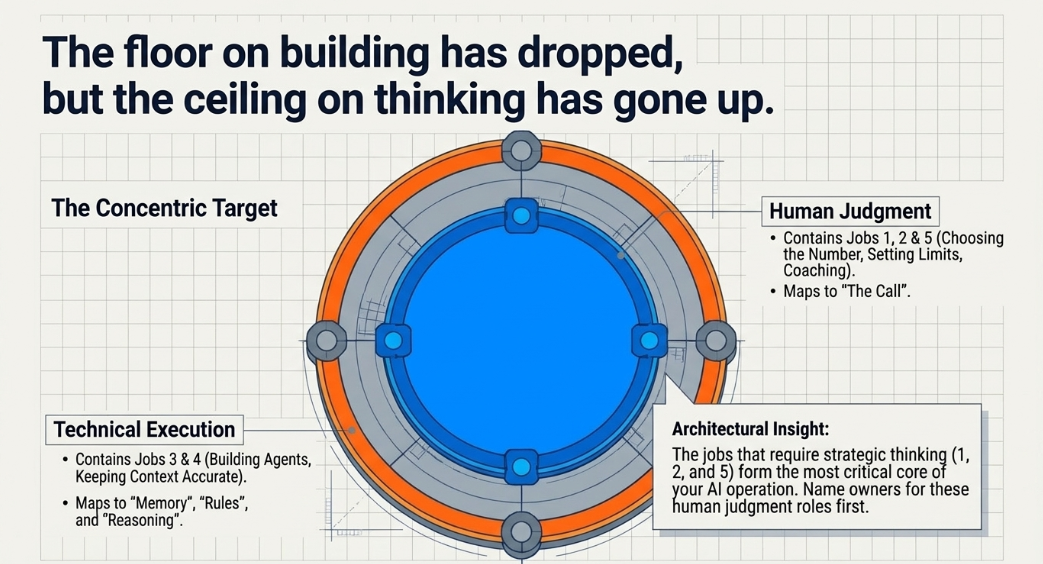
Whichever way the jobs are covered, the test is Cost per Outcome, or judging AI by the outcome it produces instead of by headcount or activity. As a HubSpot Elite Partner, CETDIGIT sets up AI agents inside HubSpot with handoff and escalation rules, testing and conversation reviews, which map to jobs 2, 3, and 5.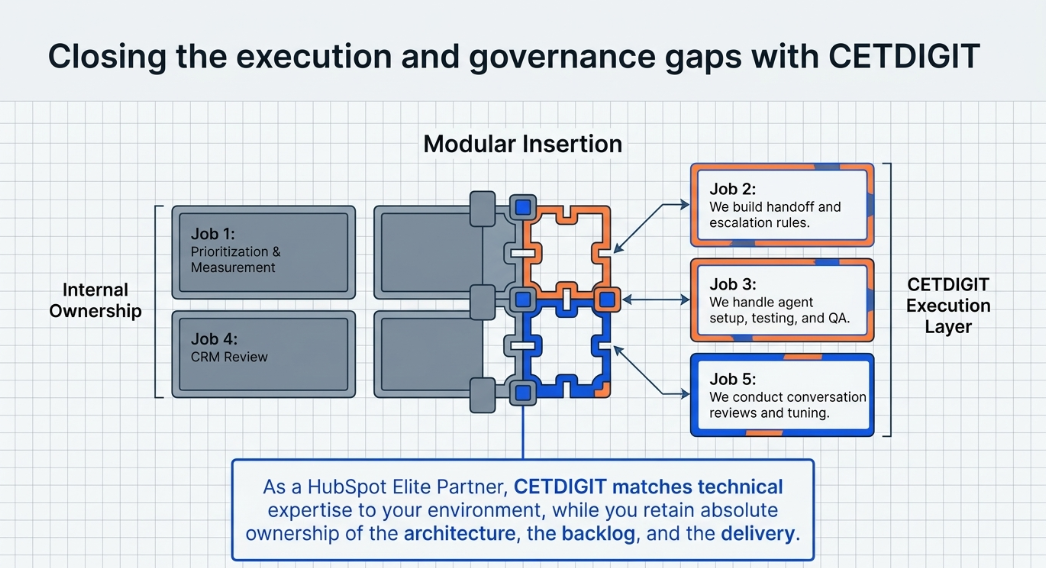
Recommended Path
There are three ways to cover the jobs, and each fits a different situation.
Hats on existing people fits when a few use cases are running, and someone already owns the CRM. IAPP's survey of more than 670 respondents, fielded in spring 2024, found that organizations build AI governance teams step by step, tasking the existing workforce first and hiring later. The condition is that nobody reviews only their own agent.
A first hire plus an outside partner fits when the jobs outgrow your people but do not yet justify a standing team. In CETDIGIT's view, the hire covers jobs 1 and 2 because those need deep knowledge of your business, and a partner covers agent setup, testing, and reviews. The first step is an AI roadmap with named owners.
A standing in-house team fits when AI runs across several functions, and the jobs need full-time attention. HubSpot's own setup, a central AI strategy team plus dedicated teams for Sales, Customer Success and Product, shows the shape at a scale few readers will match.
The right choice depends on how many of the five jobs already have an owner. To see the outside-partner option, read how CETDIGIT helps your team get AI working.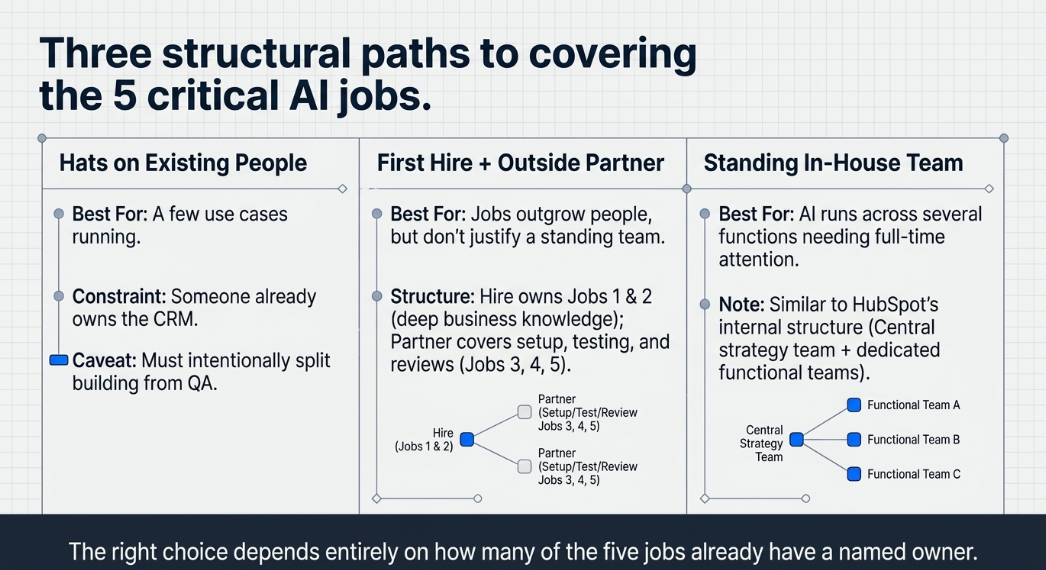
FAQ
What new AI roles is HubSpot talking about?
HubSpot's CEO named three roles in the UNBOUND 2026 opening keynote: AI specialists, Go-To-Market engineers and governance experts. As far as we could find, HubSpot has not defined any of them, so treat the titles as labels for work and use the five jobs above as the working list.
What does an AI governance role actually do?
IAPP's AI Governance Skills Framework sorts the work into eight types, from policy and risk to legal and assurance, and a single role is likely to cover two or more. NIST adds that roles and responsibilities should be documented and clear.
Who should own AI in a sales and marketing team?
In a Gartner poll of webinar attendees, only about a quarter aligned accountability for AI to one clear role. The poll is not representative of the market. A practical start is one named owner for the business number AI is for, which is job 1.
Do I need to hire an AI specialist, or can my existing team run it?
IAPP's spring 2024 survey found that organizations task existing people first and hire later, and only 10 of 671 respondents expected to need no additional AI governance staff in the next 12 months. That points to a sequence: start with named hats, and hire when a job outgrows the person wearing it.
Can an outside team cover part of this, or do we have to hire all of it?
IAPP found that smaller companies look for one person to cover all of AI governance. An outside team can take on agent setup, testing and reviews while your people keep the business number and the limits. That split is CETDIGIT's view, not a research finding. The full range of CETDIGIT's AI services shows where an outside team fits.
How do I know whether the team is working?
In McKinsey's survey of 1,491 respondents, tracking well-defined KPIs for gen AI had the strongest correlation with self-reported EBIT impact among 12 practices, yet fewer than one in five organizations reported doing it. That is correlation, not proof. Our test is Cost per Outcome: the dollar cost of each result the business wanted, not hours logged or messages sent.
Build Your In-House AI Team
If you want to organize an in-house AI team, CETDIGIT can help you add the right specialists with the right expertise, matched to your technical environment, while you keep ownership of the architecture, backlog and delivery. Learn more about CETDIGIT's expert-led AI staffing.


Leave a Comment