


HubSpot works for manufacturers as the commercial front end, once it is connected to the ERP, so quote data and customer data can be reconciled in one place. Native quotes, deals, and line items are available on all Sales plans. Representing ERP structures like distributors, orders, or SKUs as their own records requires Enterprise. Once that connection is clean, AI agents for quote follow-up have something true to work from.
The Monday forecast argument
It is 9:15 on a Monday, and six people are arguing about a number.
The commercial director has a forecast from the CRM. The GM has a different number from the ERP, built off open orders and quotes actually issued. Sales ops has a spreadsheet reconciling the two, already three days stale. The distributor business sits in a fourth tab, because nobody has settled whether a dealer order is a live opportunity or booked revenue.
Nobody is wrong. Everyone is reading accurate data out of systems that have never spoken to each other.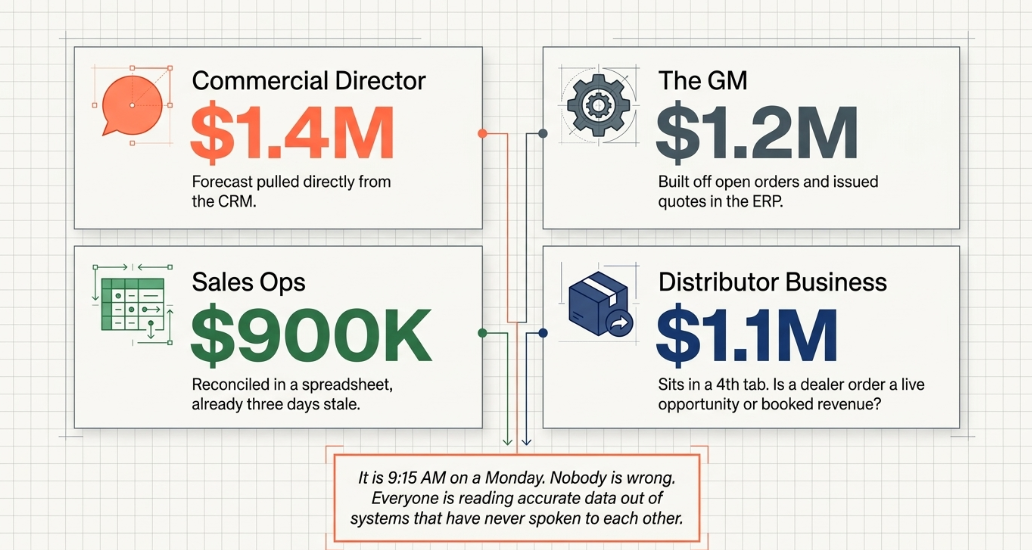
By 10:00, the meeting produces a number everyone can live with, and nobody believes. Then a rep opens the quote he built in the ERP last Thursday and re-keys it into the CRM so the account looks current. Eleven minutes, four times a week, times seven reps.
That re-keying is the Silo Tax in a manufacturing business. It is not a productivity problem. It is why the forecast is an argument.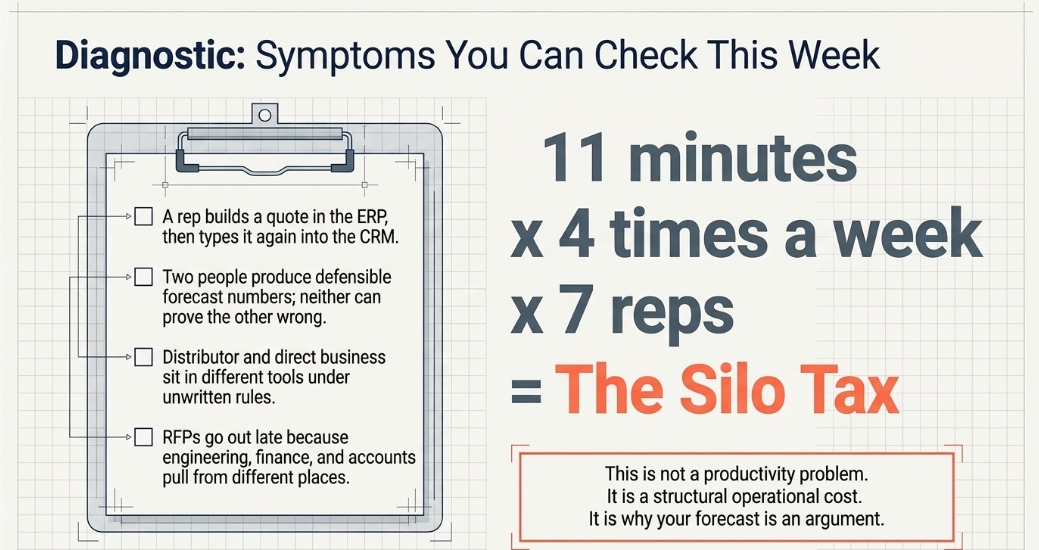
Two systems that own different halves of the same customer
The ERP owns SKUs, price lists, inventory, order history, and shipping. The CRM owns leads, accounts, engagement history, quote stages, and the forward view. Both are correct about their half. Neither has the other half.
So a quote issued in the ERP stays invisible to the CRM until someone types it in. Every commercial question spanning both halves, which is most of them, gets answered by hand.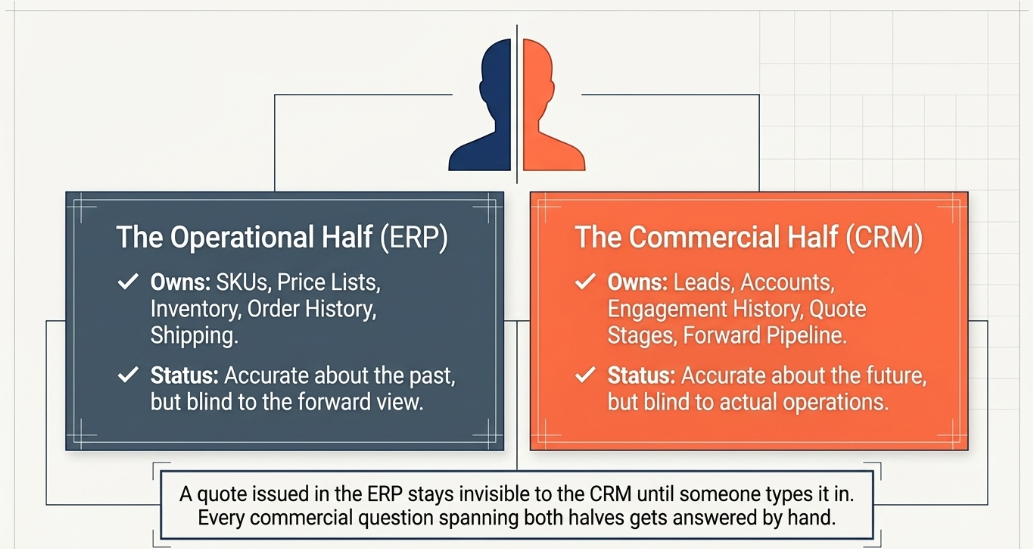
Who this affects
Mid-market manufacturers and distributors, roughly $10M to $200M in revenue, 25 to 500 employees. Long procurement cycles, a mix of direct and distributor channels, and an ERP that works fine at the job it was bought for.
The tell is team size against data size. A manufacturer doing $60M might have four people in commercial ops carrying a problem that would justify a department elsewhere. No headcount is coming, which is why spreadsheets have carried it.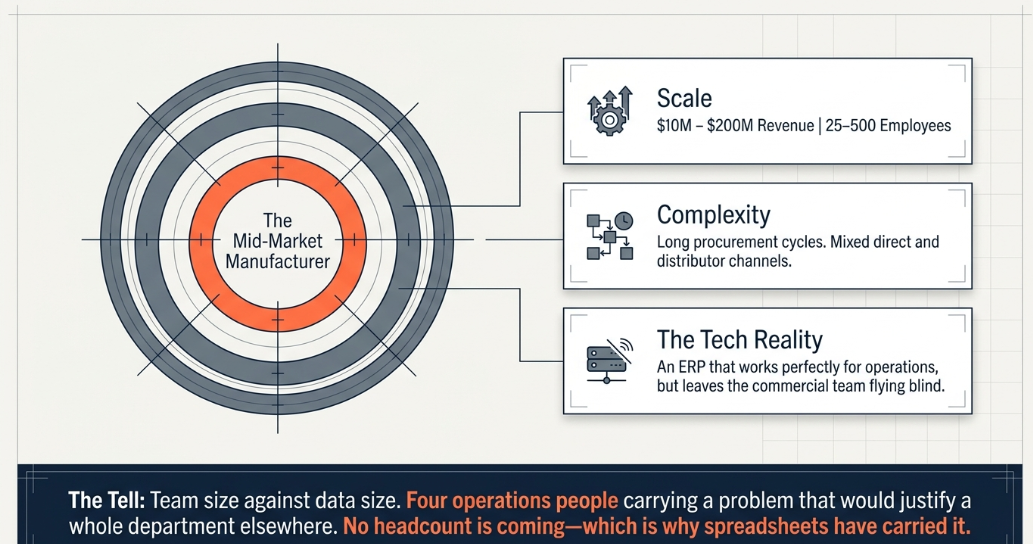
Symptoms you can check this week
- A rep builds a quote in the ERP, then types it again into the CRM.
- Two people produce two defensible forecast numbers, and neither can prove the other wrong.
- Distributor and direct business sit in different tools, or under different rules nobody wrote down.
- An RFP goes out late because engineering, finance, and the account team each pulled a piece from a different place.
- Nobody can answer "what has this account bought, and what are we quoting them now" from one screen.
Why a standalone CRM does not fix it
The usual move is to buy a better CRM. That fails for a specific reason: a CRM that does not know the ERP's quote and order data is a second place to type things, not a single place to look.
Reps double-enter. Adoption drops because a system you feed by hand is a system you feed last. The forecast stays unreliable, because it runs on activity rather than on what was quoted.
Then the AI conversation ends before it starts. An agent pointed at a CRM that cannot see what was shipped or which distributor placed the order, and has nothing accurate to reason over. Connect the data, then add the agents.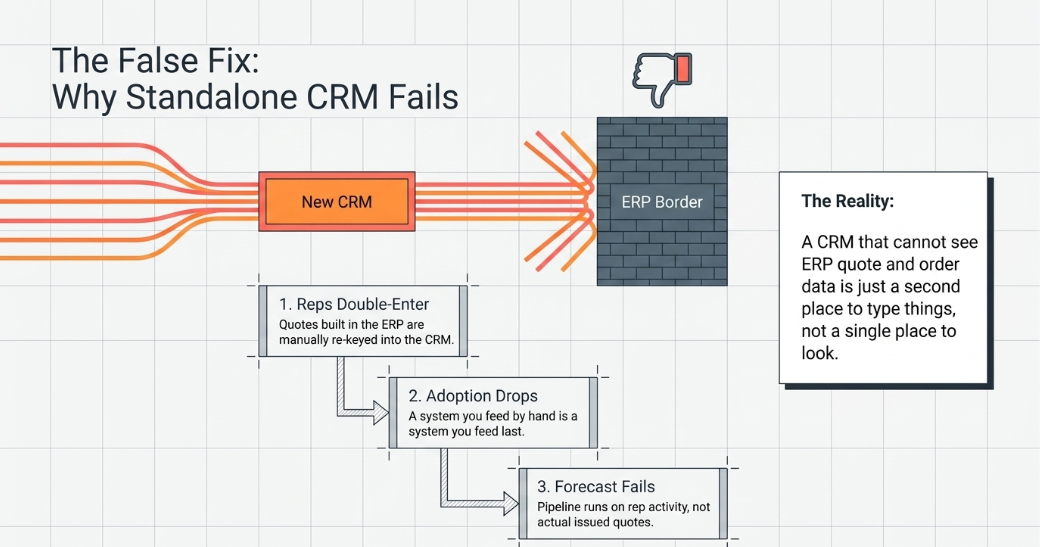
The HubSpot and AI answer, in the right order
Make HubSpot the commercial front end. Quotes, deals, and line items are native Sales objects available across plans, so you can build and track quotes in HubSpot without Enterprise. Custom objects are the real Enterprise line: if you want Distributor, Order, or SKU as their own record types, that requires an Enterprise subscription, across all hubs. One fact says you can start at Professional. The other says where the budget goes.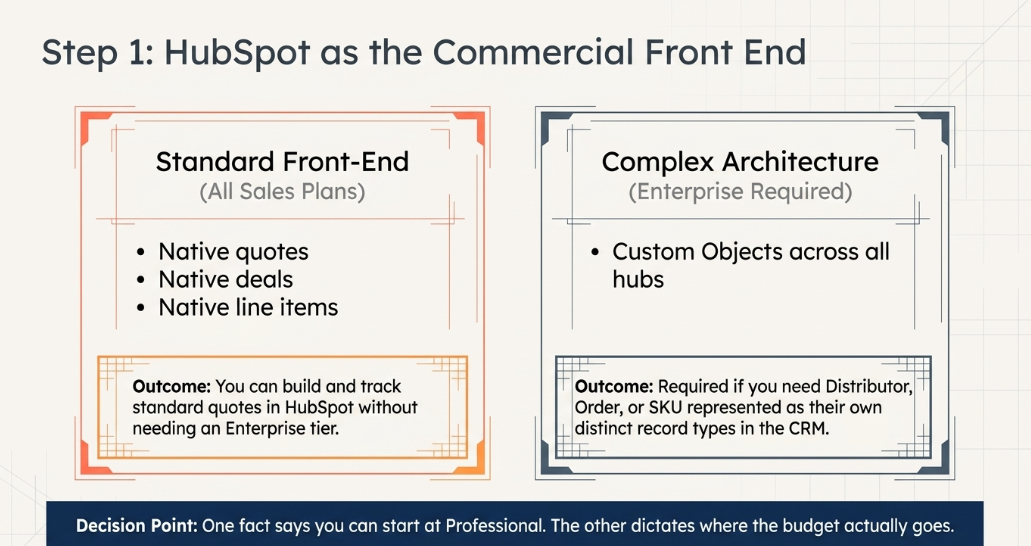
Connect the ERP honestly. This is not one button. Operations Hub data sync moves records two ways and passes historical as well as ongoing data, and basic account and contact sync is broadly available. Programmable automation and advanced governance sit at Operations Hub Professional and Enterprise. Sales orders and quote line mapping usually need custom work on top. Scope that before you sign, not after.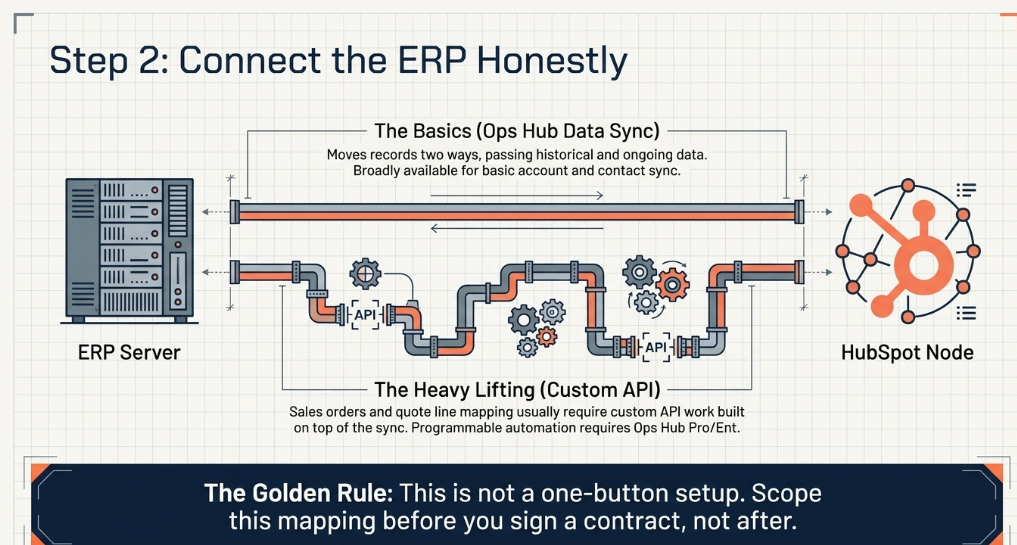
Then put AI on top. Breeze is HubSpot's AI layer. Three agents are generally available: Customer Agent, Prospecting Agent, and Data Agent. Company Research Agent and Customer Health Agent are in beta. The Prospecting Agent researches enrolled accounts and runs guardrail follow-up, which is where quote and account follow-up lands; it requires Sales Hub Professional or Enterprise. The Data Agent categorizes record data and runs inside workflows, though some of its summarization behaviors carry beta labels. Triggering agents from a workflow through the Run Agent action is also beta.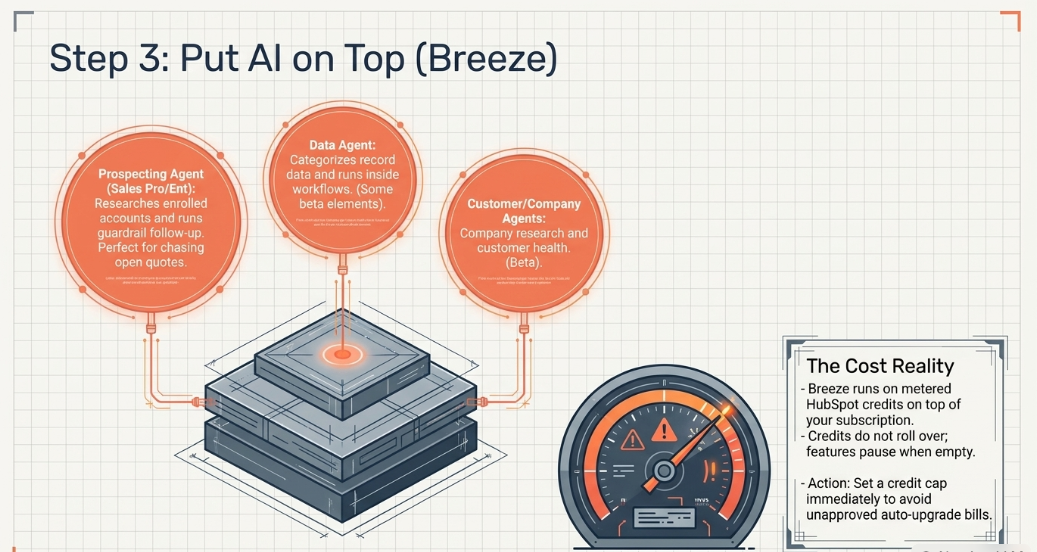
|
What you want |
What it takes |
Where it sits |
|
Build and send quotes from the CRM |
Native quote, deal, line item objects |
All Sales plans |
|
Distributor, Order, or SKU as their own records |
Custom objects |
Enterprise only, all hubs |
|
Two-way sync of accounts and contacts |
Ops Hub data sync or marketplace connector |
Basic sync is broadly available |
|
Sales orders and quote line mapping |
Custom API works on top of sync |
Ops Hub Pro/Enterprise plus scoped build |
|
AI follow-up on open quotes and accounts |
Breeze Prospecting Agent |
Sales Hub Pro/Enterprise, metered on credits |
|
AI categorizing records inside workflows |
Breeze Data Agent |
Metered on credits; some behaviors in beta |
Breeze agents run on HubSpot credits on top of your subscription. Allotments vary by tier, credits do not roll over, and usage-based features pause when they run out. Auto-upgrade defaults can produce a bill nobody approved, so set a credit cap.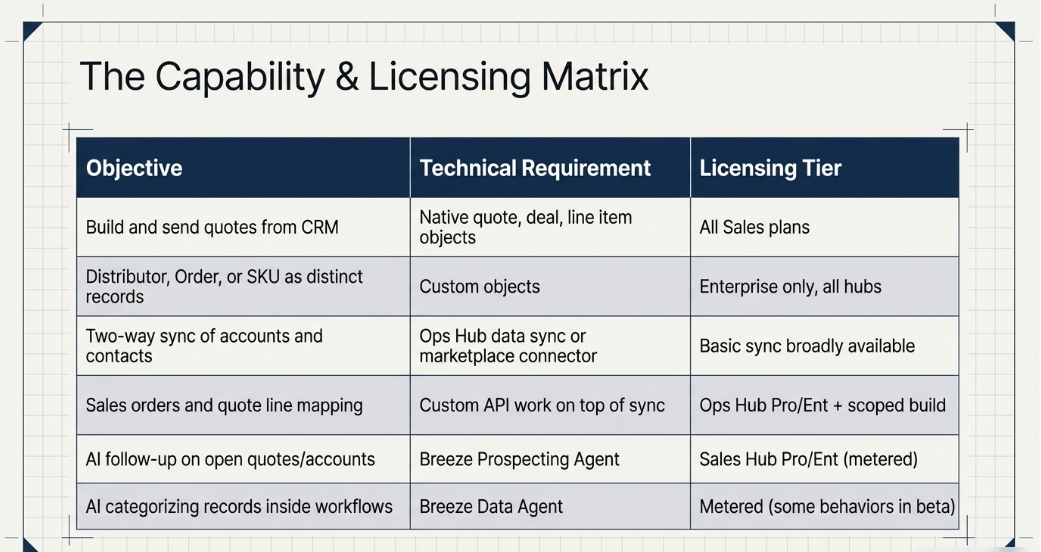
What CETDIGIT does here
CETDIGIT is a HubSpot Elite Partner, and for a manufacturer, the work that matters is the connection underneath the CRM.
In CETDIGIT's ERP-integration work, the deliverable is the reconciliation: the quote a rep built in the ERP shows up against the customer in HubSpot, distributor and direct orders are distinguishable, and the forecast is built from issued quotes rather than rep optimism. The Enterprise custom-object question gets answered against your actual ERP structure before anyone buys a tier. Agents go on last.
The same logic runs through other sectors, including financial advisors, where the CRM tracks contacts and the business runs on households.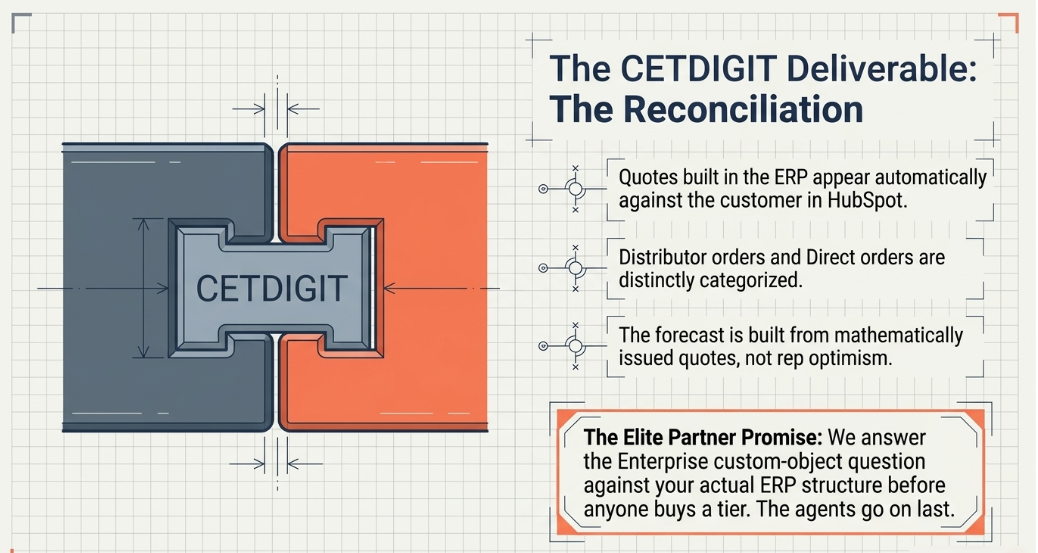
Where to start
If the question is what HubSpot AI agents do once your systems are connected, start with AI agents built on HubSpot. If it is really about why your data does not produce a forecast anyone trusts, the AI Revenue Engine is the closer fit.
FAQ
Does HubSpot work for manufacturers?
Yes, as the commercial front end, provided it is connected to the ERP. HubSpot handles leads, accounts, quotes, engagement history, and the forward pipeline. It does not replace the ERP. The sync between them is what makes the pairing work, so a rep is not typing the same quote twice, and the forecast reflects what was actually issued.
Can HubSpot connect to my ERP?
Usually, but the method depends on your ERP and the data you need. Operations Hub data sync moves records two ways and passes historical as well as ongoing data. There are marketplace connectors for common systems, and custom API work for the rest. Account and contact sync is the easy part. Sales orders and quote lines typically need custom mapping, so scope it before you buy a tier.
What HubSpot tier do manufacturers need?
It depends on how much ERP structure you want represented in HubSpot. Quotes, deals, and line items are native Sales objects on all plans, so you can start quoting at Professional. Custom objects require Enterprise across all hubs, so Distributor, Order, or SKU as their own record types puts you at Enterprise. Breeze Prospecting Agent requires Sales Hub Professional or Enterprise.
Can HubSpot AI follow up on open quotes?
The Breeze Prospecting Agent is generally available, researches enrolled contacts and target accounts, and runs guardrail outreach. It requires Sales Hub Professional or Enterprise and runs on HubSpot credits. The caveat sits upstream: follow-up quality depends on whether HubSpot can see the quote and the order history. An agent chasing an account whose purchase record lives only in the ERP writes a confident, wrong email.
What do Breeze agents cost to run?
They are metered rather than licensed. Agents consume HubSpot credits on top of your subscription; allotments vary by tier, and unused credits do not roll over. When credits run out, usage-based features pause. HubSpot changed its per-unit pricing in April 2026, so check current credit terms directly rather than trusting a figure in an article.
Worth a short call to walk through how your ERP quotes and CRM accounts would actually connect. Book a time with the CETDIGIT team.


Leave a Comment