


Your P&L doesn't fail all at once. It leaks, silently, at the joints, until the day the whole system stops cooling.
It's 6:47 PM on the second 97-degree day in a row. Ray owns a 14-truck HVAC shop outside Tampa. Every tech is on a no-cool call. The office closed at 5. His cell has three voicemails and, on the call log, eleven missed calls he'll never hear about, because the people who placed them didn't leave a message. They went back to Google and dialed the next company that picked up.
Ray doesn't feel any of this. That's the point. He'll look at the day's numbers tomorrow and see a good day: fourteen trucks, full boards, healthy tickets. What he won't see is the eleven conversations that never happened, three of them no-cool emergencies worth $600 to $800 each, one of them a homeowner whose 16-year-old system was one capacitor away from a $12,000 replacement. That revenue didn't get lost in a bad quote or a lost bid. It hissed out through a seam Ray can't see.
HVAC revenue behaves like refrigerant. It doesn't drain out the bottom where you'd notice. It escapes at the joints, the handoffs between one step of your business and the next, in amounts too small to alarm you on any single day, until the season ends and the charge is gone. Every shop has these leaks. Most owners have never put a gauge on them.
Here's where they are.
The Market Is Squeezing the Seams Tighter
Four forces are converging on independent HVAC operators in 2026, and every one of them raises the cost of a leak.
Private equity is buying the block. Through early June 2026, private equity firms accounted for 39 of 77 tracked HVAC sector M&A transactions, more than half of all disclosed deals, and the prior year saw PE add-on transactions targeting HVAC service providers rise 88% year over year. The consolidator two towns over answers every call in one ring and follows up on every quote by machine. When you leak, they catch what falls. THE HARDWIRETHE HARDWIRE
The refrigerant transition is inflating the stakes of every replacement. The switch to A2L refrigerants like R-454B and R-32 is raising new-system installation costs by roughly 10% and requires upgraded technician training, with retrofitting existing R-410A systems not allowed, a system on the old refrigerant has to be replaced, not converted. That pushes more homeowners toward big-ticket installs, which means the estimate you fail to follow up on is worth more than it was two years ago. GetJobber
The technician shortage means you can't staff your way out. National data shows roughly half of employers across HVAC and plumbing report difficulty finding skilled applicants. You cannot solve a peak-season phone problem by hiring three more people who answer phones. The labor isn't there. PHCC
And margins are already thin. 83% of HVAC businesses raised prices in the past 12 months to cover materials and refrigerant cost, which means growth increasingly has to come from capturing what you already generate, not from raising rates again. GetJobber
Put together, the message is blunt: in 2026 the independent HVAC shop wins or loses on how tightly it seals its seams. So let's find them.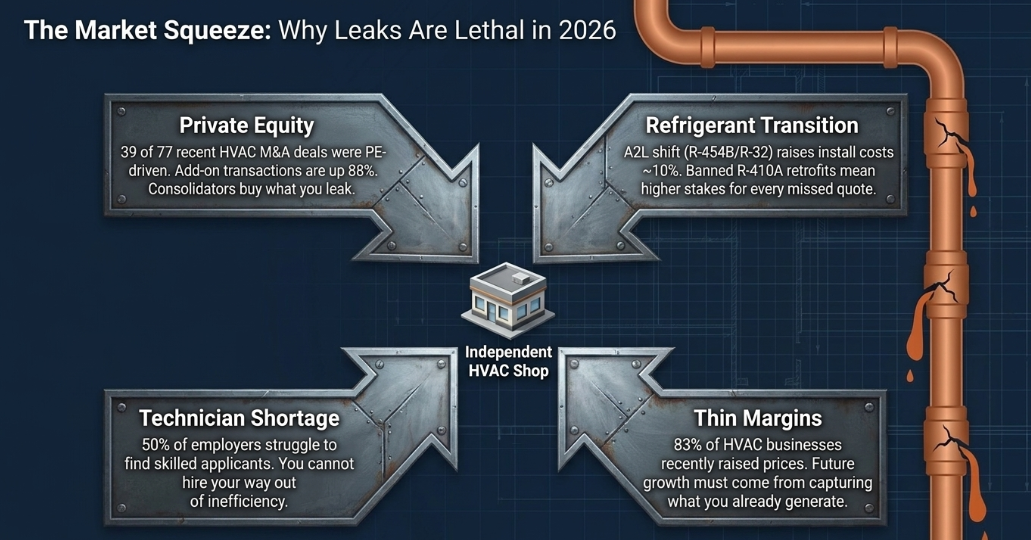
The Four Seams Where Your Revenue Escapes
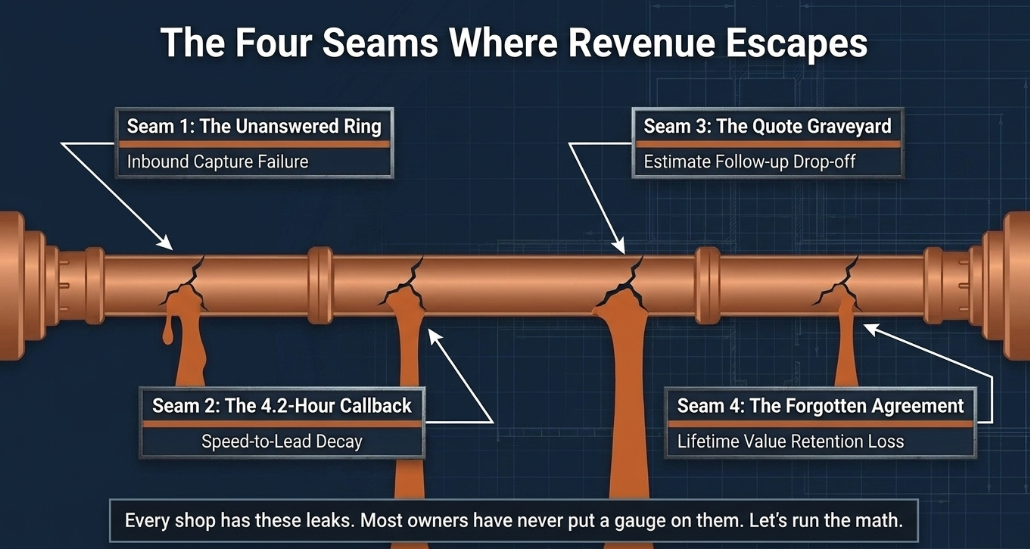
Seam 1 — The unanswered ring.
This is the biggest leak in the business and the one owners most consistently underestimate, because a missed call leaves no trace on the invoice.
CallRail and Invoca benchmarks place the average missed-call rate for home-service contractors at 20–30% of inbound volume, rising to 40–50% during seasonal peaks. And the caller doesn't wait. 78% of callers won't leave a voicemail, they immediately call the next contractor, and 31% of emergency calls happen after business hours, precisely when your phone is dark. AINORA + 2
Now put a dollar figure on it, sourced and extrapolated. At a $450 blended revenue-per-booked-call and a 65% book rate, a shop missing 20 calls a week loses 20 × 0.65 × $450 = $5,850 weekly, over $300,000 annually. Ray's shop is bigger and his peak miss rate is worse. His leak is larger than that. AINORA
Small concrete loss × operational scale = a number that would change your year.
Seam 2 — The 4.2-hour callback.
Even the calls you do eventually return leak, because you return them too late. The average callback delay for HVAC contractors is 4.2 hours, and in those four hours, 67% of callers who didn't reach you have already booked someone else. The callback isn't worthless, it's just arriving after the decision is made. Artifactaisolutions
The speed math is unforgiving. Contractors who call web leads back within 5 minutes book roughly 2–3x the jobs of those who call back within 60 minutes, and 5–10x more than those whose first callback is the next business day. Every minute between the ring and the response is refrigerant leaving the line. AINORA
Seam 3 — The quote graveyard.
A tech spends an hour at a house, writes an $8,500 replacement estimate, emails it, and drives to the next job. The next morning, the dispatcher asks whether the homeowner signed. Nobody knows. The job ticket sits in a "sent" column for three days while the homeowner gets a call from a competitor who followed up within the hour. This is the quote graveyard, the folder of sent estimates that never closed, not because the price was wrong, but because the follow-up never happened. US Tech Automations
Most HVAC companies present a replacement estimate and follow up once, if at all, a customer who was interested but not ready gets one email and then silence. The recoverable revenue here is measured and large: HVAC companies that automate quote follow-up recover 18–24% of previously lost bids. On structured good-better-best proposals, the same ten monthly replacement opportunities at $8,500 move from a 42% close rate to 52%, roughly $35,700 to $44,200 in closed revenue per month. That ten-point swing is sitting in your graveyard right now. Simpro + 2
Seam 4 — The forgotten agreement.
This is the slow leak, the one that empties the tank over years. The maintenance agreement is the most valuable relationship you own: the 2026 benchmark puts average residential HVAC customer lifetime value at $15,340, but a customer attached to a maintenance plan is worth $47,200 across the relationship. Triple the value, same customer. Smartac
And the #1 reason those plans cancel isn't price. It's selling the agreement, collecting payment, and never scheduling or completing the maintenance visits, the customer realizes months later they've been paying for nothing, feels taken advantage of, and cancels. The industry benchmark for renewal is 70–80%, and top performers with automated renewal workflows reach 90%. Every point below that benchmark is a plan customer reverting to a one-time customer, a $47,200 relationship collapsing back to $15,340. That's not a rounding error. That's the tank draining. OXMaintOXMaint
Sealing the Seams: What the System Actually Does
Return to Ray. Same 6:47 PM, same two-day heat wave, same fourteen trucks in the field. What's different is that his shop now runs on HubSpot Smart CRM as the system of record, with CETDIGIT-built AI and automation layered on top, and the seams are sealed one by one against the exact leaks above.
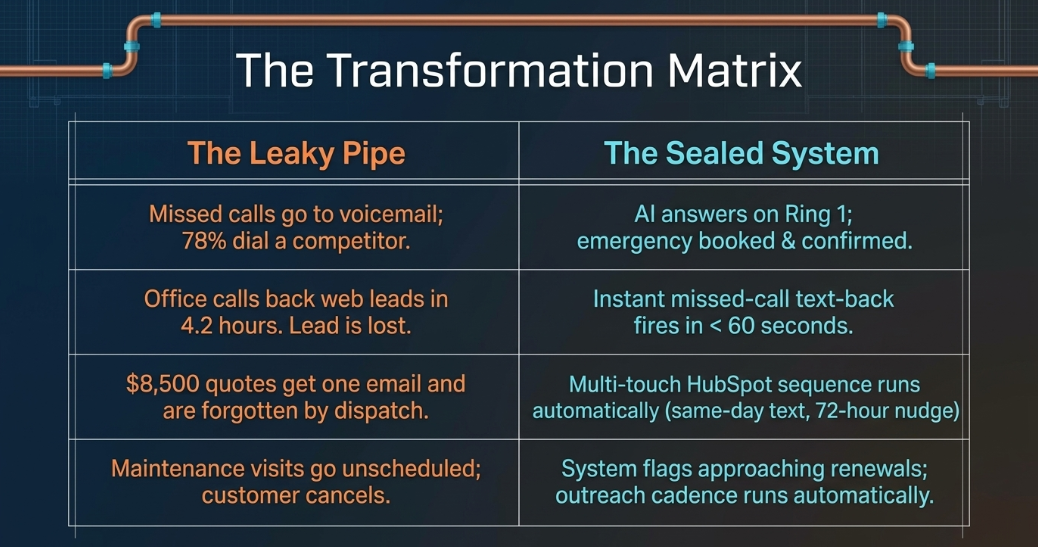
The unanswered ring, sealed. When the office phone rings after 5 PM, and no human can pick up, an AI voice agent answers on the first ring, the call CETDIGIT's system catches that Ray's front desk missed. It speaks naturally, qualifies the caller, recognizes a no-cool emergency, captures the job details, books the appointment directly onto the board, and sends an SMS confirmation. The eleven calls Ray never heard about are now eleven contact records in HubSpot with eleven booked or triaged jobs. The seam that was bleeding $300K a year is closed at the source.
The 4.2-hour callback, sealed. For any lead that does slip, a web form, a missed cell call, or an instant missed-call text-back fires within 60 seconds, re-engaging the homeowner before they dial the next contractor. The 4.2-hour gap becomes a 60-second gap. The 2–3x booking advantage of speed stops belonging to the consolidator and starts belonging to Ray.
The quote graveyard, sealed. Every replacement estimate becomes a HubSpot deal the moment the tech writes it. An automated multi-touch follow-up sequence runs on its own, a same-day text, a "before your quote expires" nudge at 72 hours, a value-and-financing touch a few days later, none of it depending on a dispatcher remembering. The graveyard empties into the pipeline, and the 18–24% of bids that used to die of silence get worked.
The forgotten agreement, sealed. HubSpot workflows triggered by job-completion dates and contract terms make the #1 churn driver structurally impossible: no maintenance visit goes unscheduled, because the system flags every plan with a visit coming due and every agreement approaching renewal. Spring AC and fall furnace outreach goes out on the seasonal cadence automatically. The renewal reminder at 30 days, the follow-up at 14, and the call trigger for non-responders all run without anyone remembering. The $47,200 relationship stays a $47,200 relationship.
None of this is Ray working harder or hiring people who don't exist. It's the same demand he already generates, no longer escaping at the joints.
The Self-Audit: Three Questions You Can Answer Before Friday
You don't need a consultant to find your leaks. You need thirty minutes and honest answers.
- Pull your call log for the last two peak-season weeks. How many inbound calls went unanswered, and what's your booked-call value times your book rate times that number? That's your Seam 1 leak, in dollars, this month.
- Pull your last 30 replacement estimates. Can you say what happened to each one? If you can't say what happened to each one, you don't have a follow-up process; you have a graveyard. Simpro
- Pull your active maintenance agreements. How many have a visit more than 30 days overdue? Every one of those is a cancellation the customer hasn't gotten around to yet.
If those three numbers made you uncomfortable, that's the gauge reading the leak.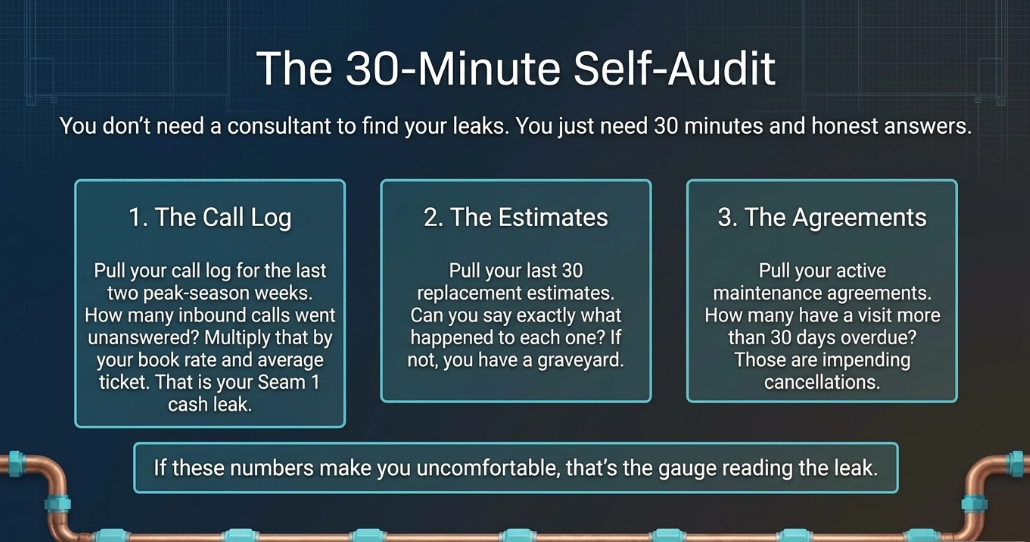
CETDIGIT builds the sealed system for HVAC operators on HubSpot Smart CRM, AI voice agents that answer every call, automated follow-up that empties the quote graveyard, and recurring-service workflows that make a forgotten maintenance visit impossible.
Stop charging a system that's leaking at the seams. Book your free consultation, and we'll map exactly where your revenue is escaping and seal it.



Leave a Comment