


Many caterers track event inquiries in a spreadsheet, a shared inbox, or a general-purpose CRM, and the record splits when an inquiry becomes a booking. A catering CRM keeps each inquiry as one contact record and moves that same record through quote, deposit, and event. CaterSuite does this on HubSpot: each inquiry is a contact and each booking a deal.
Wednesday, 4:20 PM. The sales desk is quiet for about four minutes, and then the phone rings. A client is calling back about a quote that went out three weeks ago. She remembers the price and roughly the headcount. She does not remember whose name went on the proposal, and the coordinator who sent it is at a tasting until six.
You search for the quote. It is a PDF in a sent folder, attached to an email thread that started with a web form. The web form lives in the marketing platform. The phone call where she said the count was about 140, maybe 150, is not in any system at all. It is in a note at the coordinator's desk. The deposit, if it cleared, sits in accounting under a slightly different spelling of her last name. Nobody in the room can say which tool holds the inquiry, so nobody can say with confidence where the conversation actually stands.
You tell her you will call back before close. Then you start the search again, from the beginning, in four places.
This is The Disconnect. The gap between marketing, sales, and catering operations where each runs in its own system and nothing talks to anything else: inquiries land in seven places, follow-ups live on sticky notes, bookings happen that the kitchen hears about at the briefing. A question about which CRM is really a question about where the inquiry lives: that is The Disconnect. The pattern is set out in detail in why do catering inquiries slip through the cracks even when I watch my inbox.
Why the inquiry gets split
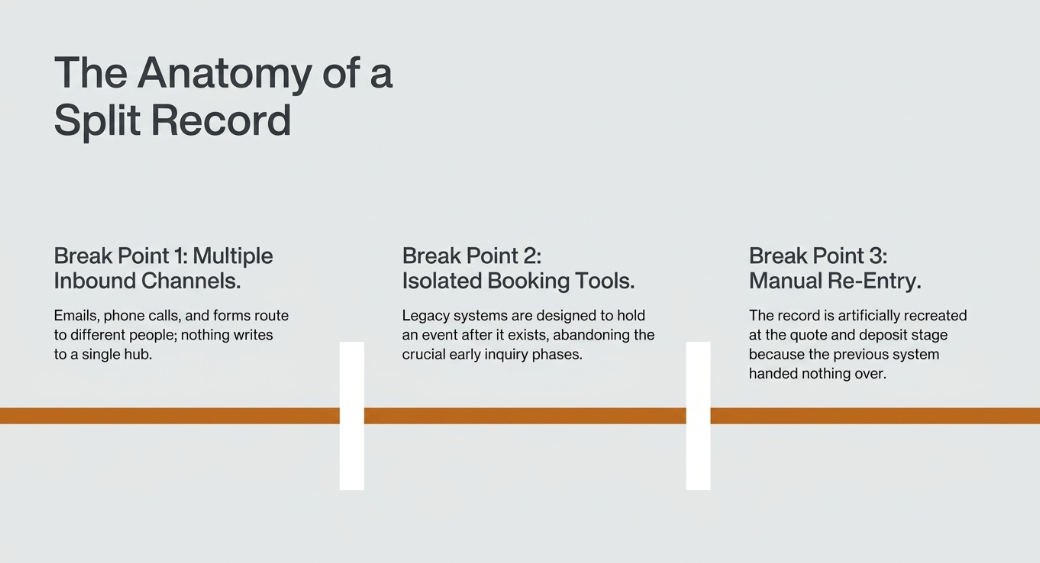
The split usually happens in three places, and each one moves the record somewhere new.
- Inquiries arrive through several channels. Email, phone calls, direct messages, and referrals reach different people, and not every channel writes to the same place.
- The booking tool a team already runs is built around the booking. It is designed to hold an event once it exists. The stretch before that- the first call, the second question, and the revised headcount- tends to live in whatever app the person had open at the time.
- The record is recreated at quote and deposit. Someone retypes the contact, the date, and the headcount into the next system, because the previous one did not hand anything over.
The same split shows up beyond catering. A restaurant-catering piece from QSRweb, dated 30 July 2026, argues that the problem is separate systems rather than missing technology. It is written for restaurants, so read it as framing. On the catering side, a Cater+Event review dated 26 January 2026 names tool overload as the main technology problem operators face, and says the most successful operators fold their stack into fewer, integrated systems.
What the split costs
The typing is the smallest part of the cost. Every retyped inquiry is time paid to the person who was supposed to be selling. The higher cost is the follow-up that never happened, because the reminder sat in a tool nobody opened on Thursday. Then there is the client who calls back and gets a second-hand answer, and the booking that has to be confirmed again at deposit as if it were new. Operators feel this at the desk and in the Monday meeting long before it shows up anywhere a report can count it.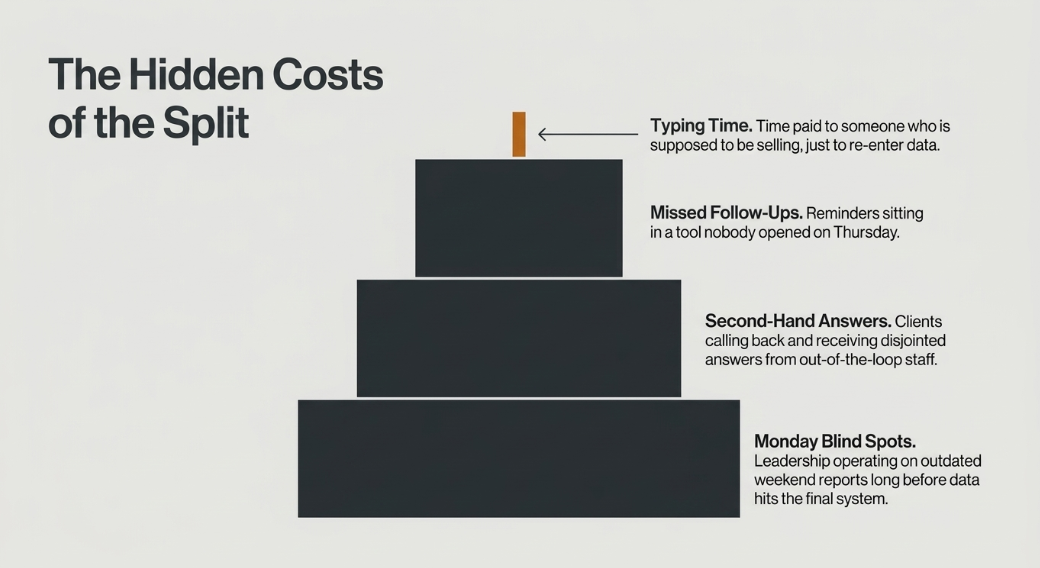
Where the inquiry record lives today
Ask these six questions of your own setup. Each one shows where a record breaks.
- Where does the first message land? Which inbox, form, or phone line receives the inquiry, and who can see it?
- Who owns the next follow-up? Is there one named place where the next call date sits?
- Where is the quote kept? Is it attached to the same record as the inquiry, or to a separate file?
- What happens at deposit? Does the booking reuse the inquiry record, or does someone re-enter the contact?
- Can the kitchen see the same booking? Does production read the live record, or a copy made last week?
- What happens when a client writes twice? Do both messages land on one contact, or on two?
If the answers come from three different people, the record is already split.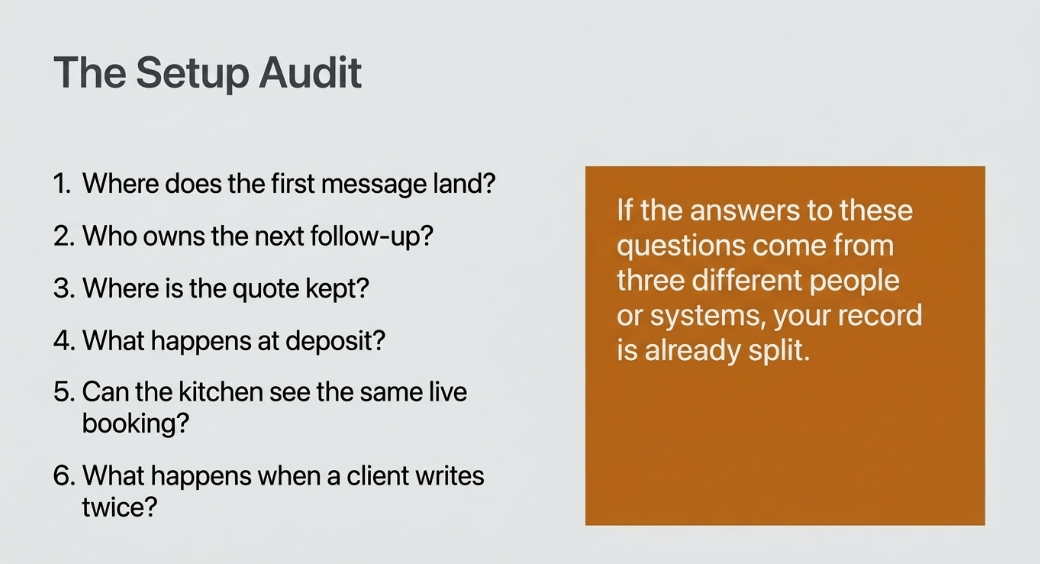
A catering CRM gives the inquiry one home
Two objects do most of the work in HubSpot's documentation: the contact, and the deal that follows it. Each record keeps its properties and its activity history attached, so the history stays with the record as the job moves forward. That is the object model a catering inquiry needs.
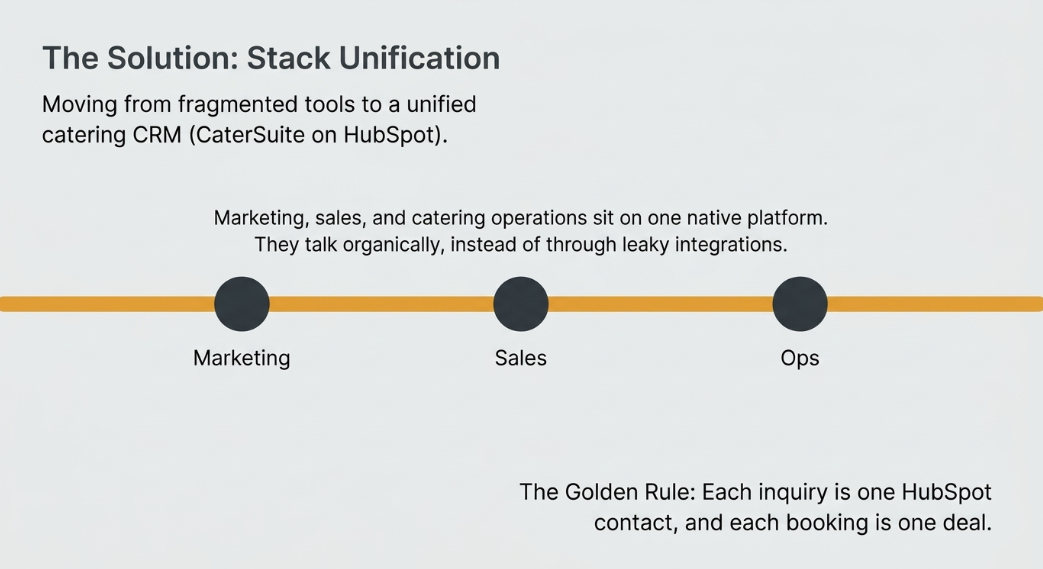
This is the Stack Unification argument. Marketing, sales, and catering operations sit on one platform, so they talk natively instead of through integrations that leak. The approach is set out in which catering software connects to HubSpot. Applied to a catering inquiry, each inquiry is one HubSpot contact and each booking is one deal, moving through catering stages from inquiry to event. The unified booking and inquiry system holds that pipeline in the module named Catering CRM & Sales Pipeline, as the product page names it.
The booking stages are walked through in more detail in how do catering businesses use HubSpot to manage bookings.
Where to start
For a multi-event operation that wants inquiries and bookings in one place, the first step is to look at the unified booking and inquiry system. The page lists six modules, named as the page names them: Catering CRM & Sales Pipeline, End-to-End Marketing Automation, Event & Venue Management, Kitchen & Production Workflows, Staffing Coordination, and Reporting & Forecasting.
The page lists integrations for finance (QuickBooks, Xero, NetSuite and Sage), kitchen and recipe work (Galley, Restaurant365 and Meez), staffing (Nowsta and StaffMate) and proposals (HubSpot Quotes and PandaDoc). Point-of-sale and inventory connections are listed as custom.
Delivery is phased. The page's own wording puts the first phase live in three to five weeks, and it gives no total duration, so plan around phases rather than a finish date. Pricing is not published on the page.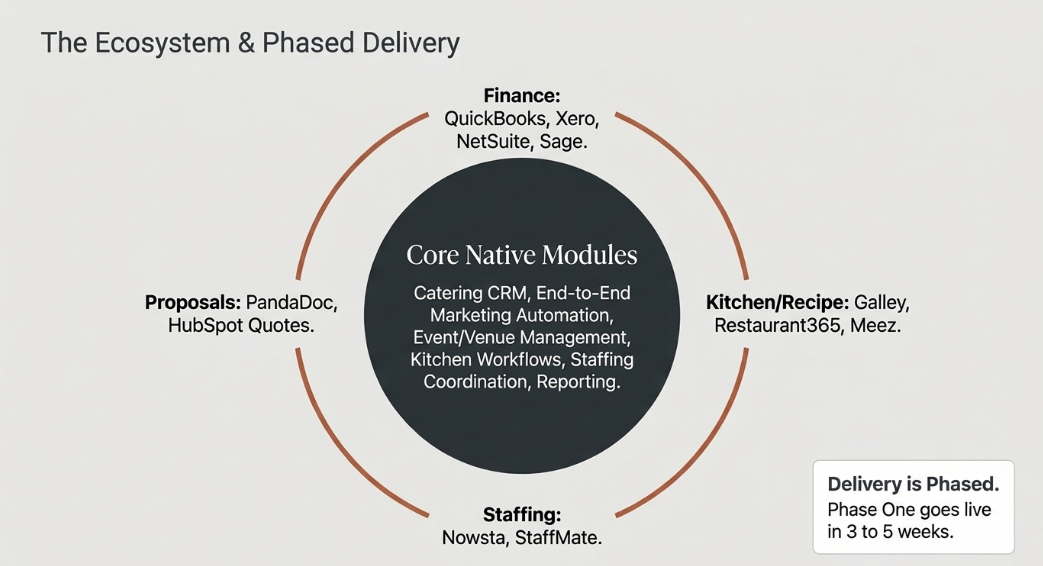
What changes when the inquiry is the first record
Once the inquiry is the first record, the Wednesday call looks different. The quote is attached to the contact who asked for it. The deposit moves the same deal along its stages rather than starting a new entry in accounting. The kitchen reads the booking sales is working on, not last week's copy. The person on the phone answers from one screen, and the coordinator who was at the tasting finds the whole thread waiting when she gets back.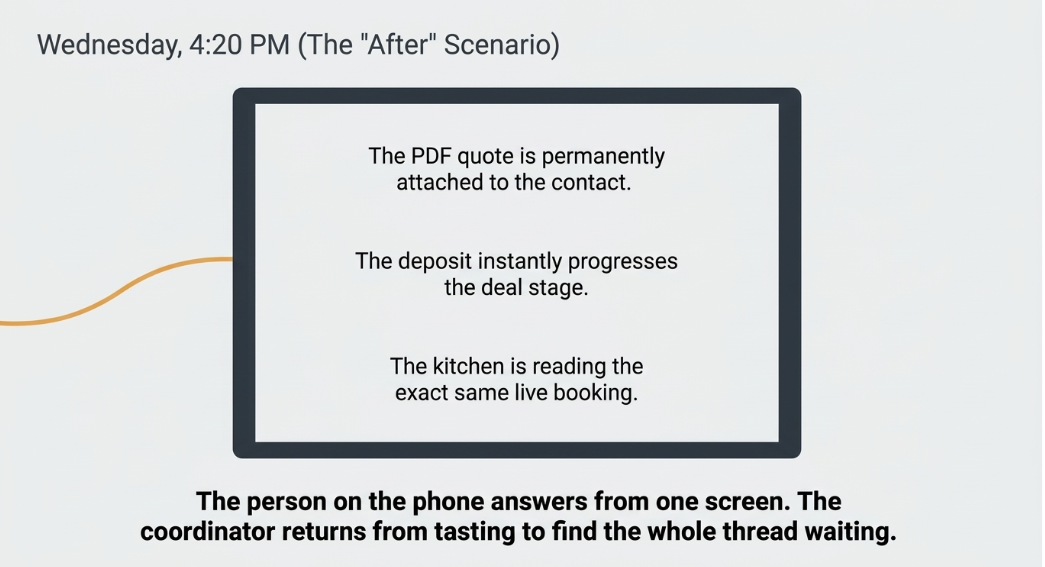
Nothing about the catering work changes. The menus, the staffing, and the event itself stay the same. What stops is the copying: the moment when a detail that was known on Monday has to be found again on Thursday.
Questions operators ask
Does this work for caterers who already use HubSpot?
Yes. The model is built on HubSpot, so a team already running marketing and sales there extends the same platform to catering rather than adding a second one. The Cater+Event review dated 26 January 2026 describes consolidation as the direction the most successful operators are taking.
Is a spreadsheet enough to track inquiries?
A spreadsheet can list inquiries. It does not carry the activity history that belongs to a contact, and it does not move a booking through stages on its own. Once a second person needs the same record, the spreadsheet becomes the second place the inquiry lives.
What is the difference between a contact and a deal here?
The contact is the person who inquired. The deal is the booking they are working toward. One contact can hold more than one deal over time, which is what a repeat client looks like in this model.
Does this replace my accounting software?
The page lists QuickBooks, Xero, NetSuite, and Sage as finance integrations. It does not describe itself as a replacement for them, so treat accounting as a connected system rather than a removed one.
How long until the first phase is live?
The page says three to five weeks for the first phase. It gives no total duration for the full set of phases, so ask for the phases, not a single date.
Is pricing published?
No. The product page does not publish pricing, so any figure you hear has to be confirmed directly.
The question behind the question
"Which CRM do caterers use?" is really asking where the inquiry lives on the day the client calls back. If the honest answer is three places and a note at someone's desk, the tool question is the wrong place to start. Start with the one record, from the first message to the event, and then ask whether the systems you already have can hold it without a person copying it by hand.
Next step
To see whether that record can live in one place for your operation, look at a single platform that unifies catering operations.


Leave a Comment