


Whether HubSpot Breeze is worth the credits comes down to one number: Cost per Outcome. Cost per Outcome is the credits a use case consumes plus your team's time reviewing its work, divided by the outcomes it adds above your own pre-AI baseline. Credits are the run cost, not the return. A spend limit controls the bill; it cannot tell you whether the bill was worth paying. Keep, cap, pause, or move each use case by that number.
The Credit-Balance Moment
It is the third Tuesday of the month, a little after nine, and the RevOps lead at a growing HubSpot company has a new alert: the account has used 90% of its monthly credits. She opens the usage page as Super Admin. The breakdown is clean: so many credits on the customer agent, so many on the prospecting agent.
By Thursday, the account reaches its limit, and the agents pause. Her CFO forwards the billing email with one line: "What did we get for that?" She cannot answer. The page counts what it cost, not what happened.
This scene is a composite, not a client story. It is also the conversation that comes up most often across the full range of CETDIGIT's AI services, and it is rarely about the price of a credit.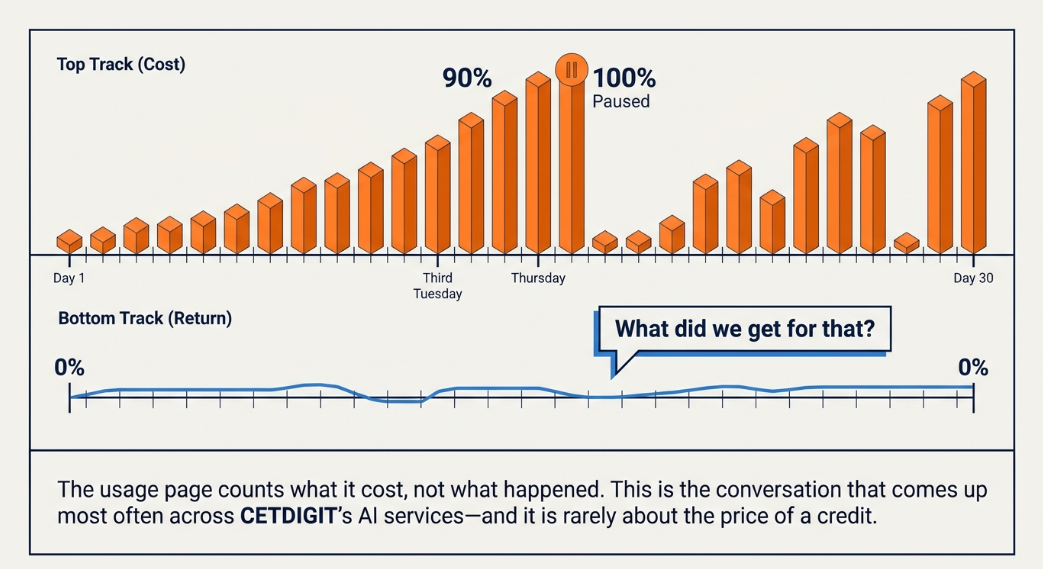
Problem Definition: What the Credits Bill Tells You and What It Doesn't
Start with what is true: credits are real money. Per HubSpot's credits page, reviewed October 28, 2026, a credit costs $0.010, additional credits come in capacity packs of 1,000 for $10, and usage beyond your monthly limit is billed through Pay-as-You-Go, which HubSpot makes the default for purchases from September 16, 2026. If you run AI agents built on HubSpot, your CFO sees that line every month.
The usage report is honest about cost. It cannot show whether the spend moved a number you care about, because the outcome lives elsewhere: in the pipeline, the support queue, the deals that closed. At UNBOUND 2026, HubSpot's CEO Yamini Rangan called this stage "the maxing phase." Most teams turned the agents on; fewer can say what they are worth.
The wider research agrees. Deloitte's State of AI in the Enterprise, a survey of 3,235 leaders in 24 countries fielded in August and September 2025, found 66% of organizations reporting productivity and efficiency gains, while 74% hope to grow revenue through AI and only 20% already do. Revenue growth, in Deloitte's words, "largely remains an aspiration."
The problem is not the price per credit. It is that the credits bill is the only number in the room. Cost per Outcome puts the outcome beside it.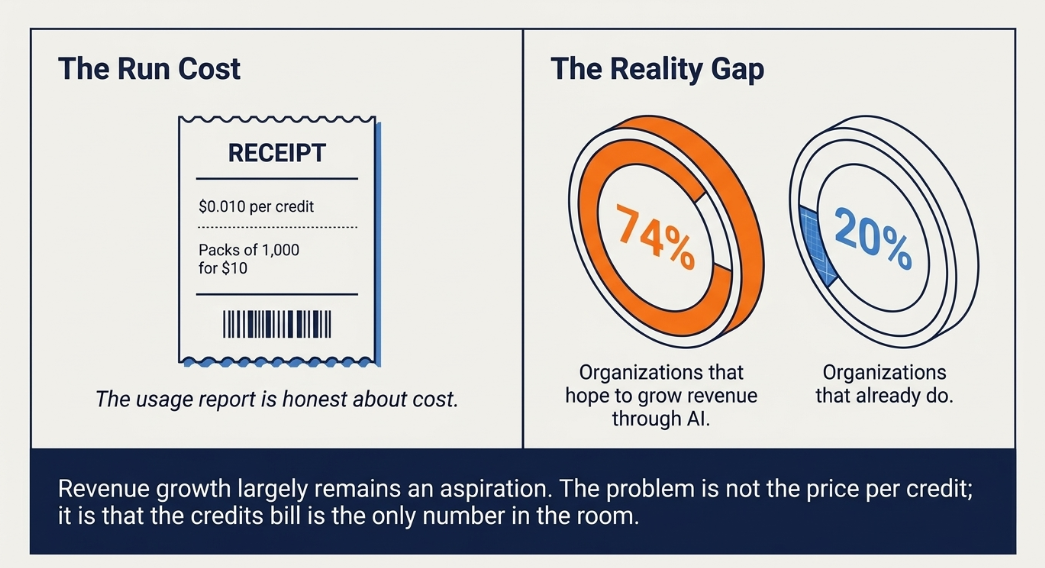
Who This Affects
This is for the Founder, VP of Sales, or RevOps lead who approved the credits and now owns the question. You turned on the customer agent, the prospecting agent, or both, and you have a usage page and a revenue report with nothing connecting them.
It is less useful if you have not turned on any agents, or if you only use Breeze Assistant, which HubSpot says is included with every subscription at no additional cost.
Symptoms
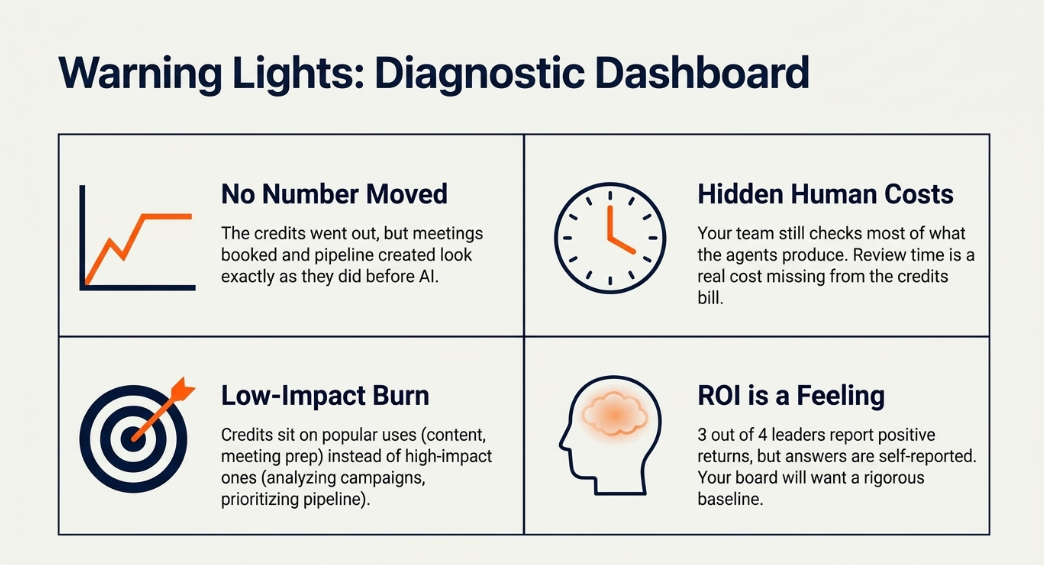
- The credits went out and no number moved. The usage page climbs, and the metric you would point to, whether meetings booked or pipeline created, looks the way it did before.
- Your team still checks most of what the agents produce. That review time is a real cost, and it is not on the credits bill.
- The credits sit on the popular uses, not the high-impact ones. Drawing on HubSpot's UNBOUND 2026 survey of about 6,000 customers and prospects, Rangan named content, email, and meeting prep as popular but low-impact, and analyzing campaigns, prioritizing pipeline, and analyzing customer feedback as high-impact.
- The return you report is a feeling. In the Wharton and GBK Collective survey of more than 800 senior leaders at large US companies, "Three out of four leaders reported positive returns on AI investments." The researchers cautioned that the answers are self-reported; your board will want your baseline.
Root Causes: Why a Cap Can't Answer "Worth It"
HubSpot shipped two useful changes this year. Both are easy to mistake for an answer.
What HubSpot's controls do
Per HubSpot's credits documentation, reviewed October 28, 2026, once you have bought additional credits, HubSpot sets an account-level limit up to 50% beyond your monthly credits, and you can adjust account-, feature-, and activity-level limits at any time. Alerts fire at 75%, 85%, and 90%, and features pause at the limit. HubSpot notes that beta features may begin consuming credits.
Use them. But a ceiling on the bill tells you the most you will spend, not what the spend returned. In Gartner's March 2026 survey of 353 data, analytics and AI leaders, only 44% of organizations had adopted financial guardrails or AI FinOps practices, and Gartner's analysts argued that ROI is more than a financial measure. Limiting spend and measuring return are different jobs.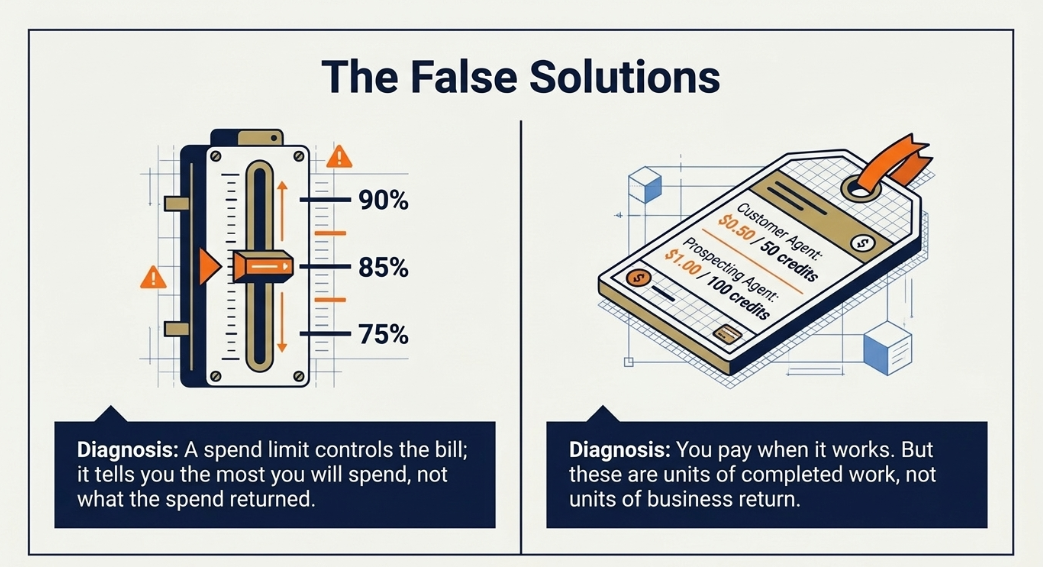
What HubSpot's price unit counts
In April 2026, HubSpot moved two agents to outcome-based pricing: Customer Agent at $0.50 per resolved conversation, down from $1.00 per conversation, and Prospecting Agent at $1.00 per lead recommended for outreach. HubSpot's rate sheet lists those as 50 and 100 credits, and rates may change. HubSpot's Jon Dick put it plainly: "You pay when it works, full stop."
That is a fair deal on HubSpot's side of the line. A resolved conversation and a recommended lead are units of completed work, not your revenue outcome. A recommended lead that nobody works is paid work with no return.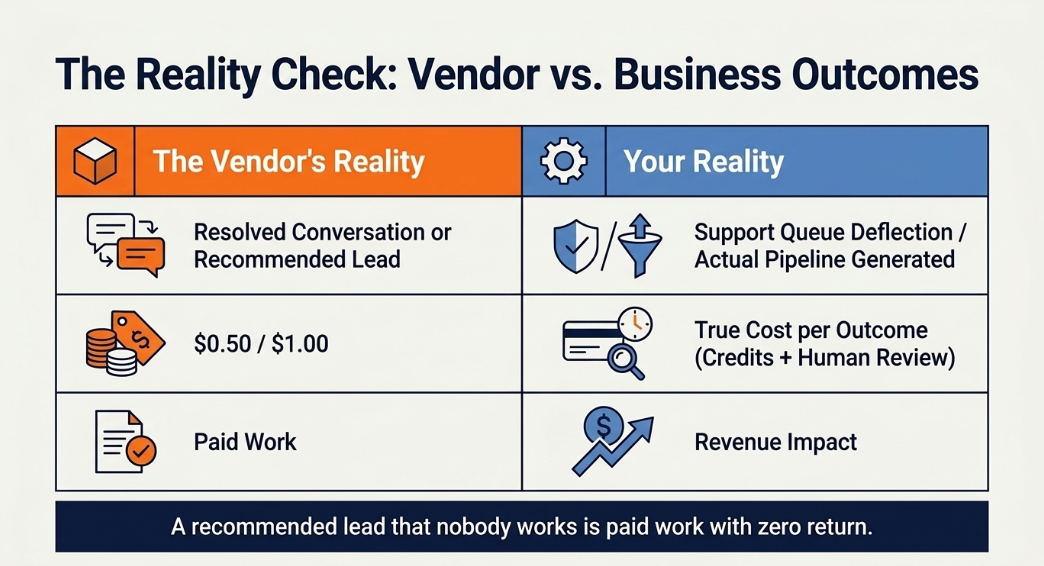
Decision Table: Keep, Cap, Pause or Move the Use Case
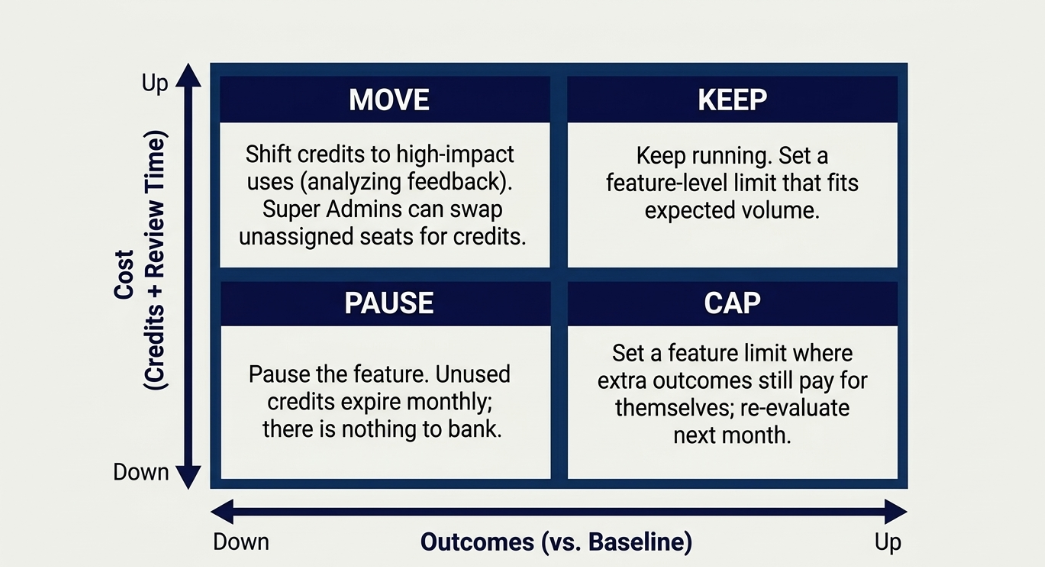
Start where HubSpot's Dharmesh Shah started at UNBOUND 2026: name your number. Pick the metric each use case should move, pull its pre-AI baseline, and set credits plus review time beside the outcomes counted against it.
|
What your own numbers show |
Decision |
What to do in HubSpot |
|
Outcomes are up against your pre-AI baseline, and credits plus review time per outcome are no higher than the same outcome cost before. |
Keep |
Keep it running, with a feature-level limit that fits the volume you expect. |
|
Outcomes are up, but credits and review time are growing faster than the outcomes. |
Cap |
Set a feature-level spending limit where the extra outcomes still pay for themselves, and check again next month. |
|
Your test window has closed, credits are still going out, and nothing is up against your baseline, or review time eats the gain. |
Pause |
Pause the feature; unused credits expire monthly, so there is nothing to bank. |
|
The use case is one of the popular, low-impact ones, and the number has not moved. |
Move |
Put the credits toward a high-impact use case such as prioritizing pipeline or analyzing customer feedback. A Super Admin can also swap unassigned seats for credits; HubSpot notes the swap cannot be reversed. |
The CETDIGIT Perspective
Cost per Outcome is not a line on a scorecard. It is a decision test with three parts most ROI templates leave out.
First, the cost includes people. Credits are the visible cost; your team's review time is the hidden one. Leave it out and every agent looks cheap.
Second, the outcome is yours, not the vendor's. HubSpot counts a resolution or a recommended lead; you count what changed in your business. The FinOps Foundation's guidance on AI business value points the same way: map AI cost to each use case, judge it by its contribution to the result it serves, and reallocate on the results.
Third, an outcome only exists if something acts on the work. That is the difference between a system that records what the AI suggested and a System of Action, where the suggestion triggers the next step and the result gets counted. A credit spent on a suggestion nobody acted on is a cost with no outcome. Run enough of those, and you build the Optimization Debt that accumulates when a system records but does not act: paying for capability nobody wired into a decision.
We set out how an AI Revenue Engine measures Cost per Outcome earlier this year; the credits bill makes that test more urgent. It is the center of how CETDIGIT's AI Revenue Engine ties AI spend to revenue outcomes.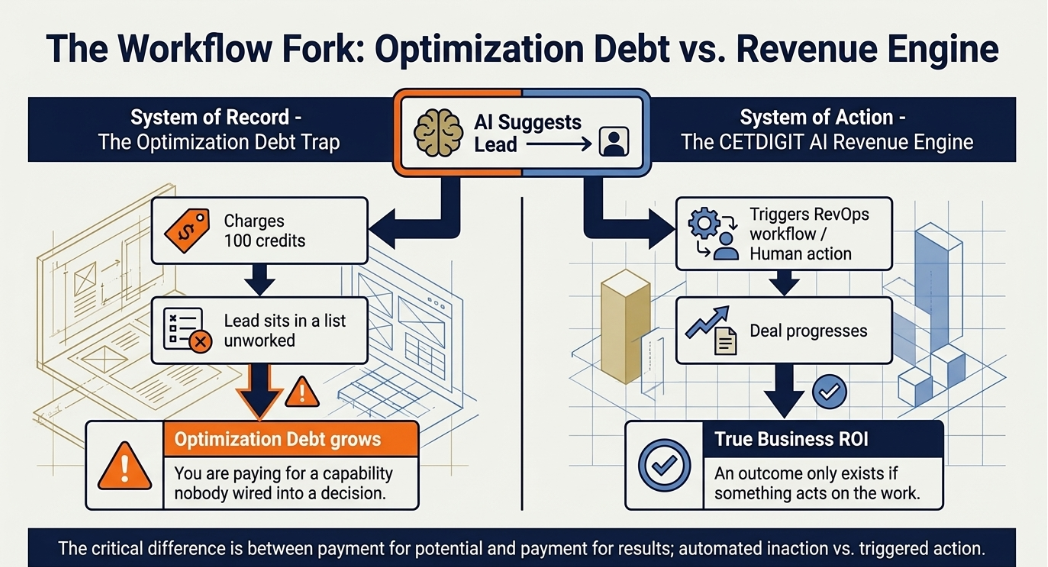
Recommended Path
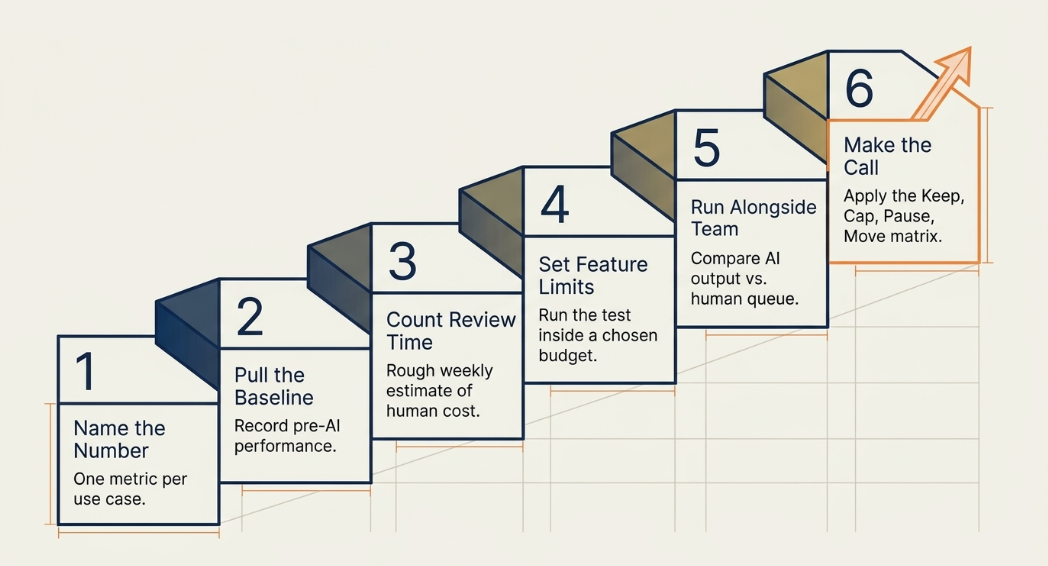
You do not need to switch the agents off. Decide from your own numbers, in 30–90 days, before you spend more.
- Name the number. Give each use case the one metric it is meant to move.
- Pull the baseline. Record what that metric looked like before the agent turned on.
- Count the review time. A rough weekly estimate is enough.
- Set feature-level limits now. The test should run inside a budget you chose.
- Run it alongside your team first. Let the agent and your team work the same queue and compare; this is how CETDIGIT runs new AI alongside your team first.
- Make the call. Use the table above to keep, cap, pause, or move each use case.
The same test sits at the start of CETDIGIT's AI services, not the end.
FAQ
How much does HubSpot Breeze cost in credits?
Per HubSpot's documentation, reviewed October 28, 2026, a credit costs $0.010, and the rate sheet lists 50 credits per resolved conversation for Customer Agent and 100 credits per lead recommended for outreach for Prospecting Agent. Included monthly credits vary by plan, and rates may change.
Are HubSpot credits worth it?
Deloitte's 2026 State of AI in the Enterprise found that 74% of organizations hope to grow revenue through AI, while only 20% already do. Credits are worth it for use cases whose Cost per Outcome, meaning credits plus review time per outcome above your pre-AI baseline, is no higher than that outcome cost before. Cap, pause, or move the rest.
How do I know if Breeze agents are paying for themselves?
HubSpot's Dharmesh Shah gave the first step at UNBOUND 2026: name the metric you want to move. Then compare outcomes above its pre-AI baseline with credits plus review time. If activity is up and revenue is not, it is the gap described in how an AI revenue engine differs from marketing automation.
What happens when HubSpot credits run out?
Per HubSpot's documentation, reviewed October 28, 2026, you receive notifications at 75%, 85%, and 90% of your credit limit, and features pause when the limit is reached. Unused credits do not carry over.
Is Breeze Assistant included?
HubSpot says Breeze Assistant is included with every subscription at no additional cost. The agents are separate: HubSpot now groups them under Agent Hub (formerly Breeze Agents), and agents such as Customer Agent, Prospecting Agent, and Data Agent run on credits.
Is deciding what Breeze is worth a one-off exercise or part of something bigger?
Gartner's March 2026 survey found only 44% of organizations had adopted financial guardrails or AI FinOps practices. It works best as a monthly review: the continuous loop of tracking, judging, and reallocating that the FinOps Foundation describes. That loop is the idea behind the AI services behind this approach.
Stack Unification Audit
Diagnostic of where your AI investment is leaking, connect the stack, then activate AI.
If the credits bill is the only number in the room, a Stack Unification Audit puts the outcome beside it: which use cases earn their credits, which do not, and what has to connect before more spend makes sense. Book a Stack Unification Audit.


Leave a Comment