


Direct answer. Yes, and it needs a better one, because buying AI agents turns the CRM into a System of Action: the record an agent reads to make a decision somebody has to act on, rather than a report somebody has to read. An agent with no customer memory cannot say which repeat-order account went quiet. As HubSpot's co-founder put it at UNBOUND 2026, models depreciate, and context appreciates.
A Tuesday pipeline review at a distributor
A Tuesday pipeline review is the hour a distributor's sales leader finds out which customers have gone quiet. Picture the owner of a mid-sized industrial distributor walking into that meeting with a headline still open on their phone: AI agents are about to make the CRM obsolete. A vendor pitch from the month before said the same thing in friendlier words, and the owner has started to wonder why the company is still paying for HubSpot at all.
Someone in the room tries the standalone agent the company signed up for in the spring. The question is simple, and in a repeat-order business it is the one that matters most: which accounts that reordered every quarter last year have not ordered this quarter? The agent produces a fluent paragraph about customer retention in general. It names no account. It cannot, because nobody ever gave it the reorder history, the quote history, or the name of the person who owns each relationship.
Five minutes later the inside sales manager answers the question herself, from HubSpot. She opens a company record someone has kept up for three years: the contacts, the closed-won orders, the last call logged, the open quote on a re-spec. The account went quiet in August. She finds two more like it before the meeting ends. The answer the agent could not give was sitting in the system the headline had just declared dead.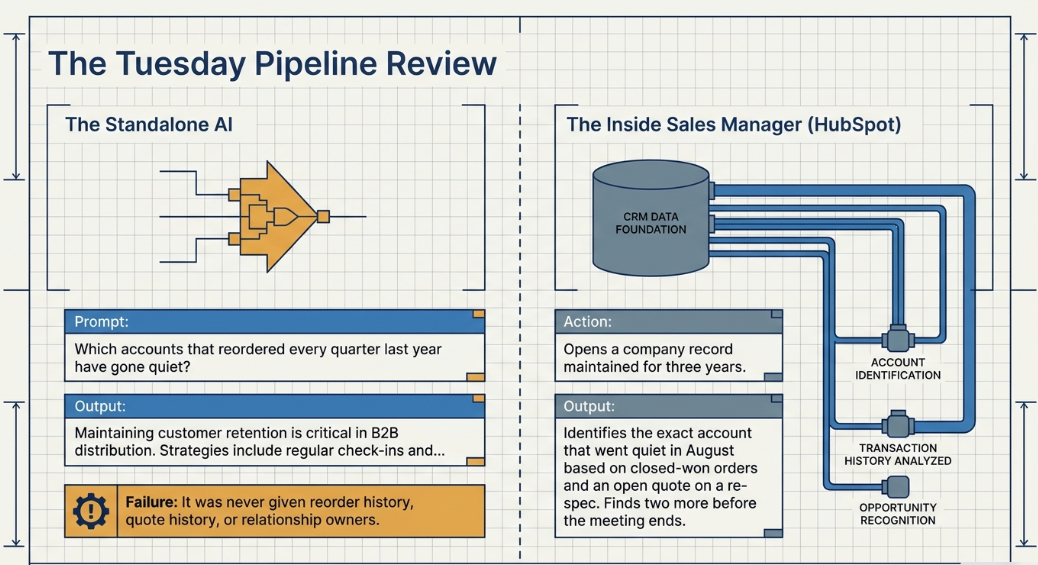
What “CRM is dead” gets right, and where it stops
“CRM is dead” is right about one thing: a CRM nobody updates is dead weight, and an AI placed on top of it has very little chance. A CIO columnist declared CRM officially dead in 2025, and the argument lands because most leaders have watched a system fill up with stale contacts, empty fields, and quotes that never closed. HubSpot's own customer panel at UNBOUND 2026 said much the same. A RevenueWell executive on that panel said layering AI on dirty data accelerates the problems a company already had. An IFS executive on the same panel put it more bluntly: a platform nobody uses compounds bad data, and the AI then has little chance.
Where the argument stops is the conclusion. An agent does not remove the need for a customer record; it changes what the record is for. For most of its life, the CRM has been a report: a place reps fill in so a manager can read it on Friday. An agent turns it into a System of Action, which is a CRM that produces a decision somebody has to act on, not a report somebody has to read. The agent reads the record, reasons over it, and writes down which account needs a call and why. A person decides.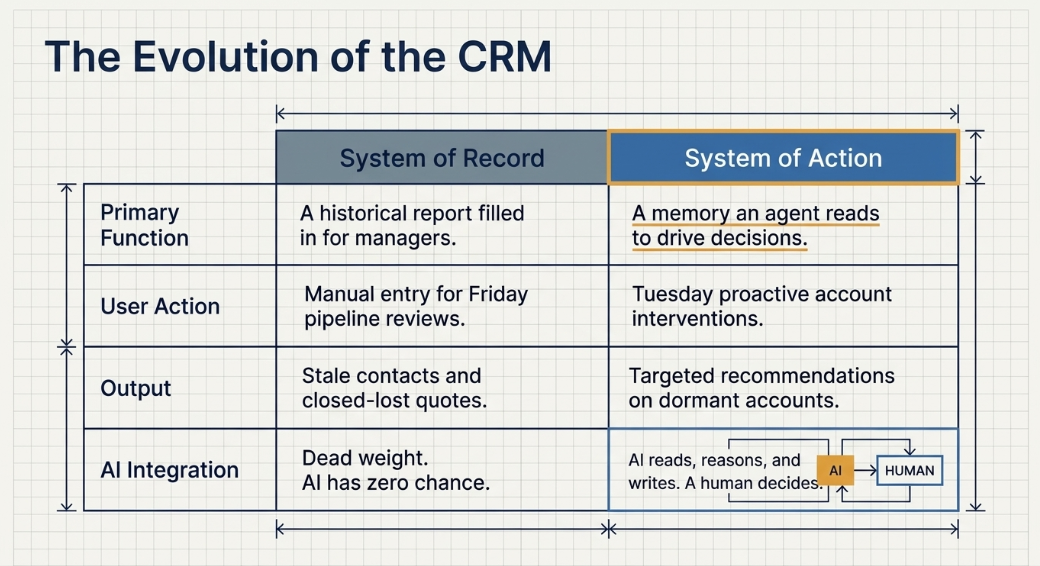
That shift is why the analysts who watch this market have not followed the obituary. Constellation Research argued in April 2026 that CRM is being right-sized for AI, not killed by it. Forrester, writing after the February 2026 software sell-off, argued that the enterprise core is transforming rather than disappearing. The verdict a stale CRM deserves is not “switch it off”. It is “make it worth reading, because something is about to read it every week”.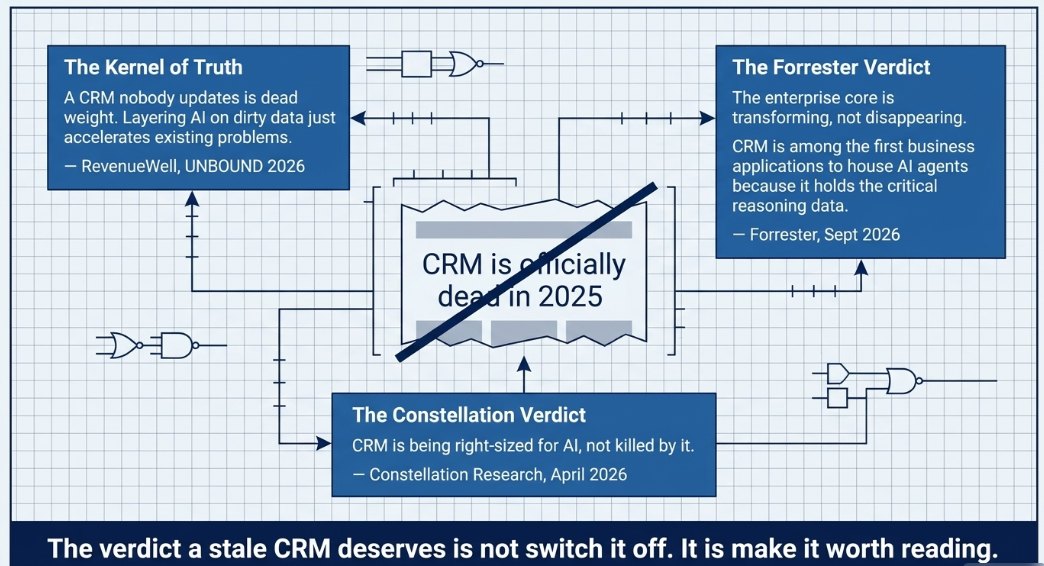
Who this question belongs to
This question belongs to the leaders of mid-market distributors, manufacturers, and industrial B2B companies that run on HubSpot and sell on repeat orders. That usually means the owner or CEO, the head of sales, and the head of operations: the people accountable for whether a dormant account gets a call before a competitor quotes the next job.
Most of them have already tried AI and are not yet running on it. HubSpot's UNBOUND 2026 study of about 6,000 companies reported that 90% use AI and 6% see transformational results. Distribution looks the same from the inside. Distribution Strategy Group's December 2025 survey of 233 distribution executives found 63 per cent still piloting or exploring AI, and only 18 per cent of those with siloed data were confident of a return.
If your customers reorder, re-spec, or renew, and someone has told you this year that the CRM no longer matters, this question is yours. It is also the territory manager's and the inside sales manager's, because they are the people who will be asked to trust whatever the agent says about their accounts.
Signs you are about to buy the wrong horse
These signs show that a distributor is about to buy an agent with nothing to remember its customers with. Run the list against your own portal and your own shortlist of vendors.
- The agent you are evaluating cannot name a single dormant account when you ask it to.
- The vendor describes the agent's memory as its model, or as the internet, rather than your customer records.
- Your reorder history lives in the ERP and never reaches the company record in HubSpot.
- Your open quotes carry no close date and no next step.
- Your key accounts have no named relationship owner on the company record.
- Your reps keep the real customer notes in their inbox rather than on the record.
- Your ERP, CRM, e-commerce, and analytics tools are all owned, and none of them talk to each other.
The last sign is the most common one. Distribution Strategy Group's 2026 technology benchmark reports that more than half of distributors own ERP, CRM, e-commerce, and analytics tools that are not connected to each other. Each sign on this list is a gap in the memory, not a reason to abandon it. None of them is fixed by buying a second system that remembers even less than the first.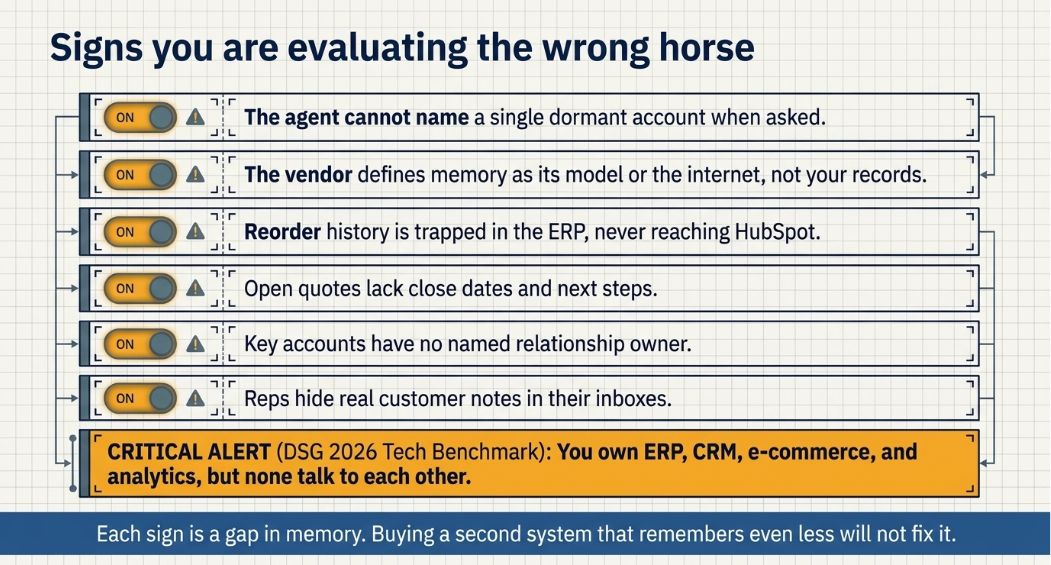
Why AI agents need the CRM more, not less
AI agents need the CRM more, not less, because an agent can only reason over what it is given to read, and the CRM is where a distributor already keeps what it knows about its customers. Four mechanical reasons follow from that.
The first is that the model is the part that goes out of date. As HubSpot's co-founder put it at UNBOUND 2026, models depreciate, and context appreciates. The model a vendor sells this year will be replaced next year. The three years of reorder history, quote history and relationship notes in your company records only become more valuable as they grow, and no vendor can ship them to you. HubSpot's CEO made the same point from the other side: the high-value use cases are the ones rich in context and data, and a company's data is its advantage. She defined context as the knowledge about your business, your customers, and your team, which for a distributor is a fair description of a well-kept CRM. HubSpot's co-founder also joked that friends don't let friends vibe-code their own CRM; the joke works because the memory is the hard part to rebuild.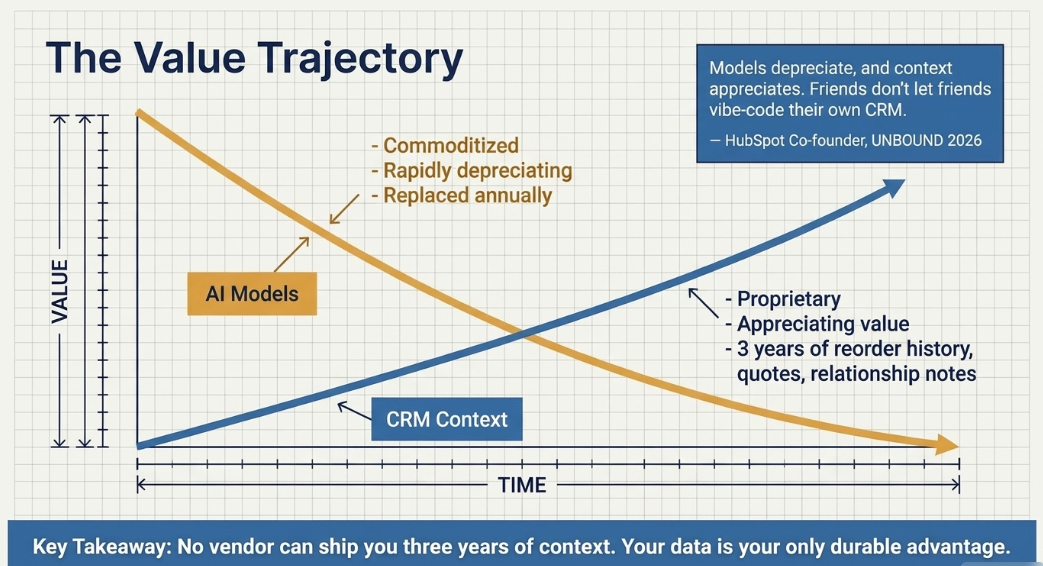
The second is that agents start where the customer data already lives. Forrester wrote in September 2026 that CRM is among the first business applications to have AI agents working inside it, because it holds the customer data agents reason over and people can correct the mistakes. An agent sold as a replacement for the CRM has to rebuild that data somewhere else before it can say anything specific about your accounts.
The third is that a memory split across places produces answers that match none of them. When an agent reads from several disconnected sources, such as a spreadsheet, an inbox, and last spring's ERP export, and reconciles none of them, the result is Context Collapse: three partial pictures of the same customer and a recommendation that fits none of them. HubSpot's CEO said at UNBOUND 2026 that AI with bad context is worse than no AI. An agent with no CRM behind it is the far end of that scale.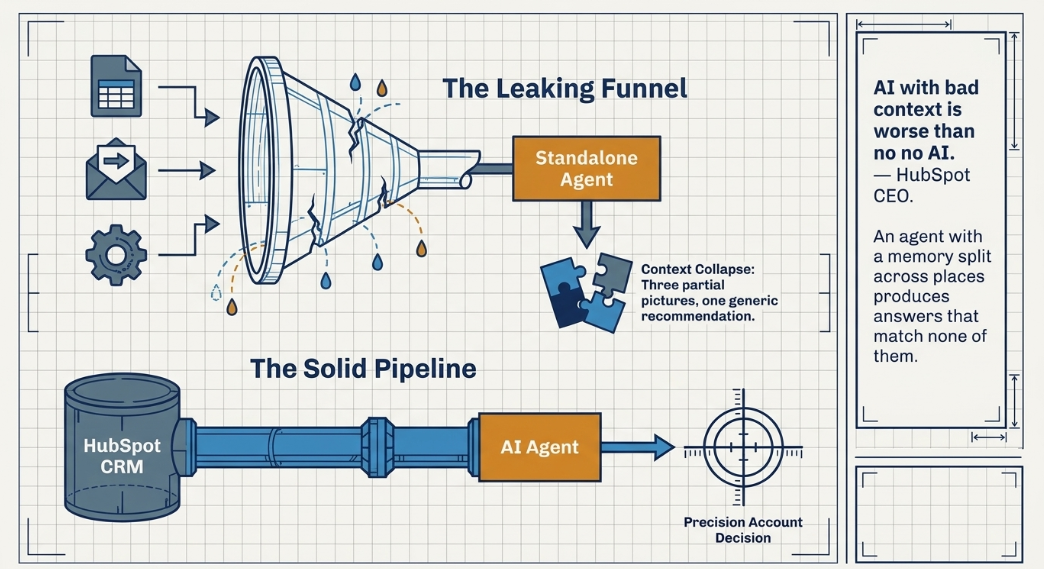
The fourth is that agents without a memory get cancelled. Gartner predicted in June 2025 that more than 40 per cent of AI agent projects would be cancelled by the end of 2027, citing cost, unclear value and weak risk controls. McKinsey's 2025 global survey found that while 88 per cent of organisations use AI, no more than one in ten is scaling agents in any single business function. The pattern behind both figures will be familiar to anyone who has read about why an AI pilot stalls after the first month at a distributor: the agent produced something interesting, nobody had to act on it, and nothing it said was tied to a customer record anyone trusted.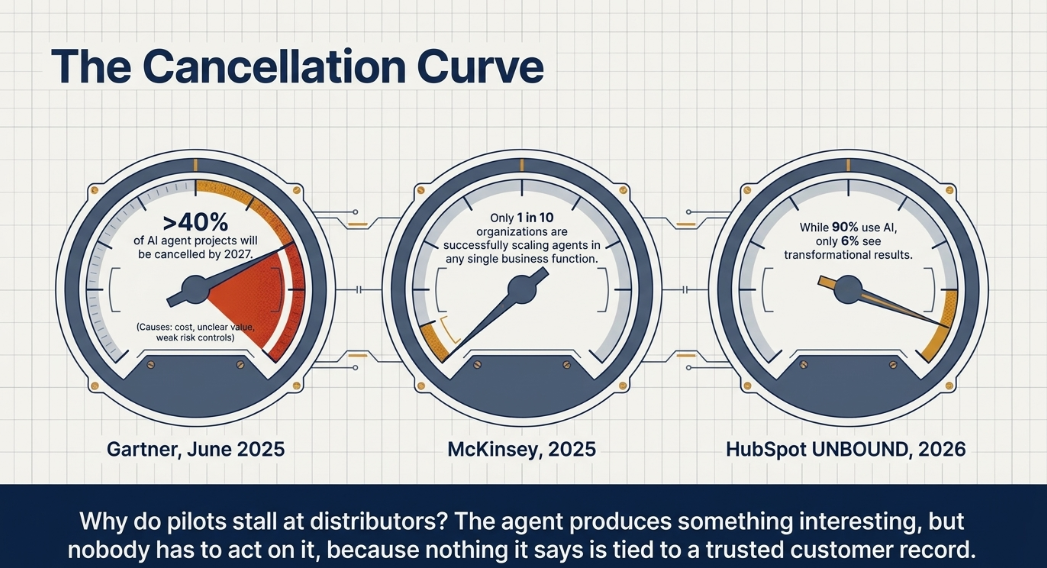
What to do, by situation
The right next step depends on what your CRM holds today, not on whether agents are coming. Find the row that describes your company.
|
If your situation is |
Do this |
Why |
|
The CRM is a report nobody reads before Friday. |
Pick one decision, such as which repeat-order accounts need a call this week, and make the CRM the memory for that decision only. |
One decision gives the record a weekly reader, and a record with a reader stays current. |
|
The reorder history lives in the ERP, not in HubSpot. |
Get the reorder history onto the company record before an agent weighs it. Start with whether a distributor's CRM data is ever clean enough to start. |
An agent cannot weigh what is not in the record it reads. |
|
You already bought a standalone agent. |
Ask the vendor which customer records it reads and where they live. |
An agent with nothing to read writes general advice, not account decisions. |
|
A vendor says agents replace the CRM. |
Ask what the agent will remember your customers with on Wednesday. |
If the answer is not your customer history, you are buying a model, not a memory. |
|
The CRM is kept up, but nobody acts on it. |
Let one agent read it and write a recommendation a person approves or overrules. |
That is the turn from report to System of Action. |
Most distributors sit in more than one row. Start with the row nearest the top that applies, because each later row assumes the earlier ones are in hand.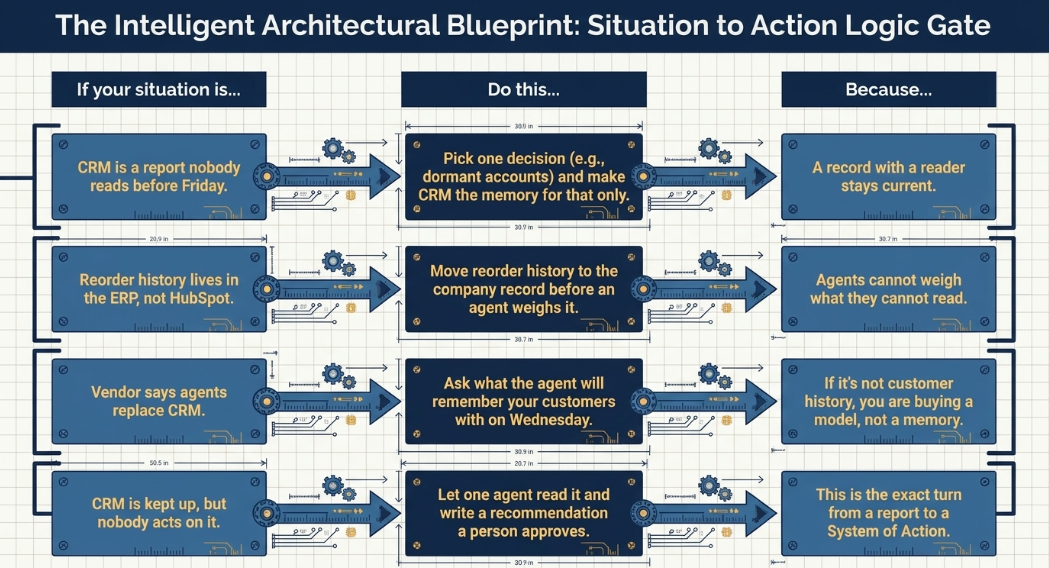
The CETDIGIT perspective: the CRM is the memory
CETDIGIT's view is that the CRM is the memory, workflows are the rules, agents do the reasoning, and people make the call, in that order. Others in the market describe the CRM as the memory agents think with, and they are right. What matters for a distributor is what that memory holds: the reorder history, the relationship owner, and the open pipeline, together on one company record. That combination is what the Tuesday question needs, and it is the combination a standalone agent does not have.
The recurring-accounts agent CETDIGIT builds is designed around that memory. It reads what is already in HubSpot, meaning the company relationships, closed-won history, recent activity, and open pipeline, and puts that CRM evidence first. On every account it flags, it writes a reason and a confidence score, plus a written explanation the owner can check and overrule. It does not email, call, assign work, or change deal stages. It runs alongside your team first: recommendations are written, not acted on.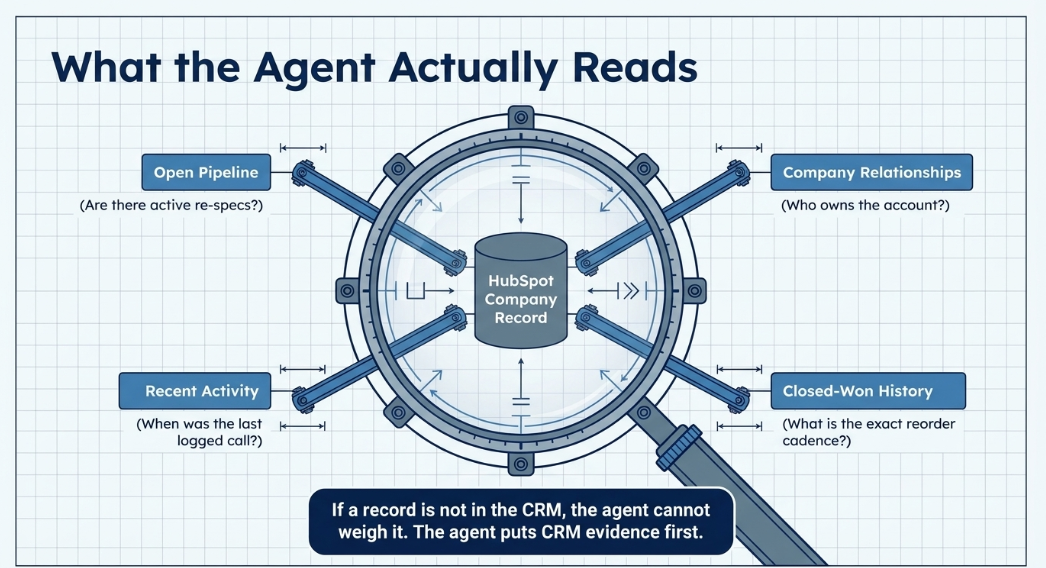
Before anything runs, CETDIGIT reviews the data read-only on days one to three and returns one of three verdicts: ready, ready with small additions, or not yet. The review comes first because the memory decides the quality of every recommendation the agent will write.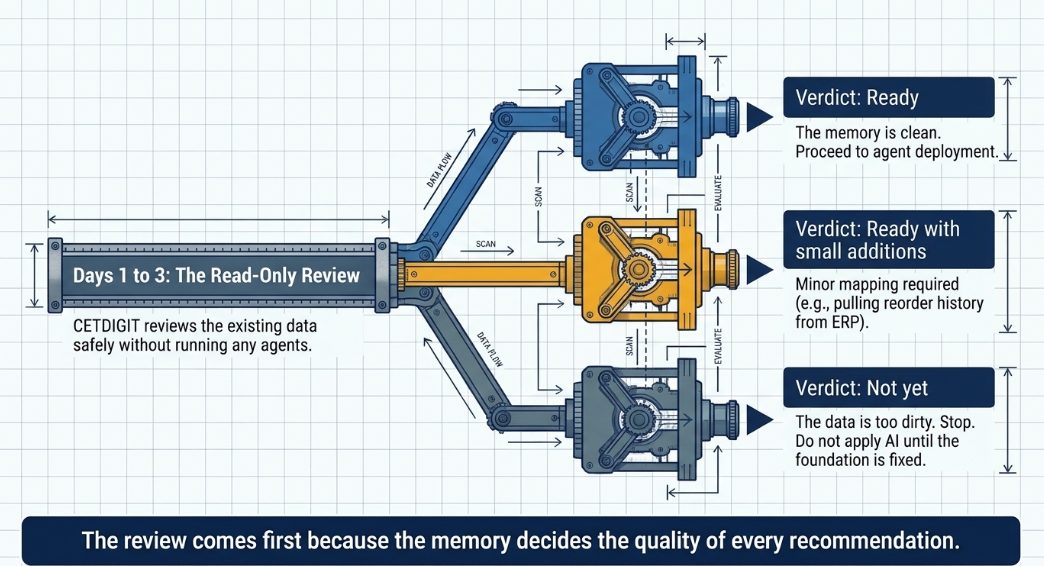
HubSpot's product keynote at UNBOUND 2026 framed every build around one question: will customers trust it? For a distributor, trust starts with being able to see what the agent read before it flagged an account. That is only possible when the memory is a record the company already keeps and can open. Every selling agent needs a memory. A distributor on HubSpot already owns one.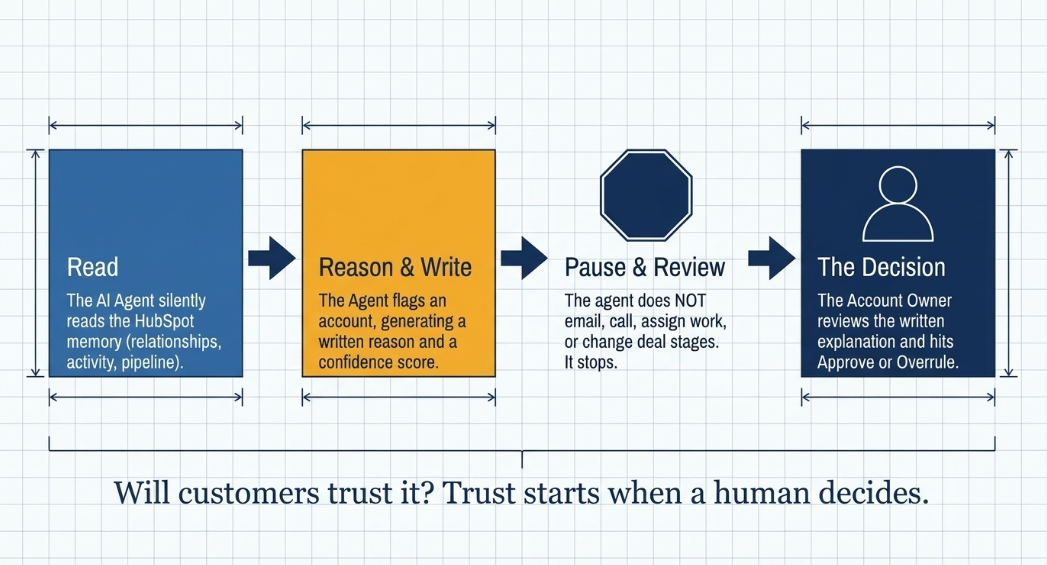
Recommended path: keep the CRM and give it a reader
The next step for a leader at this stage is not a purchase; it is a decision about what the CRM is for. Choose one decision your sales leaders make every week, such as which repeat-order accounts need a call, and list the records that decision depends on. Check whether those records live in HubSpot today. If they do, the CRM is already the memory an agent needs. If they do not, that gap is the work, and switching the CRM off would only widen it. When you want to see how a CETDIGIT engagement runs, the method starts with the same read-only look at the data as it is.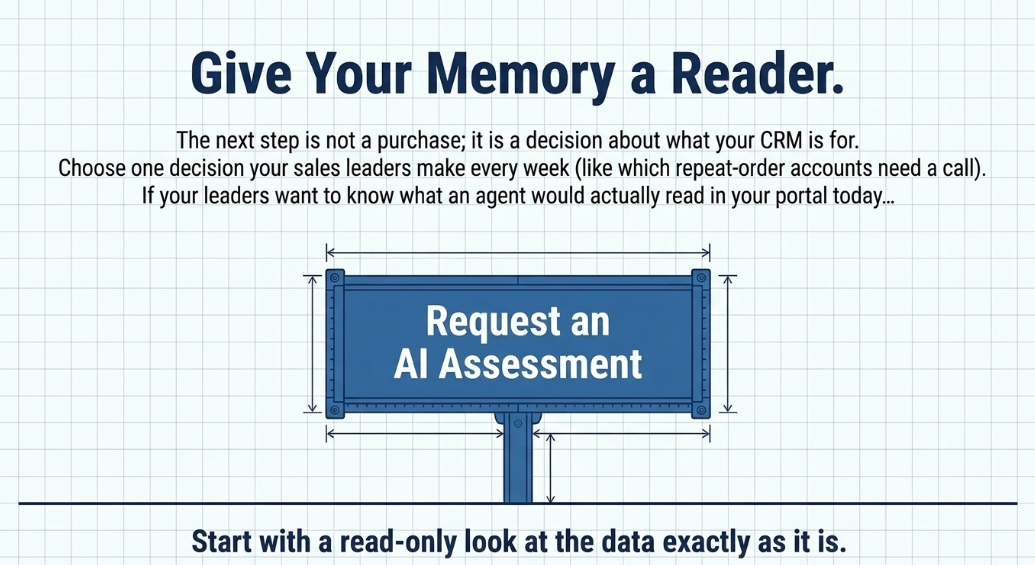
Frequently asked questions
These are the questions distributor leaders ask most often when they hear that AI agents replace the CRM.
Does a distributor still need a CRM if it buys AI agents?
Yes. As HubSpot's co-founder put it at UNBOUND 2026, models depreciate, and context appreciates, and for a distributor, the context is the reorder history, quote history, and relationship owners held in the CRM. Forrester wrote in September 2026 that CRM is among the first business applications to have AI agents working inside it, because it holds the customer data agents reason over. Buying agents make the CRM more important, because something now reads it every week.
Will AI agents replace the CRM?
Not on the evidence so far. Constellation Research argued in April 2026 that CRM is being right-sized for AI, not killed by it, and Forrester argued after the February 2026 software sell-off that the enterprise core is transforming rather than disappearing. What changes is the CRM's job: less a report for a manager, more a memory for an agent, with a person still making the call on every account.
What does a recurring-accounts agent actually read?
CETDIGIT's recurring-accounts agent reads what is already in HubSpot: company relationships, closed-won history, recent activity and open pipeline, with that CRM evidence first. On each account it flags, it writes a reason and a confidence score that the owner can check and overrule. It does not email, call, assign work, or change deal stages. If a record is not in the CRM, the agent cannot weigh it.
Isn't our CRM too messy to be a memory?
HubSpot's CEO said at UNBOUND 2026 that AI with bad context is worse than no AI, and a RevenueWell executive on HubSpot's customer panel said AI on dirty data accelerates the problems a company already had. That is a reason to establish what the agent reads, not to abandon the record. A read-only review of the data as it is tells you whether it is ready, ready with small additions, or not yet.
What happens to AI agent projects with no customer memory?
Gartner predicted in June 2025 that more than 40 per cent of AI agent projects would be cancelled by the end of 2027, citing cost, unclear value and weak risk controls. McKinsey's 2025 global survey found no more than one in ten organisations scaling agents in any single business function. An agent with no customer record to reason from produces general advice, and general advice is the first thing a budget review cuts.
How does this fit with CETDIGIT's other AI work?
HubSpot's CEO told UNBOUND 2026 that the high-value use cases are the ones rich in context and data. CETDIGIT's work starts from that premise: one decision at a time, built on the customer memory a company already owns. The recurring-accounts decision is one part of CETDIGIT's broader AI services framework, which sets out the wider range of AI work CETDIGIT does.
Who decides when the agent is wrong?
HubSpot's product keynote at UNBOUND 2026 framed every build around one question: will customers trust it? In CETDIGIT's design, the answer to who decides is a person. The agent reasons and writes a recommendation with its reasoning; the workflow enforces the rules, and the account owner decides and can overrule any recommendation the agent makes.
If your leaders have heard that the CRM is dead and want to know what an agent would actually read in your portal, Request An AI Assessment.


Leave a Comment