


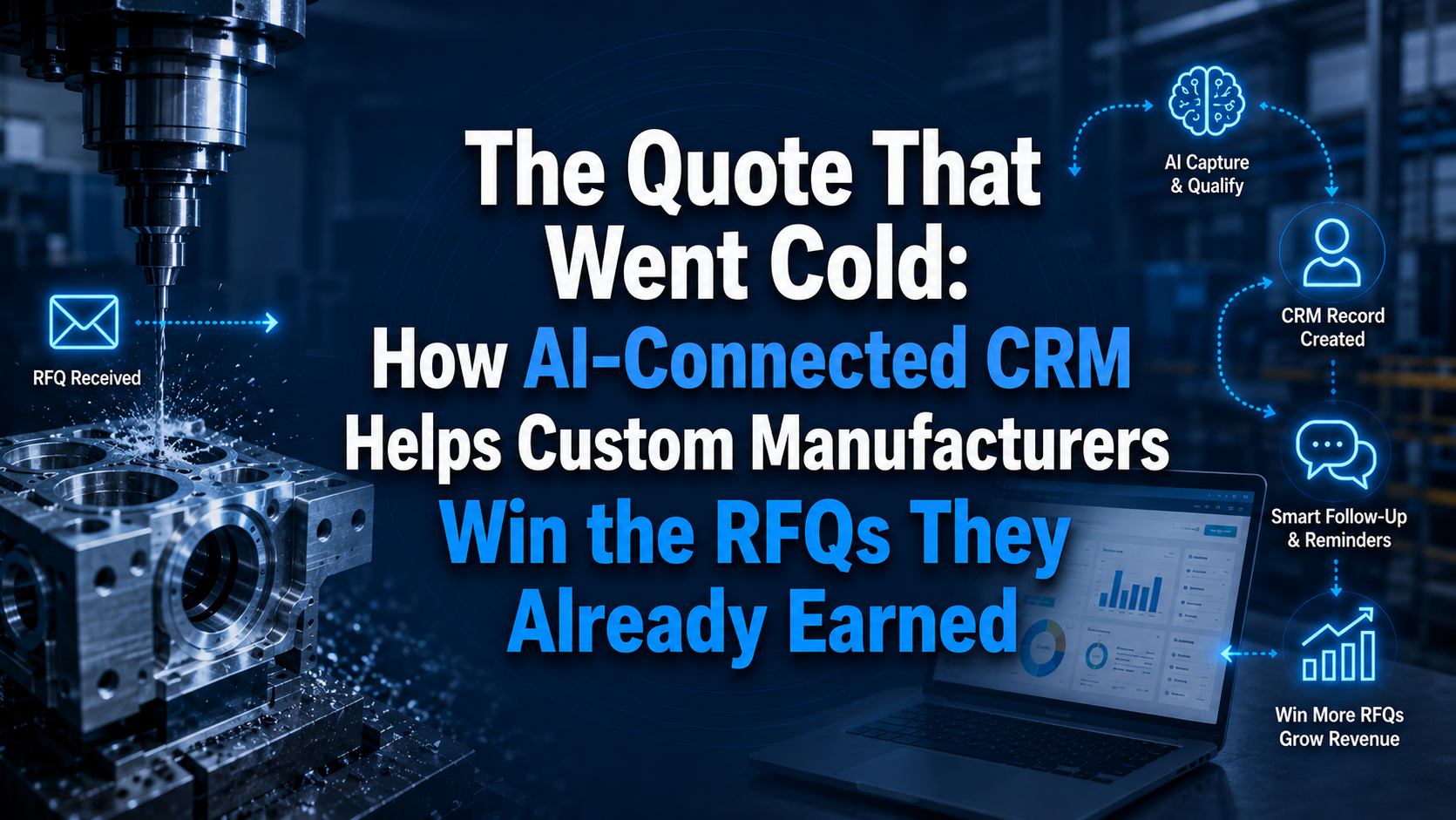
The RFQ arrives on a Thursday afternoon: a buyer at an OEM needs five hundred machined housings, drawings attached, delivery in ten weeks. Your best estimator opens it Friday morning between production fires, realizes the tolerances need an engineering review, and forwards it to the shop floor lead. The quote goes out the following Wednesday, six days after the inquiry landed. Clean quote, fair price, good margin. Then nothing. Nobody follows up, because following up is nobody's job. Three weeks later, the buyer awards the work to a shop that quoted in two days and called twice. The order was lost before your machines ever had a chance to win it.
Talk to sales managers at precision machine shops, fabricators, contract electronics manufacturers, and custom industrial builders, and you hear the same story with different part numbers. CETDIGIT works with dozens of manufacturers, from custom machining and fabrication shops to electronics and industrial automation firms, and the pattern is remarkably consistent: the operational side of the business is instrumented to the minute, while the revenue side runs on memory and inbox archaeology.
Why manufacturing sales fall through the cracks
It is not for lack of systems. A typical shop runs its operations through an ERP such as Epicor Kinetic, JobBOSS2, E2, Global Shop Solutions, Plex, or NetSuite. Quoting often happens inside the ERP's estimating module or in a spreadsheet an estimator has refined over fifteen years. Drawings live in CAD vaults, quality documentation sits in an ISO 9001 or AS9100 binder structure on a shared drive, and customer communication lives in individual email inboxes.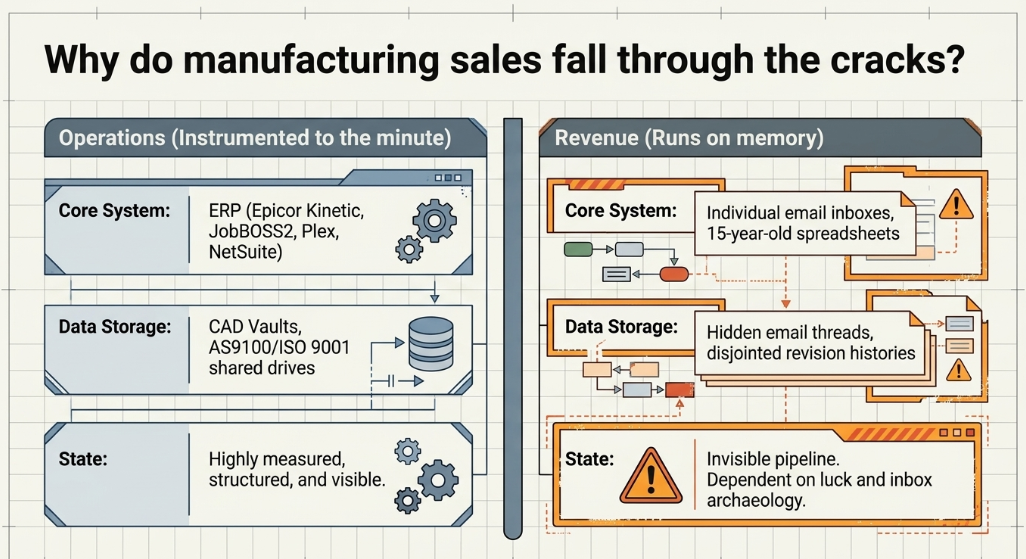
What is missing is a system of record for the commercial conversation. When the RFQ, the engineering questions, the revision history, and the follow-up cadence all live in email threads, the pipeline is invisible. Leadership cannot answer basic questions: how many open quotes do we have out, what is our win rate on aerospace work versus medical, how long does it take us to turn a quote, which longtime accounts have quietly stopped sending us RFQs. Every estimator retirement takes a decade of pricing judgment and customer knowledge out the door. And repeat business, the lifeblood of a job shop, depends on someone remembering that the housing order from eighteen months ago is probably due for a reorder, which in practice means it depends on luck.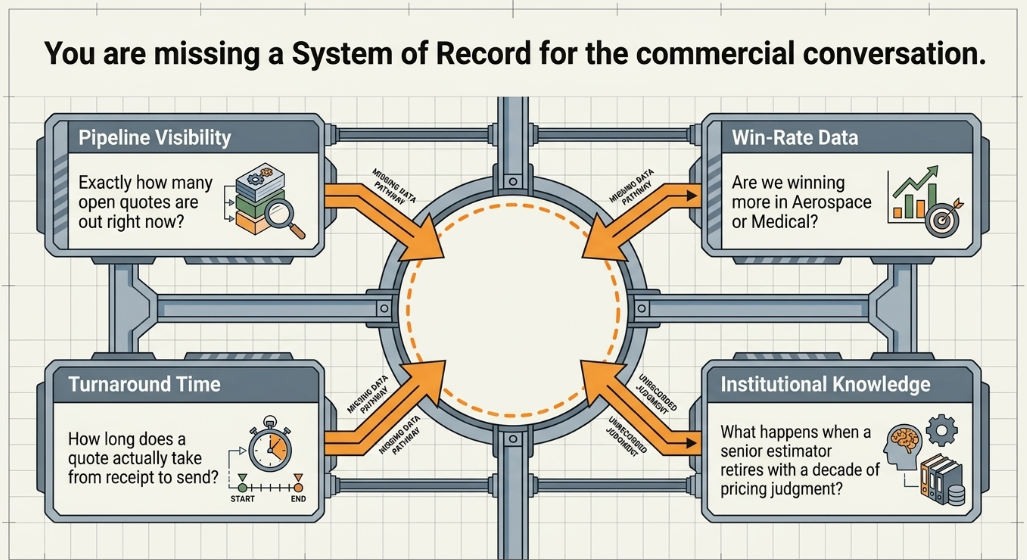
What a CRM actually does for a job shop, once AI is involved
Manufacturers have historically been justified CRM skeptics, because a CRM that demands manual data entry from estimators who are already stretched simply becomes an empty database. What changes the equation is pairing a modern CRM, HubSpot or Salesforce, with AI automation that does the clerical work people were never going to do.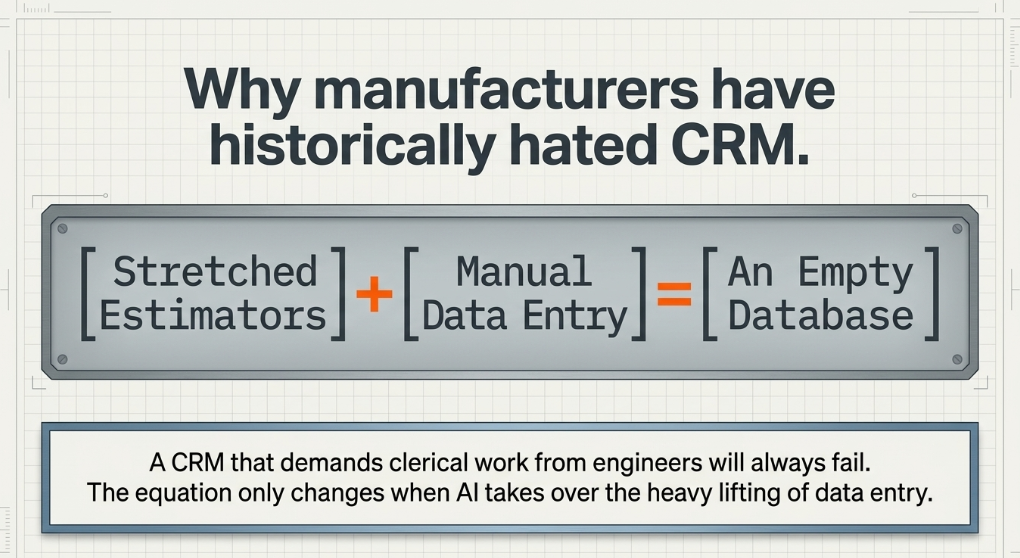
Start at intake. AI can read an inbound RFQ email, extract the customer, part references, quantities, and requested dates, create the deal record, and route it to the right estimator with the drawings attached, so the pipeline is populated the moment the inquiry arrives rather than after someone gets around to logging it. Quote turnaround time becomes a measured number instead of a feeling, and shops discover quickly that speed of quote is one of the strongest predictors of win rate.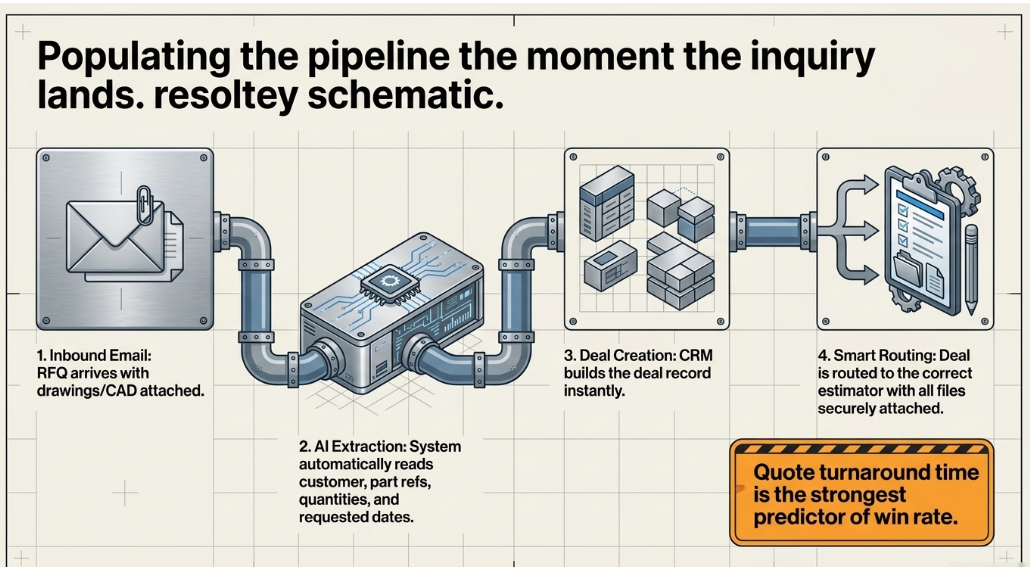
Follow-up stops depending on memory. If a quote has been out for five days with no response, the system nudges the estimator or drafts the check-in email itself, referencing the actual quote. When a deal is marked lost, the reason gets captured, and after a quarter you know whether you are losing on price, lead time, or responsiveness, which are three very different problems. Reorder intelligence works the same way: the CRM watches order cadence by account and raises a hand when a customer who used to order quarterly goes silent, turning account management from an annual trade-show conversation into a weekly rhythm.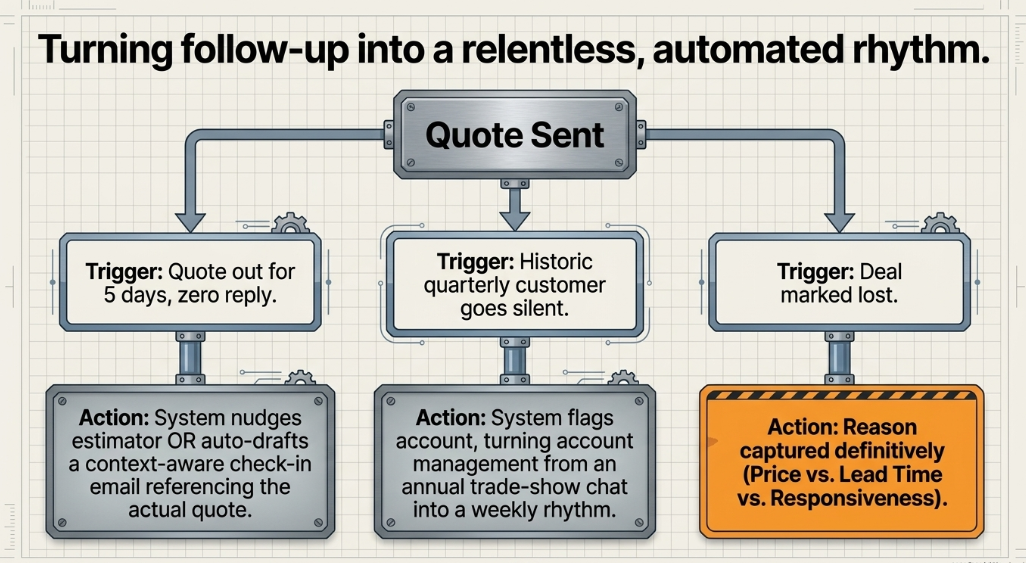
Retrieval-augmented answers from your own tribal knowledge
The deeper opportunity is what agentic retrieval-augmented generation does with the documents a manufacturer already has. Imagine an estimator asking, in plain language, "Have we quoted anything in 17-4 stainless with tolerances this tight, and how did we price it?" and getting an answer drawn from past quotes, job travelers, and win-loss history, with citations pointing to the specific source documents. Imagine a quality manager asking which active jobs are subject to a customer's flow-down requirements and getting an answer grounded in the actual purchase order terms. That is not a search box; it is an institutional memory that does not retire.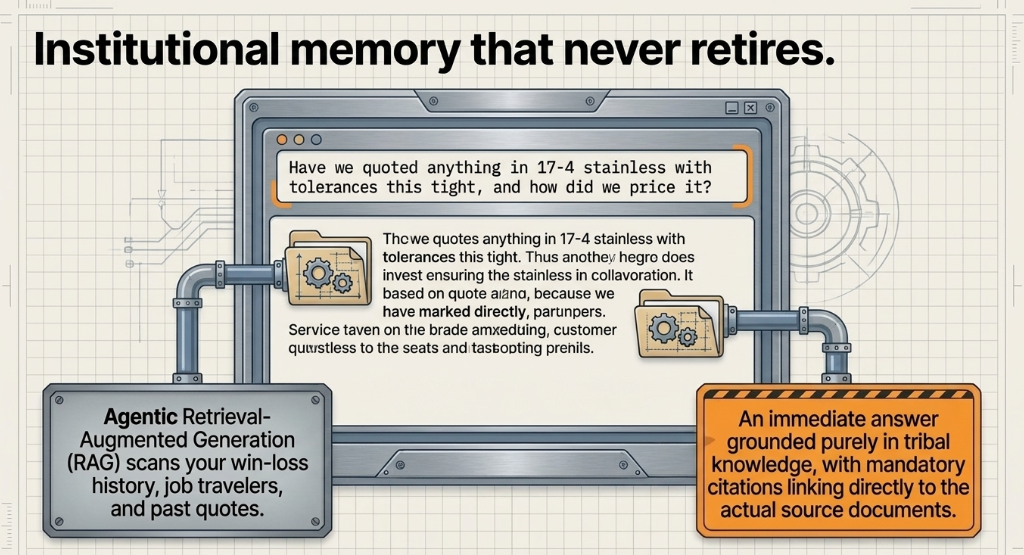
For shops in defense and aerospace supply chains, the governance around this matters as much as the capability. ITAR-sensitive technical data demands strict control over where documents are stored and processed, AS9100 audits demand traceability, and any AI outreach to prospects has to respect consent rules, including TCPA when calling or texting. This is why CETDIGIT builds on CETRAI, our AI platform designed for regulated, high-volume environments: a multi-LLM architecture with Claude as the primary model, retrieval with mandatory source citations so answers are verifiable rather than plausible, SSO integration, and audit logging that shows exactly who asked what and which documents informed each answer.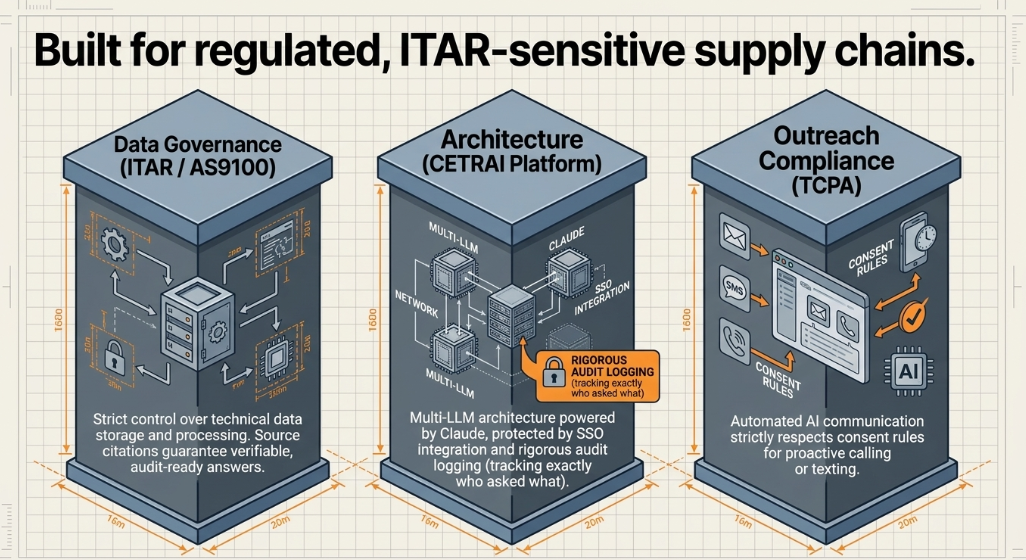
How this gets bought and rolled out on a shop floor timeline
Manufacturers do not buy software the way SaaS companies do. The decision usually involves the owner or general manager, the sales lead, and whoever owns the ERP, and the first question is always integration: nobody wants a second system of record fighting with Epicor or JobBOSS. The right architecture keeps the ERP as the operational source of truth for jobs, routings, and invoicing, while the CRM owns the commercial pipeline, with the two synchronized so a closed-won deal flows into estimating and production without rekeying. A sensible rollout starts with RFQ intake and quote follow-up, the highest-leverage ninety days, then layers in reorder monitoring and the RAG knowledge base once the team trusts the pipeline data. As a Salesforce Crest Partner and HubSpot Elite Partner with more than 300 AI and CRM deployments, CETDIGIT has run this integration playbook across both platforms and across ERPs common on American shop floors.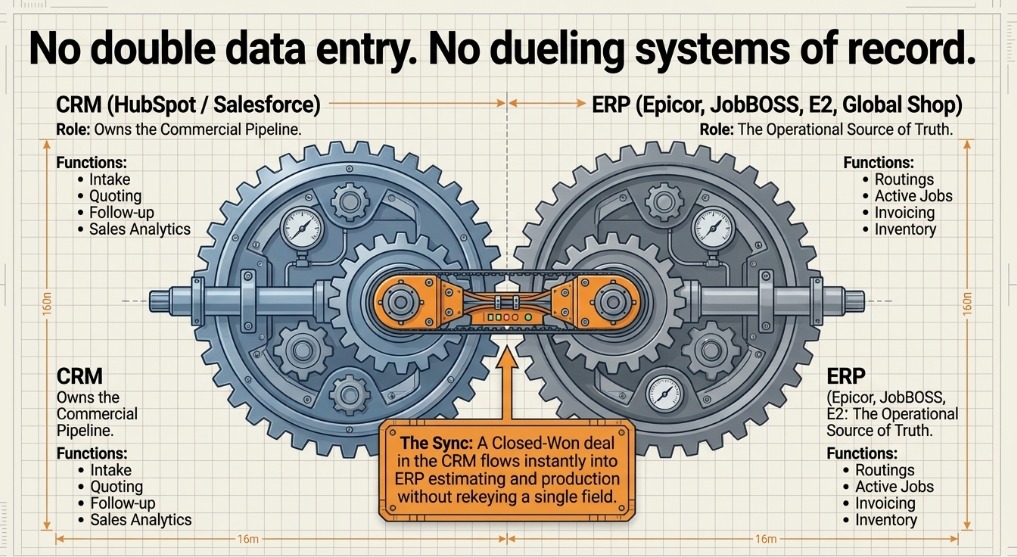
The math your competitors are already doing
Run the numbers on your own shop: quotes sent last year, average order value, current win rate. For most custom manufacturers, winning even three or four more jobs per hundred quotes, purely through faster turnaround and disciplined follow-up, is worth more than any new machine on the capital plan, at a fraction of the cost. The work is already coming to you. The question is whether your commercial process is good enough to keep it.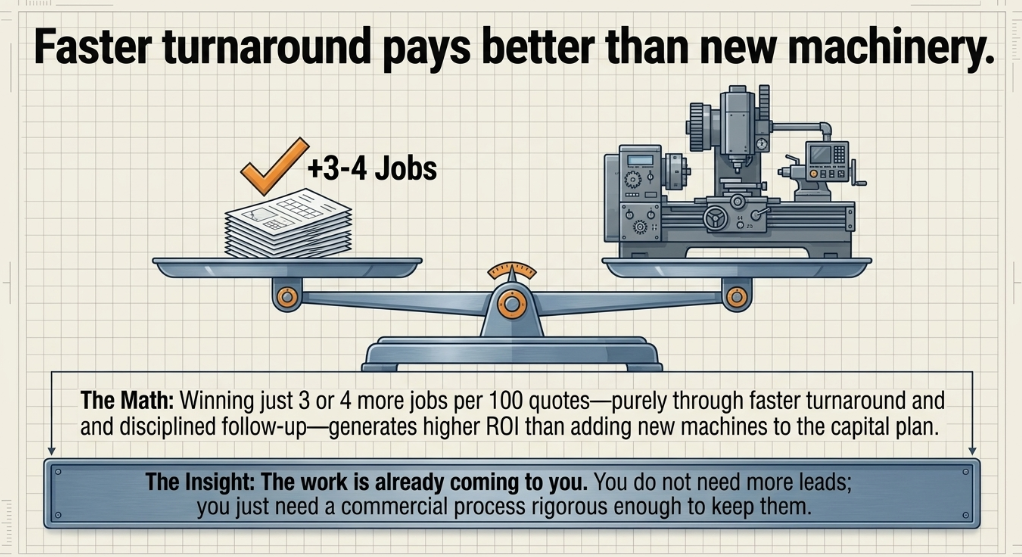
If you run sales at a manufacturer and any of this sounds familiar, CETDIGIT would welcome the conversation. Schedule a consultation, and we will look at your current quote-to-close process, your ERP landscape, and where AI-connected CRM automation would pay back fastest, with a roadmap sized for a shop's budget and attention span, not an enterprise software project.
Related Reads
From Bid to Build: How AI-Powered CRM Automation Stops Construction Firms from Losing the Jobs They Never Followed Up On
Your CRM Already Knows the Answer: How AI Integration Turns Salesforce into an Intelligent Operating System
The Real Cost of Waiting: What Business Owners Lose by Delaying AI Adoption

Leave a Comment