


Direct answer. A distributor’s CRM data is clean enough to start with an AI agent when it has a Data Foundation for one decision: the company records, dated order history, and account owners that single decision reads. It does not need a clean portal first. The first step is a read-only review of those records, on the data as it is, which returns one of three verdicts: ready, ready with small additions, or not yet.
What the portal looks like when someone suggests AI
This is an illustrative scene, not a client story, but anyone who runs operations at a distributor will know the room.
The operations lead opens HubSpot to show the owner why the AI idea has to wait. One of the steadiest repeat-order customers is filed three ways: the full legal name, a short name a rep typed in a hurry, and a branch number carried over from the old system. The open pipeline is full of quotes from the spring with no close date, because nobody closes out a quote when the customer simply stops answering. The re-spec orders, the ones that tell you a customer is redesigning a product line, were logged as notes on the buyer’s contact instead of as deals on the company.
The owner looks at the screen for about ten seconds and says what everyone is thinking: our data isn’t clean enough. The AI project is parked behind a cleanup project. The cleanup project gets a kickoff meeting and no end date.
Six months later, the portal is a little tidier, and nothing is reading it. The accounts that went quiet in the spring are still quiet. The decision about which customers needed a call this week was never made by anything except someone’s memory.
The fear in that room is reasonable. The conclusion drawn from it- wait until the data is clean- is the expensive one.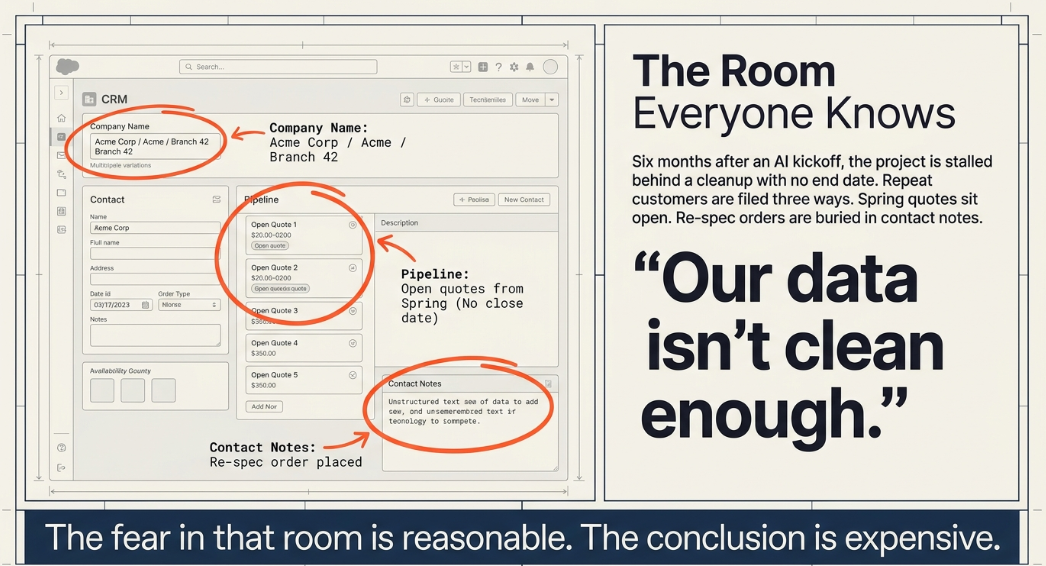
Why “our data isn’t clean enough” is a real fear with the wrong conclusion
“Our data isn’t clean enough” is the most common reason a distributor gives for not starting with an AI agent, and it rests on a true observation. HubSpot’s CEO said at UNBOUND 2026 that AI with bad context is worse than no AI. On the same programme, a RevenueWell executive on HubSpot’s customer panel said that layering AI onto dirty data speeds up the problems a company already had, and that many organisations skip the step of dealing with that data first. An IFS executive on the same panel put it more bluntly: a powerful platform nobody uses just compounds bad data, and AI then has little chance.
Nothing in this article argues with them. Bad data handed to an AI is a real risk, and a leader who refuses to take that risk blind is doing the job properly.
The trouble is what “clean” gets measured against. Most leaders who say their data isn’t ready are picturing the whole portal: every company, every contact, every deal since the migration. Measured that way, clean has no finish line, because the portal keeps changing while you clean it.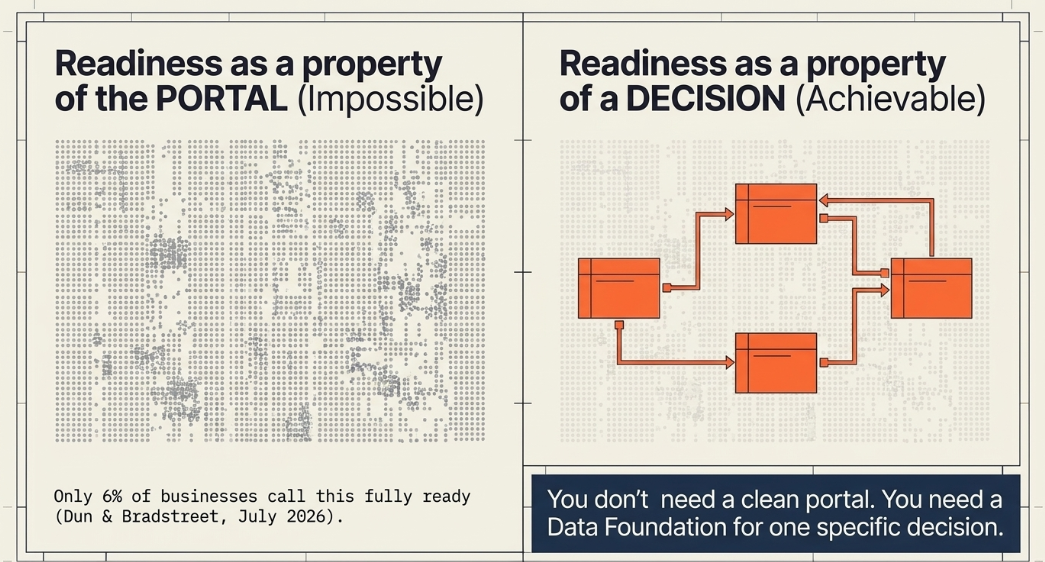
The useful measure is narrower. A Data Foundation, in plain words, is the set of records one decision reads, in a state where they match what your people already know about those customers. For a distributor deciding which recurring accounts need attention this week, that means company records with their deals attached, dated order history, recent activity, the open pipeline, and a person who owns each relationship. It does not mean the whole portal.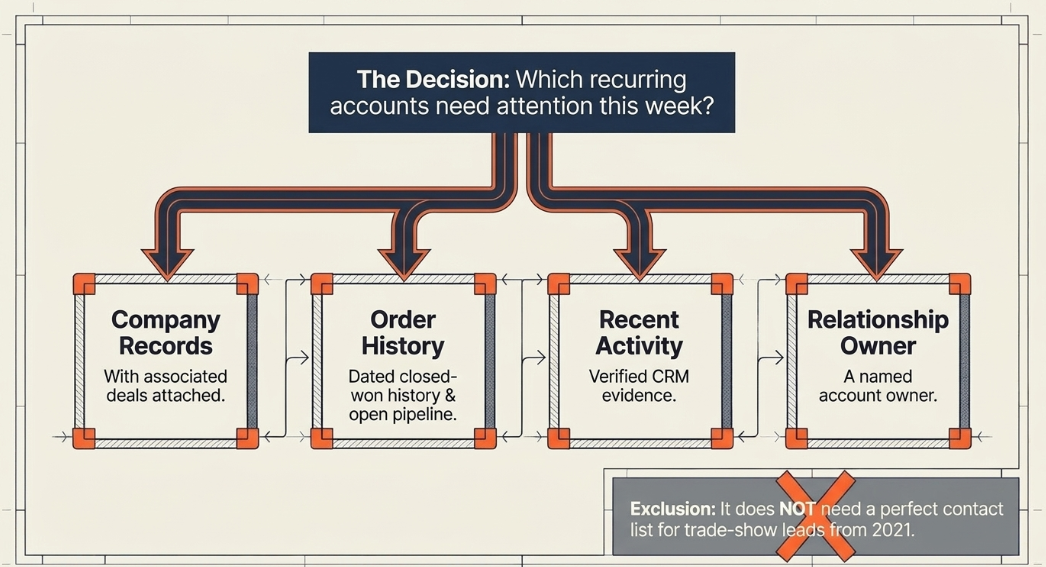
The portal-wide picture is where the gloomy numbers come from. Gartner’s survey of 1,203 data management leaders, published in February 2025, found 63 per cent were not sure, or did not have, the right data practices for AI. That describes how organisations feel about their data in general. It says little about whether the records behind one decision are usable, and that is the question worth answering first.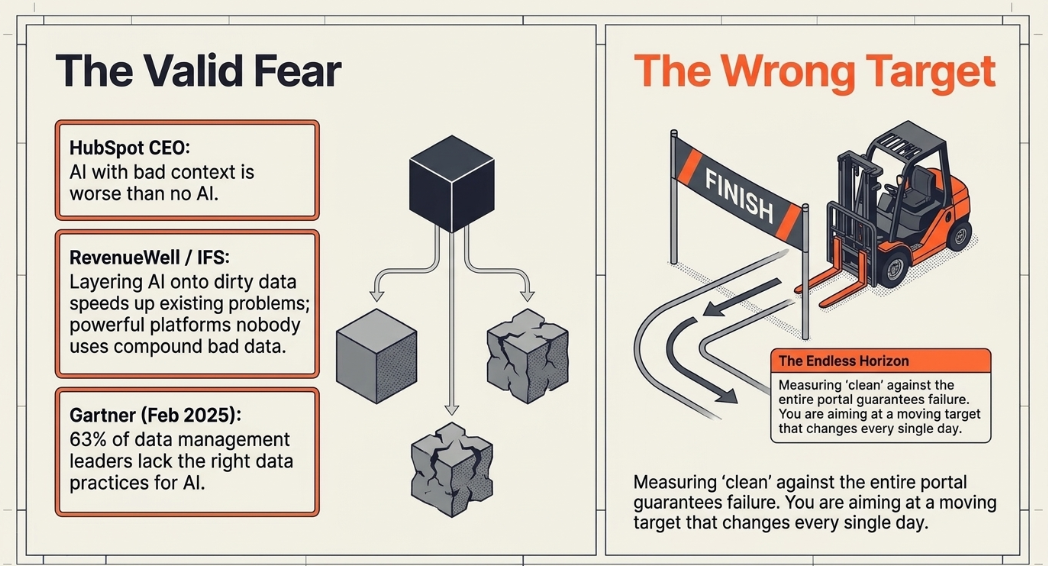
If you have already turned on an AI tool and watched it fade, that is a different problem from this one, covered in why AI pilots stall after the first month at a distributor.
Who this question belongs to
This question belongs to leaders at mid-market industrial, manufacturing, and distribution companies that run sales on HubSpot and live on repeat business. The owner or CEO who has watched one AI experiment fade. The head of sales whose best accounts reorder on a cycle nobody ever wrote down. The RevOps or operations lead who knows exactly where the portal’s problems are, because they inherited some of them in the migration.
These businesses share a pattern. Revenue comes from customers who reorder, re-specify, and renew, so the cost of a quiet account is real but invisible until the quarter closes. The records that would show it are in HubSpot, spread across companies, contacts, deals, and notes in ways that made sense to whoever entered them.
One caveat on the evidence. Most of the hard data on AI-ready data is cross-sector: Gartner, RAND and Dun & Bradstreet surveyed organisations of every kind. None of them measured distributor CRM data specifically, and this article does not pretend otherwise.
Signs your portal feels “not ready”
A portal feels “not ready” when the records that matter most cannot be trusted at a glance. Run this list against your own HubSpot; most distributors will recognise several items.
- Open quotes sit in the pipeline with no close date and nobody closing them out.
- The same customer appears under more than one company name.
- Repeat and re-spec orders are recorded in notes rather than as deals on the company.
- Some company records have no relationship owner.
- Closed-won history starts on the day you moved into HubSpot, and nothing earlier is there.
- Nobody can say which records an AI tool would read first.
- The AI project has a cleanup step in front of it with no end date.
None of these items mean you cannot start. Each one either matters to the decision you pick or it does not, and finding out which is what the first step is for.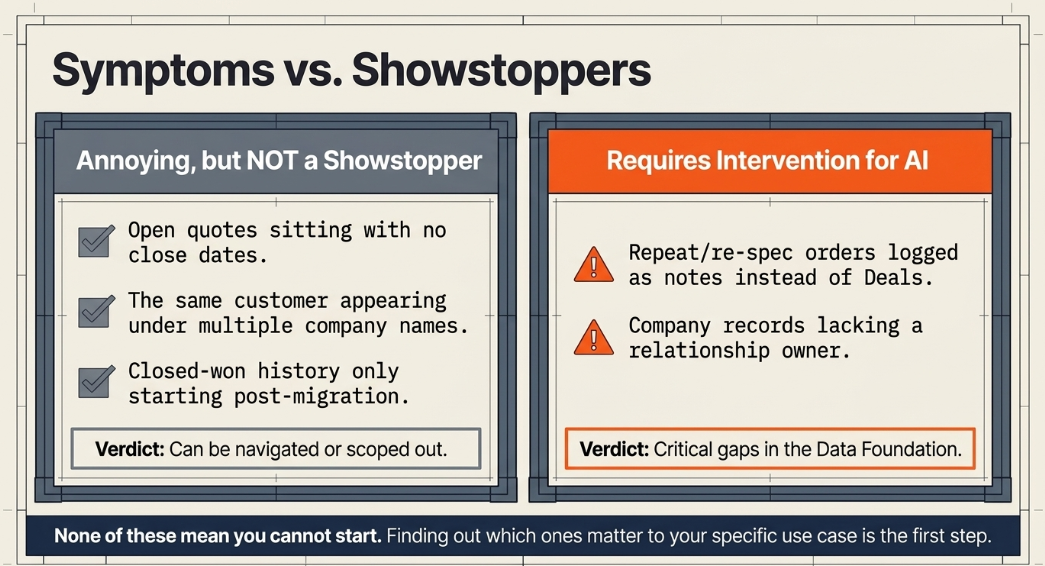
Why waiting for clean data rarely ends
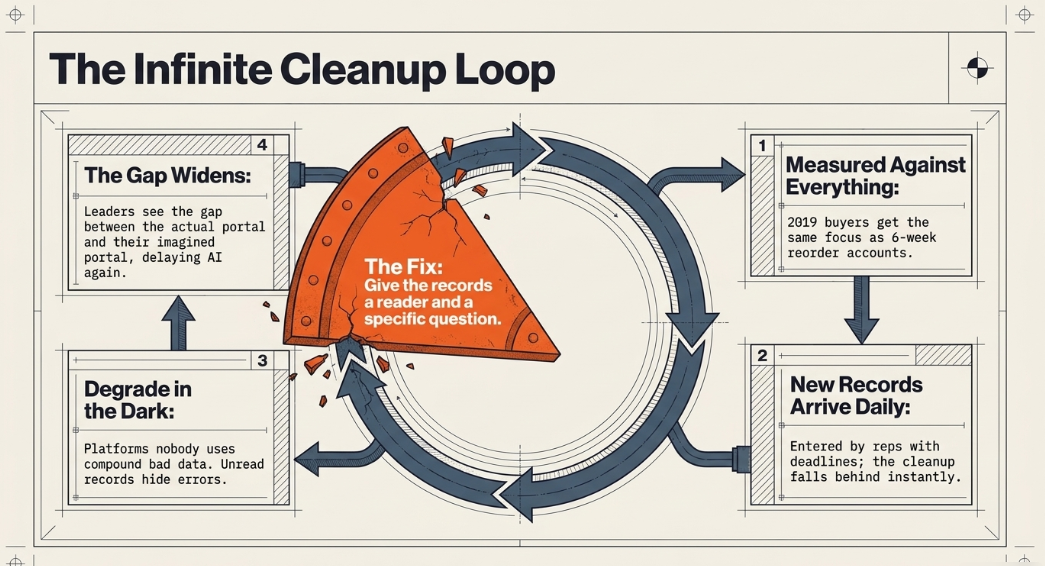
Waiting for clean data rarely ends because the cleanup is aimed at the portal instead of at a decision. Four mechanisms keep it going.
Clean is measured against everything
A portal-wide cleanup has no finish line because every record counts the same. The customer who last ordered in 2019 gets the same attention as the one who reorders every six weeks. New records arrive every day, entered by people with deadlines, so the cleanup is always behind. Leaders read the gap between the portal they have and the portal they imagine, and conclude they are not ready.
Readiness belongs to a use case, not a portal
Readiness is a property of what you are trying to do with the data. Gartner said as much in the same 2025 release: whether data is AI-ready is judged per use case, and the data has to represent that use case. A distributor deciding which recurring accounts need a call needs company records, deals, dated order history, and owners for those accounts. It does not need a perfect contact list for the trade-show leads from three years ago.
CETDIGIT has made the same argument for HubSpot generally: readiness is a property of one decision [per rev b], not of the portal.
Records improve when something reads them
A record nobody reads has nobody to notice it is wrong. That is the point the IFS executive was making about platforms nobody uses: the data gets worse in the dark. A cleanup project with no reader at the end of it has the same problem. The fix is to give the records a reader and a question, so the gaps that matter to that question show up and the ones that don’t can wait. Distribution Strategy Group’s June 2026 panel on fixing the data problem for AI treated cleanup priority as a sequencing question, which is the right frame.
The cleanup is mistaken for the first step
Data quality is a real cause of failed AI projects, which is exactly why it should be checked early and narrowly rather than treated as a gate. RAND’s 2024 study, built on 65 practitioner interviews, ranked leaders misreading the problem first and data problems among the top causes; 30 of its 50 industry interviewees raised data quality. Both findings point the same way. Know which problem you are solving, then check the data that problem needs. A cleanup that starts before the problem is named gets both steps backwards.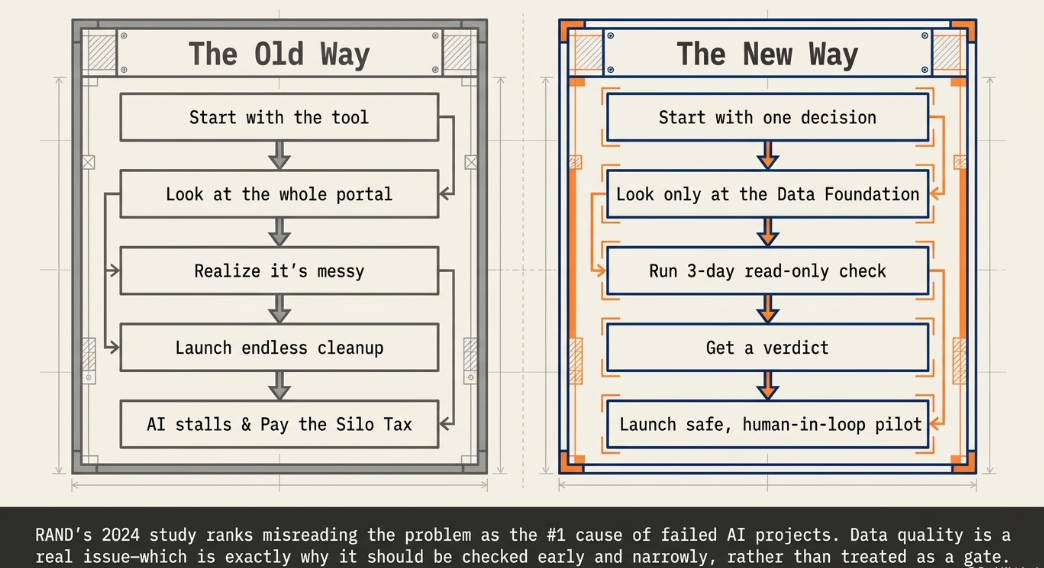
What to do, by situation
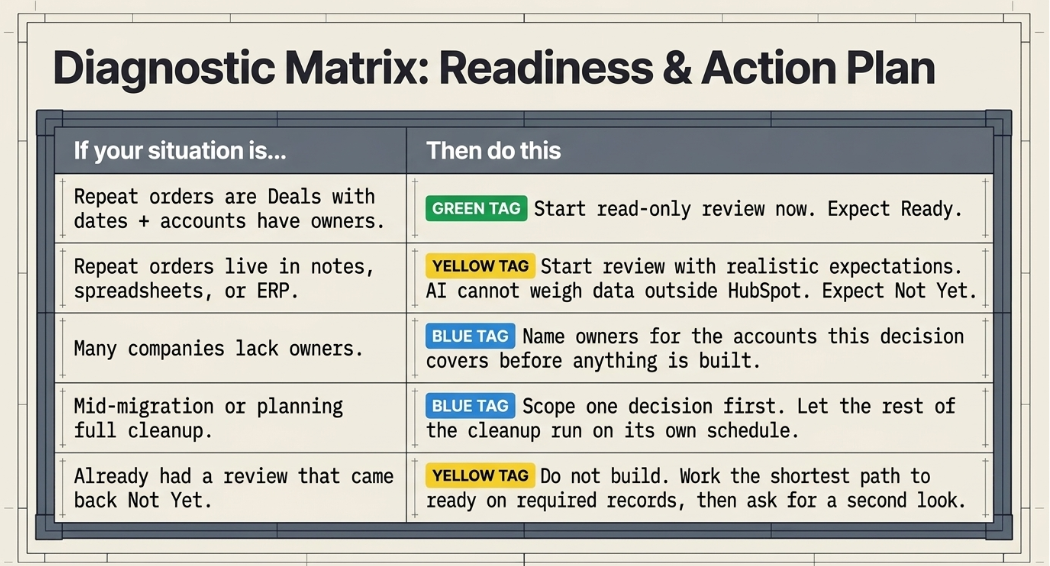
The right first move depends on where the records behind your decision live today. Find the row closest to your portal.
|
If your situation is… |
Then do this |
|
Repeat orders are deals on company records, with dates, and most accounts have an owner. |
Start with a read-only review now. Expect a verdict of ready or ready with small additions, and expect to learn where the gaps sit. |
|
Repeat, and re-spec orders mostly live in notes, spreadsheets, or your ERP rather than as deals in HubSpot. |
Start anyway, with realistic expectations. An agent cannot weigh data that is not in HubSpot, so the honest verdict may be not yet, with the shortest path to ready named. |
|
Many company records have no relationship owner. |
Name owners for the accounts the decision covers. A relationship owner on each company is one of the things checked before anything is built. |
|
You are mid-migration or planning a full portal cleanup. |
Do not make the cleanup the gate. Scope one decision and ask what its records need; the rest of the cleanup can run on its own schedule. |
|
You already had a review that came back not yet. |
Do not build. Work the shortest path to ready on the records that decision reads, then ask for a second look. |
|
|
How CETDIGIT starts: a read-only review on days 1–3
CETDIGIT starts the Sales Analyst Agent with a read-only review of your data as it is, before anything is built. In the offer page’s own words, CETDIGIT reviews your data read-only on days 1–3 and tells you: ready, ready with small additions, or not yet.
The review looks at the records the agent’s one decision depends on: company records with associated deals; dated closed-won history, recent activity, and open pipeline; and a relationship owner on each company. For dealers and distributors, it also checks contract or renewal dates where they are available. Nothing is changed in your portal while this happens.
If the answer is not yet, the page is plain about what follows: we tell you what is missing and give you the shortest path to ready. We do not build on thin data. That line is the honest limit of everything in this article. Starting on the data as it is means the first read happens on the data as it is. It does not mean an agent gets built on records that cannot carry the decision.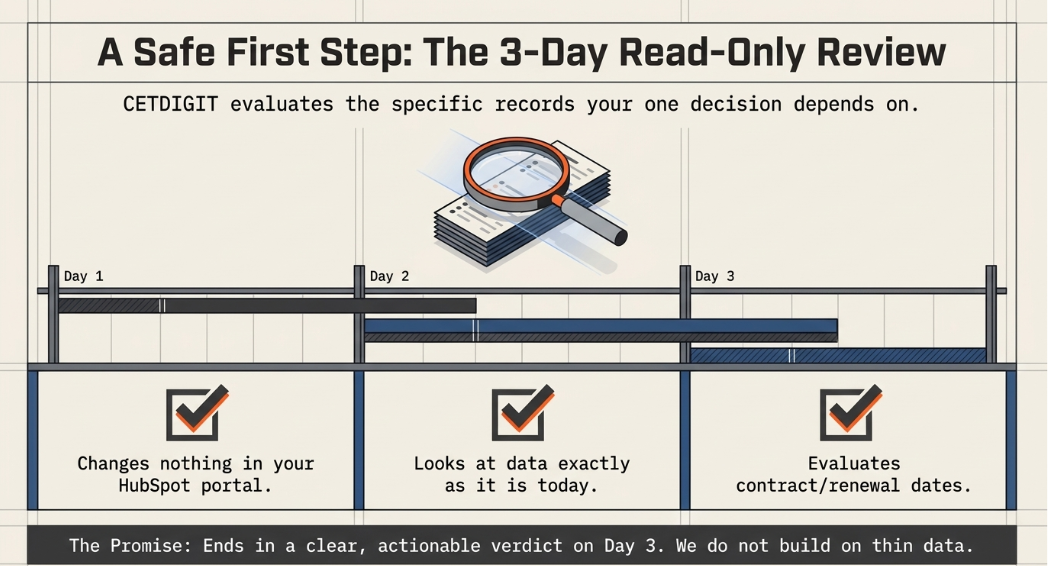
If the answer is ready, day 5 brings a one-page plan covering inputs, outputs, boundaries, schedule, and credit arithmetic, and the work proceeds on day 6 unless you say pause. When the agent runs, it reads your company relationships, closed-won history, recent activity, and open pipeline, with CRM evidence first. It runs alongside your team first: recommendations are written, not acted on. Every flag carries a reason and a confidence, with a written reason your people can check and overrule. It does not email, call, assign work, or change deal stages. On day 30 you decide whether to keep it or switch it off.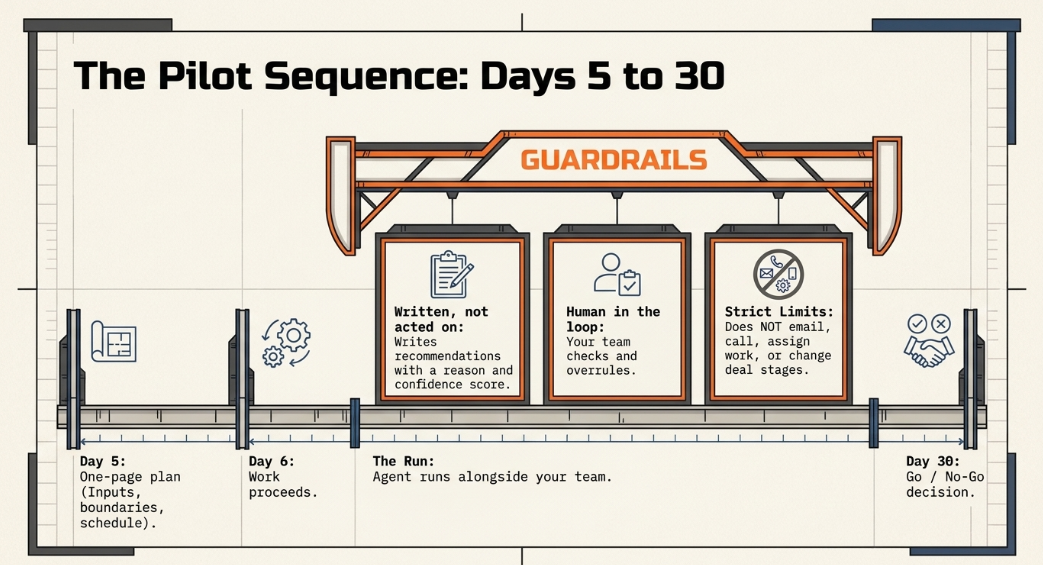
Waiting has a price as well. CETDIGIT calls it the Silo Tax [per rev b]: the cost a distributor pays every week while order history sits in records nobody reads across, and the accounts going quiet are noticed only after the fact. You can see the whole sequence in how a CETDIGIT engagement runs.
That is why this first step does not stall in a cleanup. It ends in a verdict, and a verdict is something a leader can act on.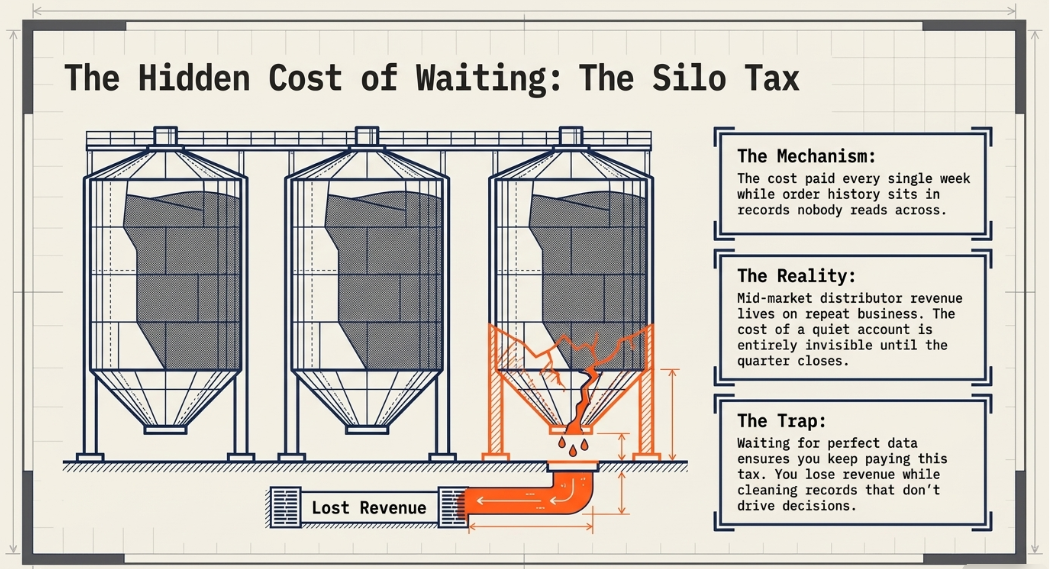
What to do next if you are still deciding
If you are weighing whether to start, the next step is to name one decision and find out whether its records are usable, not to schedule a cleanup.
Pick the decision first. For most distributors, it is the one that costs the most when it is missed: which recurring accounts need attention this week, and why. Then hold your portal up against the list in this article. Are those accounts filed as companies with deals attached? Is the order history dated? Does each one have an owner? You will know within an afternoon whether you are closer to ready than the whole portal suggests.
When you want a second opinion on that, a read-only verdict is the smallest safe step. CETDIGIT’s Data and AI Foundation service is where the records work sits when the verdict asks for it.
Frequently asked questions
Do we need to clean our CRM data before we start with an AI agent?
HubSpot’s CEO said at UNBOUND 2026 that AI with bad context is worse than no AI, so the data matters. It does not follow that the whole portal must be clean first. What an agent needs is a Data Foundation for one decision: the records that decision reads, in a state that matches what your people know. A read-only review of those records, on the data as it is, tells you whether they are ready, ready with small additions, or not yet. Cleaning the rest of the portal can follow on its own schedule.
What does a read-only review of HubSpot data look at for a distributor?
Gartner has said AI-ready data is judged per use case, and a read-only review follows that logic by looking only at what one decision needs. For CETDIGIT’s Sales Analyst Agent, that means company records with associated deals; dated closed-won history, recent activity, and open pipeline; and a relationship owner on each company. For dealers and distributors it also checks contract or renewal dates where available. The review runs on days 1–3, changes nothing in the portal, and ends in one of three verdicts.
What happens if the review says our data is not ready?
Gartner predicted in 2025 that organisations will abandon 60 per cent of AI projects unsupported by AI-ready data through 2026, which is why a not-yet verdict is worth having before a build rather than after. When CETDIGIT’s review returns not yet, the offer page commits to telling you what is missing and giving you the shortest path to ready. Nothing is built on thin data. You work the gaps that matter to that one decision, then ask for a second look.
Is any company’s data actually ready for AI?
In Dun & Bradstreet’s July 2026 survey of 10,000 businesses, 6 per cent called their data fully ready for AI at scale and 36 per cent said mostly ready; the figures are self-reported. Those answers describe whole organisations. A distributor whose portal is far from fully ready can still have the records behind one decision in usable shape, and the only way to know is to look at those records specifically.
Will the agent change anything in our HubSpot during the first run?
The first run is written, not acted on. CETDIGIT’s Sales Analyst Agent runs alongside your team first: it writes a recommendation, with a reason and a confidence, on the company record for a person to check and overrule. It does not email, call, assign work, or change deal stages, and it cannot weigh data that is not in HubSpot. The read-only review on days 1–3 changes nothing at all. On day 30, you decide whether to keep the agent or switch it off.
How does a data review fit with the rest of CETDIGIT’s AI work?
RAND’s 2024 study ranked leaders misreading the problem as the first cause of failed AI projects, so CETDIGIT starts from one named decision rather than from a tool. The read-only review sits at the front of that work, and the records work it may call for sits with the Data and AI Foundation service. Both are part of CETDIGIT’s broader AI services framework, which covers what comes after the first decision is running.
Find out where your records stand
If you would rather know where your records stand than keep guessing, the next step is [per rev b].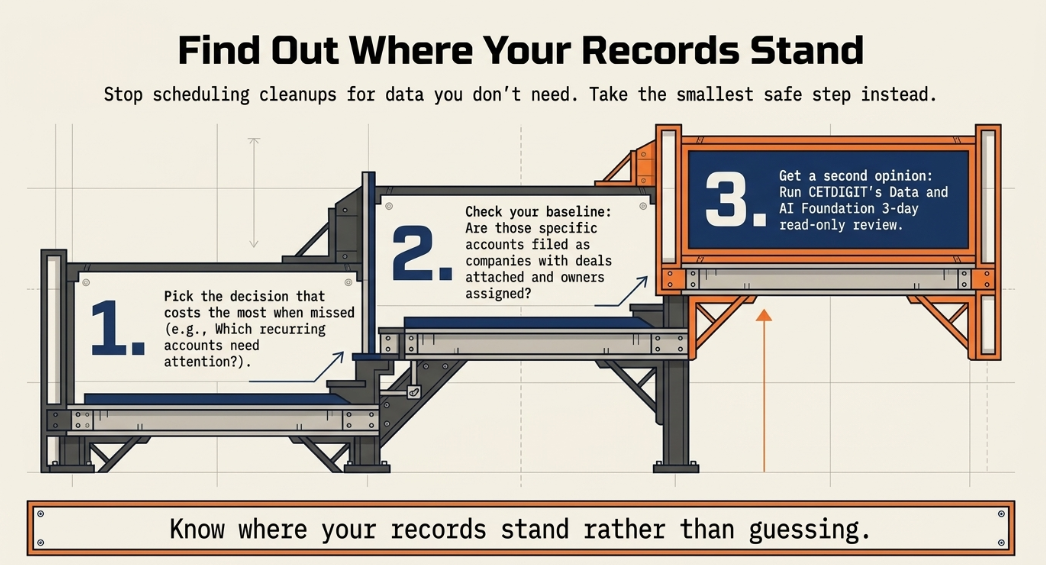


Leave a Comment