


Direct answer. An AI pilot stalls after the first month at a distributor because it was never a System of Action: nothing it produced had to be acted on by a named person, on a named account, by a named date. A System of Action is the point where analysis becomes a written decision someone has agreed to act on or overrule. Without that point, scores and dashboards accumulate, curiosity runs out, and the pilot quietly stops being anyone’s job.
The quarter after the pilot
The quarter after the pilot is the period when an AI tool is still switched on but has stopped being anyone’s job. It looks like this.
The pipeline review still happens every Tuesday morning. Same room, same coffee, same open-deals report. Somewhere in the browser there is also a tab for the dashboard the AI pilot built back in the spring. Nobody opens it anymore. Nobody decided to stop opening it either; it just fell off the agenda one week and never came back.
Meanwhile, a repeat-order account has gone quiet. This is a customer that has bought the same hose fittings and gaskets roughly every six weeks for four years. It is now a month past its re-order cycle. Nobody in the room has noticed, because nobody in the room was asked to look at that account specifically. The AI was switched on the whole time. It may well have scored this customer somewhere in that unopened tab. But it never said to anyone: call this account, this week, for this reason. So the rep who owns the account never had to do anything with the pilot’s output, and did not.
Ask the leaders who ran that pilot what happened, and the answer is almost always the same sentence. “We tried AI. It stalled.” It is said as a verdict, usually a verdict on AI.
Now put a different shape beside it. A run that is built to end. It runs alongside your team first for thirty days, reading only what is already in HubSpot. Nothing is asked of the reps while it runs. On day thirty, the output is not a dashboard. It is one account, one reason, one recommended action written on the company record, for a person to act on or overrule. And then a decision is made by a person: keep it, or switch it off.
The difference between those two shapes is the whole of this article.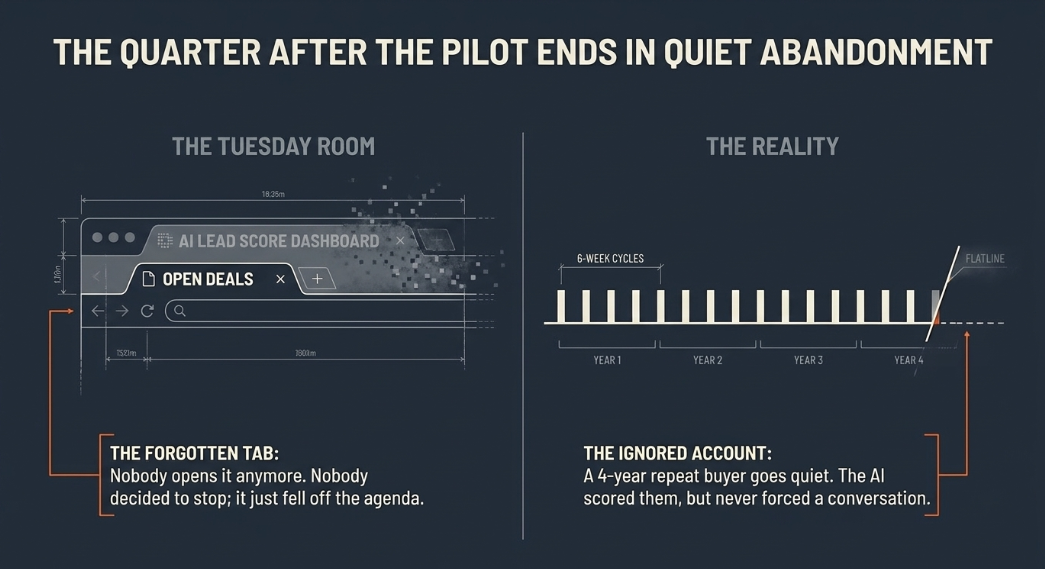
“We tried AI, it stalled”
“We tried AI, it stalled” is the sentence a distributor’s leaders use for a pilot that still runs but no longer changes anything. The stall is not a distributor problem, or a HubSpot problem, or even a problem with the particular tool. It is the normal outcome right now.
HubSpot’s UNBOUND 2026 study of about 6,000 companies reported that nine in ten of the companies surveyed are using AI, and that only six per cent are seeing transformational results. HubSpot’s CEO called the gap between those two numbers the maxing phase: in her words, agent maxing, pilot maxing, token maxing. HubSpot’s own framing is that transformation does not happen in the maxing phase; it happens in what they call the outcomes era, when a company stops piling up pilots and starts asking what each one was supposed to change.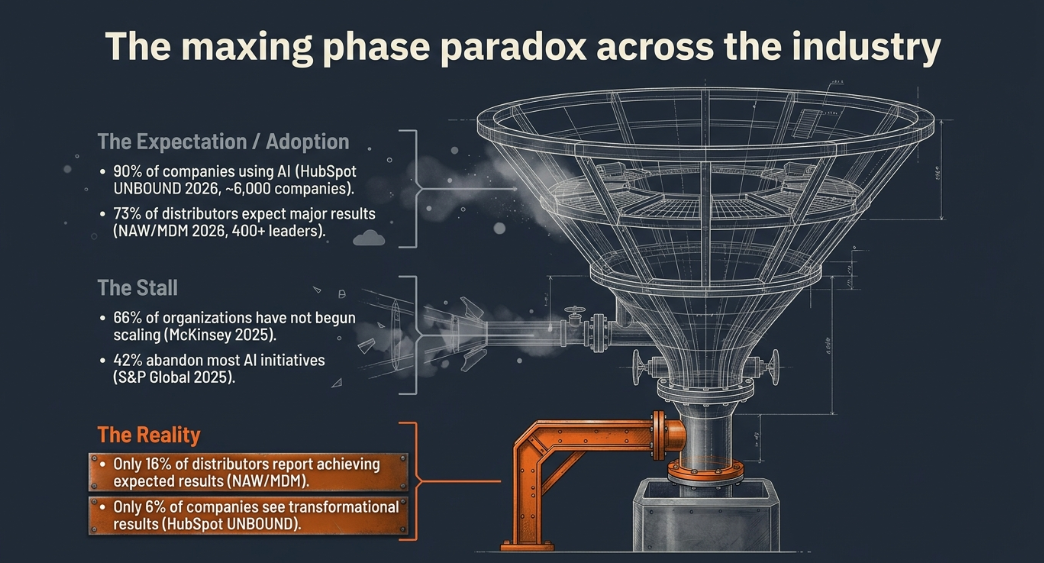
For a distributor, “pilot maxing” has a very specific look. It is the dashboard tab. It is the lead score nobody trusts enough to call from. It is the summary email that arrives on Monday and is deleted by Tuesday. Each of those is AI in use. None of them is AI anyone is running on.
The point of this article is not that the pilot was a mistake. It is that the pilot stalled for a reason that has nothing to do with whether the model was any good, and that reason is fixable by design.
Who this happens to
This happens to mid-market distributors and manufacturers on HubSpot whose revenue depends on repeat orders and re-order cycles. The reader we have in mind runs sales, operations, or revenue at one of them. Some accounts re-spec every year; some just buy the same thing every month until they quietly stop. There is a Tuesday pipeline review. There is a list, somewhere, of dormant accounts that nobody has a plan for. And there was an AI pilot, last year or this one, that is now somewhere between “paused” and “forgotten”.
The honest caveat is that most of the hard data on AI pilots is cross-sector, not distribution-specific, and we will say so wherever we use it. McKinsey’s 2025 global survey found that almost nine in ten organisations use AI, yet nearly two-thirds had not begun scaling it; among companies under 100 million dollars in revenue, roughly 29 per cent had reached the scaling stage, against nearly half of companies above five billion. The smaller the company, the more likely the pilot is still a pilot.
The distributor picture comes from trade research rather than analyst surveys. NAW and MDM’s 2026 study of more than 400 distribution leaders found, according to the publishers’ own summary, a wide gap between what distributors expect from AI and what they say they have achieved: 73 per cent expecting results that only 16 per cent report having reached, while nearly nine in ten say they are actively pursuing AI. Distribution Strategy Group’s 2026 benchmark describes most distributors as still exploring or piloting rather than running on it. None of this is a criticism of distributors. It is a description of where the industry sits, and it is exactly the position our reader is in.
What a stalled pilot looks like
A stalled pilot shows four symptoms a leader can check in an afternoon, and most stalled pilots show all four. Run this list against the pilot you ran.
- The pilot ended with a report instead of a rollout: someone wrote up what the AI found, and the write-up became the output.
- The activity metrics looked healthy to the end: accounts scored, summaries written, and logins counted, while nothing measured what a person did differently.
- The dashboard had no Tuesday reader: nobody’s job depended on opening it at a fixed time, so once curiosity ran out, nothing replaced it.
- No account was ever named: the output never put one customer in front of one person with a reason to call.
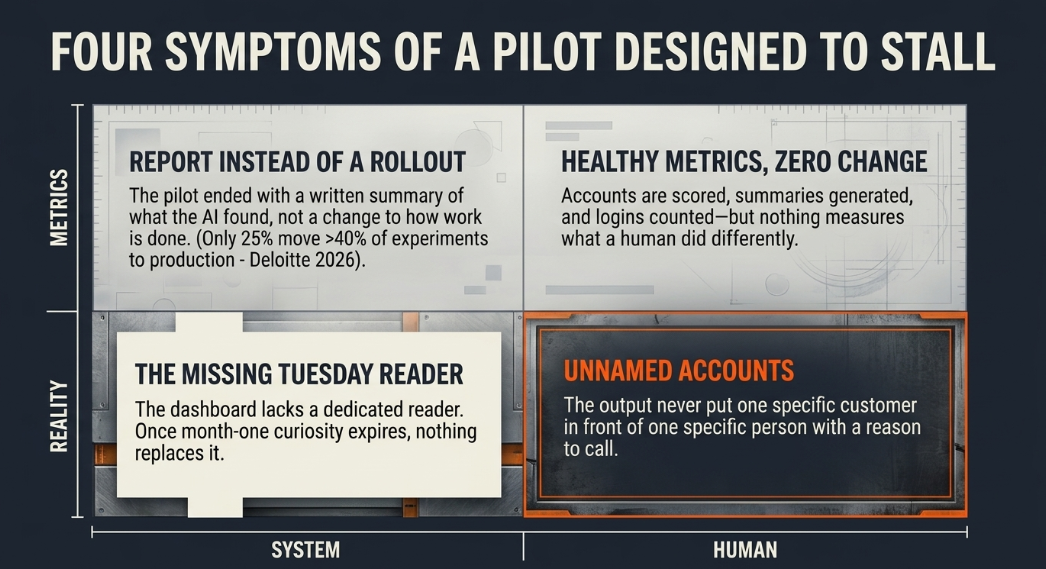
The report, instead of a rollout, is the most common ending. Nothing in the write-up is assigned to a person with a date, so the document is where the pilot stops. Deloitte’s 2026 enterprise survey found that only a quarter of organisations had moved even 40 per cent of their AI experiments into production, and that 37 per cent were using AI at a surface level, with little or no change to how the work is done.
The healthy activity metrics are the symptom that hides the others. Every one of those numbers measures what the tool did. None of them measures what a person did differently because of it. A pilot can report rising activity right up to the week it is abandoned.
The missing Tuesday reader is the symptom that explains the timing. In the first month, people look out of curiosity; by the second month, curiosity is spent. S&P Global Market Intelligence’s 2025 survey, as reported by CIO Dive, found that the share of companies abandoning most of their AI initiatives had risen to 42 per cent from 17 per cent a year earlier, and that the average organisation scrapped 46 per cent of its AI proofs of concept before production.
The account that was never named is the symptom that matters most for a distributor, because a distributor’s revenue is a list of named accounts with a buying rhythm. If the pilot never put one of those names in front of one person with a reason to call, then nothing it did could ever have shown up in revenue. Gartner predicted back in 2024 that at least three in ten generative AI projects would be abandoned after proof of concept, citing data quality, risk controls, cost, and unclear business value. Notice what is not on that list: the model being wrong.
Why pilots stall
AI pilots stall because the output was designed to inform rather than to be acted on, and every other cause people name sits downstream of that one. Ask around, and you will hear three diagnoses, in this order: our data was not clean enough, we did not have the skills to run it, and the reps would not change how they work. Each of those is real. Each is also downstream of something earlier.
RAND’s 2024 study of why AI projects fail, built on 65 interviews with experienced practitioners, found that the most common cause was leadership misreading the problem and the metrics, not the model. RAND’s framing, which it hedges as “by some estimates”, is that more than 80 per cent of AI projects fail, roughly twice the rate of IT projects that do not involve AI. Two of its findings describe the distributor’s stalled pilot almost exactly. First, that senior leaders switch priorities every few weeks or months, so projects are discarded before they can demonstrate results, or completed projects are simply ignored. Second, that models get deployed which were optimised for the wrong metric, or which do not fit into the actual business workflow. RAND’s advice is to choose enduring problems and commit to one for at least a year.
McKinsey’s 2025 survey reaches the same place from the other side. The companies seeing value, a group of roughly six per cent it calls high performers, were nearly three times as likely to have fundamentally redesigned individual workflows around the AI, and more likely to have defined processes for when a person must validate a model’s output. They did not bolt AI onto the old workflow and hope. Deloitte’s 2026 survey adds the uncomfortable corollary: the number one way companies adjusted their talent strategy for AI was education, not role or workflow redesign. In other words, most companies trained people to use a tool that still did not ask them to do anything.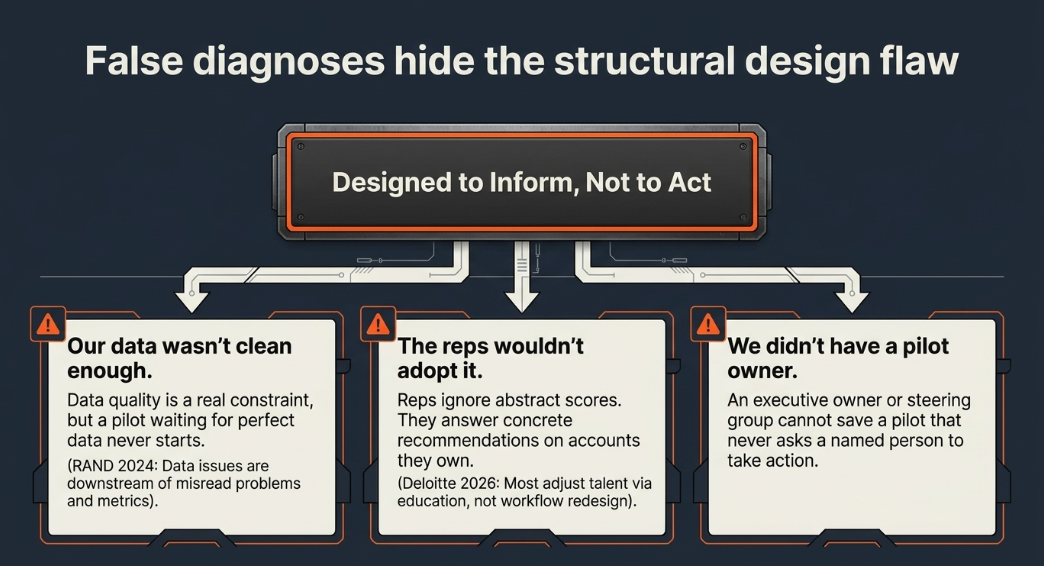
Here is where we part company with the consensus. The field has now largely settled on “the pilot had no owner” and “set a go/no-go date before you start” as the fix. Both are good advice, and neither is enough. A pilot can have a named executive owner, a steering group, and a go/no-go date and still stall, because the owner of the pilot is not the same thing as a person who has to act on its output. The question is not who owns the pilot. The question is whether the pilot ever asked a named person to act on a named account by a named date. If the answer is no, there was no mechanism by which anything could change, however good the model was.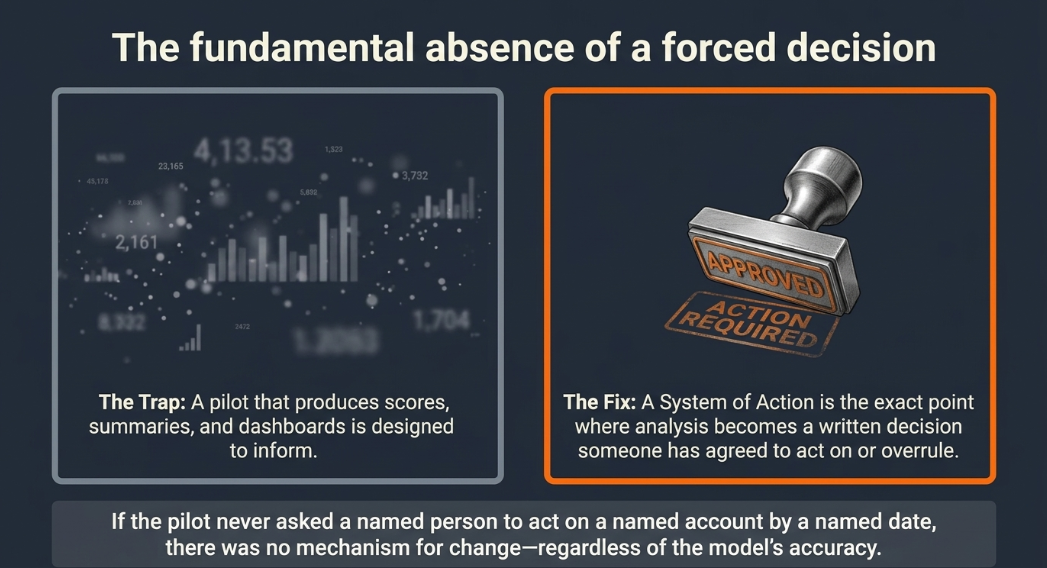
That is a design problem. A pilot that produces scores, summaries, and dashboards is designed to inform. A pilot that produces one recommendation on one account, with a reason, for one person to accept or overrule by a date, is designed to end in a decision. The first is a running pilot. The second is a finished run. The table below sets the two shapes side by side.
|
|
Running pilot |
Finished run |
|
What it reads |
Whatever it was connected to, often including the open internet |
What is already in HubSpot: company relationships, closed-won history, recent activity, open pipeline |
|
What it writes |
Scores, summaries, a dashboard |
One flag per account with a reason and a confidence, written on the company record |
|
Who has to act |
Nobody in particular; the output is there if anyone wants it |
A named person, on a named account, by a named date, who can act or overrule |
|
When it ends |
It does not; it runs until it is forgotten |
Day thirty, by design |
|
What is decided on day thirty |
Nothing; there is no day thirty |
Keep it or switch it off, decided by a person on the evidence of the run |
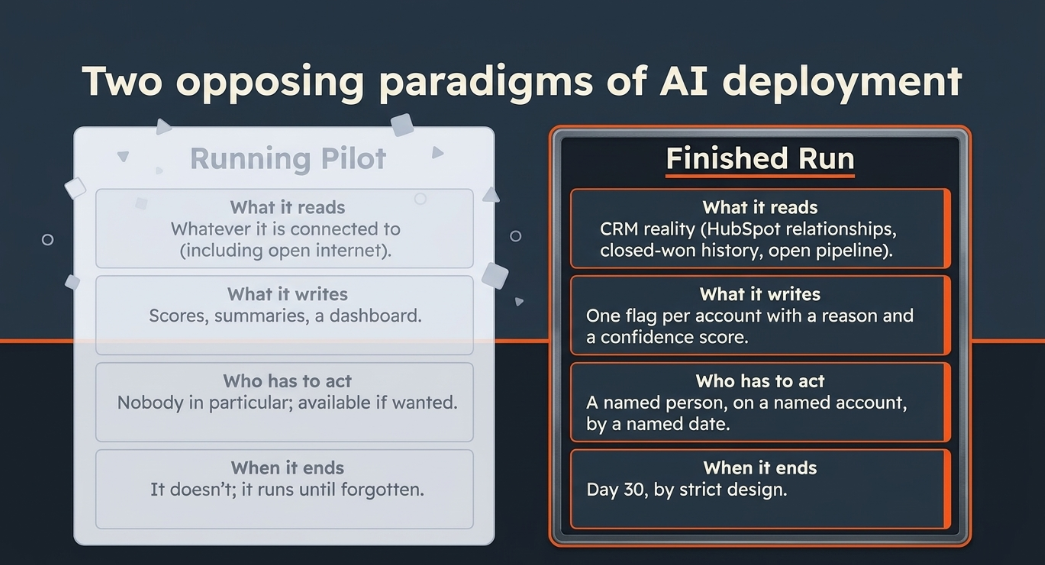
Read the left column, and you are reading the quarter after the pilot. Read the right column, and you are reading what a System of Action looks like on a distributor’s HubSpot portal. Only the second has a way to survive the quarter, because at some point somebody has to say yes or no.
What to do, by situation
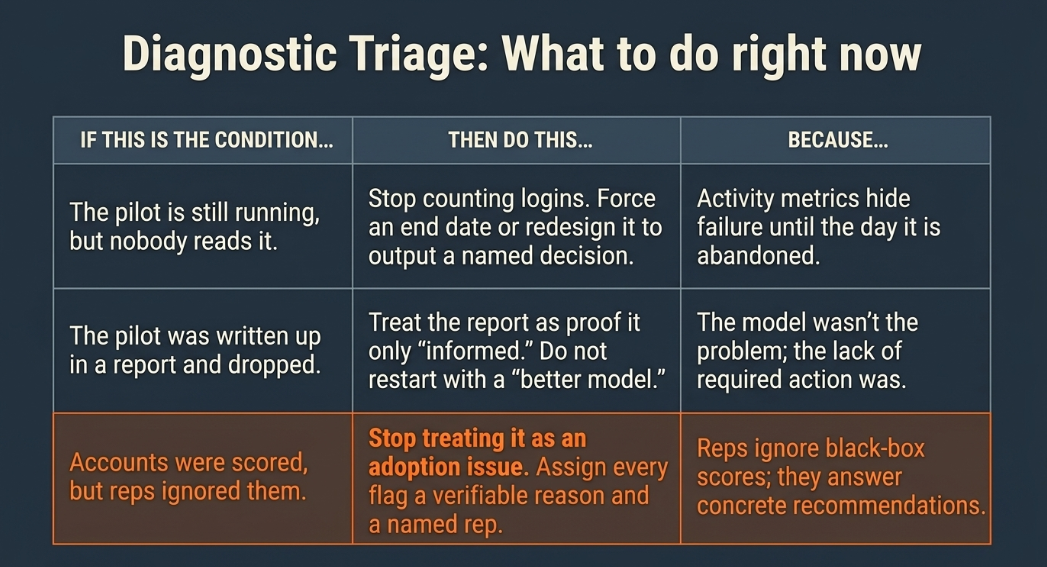
The right next step depends on where the pilot stands today, not on which tool it used. Find the row that describes your situation.
|
If your situation is… |
Then… |
Because… |
|
The pilot is still running, and nobody reads what it produces |
Stop counting its activity. Ask what its output asked anyone to do. Then either give it an end date or redesign it so that it ends in a decision on a named account. |
A pilot that cannot end cannot be judged, and activity metrics will keep looking healthy until the day it is abandoned. |
|
The pilot was written up and then quietly dropped |
Treat the write-up as evidence that the pilot informed and did nothing more. Ask whether it ever named an account. Do not restart the same shape with a better model. |
The model was never the reason it stopped; the absence of anything to act on was. |
|
The pilot scored accounts, and the reps ignored the scores |
Stop treating it as an adoption problem. Give every flag a reason and a named person, one account at a time, where the rep already works. |
A rep ignores a score. A rep answers a recommendation on an account they own, with a reason they can check. |
|
There has been no pilot yet, and there is pressure to start one |
Start with one decision: which recurring accounts need attention this week. Run it alongside the team for thirty days, built to end, with the metric named before day one. |
One bounded decision with an end date is the only shape that can produce a yes or a no instead of a dashboard. |
The CETDIGIT perspective
Our perspective is that the pilots that die are the ones nobody has to act on, and we build agents around that fact.
The agents we build for HubSpot customers are designed around the right-hand column of the first table. The Sales Analyst Agent, for example, does one job: it works out which recurring accounts need attention this week, and why. It reads what is already in HubSpot, meaning the company relationships, closed-won history, recent activity, and open pipeline, and puts that CRM evidence first. On every account, it flags it, writes a reason and a confidence score, plus a written explanation the owner can check and overrule. It does not email, call, assign work, or change deal stages. People make the call. The agent proposes, the workflow enforces the rules you have written down, and a person decides, in that order.
It runs alongside your team first. For the first thirty days, the recommendations are written, not acted on, so nothing is asked of the reps while the run is underway and nothing about their week changes. At the end of the run, there is a decision, taken by a person: keep the agent or switch it off. The run is built to finish, which is the point. GDIC is one of the clients where this agent runs today.
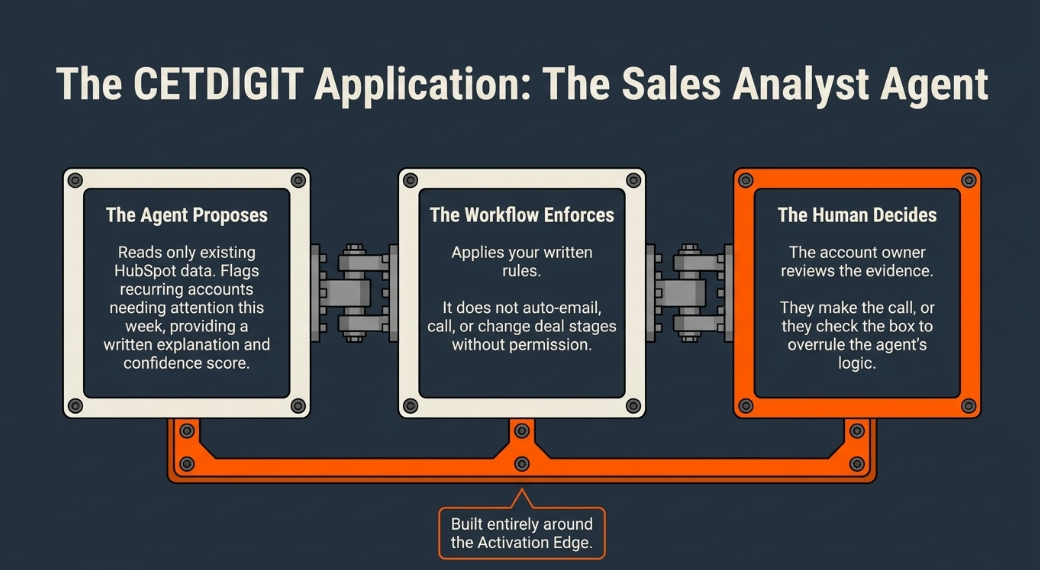
The reason this shape does not stall is not that the model is cleverer. It is that the output crosses what we call the activation edge: the line between analysis that informs and a recommendation someone has to answer. A score on a dashboard sits on the wrong side of that line forever. One account, one reason, one recommended action on the record sits on the right side from day one.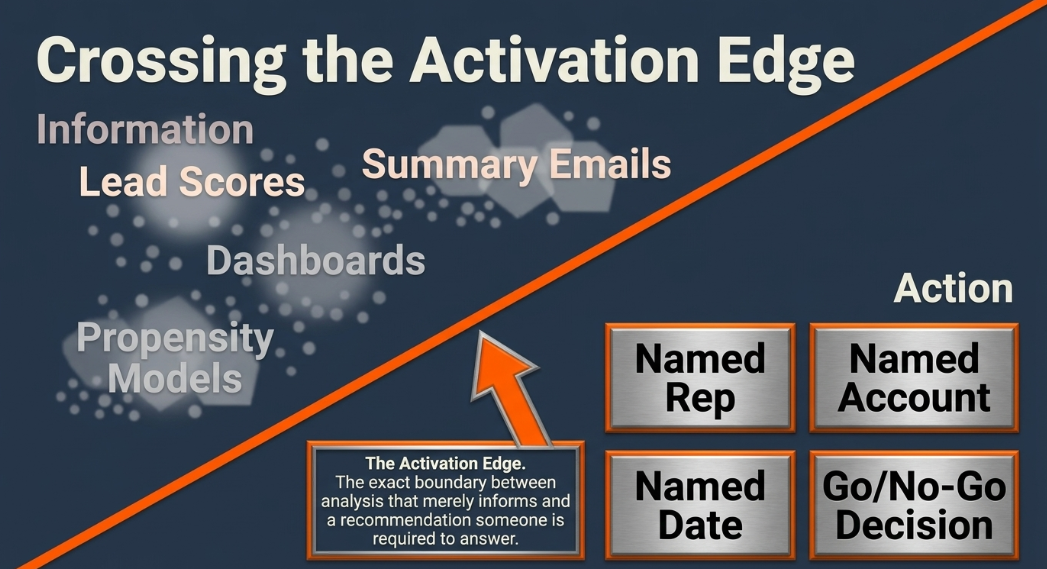
HubSpot’s own leadership frames the same thing in its own language. HubSpot’s product lead put it at UNBOUND 2026 as a single question that every decision comes down to: will customers trust it? Trust is not earned by a dashboard. It is earned by a flag that was right, on an account you knew, for a reason you could check. And a HubSpot customer on the UNBOUND panel described never taking their hands fully off the wheel, even as they loosened the reins on what their AI was allowed to send. That is the posture a finished run assumes from the start: the agent reasons, a person decides.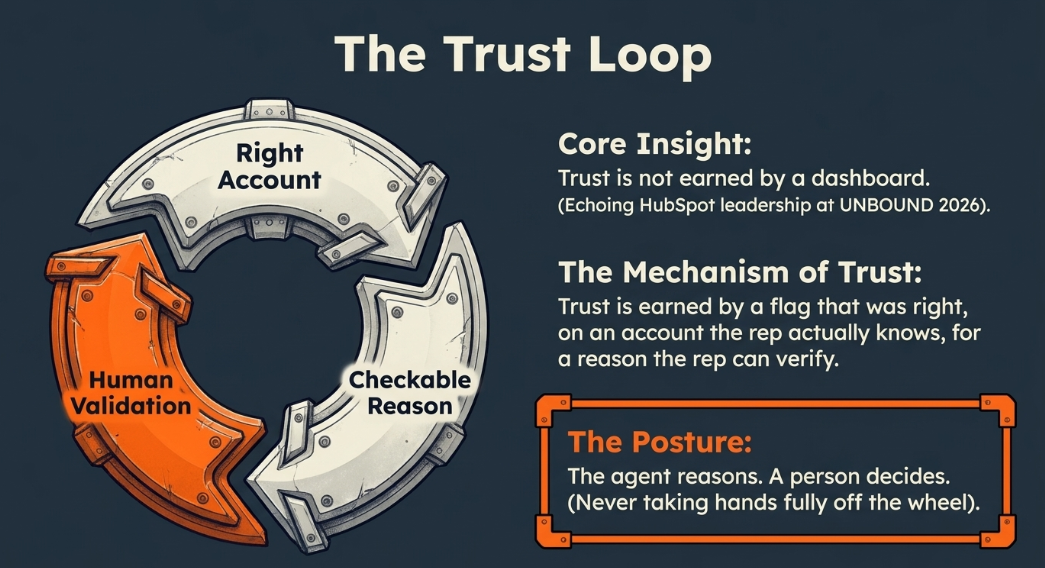
What to do next
The next step for a leader at this stage is to re-read the stall correctly, not to decide anything about AI this week. The wrong reading is expensive: it treats a design problem as a verdict, and the verdict quietly removes the one lever that would have worked. So take the pilot that stalled and ask three questions of it, in this order.
First: what did its output actually ask anyone to do? Not what it showed, not what it scored, but what action it put in front of a named person. If the honest answer is nothing, the pilot was never designed to survive, and its stall says nothing about whether AI can work in your portal.
Second: did it ever name an account? Your revenue is a list of named accounts with a buying rhythm. If the pilot never put one of those names in front of the person who owns it, with a reason, then it could not have moved revenue no matter how accurate it was.
Third: when was it supposed to end, and what was supposed to be decided? A run that cannot end cannot be judged. A run that ends on a day, with a yes or a no on the record, can be.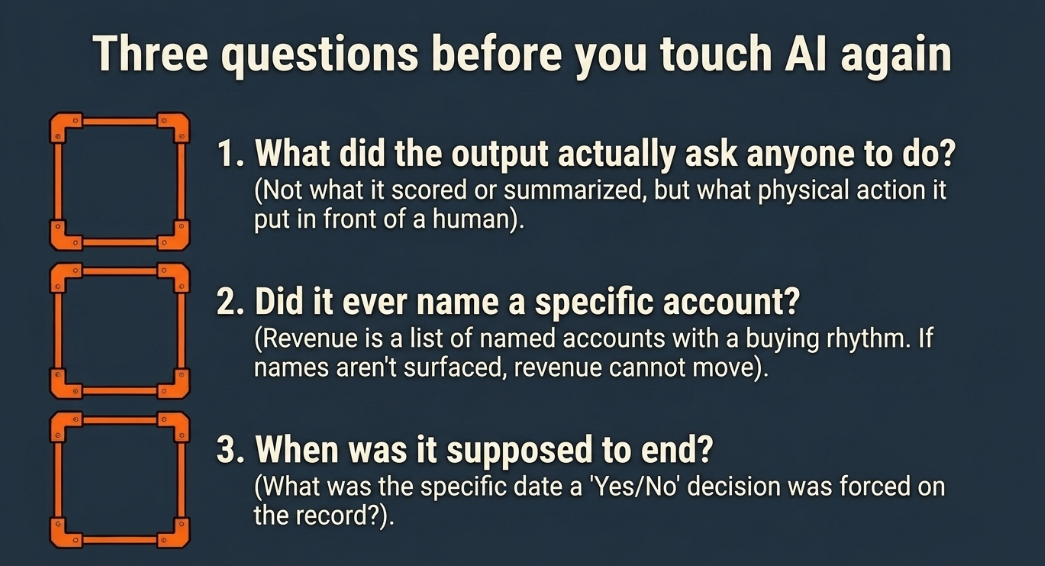
If those three questions make the stall look different, that is the whole intent of this piece. The pilot did not fail. It stopped being anyone’s job on a Tuesday. The next one does not have to be built that way; how a thirty-day run is structured so that it has to end in a decision is laid out here: [link — per rev b].
Frequently asked questions
Why do AI pilots stall after the first month?
HubSpot’s UNBOUND 2026 study of about 6,000 companies reported that nine in ten are using AI while only six per cent are seeing transformational results. RAND’s 2024 study of failed AI projects found the most common cause was leadership misreading the problem and the metrics, not the model: priorities switch before results arrive, or finished projects are ignored because nothing in the workflow depended on them. The first month is when curiosity runs out; if the output has not become someone’s job by then, nothing replaces curiosity.
Is it our data that is the problem?
RAND found data problems among the root causes of AI project failure, but downstream of a misread problem and the wrong metrics, and Deloitte’s 2026 survey found most organisations were adding AI with little or no change to how the work is done. Data quality is a real constraint, but it is not usually why a pilot stalls. A pilot that reads what is already in HubSpot and reports what it could not read will show you your data problem on the way to a decision. A pilot that waits for perfect data never starts.
How long should an AI pilot run at a distributor?
RAND’s recommendation is to choose an enduring problem and commit to it for at least a year rather than switching priorities every few weeks. A first run, however, should be short and built to end: the Sales Analyst Agent runs alongside your team first for thirty days, with recommendations written rather than acted on, and ends with a decision to keep it or switch it off. The year-long commitment is to the problem, which is the accounts nobody is calling. The thirty days is the test of whether this way of solving it earns its place.
What should the output of an AI pilot look like?
McKinsey’s 2025 survey found the companies seeing value from AI were nearly three times as likely to have redesigned the workflow around the AI’s output rather than bolting the tool onto the old one. In practice, that means the output is not a score or a dashboard but a recommendation on a named account with a reason and a confidence, written on the record, for a named person to act on or overrule. If a rep cannot tell from the output what to do next and why, the output is information, not a decision, and it will be ignored.
Is this a distributor problem or everyone’s problem?
McKinsey’s 2025 survey found nearly two-thirds of organisations across all sectors had not begun scaling AI, with only around 29 per cent of companies under 100 million dollars in revenue reaching that stage, so the stall is everyone’s. The distributor version is sharper only because distribution revenue is a list of named accounts with re-order cycles: when a pilot never names an account, the cost is visible in the next quarter’s repeat orders. NAW and MDM’s 2026 survey of more than 400 distribution leaders found, per the publishers’ summary, a wide gap between what distributors expect from AI and what they report having achieved.
Where does a distributor start once the stall is understood?
Deloitte’s 2026 survey found that only a quarter of organisations had moved even 40 per cent of their AI experiments into production, which is the measure of how rarely a pilot is designed to end. A distributor starts with one decision rather than a platform: which recurring accounts need attention this week. The run is thirty days, alongside the team, written not acted on, with the metric named before day one and a yes or no on day thirty. How that run is structured, step by step, is set out here: [link — per rev b].


Leave a Comment