


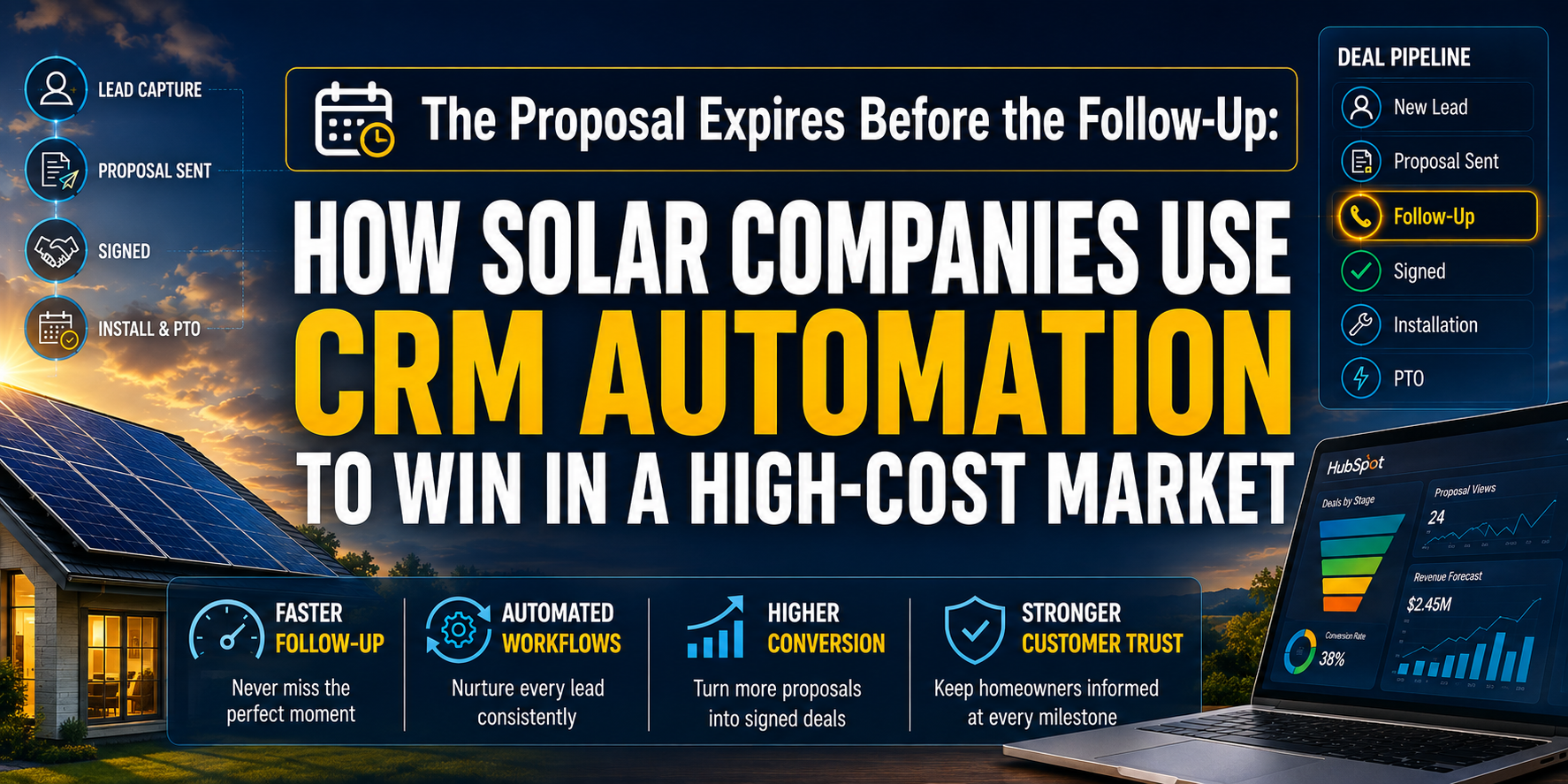
The design was beautiful. Your team pulled the homeowner's roof in Aurora, modeled the shading from the neighbor's oak, sized the array at 9.6 kW, priced two financing options through the lender portal, and sent a proposal the same afternoon. The homeowner opened it twice that week. Then a project ran over, a crew called in sick, the sales rep who owned the deal spent three days chasing a permit revision, and the follow-up call never happened. Six weeks later, the homeowner signed with another installer whose system was slightly smaller and slightly more expensive, because that company called back on day two and again on day nine.
Solar operators do not lose deals because their engineering is weak. They lose deals in the space between systems, and there are more systems in a solar company than in almost any business of comparable size. Leads arrive from canvassers with tablets, from web forms, from purchased lead feeds, and from referrals. Designs live in Aurora Solar or OpenSolar. Financing approvals live in GoodLeap, Sunlight Financial, or Mosaic portals. Site surveys, permitting, interconnection paperwork, installation scheduling, and inspection dates live in a project tool or, more often, a heroic spreadsheet. Somewhere there is a CRM, but for many installers it is a contact list that stopped being trusted around the time the company grew past two crews.
The economics stopped forgiving sloppy pipelines
For a decade, rich incentives and cheap leads let solar companies outgrow messy operations. That era is over. Customer acquisition cost in residential solar now commonly runs into thousands of dollars per closed deal once marketing, lead purchases, and commissions are counted. Net-metering reforms like California's NEM 3.0 changed the payback story customers were promised and made every sales conversation more consultative, which means longer cycles and more touchpoints per close. Federal incentives are in flux, so financing conversations change quarter to quarter. And homeowners now collect three or four bids as a matter of routine, which turns follow-up speed and consistency into the deciding variable. In this market, an installer's pipeline discipline is worth as much as its price per watt.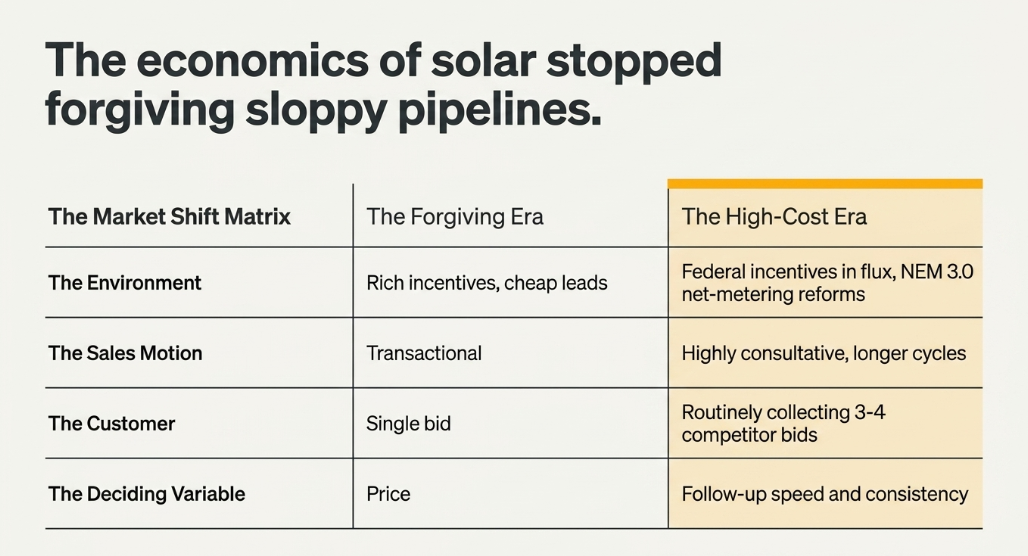
Add the timeline problem unique to solar: a deal is not done at signature. Between contract and permission to operate sit the site survey, engineering review, permit submission, utility interconnection application, installation, inspection, and PTO approval, often across two or three months and a dozen handoffs between sales, operations, and subcontractors. Every handoff is a place where a customer stops hearing from the company that just took a five-figure commitment from them. Cancellation between signature and installation is one of the quietest profit leaks in the industry, and it is usually a communication failure, not a product failure.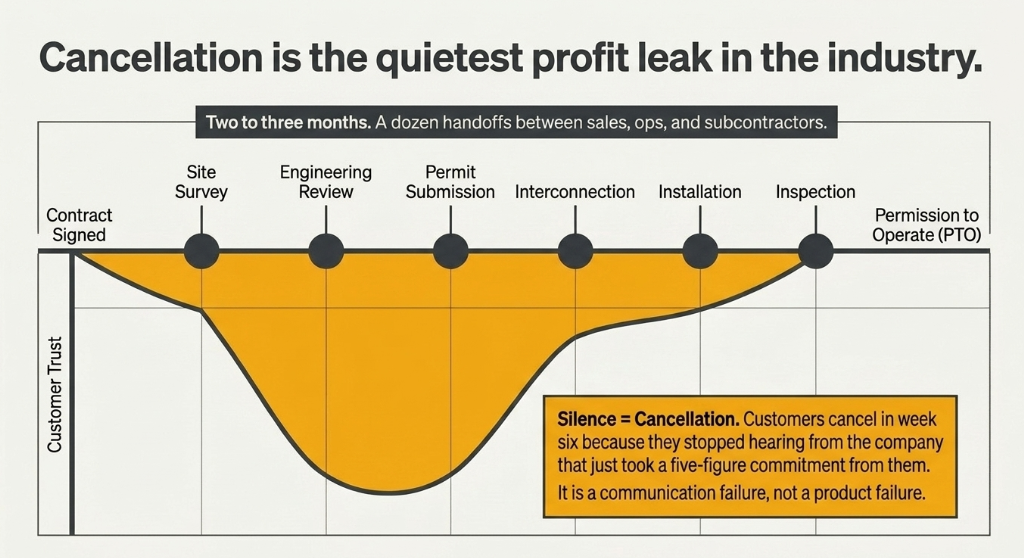
What a properly built CRM changes
The fix is not another point tool. It is making one system, usually HubSpot or Salesforce, the operating spine that every other tool reports into, and then letting automation do the work humans keep dropping. Implemented well, that looks concrete rather than abstract.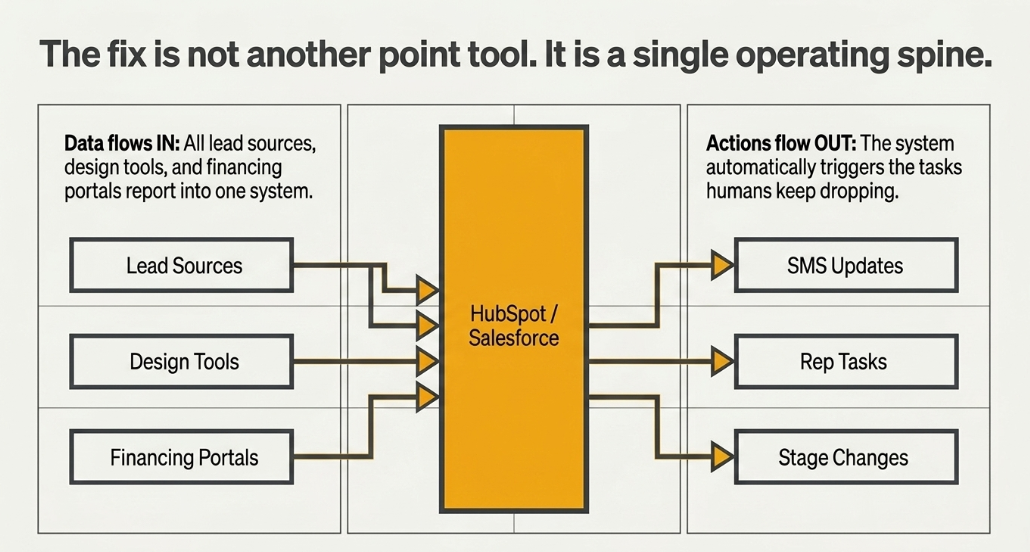
Every lead source lands in one pipeline with its source recorded, so the canvassing team, the web forms, and the purchased feeds can finally be compared on cost per installed watt rather than cost per raw lead. Proposal and design activity syncs from the design tool, so a rep can see that a homeowner opened the proposal twice on Tuesday and can be prompted to call Wednesday morning. Follow-up sequences run automatically on unsigned proposals, spaced and worded by the company rather than left to each rep's memory, and they stop the moment the customer signs instantly or opts out. Financing status flows in from the lender portal, so an expiring credit approval triggers a task instead of a surprise. After signature, stage changes in the project workflow trigger customer updates automatically: survey scheduled, permit submitted, interconnection approved, crew assigned. The customer who hears from you at every milestone is the customer who does not cancel in week six.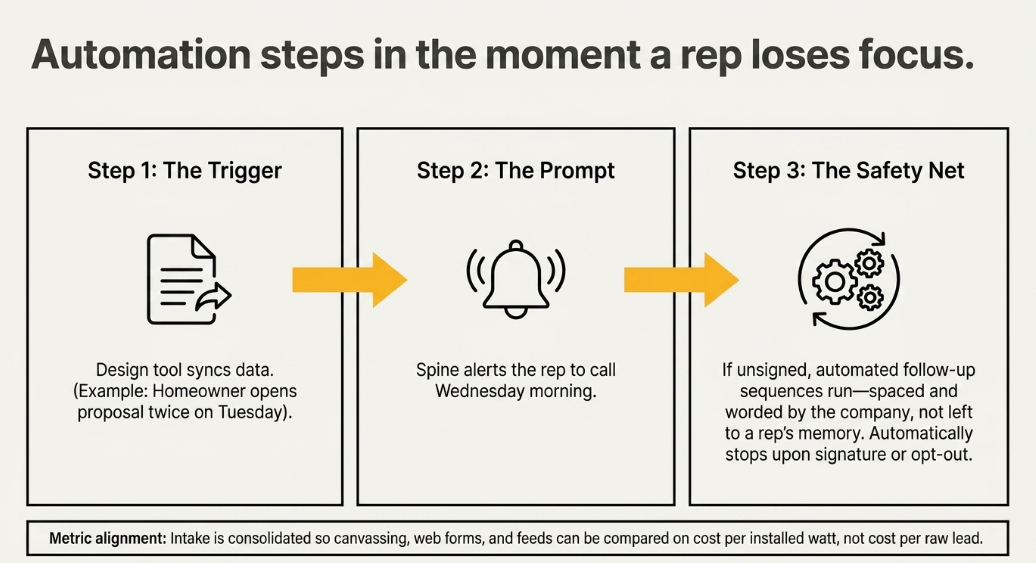
Management gets something it has usually never had: a forecast built on real stage probabilities, per-crew and per-rep visibility, and an honest answer to which half of the marketing budget is wasted. When the company later adds AI on top, the payoff compounds, because AI is only as good as the data under it. A CRM that holds every proposal, every objection note, and every cancellation reason is the raw material for automated deal scoring, for assistants that draft milestone updates and answer internal questions from company knowledge, and for spotting the patterns that predict which signed deals are at risk of cancelling.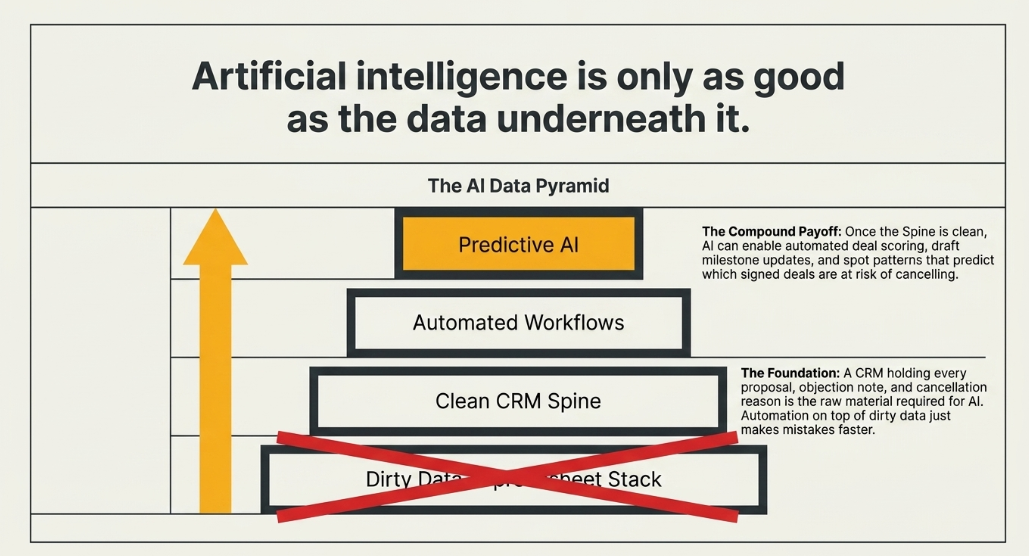
One compliance note belongs in any honest discussion of solar sales operations. Solar outreach is under active regulatory and litigation scrutiny, and TCPA rules on calls and texts to consumers are enforced aggressively in this industry. A CRM built correctly is a protection here, not a liability: consent is captured and time-stamped at the lead source, do-not-contact preferences are honored automatically across every sequence, and outreach history is auditable. The spreadsheet stack can do none of that.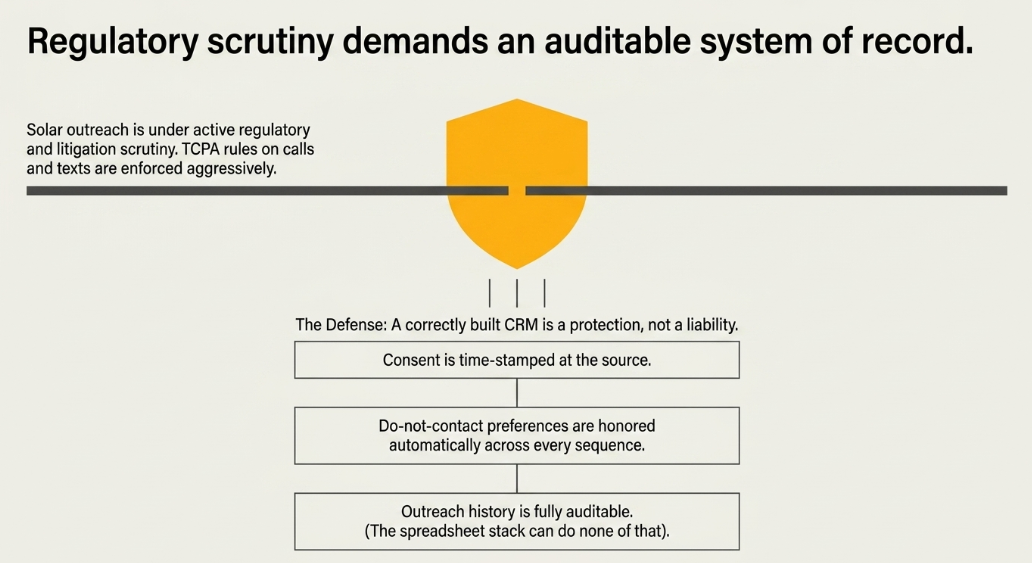
Where to start
Installers who make this transition successfully do it in a deliberate order. First, they consolidate lead intake and deduplicate the existing database, because automation on top of dirty data just makes mistakes faster. Second, they map the real pipeline, sales stages, and post-signature operational stages together, and rebuild it in the CRM with the fields solar actually requires: system size, utility territory, financing partner, permit jurisdiction, target PTO date. Third, they connect the design and financing tools, then switch on a small set of high-value automations: proposal follow-up, financing-expiry alerts, and milestone communications. Only then do they expand into scoring, forecasting, and AI-assisted workflows. Companies that try to automate everything in month one usually end up back in the spreadsheet by month three.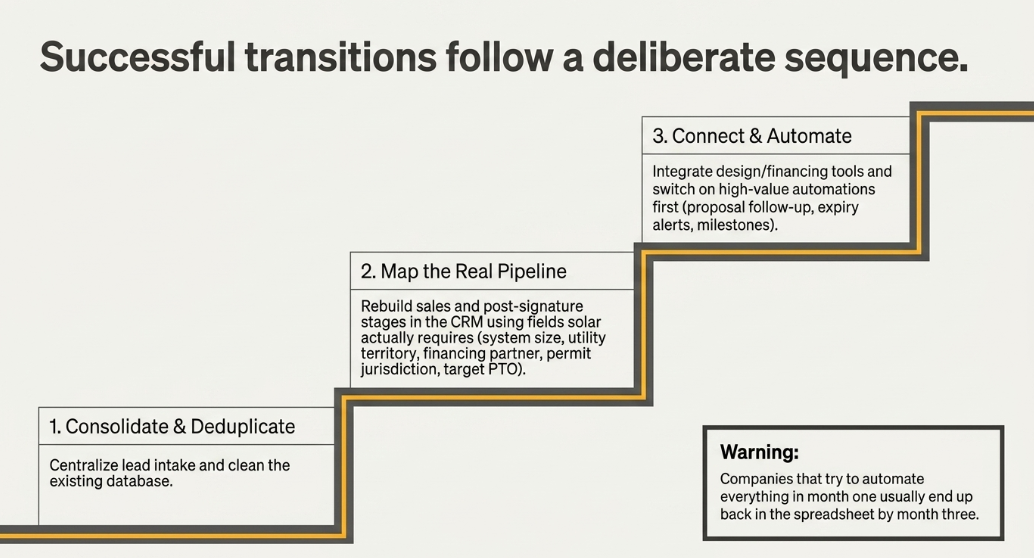
Ready to see your whole pipeline in one place?
CETDIGIT is an AI solutions builder with more than 300 AI and CRM deployments, a Salesforce Crest Partner and a HubSpot Elite Partner, and we work with energy and home-improvement companies to turn a stack of disconnected tools into one accountable revenue system: CRM implementation, lead-source consolidation, design and financing integrations, lifecycle automation from first touch to PTO, and the reporting layer that shows where every dollar of acquisition spend actually goes. If your proposals are aging in someone's outbox while your acquisition costs climb, schedule a consultation with our team, and we will map your lead-to-PTO pipeline and show you exactly where deals are leaking today.
Related Reads
From Bid to Build: How AI-Powered CRM Automation Stops Construction Firms from Losing the Jobs They Never Followed Up On
The Quote That Went Cold: How AI-Connected CRM Helps Custom Manufacturers Win the RFQs They Already Earned
Your CRM Already Knows the Answer: How AI Integration Turns Salesforce into an Intelligent Operating System



Leave a Comment