


Direct answer. A distributor's AI flags go unread after month one because of Optimization Debt: every month, a known problem is left to a dashboard instead of a decision. The flags are often correct. What is missing is a named person whose job is to read them and an existing meeting where that reading happens. Name the reader, and the meeting before the next run, and correct flags start turning into calls instead of an agenda item.
A Thursday call in week five
Week five of an AI pilot often looks like an ordinary Thursday call, and that is the problem. Picture a regional distributor of industrial supplies. The regional sales manager who asked for the pilot is on leave this week. The agenda still carries the same line at item three: flagged accounts. Someone shares a screen, and the list is there, as it was last week and the week before.
A contractor who used to reorder fittings like clockwork has gone quiet. A plant maintenance buyer has not placed an order since the summer shutdown. A long-standing account has moved part of its spend somewhere else, and nobody on the call knows where.
Every one of those flags is reasonable. Anyone at the table would have called those accounts if they had spotted them first. But nobody at the table was told the list was theirs. The one person who was going to own it is not on the call. Someone says they think it is being handled, the meeting moves to item four, and the list stays where it was.
Nothing broke. The agent ran. The flags were right. By the end of month two, this pilot will be described as having stalled, and someone senior will ask whether AI was ever going to work for a business like this. That is the wrong question. The flags did their job. Reading them was nobody's job.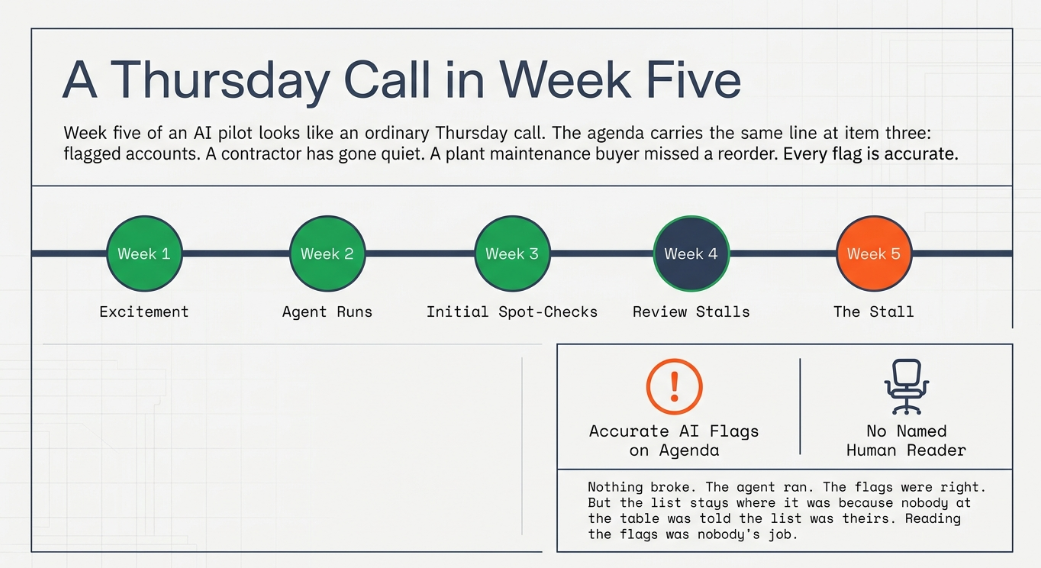
What does it mean when AI flags go unread?
Unread flags are a stall that happens after the AI has done its work. The output exists; it is often correct, and no decision follows from it. That is a different failure from a pilot that never produced anything useful, and it needs a different fix.
The name for it is Optimization Debt: every month a known problem is left to a dashboard instead of a decision. In this case, the problem is not hidden. The agent has already found it and written it down. The debt is the gap between that list and a phone call, and it grows every week the list sits unread.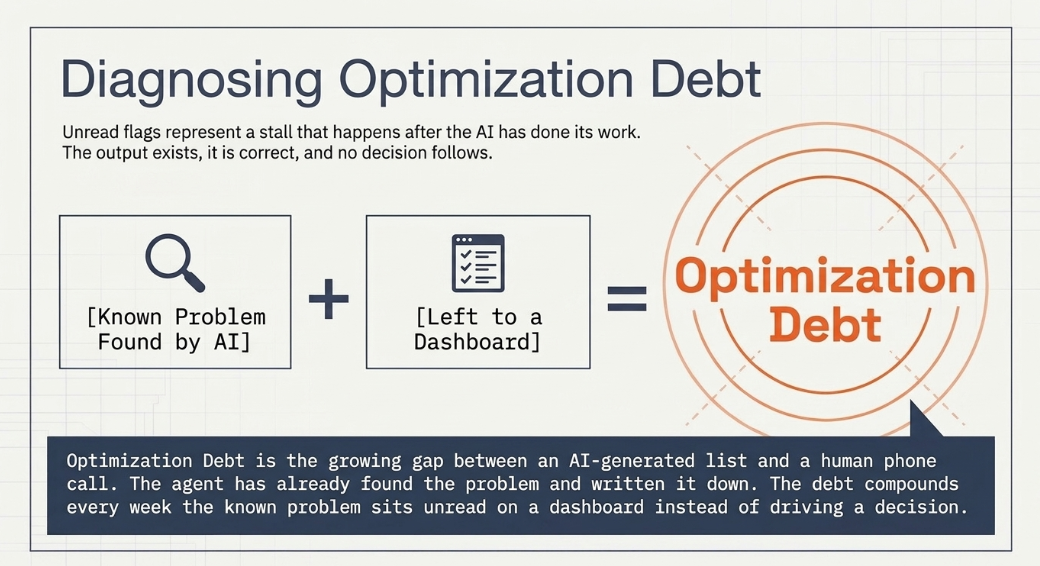
This is common, not unusual. HubSpot's UNBOUND 2026 study of about 6,000 companies found that 90% are using AI, but only 6% report transformational results. Many of the companies in between are not running broken tools. They are running tools whose output never reaches a person who is expected to act on it.
The pattern is wider than HubSpot's customer base. An MIT Project NANDA study reported in Fortune found that 95% of the generative-AI pilots it studied showed no measurable return, and the study treated the stall as a problem of how organizations learn to use the tools rather than a fault in the models themselves.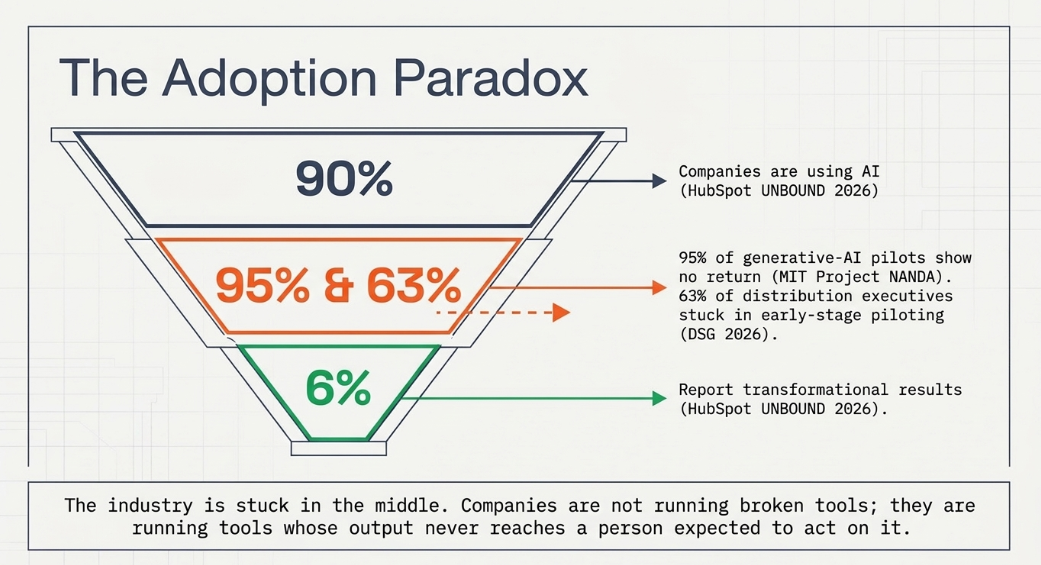
If your pilot stopped producing anything at all, that is a related but separate problem, covered in why an AI pilot stalls after the first month at a distributor. This piece is about the quieter case: the flags kept coming, and nobody read them.
Who runs into unread AI flags?
Unread flags show up most at mid-market distributors on HubSpot that have tried AI and are not yet running on it. The reader of this piece is usually the owner, the head of sales, the operations lead, or the RevOps manager: the person who signed for the pilot, or the person who will be asked why it did not work.
These businesses share a few traits. Revenue depends on repeat orders. Account owners carry more customers than they can call every month. Dormant accounts are a known worry, which is why the pilot was approved in the first place. And the weekly rhythm of the business, the Monday pipeline review and the Thursday regional call, was set long before any agent existed.
Distribution Strategy Group's 2026 survey of 233 distribution executives found 63% of distributors still in early-stage piloting, against 27% implementing across the business. Most distributors sit in the same place: past the first trial, short of the routine that makes it stick. If the flagged list in your portal has been on the agenda for a month and no account has changed hands, this applies to you.
What are the signs that your AI flags are going unread?
Unread flags have recognizable signs, and most of them show up in meetings rather than in the software. Run this list against the last four weeks:
- The flagged list has appeared on three agendas in a row without a single account changing hands.
- Nobody on the call can say who last opened the list, or when.
- The person who asked for the pilot has changed role, gone on leave or stopped attending the meeting.
- A flag comes up, someone says it is probably being handled, and the meeting moves on.
- The flags you spot-check turn out to be accounts you would have called yourself.
- The pilot's review date passed without a decision to keep it or stop it.
Two or more of these usually mean the agent is not the part that stopped. The reading is.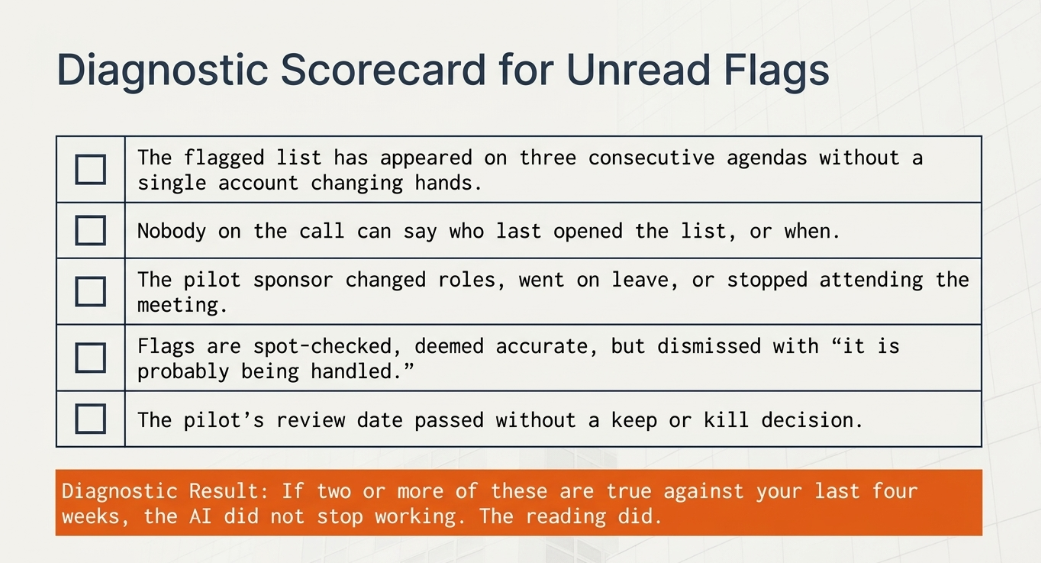
Why do AI flags go unread?
AI flags go unread for mechanical reasons: who owns the output, when it is reviewed, and where it lands. None of them is a verdict on the model.
No one was named to read them
The first cause is that the pilot named a sponsor but not a reader. The sponsor wanted the flags and approved the run. The reader is the person who opens the list each week and decides what happens to each account on it. Most pilots assume those are the same person, and they are not. When the sponsor goes on leave, changes role or simply gets busy, the list has no one. Sales assumes operations is watching it. Operations assumes the account owners are. Each assumption is reasonable, and together they mean nobody reads it.
The meeting never changed
The second cause is that the review rhythm was written before the agent arrived. The Monday pipeline review covers open deals, the forecast and blockers. The flagged list is new, so it is added at the bottom, or as item three on a call where the person who cares about it is absent. Distribution Strategy Group's survey found that among distributors scaling AI, 55% of projects are executive-led against 15% that are IT-led, and the report ranks people challenges ahead of technology among the barriers. A list that has no fixed place in the week depends on goodwill, and goodwill tends to run out around the fourth week.
The output landed outside anyone's job
The third cause is where the output goes. If the flags live somewhere that is not part of anyone's weekly work, reading them is extra work, and extra work is the first thing dropped in a busy month. The MIT Project NANDA study put the gap down to how organizations learn to use the tools, not to the tools. The flags are not wrong. They are simply not in anyone's path.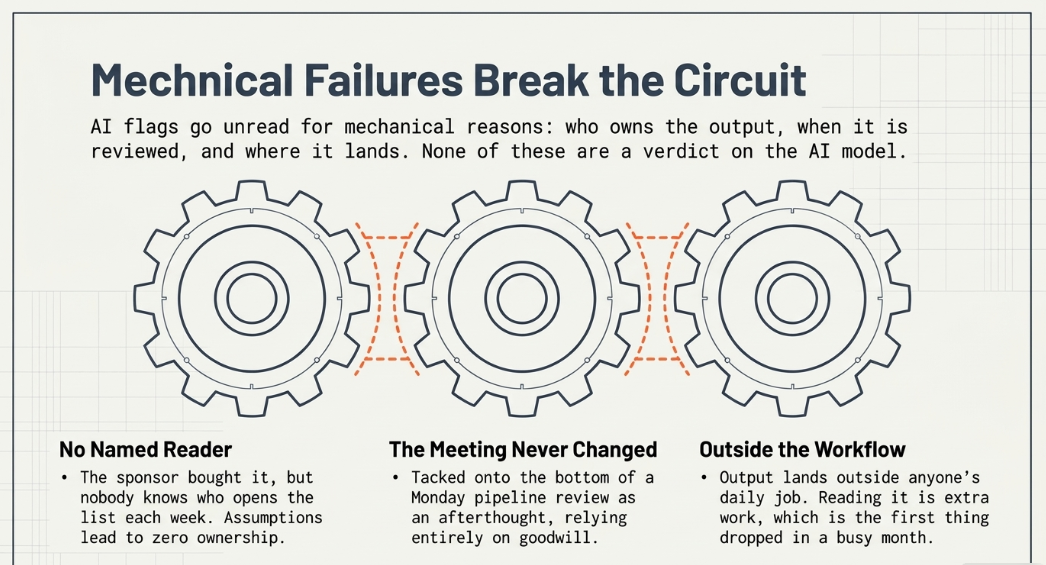
Blaming the data is the usual detour
When a pilot goes quiet, the data is usually blamed first. Sometimes that is right, and the question of whether a distributor's CRM data is ever clean enough to start with an AI agent deserves its own answer. But there is a simple test. Take a handful of flags from the last month and look at them yourself. If they are reasonable accounts to call, the data has done its part. What failed was the reading, and a data clean-up project will not fix that.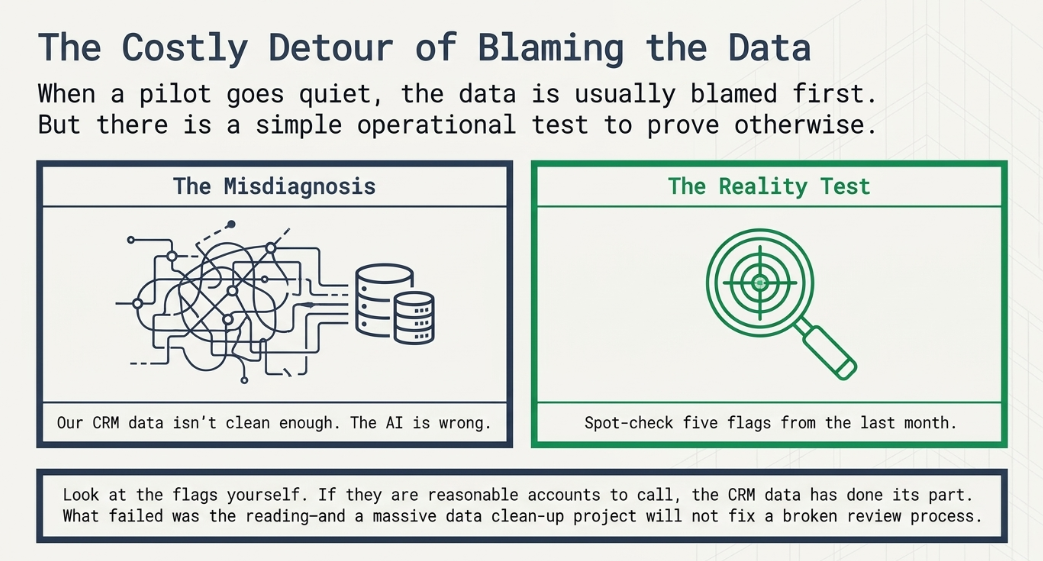
What should a distributor do about unread AI flags?
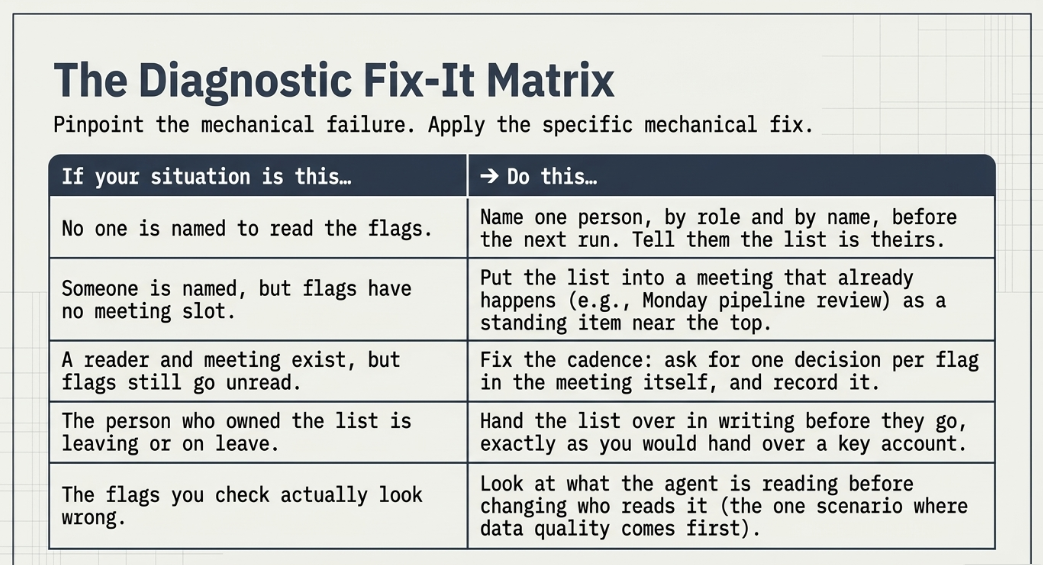
The fix depends on which part is missing: the reader, the meeting, or the habit. Find your situation in the left column and start with the action beside it.
|
If your situation is this |
Do this |
|
No one is named to read the flags. |
Name one person, by role and by name, before the next run, and tell them the list is theirs. |
|
Someone is named, but the flags have no slot in a meeting. |
Put the list into a meeting that already happens, such as the Monday pipeline review, as a standing item near the top. |
|
A reader and a meeting both exist, and the flags still go unread. |
Fix the cadence, not the agent: ask for one decision per flag in the meeting itself, and record it. |
|
The person who owned the list is leaving or on leave. |
Hand the list over in writing before they go, the same way you would hand over an account. |
|
The flags you check look wrong. |
Look at what the agent is reading before you look at who is reading the flags; this is the one case where the data comes first. |
How CETDIGIT looks at unread flags
CETDIGIT treats the reader as part of the design, decided before the first run rather than discovered after the first month. The arrangement is simple to say: the CRM is the memory, workflows are the rules, agents do the reasoning, and people make the call. Pilots that go quiet usually have the first three and skip the last one. The agent reasons well, the flags are written, and no person has been told the call is theirs.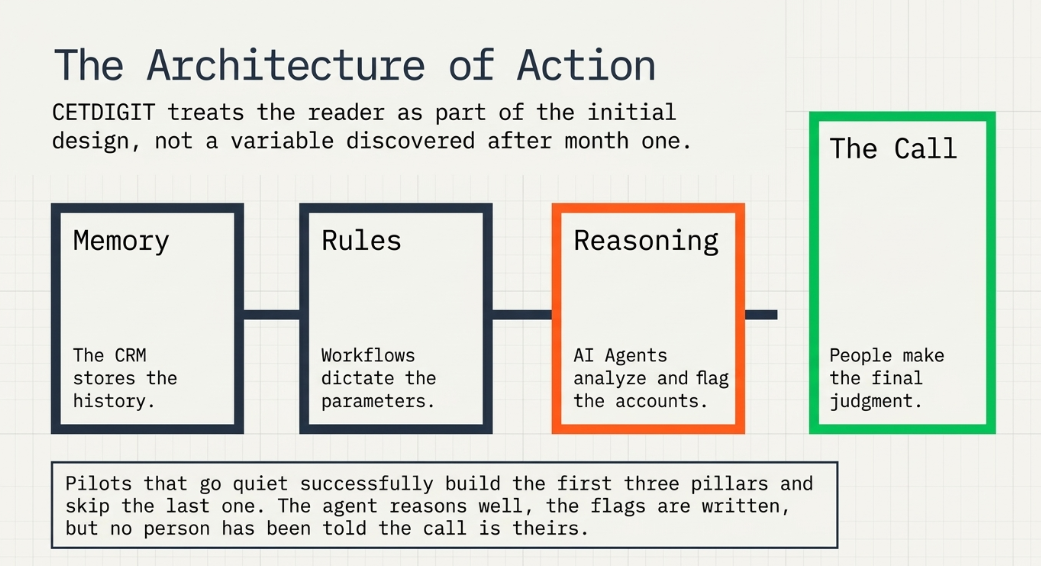
That is why the first questions worth answering come before anything runs. Who reads the flags, by name? In which meeting does that already happen? If neither has an answer yet, the honest move is to settle both first. An agent that produces correct flags nobody reads costs money and teaches the business that AI does not work, which is worse than not starting.
It is also why one decision comes before many. HubSpot's research found the best-performing companies run four or five use cases per stage, not fifty. One decision with one named reader is easier to keep alive than five decisions spread across a department, and once that one is read every week, the next one has somewhere to land. Fewer things, done right.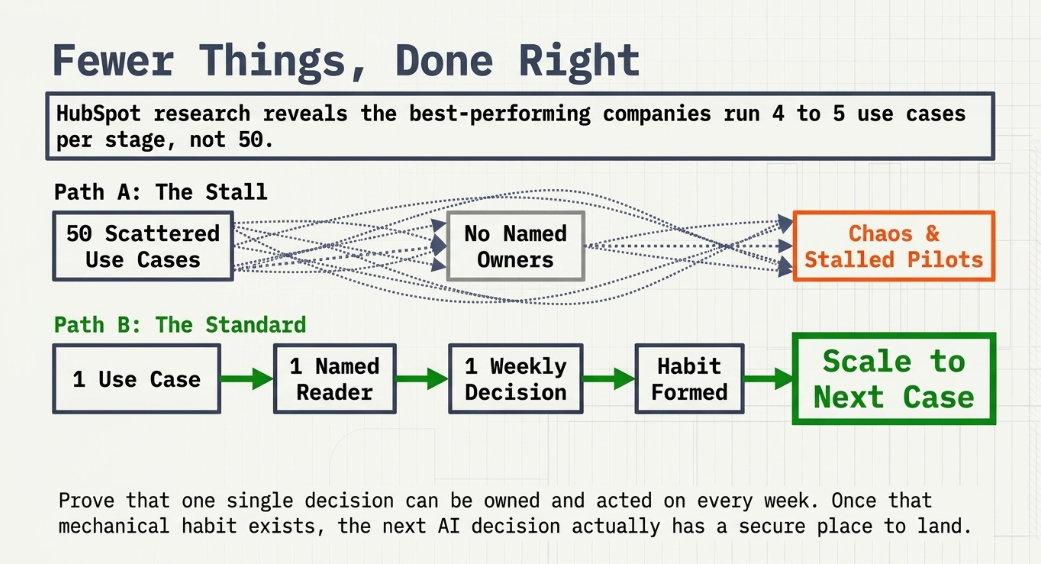
Human review is not a sign of distrust in the tool. On HubSpot's UNBOUND customer panel, Kim Cormier of RevenueWell, a dental software company, described having people review the AI's output from the start and never fully letting go of it, even after the review was relaxed over time. The industry is different, and the principle carries: someone reads it, and everyone knows who. Gartner's May 2026 survey of 645 B2B buyers points the same way from the other side of the sale, finding that 69% still turn to a sales rep to validate what the AI told them. A named human step is the normal shape, not an exception.
Set up this way, this one won't stall in the way the Thursday call did. Not because the AI is better, but because the list has an owner before it has its first entry.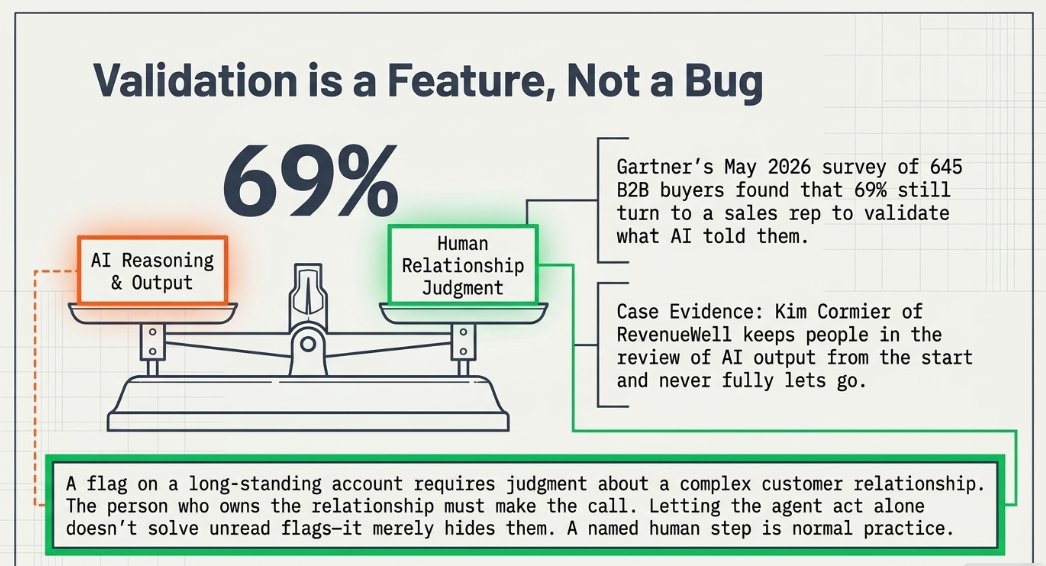
What to do before the next run
The next step at this stage is to find out whether your flags have a reader before changing anything about the agent. Answer two questions in writing: who reads the flags, by name, and in which existing meeting. If the answers are clear, put the list into that meeting next week and ask for one decision per flag. If they are not, that is the work to do first, and it is usually a short conversation rather than a project. For working out who the named reader should be and where the flags fit into your week, CETDIGIT's AI Implementation Model sets out how an engagement is approached from the first decision onward.
Frequently asked questions
Why do AI pilots at distributors stall when the output is right?
An MIT Project NANDA study reported in Fortune found that 95% of the generative-AI pilots it studied showed no measurable return, and it framed the cause as how organizations learn to use the tools. At distributors, the most common form is unread output: the flags are correct, but no person is named to read them, and no existing meeting includes them. That is Optimization Debt, a known problem left to a dashboard instead of a decision. The fix is ownership and cadence, not a different model.
Who should read an AI agent's flags at a distributor?
Gartner's May 2026 survey of 645 B2B buyers found that 69% still turn to a sales rep to validate what the AI told them, so a named human step is normal practice. At a distributor, the reader is usually the person who runs the weekly pipeline review: a sales manager, an operations lead, or the owner. What matters is that it is one named person, that they know the list is theirs, and that someone takes it over in writing when they are away.
How often should a distributor review flagged accounts?
HubSpot's research found the best-performing companies run four or five use cases per stage, not fifty, which argues for a short list reviewed often rather than a long list reviewed rarely. For most distributors, weekly is right, inside a meeting that already happens, such as the Monday pipeline review. Give the list a fixed slot near the top of the agenda and ask for one decision per flag: call, do not call, or pass it to the account owner.
Is bad data the reason nobody acts on AI flags?
HubSpot's UNBOUND 2026 study of about 6,000 companies found 90% using AI and only 6% reporting transformational results, and data quality is often blamed for that gap. Sometimes it is the cause. But if you spot-check the flags and they are reasonable accounts to call, the data has done its part. When correct flags go unread, the cause is ownership and cadence: no named reader, and no place in the week where the reading happens.
Should the AI act on its flags by itself so nobody has to read them?
On HubSpot's UNBOUND customer panel, Kim Cormier of RevenueWell, a dental software company, described keeping people in the review of AI output from the start and never fully letting go. That is the right starting shape for a distributor too. A flag on a long-standing account is a judgment about a customer relationship, and the person who owns that relationship should make the call. Letting the agent act alone does not solve unread flags. It hides them.
How does fixing unread flags fit with the rest of an AI program?
HubSpot's study found only 6% of companies report transformational results from AI, and most of the rest sit between trying tools and running on them. Fixing unread flags is often the first step out, because it proves one decision can be owned and acted on every week. Once that habit exists, the next decision has somewhere to land. CETDIGIT's broader AI services framework is built around that order: one decision, owned by a person, then the next.
What is Optimization Debt?
HubSpot's UNBOUND 2026 study found 90% of companies using AI and only 6% reporting transformational results, and much of the space between those numbers is Optimization Debt. Optimization Debt is every month a known problem is left to a dashboard instead of a decision. With AI flags, the problem has already been found and written down; the debt is the time between the list and the phone call. It grows each week the list goes unread, and it is paid down by naming a reader and a meeting.
Find out who should be reading your flags
If the flags in your portal are right and nobody is reading them, the first step is working out who should, and where in your week it happens. Request An AI Assessment

Leave a Comment