


It is 9:00 AM on a Thursday. Maria runs a catering company doing 200 events a year, corporate lunches, wedding receptions, and private dinners. She has a good crew and a solid reputation. What she does not have is a system.
Right now, a new inquiry has just come in through her website. It is sitting in a shared Gmail inbox alongside fourteen other emails. The lead form data is not in her spreadsheet yet because nobody has copied it over. Her sales coordinator is at a venue walk-through and will not see it until noon. By the time someone calls the prospect back, it has been four hours. In the catering industry, four hours is often the difference between booking and losing a job to the competitor who picked up the phone first.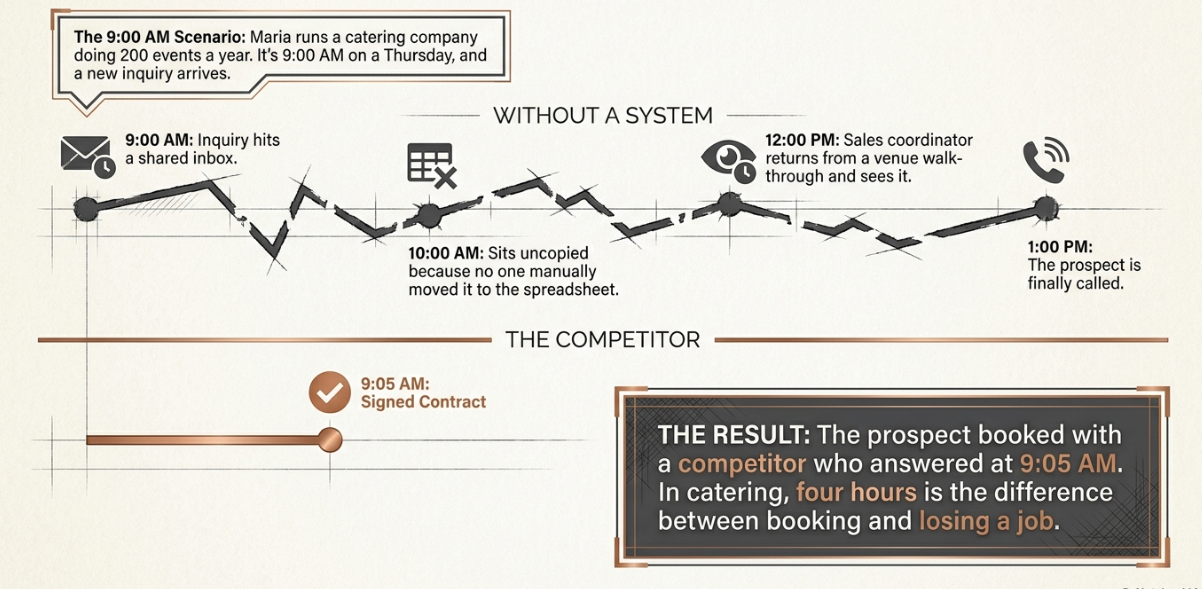
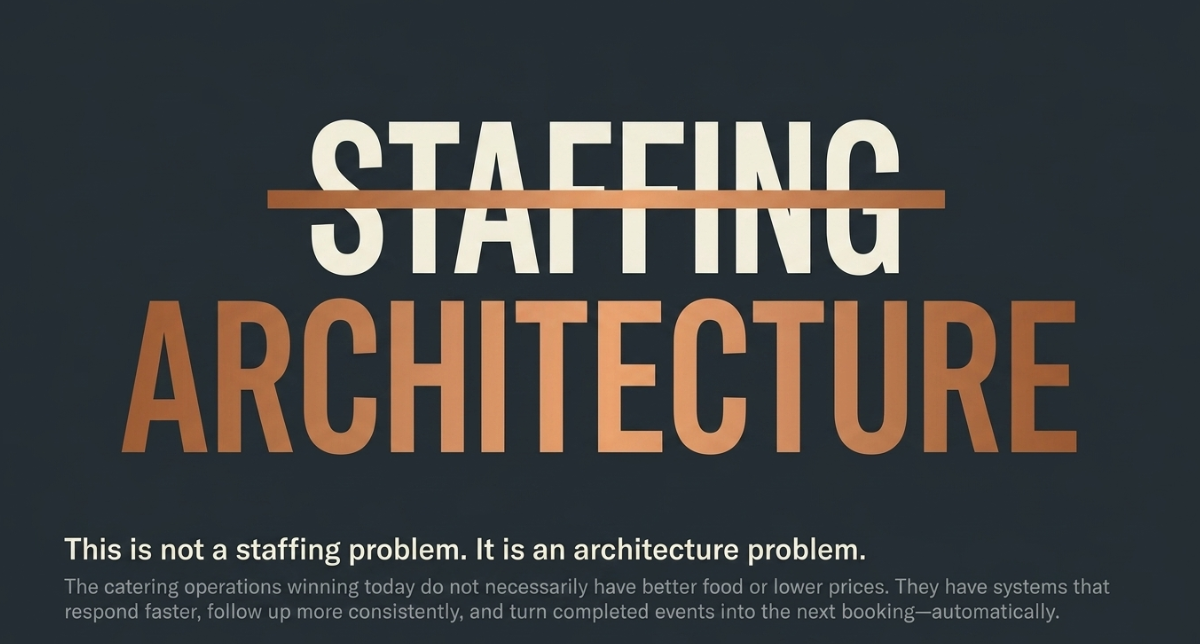
This is not a staffing problem. It is an architecture problem.
The operations that are winning in catering right now are not necessarily the ones with the best food or the lowest price. They are the ones whose systems respond faster, follow up more consistently, and turn every completed event into the next one, automatically.
This article explains how catering companies are using HubSpot to build that system, what "event management orchestration" actually means in practice, and whether this approach fits your operation.
What Event Management Orchestration Actually Means for a Catering Business
Event management orchestration is the practice of connecting every stage of a catering event, from first inquiry to final review, inside a single, automated system, so that data flows between stages without manual intervention and no step depends on a person remembering to do it.
In plain terms, the inquiry triggers the follow-up. The signed contract triggers the pre-event checklist. The completed job triggers the review request. Nothing waits for someone to copy a note from one place to another.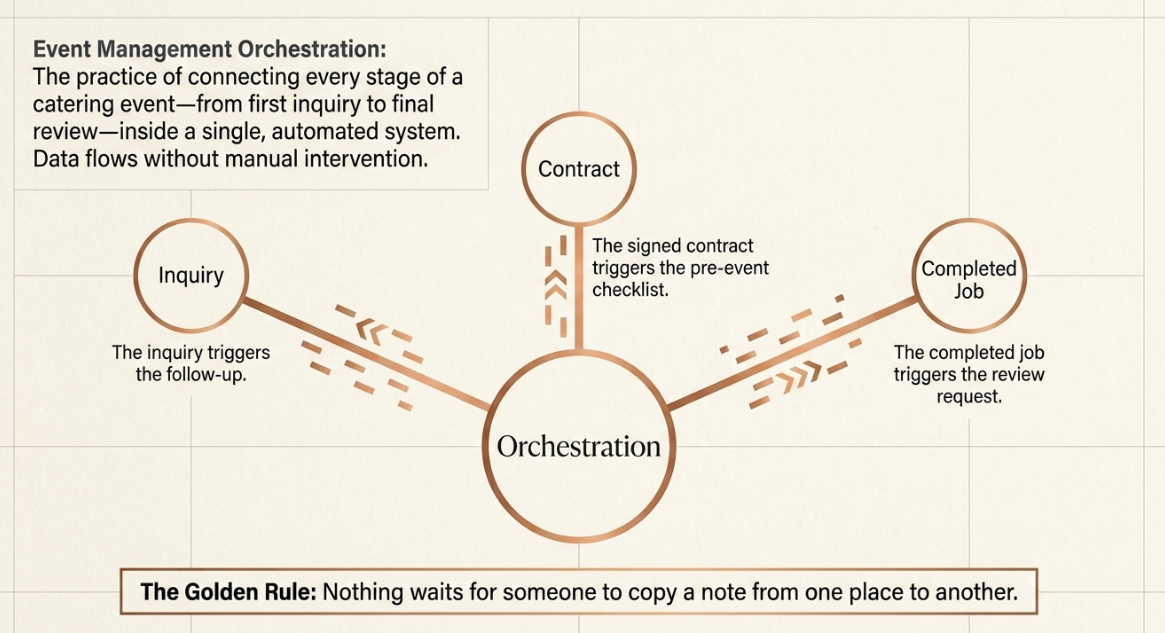
For catering specifically, orchestration matters more than in many other industries because the sales cycle, the operational cycle, and the client communication cycle all run in parallel and depend on each other. A missed handoff between sales and operations does not just create internal friction; it shows up on the day of the event, in front of the client.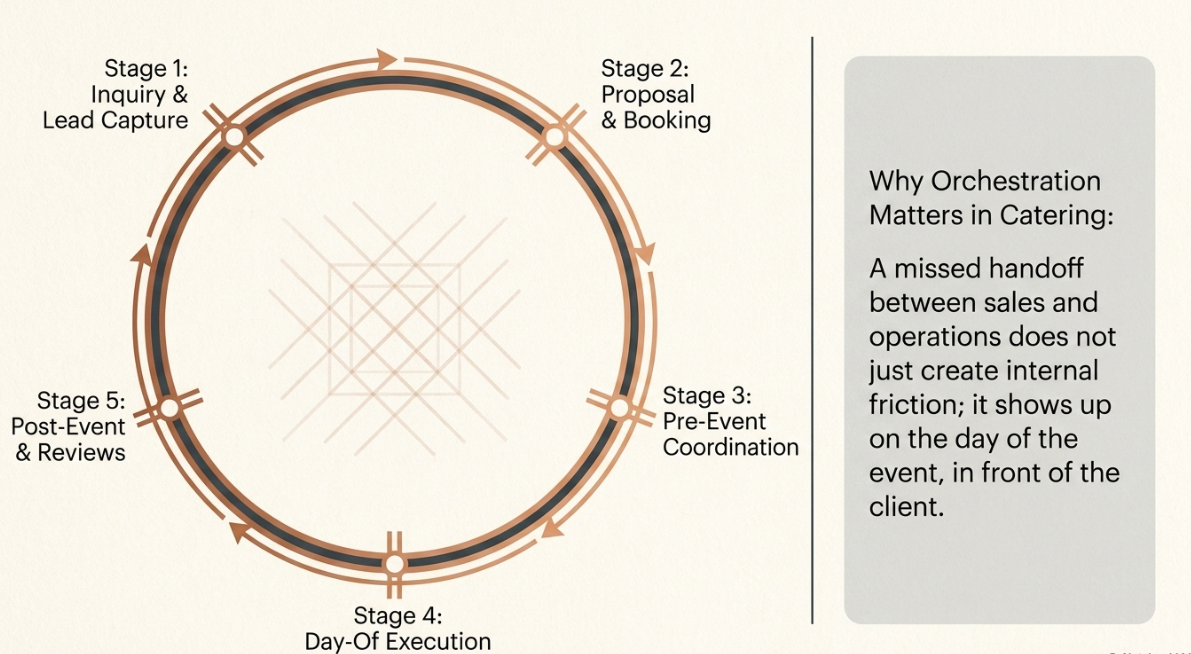
HubSpot serves as the orchestration layer because it combines CRM, workflow automation, pipeline management, and communications in one platform. When configured for catering operations, it replaces the combination of spreadsheets, email chains, and standalone event software that most growing catering companies are currently duct-taping together.

The Five Stages of a Catering Operation HubSpot Can Connect
Most catering operations run through five distinct stages. Each one has a handoff point where things typically break down. Here is what each stage looks like with and without an orchestrated system.
Stage 1: Inquiry and Lead Capture
Without a system, Leads arrive through multiple channels, website form, phone call, referral, social media, and land in different places. Someone manually consolidates them, eventually.
With HubSpot, every inquiry source feeds into one CRM pipeline automatically. The moment a form is submitted, a contact record is created, a follow-up task is assigned, and an automated acknowledgment goes to the prospect. If no one responds within a set window, HubSpot sends an internal alert. The response-time problem Maria had this morning does not exist.
Stage 2: Proposal and Booking
Without a system, the estimator pulls details from email, builds a quote in a Word document, emails it as a PDF, and then hopes the prospect responds. Follow-up is manual and inconsistent.
With HubSpot, Proposal templates are linked to the deal record. When a proposal is sent, an automated follow-up sequence begins. The system tracks whether the prospect opened the document. If the deal moves to "Booked," the contract process is triggered. No manual chasing required.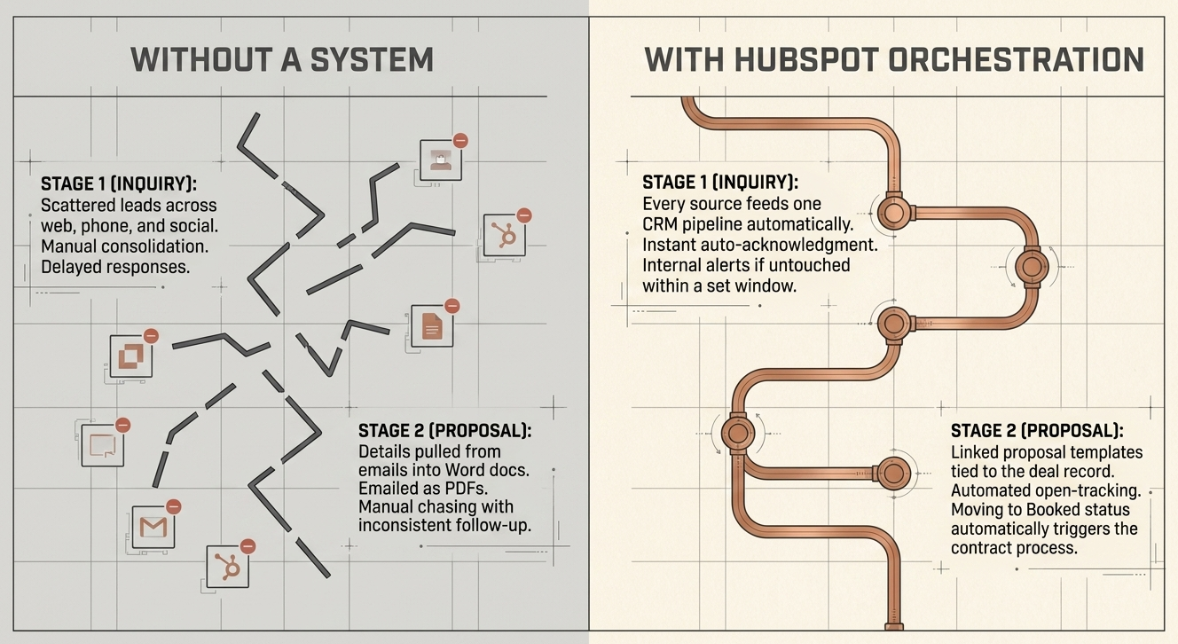
Stage 3: Pre-Event Coordination
Without a system, Event details live in a shared folder, a catering-specific tool, or someone's head. Operations do not always have the client notes and sales captured. Last-minute changes get lost in a chain of texts.
With HubSpot, the booked deal record holds every client preference, dietary requirement, venue detail, and change log. Operations access the same record sales used. Automated reminders go to the event coordinator at set intervals before the date. Client communications, confirmations, final headcount requests, and day-of logistics trigger automatically based on the timeline.
Stage 4: Day-Of Execution Support
Without a system, the day-of run sheet is a printed document or a PDF. Any change requires a phone call.
With HubSpot, the event record is accessible on mobile. Staff notes, client updates, and any issues logged during the event attach to the deal record in real time, creating a documented history that informs future events with the same client.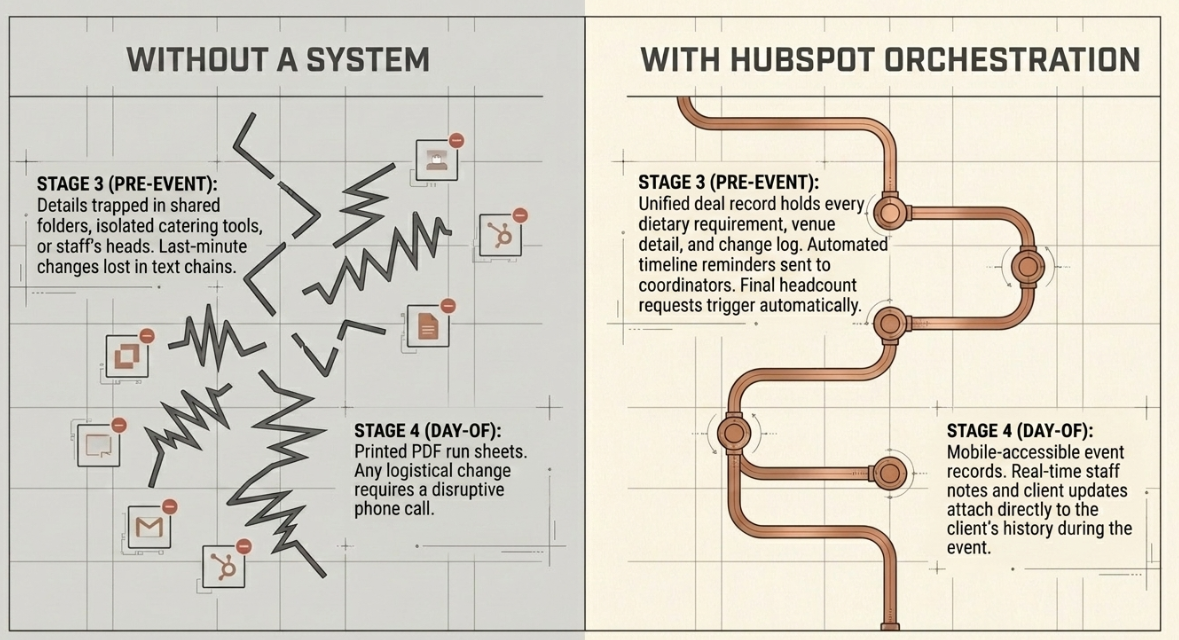
Stage 5: Post-Event Follow-Up and Reviews
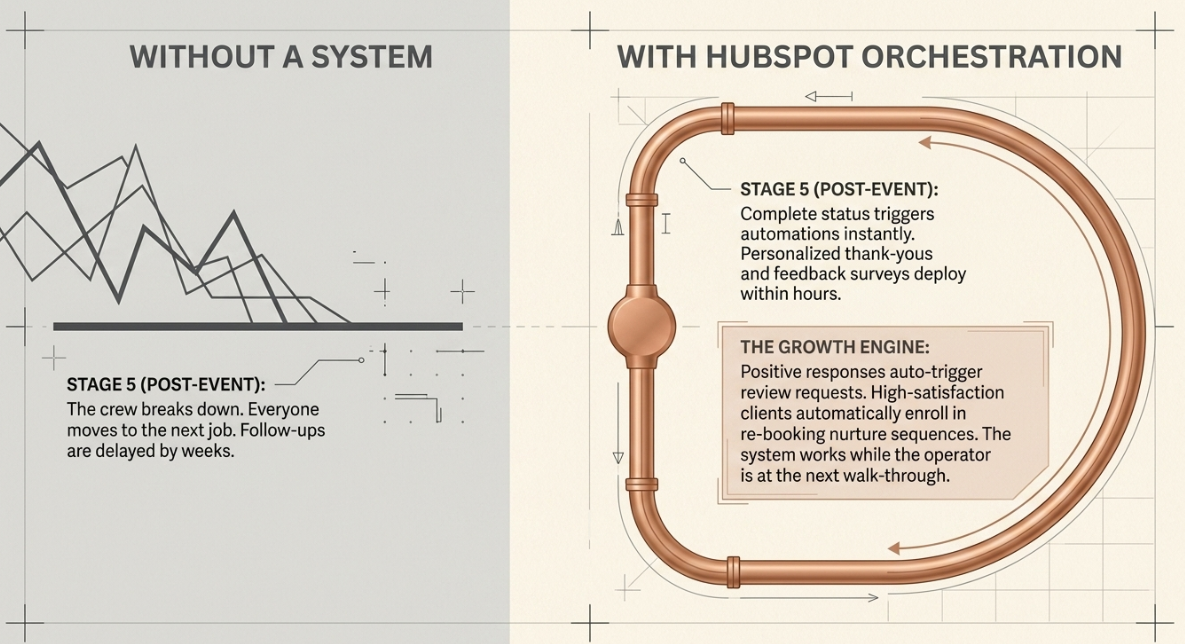
Without a system, the event ends. The crew breaks down. Nobody sends a follow-up for two weeks because everyone is already on the next job.
With HubSpot, the moment a deal is marked "Complete," an automation fires. The client receives a personalized thank-you message and a feedback survey within hours, while the experience is still fresh. Positive responses trigger a review request. High-satisfaction clients are automatically enrolled in a re-booking nurture sequence. Maria does not have to remember any of this. The system does it while she is already at the next walk-through.
HubSpot vs. Caterease — What Each System Is Actually Built For
Caterease is purpose-built for catering. It handles banquet event orders, staffing, menu management, and event-specific logistics well. For operators who need deep event-specific functionality out of the box, it has real strengths.
HubSpot is built as a CRM and marketing automation platform. It is not natively a catering management tool. What it does better than Caterease is manage the front-end sales pipeline, automate client communications across the full lifecycle, and give you a unified view of every client relationship, not just individual events.
The practical question is not "which one is better" but "which gap is currently costing you more."
|
Capability |
Caterease |
HubSpot |
|
Banquet Event Orders (BEOs) |
Native, purpose-built |
Requires customization or integration |
|
Menu and recipe management |
Native |
Not native |
|
CRM and contact management |
Basic |
Comprehensive |
|
Sales pipeline visibility |
Limited |
Full |
|
Marketing automation |
Not included |
Core feature |
|
Post-event follow-up automation |
Manual |
Automated |
|
Client communication history |
Event-level |
Full relationship view |
|
Reporting and revenue dashboards |
Event-focused |
Business-wide |
|
Scalability beyond catering ops |
Limited |
Broad |
|
Integration with other business tools |
Limited |
Extensive |
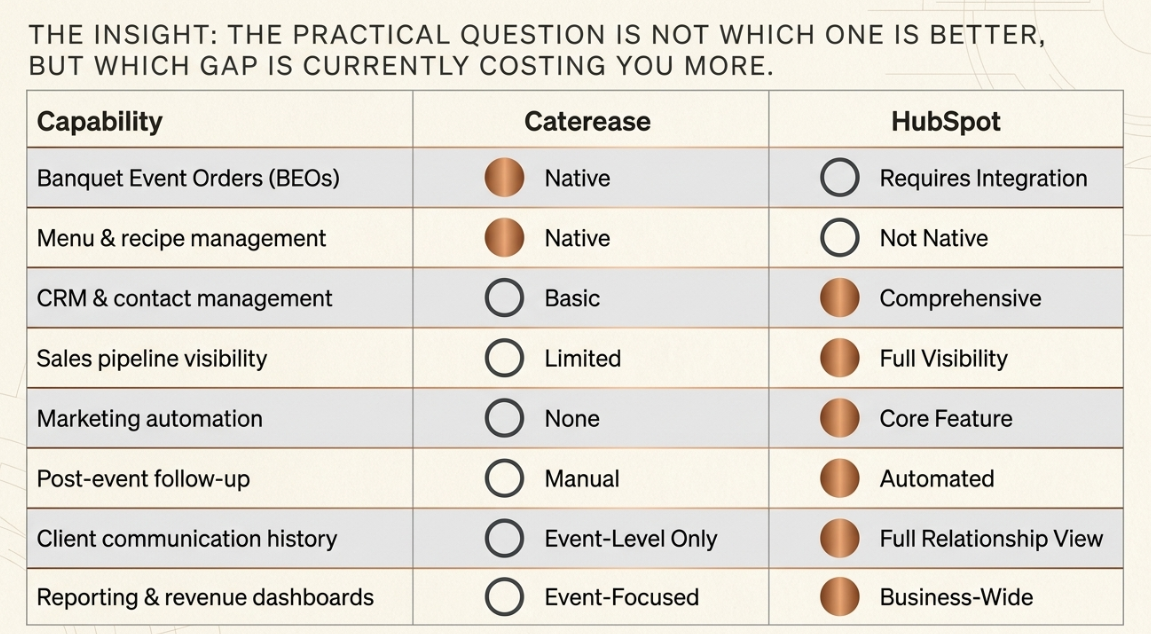
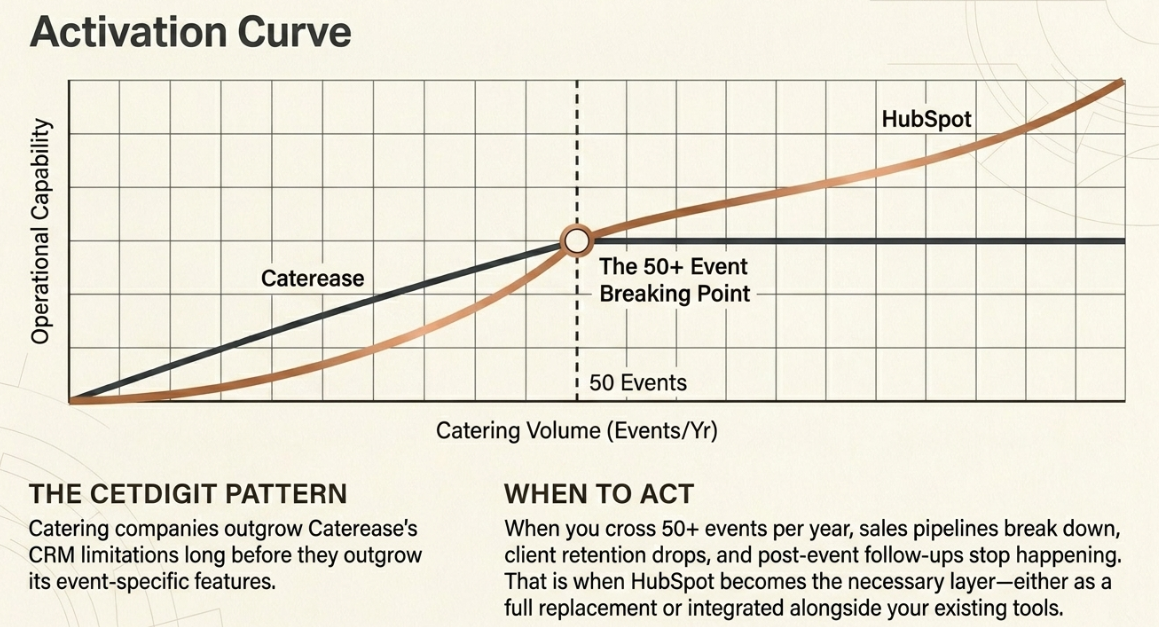
The pattern CETDIGIT sees most often: catering companies outgrow Caterease's CRM limitations before they outgrow its event-specific features. When you are doing enough volume that the sales pipeline, client retention, and post-event follow-up are breaking down, that is when HubSpot becomes the right layer to add, either as a replacement or as a connected system alongside your existing tools.
Who This Approach Is For, and Who It Is Not
This approach fits catering companies that:
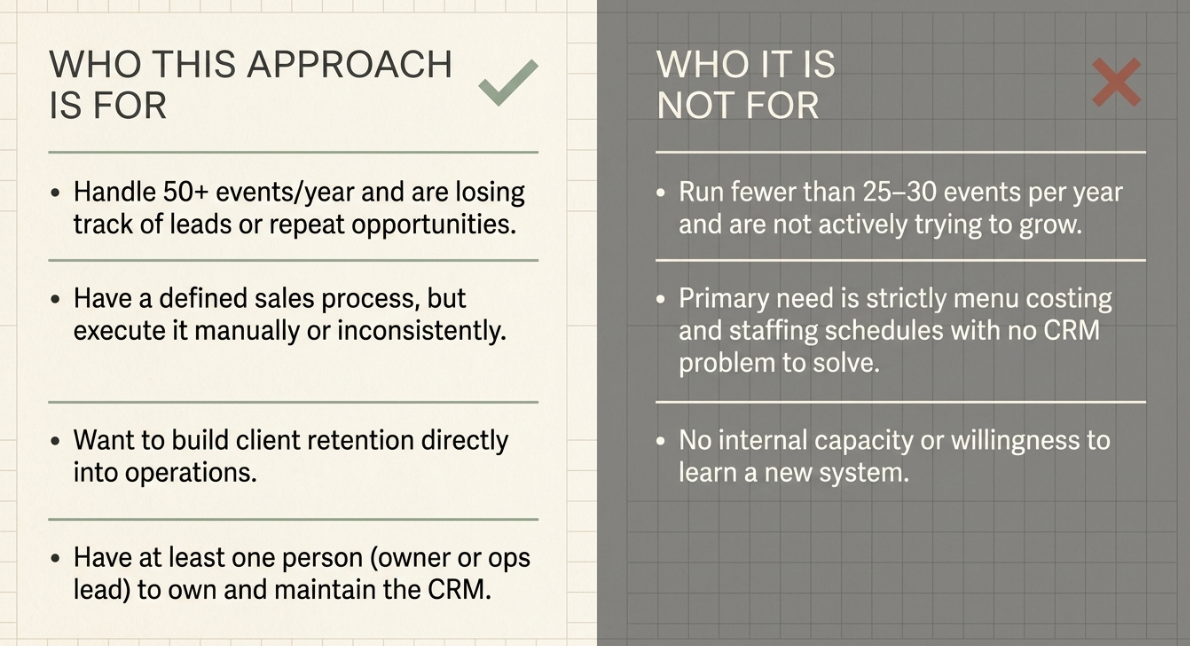
- Handle 50 or more events per year and are losing track of leads, follow-ups, or repeat client opportunities
- Have a defined sales process, but are executing it manually or inconsistently
- Want to build client retention and repeat booking into their operations, not just run individual events
- They are growing and recognize that their current system will not scale past a certain volume
- Have at least one person (owner, ops lead, or coordinator) who can own the CRM and maintain it
This approach is not the right fit if:
- Your primary need is deep event-specific logistics, BEOs, staffing schedules, and menu costing, and you have no CRM or follow-up problem worth solving
- You are running fewer than 25–30 events per year and are not actively trying to grow
- No one in your organization has the capacity to learn and maintain a new system
What You Need in Place Before You Start
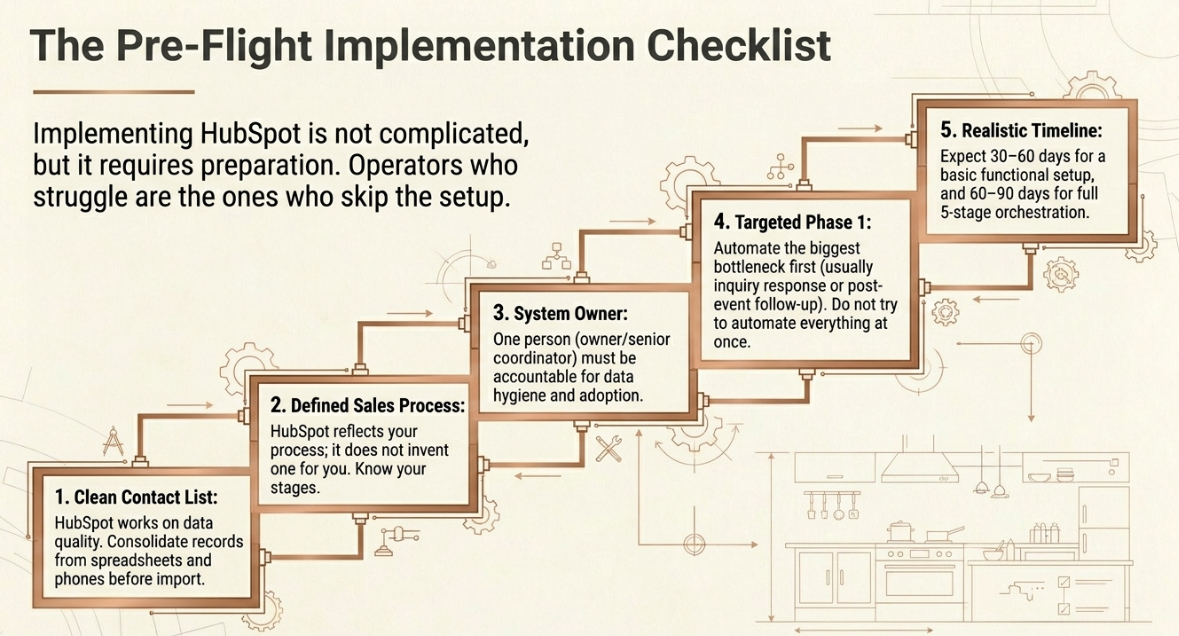
Implementing HubSpot for catering event management is not complicated, but it requires preparation. The operators who struggle are almost always the ones who skipped the setup work.
Before you go live, you need:
- A clean contact list. HubSpot works on data quality. If your client and prospect records are scattered across spreadsheets, email threads, and your phone, dedicate time to consolidating them before import.
- A defined sales process. You do not need to have it perfect, but you need to know the stages a lead moves through before it becomes a booked event. HubSpot reflects your process; it does not invent one for you.
- Someone who owns the system. A CRM does not run itself. One person needs to be accountable for data hygiene, workflow updates, and adoption. In a small catering operation, this is often the owner or a senior coordinator.
- Clarity on what you are automating first. Trying to automate everything at once is the fastest way to a failed implementation. Pick the one stage that is costing you the most, usually inquiry response or post-event follow-up, and build that first.
- A realistic timeline. A basic HubSpot setup for a catering operation can be functional in 30–60 days. A fully orchestrated system across all five stages typically takes 60–90 days, depending on data complexity and team adoption pace.
What Changes After the System Is Running
The operators who have made this shift describe two changes that matter most.
The first is visibility. For the first time, they can see exactly where every lead is in their pipeline, how long it takes to convert an inquiry to a booking, and which clients have not been followed up with. The business stops running on memory and starts running on data.
The second is reclaimed time. The follow-ups, the review requests, the pre-event reminders, those tasks still happen. They just happen without anyone manually doing them. For a catering operation running on a lean team, that reclaimed time is the difference between being reactive and being strategic.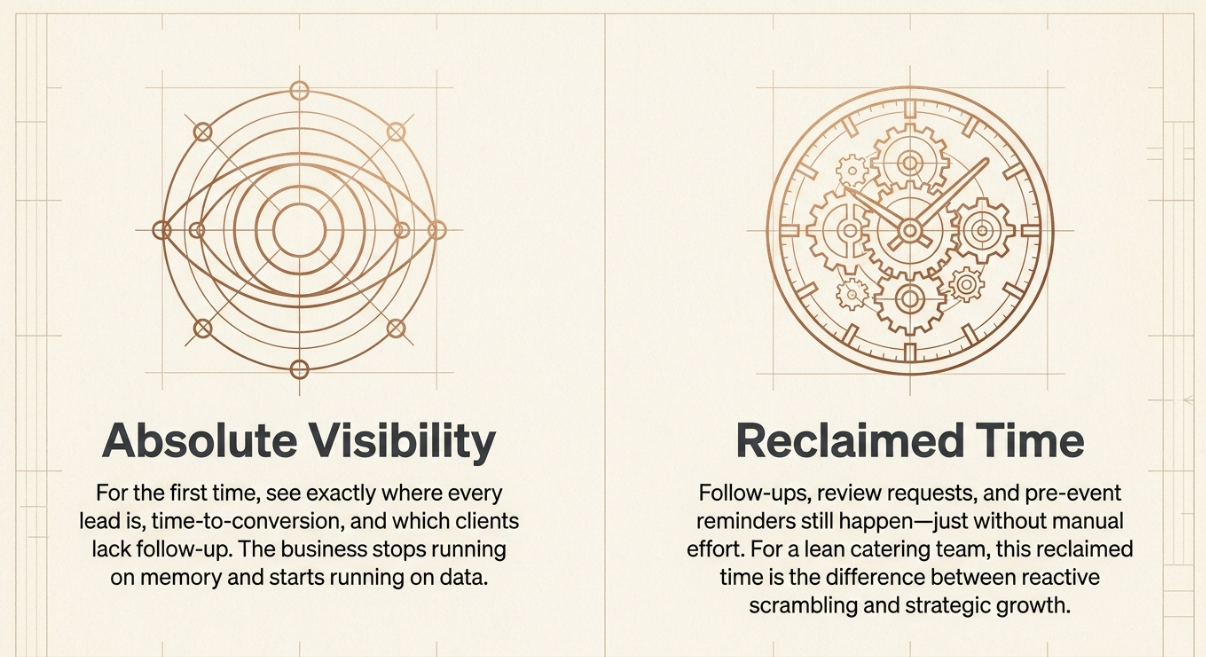
Ready to Run Your Catering Operation on HubSpot?
CaterSuite is the catering management platform built natively on HubSpot, not connected to it. Inquiry capture, proposal, booking, pre-event coordination, and post-event follow-up, all running on the platform your marketing and sales team already uses every day.
See the catering operations platform built on HubSpot

Leave a Comment