


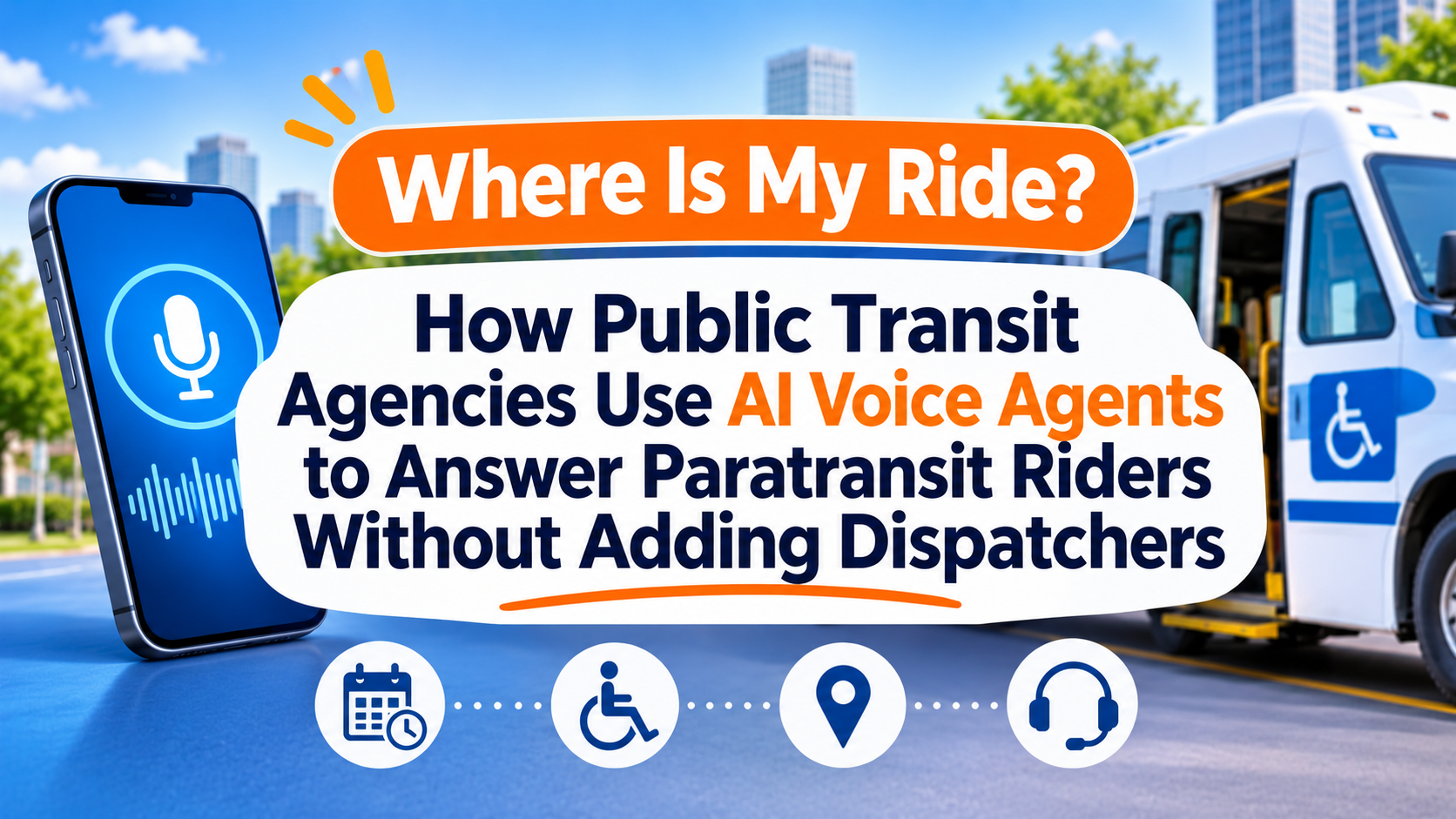
At a paratransit agency, the phone is not a side channel. It is the service. A rider who uses a mobility device, a white cane, or a screen reader does not open an app to book tomorrow's dialysis appointment. They call. They call again at 4:40 in the afternoon when the vehicle has not arrived inside the pickup window. And they call a third time when the return trip was never confirmed. Every one of those calls lands on a small team of reservationists and dispatchers who are also trying to run the day's schedule.
This post is for the people who run that operation: paratransit managers, customer service supervisors, operations directors, and the procurement staff who write the scope of work for the next scheduling platform. It covers what an AI voice agent can honestly do on a paratransit line, where it must stop, and what an agency should settle before turning one on.
Why the paratransit phone line is its own problem
Complementary paratransit under the Americans with Disabilities Act exists because federal rules require service comparable to fixed route, and those rules speak directly to how riders reach you. Reservation service must be available during normal business hours, and patterns of significantly untimely pickups, trip denials, or missed trips are treated as compliance problems, not customer service blemishes. A phone line that rings through to a long hold queue is part of how an agency shows that the service is usable.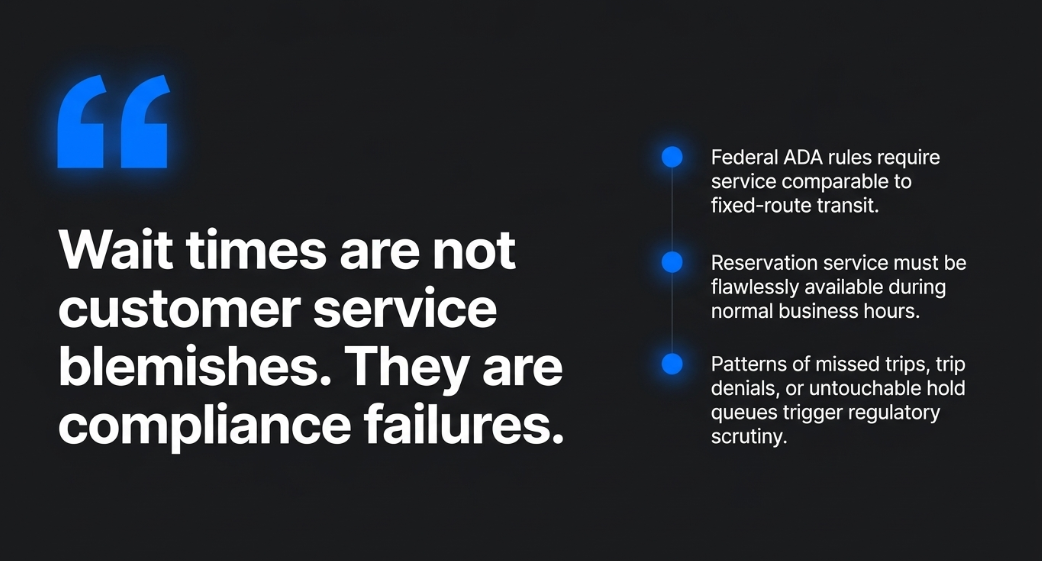
The call mix is unlike a general utility call center. Reservation calls arrive in clusters, because riders book against next-day service and the lines flood in the late morning and mid-afternoon. Status calls spike when the weather turns, or a vehicle runs behind. Eligibility and recertification questions come in steadily. Underneath all of it sits a smaller number of calls that must reach a human immediately: a rider stranded at a curb, a driver who cannot find an entrance, a caller in distress.
The callers add complexity. Many have speech differences, hearing loss, or cognitive disabilities. Many speak a language other than English at home. Some call through relay services. An automated system that treats them like generic customers will fail them.
The calls an agent can take, and the ones it should hand off
Think of an AI voice agent as a very patient front-line colleague with a short, clearly written job description. Four kinds of calls fit it well.
The first is the status call. A rider asking where the vehicle is does not need a person to look up the trip and read an estimate aloud. Where the scheduling and dispatch platform exposes that information through an interface, an agent can answer in seconds and offer to connect the rider to dispatch if the vehicle is outside the pickup window. Every status call handled this way is a dispatcher who stays focused on the board.
The second is routine trip management: confirming a booked trip, reading back pickup and return details, and handling a cancellation. Late cancellations and no-shows carry real operational cost, and a rider who can cancel with one call at any hour is more likely to do it in time.
The third is policy and procedure questions: service hours, how to apply and recertify, how to pay a fare, where the service area ends. These answers live in agency documents, and an agent that retrieves from those documents and cites its source is far safer than one improvising. An agent that cannot point to the passage it relied on should say it does not know and transfer the call.
The fourth is after-hours coverage. Reservation windows do not match the lives of the people being served. An agent can capture a trip request for the morning team, answer common questions, and escalate genuine emergencies according to a written protocol.
What the agent must not do matters just as much. It should not decide eligibility, grant exceptions, waive a suspension, or interpret medical information. And it should never keep a struggling rider in the system. A caller who says they are outside and the vehicle has not come, who sounds confused, or who simply asks for a person goes to a person immediately, with a summary already in front of the human who picks up.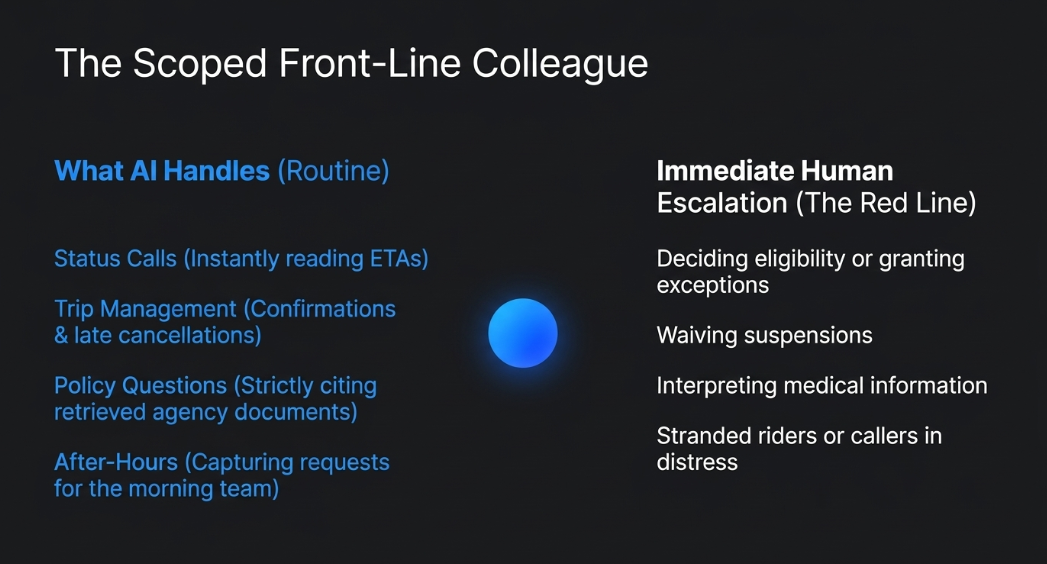
Where this meets the scheduling software
Transit agencies do not run on one system. A scheduling and dispatch platform holds trips, vehicles, and the manifest. An eligibility database holds applications and certifications. A payment solution handles fares, and a passenger portal handles online booking. Scopes of work increasingly list the interactive voice response, the portal, the payment solution, and the operator application as separate line items.
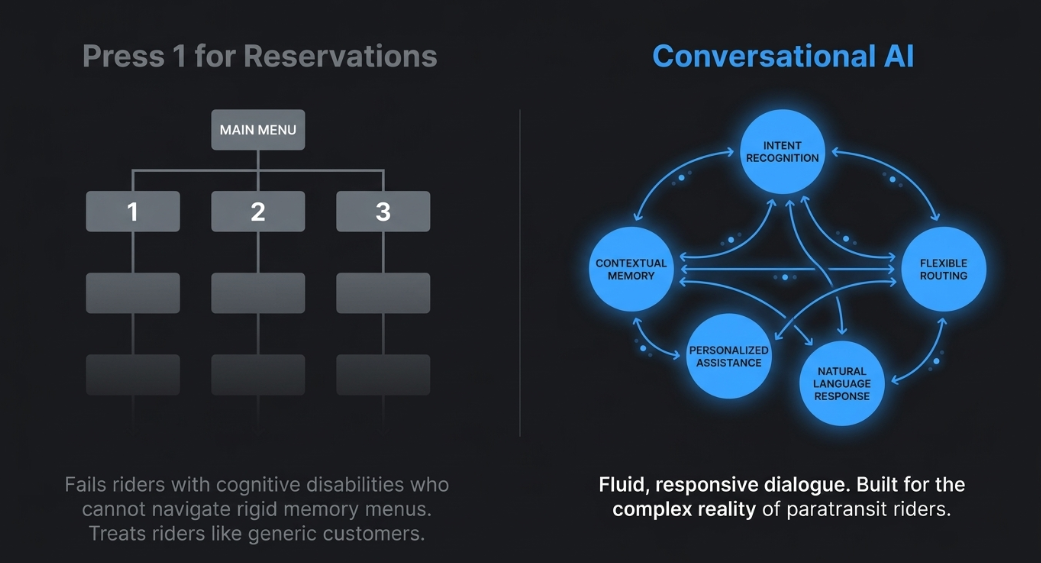
That structure explains why many agencies are disappointed in the IVR they already own. A menu that says "press one for reservations" was built for limited choices, and a rider with a cognitive disability should never be asked to remember which number to press. A conversational agent changes the front end, but it still depends on the data behind it. The practical question is which actions the agent can safely read, which it can safely write, and which stay with staff. A well-run project starts read-only, with trip status and general information, and adds actions like cancellations only after the agency has watched the agent perform for several weeks.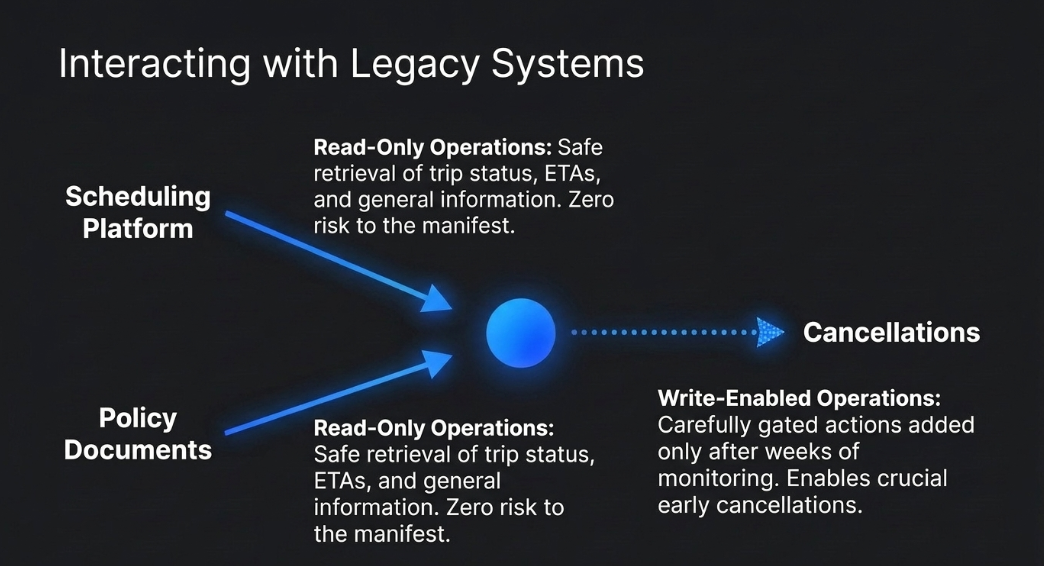
Accessibility, language access, and consent
For paratransit riders, accessibility is part of the service itself. A voice agent must speak at a pace riders can follow, repeat on request, tolerate pauses and corrections, and work alongside relay services. Agencies that receive federal transit funding are also expected to serve riders with limited English proficiency, and multilingual intake is one of the clearest places an agent extends service rather than merely trimming cost.
Outbound calls need care. Trip reminders and arrival notices help riders, but automated calls and texts fall under the Telephone Consumer Protection Act, so agencies should confirm how consent is captured at application, honor opt-outs immediately, and keep a record. Call recording rules vary by state, so the greeting should say plainly that the caller is speaking with an automated assistant and that the call may be recorded. Rider records also carry disability-related information, which calls for access controls, audit logging, and retention rules that satisfy public records requirements.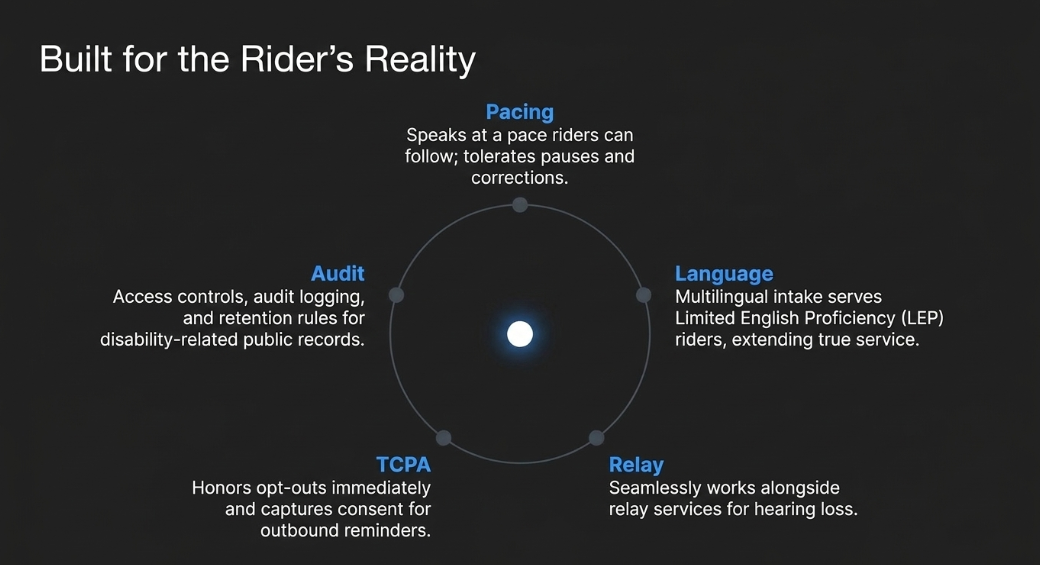
What a sensible rollout looks like
Agencies that do this well move in stages. They analyze a few weeks of call records to learn what riders actually ask and at what hours. They write the escalation protocol with operations and safety staff before anything is built. They pilot with status calls and after-hours coverage, where risk is lowest. They ask riders and disability advisory committee members to test the experience before launch, and they review transcripts weekly in the first months, because transcripts show where a script is failing real people.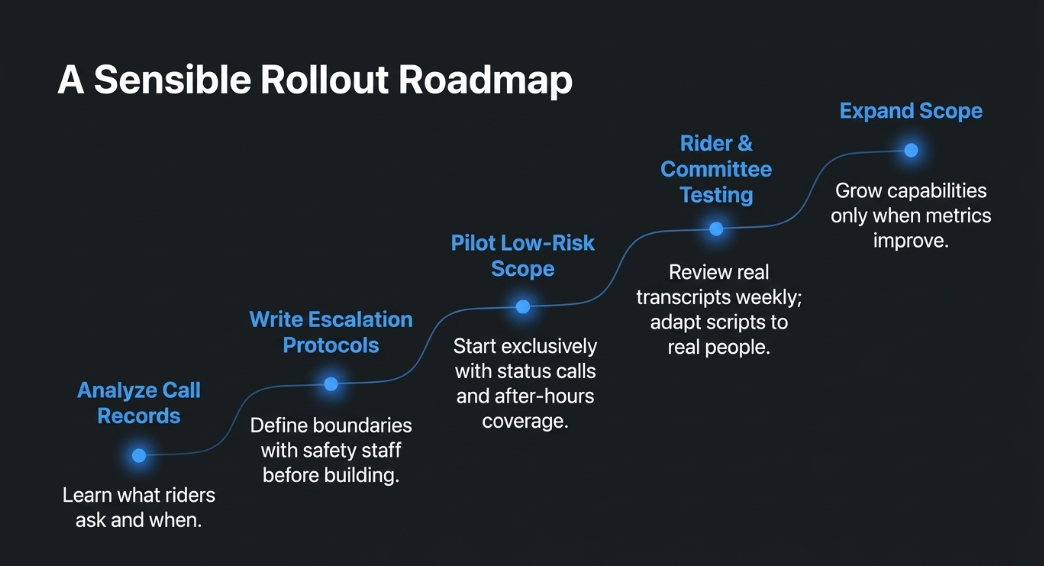
Success should be measured in terms an operations director already uses: hold times, abandoned calls, transfers to dispatch with a useful summary, trips cancelled before the window rather than after, and rider complaints. If the numbers improve and complaints do not rise, scope can grow. If not, the agency learned something cheaply.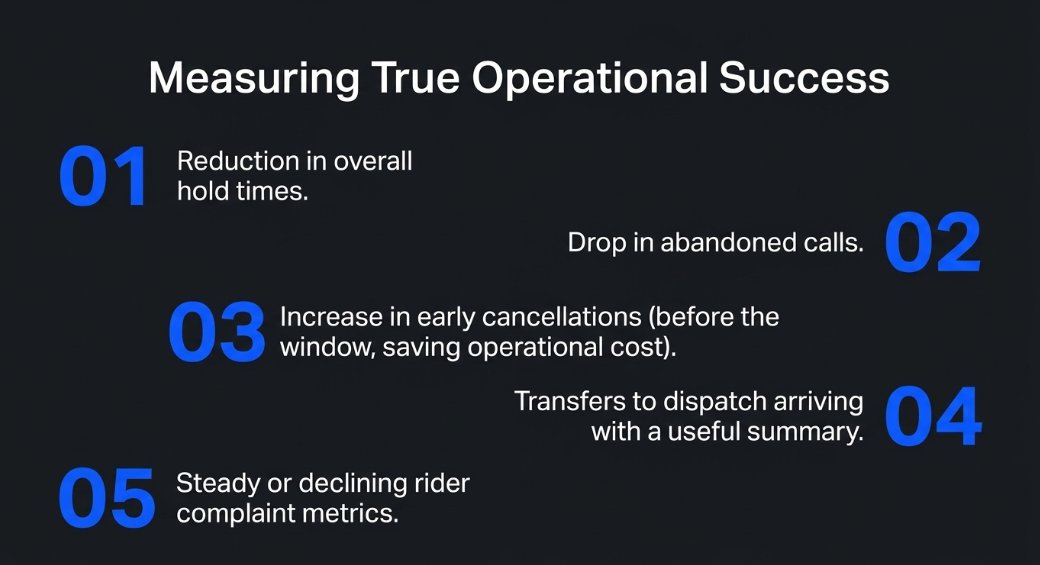
For agencies exploring this, CETRAI's government page describes how its voice and chat platform is built for regulated, high-volume public-sector environments, including source-cited answers and audit logging. It is a useful reference when writing requirements for your own pilot.
Talk to CETDIGIT
Cetrix Technologies LLC (CETDIGIT) has delivered more than 300 AI and CRM deployments and is a Salesforce Crest Partner and HubSpot Elite Partner. If your agency is weighing an AI voice agent for rider calls, or planning how it should connect to your scheduling platform and records, we would welcome the conversation. Schedule a consultation with CETDIGIT, and we will help you map the call types, the integrations, and the safeguards before you commit to a build.
Related Reads
The Voucher Holder Who Called Four Times: How Public Housing Authorities Use AI Voice Agents to Answer Residents Without Adding Headcount
Enrollment Week at the Front Office: How AI Voice Agents Help School Districts Answer Every Parent Call
Four Systems, One Client: Why Economic Development Agencies Are Retiring the Spreadsheet Stack

Leave a Comment