


It is the last week of October, and every veterinary front desk knows what is coming. Somebody's Labrador is about to find the trick-or-treat bucket. The call will arrive at 8:15 on a Friday evening, from an owner who is half panicked and half apologetic, asking whether a handful of chocolate bars or a pack of sugar-free gum is an emergency. On the other end of the line is a client service representative who is also checking in a dog with a limp, holding a place in line for a cat owner at the counter, and watching two other lines light up.
That moment is the real subject of this article. Not artificial intelligence in the abstract, but the specific, human pressure of a veterinary phone line, and what a well-designed voice agent can and cannot do to relieve it.
The Busiest Room in the Hospital Is the Lobby
A veterinary front desk does an unusual amount of work for a handful of people. The same two or three client service representatives check patients in and out, collect payments, schedule follow-ups, handle refill requests, answer questions about boarding and vaccines, and field every call that comes in. When a person is standing at the counter and a phone is ringing, the person usually wins, and the phone rolls to voicemail.
The cost of that choice is uneven. A caller with a routine question will usually leave a message and wait. A caller with a sick animal will not wait; they will call the next practice on the list. A prospective new client, who may be comparing three clinics, rarely leaves a message at all. None of this is a failure of effort. It is arithmetic. The people are doing two jobs at once, and the phone is the one that loses.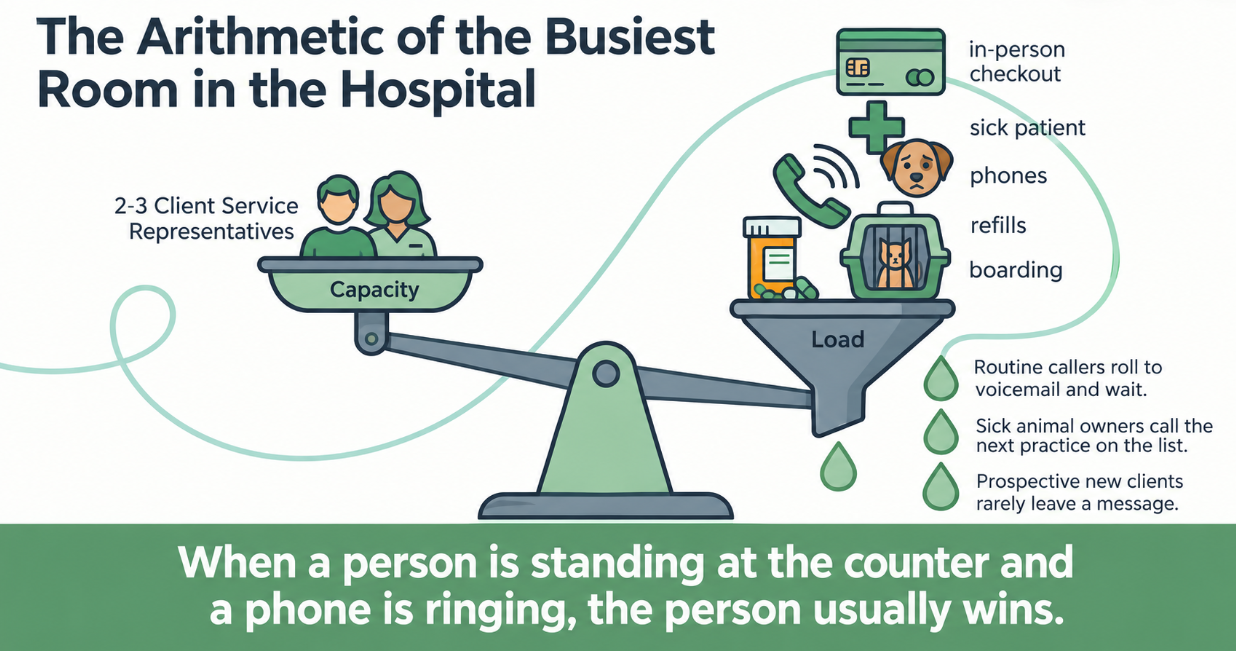
Sorting the Calls Before Answering Them
Anyone who has worked a vet phone line knows that calls fall into a few distinct families, and each one needs a different response. Routine requests include appointment booking, vaccine and wellness questions, boarding, prescription refills, and records transfers. Clinical urgency covers ingestions, vomiting, breathing trouble, injuries, and anything the caller describes with the word “suddenly.” End-of-life calls are a category of their own and need the most care. Finally there are prospective clients, who want to know if the practice is accepting new patients and what a first visit looks like.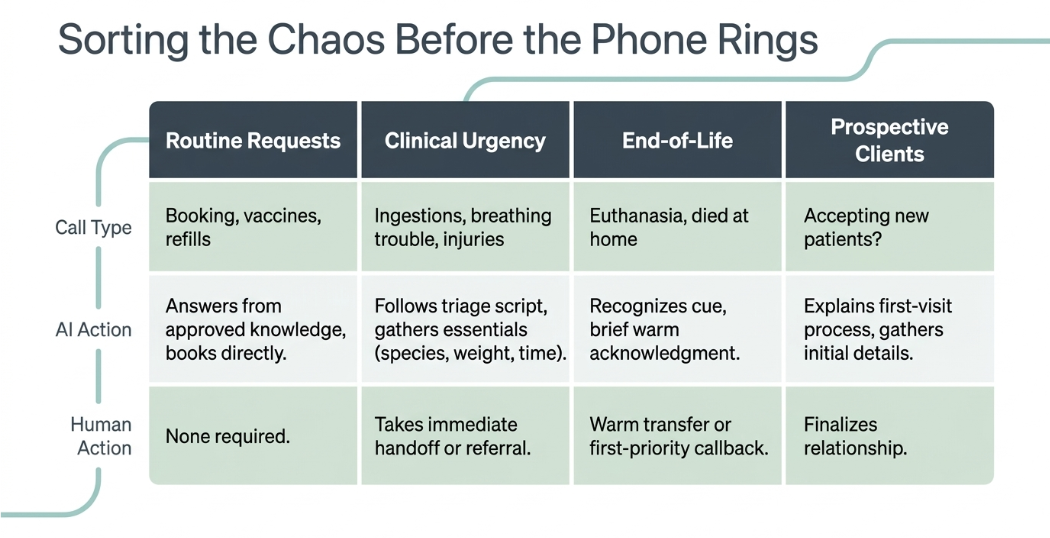
A voice agent earns its place by sorting these correctly and quickly. For routine calls, it can answer from the practice's approved information and book directly. For urgent calls, the principle has to be conservative: the agent does not diagnose, does not tell an owner that something is fine, and does not offer home treatment advice. It follows a short triage script that the practice's medical director has approved, collects the essentials such as species, weight, what was eaten, and when, and then hands the call to a human on the on-call team or to the practice's emergency referral partner. Where the practice wants it, it can also give the owner the number for an animal poison control service. The goal is speed to the right person, not a clinical opinion.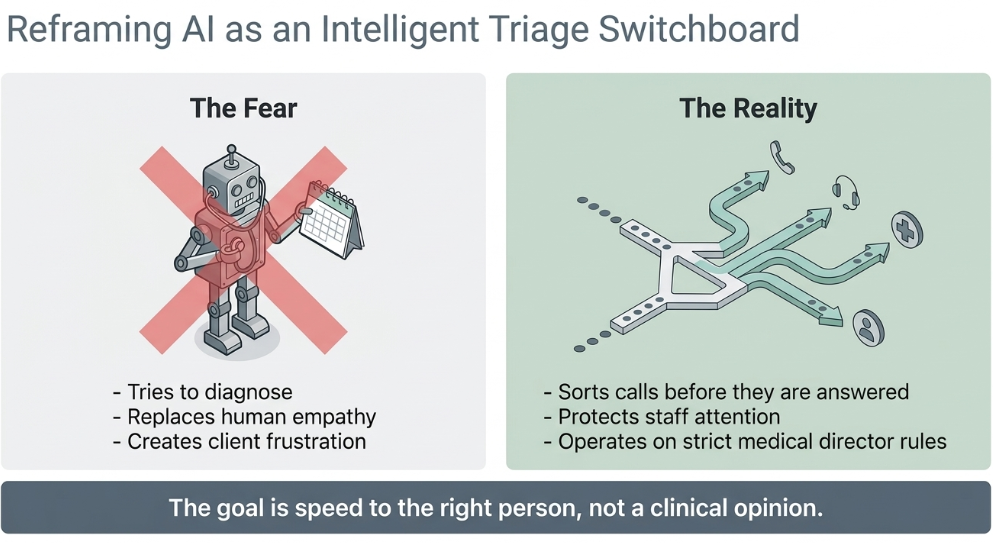
The Calls That Should Always Reach a Person
End-of-life calls deserve their own paragraph. When an owner calls to ask about euthanasia, or to say that a pet has died at home, an automated voice is the wrong answer. A well-configured agent recognizes the cue, responds with brief, warm acknowledgment, and transfers the call to a staff member, with a short summary so the owner does not have to repeat anything. If nobody is available, it takes a message and flags it for the first callback of the next business day. A good rule for any practice evaluating this technology: when in doubt, the call goes to a human. Technology that protects the front desk team from the volume, so they can give their full attention to the calls that matter most, is a gain. Technology that tries to replace compassion is not.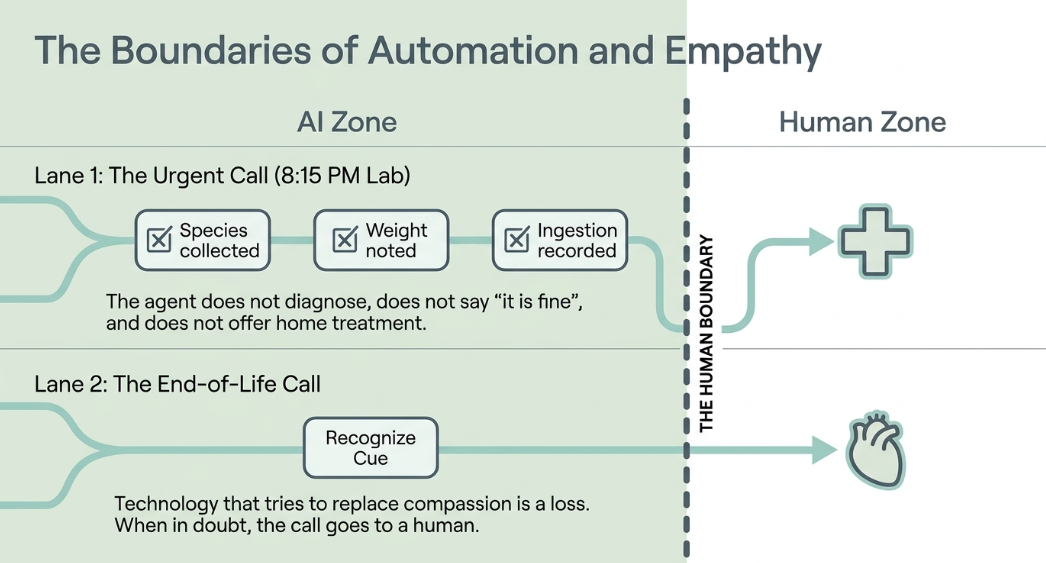
Where the Practice Management System Fits In
Booking is where many early deployments stumble. A veterinary schedule is not a simple list of open slots. A wellness exam, a new puppy series, a dental, a recheck, and a surgical drop-off have different lengths, different required staff, and sometimes different rooms. The agent needs to respect those rules, which means it has to read from, and write back to, the practice management system the team already uses, whether that is Cornerstone, AVImark, eVetPractice, Covetrus Pulse, ezyVet, Provet Cloud, Shepherd, Digitail, or another platform. Some of these expose open interfaces, while others are reached through a client engagement or scheduling layer. Integration depth varies by system, so it is the first question to settle in any evaluation, ahead of voice quality or price.
The write-back matters just as much. Every call should leave a record: who called, which patient, the reason, what the agent did, and whether a person needs to follow up. When that note lands in the client's file, the next team member who picks up the phone starts with context instead of a blank screen.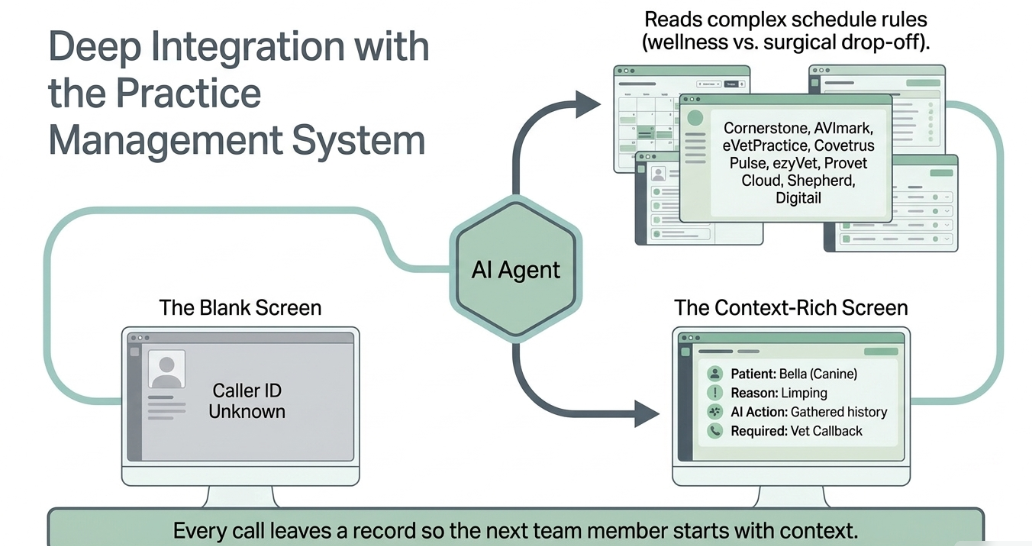
Compliance Looks Different in Veterinary Medicine
Practice owners are sometimes surprised to learn that HIPAA generally does not govern animal health records. That does not mean the field is unregulated. State veterinary practice acts set expectations for record-keeping and confidentiality, and the veterinarian-client-patient relationship governs when a prescription can be issued and, in many states, when telemedicine is permitted. A voice agent should never authorize a refill or imply that a prescription is approved. It collects the request, confirms the details, and routes it to the clinical team for a decision.
Two further areas apply to almost any phone-based automation. The Telephone Consumer Protection Act governs automated calls and texts, including appointment and vaccine reminders, so consent has to be captured and recorded properly. Call recording laws vary by state, and a growing number of jurisdictions expect callers to be told when they are speaking with an automated system. Practices should confirm the current requirements for the states where they operate with their own counsel.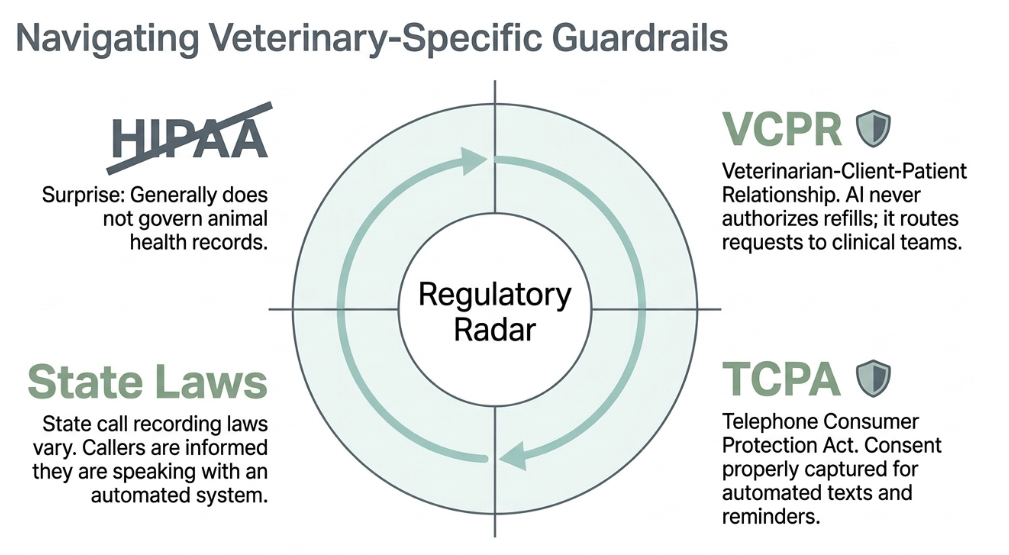
Beyond Inbound: Recalls, Overflow, and Multi-Location Groups
Once inbound calls are under control, the same infrastructure supports the quieter revenue work that most practices never have time for. Overdue vaccine and wellness reminders, dental recall lists, and wellness plan renewals can all be worked with consented outreach, with replies booked straight into the schedule. For veterinary groups with several hospitals, a single agent can greet callers consistently, route them to the right location, and spill overflow calls between sites when one front desk is overwhelmed. Multilingual intake is useful in practices that serve communities where English is not the first language at home.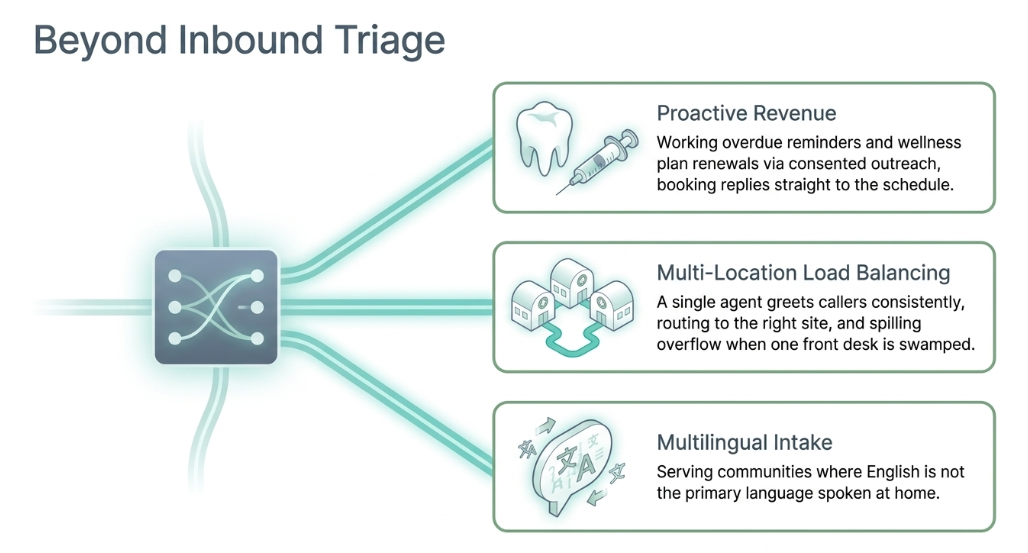
A Practical Way to Start
The most successful rollouts are modest at first. Spend two weeks reviewing call logs or recordings and sort the calls into the categories above. Write the triage script with your medical director rather than accepting a template. Begin with after-hours and overflow coverage, where the alternative is voicemail, and leave daytime calls with your team until the numbers justify a change. Then review transcripts every week for the first month. Watch the share of calls answered, the share handed to a human, the bookings made, and the calls where the agent said it did not know. Those last ones are the most useful, because they show exactly where your knowledge base needs work.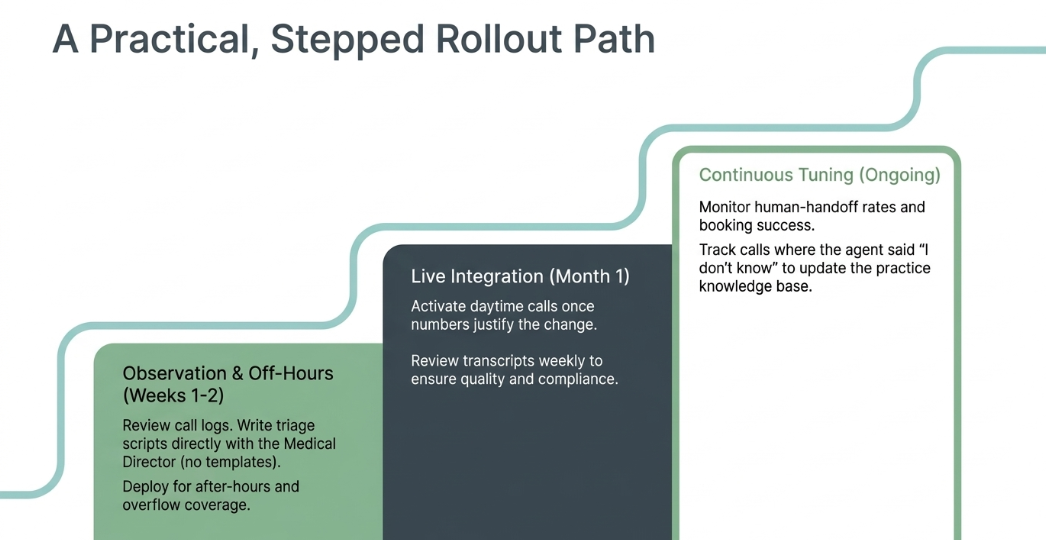
For teams that want to see how a purpose-built platform handles this in practice, including source-cited answers, human handoff, and audit logging, CETRAI is CETDIGIT's AI voice and chat platform for high-volume, regulated environments, and its public site is a useful resource while you shape your requirements.
Talk With CETDIGIT
CETDIGIT has delivered more than 300 AI and CRM deployments as a Salesforce Crest Partner and HubSpot Elite Partner, and we help service organizations connect voice and chat automation to the systems their teams already depend on. If your practice or veterinary group is weighing how to cover the phones without wearing out your team, schedule a consultation with CETDIGIT, and we will walk through your call mix, your practice management system, and a sensible first phase.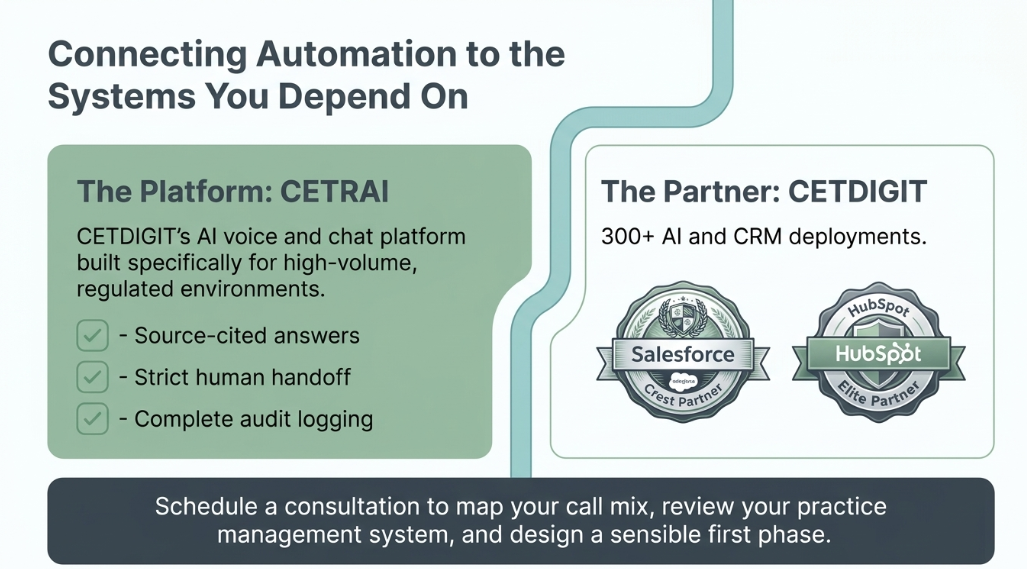
Related Reads
The Hygiene Recall List Nobody Has Time to Call: How AI Voice Agents Help Dental Practices Fill the Schedule
The Furnace Call at 9:40 P.M.: How HVAC and Plumbing Contractors Use AI Voice Agents to Win Emergency Jobs
The Missed Call Problem in Healthcare: How AI Voice Agents Give Medical Practices Their Phones Back


Leave a Comment