


It is a few minutes past nine on a Monday, and the front desk of a mid-sized housing authority already has eleven people on hold. A voucher holder wants to know whether her annual recertification paperwork arrived. A public housing resident reports that water is dripping through his bathroom ceiling. A man on the waiting list, who has not heard anything in fourteen months, wants to know if he is still on it. Two callers speak Spanish as their first language. Somewhere in the queue is a person who called Friday, Saturday, and again this morning, and who is by now less interested in the answer than in being heard.
None of these callers is difficult. Almost every one has a routine question, and a stretched team is answering them. That gap is where housing authorities lose time, goodwill, and sometimes compliance standing.
Why the phone is the hardest part of a housing authority
A housing authority is really several operations sharing one phone number. The Housing Choice Voucher program has its own rhythm of intake, eligibility, inspections, annual and interim recertifications, and landlord contact. Public housing has work orders, unit inspections, and lease administration. The waiting list belongs to neither program and to both, because it is the first thing most of the public ever interacts with. Each of these produces calls, and most of the calls arrive at the same moments: the first of the month, the week recertification notices go out, the morning after a storm.
The systems underneath are specialized. Many authorities run a housing management platform such as PHA-Web, Yardi, or Tenmast for tenant files, rent calculation, and inspections, and a separate ticketing tool for maintenance. Staff are constantly moving between them to answer what sounds like a one-line question. Every inquiry that needs a lookup costs a caseworker several minutes, and every caseworker minute spent on a status question is a minute not spent on the files that carry real deadlines.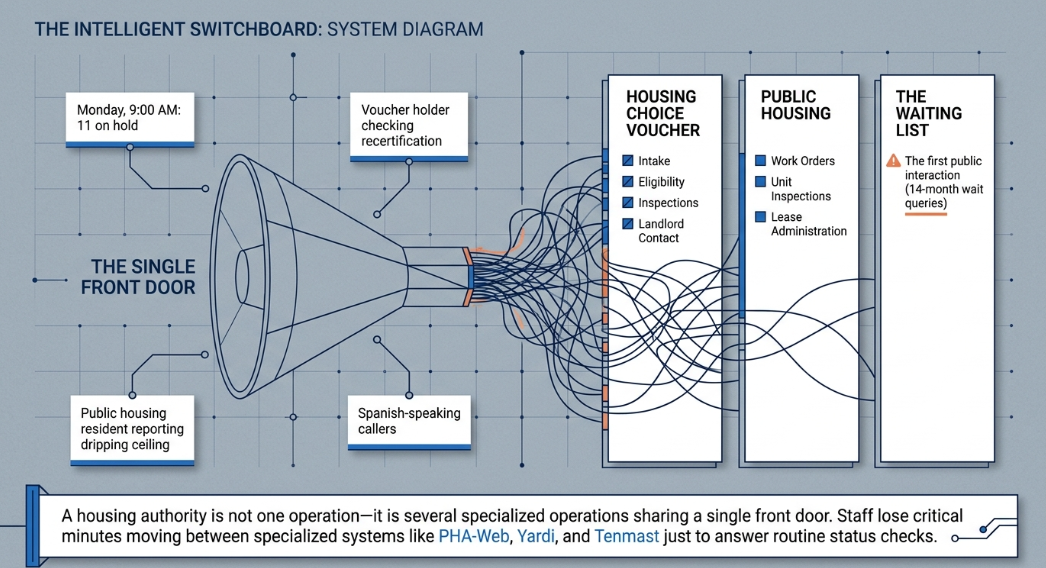
The financial climate makes this harder. HUD told housing authorities in a December 2025 letter, building on PIH Notice 2025-28, to take cost-saving measures to avoid voucher funding shortfalls, including holding back on issuing new vouchers, and said plainly that it could not guarantee funding to resolve shortfalls. When issuance slows, and budgets tighten, applicants and participants do not stop calling. They call more, because uncertainty generates questions. Staff capacity is flat or shrinking while inbound demand is climbing.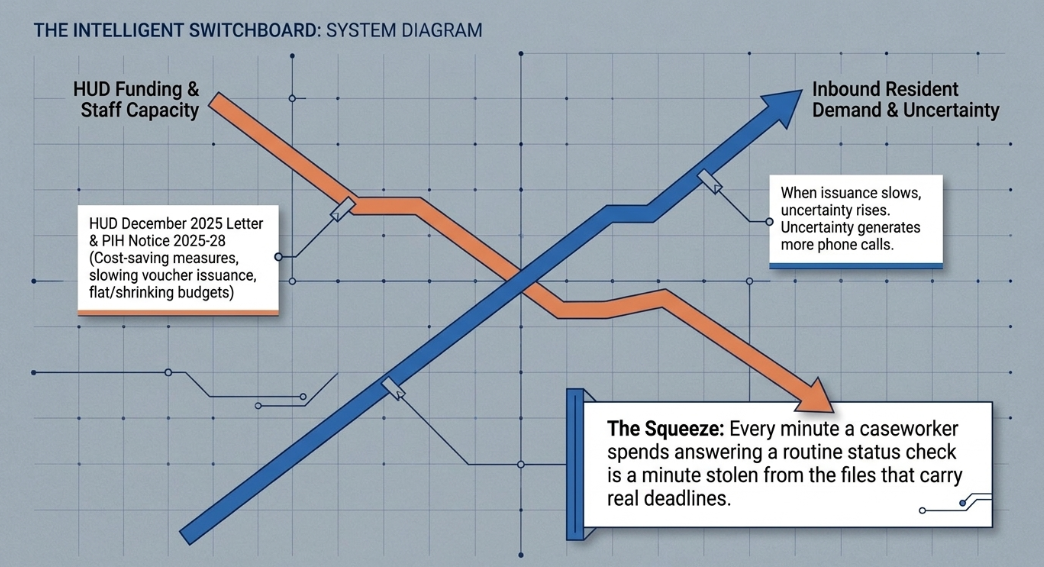
What an AI voice agent should and should not do in this setting
The first instinct in the public sector is caution, and that instinct is correct. A housing authority cannot have software improvising answers about eligibility, termination, reasonable accommodations, or grievances. Those decisions carry legal weight, and they belong to people. The question is not whether to let automation make decisions. It is whether automation can take on the portion of the call volume that involves no decision at all.
That portion is larger than most directors expect. Office hours and document requirements. Where to drop off a form. When recertification is due and what to bring. How to report a change in household income. Whether an inspection is scheduled and how to reschedule it. A well-built agent answers these from content the authority has approved and nothing else, says clearly when it does not know, and hands the caller to a person instead of guessing. It tells the caller up front that they are speaking with an automated assistant and gives them a path to staff, voicemail, or emergency instructions at any point.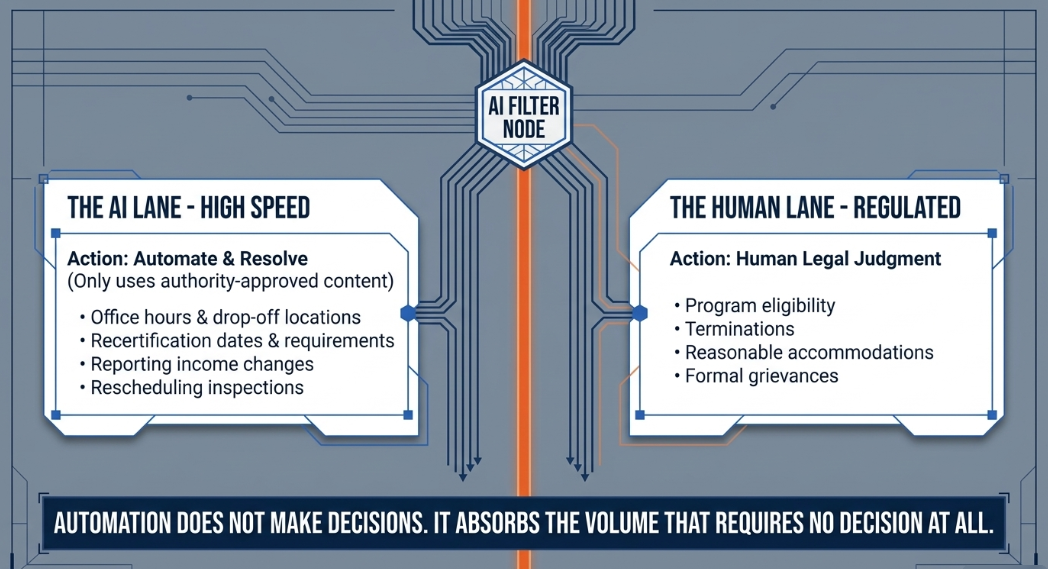
The behavior that matters most is on the maintenance line. A resident describing a leak, a lockout, or a heating failure needs two things quickly: a complete ticket and the right urgency. A good agent collects identity, unit, callback information, a description of the problem, access instructions, and any urgency indicators, applies the authority's own emergency and priority rules, and either escalates immediately or writes a full ticket into the work order system. It also should never tell a resident that a repair is finished. Completion language should be released only after maintenance staff records the work as done in the system of record. An agent that cannot overstate its own work is an agent a board can approve.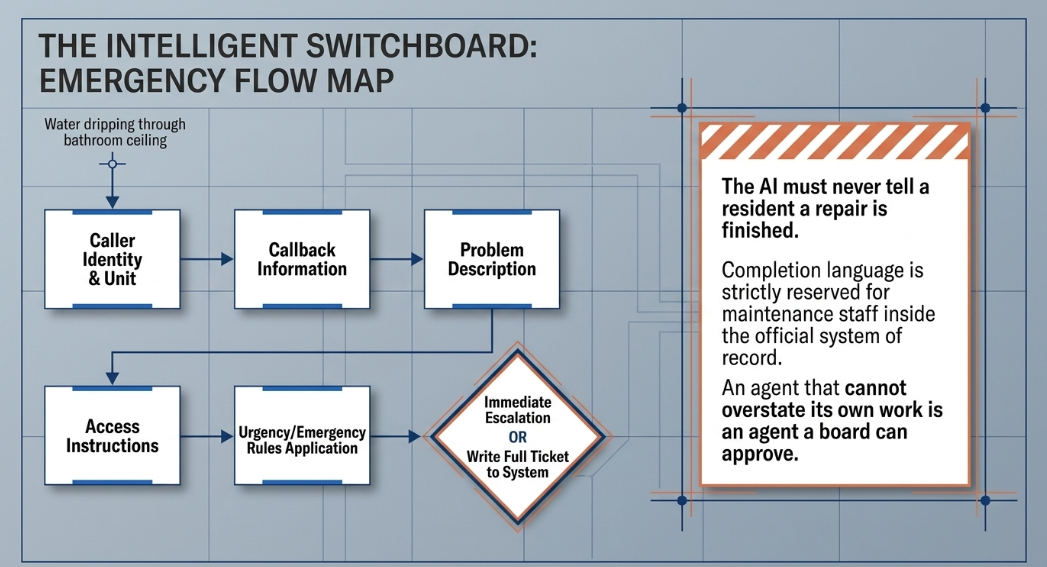
The overnight and multilingual problem
Two features of the resident population make phone coverage a fairness issue as much as an efficiency one. First, emergencies do not keep business hours. A burst pipe at eleven at night should reach an on-call path, not a voicemail box that nobody checks until nine. Authorities can designate their own after-hours routing, whether an on-call number, an emergency instruction message, or a voicemail with a committed callback, and an agent can apply that routing consistently every time, without relying on whoever happens to be covering.
Second, language access. Many authorities serve communities where a large share of residents are more comfortable in Spanish, or in one of a dozen other languages. Staffing a bilingual line around the clock is difficult for any agency. A voice and chat agent that works in English and Spanish, with additional languages added as the community requires, makes the same information available at the same quality to every caller. For an organization that takes its fair housing and language access obligations seriously, that consistency is the point.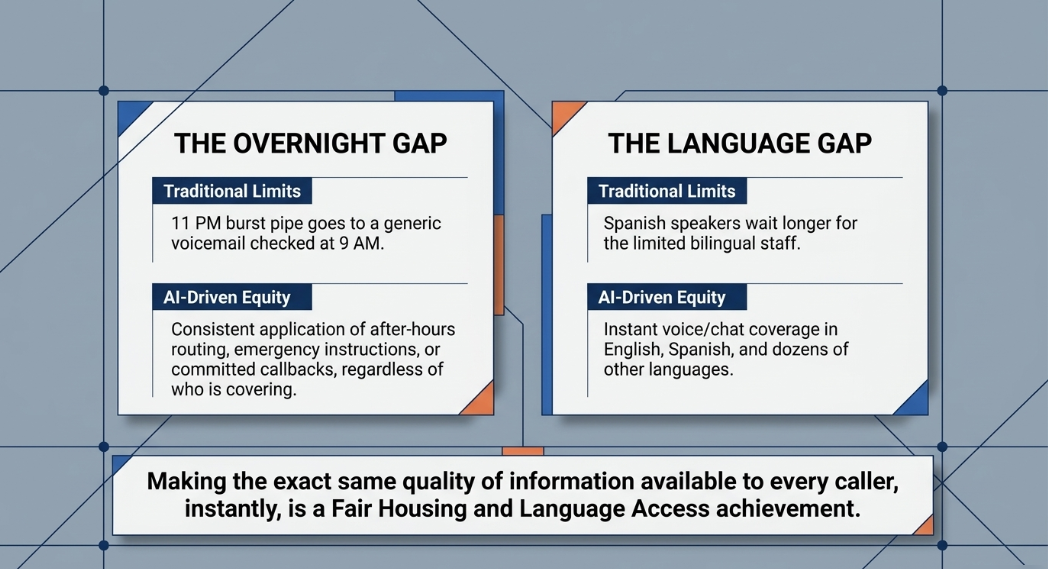
The compliance questions a board will ask
Any serious proposal for a housing authority has to answer a predictable set of questions, and the answers should be in writing. Where is resident data stored, and which vendors process it? How long is call content retained? Is it used to train anyone's models? Who controls the scripts, the escalation rules, and the outbound message templates? Can the authority pause any workflow at any time? Is there an audit trail of every interaction? Outbound reminders by text or voice bring in TCPA consent requirements, and anything touching victim-protected records under VAWA, protected personal information, or reasonable-accommodation requests has to route to a trained person, not a script.
Public records law and accessibility matter too. Call logs and reports may be subject to open records requests, and chat and web channels need to meet WCAG 2.1 AA, with an easy route to a human for callers who cannot use the voice channel.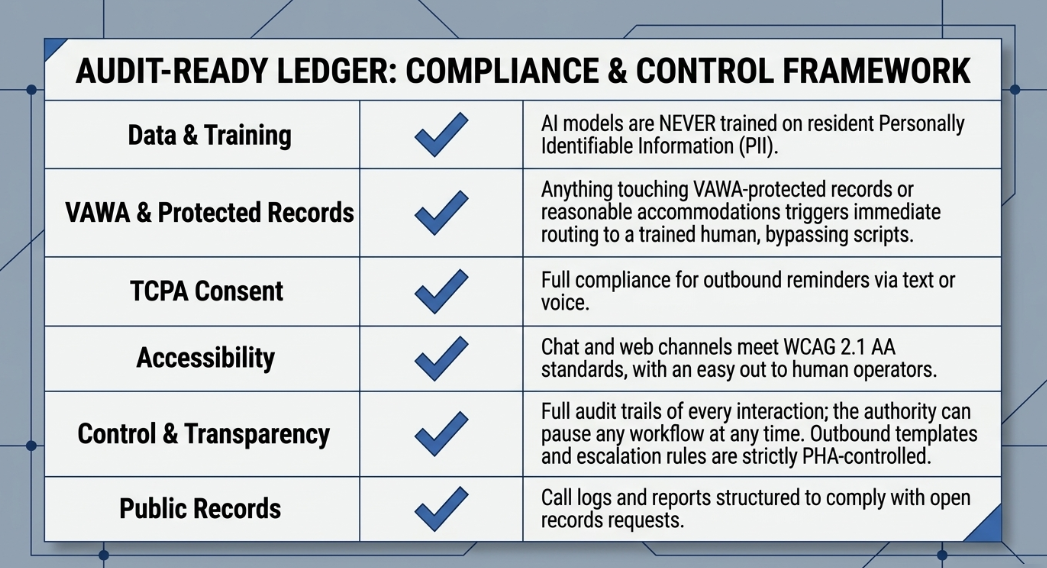
Where the time actually comes back
The measurable benefit is not that a robot replaced a caseworker. It is that a caseworker stopped being the first line of defense against routine questions. Across CETDIGIT's bilingual AI voice and chat deployments, we have seen manual intake calls fall by roughly 40 percent and phone-based processing time drop sharply, because the information a person needs arrives already collected and the ticket arrives already complete. Staff spend their day on recertifications, inspections, and the residents whose situations really do need judgment. The caller who dialed four times gets an answer on the first attempt, or a documented callback commitment, which is often what she wanted all along.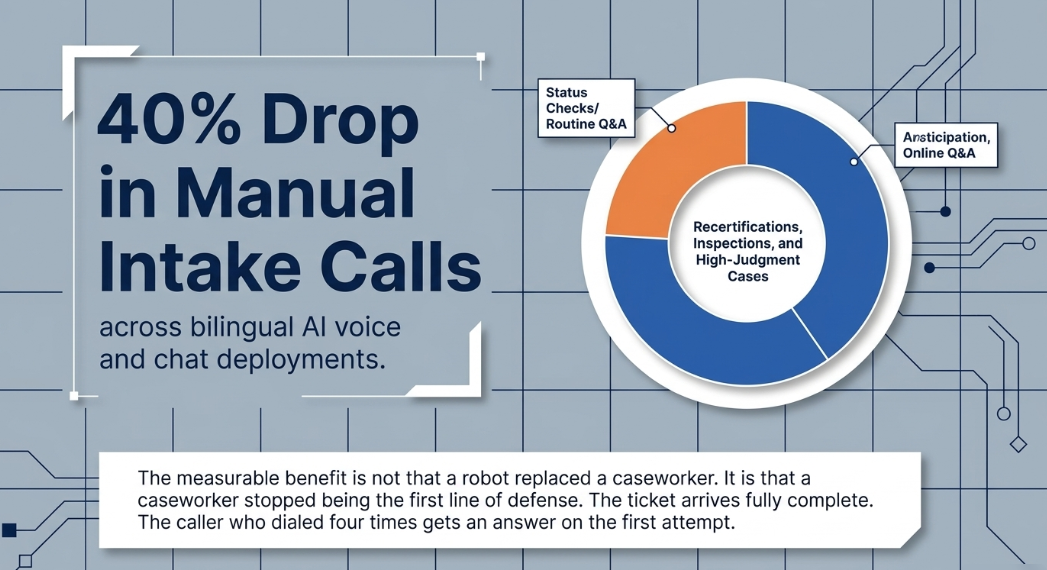
The integration work determines whether this succeeds. An agent that answers questions but does not write to the housing management platform or ticketing system just creates a second inbox. The strongest implementations connect through approved APIs, webhooks, or secure file exchange, write clean records with the right fields, and give directors a monthly view of volume by channel, language, ticket type, and escalation reason. For authorities exploring this, a resource such as the CETRAI public sector overview shows how a voice and chat platform is structured for regulated, high-volume environments, including source-cited answers and audit logging.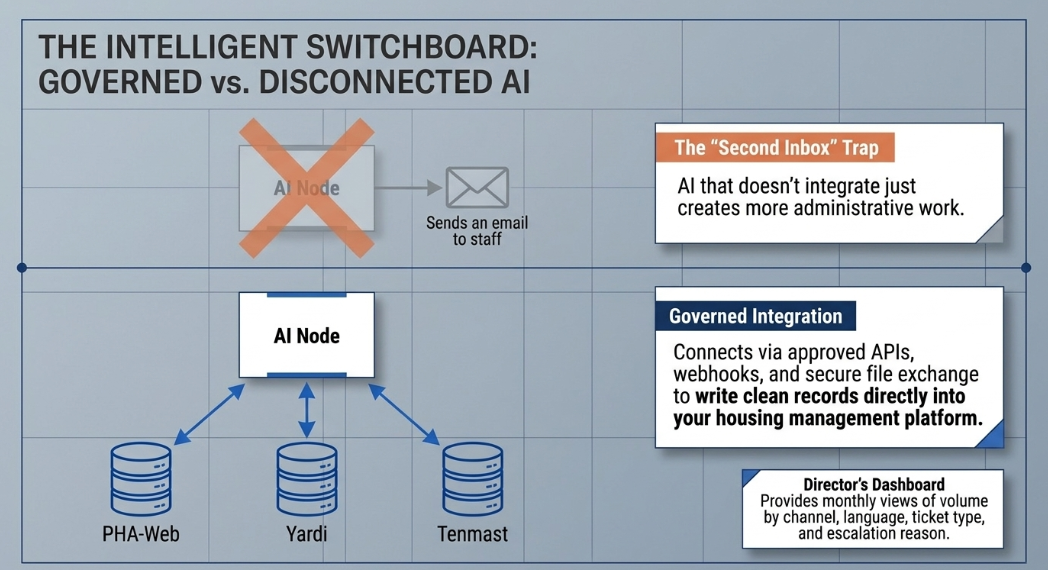
Start with the call you already know is routine
The sensible first step is narrow: one program, a short list of approved answers, an emergency path reviewed by maintenance leadership, and a written escalation rule for everything else. Prove it for a month, read the transcripts, and expand from there.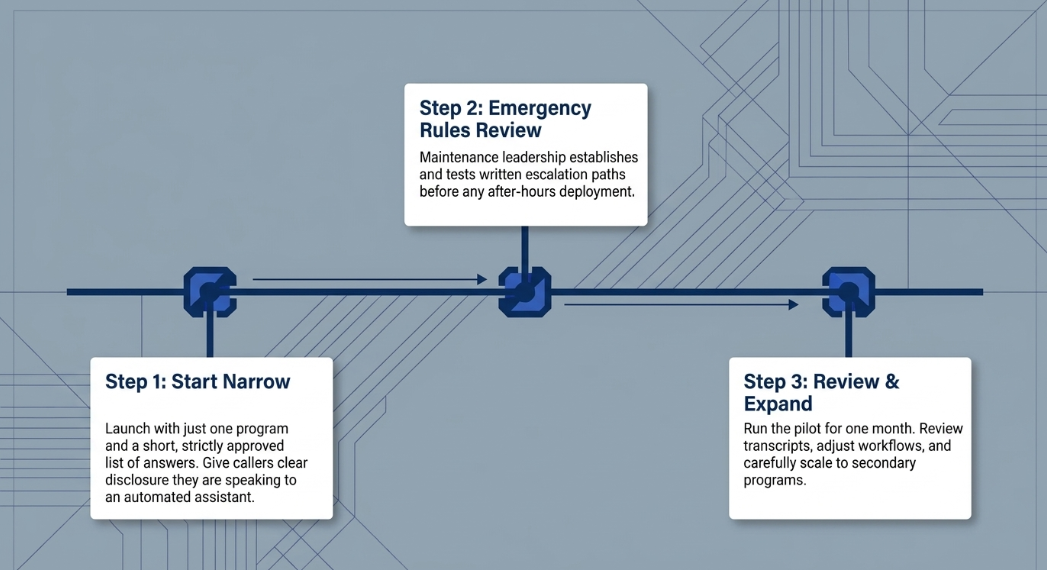
CETDIGIT designs and builds AI solutions for public agencies, with more than 300 AI and CRM deployments behind us as a Salesforce Crest Partner and HubSpot Elite Partner. If your authority is weighing how to answer more residents with the staff you have, we would be glad to walk through what a scoped, governed first phase looks like. Schedule a consultation with the CETDIGIT team and bring your three most common call types.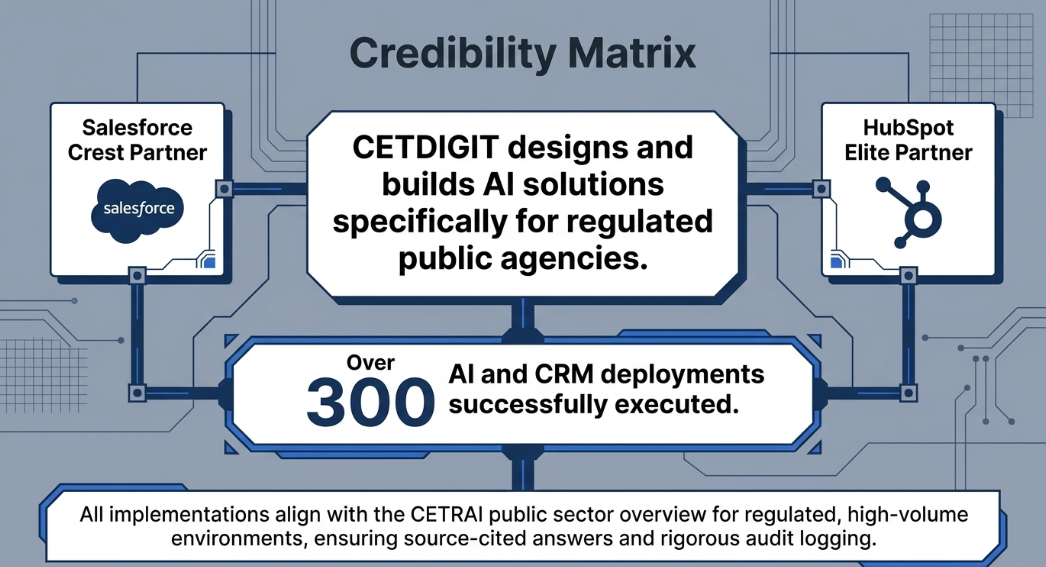
Related Reads
The Leasing Call That Came In at 6:47 P.M.: How Property Management Companies Use AI Voice Agents to Fill Units and Route Emergencies
Four Systems, One Client: Why Economic Development Agencies Are Retiring the Spreadsheet Stack
The Missed Call Problem in Healthcare: How AI Voice Agents Give Medical Practices Their Phones Back


Leave a Comment