


At 5:15 on a Tuesday morning, a warehouse supervisor realizes that two of his six temporary packers have not shown up and that the first truck is due at seven. He calls the staffing agency that supplies his crew. The branch is dark until 7:00, so the call rolls to voicemail, and he leaves a message he is already tired of leaving. By 5:40, he has called the agency across town. That agency's recruiter is awake, answers on the second ring, and gets the order. The first agency finds the voicemail at 7:05, calls back, and learns it is too late. Nothing about the first agency's recruiters was wrong. The phone simply was not covered at the hour when the work was actually happening.
Anyone who runs a light-industrial, clerical, or healthcare staffing branch recognizes the scene. Staffing is a business of deadlines measured in hours, and the people who generate revenue, the recruiters and account managers, are also the people who answer the phone. This post looks at how AI voice agents change that equation for staffing agencies specifically, what they should and should not be trusted to do, and what has to be true behind the scenes for the technology to help rather than create a new pile of unread messages.
Two Phone Problems, Not One
A staffing agency has two distinct callers, and they want different things. Client callers want to place or change an order, report a no-show, extend an assignment, or ask who is arriving tomorrow. Candidate and associate callers want to know where to report, what time the shift starts, whether the assignment was cancelled, when the paycheck posts, how to reset a timekeeping login, or whether the agency has any work this week. Many of these calls arrive outside business hours because shifts start early, end late, and are filled on weekends.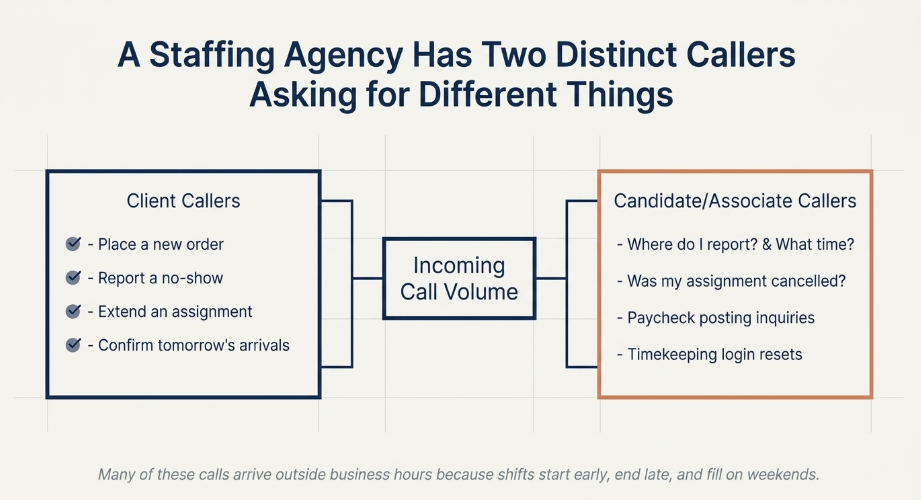
Most of those calls are routine and answerable from information the agency already holds in its applicant tracking system. Bullhorn, Avionté, TempWorks, JobDiva, and Crelate all carry the assignment, the worksite, the start time, and the pay schedule. The trouble is that a recruiter has to stop sourcing, stop interviewing, or stop negotiating with a client to read that information aloud for the fortieth time that week. Status calls are the quiet tax on recruiter time, and they get heavier every time a large assignment starts or ends.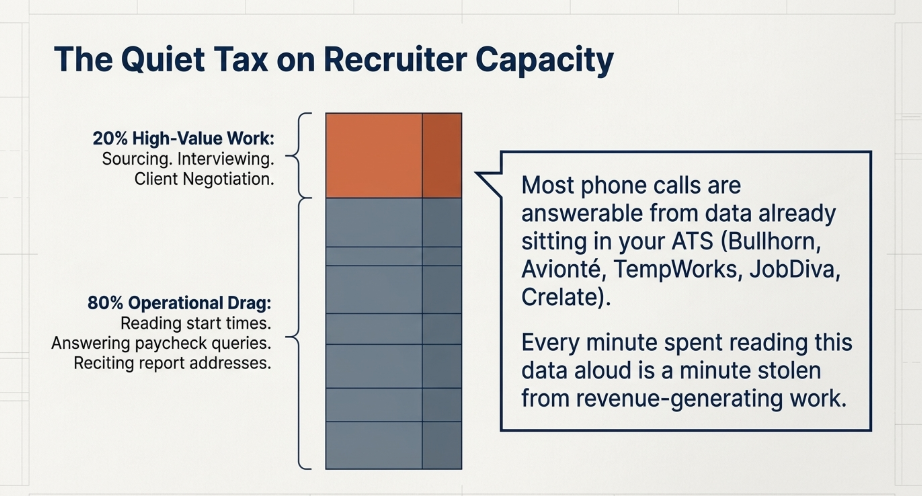
What a Well-Scoped Voice Agent Handles
The best early uses are narrow and operational. After hours, the agent answers client calls, collects the details of a new order, and drafts it for a recruiter or dispatcher: the client, the site, the shift, the headcount, the skills or certifications required, and the contact on site. It does not promise a fill rate or commit the agency to a bill rate. It captures the order cleanly and flags it as urgent, so the first person in the branch at 7:00 sees the order at the top of the queue instead of buried in voicemail.
For candidates and associates, the agent answers the logistical questions from approved agency documents: the report address, the arrival time, the dress and safety equipment requirements, the pay calendar, and the process for submitting a timesheet. It can take a call-off, record the reason and the shift affected, and alert the coordinator who backfills it. In workforces where many people are more comfortable in Spanish, or another language, answering in the caller's language is not a convenience. It is the difference between a worker who calls the agency and a worker who simply does not show up.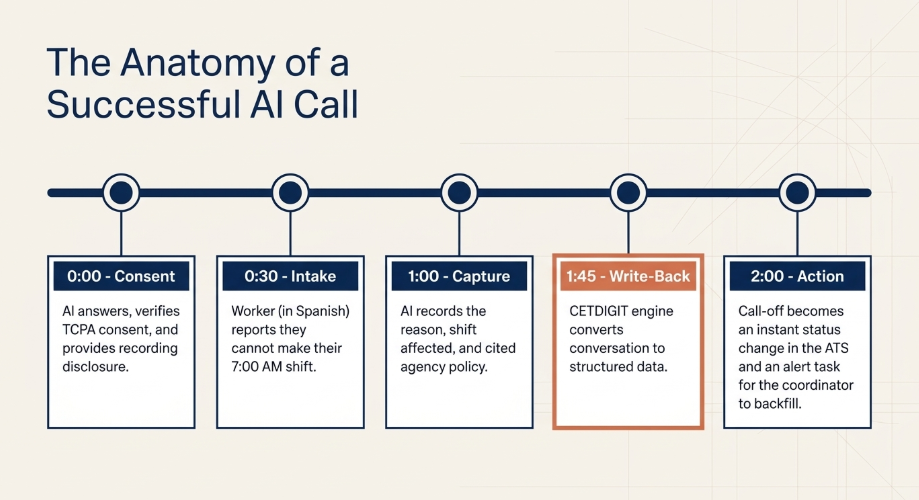
What It Should Not Do
Staffing is an employment business, and employment decisions carry legal weight. A voice agent should not decide who is hired, rank candidates on subjective impressions, or answer questions about wages, overtime, or immigration status as though it were counsel. Several jurisdictions, including New York City and Illinois, regulate automated tools used in employment decisions, and the rules continue to evolve. The safest design keeps the agent on logistics and structured information gathering, hands every judgment call to a recruiter, and keeps a record of what the agent said and why. If a caller raises a harassment complaint, an injury, or a pay dispute, the correct behavior is a prompt handoff to a human, not an attempt to resolve it.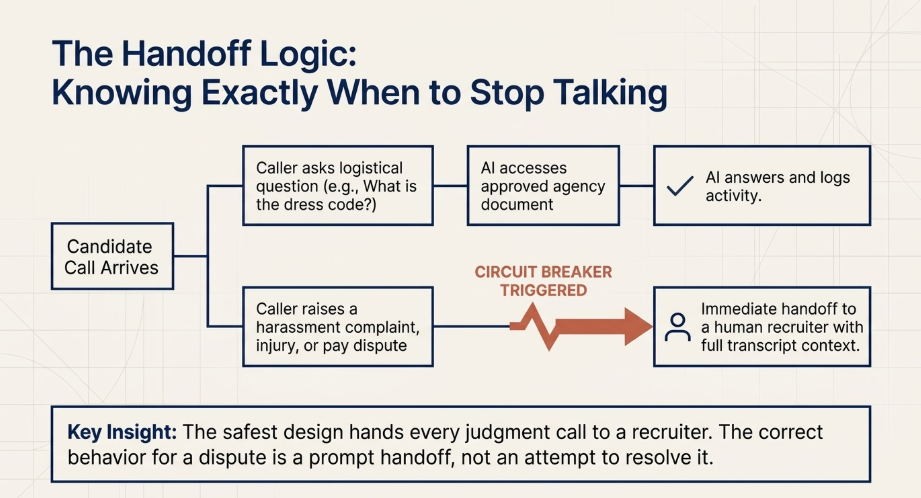
Consent, Recording, and Candidate Data
Staffing agencies live on text messages and outbound calls, which makes the Telephone Consumer Protection Act a daily concern. Consent should be captured at the moment a candidate applies, stored as a field in the system of record, and honored every time, including when a worker replies with a stop request in an unexpected phrasing. The FCC's rule on revoking consent across channels has had its effective date pushed back more than once, with the latest guidance we have seen pointing to January 31, 2027, but the practical lesson is to build opt-out handling now rather than rush it later. Call recording adds another layer, because an agency in one state routinely talks to candidates in another, and states differ on whether one party or all parties must consent. A clear disclosure at the start of every call is cheap insurance.
Candidate data deserves restraint as well. A voice agent has no business collecting Social Security numbers or bank details by phone. It can send a secure link to the agency's onboarding portal instead, which keeps sensitive data out of call transcripts entirely.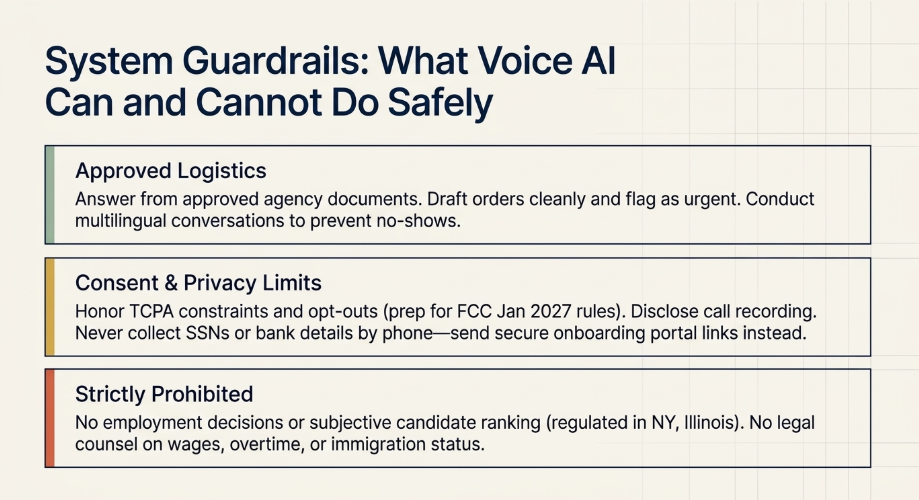
The Part That Decides Whether It Works: Write-Back
Many agencies that try voice automation discover that the agent answers beautifully and then leaves a trail of notes nobody reads. The difference between a pilot and a production system is write-back. When a call ends, the conversation should become structured data in the places recruiters already work. A new order becomes a draft job order in the applicant tracking system. A call-off becomes a status change and a task for the coordinator. A returning candidate's question becomes a logged activity on their record. If the agency also uses HubSpot or Salesforce on the client-development side, an after-hours order from a prospect or lapsed client should land on that account with the call summary attached, so the account manager opens the day with context instead of a mystery voicemail.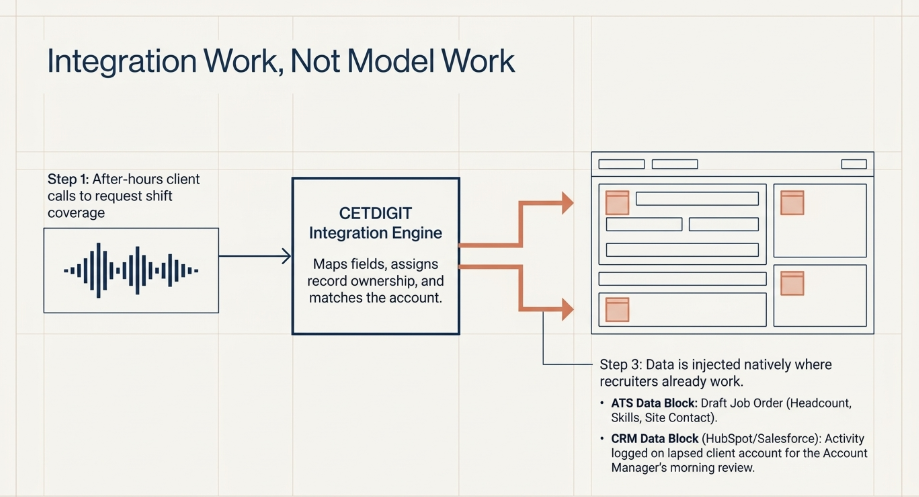
This is integration work, not model work. It involves mapping fields, deciding which system owns which record, handling duplicates when the same worker calls from a new number, and routing by branch and region. Agencies that treat it as an afterthought end up with a clever assistant that adds to the recruiters' inbox. Agencies that plan it first get a morning queue that tells each recruiter exactly who called overnight and what needs a person.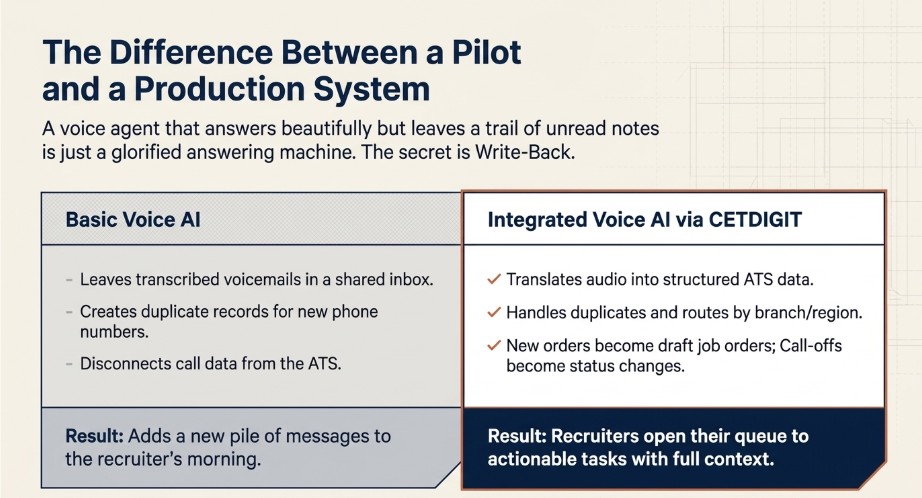
Where CETRAI and CETDIGIT Fit
Platforms built for high-volume, regulated call handling, such as CETRAI, are designed around exactly these constraints: answers drawn from approved documents with the source cited, multilingual conversations, consent-aware outreach, and audit logs that show what was said on every call. CETDIGIT brings the surrounding work, which is connecting the voice layer to the applicant tracking system, HubSpot, or Salesforce, shaping the data model so calls become usable records, and designing the human handoff rules so recruiters stay in charge of the decisions that matter.
The practical starting point is small. Choose one branch and one call type, such as after-hours client orders or associate shift questions. Write the approved answers, define what triggers a handoff, connect the write-back, and review real transcripts weekly with the branch manager. Expand only after the recruiters trust the queue the agent hands them.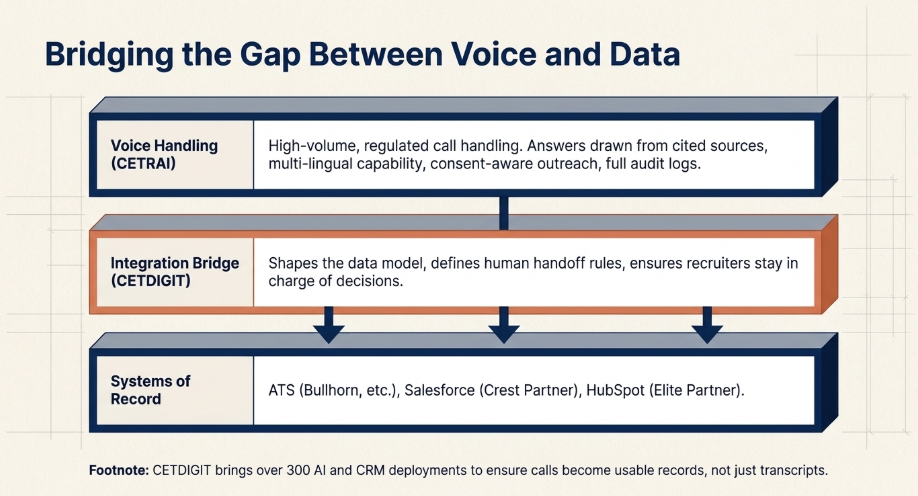
Talk With CETDIGIT
Cetrix Technologies LLC (CETDIGIT) is an AI solutions builder with more than 300 AI and CRM deployments, a Salesforce Crest Partner, and a HubSpot Elite Partner. If your agency is losing after-hours orders, spending recruiter hours on status calls, or wondering how voice automation would connect to your applicant tracking system and CRM, we would be glad to walk through your workflow. Schedule a consultation with the CETDIGIT team to map where a pilot would fit and what it would take to do it responsibly.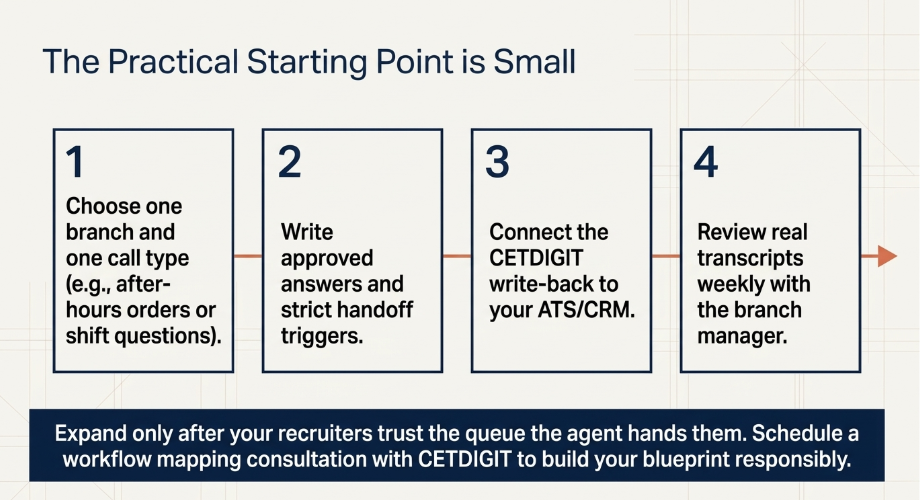
Related Reads
The Hygiene Recall List Nobody Has Time to Call: How AI Voice Agents Help Dental Practices Fill the Schedule
The Voucher Holder Who Called Four Times: How Public Housing Authorities Use AI Voice Agents to Answer Residents Without Adding Headcount
The Busiest Phone in the Building: How Auto Dealerships Use AI Voice Agents to Stop Losing Service Appointments and Sales Leads

Leave a Comment