


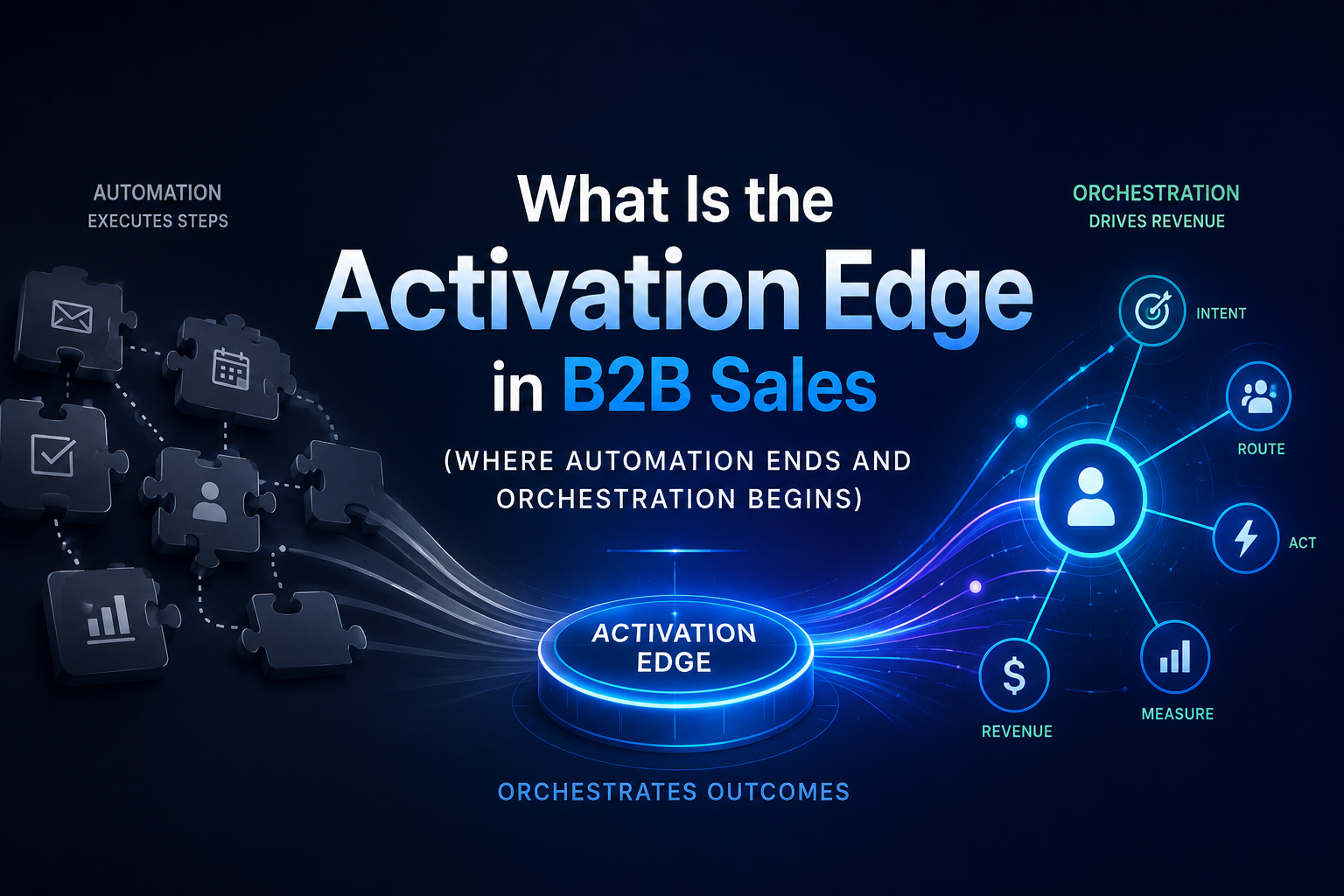
The Activation Edge is the orchestration layer that sits above sales automation, where tool execution stops being a set of disconnected steps and starts acting on a live revenue signal. It is the counterpart to the Cognitive Core, the system of record that holds deal logic but does not act on it. Automation executes steps on a schedule. The Activation Edge orchestrates outcomes: it decides what should happen next, connects the tools that carry it out, and measures the result against revenue.
The Stack That Executes but Doesn't Orchestrate
You've automated a dozen steps. The sequences fire. The CRM logs every touch. The prospecting tool drafts outreach, the enrichment tool appends data, and the dashboards fill with activity. And yet the handoffs still break. A lead clears one stage and stalls before the next tool picks it up. Nothing moves the work end-to-end, because nothing is orchestrating it.
That's not a tooling shortage, it's an orchestration gap. Each tool executes its own task in isolation, and no layer above them decides what should happen, in what order, against which account. The cost shows up in the results. MIT's 2025 NANDA research found that most enterprise AI pilots never reach measurable P&L impact, roughly 95% of them, and the cause wasn't model quality. There was a learning gap between the tools and the workflows they were dropped into.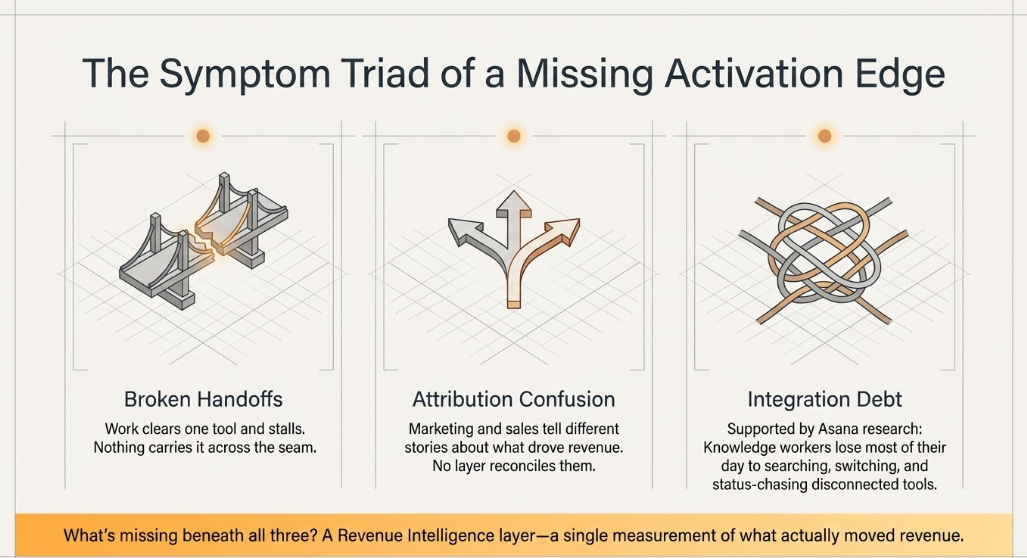
This is the Silo Tax: disconnected systems that add latency and rework instead of accelerating revenue. The fix isn't another tool. It's a layer that connects the ones you already run.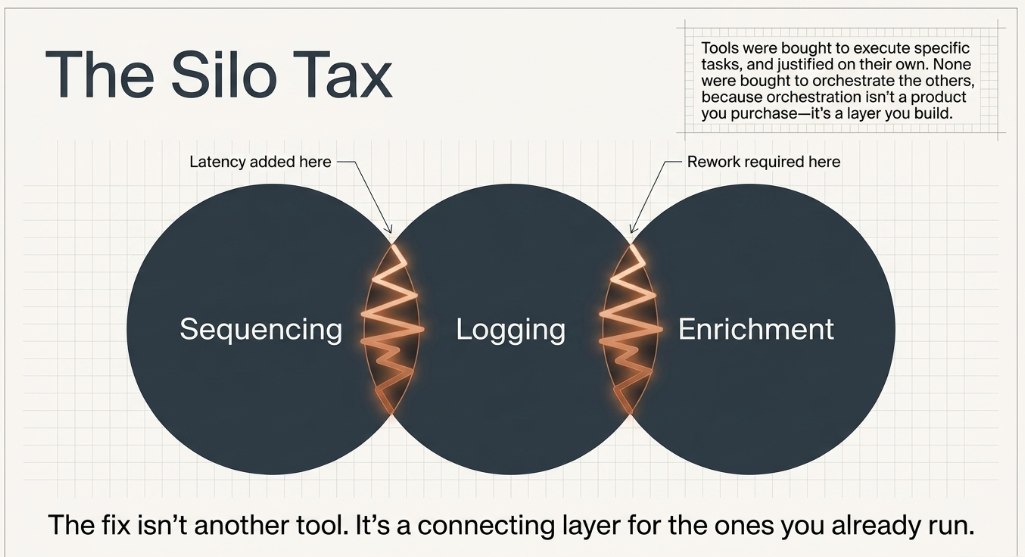
So What Is the Activation Edge?
The Activation Edge is the layer where execution becomes orchestration. Automation acts on a calendar. Send this on day three, create that task on day five. The Activation Edge acts on signal; this account just showed intent, so route it, prioritize it, and trigger the next step now, across whichever tools need to move.
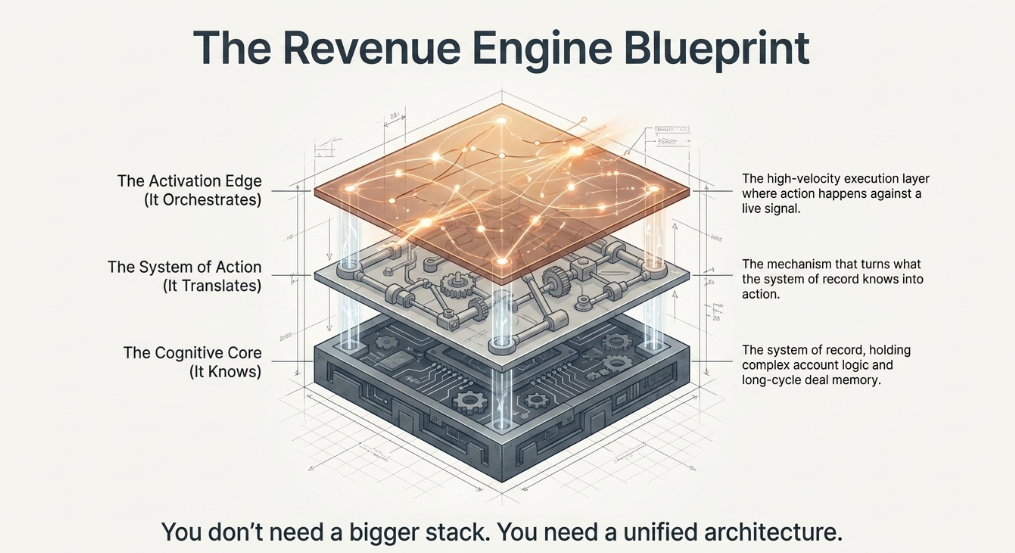
It works in contrast to the Cognitive Core. The Cognitive Core is the system of record: it holds the complex account logic, the long-cycle deal memory, and the structured history of who bought what and why. The Cognitive Core knows. The Activation Edge acts. Connecting the two is the System of Action, the mechanism that turns what the record knows into what the stack does next. Without it, the record sits full and inert while the automation tools fire blindly on a timeline.
The term was first defined as part of the AI revenue engine architecture, where the Activation Edge and Cognitive Core were introduced as the two halves of a connected revenue system. This article is its dedicated definition, because the Activation Edge is the half that most teams are missing.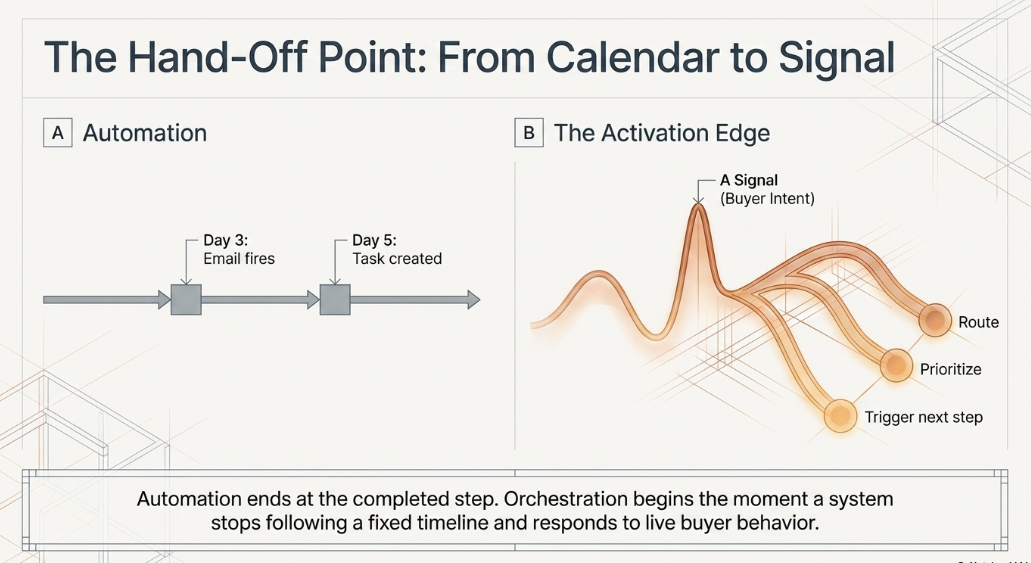
Automation Ends Where Orchestration Begins
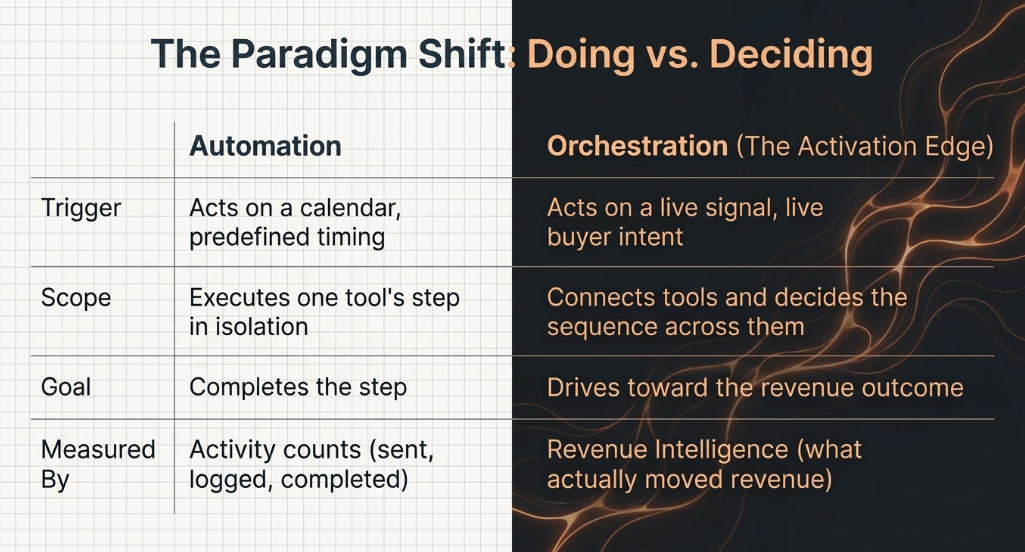
Here's the distinction that decides whether a stack produces revenue. Automation executes predefined steps. Orchestration decides which steps should run, connects the tools that run them, and adjusts based on the outcome. One is a list of instructions. The other is a layer of judgment sitting on top of those instructions.
The evidence that the judgment layer is where value lives is strong. BCG's 2024 global AI survey of more than 1,000 executives produced what they call the 10-20-70 rule: about 10% of AI value comes from the algorithms, 20% from data and technology, and most of AI's value — roughly 70% — comes from people and process, not the tools themselves. That 70% is orchestration. It is exactly what automation cannot supply on its own.
This is the same line drawn in our look at the line between AI sales workflows and plain automation: automation is the floor, and the Activation Edge is the layer above it that makes the floor worth standing on.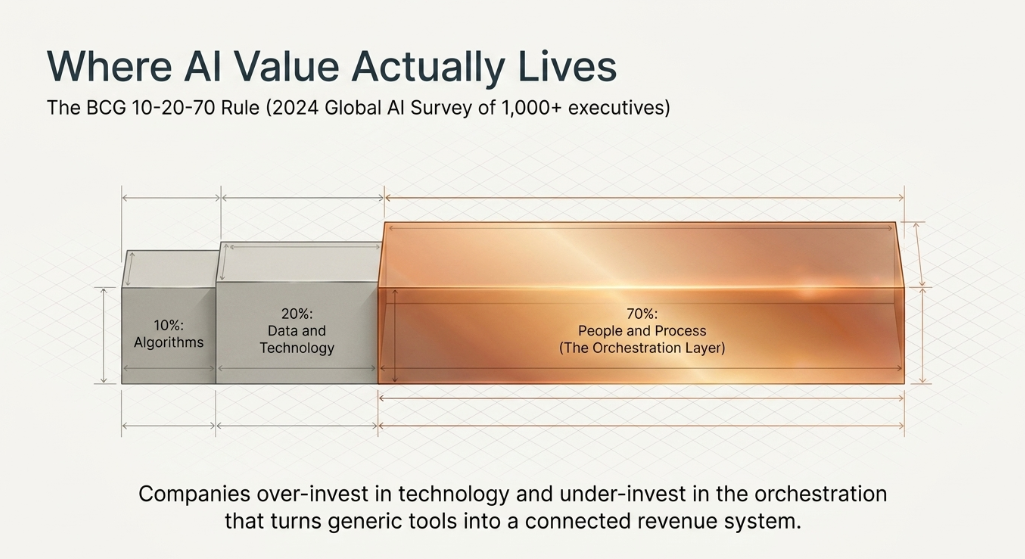
Who This Affects
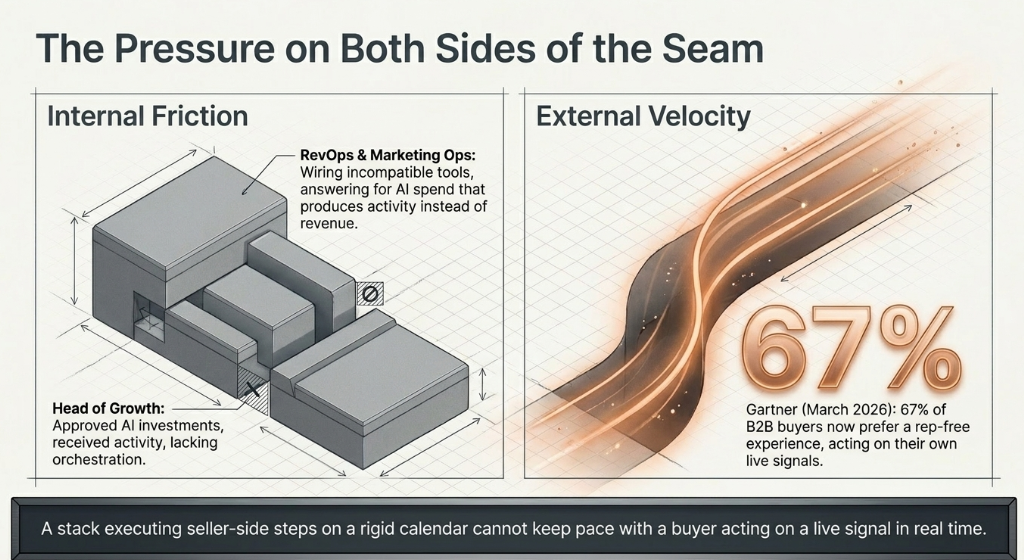
If you run RevOps or Marketing Ops, this is your daily reality. You're the one wiring tools that were never designed to talk to each other, explaining why the engagement numbers don't reconcile with the pipeline, and answering for an AI spend that hasn't shown up in revenue. The tools work. The orchestration doesn't exist yet, and you absorb the gap between them.
It lands on the Head of Growth, too, the one who approved the AI investments and got activity in return, not revenue. The reason isn't the tools that were chosen. It's that nothing was built to orchestrate them.
The pressure is rising from the buyer side as well. Gartner's March 2026 survey found 67% of B2B buyers now prefer a rep-free experience, and buyers are moving through the purchase on their own terms, increasingly with their own AI tools. A stack that only executes seller-side steps on a calendar falls further behind a buyer who is acting on a signal in real time.
The Symptoms of a Missing Activation Edge
The absence of an Activation Edge has a recognizable shape:
- Broken handoffs. Work clears one tool and stalls before the next one acts, because nothing carries it across the seam.
- Attribution confusion. Marketing and sales tell different stories about what drove closed revenue, because no layer reconciles them.
- Integration debt. More of your team's time goes to connecting tools than using them. Asana's research across knowledge workers found that teams lose most of their day to coordinating disconnected tools, the searching, switching, and status-chasing that eats up the hours.
What's missing underneath all three is a Revenue Intelligence layer, a single measurement view of which activity actually moved revenue. Without it, every tool reports its own success, and none of them reports the outcome.
Why the Gap Exists
The gap exists because of how the stack was assembled. Tools were bought to execute specific tasks, send sequences, log calls, and enrich records, and each was justified on its own. None was bought to orchestrate the others, because orchestration isn't a product you purchase. It's a layer you build.
MIT's NANDA research points at the same root from another angle: the failure of most AI pilots was an integration gap, generic tools that never learned the workflow around them. BCG's survey shows the budget pattern that follows: heavy spend on technology, light investment in the people and process work that actually creates value. The Cognitive Core holds the record. The automation tools execute the tasks. Between them, nothing acts on what the record knows. That space between knowing and acting is where the Activation Edge belongs.
Automation vs. Orchestration (A Quick Comparison)
|
Automation |
Orchestration (the Activation Edge) |
|
|
Trigger |
Acts on a calendar, predefined timing |
Acts on signal, live buyer intent, via the System of Action |
|
Scope |
Executes one tool's step in isolation |
Connects tools and decides the sequence across them |
|
Goal |
Completes the step |
Drives toward the revenue outcome |
|
Measured by |
Activity counts (sent, logged, completed) |
Revenue Intelligence, what actually moved revenue |
The short version: automation does the step. Orchestration decides whether the step should happen at all, and what comes next.
How CETDIGIT Builds the Activation Edge
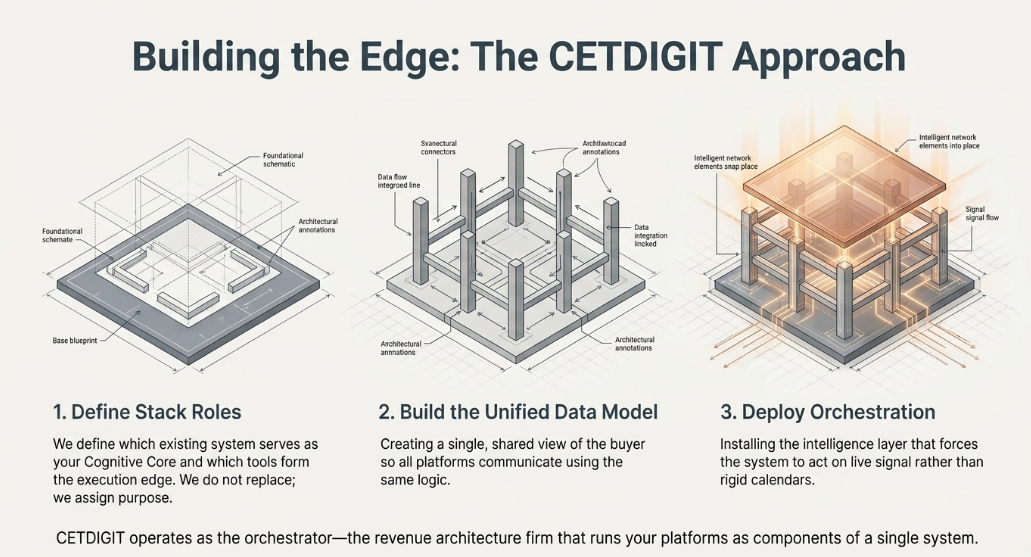
CETDIGIT operates as the orchestrator, the revenue architecture firm that runs both platforms as components rather than partnering with either. We define the roles in your stack, which system is the Cognitive Core, which tools form the Activation Edge, and then build the Unified Data Model that lets them share one view of the buyer. On top of that sits the orchestration layer that makes the system act on a signal rather than on a calendar.
That's what turns a collection of tools into the revenue engine the Activation Edge plugs into, within CETDIGIT's broader AI services architecture: not new software, but a connecting layer that makes the software you already own act as one system. The 70% of AI value BCG attributes to people and process is precisely the part this layer supplies.
Where to Start
The first move is diagnostic, not procurement. Before adding anything, map what each tool does, what signal it generates, and where that signal dies because nothing acts on it. That map almost always shows the same thing: the execution is fine, and the orchestration is missing.
From there, the work is connecting what you have into AI sales workflows that orchestrate, not just execute, and placing the result inside where the Activation Edge fits in CETDIGIT's full AI services framework. You don't need a bigger stack. You need a layer above the one you have.
Frequently Asked Questions
What is the activation edge in B2B sales?
The Activation Edge is the orchestration layer above sales automation, the layer that acts on live buyer signals, connects the tools that execute, and drives them toward a revenue outcome. It's the counterpart to the Cognitive Core, the system of record that holds deal logic but doesn't act. BCG's 2024 research found roughly 70% of AI value comes from this people-and-process orchestration layer, not the tools themselves.
Where does sales automation end and orchestration begin?
Automation ends at the completed step. Orchestration begins at the decision about whether that step should happen, in what order, against which account, and what should follow it. The handoff point is signaled: the moment a system stops following a fixed timeline and starts responding to live buyer behavior is the moment it crosses from automation into the Activation Edge.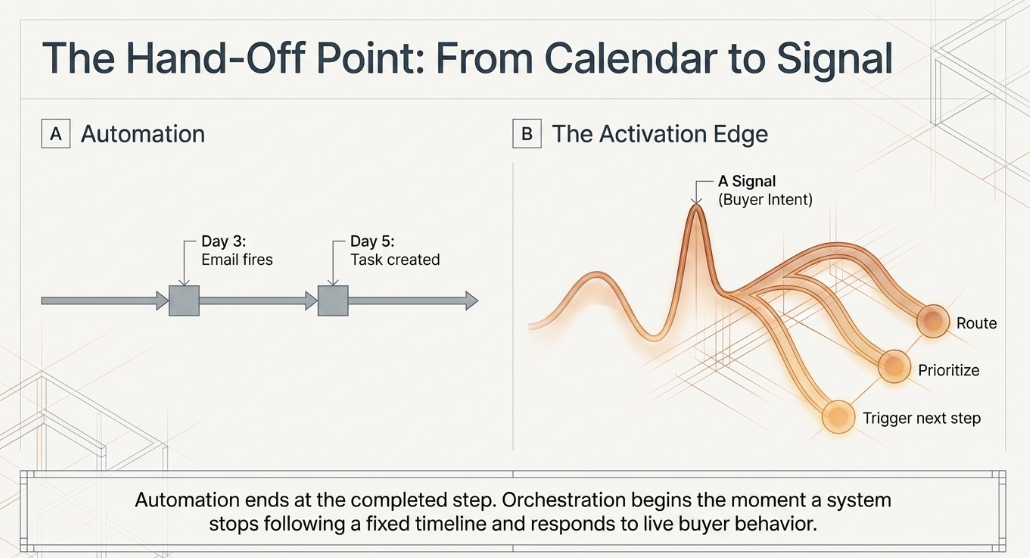
What's the difference between automation and orchestration in sales?
Automation executes predefined tasks on a schedule. Orchestration decides which tasks run, connects the tools that run them, and adjusts based on outcome. MIT's 2025 NANDA research found roughly 95% of enterprise AI pilots delivered no measurable P&L impact, largely because tools executed in isolation with no orchestration layer connecting them to the workflow.
Is the activation edge the same as the system of action?
They're related but distinct. The System of Action is the mechanism that turns what the system of record knows into action. The Activation Edge is the high-velocity execution layer where that action happens against a live signal. The System of Action is how knowing becomes doing; the Activation Edge is where the doing is orchestrated and measured.
How does the activation edge relate to the Cognitive Core?
They're two halves of one revenue system. The Cognitive Core is the system of record, complex account logic, and long-cycle deal memory. The Activation Edge is the execution layer that acts on what the Core knows, in real time. The Core knows; the Edge acts. A connected revenue system needs both, plus the System of Action joining them.
Does the Activation Edge apply to inbound channels like voice and chat?
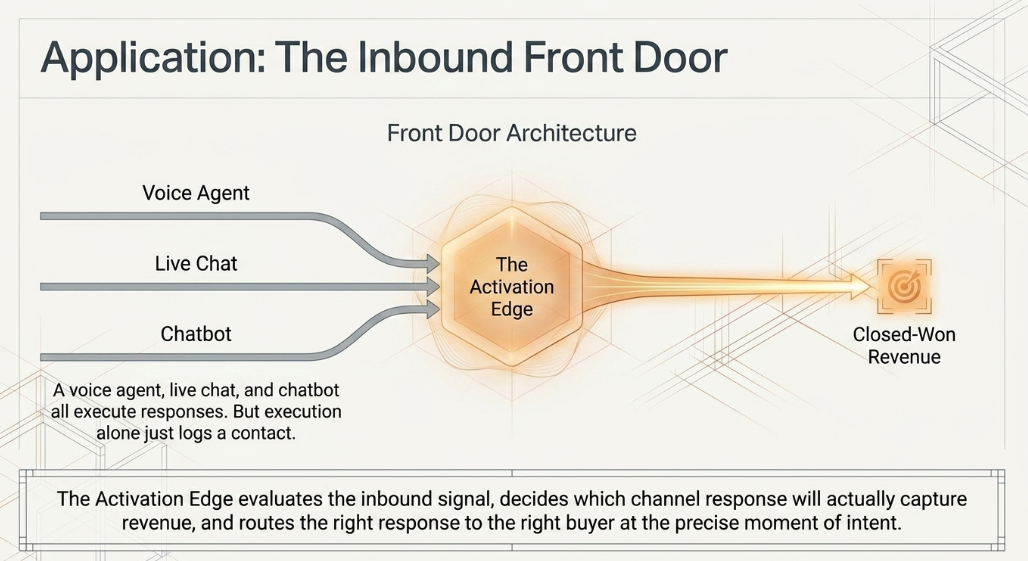
Yes. Inbound channels are one of the clearest places the Activation Edge shows up, the layer that decides which channel response actually captures revenue rather than just logging a contact. We worked through this in the Activation Edge applied to inbound channels: a voice agent, live chat, and chatbot all execute responses, but the Activation Edge is what routes the right one to the right buyer at the moment of intent. Same principle, applied at the front door.
Stack Unification Audit
Diagnose where your AI investment is leaking, connect the stack, then activate AI. We'll map where the signal dies between your tools and show you what an orchestration layer would change first.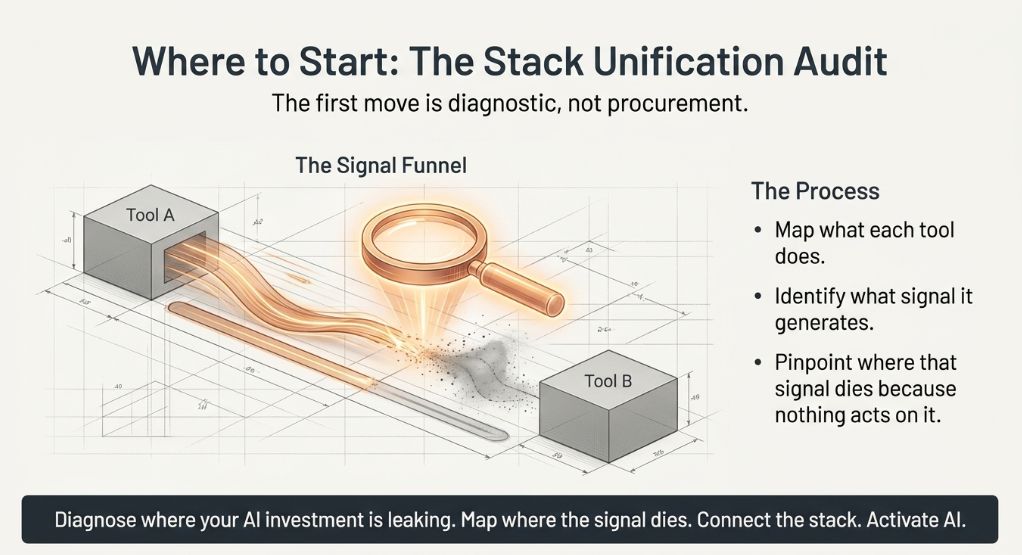
Leave a Comment