


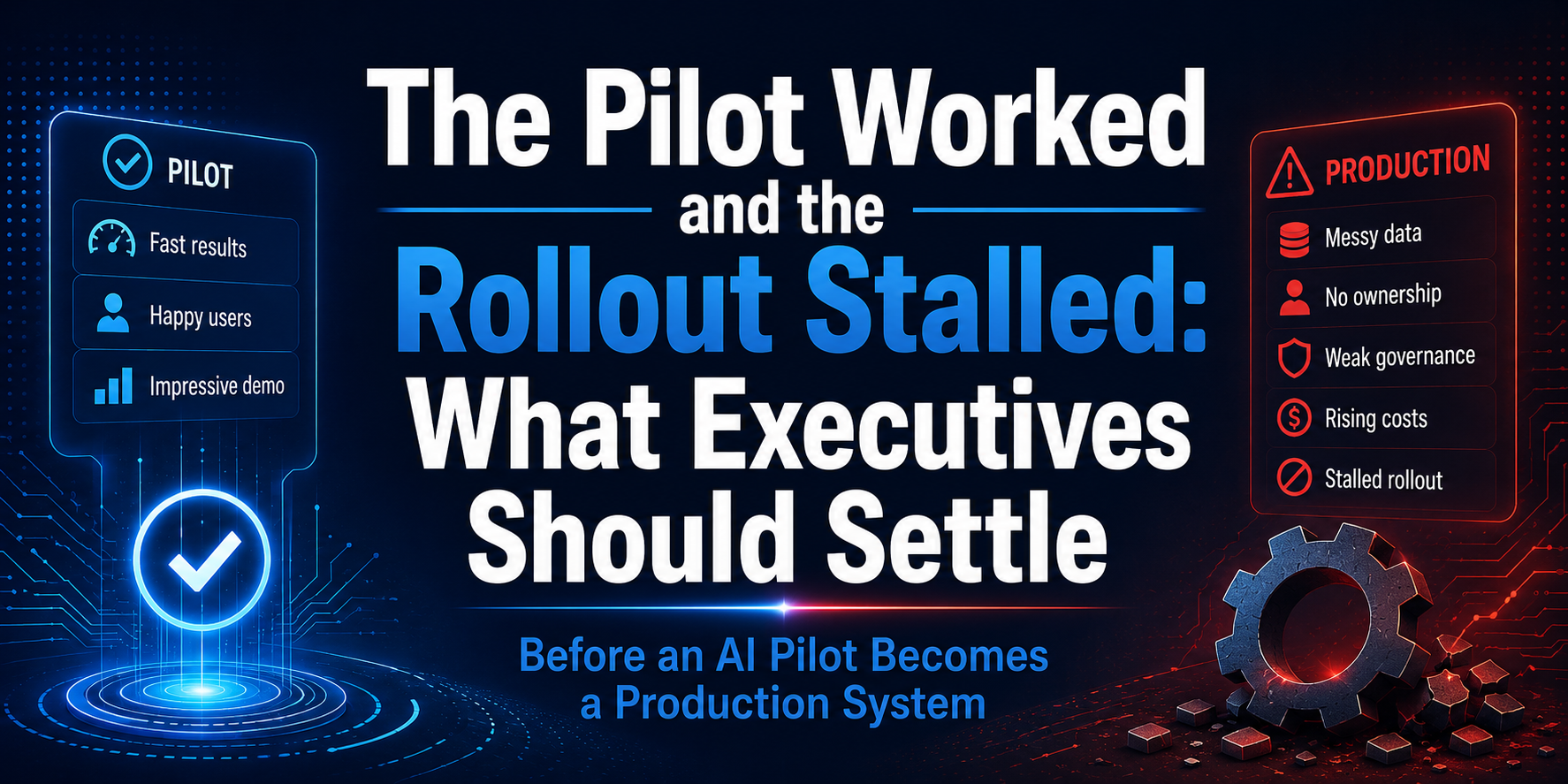
The demo went well. Everyone in the steering committee meeting agreed on that. The AI assistant summarized a customer history in seconds, drafted a follow-up email that sounded like the account owner, and flagged a renewal risk nobody had noticed. The CEO asked how soon it could be rolled out. Six months later, it is still a pilot, three sales reps use it occasionally, and the person who built it has moved to another project. If this sounds familiar, you are in good company, and the explanation is rarely that the technology failed.
What the numbers suggest
Published figures on this problem vary widely, and it is worth being careful with them, because the answer depends on how a survey defines production. A Forrester figure cited in recent industry commentary says roughly 88 percent of agent pilots never reach production, while S&P Global Market Intelligence data cited in the same coverage puts enterprises running an agent in production at scale at around 11 percent. Other surveys of senior leaders report much higher numbers of companies running agents in production, usually because they define the term loosely. Treat all of these as directional. The pattern they share is the one that matters: starting is easy, and finishing is rare.
BCG's 2026 research, as cited in the same commentary, attributes roughly 70 percent of the success of AI transformation to people, process, and culture rather than to the technology itself. In our experience across more than 300 AI and CRM deployments, that ratio feels right. The model is seldom the bottleneck. The organization around it usually is.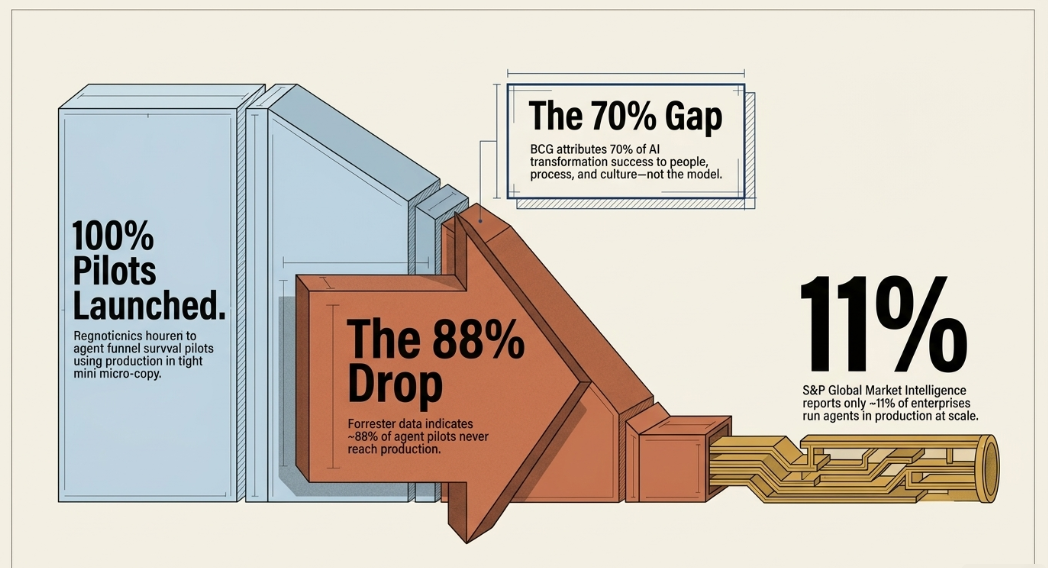
Why pilots stall
The first reason is that a pilot runs on friendly data and production does not. A pilot is typically built on a clean export, a handful of well-maintained accounts, and a user who knows how to phrase a request. Production runs against the entire CRM, including duplicate contacts, fields that three teams use three different ways, notes typed in a hurry, and opportunity stages that mean something different in each region. An AI agent exposes this immediately. It will confidently summarize an account with conflicting owners, or recommend a next step based on a stage nobody updated in a year. The pilot looked impressive because it avoided the mess. Production cannot.
The second reason is that nobody owns the result after the demo. During the pilot, a motivated person champions it. When the pilot ends, the question becomes who is accountable for accuracy, who fields complaints from the sales floor, who decides what the agent is allowed to do, and who pays when usage grows. If those answers are not written down before launch, they default to no one, and a system with no owner decays quickly.
The third reason is deferred governance. Pilots usually run with broad access and few controls because speed is the goal. Production requires permissions that match job roles, an audit trail, human review where the stakes are high, and a plan for what happens when the agent is wrong. A recent Retool survey of technology leaders, cited in the same coverage, found that only 8 percent rated their internal governance of AI-built tools as strong, and that more than a fifth had experienced a production incident tied to an AI-generated tool in the past year. Governance is not a brake on adoption. It is what lets an executive sign the approval.
The fourth reason is cost. Many AI capabilities, including those inside the major CRM platforms, are priced on consumption. A pilot with twenty users costs almost nothing, and the same capability across two thousand employees can produce a bill that surprises the finance team. Without usage limits, per-team budgets, and a clear view of value per interaction, the first invoice often ends the program.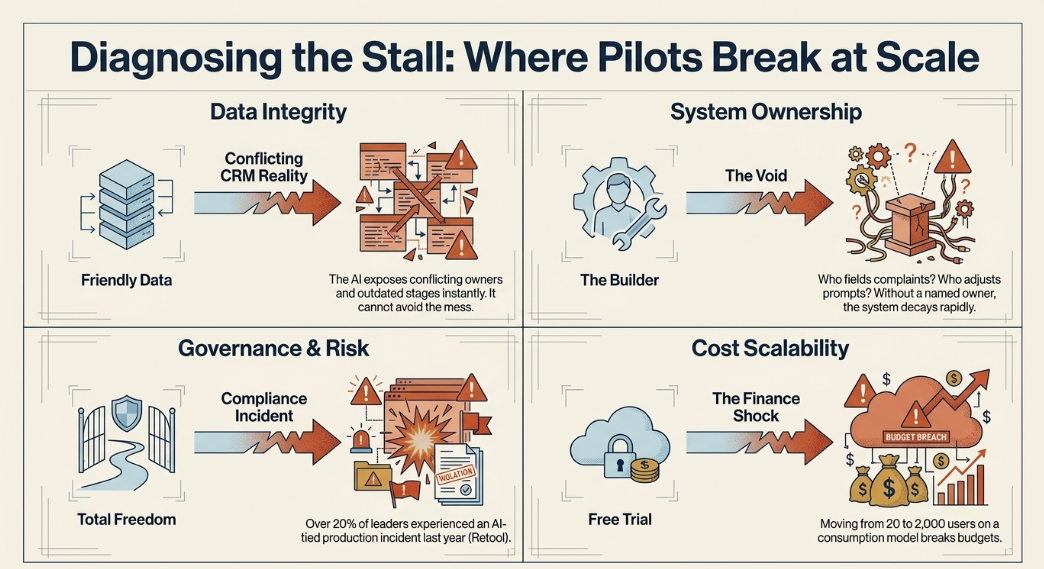
Five questions to answer before approving the next pilot
Rather than asking whether the technology works, which it almost always does in a demo, ask the questions that predict whether it survives.
First, which business metric will change, and who has agreed to be measured on it? A pilot tied to a vague hope of productivity cannot be defended in a budget review. A pilot tied to lead response time, quote turnaround, case resolution time, or renewal rate can.
Second, what data does it depend on, and who is accountable for the quality of that data? If the honest answer is that the CRM has not been cleaned in years, the first phase of the project is data and process, not AI. That is not a detour. It is the project.
Third, who owns the system after launch? Name a person, not a committee. That person should hold the authority to change prompts, permissions, and workflows, and the responsibility for the results.
Fourth, what is the agent not allowed to do? Define the boundaries in writing: which records it can read, which fields it can change, which actions require a human to approve. Autonomy should expand as trust is earned, not before.
Fifth, what will it cost at ten times the pilot's scale? Ask for the projection before the pilot starts, and decide in advance what level of spend the business case supports.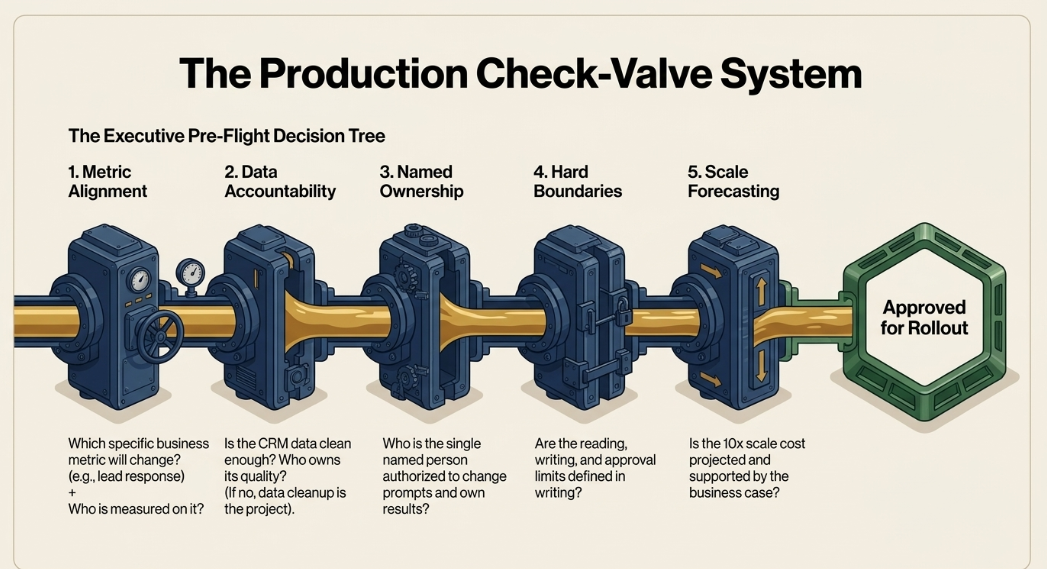
The unglamorous work that makes the difference
The organizations that get AI into daily use tend to do something that looks boring from the outside. They agree on a single definition of an opportunity stage. They deduplicate accounts. They decide who can see what. They connect the AI to the system of record, so that its answers are grounded in real, current data rather than a snapshot, and so that what it produces is written back where the team already works. They train the people who will use it, and they review the first month of real interactions with the same attention they gave the demo.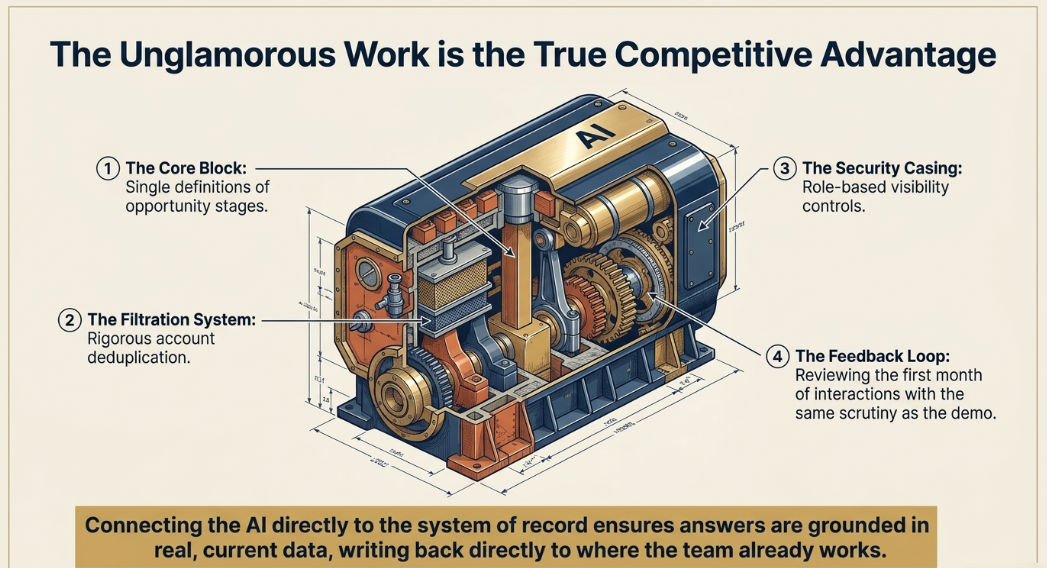
This is where an implementation partner earns its place. CETDIGIT is a Salesforce Crest Partner and a HubSpot Elite Partner, and the question we ask first is rarely about models. It is about the CRM: how clean is it, who owns it, and what decision should it make faster? From there we build the integration, the guardrails, and the adoption plan so that a pilot has a route to becoming an operating system for the business, not just a good meeting.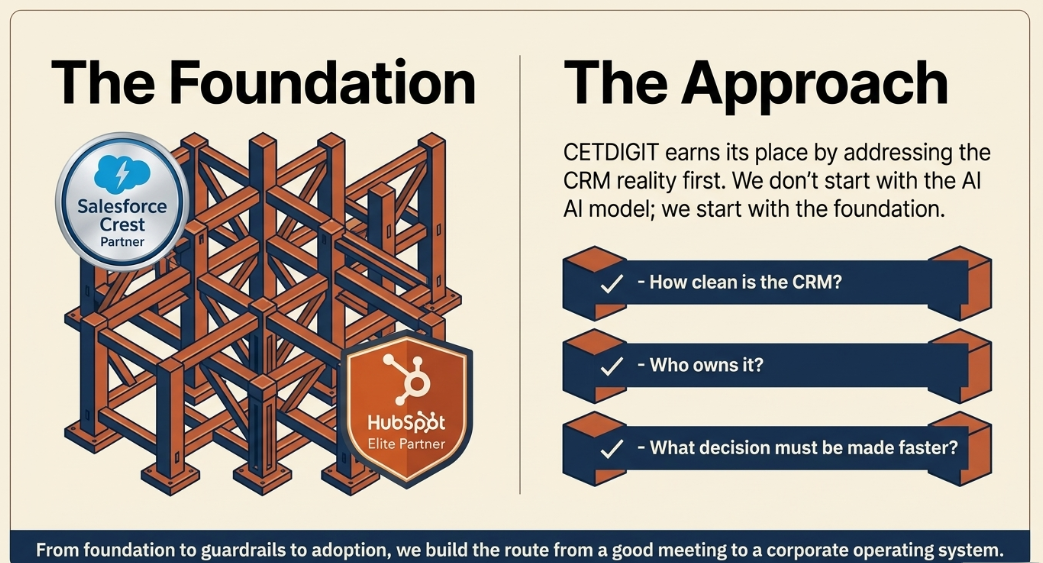
A better definition of a successful pilot
A successful pilot is not one that impresses a room. It is one that leaves behind a documented owner, a cleaned data foundation, a governance model, a cost forecast, and a measured result against a business metric. If a pilot produces those five things, rollout becomes a decision rather than a leap. If it produces only a demo, you have learned that the technology works, which you probably knew already.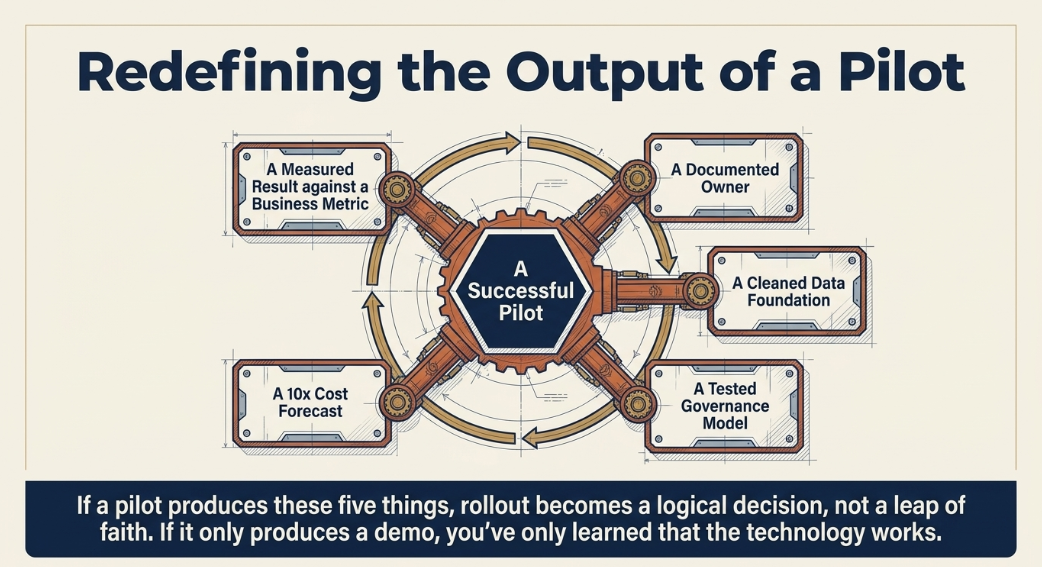
If you have a pilot that has not moved, or you are about to approve one and want it designed for production from the start, CETDIGIT can help. Schedule a consultation with our team, and we will review your CRM foundation, your use case, and the five questions above with you, so that your next pilot has somewhere to go.
Related Reads
Where to Start With AI: A Practical Guide for Business Leaders Who Know They Are Behind
Your CRM Already Knows the Answer: How AI Integration Turns Salesforce into an Intelligent Operating System
Agentforce Turns Itself On: What Salesforce's Winter '27 Release Means for Your Org Before the October Go-Live


Leave a Comment