


Somewhere in the last year, the question in your board meetings changed. It used to be "should we be doing something with AI?" Now it is "what are we doing with AI?", and it is asked with the expectation that you have an answer. Maybe a competitor mentioned an AI initiative in their last announcement. Maybe your newest hires keep asking why so much of their day is manual. Maybe you have sat through three vendor demos that all looked impressive and left you no closer to a decision.
If that sounds familiar, you are in the majority, not the minority. Most of the executives we talk to are not skeptics. They believe AI matters, they suspect they are late, and they are stuck on the same practical question: where, exactly, do we start? Not in the abstract — in this company, with this team, this budget, and this messy stack of systems that already runs the business.
After more than 300 AI and CRM deployments across industries, we can tell you that the companies that get real returns rarely start with the boldest idea in the room. They start with a specific kind of small. Here is the thinking we walk leadership teams through.
Start with a leak, not a moonshot
The instinct is to look for a transformative flagship project, because that is what the board conversation seems to demand. Resist it. First AI projects fail most often not because the technology falls short but because the project was chosen for its ambition rather than its measurability.
Instead, look for a leak: a place where revenue or hours are visibly draining out of the business today. Inquiries that go unanswered after hours. Quotes and proposals that never get a follow-up. Leads that sit for two days before anyone calls them back. Customer questions that your team answers by hand forty times a week from the same three documents. Data typed twice into two systems. Every company has these; everyone privately knows where they are, and they share three convenient properties: the loss is quantifiable before you start, the win is visible within weeks, and nobody's job identity is threatened by fixing them. A first project needs all three, because its real product is not just savings; it is the organization's belief that AI works here.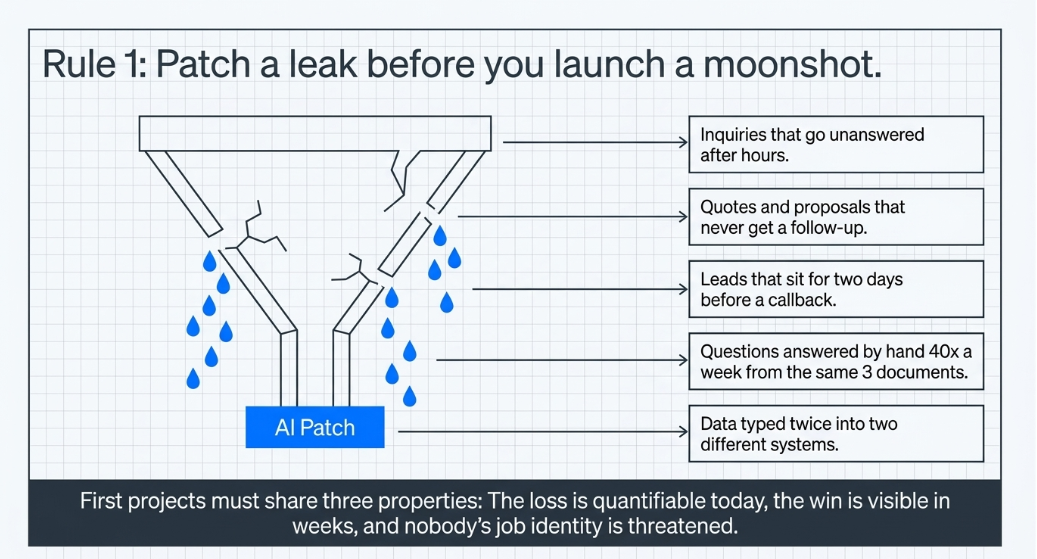
Start where your data already lives
The second filter: put your first AI project on top of the system that already holds your customer truth, which for most companies is the CRM — Salesforce, HubSpot, or whatever your teams live in daily. AI is only as good as the context it can reach. An assistant grounded in your actual pipeline, purchase history, and service records can do useful work on day one; a standalone tool bolted onto the side of the business starts ignorant and usually stays that way, becoming one more login nobody opens by November.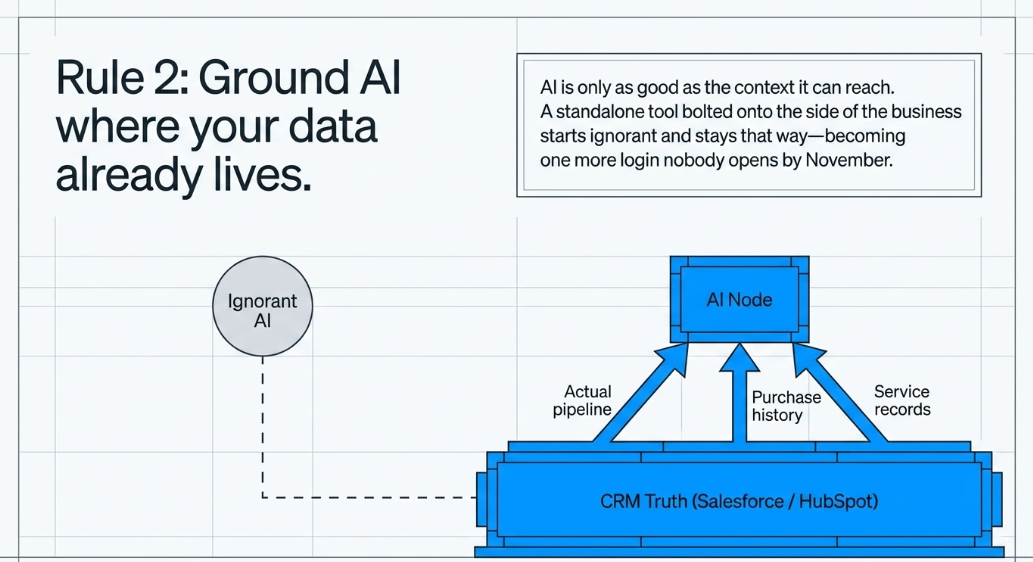
This is also where an honest readiness check belongs, and it is less about technology than leaders expect. If your CRM is three years out of date, full of duplicates, with half the deals living in spreadsheets and inboxes, then step zero is not an AI project at all; it is a data clean-up, and it is worth doing regardless of AI because it fixes reporting and forecasting at the same time. The other readiness ingredient is ownership: one named person inside your company who owns the outcome, has the authority to change the process around the tool, and reports on the metric. Projects with no internal owner become the vendor's project, and the vendor's project quietly dies.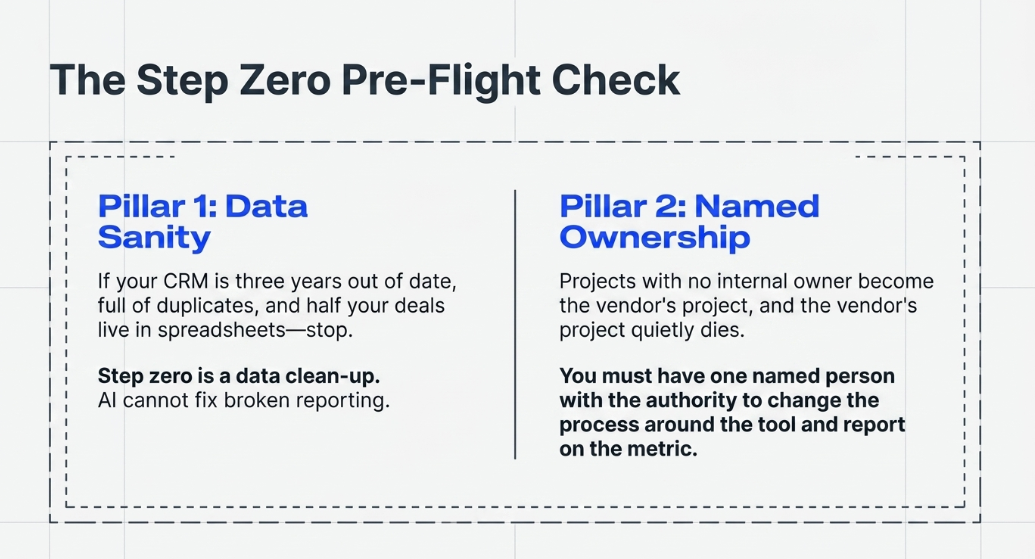
Buy the commodity, build the differentiator
Build-versus-buy stalls more first projects than budget does, so here is the short version. If the problem is common to thousands of companies- answering routine calls, qualifying inbound leads, drafting follow-ups, routing tickets- buy or configure a proven platform, because you will get to value in weeks and inherit someone else's hard-won lessons about security and edge cases. Reserve custom building for the thing that actually makes you different: the proprietary pricing logic, the domain knowledge nobody else has, the workflow your industry alone runs. Most first projects should be configuration, not invention. The companies that reverse this, custom-building a commodity while their differentiator waits, spend a year and a lot of money learning what the market already knew.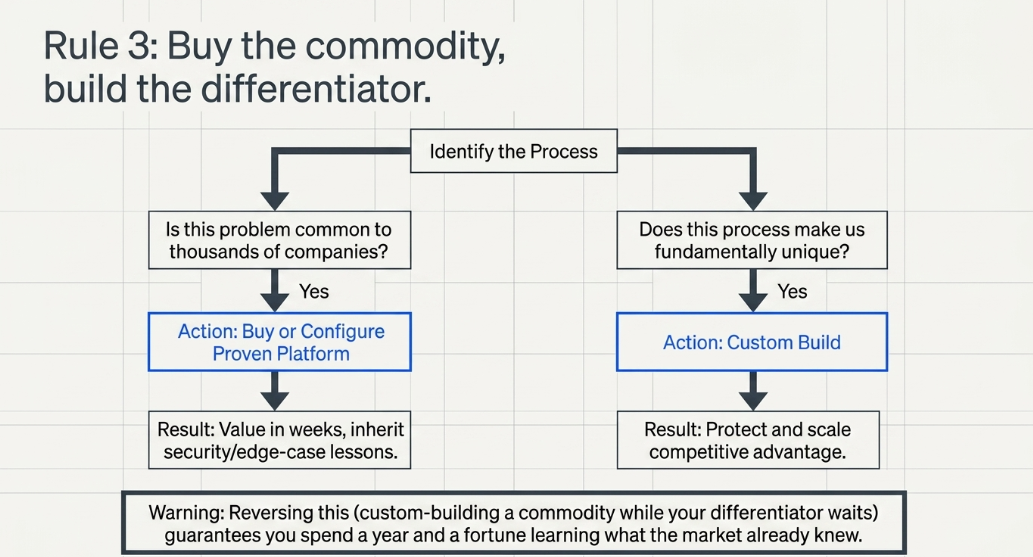
Give it ninety days, one metric, and a real decision at the end
Scope the first project so it can prove itself inside a quarter. One process, one metric agreed in writing before the work starts: response time, follow-up rate, hours returned, revenue recovered, and a baseline measured before anything is switched on, because without the "before" number no one can say what the "after" means. Then hold a real decision meeting at day ninety with three honest options: scale it, fix it, or kill it. Killing a pilot that did not pay is not failure; it is the discipline that makes the next bet cheaper. What actually kills AI programs is pilot purgatory, the demo that runs indefinitely, satisfying curiosity, proving nothing, and souring the organization on the whole subject.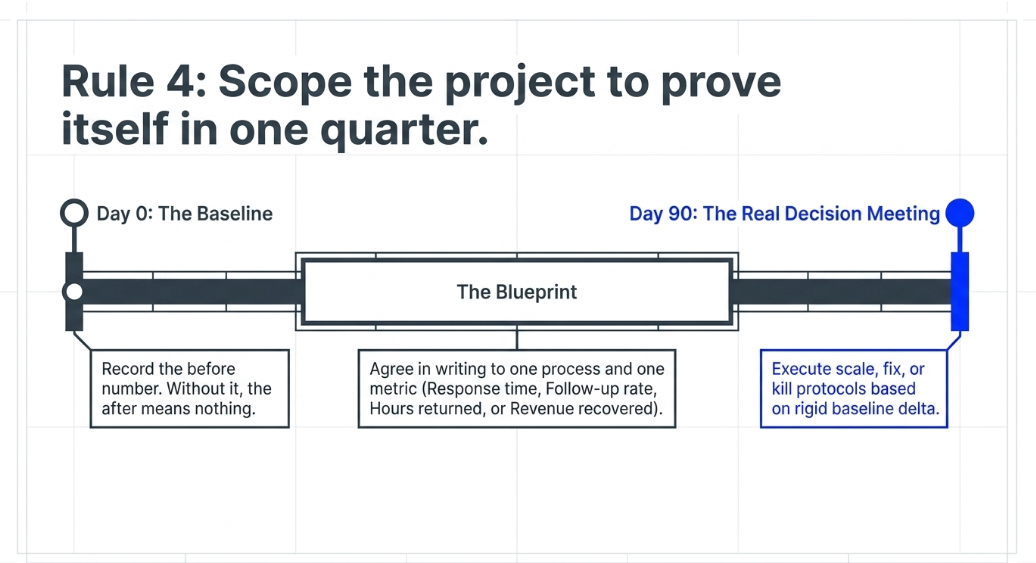
Notice what this sequence does to the board conversation. In one quarter, "what are we doing with AI?" gets a concrete answer: here is the process we automated, here is the baseline, here is the result, here is what we are scaling next. That answer, modest as it sounds, puts you ahead of most companies still comparing demos.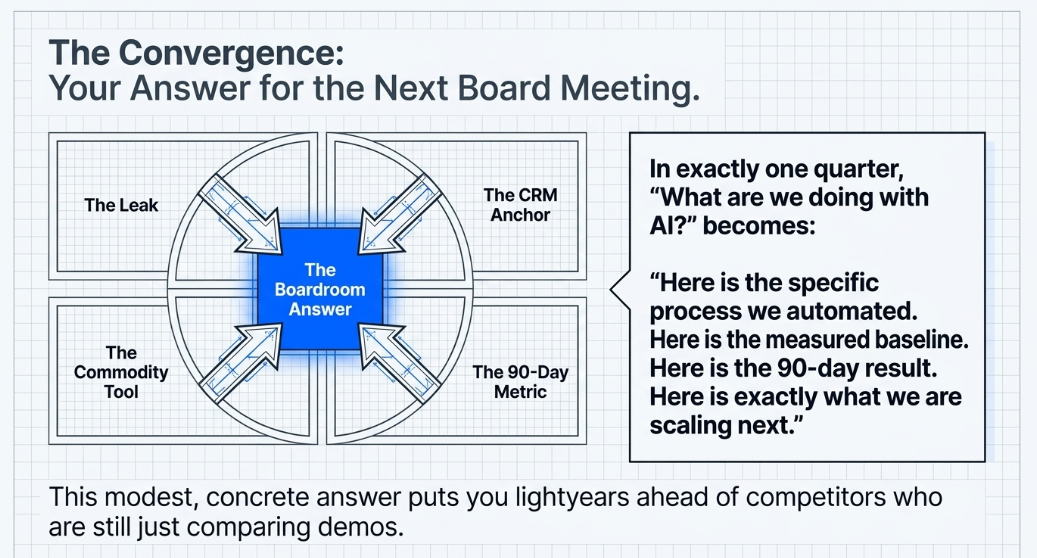
You do not have to figure this out alone
CETDIGIT has guided this exact conversation with hundreds of leadership teams. As a Salesforce Crest Partner and HubSpot Elite Partner with more than 300 AI and CRM deployments behind us, we have seen which first projects pay back and which ones stall, across manufacturing, professional services, education, healthcare, financial services, and beyond. If your version of "we know we should start, we just don't know where" deserves a better answer before your next board meeting, schedule a consultation with CETDIGIT. We will look at your systems and your leaks with you, and leave you with a first project worth ninety days of your team's attention, whether or not you build it with us.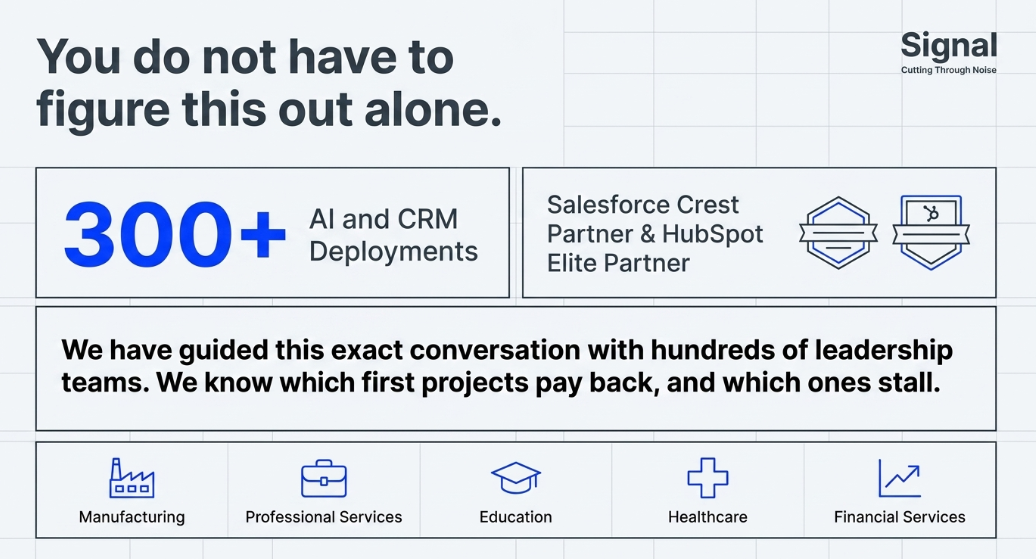
Related Reads
The Real Cost of Waiting: What Business Owners Lose by Delaying AI Adoption
Your CRM Already Knows the Answer: How AI Integration Turns Salesforce into an Intelligent Operating System
Beyond Standard RAG: How Agentic RAG is Transforming Enterprise AI in Salesforce and HubSpot

Leave a Comment